




A dual-network hydrogel sensor via stepwise hydrogen-bond modulation for sensing in underwater and sub-zero environments
 0
0 Abstract
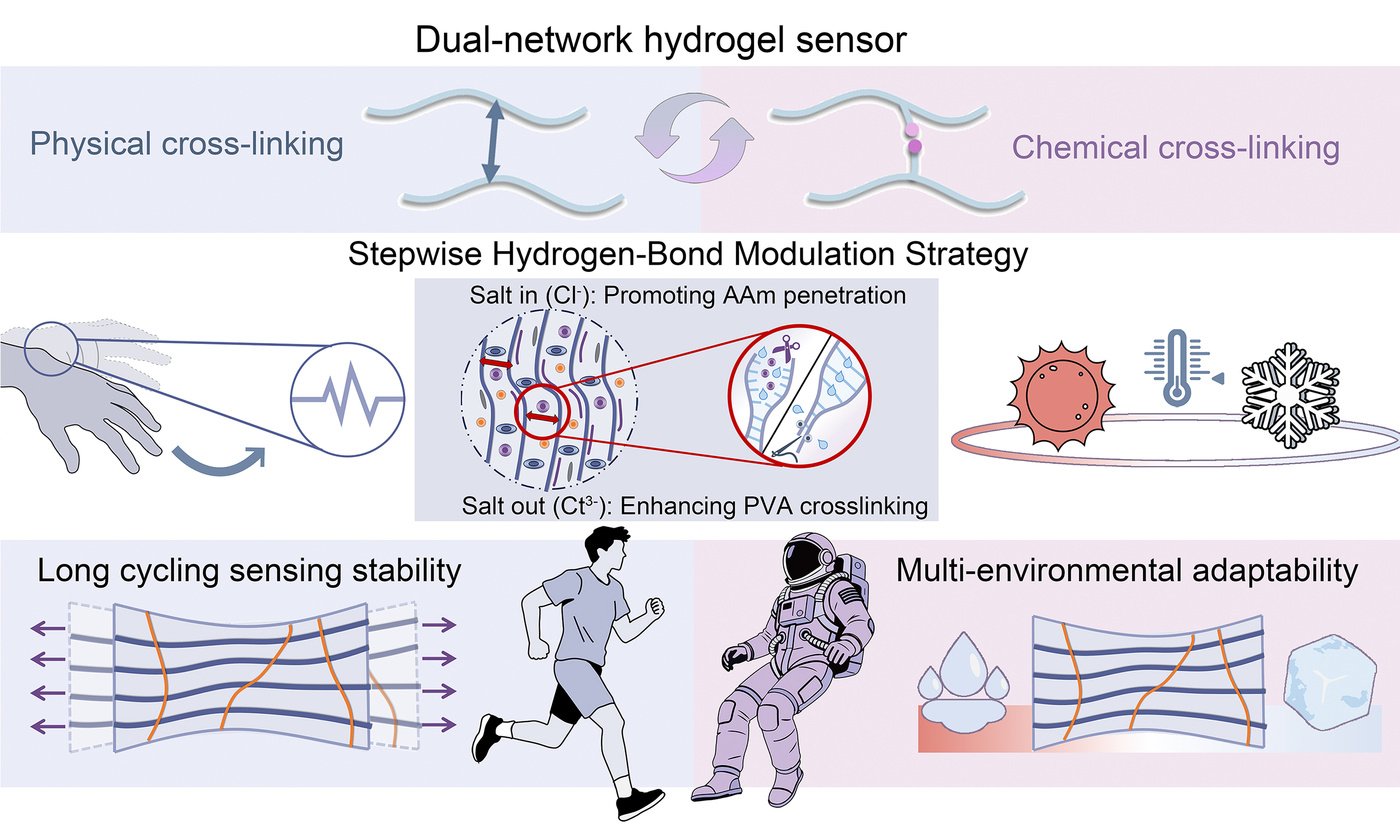
Conductive hydrogels can convert external stimuli (such as strain and pressure) into detectable electrical signals, making them ideal candidates for next-generation sensors. Among them, dual-network (DN) hydrogel sensors display uniform stress dissipation, thus effectively enhancing the overall mechanical properties compared to single-network hydrogels. However, the construction of dual networks still faces challenges in reconciling the formation of physically and chemically crosslinked networks. Additionally, the presence of a large amount of unstable “free water” within hydrogels also limits their adaptability to multi-environment sensing. To address these issues, this study developed a stepwise hydrogen bond modulation strategy based on the Hofmeister effect for fabricating DN hydrogels. By introducing magnesium chloride (MgCl2) to weaken interchain hydrogen bonds, polyvinyl alcohol (PVA) hydrogels could achieve more efficient absorption of acrylamide (AAm) solution to form a highly interpenetrating DN. Meanwhile, MgCl2 and poly(3,4-ethylenedioxythiophene)-poly(styrenesulfonate) (PEDOT:PSS) could synergistically enhance the ionic conductivity. Subsequently, the water/glycerol solution of sodium citrate (Na3Ct) could further strengthen the PVA cross-linking and modulate “free water”, thereby enhancing the mechanical strength and environmental tolerance. The study also provided an in-depth analysis of the underlying mechanism using Raman spectroscopy, offering new insights and theoretical support for related future research. The prepared hydrogel enhanced-PVA/PAAm/PEDOT:PSS/MgCl2 (PPPM-E) demonstrated capabilities in underwater Morse code communication and low-temperature gesture recognition sensing. Based on a convolutional neural network, the system achieved 99.56% accuracy in gesture recognition, highlighting its excellent multi-environment sensing performance.
Keywords
INTRODUCTION
With the advancement of technology, hydrogel-based sensors exhibit tremendous potential in areas such as motion monitoring, human-machine interaction, and flexible electronics[1-3]. These soft, water-rich materials closely resemble biological tissues, offering excellent biocompatibility and seamless irregular surface fitting[4-6]. Based on different compositions, hydrogel-based sensors can convert various stimuli (e.g., strain, temperature, pressure) into quantifiable electrical signals, making them a promising platform for next-generation sensing systems[7-10].
However, traditional single-network hydrogel sensors suffer from inherent limitations during intense motion applications. These kinds of hydrogels exhibit weak mechanical strength and limited fatigue resistance, which restricts their stability under sustained or cyclic high-strain loading[11-13]. In contrast, dual-network (DN) hydrogels interpenetrate two polymer networks with complementary properties to achieve performance enhancement[14-17]. These hydrogels typically consist of a physically crosslinked polymer network (e.g., polyvinyl alcohol, PVA; gelatin, Gel) and a chemically crosslinked polymer network (e.g., polyacrylamide, PAAm; polyacrylic acid, PAA)[18-20]. Stress can be uniformly dissipated within different networks, thereby improving overall mechanical stability and making DN hydrogels more suitable for demanding sensing applications. However, an important and often overlooked problem arises during the synthesis of DN hydrogels: the fabrication processes for physical and chemical crosslinking are always interactive[11,21]. For example, although a PVA network can be effectively formed through cyclic freeze-thawing, this low-temperature process tends to disrupt the polymerization of PAAm/PAA network. Similarly, some polymerization reactions and thermally driven chemical processes can also degrade physically crosslinked polymer networks. Although numerous construction strategies have been proposed in recent studies, the procedures remain complex and lengthy[22-24]. Hence, achieving uniform penetration of the dual networks with a simple yet effective method remains the key to further application.
In addition, hydrogel sensors also face another key issue of poor stability in varying environments (such as underwater, sub-zero conditions). The primary reason is that a large amount of the water in hydrogels exists as loosely bound “free water”, which is connected via simple water-water hydrogen bonds[25-27], thus exhibiting similar properties to bulk water. Based on this, the water within hydrogels would readily evaporate under hot conditions and rapidly crystallize in cold environments, leading to inevitable performance degradation[28-30]. Hence, effective modulation of “free water” during fabrication is also a key factor in enabling the application of hydrogels for sensing across multiple environments.
Previous studies have shown that some specific ions can modulate the interchain hydrogen bonds in physically crosslinked PVA hydrogels, thereby affecting the hydrophilicity of the hydrogel chains, a phenomenon known as the Hofmeister effect[31]. Among them, ions with a “salting-in” effect can disrupt interchain hydrogen bonds, introducing water into the PVA matrix and dispersing the polymer chains[32]. In contrast, ions with a “salting-out” effect expel water from the PVA matrix, strengthening the interchain hydrogen bond crosslinking, thus enhancing the overall mechanical strength[33].
This special and reversible mechanism provides a new perspective for the integrated design of double-network hydrogels. We therefore considered a stepwise modulated process using two salts with opposite Hofmeister effects to guide the assembly: First employ a salting-in salt to loosely open the PVA physical cross-linked network and promote high-efficiency chemical cross-linked network monomer infiltration and in-situ polymerization; then apply a salting-out/solvent-exchange step to expel excess interstitial water, re-tighten the PVA matrix, suppress “free water”, and consequently boost mechanical robustness and environmental tolerance.
In this study, the “salting-in” effect of magnesium chloride (MgCl2) is used to weaken the interchain hydrogen-bond crosslinking of PVA, thereby increasing its ability to absorb the acrylamide (AAm) solution, thus subsequently forming a more uniformly penetrated PAAm secondary network. Afterward, the immersion in “salting-out” sodium citrate (Na3Ct) water/glycerol binary solution further strengthens the hydrogen-bond crosslinking of PVA and transfers internal “free water” to stable “binding water”, which further enhances the overall mechanical, water-retention and freeze-resistance properties of the hydrogel. Through this cleverly designed guiding strategy, we achieved the rapid and efficient construction of a double-network hydrogel at low cost, while significantly enhancing both its mechanical strength and environmental tolerance. The resulting DN hydrogel, denoted as enhanced-PVA/PAAm/PEDOT:PSS/MgCl2 (PPPM-E), exhibited significantly enhanced mechanical properties (618 kPa stress at 432% strain), long-term cyclic stability and improved ionic conductivity of 6.51 mS·cm-1, thereby achieving a balance between mechanical robustness and sensing properties. Meanwhile, PPPM-E exhibits no distinct crystallization peak within the temperature range from -100 to 10 °C and shows a significantly reduced swelling variation, demonstrating excellent tolerance in both underwater and sub-zero environments. The underlying mechanism of this stepwise hydrogen-bond modulation strategy was elucidated in detail, which also provides new insights and theoretical support for future research. In practical applications, PPPM-E demonstrates effective sensing capabilities both underwater and at low temperatures (-20 °C), highlighting its considerable potential for future multi-environment applications such as flexible sensing and human-machine interaction.
EXPERIMENTAL
Materials
PVA (with 98.0-99.0 mol% alcoholysis degree and 54.0-66.0 mPa·s viscosity; Sigma-Aldrich, Shanghai, China), magnesium chloride hexahydrate (MgCl2·6H2O, Sinopharm Chemical Reagent Co., Ltd Shanghai, China), sodium citrate dihydrate (Na3C6H5O7·2H2O, Sinopharm Chemical Reagent Co., Ltd Shanghai, China), AAm (> 99%, Sigma-Aldrich, Shanghai, China), N,N’-methylenebisacrylamide (MBAA, > 99%, Sigma-Aldrich, Shanghai, China), lithium phenyl (2,4,6-trimethylbenzoyl) phosphinate (LAP, ≥ 98%, Sigma-Aldrich, Shanghai, China), poly(3,4-ethylenedioxythiophene)-poly(styrenesulfonate) (PEDOT:PSS, 1.3-1.7 wt% dispersion in H2O, Xi’an Yuri Solar Co,. Ltd, Xi’an, China).
Synthesis of different hydrogels
Synthesis of enhanced-PVA hydrogel
Add 1 g of PVA to 9 mL of ultrapure water, and stir at 90 °C until completely dissolved. After cooling the solution, perform ultrasonication to remove potential air bubbles. Pour the prepared solution into a mold and subject it to directional freezing. Place the obtained sample in a -20 °C freezer, remove it after 24 h, and allow it to thaw at room temperature. Repeat this process twice. Soak the resulting sample in a 0.2 M sodium citrate solution (with a Vwater/Vglycerol value of 1:1) and let it stand for 24 h; then the final sample was briefly heated to remove surface moisture to obtain the final enhanced-PVA (PVA-E) sample.
To distinguish the hydrogel states at different stages, samples without the “-E” suffix in the following text refer to hydrogels that have not been strengthened in the sodium citrate water/glycerol solution, whereas those with the “-E” suffix denote the strengthened hydrogel.
Synthesis of enhanced-PVA/PAAm hydrogel
After directional freezing of PVA and two freeze-thaw cycles, immerse it in a sufficient volume of 2 M AAm solution (containing 1.5 wt% MBAA and 1 wt% LAP) and soak overnight. Then, perform crosslinking under 365 nm ultraviolet (UV) light for 10 min. Subsequently, soak the obtained sample in a 0.2 M sodium citrate solution (with a Vwater/Vglycerol value of 1:1) and let it stand for 24 h; then,, the final sample was briefly heated to remove surface moisture to obtain the final enhanced-PVA/PAAm (PP-E) sample.
Synthesis of enhanced-PVA/PAAm/PEDOT:PSS hydrogel
Mix 1.0 g of PVA with 1 mL PEDOT:PSS solution to prepare a 10 wt% PVA mixing solution. The remaining synthesis steps are consistent with those for PP-E. The final products are named as enhanced-PVA/PAAm/PEDOT:PSS (PPP-E).
Synthesis of enhanced-PVA/PAAm/MgCl2 hydrogel
Mix 1.0 g of PVA with varying mass (0.2, 0.4 and 0.6 g) of MgCl2·6H2O to prepare a 10 wt% PVA mixing solution. The remaining synthesis steps are consistent with those for PP-E. The final products are named as enhanced-PVA/PAAm/MgCl2 (PPM-E).
Synthesis of PVA/MgCl2-x hydrogel
Mix 1.0 g of PVA with varying masses (0.2, 0.4, and 0.6 g) of MgCl2·6H2O to prepare a 10 wt% PVA solution. Pour the prepared solution into a mold and subject it to directional freezing. Place the obtained sample in a -20 °C freezer, remove it after 24 h, and allow it to thaw at room temperature. Repeat this process twice. The final products are named as PVA/MgCl2-x (PMx, x = 0.2, 0.4, and 0.6).
Synthesis of PPPM-E hydrogel
Mix 1.0 g of PVA with 0.4 g MgCl2·6H2O and 1 mL PEDOT:PSS solution to prepare a 10 wt% PVA mixing solution. The remaining synthesis steps are consistent with those for PP-E. The final products are named as PPPM-E.
Characterization
Fourier transform infrared (FT-IR) spectra were recorded on a Thermo Fisher Nicolet iS20 spectrometer (USA). Chemical state analysis was performed using X-ray photoelectron spectroscopy (XPS) via a Thermo Scientific K-Alpha instrument (USA). Scanning electron microscopy (SEM) morphology was tested through a ZEISS Sigma 300 scanning electron microscope (Germany). The Raman spectra were recorded under 532-nm excitation by a Confocal Laser Raman Spectrometer (Witec Alpha 3000R, Germany). All electrochemical measurements were conducted using a CS350M electrochemical workstation (CorrTest Instruments, Wuhan, China). Differential scanning calorimetry (DSC) testing was performed using a Netzsch DSC 200 F3 instrument (Germany) with a cooling rate of 5 °C per minute. Rheological testing was conducted using an Anton Paar MCR 102e instrument (Austria).
Raman spectra analysis
To ensure that the Raman spectra reflect the hydrogen bonds of polymers, the samples were all dried to a constant weight before the tests. Tests in a hydrated state will be separately specified. For single spectra, Raman spectra in the range of 3,000-3,600 cm-1 were collected from five randomly selected measurement positions per sample to ensure fitting reproducibility. The original Raman spectral data were processed using WITec Project software under the following sequence:
(1) Cosmic Ray Removal
(2) Background Subtraction to eliminate fluorescence background interference.
(3) Savitzky-Golay smoothing to increase the signal-to-noise ratio.
(4) Fitting.
Electrochemical impedance spectroscopy testing
The hydrogel was cut into cylindrical discs with a diameter of 1 cm and sandwiched between two stainless steel sheets, forming a coin-cell configuration. During the measurement process, the frequency range was set from 106 to 10-1 Hz with an applied voltage of 10 mV. The electrochemical conductivity is calculated by the following formula:
Parameters: σ represents Conductivity (S·cm-1); L represents the distance between positive and negative electrodes (cm); R represents bulk resistance measured from electrochemical impedance spectroscopy (EIS) fitting curves (Ω); A represents the contact area between the positive/negative electrode and hydrogel (cm2).
Sensing performance test
The hydrogel’s sensing performance was tested on the volunteer’s body movements with the volunteer’s consent. The working and counter electrodes were directly connected to the two ends of the hydrogel. Real-time current-time (I-t) curves were observed using the electrochemical workstation with a constant bias voltage of 5 V. The resistance was calculated according to R = V/I, and the relative resistance change was subsequently calculated as ΔR/R0 = (R - R0)/R0.
For underwater sensing tests, tap water was used to simulate an underwater motion environment.
In the cold environment sensing test, the hydrogel was first placed in a -20 °C freezer and kept stationary for 48 h. It was then fixed to both ends of an antifreeze glove, with wires connected to the two terminals of the hydrogel. Sensing signals were subsequently acquired inside the freezer.
During the data collection process, each gesture was measured 1,000 times, and a dataset containing 8,000 gesture data points was constructed. The gesture dataset was randomly split into training and test sets with an 80%:20% ratio.
Computational details
Geometry optimizations were carried out using the DMol3 module at the GGA-PBE level of theory with the DNP basis set. Full relaxation of all structures was achieved when the convergence thresholds for energy (1.0 × 10⁻⁵ Ha), maximum force (0.002 Ha/Å), and displacement (0.005 Å) were met. Harmonic vibrational frequency analyses were conducted on all optimized structures to verify that they correspond to local minima with no imaginary frequencies. Single-point energy (SP) calculations were then performed on the optimized geometries at the same theoretical level. Solvent effects were approximated via the COSMO continuum solvation model during both optimization and SP calculations.
All geometry optimizations, frequency analyses, and SP calculations were executed with the DMol3 program. The binding energy (ΔEbind) was determined as: ΔEbind = EAB - EA - EB, where EAB, EA, and EB denote the total energies of the complex and the isolated components, respectively.
RESULTS AND DISCUSSION
Characterization of PPPM-E
Figure 1A illustrates the synthesis process of the hydrogel constructed via a stepwise hydrogen-bond modulation strategy. Initially, a mixed solution containing PVA and PEDOT:PSS, was prepared. Then, MgCl2 was introduced into the precursor solution to prepare a directionally frozen PVA-based hydrogel precursor. The salting-in effect of MgCl2 could weaken the interchain binding of PVA and enhance the infiltration of the AAm solution. Subsequently, the double-network PPPM hydrogel was constructed via in-situ polymerization of AAm monomers under UV irradiation. The resulting PPPM is further subjected to “salting-out” reinforcement and solvent exchange in a Na3Ct water/glycerol solution, finally producing the PPPM-E hydrogel. To distinguish the hydrogel states at different stages, samples without the “-E” suffix in the following text refer to hydrogels that have not been strengthened in the Na3Ct water/glycerol solution, whereas those with the “-E” suffix denote the strengthened hydrogel.
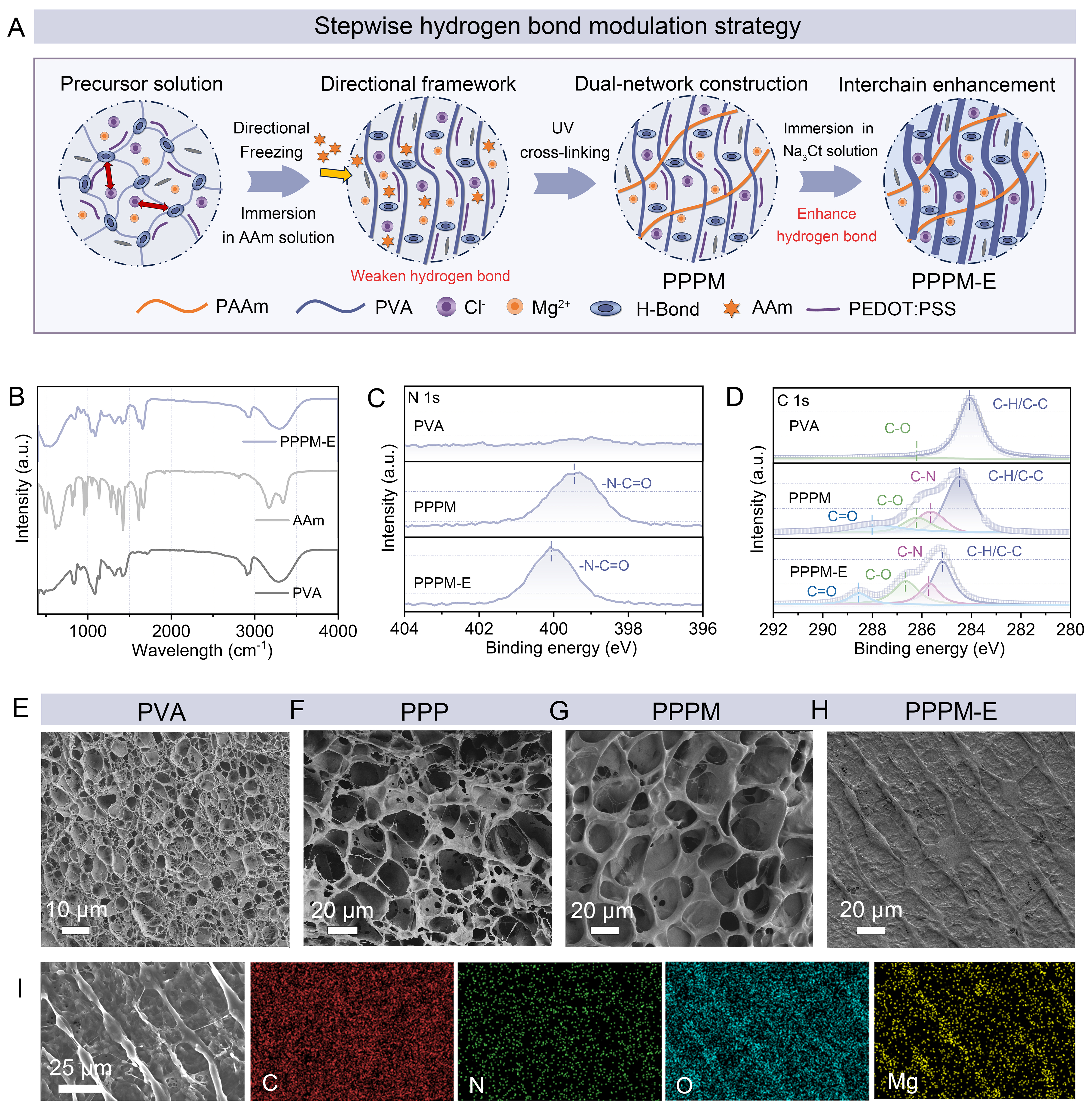
Figure 1. (A) Schematic illustration of the synthesis; (B) FT-IR spectra of PVA, AAm, and PPPM-E; (C and D) XPS spectra of PVA, AAm, and PPPM-E, (C) N 1s, (D) C 1s; (E-H) SEM images of PVA, PPP, PPPM, and PPPM-E; (I) Surface elemental mapping of PPPM-E. The scale bar shown in the first figure I applies to the remaining figures in panel I. FT-IR: Fourier transform infrared; PVA: polyvinyl alcohol; AAm: acrylamide; PPPM-E: enhanced-PVA/PAAm/PEDOT:PSS/MgCl2; XPS: X-ray photoelectron spectroscopy; SEM: scanning electron microscopy; PPP: PVA/PAAm/PEDOT:PSS; UV: ultraviolet; PAAm: polyacrylamide; PEDOT:PSS: poly(3,4-ethylenedioxythiophene)-poly(styrenesulfonate).
Figure 1B shows the FT-IR spectra, indicating that PPPM-E exhibits characteristic peaks of both PVA and AAm. The disappearance of the strong AAm peak at
To demonstrate the modulating effect of the stepwise modulation on the hydrogel structure, we compared the cross-sectional morphology of the single-network PVA, the PVA/PAAm/PEDOT:PSS hydrogel without MgCl2 (PPP), PPPM, and PPPM-E. Compared with the single-network PVA [Figure 1E], the DN PPP [Figure 1F] exhibits an interconnected polymer network yet lacks overall uniformity. After introducing MgCl2, PPPM [Figure 1G] displays an enlarged pore structure and more uniform surface loading, indicating that MgCl2 effectively disperses the PVA skeleton and promotes the penetration of the PAAm secondary network. After salting-out reinforcement, the enhanced crosslinking of PVA chains results in a more compact interface in PPPM-E [Figure 1H], and a clear directional structure can also be observed. Moreover, the elements in PPPM-E remain homogeneously distributed [Figure 1I], further confirming the uniform fabrication of PPPM-E. These results preliminarily verify that the stepwise hydrogen-bond modulation strategy could effectively modulate the structure of PPPM-E.
Enhanced physical properties of PPPM-E
Based on this strategy, the anisotropic PVA framework enhances mechanical strength, while the multiple coordination modes between the dual network and MgCl2/PEDOT:PSS contribute to uniform stress dissipation. The addition of glycerol further enhances the water retention of the hydrogel over a wide temperature range [Figure 2A]. Consequently, compared to PVA-E, PP-E, and PPP-E, PPPM-E exhibits significantly enhanced mechanical properties, achieving an ultimate stress of 618 kPa at 432% strain [Figure 2B and Supplementary Figure 1], which is attributed to the highly effective construction of the dual network and the presence of multidimensional coordination within. We further prepared cylindrical hydrogel samples with a diameter of 1 cm and performed cyclic compression-release tests [Figure 2C]. After 2,000 cycles, PPPM-E still shows stable force-time curves [Figure 2D] without structural failure or degradation, further confirming the outstanding and stable mechanical performance of PPPM-E.
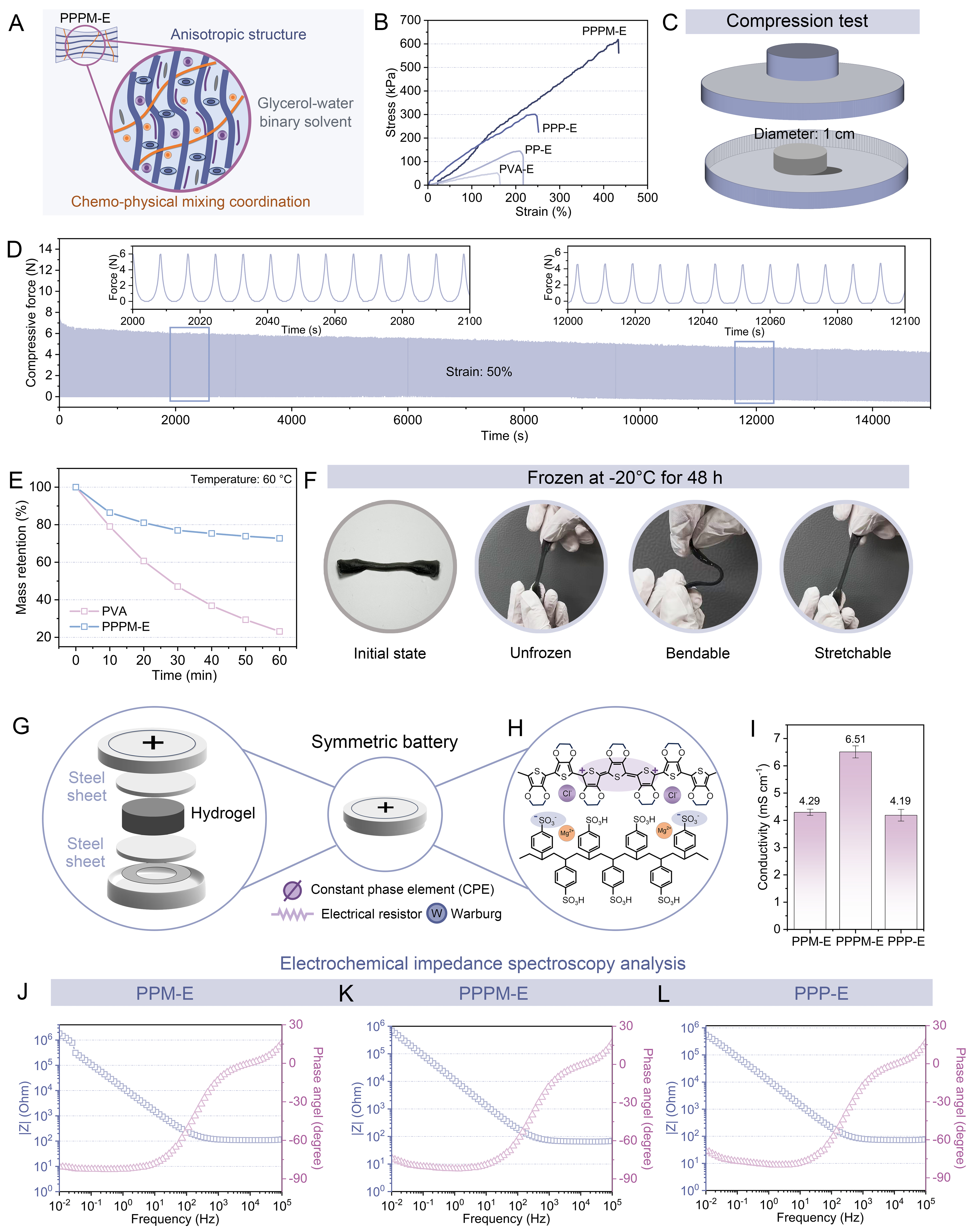
Figure 2. (A) Schematic diagram of the PPPM-E structure; (B) Tensile stress-strain curves of different hydrogels; (C) Schematic diagram of the compression test; (D) Force-time curves under compression cycles; (E) Mass retention-time curves of PPPM-E and PVA at 60 °C; (F) Digital photos of the freeze resistance test for PPPM-E at -20 °C; (G) Schematic diagram of the coin-cell structure; (H) Schematic diagram of the potential synergistic effect of PPPM-E; (I) Ionic conductivity of PPP-E, PPM-E, and PPPM-E (Error bars represent standard deviation, n = 5); (J-L) Bode plot of (J) PPM-E; (K) PPPM-E and (L) PPP-E. PPPM-E: Enhanced-PVA/PAAm/PEDOT:PSS/MgCl2; PVA: polyvinyl alcohol; PPP-E: enhanced-PVA/PAAm/PEDOT:PSS; PPM-E: enhanced-PVA/PAAm/MgCl2; PP-E: enhanced-PVA/PAAm; PVA-E: enhanced-PVA.
In addition, the hydrogel’s adaptability to different environments is also crucial for practical application. Therefore, we also evaluated the performance of PPPM-E under both high- and low-temperature conditions. We first conducted a water-loss test on PPPM-E and the single-network PVA at 60 °C. The results in Figure 2E show that after heating for 1 h, PPPM-E can still retain 78% of its mass, while PVA retains only 25%, indicating the excellent water retention ability of PPPM-E. In addition, the swelling results indicate that PPPM-E significantly reduces the swelling property, decreasing the area retention from 144.3% for PPPM to 124.3%. This demonstrates that the salting-out strengthening process endows the hydrogel with excellent anti-swelling capability [Supplementary Figures 2 and 3]. Moreover, after being kept at -20 °C for 48 h, PPPM-E maintains its initial soft morphology and can still be bent and stretched [Figure 2F], further demonstrating its remarkable anti-freezing properties. To further analyze the effect of stepwise hydrogen-bond modulation on antifreeze performance, we conducted differential scanning calorimetry (DSC) tests on samples at different stages
Furthermore, conductivity is also key to achieving effective sensing. In this study, we designed a dual-conductive component system consisting of the conductive polymer PEDOT: PSS and the conductive ionic salt MgCl2, aiming to achieve a synergistic enhancement of the hydrogel’s conductivity. As shown in Figure 2G and H, we prepared control hydrogels containing only PEDOT:PSS (PPP-E) and only MgCl2 (PPM-E) for comparison. Different hydrogels were sandwiched between two stainless steel sheets to form a coin cell; then the EIS tests were conducted using an electrochemical workstation. The results in Figure 2I show that PPPM-E achieves a high ionic conductivity of 6.51 mS·cm-1, which is superior to the 4.29 mS·cm-1 of PPM-E and 4.19 mS·cm-1 of PPP-E. One possible interpretation is that a synergistic conduction mechanism exists between PEDOT:PSS and MgCl2[36], which may be associated with the coordination and migration of ions with the PEDOT and PSS functional groups. However, a deeper understanding of the underlying mechanism requires further exploration in future studies. In the Bode plots [Figure 2J-L], PPPM-E also exhibits significantly lower resistance compared to PPM-E and PPP-E, which further confirms the conductivity results.
Mechanism of stepwise hydrogen-bond modulation
The remarkable performance enhancement of PPPM-E could be attributed to the stepwise hydrogen-bond modulation process of the PVA physical network by different Hofmeister-effect ionic salts. Specifically, MgCl2 could not only serve as a conductive component, but also exhibit a salting-in effect, disrupting the interchain hydrogen bonds of PVA and allowing more AAm monomer solution to infiltrate the interior [Figure 3A]. This enables more thorough infiltration of the PAAm secondary network after in-situ polymerization. During the strengthening process, Na3Ct exhibits a salting-out effect, which expels water from between the chains and then reinforces the interchain crosslinking of PVA, thereby enhancing mechanical strength. Simultaneously, the solvent exchange between internal water in the hydrogel and glycerol could further convert “free water” into more stable “bound water” through strong hydrogen bonding. This “weakening-strengthening” stepwise modulation process is consistent with the results of rheological tests. After introducing magnesium chloride, the modulus of the PPM hydrogel decreased compared to that of the PP hydrogel, whereas the modulus of the strengthened PPPM-E hydrogel increased significantly [Supplementary Figure 5]. To further illustrate the differential effects of different ions, we calculated the binding energy of different ionic salts with water [Figure 3B]. The results show that MgCl2 has a significantly higher binding energy with water compared to Na3Ct, indicating its superior ability to draw more aqueous AAm solution deeper into the hydrogel[37].
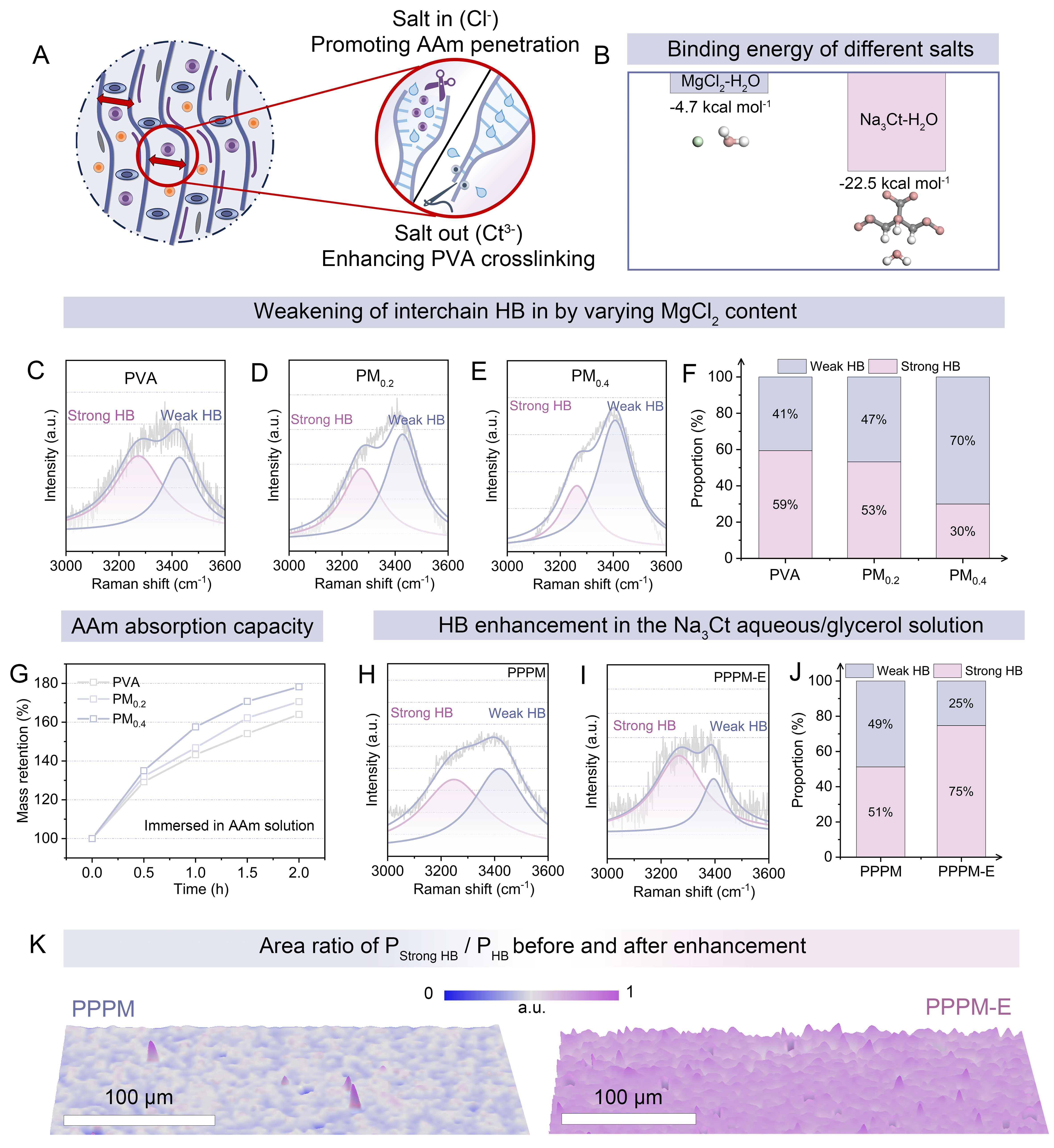
Figure 3. (A) Schematic diagram of the stepwise hydrogen bond modulation mechanism; (B) Binding energies of MgCl2 and Na3Ct with water; (C-E) Raman spectra of hydrogels with different MgCl2 contents: (C) PVA, (D) PM0.2, and (E) PM0.4; (F) Change in the proportion of hydrogen bonds in the Raman spectra of hydrogels with varying MgCl2 content; (G) Mass-time curves of hydrogels with different MgCl2 contents after immersion in the AAm solution; (H and I) Raman spectra of (H) PPPM and (I) PPPM-E before and after strengthening; (J) Change in the proportion of hydrogen bonds in the Raman spectra before and after strengthening; (K) Surface Raman mapping images of PPPM and PPPM-E. PVA: Polyvinyl alcohol; AAm: acrylamide; PPPM: PVA/PAAm/PEDOT:PSS/MgCl2; PPPM-E: enhanced-PVA/PAAm/PEDOT:PSS/MgCl2; HB: hydrogen bond.
As mentioned above, the stepwise modulation strategy achieves a two-stage process of “weakening-strengthening” the hydrogen bonds between PVA chains. To verify this stepwise modulation process, we conducted Raman spectroscopic analysis of hydrogel samples at different stages. We first prepared PVA hydrogels containing different concentrations of MgCl2 (denoted as PMx, where x = 0.2, 0.4, 0.6) and conducted Raman spectroscopy on the dried samples to evaluate the interchain crosslinking. The hydrogen bond Raman peaks in the 3,000-3,600 cm-1 region were divided into two parts: strong hydrogen bonds (Strong HB, at ~3,280 cm-1) and weak hydrogen bonds (Weak HB, at ~3,420 cm-1)[38-40]. The former is primarily formed by interchain crosslinking of PVA chains, while the latter is dominated by weaker interactions like “free water”. As shown in Figure 3C-E, as the MgCl2 content increases, the intensity of the Strong HB peak decreases, while the Weak HB peak gradually rises. The proportion of Strong HB has already decreased to 30% in PM0.4 [Figure 3F]. In the SEM images [Supplementary Figure 6], as the MgCl2 content increases in the PMx series, the pore size gradually enlarges, indicating weakened crosslinking of the PVA chains, which corresponds to Raman spectra. Although PM0.6 could further reduce the ratio of Strong HB [Supplementary Figures 7 and 8], the structure of hydrogels at these concentrations became unstable, which struggles to maintain its shape after thawing or when immersed in the AAm monomer solution, and it easily breaks when gripped with tweezers. Hence, we only used PM0.4 as the modulation concentration in this study. The Raman results under the hydrated hydrogels further validate the preceding analysis. As the concentration of MgCl2 increases, the intensity of the hydrogen-bond-related peaks gradually increases, and the Weak HB peak becomes more pronounced, indicating greater water enrichment within the hydrogel interior [Supplementary Figure 9A]. This enhanced hydration verifies the effect of “salt in” for facilitating the infiltration and absorption of the monomer solution. Due to the weakened interchain crosslinking, PM0.4 exhibited a higher mass increase ratio than PVA and PM0.2 after soaking in the AAm solution for 2 h [Figure 3G], indicating that more AAm monomers were introduced into the hydrogel framework to form a more effectively infiltrated PAAm secondary network, confirming the earlier hypothesis.
After constructing the DN hydrogel PPPM, the salting-out effect of Na3Ct could further promote hydrogen-bonding cross-linking between PVA chains, while the solvent exchange of glycerol could also convert unstable “free water” into stable “binding water” through strong hydrogen-bond coordination, thereby enhancing the overall mechanical strength and multi-environment stability[41,42]. In the hydrated state, compared with PPPM, the Raman spectrum of PPPM-E shows a significantly reduced intensity of the HB peaks, and the prominence of the Weak HB peak subsides. This indicates that water has been expelled and the content of free water has decreased correspondingly [Supplementary Figure 9B]. As shown in Figure 3H-J, the proportion of Strong HB in PPPM-E increases from 51% to 75% compared to PPPM, indicating enhanced PVA crosslinking of PPPM-E, which also explains the improvement in the mechanical properties. To more intuitively reflect this hydrogen bond modulation, we performed Raman mapping tests on the surfaces of PPPM and PPPM-E, using the ratio of the Strong HB peak to the total hydrogen bond peak as the basis for the color bar change. The results in Figure 3K show that the surface of PPPM-E displays a distinct and uniform purple color, indicating a significant increase in the overall proportion of Strong HB compared to PPPM. In addition, to cross-validate the evolution of the hydrogen-bond network from different spectroscopic perspectives, we also performed FT-IR spectroscopy analysis of hydrogels at different stages [Supplementary Figure 10]. The results indicate that after the introduction of MgCl2 to form the PPM hydrogel from the PP hydrogel, the HB peak shifts toward a higher wavenumber, suggesting an increase in the proportion of Weak HB. Following the strengthening treatment that converts PPPM into the PPPM-E hydrogel, the peak intensity corresponding to Strong HB rises markedly, reflecting enhanced hydrogen-bond cross-linking within the internal polymer network.
All the above results demonstrate that this strategy achieves the construction of DN hydrogels in a simple and effective method through stepwise hydrogen bond modulation, while also significantly reducing the “free water” content inside the hydrogel. This approach not only avoids the negative interference among different crosslinking network constructions but also enhances the potential of hydrogels for sensing applications in multi-environments, offering new design insights and theoretical support for subsequent research.
Motion sensing tests of PPPM-E
To validate the application performance of PPPM-E, we further conducted practical sensing tests on the material. In Figure 4A, we measured the resistance changes (∆R/R0) of PPPM-E under different strain levels. Benefiting from the directional structural design, PPPM-E exhibited distinct responses even at low strain amplitudes. The sensor exhibits a gauge factor (GF) of 0.76 [Supplementary Figure 11], with response and recovery times of 440 and 468 ms, respectively [Supplementary Figure 12], demonstrating outstanding strain response capabilities. Meanwhile, due to the excellent stress dissipation provided by the DN structure, PPPM-E maintained stable resistance response over more than 300 long-term cycles at 100% strain [Figure 4B]. We further utilized PPPM-E for sensing tests involving different motions [Figure 4C]. Under different finger-bending angles, PPPM-E consistently produced distinguishable ∆ R/R0 curves [Figure 4D]. It also accurately detected wrist and knee bending [Figure 4E and F], and generated specific response curves for varying degrees of mouth opening and closing [Figure 4G]. All these results demonstrate the outstanding sensing capability of PPPM-E.
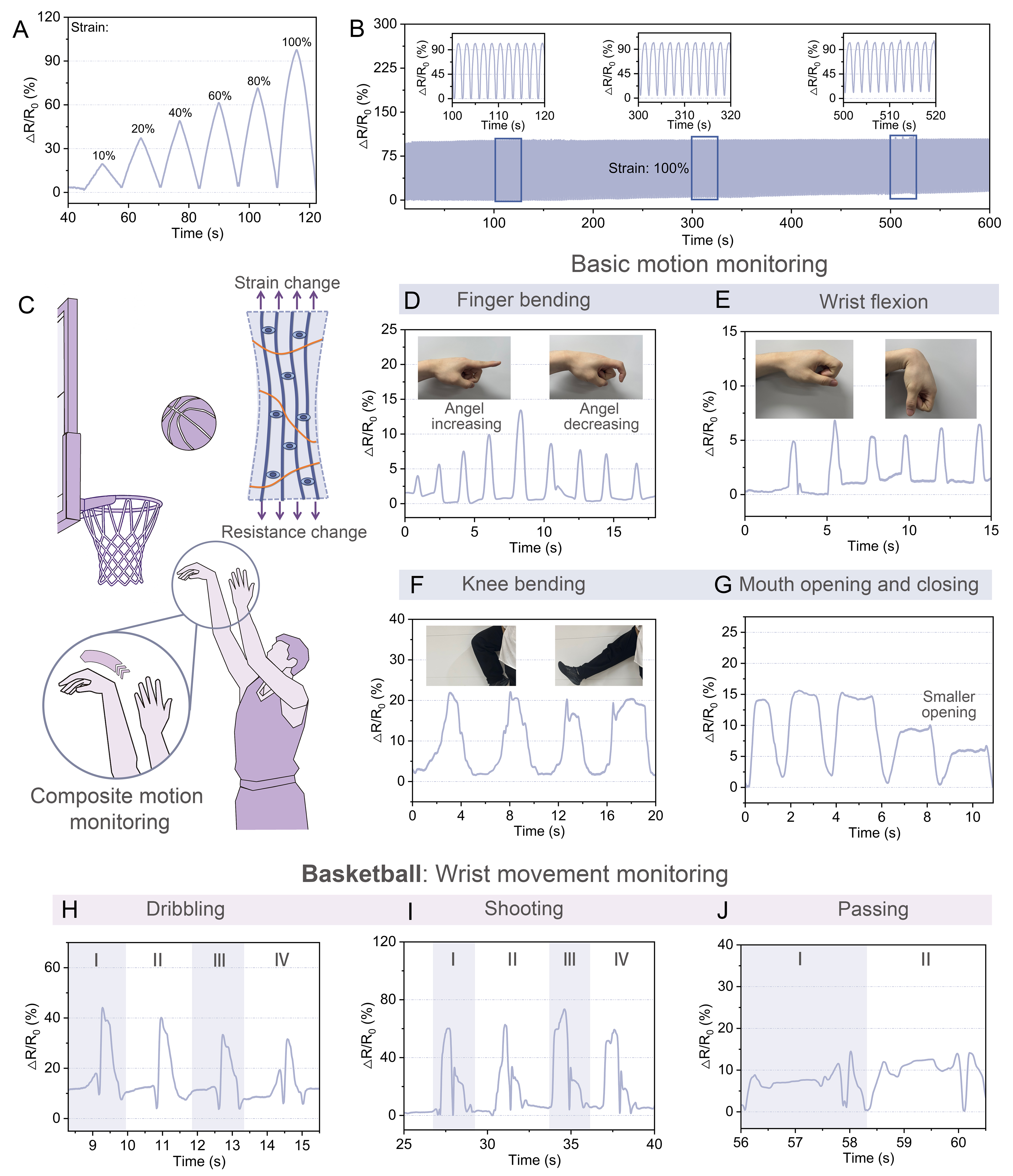
Figure 4. (A) ∆R/R0-strain response curve of PPPM-E; (B) Long-term cyclic curve of PPPM-E under 100% strain; (C) Schematic diagram of PPPM-E for basketball motion sensing; (D-G) Resistance change rate curves of PPPM-E under different basic motions: (D) finger bending at different angles, (E) wrist bending, (F) knee bending, (G) mouth opening/closing; (H-J) Resistance change rate curves of PPPM-E under different basketball techniques: (H) dribbling, (I) shooting, (J) passing. PPPM-E: Enhanced-PVA/PAAm/PEDOT:PSS/MgCl2.
In motion sensing, the differentiated perception of complex movements can help people better distinguish between different technical actions, thereby facilitating targeted guidance. Using basketball as an example, we selected three common technical actions: dribbling, shooting, and passing, and attached PPPM-E to the wrist for sensing tests. The results in Figure 4H-J show that compared to passing, dribbling and shooting produced higher ∆R/R0 values, indicating greater wrist movement amplitudes. Shooting exhibited two sharp peaks in the ∆R/R0 curve, corresponding to the larger-scale “wrist press-wrist snap” motion during a shot. These results demonstrate that PPPM-E maintains stable sensing performance even during complex movements, highlighting its adaptability to diverse sports scenarios.
Underwater morse code communication of PPPM-E
Benefiting from reducing the ratio of “free water” by the stepwise hydrogen bond modulation strategy, PPPM-E is capable of operating in underwater environments. The underwater environment is a common yet challenging scenario, where activities such as diving are often hindered by poor visibility, requiring divers to rely on complex communication devices. To address this, we developed an interactive system for underwater Morse code communication using finger bending [Figure 5A]. Among these, the bare PPPM-E was attached to the finger without extra encapsulation and connected to an electrochemical workstation for simulated testing [Figure 5B]. In Morse code, different letters are expressed by arranging “DAH” and “DIT” signals [Figure 5C]. Based on this, in our implementation, a triangular wave generated by rapid finger bending and straightening represents “DIT”, while a square wave formed by bending, holding, and then straightening the finger represents “DAH”. This allows different words to be encoded through specific bending sequences [Figure 5D]. In practical underwater tests, PPPM-E produced distinct square- and triangular-wave signals corresponding to different bending modes [Figure 5E], demonstrating its feasibility for underwater Morse code communication.
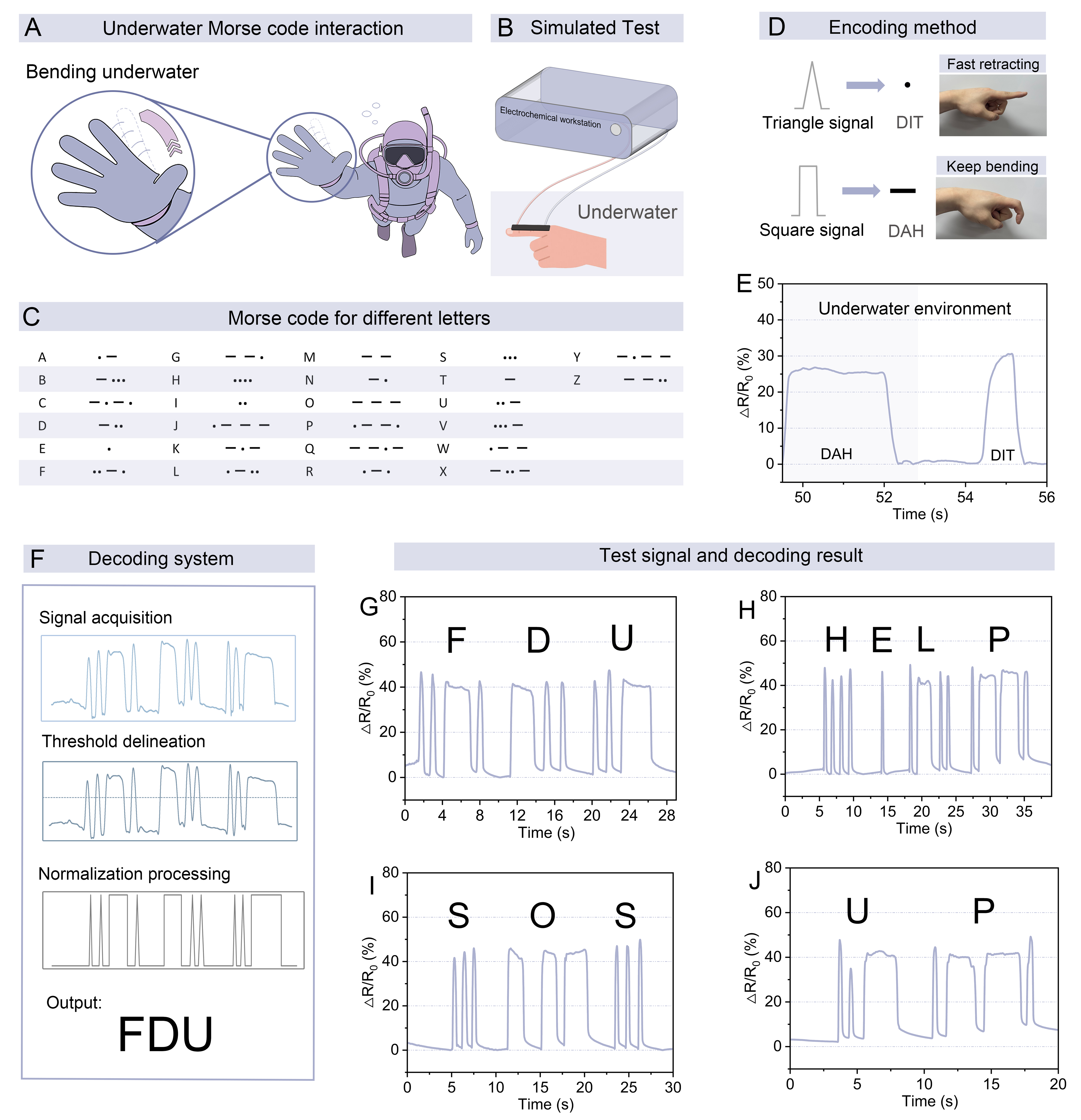
Figure 5. (A) Schematic diagram of underwater Morse code interaction; (B) Schematic diagram of the simulation test setup; (C) Morse code encoding chart; (D) Schematic diagram of the encoding method; (E) Resistance change rate of PPPM-E underwater; (F) Schematic diagram of the decoding system structure; (G-J) Underwater testing and decoding output results: (G) FDU, (H) HELP, (I) SOS, (J) UP. PPPM-E: Enhanced-PVA/PAAm/PEDOT:PSS/MgCl2.
To further improve interpretation of the signals, we also developed a decoding system for the Morse code [Figure 5F]. Through threshold setting, normalization, and pattern matching of the acquired signals, the encoded information could be quickly decoded, allowing for more efficient communication. In practical testing, PPPM-E was able to effectively represent words such as “FDU”, “HELP”, “SOS”, and “UP” underwater [Figure 5G-J], and all corresponding signals were successfully decoded and output by the system. This demonstrates the excellent underwater sensing capability of PPPM-E, further verifying the overall performance improvement and multi-environment operational ability brought by the stepwise hydrogen bond modulation strategy.
Gesture recognition under cold conditions of PPPM-E
In addition, we employed PPPM-E hydrogel to construct a gesture communication system under cold conditions, targeting snow mountain expeditions where low temperature and poor visibility hinder effective communication [Figure 6A]. In such cold environments, the “free water” in conventional hydrogels tends to crystallize, thus leading to the failure of sensing functionality. In contrast, PPPM-E could demonstrate the huge potential to operate reliably under such cold conditions because of the effective modulation of “free water”.
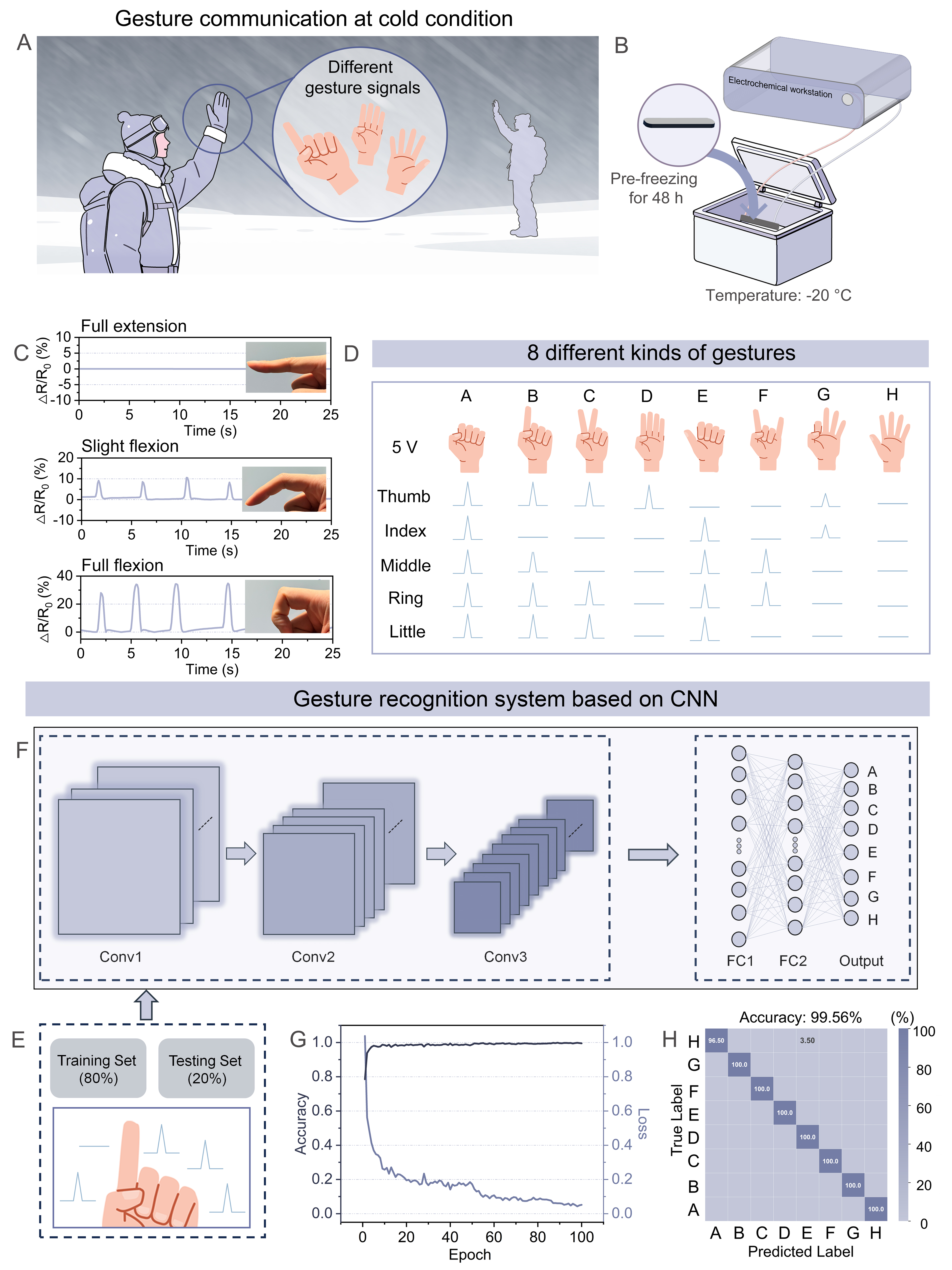
Figure 6. (A) Schematic of the gesture communication system at cold condition; (B) Schematic of the simulated cold environment setup; (C) Electrical signals matching to different degrees of finger bending; (D) Different gesture categories and their corresponding signal curves for each finger; (E and F) Framework of the CNN-based gesture recognition workflow constructed from sensing signals; (G) Accuracy and loss values over 100 epochs; (H) Confusion matrix for the classification of eight different gestures. CNN: Convolutional neural network.
To simulate this extreme scenario, the PPPM-E hydrogel sensor went through pre-freezing at -20 °C for 48 h to fully adapt to the cold environment. Then it was attached to the finger of an antifreeze glove and connected to an electrochemical workstation for testing inside a refrigerator [Figure 6B]. Owing to its excellent freezing resistance and sensing sensitivity, the PPPM-E hydrogel sensor could produce a signal with significantly different amplitudes in response to varying degrees of finger bending. Specifically, full flexion induced the largest finger deformation and thus the highest relative ∆R/R0, slight extension gave a medium signal amplitude, and full extension resulted in the smallest deformation and the lowest signal amplitude. This strict correspondence between bending degree and signal intensity provides a reliable data basis for accurate gesture recognition [Figure 6C].
We selected eight commonly used gestures for recognition, distinguished by the different bending patterns of each finger [Figure 6D]. After multiple rounds of signal acquisition under cold conditions, a gesture signal dataset was constructed and split into training and test sets with an 80%:20% ratio [Figure 6E]. The data were fed into a convolutional neural network (CNN) consisting of three convolutional layers, two fully connected layers, and a Softmax output layer [Figure 6F] for recognition of the gestures. Figure 6G shows the training accuracy and loss values over 100 epochs, and the resulting confusion matrix [Figure 6H] indicates that the model achieves an accuracy of 99.56% in the gesture recognition task. These results demonstrate the outstanding sensing capability of the PPPM-E hydrogel at low temperatures, further validating the feasibility of the stepwise hydrogen-bond modulation strategy and providing a novel and reliable solution for hydrogel-based sensing in diverse environments.
Limitations
It is essential to emphasize that evaluating the sensor’s performance in more complex multi-environmental conditions (such as varying pH environments) and its long-term stability under specific harsh conditions (e.g., low-temperature, underwater) remain important challenges that require further investigation. At the same time, although this study has provided a “proof-of-concept” demonstration of the proposed strategy, future system-level application requirements necessitate further establishment of relationships regarding inter-device repeatability, statistical variation among independently fabricated sensors, hysteresis, signal drift, baseline fluctuation, and long-term operational reliability under the proposed environmental conditions. These aspects will be a key focus of future investigation. Moreover, exploring the physicochemical enhancement mechanisms and failure modes through more multifaceted characterization methods will be a key focus for future research.
CONCLUSIONS
DN hydrogel sensors are often influenced by the synthetic conditions required for different crosslinking networks, while the substantial amount of “free water” inside the hydrogel also limits their sensing performance in multiple environments. To address this issue, this study proposes a stepwise hydrogen-bond modulation strategy. Initially, the “salting-in” effect of MgCl2 is used to weaken the interchain hydrogen bonds in directionally frozen PVA, promoting the infiltration of AAm monomers. After in-situ polymerization forms the PAAm network, the “salting-out” effect of Na3Ct then strengthens the interchain hydrogen-bond crosslinking of PVA. This approach not only enables the efficient construction of DN hydrogels while avoiding negative interference between different crosslinking steps, but also converts the unstable “free water” inside the hydrogel into stable “binding water” through the “salting-out” effect and solvent exchange, thereby enhancing the hydrogel’s performance across varied environments. The fabricated hydrogel PPPM-E exhibits an ultimate stress of 618 kPa at 432% strain, achieves a high ionic conductivity of 6.51 mS·cm-1 through the synergistic conduction of PEDOT:PSS and MgCl2, and demonstrates improved water retention and freeze resistance at 60 and -20 °C, respectively. The stepwise hydrogen-bond modulation process was analyzed in detail via Raman spectroscopy, confirming the feasibility of this strategy.
In practical sensing applications, underwater Morse code communication and a low-temperature gesture interaction system were implemented, while latter with a CNN achieved a gesture recognition accuracy of 99.56%. These results highlight the substantial potential of the hydrogel for future applications in multidimensional motion perception and human-machine interaction. Overall, this simple yet effective fabrication strategy provides new insights and theoretical support for the construction of DN hydrogels, contributing to the advancement of hydrogel sensors toward simpler preparation and broader application.
DECLARATIONS
Authors’ contributions
Conception and design of the study, performed data acquisition, performed data analysis and interpretation, drafted the work or substantively revised it: Fang, S.
Performed data acquisition, drafted the work or substantively revised it: Yang, S.; Shi, W.
Assisted with the experiment, performed data analysis and interpretation: Yang, S.; Shi, W.; Qi, J.; Han, W.; Zhang, Z.; Zhang, X.; Zheng, Y.
Provided administrative, technical supervision, and material support: Chu, J.; Zhang, R.
Availability of data and materials
The data supporting the findings of this study are presented in this manuscript and Supplementary Materials.
AI and AI-assisted tools statement
Not applicable.
Financial support and sponsorship
This work was sponsored by the Medical-Engineering Integration Research Platform of Fudan University and supported by the National Natural Science Foundation of China (62588101).
Conflicts of interest
All authors declared that there are no conflicts of interest.
Ethical approval and consent to participate
According to Article 32 of the “Measures for the Ethical Review of Life Science and Medical Research Involving Human Subjects (Trial)”, this study meets the conditions for exemption from review. The motion sensing experiments in this study involved measurements of body movements, including finger, wrist, knee, and mouth movements. The participants participated in the experiment voluntarily with informed consent.
Consent for publication
Not applicable.
Copyright
© The Author(s) 2026.
Supplementary Materials
REFERENCES
1. Zhu, P.; Du, H.; Hou, X.; et al. Skin-electrode iontronic interface for mechanosensing. Nat. Commun. 2021, 12, 4731.
2. Guo, Y.; Yin, F.; Li, Y.; Shen, G.; Lee, J. C. Incorporating wireless strategies to wearable devices enabled by a photocurable hydrogel for monitoring pressure information. Adv. Mater. 2023, 35, e2300855.
3. Fang, S.; Zhou, Q.; Zhou, M.; et al. Dual-step photo-induced self-assembled hydrogel for endogenous oral mucosal wound healing. Light. Sci. Appl. 2025, 14, 186.
4. Li, L.; Wang, X.; Gao, S.; et al. High-toughness and high-strength solvent-free linear poly(ionic liquid) elastomers. Adv. Mater. 2024, 36, e2308547.
5. Sun, L.; Wang, W.; Kang, H.; et al. Eel-inspired self-powered hydrogel nerve conduit: a fully degradable scaffold for peripheral nerve repair. Adv. Mater. 2026, 38, e16645.
6. Choi, M.; Kim, Y.; Han, H.; et al. A battery-free, wireless graphene pressure sensor for machine learning-assisted posture classification and VR/AR visualization in smart healthcare environments. Mater. Horiz. 2026, 13, 3814-26.
7. Xu, Q.; Hou, M.; Wang, L.; Zhang, X.; Liu, L. Anti-bacterial, anti-freezing starch/ionic liquid/PVA ion-conductive hydrogel with high performance for multi-stimulation sensitive responsive sensors. Chem. Eng. J. 2023, 477, 147065.
8. Zheng, S.; Liu, A.; Zhang, X.; et al. Penguin skin‐inspired, nanoparticle‐reinforced hydrogels for extreme environment‐resistant piezoionic generation and sensing. Adv. Funct. Mater. 2026, 36, e14944.
9. Ge, Y.; Peng, L.; Cao, X.; Wang, N. Triboelectrically active hydrogel drives self-charging zinc-ion battery and human motion sensing. Nano. Energy. 2024, 126, 109601.
10. Roy, A.; Afshari, R.; Jain, S.; et al. Advances in conducting nanocomposite hydrogels for wearable biomonitoring. Chem. Soc. Rev. 2025, 54, 2595-652.
11. Jiang, L.; Sha, Z.; Zheng, Y.; et al. Bioinspired hydrogels thriving in harsh conditions: where soft materials conquer hard challenges. Prog. Mater. Sci. 2025, 152, 101459.
12. Liu, Y.; Zhang, J.; Wang, D. Preparation schemes and applications of multifunctional PVA composite hydrogels. Chem. Eng. J. 2025, 508, 160946.
13. Xiao, M.; Zhang, X.; Luo, Y.; Xie, R.; Tao, K.; Wu, J. Engineering hydrogel-based conformal epidermal electrodes for human-machine interaction. Soft. Sci. 2025, 5, 40.
14. Shi, Y.; Guan, Y.; Liu, M.; et al. Tough, antifreezing, and piezoelectric organohydrogel as a flexible wearable sensor for human-machine interaction. ACS. Nano. 2024, 18, 3720-32.
15. Wang, W.; Ma, Z.; Hu, Z.; et al. Synergistic enhancement of hole–bridge structure and molecular‐crowding effect in multifunctional eutectic hydrogel strain/pressure sensor for personal rehabilitation training. Adv. Funct. Mater. 2025, 35, 2502844.
16. Zhong, Q.; Zhang, R.; Chen, Y.; et al. A mechanical contraction‐driven hydrogel dressing for pH visualization and tailored acute/chronic wound healing. Adv. Funct. Mater. 2026, 36, e12807.
17. Ke, X.; Mu, X.; Chen, S.; et al. Reduced graphene oxide reinforced PDA-Gly-PVA composite hydrogel as strain sensors for monitoring human motion. Soft. Sci. 2023, 3, 21.
18. Feng, Y.; Wang, S.; Li, Y.; et al. Entanglement in smart hydrogels: fast response time, anti‐freezing and anti‐drying. Adv. Funct. Mater. 2023, 33, 2211027.
19. Qing, M.; Hou, Y.; Xie, Z.; Qu, G.; Chen, M.; Guo, D. Thermal‐triggered polymerizable hydrogels with localized hyperthermia for shrinkage‐driven starvation therapy. Adv. Funct. Mater. 2026, 36, e12839.
20. Tang, J.; Gao, Y.; Li, T.; Qin, R.; Qi, Q.; Meng, F. Thermoresistive network in phase‐transition hydrogel: achieving on/off switchable electromagnetic interference shielding. Adv. Funct. Mater. 2025, 35, 2504959.
21. Li, Z.; Xu, W.; Wang, X.; et al. Fabrication of PVA/PAAm IPN hydrogel with high adhesion and enhanced mechanical properties for body sensors and antibacterial activity. Eur. Polym. J. 2021, 146, 110253.
22. Cui, D.; Sun, Y.; Li, T.; et al. Mechanically robust polyacrylamide/gelatin ionic hydrogels reinforced by sodium alginate for wearable device applications. Adv. Compos. Hybrid. Mater. 2025, 8, 1286.
23. Mu, R.; Gu, G.; Xu, Y.; Xi, Y.; Wei, G. Photo-stimulating dual-network microminiature hydrogels reinforced with silver sulfide nanoparticles for regulated cancer photothermal therapy. Chem. Eng. J. 2025, 510, 161836.
24. Xue, C.; Zhao, Y.; Liao, Y.; Zhang, H. Bioinspired super-robust conductive hydrogels for machine learning-assisted tactile perception system. Adv. Mater. 2025, 37, e2416275.
25. Zhang, X.; Li, D.; Yang, X.; et al. Hydro-locking in hydrogel for extreme temperature tolerance. Science 2025, 387, 967-73.
26. Wu, S.; Liu, Z.; Gong, C.; et al. Spider-silk-inspired strong and tough hydrogel fibers with anti-freezing and water retention properties. Nat. Commun. 2024, 15, 4441.
27. Fang, S.; Zhou, Q.; Yang, S.; et al. Bamboo‐basket‐inspired stepwise modulated hydrogel for multifunctional and extreme‐environment sensing. Adv. Funct. Mater. 2026, 36, e31290.
28. Ren, A.; Jia, L.; Wang, P.; Xiang, T.; Zhou, S. Toughening of anti-freezing ionic hydrogels with Zr4+-dicarboxylic acid coordination complex for low temperature sensing applications. Chem. Eng. J. 2024, 501, 157822.
29. Lv, Z.; Liu, J.; Shen, K.; et al. Elastic polymeric hydrogels via sparse chain entanglements and hydrophobic aggregates. Adv. Funct. Mater. 2026, 36, e23406.
30. Cao, Z.; Han, C.; Zhao, Y.; et al. Multifunctional eutectic hydrogel with antifreezing and self‐powered capabilities for object recognition sensing. Adv. Funct. Mater. 2026, 36, e29024.
31. Ren, J.; Chen, G.; Yang, H.; et al. Super-tough, non-swelling zwitterionic hydrogel sensor based on the hofmeister effect for potential motion monitoring of marine animals. Adv. Mater. 2024, 36, e2412162.
32. Wu, S.; Hua, M.; Alsaid, Y.; et al. Poly(vinyl alcohol) hydrogels with broad-range tunable mechanical properties via the hofmeister effect. Adv. Mater. 2021, 33, e2007829.
33. Hua, M.; Wu, S.; Ma, Y.; et al. Strong tough hydrogels via the synergy of freeze-casting and salting out. Nature 2021, 590, 594-9.
34. Dang, X.; Fu, Y.; Wang, X. Versatile biomass‐based injectable photothermal hydrogel for integrated regenerative wound healing and skin bioelectronics. Adv. Funct. Mater. 2024, 34, 2405745.
35. Yan, C.; Wang, Y.; Deng, X.; Xu, Y. Cooperative chloride hydrogel electrolytes enabling ultralow-temperature aqueous zinc ion batteries by the hofmeister effect. Nanomicro. Lett. 2022, 14, 98.
36. Xu, C.; Wang, W.; Feng, Y.; et al. Continuous piezoionicity-driven electromechanical coupling in mechanically robust conductive eutectogels. Nat. Commun. 2025, 17, 501.
37. Zhao, X.; Guo, Q.; Gao, C.; Nie, S.; Sun, R. Bioinspired extreme environment adaptive hydrogel enabled by weakening hydrogen bonding. Nano. Energy. 2025, 136, 110748.
38. Cui, Z.; Xu, T.; Yao, T.; et al. Tailoring acid-salt hybrid electrolyte structure for stable proton storage at ultralow temperature. Adv. Mater. 2025, 37, e2412104.
39. Wang, X.; Ma, Z.; Xu, S.; Zheng, D.; Bai, B.; Zong, S. Hofmeister effect induced water activation of hydrogel and its applications for the accelerated solar evaporation in brine. Water. Res. 2025, 268, 122709.
40. Wang, D.; Zhao, D.; Chang, L.; et al. Interface engineering of electron-ion dual transmission channels for ultra-long lifespan quasi-solid zinc-ion batteries. Energy. Storage. Mater. 2025, 74, 103903.
41. Jung, S.; Choi, Y. G.; Choi, B.; et al. Boron-stabilized anisotropic water-in-polymer salt electrolyte with an exceptionally low salt concentration by hofmeister effect for aqueous lithium-ion batteries. Small 2025, 21, e2502776.
Cite This Article
 Open Access
How to Cite
Download Citation
Export Citation File:
Type of Import
Tips on Downloading Citation
Citation Manager File Format
Type of Import
Direct Import: When the Direct Import option is selected (the default state), a dialogue box will give you the option to Save or Open the downloaded citation data. Choosing Open will either launch your citation manager or give you a choice of applications with which to use the metadata. The Save option saves the file locally for later use.
Indirect Import: When the Indirect Import option is selected, the metadata is displayed and may be copied and pasted as needed.
About This Article
Copyright

Data & Comments
Data
0











Comments
Comments must be written in English. Spam, offensive content, impersonation, and private information will not be permitted. If any comment is reported and identified as inappropriate content by OAE staff, the comment will be removed without notice. If you have any queries or need any help, please contact us at [email protected].