



Moisture-electric generation textiles for wearable energy devices: materials, structures, manufacturing, and applications
 0
0 Abstract
Moisture-electric generators, as an environmentally friendly energy-harvesting technology, operate independently of external conditions such as sunlight, water droplets, or wind, thereby overcoming the limitations of traditional energy sources. Moisture from the air is captured by a functional power-generation layer, where phase transitions of water molecules occur, enabling the effective conversion of the released chemical potential energy into electrical energy. Moisture-electric generation textiles (MEGTs) inherently exhibit flexibility, breathability, and biocompatibility, demonstrating significant potential as self-sustainable power sources for wearable electronics. Through feasible integration approaches, multiple functionalities can be incorporated into a single textile-based platform, paving the way for truly intelligent wearable systems. This review summarizes recent advances in moisture-electric generation mechanisms, materials, and device architectures of MEGTs. Particular emphasis is placed on modern fiber and textile manufacturing technologies, as well as on functional enhancement strategies for power generation layers and electrodes, including wet spinning, electrospinning, screen printing, and digital printing. Besides, the latest one-, two-, and three-dimensional device configurations of MEGTs are presented. The applications of these devices are further discussed in the contexts of wearable energy supply, healthcare monitoring, and smart agriculture. Based on this comprehensive analysis, this review aims to provide guidance for the optimization and innovation of flexible moisture-electric generating devices, accelerating their deployment in intelligent electronic textiles and other wearable technologies.
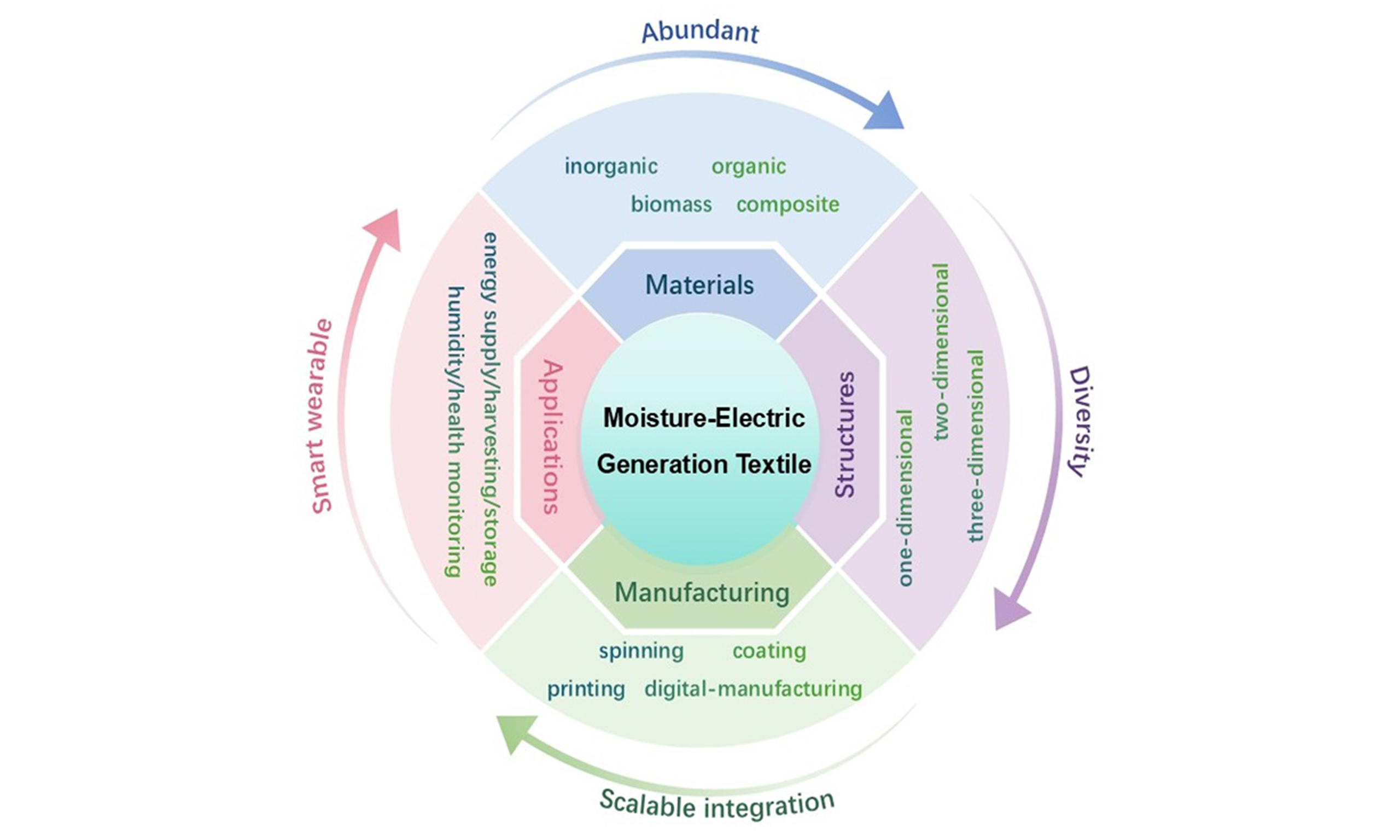
Keywords
INTRODUCTION
Against the backdrop of global focus on sustainable development, achieving carbon neutrality has become crucial for improving the environment and climate[1-3]. The carbon neutrality goal is driving the expansion of the green, clean energy industry chain[4]. Given the environmental degradation associated with fossil fuels, the development and utilization of sustainable energy technologies, such as hydropower[5,6], solar energy[7,8], and wind power[9,10], have become the forefront of energy research. Hydropower is a clean, efficient, and sustainable energy option, encompassing traditional hydroelectric power generation[11-13], evaporation power generation[14-17], and the emerging method of moisture-electric generation[18,19]. Compared to other power generation methods, such as triboelectric power generation[20,21], evaporation power generation[22,23], and solar power generation[24], they rely on friction, heat, and sunlight, respectively[25], and all exhibit dependence on external factors[14,26]. Furthermore, it is difficult for these methods to achieve continuous and stable all-weather energy supply, and their overall equipment structures are complex. Triboelectric nanogenerators (TENGs) generate signals by coupling triboelectric and electrostatic induction effects, operating during mechanical motion or contact separation[27,28]. Moisture-electric generators (MEGs) generate electricity solely through the spontaneous, continuous adsorption and desorption of ambient moisture. Evaporative power generation relies on solar-driven interfacial evaporation processes[29], requiring liquid water sources and avoiding freezing conditions[23]. MEGs can operate directly using humidity gradients in the air and function even in environments containing only water vapor, making them suitable for a wider range of applications. MEGs are physicochemical processes that operate continuously as long as atmospheric relative humidity (RH) is not zero, offering a longer theoretical lifespan. In mild, humid, non-freezing environments year-round, they can provide sustainable energy without human intervention and with low maintenance over a wide range of environmental humidity, giving MEGs the greatest advantage in providing continuous and stable power[30,31]. Compared to the previous two systems, MEGs cannot operate under diverse climatic conditions with abundant mechanical energy such as TENGs, nor can they provide the relatively stable output of evaporation systems with guaranteed water sources. Performance is limited in extremely dry or cold conditions, where reduced ion mobility and weakened proton gradients result in significant performance degradation[32]. Some teams have designed MEGs that can operate stably in dry or low-temperature environments[33-35]. As specialized complementary energy sources for specific environments, they have the potential to form hybrid energy harvesting systems with other technologies, enabling practical applications across a wider range of scenarios. Therefore, MEGs demonstrate unique application potential in sustainable energy supply due to their advantages of being environmentally friendly, structurally simple, and independent of specific geographical conditions[36].
MEGs capture moisture from the atmosphere through hygroscopic materials, driving the dissociation and migration of ions within their functional groups[17,37], ultimately achieving highly efficient electrical energy output[38,39]. Moisture-electric generation textiles (MEGTs) have shown promising applications in energy supply, wearable technology, and health monitoring, making them a focal point of academic research. They feature a simple structure and are easy to integrate flexibly, significantly reducing system complexity and manufacturing costs[40]. They can be readily embedded into self-powered miniature electronic devices or sensors[41]. In addition, these systems demonstrate high adaptability in smart wearable textiles, reducing reliance on external power sources and opening new avenues for diversified energy applications[42,43].
The development of MEGT devices is transitioning from laboratory research to practical applications. These devices hold great promise in fields such as energy supply, smart clothing, and multifunctional integration[44]. Leveraging the diversity and intrinsic properties of material systems, researchers have successfully engineered power-generating functional layers that combine high energy conversion efficiency with environmentally friendly and safe characteristics[45,46]. Device structures include one-dimensional (1D) linear, two-dimensional (2D) thin-film, and three-dimensional (3D) multilayer gel configurations. Power generation performance can also be enhanced by constructing asymmetric heterostructures[47-49]. Fibers or fabrics with different device structures can be fabricated through processes such as wet spinning, electrospinning, and dip coating[50-52]. Research in this field has evolved from early explorations of single materials to the deep integration of power generation capabilities within fibers or fabrics through sophisticated asymmetric device design and advanced textile processes such as spinning and weaving. This approach enhances output power while improving wearable flexibility and integration. These devices can drive low-power electronic devices[53,54], serve as distributed micro-power sources in extreme scenarios[55,56], and integrate flexibly with other devices[57,58]. Although research on MEGTs has made progress, it still faces the challenge of low power density output in individual devices. During long-term operation, the ion gradient gradually dissipates, affecting the device’s energy conversion efficiency[59,60]. Equipment manufacturing is constrained by material costs, with expensive materials further driving up overall costs and hindering industrial-scale production[50,61]. Adhesion issues between the power generation layer and electrodes also remain unresolved. Further research on surface modification and enhancement of materials is needed to synergistically improve moisture absorption capacity and environmental durability[62,63]. The key to advancing current technology lies in addressing its core challenges in performance, stability, and durability. Overcoming these challenges will enable applications in medical monitoring and human-machine interaction, ultimately realizing truly self-powered, comfortable, and sustainable wearable systems.
This review covers the moisture-electric generation mechanisms, materials, device structures, manufacturing processes, and application scenarios of MEGTs [Figure 1]. It focuses on exploring the potential for large-scale manufacturing and integration of these devices, as well as their applications in specific fields. To address challenges such as low power density, poor stability, and high costs, this paper proposes a synergistic development path integrating mechanisms, materials, and processes. Looking ahead, breakthroughs in these key technologies will enable MEGTs to achieve higher levels of integration and application in cutting-edge fields such as imperceptible energy replenishment, smart sensing, and personalized medicine.
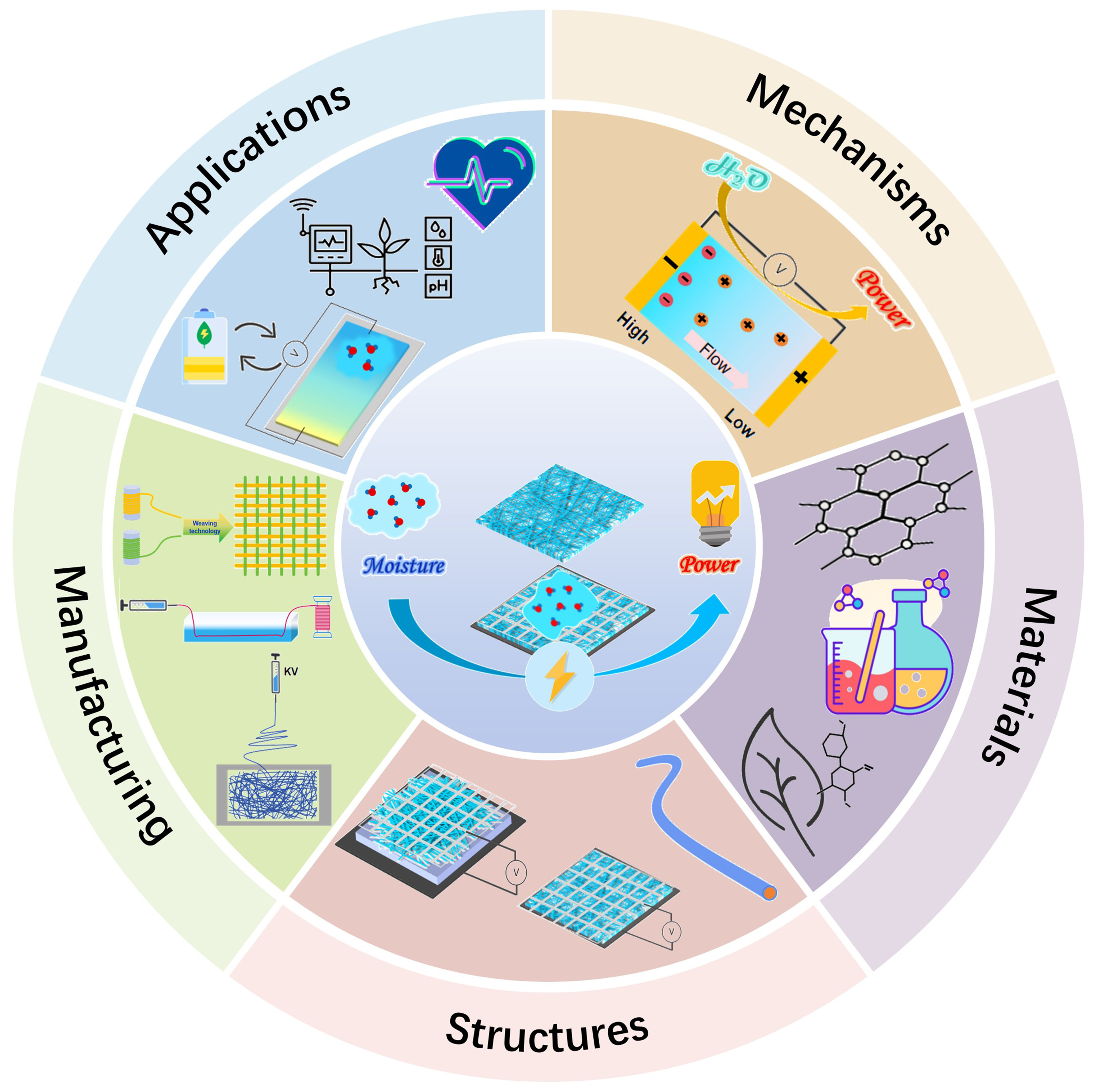
Figure 1. Schematic diagram of mechanisms, electric generation materials, device structures, manufacturing and applications of MEGTs. MEGTs: Moisture-electric generation textiles.
MOISTURE ELECTRIC GENERATION MECHANISMS
The mechanisms of MEGs primarily rely on the moisture absorption properties of materials, liquid-solid interface interactions, and ion transport mechanisms. By utilizing the adsorption of moisture by solid power-generation materials, water molecules interact with functional groups within the material and dissociate into mobile ions. The concentration gradient formed within the moisture-absorbing layer drives the directed migration of ions from regions of high to low concentration.
Interface effect
Interfacial water adsorption refers to the process whereby water molecules are captured at solid-gas or solid-liquid interfaces by surface active sites on materials, forming interfacial water films or hydration layers through physical or chemical adsorption. The atmospheric water cycle achieves efficient integration and redistribution of water and energy between the atmosphere, land surface, and subsurface through evaporation, transpiration, and precipitation[64,65]. When gaseous water molecules move freely in the atmosphere, they possess high kinetic energy[66,67]. Upon approaching the surface of a hygroscopic material, gaseous water molecules condense onto the solid surface[12]. The distance between water molecules decreases, enhancing their mutual interactions, reducing molecular kinetic energy, and increasing potential energy
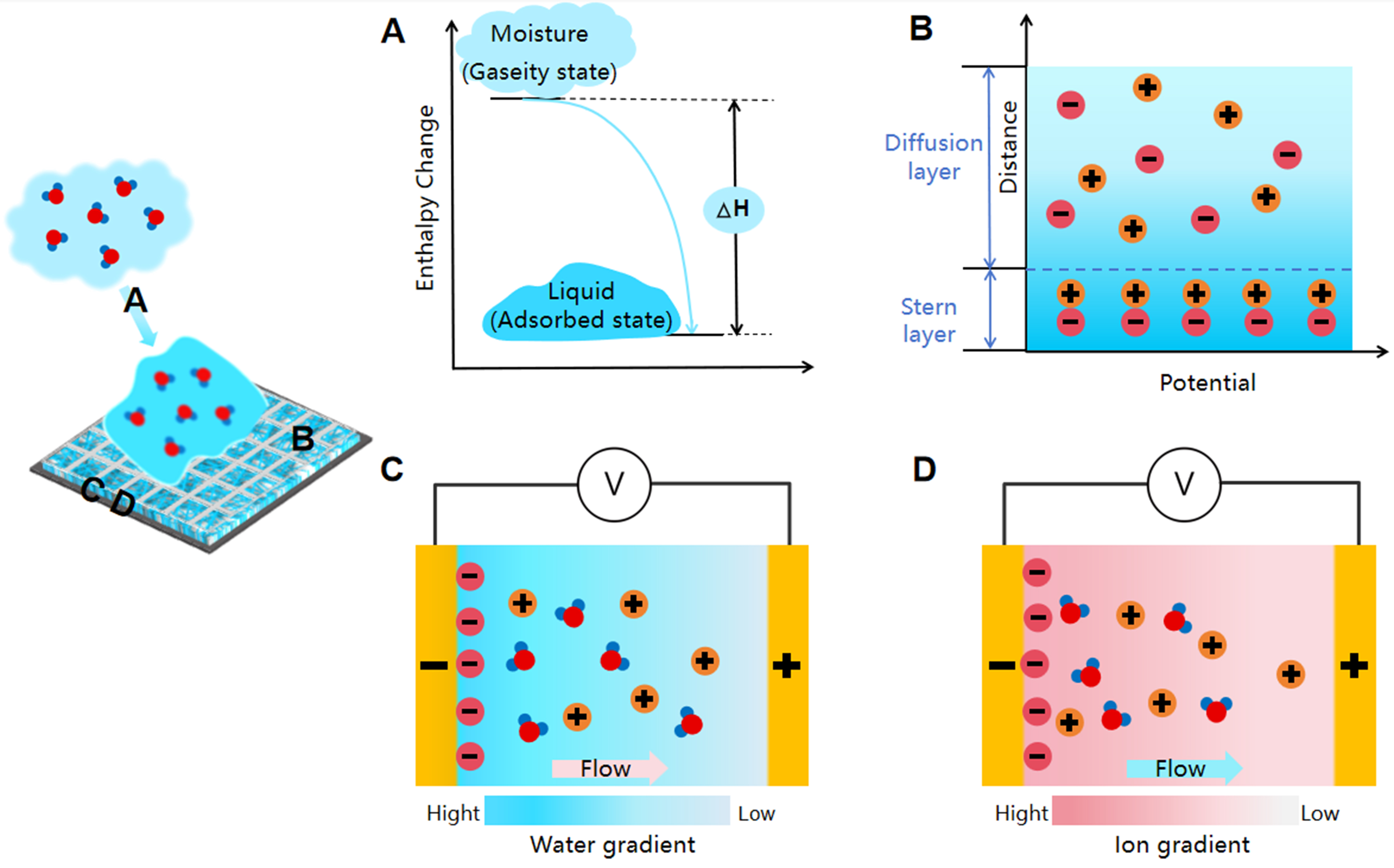
Figure 2. Mechanisms diagram of MEGs. (A) Engineering process of energy changes from gaseous water to liquid water thermodynamics; (B) The streaming potential generated by the movement of mobile counterions within the double electric layer as they are entrained by water flow; Schematic diagrams of ion diffusion and migration induced by (C) moisture gradient and (D) ion gradient in the electric generation layer. MEGs: Moisture-electric generators.
The physicochemical properties of materials in the power-generation functional layer influence device performance by regulating water-solid interactions and ion migration[32]. Pores serve as the primary pathways and sites for water molecule transport and ion migration. Multiporous structures or pore size gradients enhance the capture capacity of functional materials for water molecules while ensuring efficient ion migration channels and high migration rates[76]. Smaller pore sizes restrict ion movement, whereas excessively large pores weaken the chemical potential gradient. The chemical composition and charge distribution on the material surface are closely related to the adsorption and dissociation of water molecules. Surface defects or active sites can promote water molecule dissociation, increasing the concentration of ion carriers[62]. By optimizing these physicochemical properties, the material’s moisture absorption capacity, ionic conduction efficiency, and long-term stability can be enhanced.
Ion dissociation
When water molecules come into contact with the hygroelectric generation layer material, the interaction at their interface is a complex process. Functional groups on the material’s surface ionize or dissociate, generating surface charges. To maintain electrical neutrality at the interface, counterions in the solution accumulate at the boundary, forming a nanoscale charge distribution structure with capacitive properties. This structure constitutes the electric double layer (EDL), comprised of an inner, tightly adsorbed Stern layer and an outer, mobile diffusion layer[65,77]. Driven by external pressure or capillary action, liquids exhibit directed flow within nanoscale channels, thereby “dragging” mobile counterions (positively charged cations) within the diffusion layer of the solid-liquid interface to migrate along with them[78]. This directional charge transport induced by fluid motion forms convective currents, which manifest macroscopically as streaming currents[68]. As streaming currents develop, opposite charges gradually accumulate at opposite ends of the channel, establishing an internal potential difference related to the flow direction - the streaming potential [Figure 2B][79]. In hygroscopic power-generation materials, the adsorption and transport of water from the environment induce a dynamic response of this EDL on the material surface or within internal nanochannels, promoting the directional migration of counterions along the direction of water flow. This forms a potential gradient at both ends of the material and ultimately generates a measurable continuous current in the external circuit[13].
The material and structure of the upper and lower electrodes in MEG devices significantly influence ion dissociation within the power-generating layer. Ideal electrode materials must possess high electrical conductivity, excellent chemical stability, and ease of integration to enhance electrochemical performance and ensure long-term stability. Selecting electrode materials with high specific surface area increases adsorption sites for water molecules while simplifying the manufacturing process. In recent years, strategies for constructing asymmetric electrodes using different materials or structures have garnered significant attention[78]. By employing sandwich structures with asymmetric electrodes [such as carbon (C)/aluminum (Al) or bimetallic electrodes][80], ion concentration gradients can be significantly enhanced and ion migration pathways effectively optimized[81]. Increasing material thickness can raise voltage; however, beyond a certain limit, it impedes ion transport, leading to a decrease in current[82]. Internal ionic concentration gradients within devices are primarily achieved through two strategies[12]. First, intrinsic chemical gradients can be established within the material to form spontaneous ion diffusion pathways via asymmetric functional group modifications[83,84]. This method offers excellent stability, but precise design and controllable preparation remain challenging. Second, directional water introduction into the material, achieved through asymmetric wetting structures or unidirectional water transmission paths, can generate ion concentration gradients[34,85]. This approach imposes minimal requirements on the material itself, offering high flexibility but relying on external humidity differences for maintenance. Both strategies can be employed synergistically to enhance the device’s output performance and environmental adaptability.
Ion migration
Driven by internal water or ionic concentration gradients, freely mobile ions within the power-generating layer undergo directed migration, generating electrical output in the connected external circuit[66]. The water gradient is a core factor driving ion migration within the power generation layer, particularly during the initial moisture absorption phase and in asymmetric electrode structures. During initial moisture absorption [Figure 2C], water molecules interact with material functional groups, forming a significant water gradient that serves as the primary driving force for directed ion migration. Taking graphene oxide film (GOF) as an example, water molecules adsorb directionally and promote the dissociation of a large number of hydrogen ions (H+) from GOF. Subsequently, under the synergistic action of water gradient formation and diffusion, H+ undergoes directional movement, generating an electric current[86]. The porous structure of graphene oxide (GO) efficiently adsorbs water molecules to form a moisture gradient. Based on this principle, an asymmetric structure constructed with a moisture-proof substrate and a porous upper electrode significantly enhances this gradient[60]. The upper electrode absorbs large amounts of water and dissociates ions, while the moisture-proof substrate maintains relatively low humidity on the underside. Driven by this difference, ions migrate directionally toward the substrate, generating a stable directional current.
Establishing an ion concentration gradient is another effective strategy for driving directional ion migration [Figure 2D]. To validate this approach, Huang et al. employed directional laser irradiation technology[87]. By controlling the laser intensity to decrease with increasing GO depth, they achieved a gradient-based redistribution of oxygen-containing functional groups (Ocfgs), ultimately constructing the desired ion concentration gradient within the GO. In this asymmetric structure, Ocfgs react with water molecules, generating free ions. Due to the gradient distribution of the functional groups, the concentration of free ions also exhibits a gradient, effectively driving directional ion migration. Building upon this, the selection of electrode materials can further increase the ionic concentration gradient. For instance, replacing the top inert electrode with an Al electrode allows Al to react with water, releasing additional ions[81]. This significantly enhances the ion concentration gradient, promoting more directed ion movement and ultimately increasing voltage output. By synergistically regulating the materials and structures of the moisture-absorbing layer and electrodes, the water-ion gradient can be fully leveraged to enhance both device performance and stability.
Humidity is the core factor affecting ion migration and energy conversion efficiency. It underlies the formation of internal moisture gradients, which promote the dissociation of functional groups to produce free ions, establish ion concentration gradients, drive directional ion migration, and enhance energy conversion efficiency[45]. Humidity fluctuations can destabilize ion migration pathways, impairing charge separation efficiency. This dependence on external humidity in conventional devices can be mitigated by maintaining an internal humidity gradient through asymmetric structures[88]. Elevated temperatures accelerate the thermal motion of ions, enhancing their diffusion, but excessively high temperatures may damage material structures or cause rapid water evaporation, reducing the humidity gradient and thereby decreasing energy output. The influence of the physicochemical properties of the power generation layer on device performance has been discussed previously. Additionally, asymmetric electrode structures and robust electrode–layer interfaces promote directed ion migration[89], while highly conductive electrode materials reduce electrical resistance, further enhancing device energy output.
Streaming potential and ion diffusion are the two core mechanisms of MEG. Table 1 summarizes the key differences between them. The streaming potential mechanism converts mechanical energy into electrical energy by relying on pressure gradients to drive fluid movement within electrically charged nanochannels[45]. The viscous drag of counterions in the EDL generates flow currents, requiring an external or built-in pressure field to achieve sustained and stable electrical energy output[65]. In contrast, the ion diffusion mechanism arises from the dissipation of chemical potential gradients, enabling the direct conversion of chemical potential energy into electrical energy. Here, ions (H+) ionized by hydration undergo directed diffusion along the concentration gradient, establishing a diffusion potential[18,35]. This mechanism does not require external mechanical input and can harvest energy under static humidity conditions; however, its output typically exhibits transient or relaxation behavior and is sensitive to dynamic environmental humidity changes[12]. High-performance MEG devices can be optimized by leveraging the combined effects of both mechanisms.
Comparison of streaming potential mechanism and ion diffusion mechanism
| Mechanism | Streaming potential | Ion diffusion |
| Core principle | Liquid flow drives ion movement | Ion diffusion under chemical potential gradient |
| Material characteristics | Nanochannels, porous structures | Asymmetric hygroscopic structure |
| Output characteristics | Responsive, affected by fluid flow | High stability, long duration |
| Advantages | Stable output power, high current | Simple device structure, easy to integrate, high voltage |
| Disadvantages | Dependent on water flow or evaporation | Dependent on ambient humidity |
FUNDAMENTAL MATERIALS OF MOISTURE ELECTRIC GENERATION TEXTILES
Electric-generating materials form the core of humidity-powered devices, producing electrical output through water absorption, functional group dissociation, and ion migration. Consequently, ideal power-generating materials should combine high hygroscopicity, excellent ionic conductivity, and robust stability to ensure efficient and reliable device performance. The large specific surface area and 3D porous structure of textiles provide an excellent platform for maximizing the active interface of moisture-absorbing functional materials[90,91]. This allows nanoscale properties to be fully realized in macroscopic fabrics, significantly enhancing energy capture efficiency and output capacity[92]. Based on material type, these materials are primarily classified into four categories: inorganic, organic polymeric, biomass, and composite materials, each leveraging unique structural and performance advantages to contribute critically to the power-generating layer.
Inorganic materials
Inorganic materials, with their unique structural tunability, high electrical conductivity, and excellent thermal stability, have emerged as ideal candidates for the power-generating layer in MEGTs. Their high specific surface area provides the functional layer with abundant sites for water adsorption and ion dissociation[48]. Ions undergo directional diffusion driven by humidity gradients, while charge separation is facilitated by the ion selectivity of nanopores. The mechanical strength and chemical stability of these materials ensure that the nanostructure of the power-generating layer remains intact during prolonged cyclic moisture absorption and desorption, guaranteeing stable output performance and extending device lifespan[93]. GO as an inorganic carbon material, can form proton concentration gradients through structural regulation, making it a prominent choice for humidity-powered layers. Early studies by Zhao et al. prepared GOFs with gradient-distributed Ocfgs via a “moisture-electro-annealing” bias treatment [Figure 3A][94]. significantly enhancing proton gradient-driven effects. The team later employed directional thermal reduction to fabricate porous GOFs [asymmetric porous GO membrane (a-GOM)] with asymmetrically reconstructed functional groups, optimizing interfacial and transport behavior[95]. In the same year, laser-assisted modulation was used [Figure 3B] to selectively irradiate specific GO regions, forming a Schottky junction interface and achieving a high-performance power generation unit with output voltage up to 1.5 V[87]. Gao et al. constructed GO-reduced GO (rGO) heterostructures via localized thermal reduction of commercial GOFs, enabling efficient electricity generation by leveraging asymmetric interactions between water molecules and functional groups in distinct regions[96]. These studies exemplify a mainstream approach to enhancing device output through regulation of GO functional groups and electrode asymmetry.
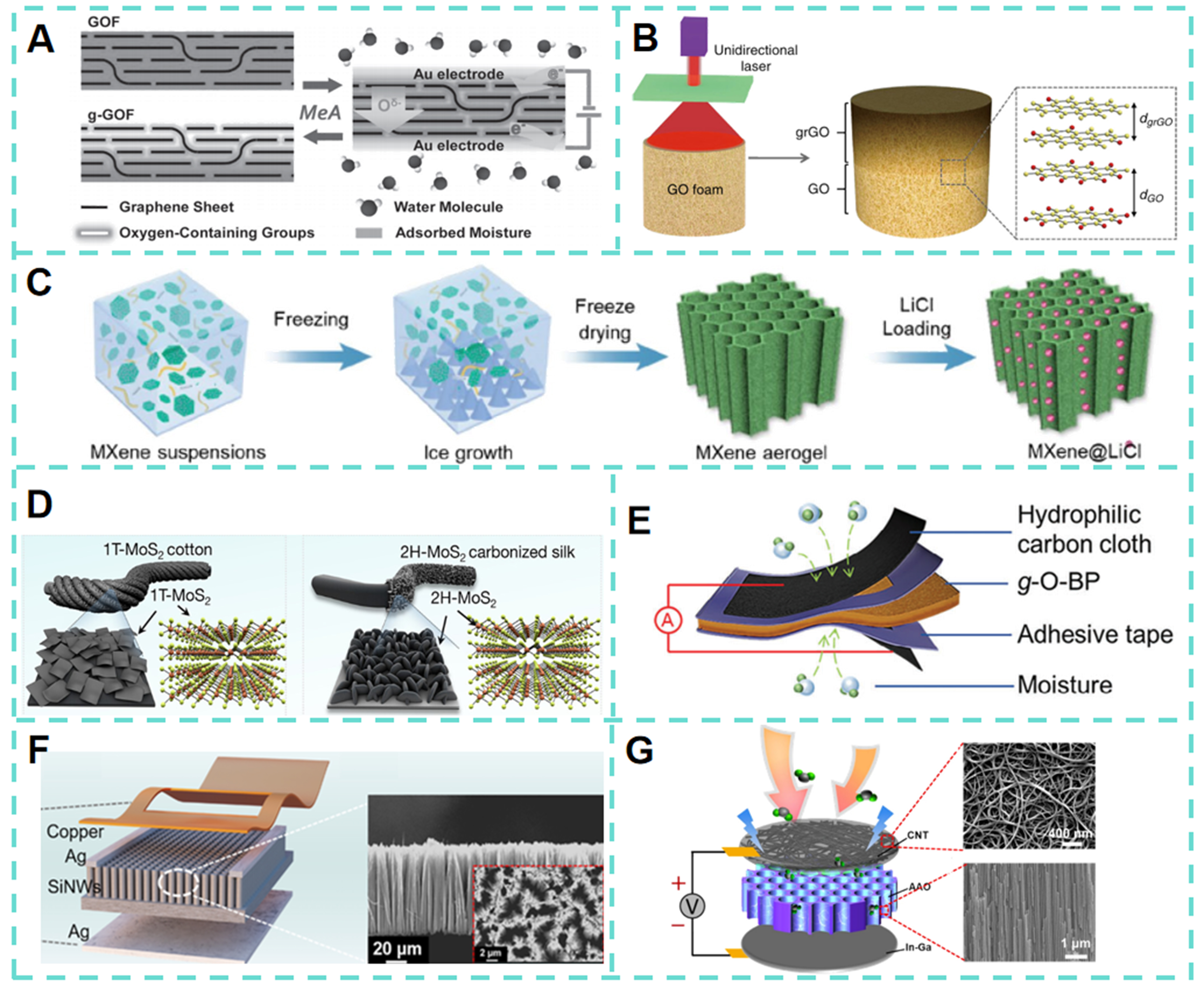
Figure 3. Inorganic materials for MEGT. (A) A g-GOF prepared by MeA method[94]. Reproduced with permission. Copyright 2015, John Wiley & Sons; (B) Laser-directed irradiation of GO block for the preparation of heterostructure GO structure[87]. Reproduced under CC BY license from Yaxin Huang, 2018, Nature Communications; (C) MXene aerogel atmospheric moisture collection device[100]. Reproduced with permission. Copyright 2024, American Chemical Society; (D) Structure of 1T-MoS2 cotton and 2H-MoS2/CSilk[98]. Reproduced with permission. Copyright 2023, American Chemical Society; (E) Structure diagram of g-O-BP device[62]. Reproduced with permission. Copyright 2024, John Wiley & Sons; (F) Structure of nano-structured silicon moisture generator and SEM image of cross section of SiNWs[58]. Reproduced with permission. Copyright 2023, Elsevier B.V; (G) Device based on an ion-diode-type PN junction and SEM images of top electrode and AAO side view[104]. Reproduced under CC BY license from Yong Zhang, 2022, Nature Communications. MEGT: Moisture-electric generation textile; g-GOF: gradient graphene oxide film; GO: graphene oxide; g-O-BP: oxygen defect gradient on the surface of black phosphorus aerogel; SEM: scanning electron microscopy; SiNWs: silicon nanowires; PN: positive-negative; AAO: anodized aluminum oxide; CNT: carbon nanotube.
To push the performance boundaries and expand the application potential of humidity-powered devices, researchers are exploring novel inorganic materials such as MXene[97], molybdenum disulfide (MoS2)[98,99], and black phosphorus (BP)[62], leveraging their unique structural and functional properties. MXene provides abundant active sites for ion adsorption and migration. Inspired by the “pump effect” of wood, Cai et al. fabricated a hygroscopic structure with a dual-hydrogen-bond network and wood-like channels via ice-templating and a controlled lithium chloride (LiCl) process [Figure 3C], achieving a moisture absorption capacity of 3.12 g·g-1 at 90% RH[100]. MoS2, as another class of 2D material, offers design possibilities for humidity-driven power generation[99]. Cao et al. designed a vertical heterojunction structure based on 2H-MoS2 (semiconducting) in carbonized silk (2H-MoS2/CSilk) and 1T-MoS2 (metallic) in cotton fiber (1T-MoS2 cotton) [Figure 3D], where the induced built-in electric field promotes proton migration and charge collection[98].
BP has attracted attention for its tunable band structure and catalytic activity. Liang et al. employed directional oxygen plasma irradiation to create an oxygen defect gradient on the surface of black phosphorus aerogel (g-O-BP), enabling spontaneous charge separation in humid environments [Figure 3E][62]. This flexible device, only 160 μm thick, delivered a voltage of 0.25 V and a current density of 0.16 μA·cm-2. Hydrophilic carbon cloth electrodes and tape encapsulation were incorporated, further enhancing mechanical flexibility and practical applicability.
In addition to the materials discussed above, 1D inorganic nanomaterials such as silicon nanowires (SiNWs)[101] and metal oxide nanowires[102] have attracted attention due to their unique water absorption properties and oriented nanoscale channel structures. As shown in Figure 3F, a typical device consists of a SiNWs-based power-generating layer and an asymmetric electrode. Under a humidity gradient, a directional charge transport pathway forms internally, enabling electrical signal output[58]. Scanning electron microscopy (SEM) images reveal that the SiNWs aggregate at the top to form a dense network of nanoconductors, providing efficient pathways for water molecule permeation and ion migration. Metal oxide nanomaterials such as titanium dioxide (TiO2)[102] and aluminum oxide (Al2O3) nanowires[103], possessing excellent charge transport capabilities and ordered arrangements, are also suitable for MEGT power-generating layers. Zhang et al. constructed a device based on an ion-diode-type PN junction [Figure 3G], composed of a nanoporous carbon nanotube (CNT) film and an anodized aluminum oxide (AAO) film[104]. SEM images show that the CNT film has an abundant pore structure facilitating water vapor transmission, while the AAO film exhibits well-defined nanoscale channels with excellent structural tunability. Together, these components achieve highly efficient humidity response and effective charge separation.
Organic materials
The core advantage of organic polymers lies in their exceptional molecular designability and rich interfacial interactions, enabling them to participate more precisely and efficiently in the mechanisms of the power-generating layer. Under the influence of water molecules, ionizable functional groups spontaneously dissociate, releasing a large number of ions and providing a high concentration of free charge carriers for the ion gradient diffusion mechanism[105]. The hydrophilic-hydrophobic microphase-separated structure effectively regulates the adsorption and transport kinetics of water. Upon water absorption, polymer segments exhibit flexibility and undergo swelling behavior, forming dynamically interconnected nanoscale hydration channels that facilitate rapid ion migration[106]. Furthermore, polymers can be processed into large-area, uniform, ultra-thin functional films on flexible substrates through various fabrication methods, enhancing their practical applications. Organic polymers, with their tunable molecular structures, excellent processability, and high flexibility, have become one of the ideal materials for MEGT devices. Their properties can be further optimized through chemical modification to meet the demands of diverse application scenarios. Polystyrene sulfonate (PSS), polyacrylamide (PAM), and sodium alginate (SA) are widely employed in the power-generating layers of MEGTs due to their functional characteristics[107]. Xu
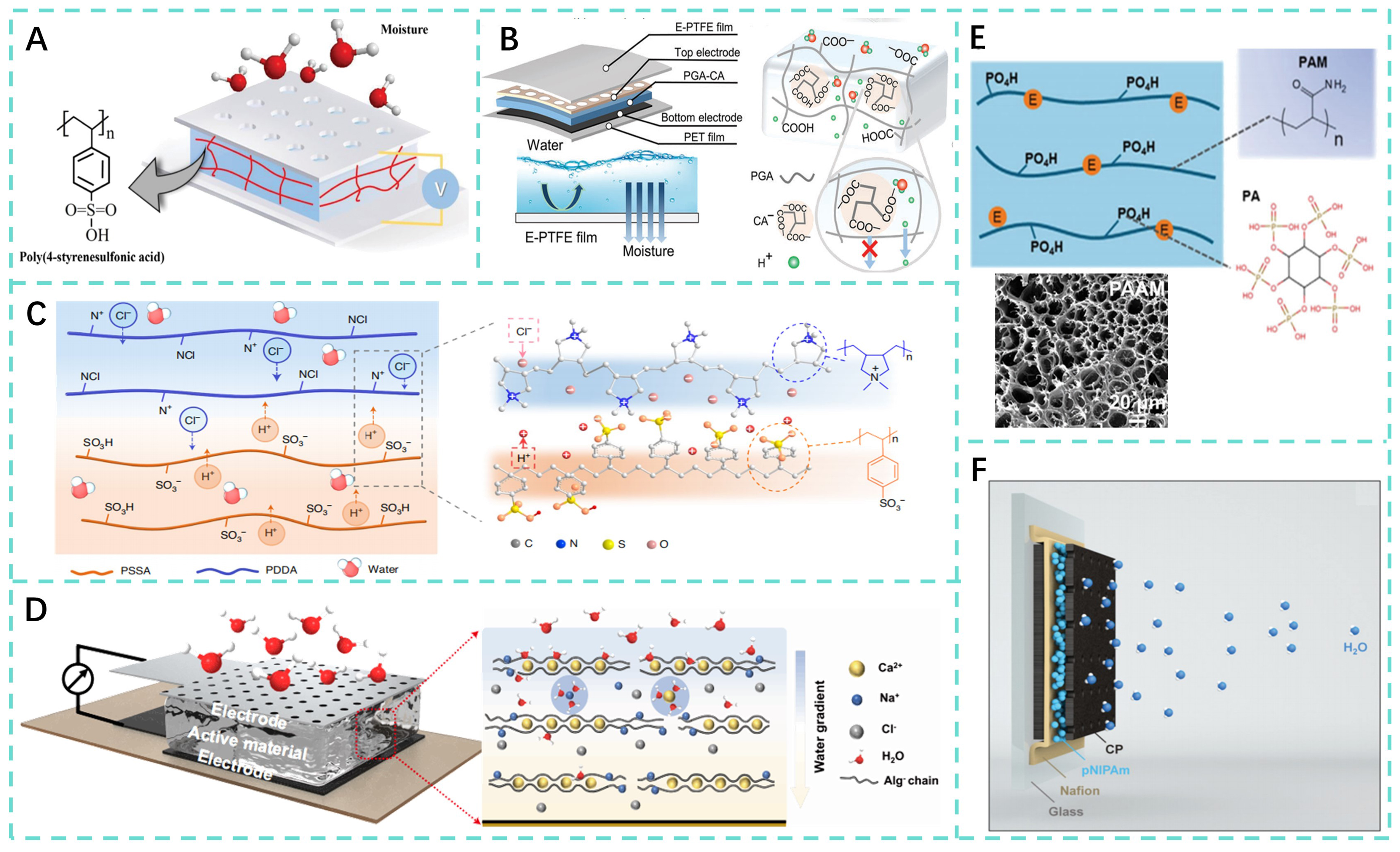
Figure 4. Organic materials for MEGT. (A) PMEG based on PSSA[108]. Reproduced with permission. Copyright 2019, Royal Society of Chemistry; (B) Schematic illustration of engineered hydrogel-based device and molecular structure and ion confinement in PGA-CA hydrogel[54]. Reproduced under CC BY license from Daozhi Shen, 2024, Advanced Science; (C) Moisture electric generation process inside BPFs structure[105]. Reproduced with permission. Copyright 2021, Springer Nature Limited; (D) Structure of green device based on supramolecular hydrogel[109]. Reproduced under CC BY license from Su Yang, 2024, Nature Communications; (E) Structure of electric generation hydrogel and SEM image of PAM hydrogel[55]. Reproduced with permission. Copyright 2024, John Wiley & Sons; (F) Schematic diagram of device based on the IPHC structure[60]. Reproduced with permission. Copyright 2022, Royal Society of Chemistry. MEGT: Moisture-electric generation textile; PMEG: polymer moisture electric generator; PSSA: poly(4-benzenesulfonic acid); PGA-CA: polyglutamic acid-citric acid; BPFs: bilayer polymer films; SEM: scanning electron microscopy; IPHC: ionic polymer-hydrogel-carbon composite; E-PTFE: expanded polytetrafluoroethylene; PET: poly (ethylene terephthalate); PAM: polyacrylamide; PA: phytic acid; CP: carbon paper.
Organic polymer composite power-generating layers can effectively enhance the overall performance of devices through synergistic effects between materials. Compared to single-material systems, composite structures demonstrate advantages in chemical stability and environmental adaptability. Wang et al. designed a bilayer polymer film (BPF) electrolyte based on the sequential stacking of a polycationic film [poly(diallyl dimethyl ammonium chloride) (PDDA)] with a polyanionic film [a mixture of PSS and polyvinyl alcohol (PVA) films (PSSA)] [Figure 4C][105]. This dual-carrier system, integrated through sequential stacking, achieved a high voltage output exceeding 1,000 V, demonstrating the potential of composite structures for functional integration and performance enhancement. In the field of green material development, Yang et al. constructed a supramolecular hydrogen power-generating layer based on PVA and SA [Figure 4D][109]. This material combines biocompatibility, degradability, and processing convenience. Coupled with an asymmetric electrode structure, it enables high-performance, environmentally friendly energy devices. Through asymmetric moisture absorption and interactions between water molecules and the functional layer, a single unit can generate an open-circuit voltage (Voc) of approximately 1.30 V. These studies demonstrate significant progress in achieving high-performance, high-voltage output, and environmentally sustainable humidity-powered devices through composite polymer strategies.
To address the current limitations of most MEGT devices, which rely on a single power generation mechanism and exhibit constrained output performance, researchers have conducted a series of innovative studies employing biomimetic design and material composite strategies. Inspired by plant water uptake mechanisms, Cheng et al. synthesized a flexible, scalable PAM hydrogel-based device using acrylamide (AAm) and phytic acid (PA) as raw materials via ultraviolet polymerization with a photosensitizer [Figure 4E][55]. Its porous network structure (as shown in the SEM image) effectively promotes water absorption and transport, while the incorporation of photosensitizers further enhances electrical performance. The device maintains stable output even at low temperatures of -20 °C. Leveraging the structural similarity of amide groups, poly(N-isopropylacrylamide) (pNIPAm) hydrogels also demonstrate application potential in power-generating layer design[110]. Liu et al. combined the ionic polymer Nafion with pNIPAm hydrogel to construct an ionic polymer-hydrogel-carbon composite (IPHC) device [Figure 4F][60]. This structure utilizes pNIPAm hydrogel as the medium and the Nafion membrane as the charge donor, enabling rapid voltage response and demonstrating strong adaptability to various practical scenarios[60]. These explorations provide new technical pathways for overcoming performance bottlenecks in high-performance devices and expanding their environmental adaptability.
Biomass materials
The core advantages of biomass materials lie in their naturally intricate multilevel structures, abundant functional groups, biodegradability, and exceptional sustainability. Their hierarchical nanostructures enable rapid adsorption and transport of water molecules via capillary action, providing efficient pathways for the diffusion and migration of water and ions[76]. The abundant intrinsic functional groups supply a continuous and biocompatible ion source for ion gradient diffusion mechanisms[111]. These groups also confer inherent surface charge to the material, facilitating the formation of an EDL. Simultaneously, their biodegradability and environmental friendliness align with sustainable development goals. Biomass materials, derived from natural plants, animals, or microorganisms, offer advantages such as renewability and wide availability[112], making them ideal candidates for MEGT power-generating layers. Common examples include lignin, proteins, and microbial cells, which can efficiently adsorb atmospheric moisture and form hydrated nanoscale channels. These channels facilitate internal ion transport, enabling highly efficient power generation. You et al. developed a low-cost, high-performance lignin sulfonate (LS-H) power-generating layer paired with graphite and zinc foil electrodes [Figure 5A][113]. The device exhibits outstanding environmental stability and mechanical flexibility, allowing continuous power generation for up to two months. Gao et al. constructed a paper-based device using natural cellulose fibers, with its structure shown in Figure 5B[114]. Its porous micro-nano architecture and abundant hydrophilic groups endow it with excellent moisture absorption and flexibility, enabling conformity to curved surfaces. These studies demonstrate the broad application potential of biomass materials in flexible, sustainable humidity-powered devices.
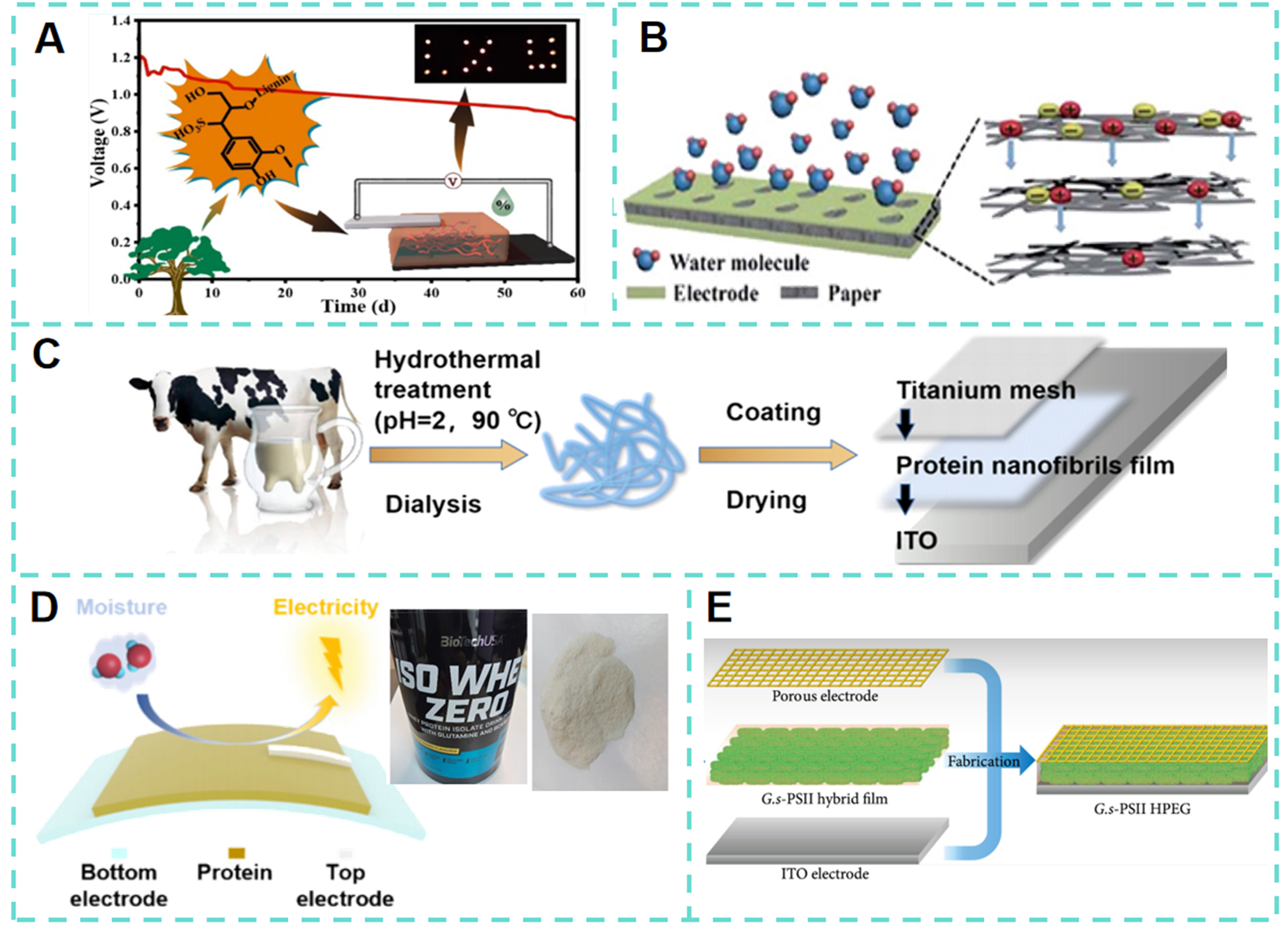
Figure 5. Biomass materials for MEGT. (A) Schematic of the device based on lignosulfonic acid and property[113]. Reproduced with permission. Copyright 2025, American Chemical Society; (B) Schematic diagram of the printing paper-based device and its working mechanism[114]. Reproduced with permission. Copyright 2019, Royal Society of Chemistry; (C) Preparation process of PNMEG[115]. Reproduced with permission. Copyright 2022, Elsevier B.V; (D) Schematic diagram of water absorption in protein-based device and optical image of protein powder[40]. Reproduced with permission. Copyright 2023, Royal Society of Chemistry; (E) The structure of the device with a G.s-PSII hybrid film as the power-generating layer[119]. Reproduced under CC BY 4.0 license from Guoping Ren, 2022, Research. MEGT: Moisture-electric generation textile; PNMEG: protein nanofibrils-moisture electric generator; PSII: photosystem II; ITO: indium tin oxide; HPEG: hydrovoltaic-photovoltaic electricity generator.
Biological protein nanofibers, as 1D supramolecular aggregates, can be extracted from natural sources or constructed through self-assembly, providing a novel route for developing green, low-cost MEGT devices[111]. Liu et al. prepared a protein nanofiber film based on milk β-lactoglobulin via pH adjustment and hydrothermal synthesis, with the structure and preparation process shown in Figure 5C[115]. This fiber membrane exhibits excellent hydrophilicity and ionization capability, delivering a high Voc of 0.65 V and short-circuit current (Isc) of 2.9 μA. The electrical performance of the constructed device surpasses most previously reported devices. Zhu et al. further utilized inexpensive, easily processed whey protein to develop a tunable power-generating layer by modulating its surface charge and hydrophilicity through pH control [Figure 5D][40]. This protein-based film achieves a maximum voltage output of 1.45 V at 40% RH and exhibits excellent flexibility, making it suitable for applications such as wearable devices and medical patches. Protein nanofibers, as a class of biomass materials with controllable properties and sustainable sources, show great promise for the fabrication of power-generating layers.
Unlike most existing devices that generate electricity only intermittently, equipment built using microbial nano-protein wires can achieve continuous and stable electrical output. Liu et al. fabricated a thin film using nano-protein filaments extracted from Sulfuribacter, which consistently generated a voltage of 0.5 V and a current density of 17 μA·cm-2 at a thickness of only 7 μm[116]. The exceptional biocompatibility and self-assembly properties of whole-cell Geobacter sulfurreducens (G.S.) simplify device fabrication, eliminating the need for complex multilayer structures[117,118]. As shown in Figure 5E, integrating G.S. with photosystem II (PSII) enables simultaneous energy harvesting from both moisture and sunlight, providing a viable strategy for enhancing the performance of hybrid moisture-powered devices[119]. These findings demonstrate the significant potential of microbial protein wires for constructing long-term stable, environmentally adaptive power-generation systems.
Composite materials
Composite materials are created by combining components with different properties at the nano- or molecular scale, resulting in superior characteristics unattainable by any single material. This precisely meets the requirements for the humidity-powered functional layer[120,121]. By leveraging the synergistic effects of multicomponent functionality, a single functional layer simultaneously achieves multiple capabilities: efficient ion supply, rapid water transport, and stable mechanical support. Through adjustments to the proportions, morphology, and interconnection methods of composite components, high power generation performance, robust stability, and extended service life are maintained[122]. The composite construction of a multi-scale, multi-level pore network structure enables seamless integration from rapid water uptake to efficient power generation, maximizing the utilization of water’s chemical potential energy while optimizing transport pathways and charge transfer efficiency. By combining the characteristics of different materials, composite materials complement each other, efficiently adsorb water molecules from the air, and dissociate free ions[123]. This approach improves the output stability of MEGT devices across a wide range of temperatures and humidity and enhances device longevity, meeting the demands of diverse practical application scenarios[85]. Many inorganic materials have surfaces enriched with active sites that can adsorb and activate water molecules, facilitating efficient charge transport[124]. In Figure 6A, Huang et al. designed an MEG device based on a GO and sodium polyacrylate (PAAS) composite power generation layer, which operates across -25 to 50 °C and 5% RH-95% RH, enabling effective ion dissociation and transport[82]. Huang et al. developed a high-performance device integrating silica (SiO2) nanofibers, SA, and rGO substrates[125]. SA provides abundant Ocfgs with hygroscopic properties, while rGO offers a 2D nanosheet structure. SiO2 nanofibers facilitate ion migration, enabling the composite to demonstrate excellent environmental adaptability. Carbonized polymer dots (CPDs) have a polymer/carbon hybrid structure with rich functional groups. Li et al. constructed a flexible functional layer based on phosphate-rich CPDs (PA-CPDs)[47]. Figure 6B illustrates the fabrication process of the PA-CPD-based flexible device. By integrating PA-CPDs with an active liquid metal (LM) top electrode, the device achieves high voltage output and favorable current density. Liu et al. designed a water-light complementary power generation device using a hydrogel fabric composed of PSS, GO, glycerol (GI), and PVA (PSS/GO/GI/PVA@Fab) as the functional layer with asymmetric electrodes [Figure 6C][59]. The device features a vertically arranged internal gradient of oxygen functional groups. Protons dissociated from the power generation layer react with the active electrode, enhancing output performance. Based on proton-driven technology, Figure 6D shows a device composed of a hygroscopic GO/polyaniline (PANI) matrix and PDDA-modified fluorinated Nafion [F-Nafion(PDDA)], which generates spontaneous charge separation followed by directed H+ ion movement, operating reliably across a wide temperature range[36]. Its inherent flexibility and bending resistance make it particularly suitable for integration into clothing as a wearable power source.
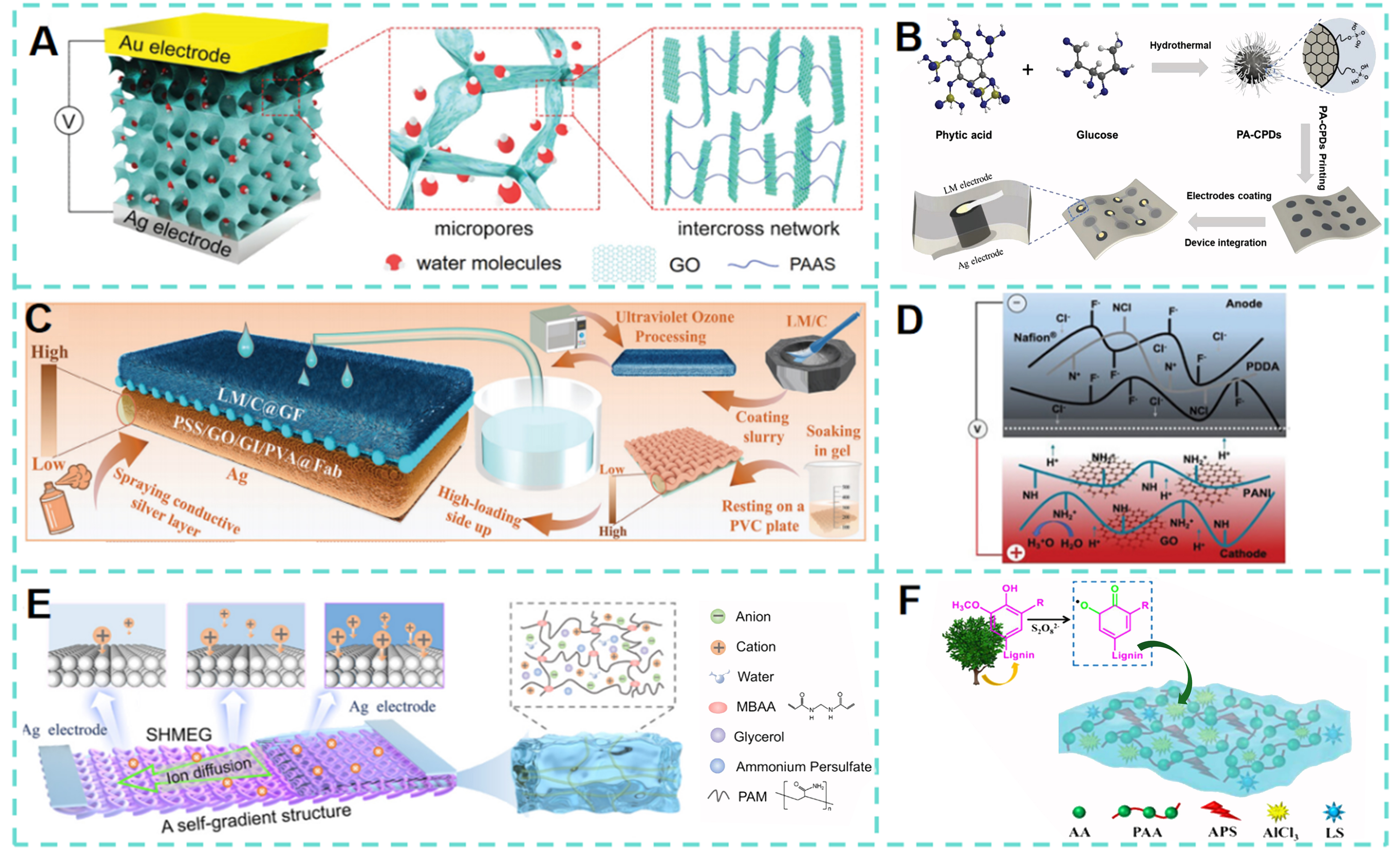
Figure 6. Composite materials for MEGT. (A) Schematic diagram of the device assembly and its porous GO composite structure[82]. Reproduced with permission. Copyright 2019, Royal Society of Chemistry; (B) Schematic of the preparation process for flexible device based on PA-CPD[47]. Reproduced with permission. Copyright 2023, John Wiley & Sons; (C) Illustration of the fabrication process for functional electric generation layer[59]. Reproduced with permission. Copyright 2024, John Wiley & Sons; (D) Working principle of polyelectrolyte double-layer devices[36]. Reproduced under CC BY license from Debasis Maity, 2023, Advanced Science; (E) Schematic diagram of the self-gradient moisture power generation device[35]. Reproduced with permission. Copyright 2025, John Wiley & Sons; (F) Diagram of the LS-Al3+-PAA hydrogel structure[127]. Modified from 127, Copyright Royal Society of Chemistry, 2023. MEGT: Moisture-electric generation textile; GO: graphene oxide; PA-CPD: phytic acid-carbonized polymer dot; LS: lignin sulfonate; PAA: polyacrylic acid; PAAS: sodium polyacrylate; LM: liquid metal; PVC: polyvinyl chloride; SHMEG: self-gradient hydrogel-based moisture-induced electric generator; MBAA: N,N′-methylene-bis(acrylamide); PAM: polyacrylamide; AA: acrylic acid; APS: ammonium persulfate.
When organic polymers, inorganic materials, and biomass materials are combined to fabricate composite power generation layers, their complementary properties enable ternary composites to effectively enhance the performance of MEGT devices. Organic polymers typically provide flexibility, inorganic materials offer chemical stability in humid environments, and biomass materials are renewable and environmentally friendly. To enhance protonation or ion diffusion, Mo et al. developed a nanocellulose-based power generation layer composed of sulfated cellulose nanofibers (SCNF) and PVA[126]. This layer features an asymmetrical water permeation structure that promotes spontaneous and efficient water absorption while facilitating ion diffusion. To further extend the operating temperature range, Yu et al. designed a low-temperature-resistant power generation layer composed of PVA, polyacrylonitrile (PAN), GI, and ethyl cellulose ether (EC) pine oil[33]. This material exhibits excellent hygroscopicity and ion migration capability even at temperatures as low as -35 °C. Drawing inspiration from the gradient structure of plant root tips, Xiao et al. developed a Y-shaped microfluidic spinning technique capable of continuously producing cellulose/CNT gas-aerogel fibers (GAFs) with gradient nanoporous structures[90]. The cellulose network facilitates rapid radial liquid diffusion and efficient water transport, while CNTs, combined with quaternized cellulose nanofibrils (Q-CNF) and sodium carboxymethyl cellulose (CMC), enable the fabrication of an asymmetric, self-powered cellulose-based power generation layer via directional freeze-drying, exhibiting high humidity sensitivity and robust durability[74]. A self-gradient power generation device was also developed by self-diffusion of a pre-gel solution onto carbon black-loaded knitted fabric [Figure 6E][35]. Leveraging the electric double-layer gradient formed at the hydrogel-carbon interface and the inherent electrode properties, the device demonstrates high moisture absorption, retention, and temperature adaptability, extending its potential applications to diverse environmental and wearable devices. For flexible, low-cost, and high-performance humidity-powered electronics, Zhang et al. reported a polyacrylic acid (PAA) ionic hydrogel-based power generation layer prepared from a lignosulfonate (LS)-Al3+ composite system [Figure 6F][127]. The green Al3+ crosslinking ions interacted at room temperature, imparting the devices with excellent mechanical properties and flexibility.
DECIVE STRUCTURES OF MOISTURE ELECTRIC GENERATION TEXTILES
MEGT devices feature power-generating layers that can be categorized into three dimensional types. 1D structures integrate power generation capabilities into a single fiber or yarn, allowing the use of natural moisture-absorbing fibers as the matrix and enabling flexible functionalization. They exhibit excellent flexibility and knitability, although their power generation performance is relatively low. These structures can be seamlessly integrated into energy-harvesting textiles, making them suitable for applications that prioritize flexibility over high power output. 2D structures primarily utilize electrospun nanofiber membranes, fabrics, or nanowires as substrates. Electrospun nanofiber membranes possess high specific surface areas and porosities, ensuring thorough interaction with moisture. Their power generation performance generally surpasses that of 1D structures, making them well-suited for localized functional flexible patch electronics and miniature sensors. 3D structures are typically fabricated using biofibers or polymeric materials to form multilayer assemblies. Synergistic interactions between the functional layers maximize device performance. These structures can be produced as standalone wearable power-generating modules or integrated into clothing, capable of supplying power to devices with moderate energy demands.
1D structure
1D single-fiber structures offer many unique advantages in humidity-generating layers, such as high specific surface area, directional charge transmission, and fast response, making them highly promising for wearable devices, flexible electronics, microsensors, and related applications. GO materials, which are widely utilized, can also be fabricated into 1D power-generating layers. Liang et al. prepared a high-performance flexible graphene fiber power generator by selectively irradiating linear regions of GO fibers with a laser[128]. Building on this, Shao et al. developed a coaxial fiber-shaped hygroelectric generator (FHEG) based on GO, in which an external Ag wire is wound on the GO shell, providing excellent compatibility with woven fabrics[52]. Similarly, Zan et al. developed a novel strategy combining complex coacervation with intrinsic potential to fabricate mechanically flexible, high-performance core-shell fiber-based MEGT [Figure 7A][50]. The MEG structure consists of a poly (3,4-ethynedioxythiophene) (PEDOT) core and a shell made of oppositely charged PDDA and SA (NaAlg) coacervate (PEDOT@PDDA/NaAlg), wrapped with a copper wire electrode. When the PEDOT electrode is assembled with the copper electrode, an inherent potential is induced, providing the driving force for directional diffusion of charge carriers and thereby enhancing device performance. Inspired by natural vascular structures, Gao et al. designed a high-performance yarn-based MEGT [Figure 7B][129]. This yarn-based moisture electric generator (YMEG) uses cotton yarn as a base, with an aluminum wire as the outer electrode and a core electrode composed of PSSA/PVA and carbon fibers. The coaxial design maintains a continuous moisture gradient between the inner and outer regions. This gradient drives the directional movement of protons and Al3+ ions from the outside to the inside through moisture diffusion, optimizing device performance. To advance research on fiber-based wet electricity generation materials and their multi-scale structures, Zhang et al. prepared SA/multi-walled CNT (MWCNT) fibers with radial oxygen functional group gradients using coaxial wet spinning[130]. By adjusting the spinning and post-stretching processes and optimizing the aggregation structure of SA/MWCNT fibers, the resulting devices exhibited excellent continuous wet electricity output and temperature adaptability. Zhang et al. also designed a coaxial fiber MEGT[131], consisting of a skin layer of SA and PEDOT:PSS and a core layer of MWCNT [Figure 7C]. In addition, the SA/PEDOT:PSS–MWCNT sheath-core fiber demonstrates versatile thermoelectric and Joule heating performance.
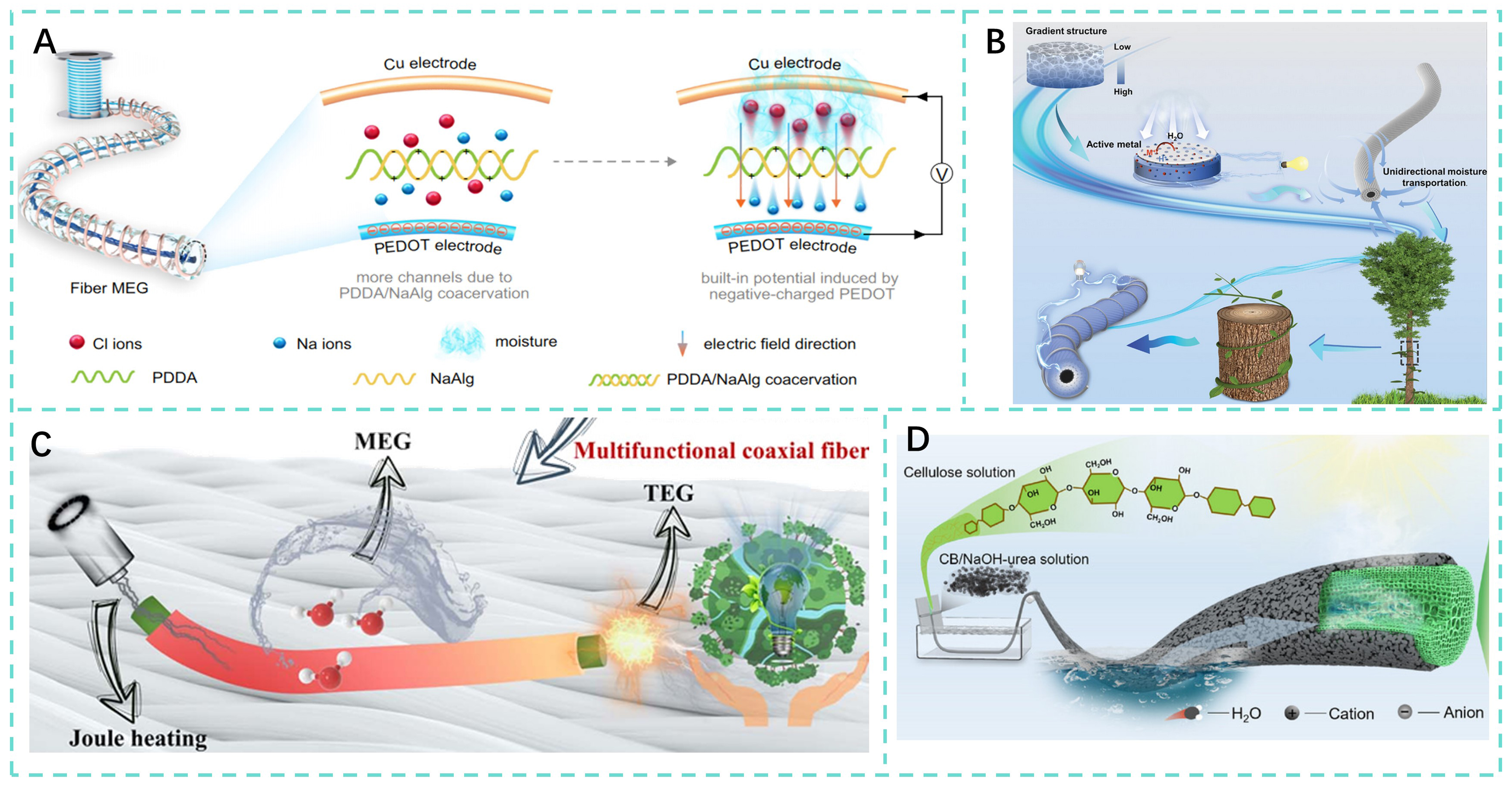
Figure 7. 1D structure of MEGT. (A) Core-shell fiber structure[50]. Reproduced under CC-BY-NC-ND license from Guangtao Zan, 2024, Nature Communications. No modifications were made to the original work; (B) Structure of radial core electrode based on bionic design[129]. Reproduced with permission. Copyright 2025, John Wiley & Sons; (C) Coaxial structure based on SA for humidity electro-optic fibers[131]. Reproduced with permission. Copyright 2023, Royal Society of Chemistry; (D) Schematic diagram of manufacturing a biomimetic fiber structure for energy harvesting[134]. Reproduced with permission. Copyright 2025, John Wiley & Sons. MEGT: Moisture-electric generation textile; SA: sodium alginate; MEG: moisture-electric generator; PEDOT: poly (3,4-ethynedioxythiophene); PDDA: poly(diallyl dimethyl ammonium chloride).
To enhance the moisture-grasping efficiency of fiber-based MEGTs, Zhang et al. proposed a device based on alginate (Alg)/MWCNT coaxial fibers[132]. This device features a radial heterostructure, with the outer and inner layers exhibiting significant differences in Ocfgs and alginate-calcium (Alg-Ca) content, thereby establishing a sustained humidity gradient. Alg/MWCNT-based MEGTs can address the problem of instantaneous and low electrical output, attributed to the design of the fiber heterostructure. Building upon prior research into radial Ocfg gradients in Alg/MWCNT fibers, Zhang et al. employed a mold-forming method to fabricate SA/MWCNT fibers with Ocfgs distributed along the fiber axis[133]. The axially heterogeneous distribution of Ocfgs facilitates water condensation. These fibers exhibit high humidity-induced electrical performance, excellent environmental adaptability, and continuous energy output. At 90% RH, an axial device only 2 cm long can achieve a maximum output power density of
2D structure
The 2D planar film-like structure offers clear advantages in humidity power generation layers, featuring a large specific surface area that allows full contact with ambient moisture. Electrospun and non-woven fiber films exhibit excellent flexibility and bendability, making them easily integrable into clothing or other wearable devices. Polymer hydrogel films, with their internal cross-linked network structures, enable rapid ion migration. When combined with fabric electrodes (such as carbon fiber cloth electrodes), the power generation layer achieves both good flexibility and air permeability while maintaining electrical performance. These advantages give 2D planar film structures broad application prospects in humidity-powered devices.
Fabric-based power generation layer films usually have abundant pores and transmission channels, which facilitate ion migration. They are typically composed of electrospun fibers, bio-based fibers, or composite fibers, and can also be fabricated by immersing non-woven fabrics in functional solutions. According to different phase-structure designs, Han et al. reported a Van der Waals heterostructure based on textiles, composed of conductive 1T phase tungsten disulfide@carbonized silk (1T-WS2@CSilk) and asymmetrically distributed carbon black@cotton (CB@Cotton) fabrics[136]. The presence of Ocfgs enhances the proton concentration gradient, improving the performance of high-performance wearable hydroelectric generators (HEGs) [Figure 8A]. In this structure, the Al sheet serves as the top active electrode, the 1T-WS2@CSilk fabric functions as the bottom inert electrode, and the CB@Cotton fabric forms the intermediate power generation layer, enabling stable operation for over 10,000 s. As shown in Figure 8B, the research team first surface-modified a nonwoven fabric substrate with CB, followed by precise coating of a PSSA/LiCl/GI/PVA composite hydrogel onto predetermined areas[39]. The resulting MEGT device enhances proton dissociation efficiency through interactions between hygroscopic salts and the polyelectrolyte PSSA, driving efficient charge output. To improve device multifunctionality, Chen et al. prepared a Janus heterogeneous film based on electrospun nanofibers by directly growing one film on another[92]. The film exhibits both moisture absorption and evaporation capabilities, with two perforated electrodes made of different materials arranged on opposite sides. Both layers are composed of nanofibers, whose abundant pores provide a large specific surface area, enabling outstanding power output. To further increase performance, Xing et al. designed an asymmetric nanofiber film combining hydrophilic PVA/PA with hydrophobic polyvinylidene fluoride (PVDF) and produced a high-efficiency wearable MEGT[91]. Using PA as a cross-linking agent, PVA nanofibers form a gel-like structure that enhances structural stability under humid conditions, while the asymmetric design ensures effective water circulation within the device. By leveraging the synergistic effects of moisture absorption and ion migration in textiles, a MEGT for wearable systems was developed using safe and environmentally friendly materials [Figure 8C][137]. PAAS served as the scaffold for water absorption and ion migration, while sodium chloride incorporation improved ionic conductivity and increased current output. As shown in Figure 8D, the MEGT device previously introduced[98] achieves sustained high-performance output through a vertically phase-engineered heteroelectrochemical bilayer. Its flexibility and body-conforming design provide an excellent foundation for wearable MEGTs as integrated self-powered devices.
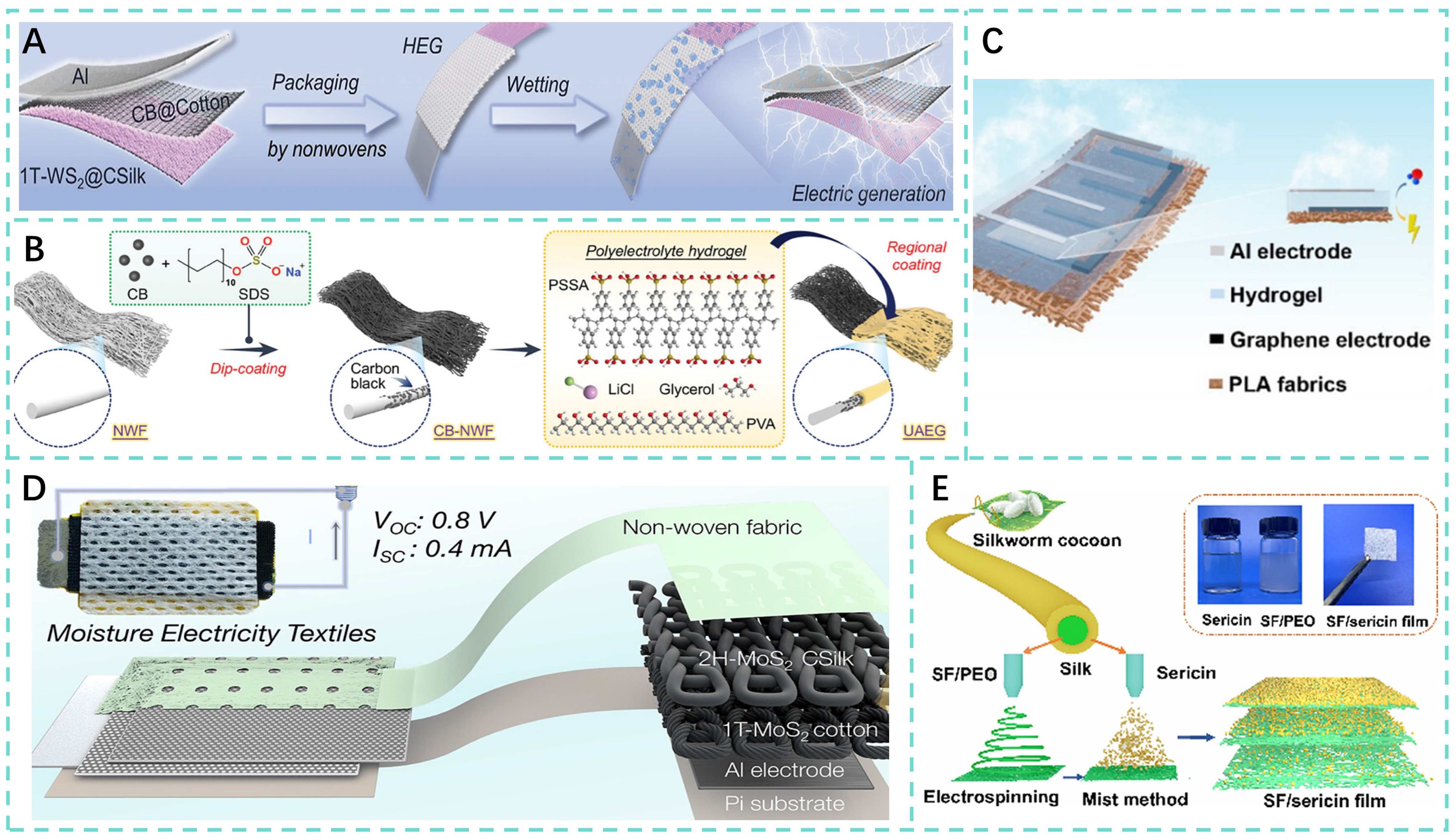
Figure 8. 2D fiber film structure of MEGT. (A) 3D schematic diagram of the manufacturing of flexible HEGs[136]. Reproduced with permission. Copyright 2024, John Wiley & Sons; (B) Fabrication process of all-weather MEGT devices[39]. Reproduced with permission. Copyright 2024, John Wiley & Sons; (C) Green wearable MEGT based on PAAS/sodium chloride[137]. Reproduced under CC BY license from Renbo Zhu, 2025, Advanced Materials; (D) Schematic diagram of the MEGT device structure composed of 2H-MoS2/CSilk and 1T-MoS2 cotton[98]. Reproduced with permission. Copyright 2023, American Chemical Society; (E) Structural composition of SS/sericin film[139]. Reproduced with permission. Copyright 2024, American Chemical Society. 2D: Two-dimensional; MEGT: moisture-electric generation textile; 3D: three-dimensional; HEGs: hydroelectric generators; PAAS: sodium polyacrylate; SS: silk fibroin/sericin; CB: carbon black; SDS: sodium dodecyl sulfate; NWF: non-woven fabric; PSSA: poly(4-benzenesulfonic acid); PVA: polyvinyl alcohol; UAEG: ultra-durable and all-weather energy generator; PLA: polylactic acid; SF: silk fibroin; PEO: polyethylene oxide.
Regarding the power generation layer of bio-based fiber structures, Su et al. employed an innovative approach to develop a simple manufacturing process for MEGT[138]. They constructed a 3D channel structure from biomass jute fibers (JE) loaded with lithium chloride salt. This structure significantly enhances water molecule capture from ambient air, enabling continuous and efficient electrical output. Protein nanostructures have great potential in bioelectricity generation due to their unique ion transport capabilities. He et al. studied a high-performance MEGT device with a cocoon-like structure[139]. Using electrostatic spinning, they prepared porous silk fibroin/polyethylene oxide (SF/PEO) films from a mixture of SF and PEO solutions[139]. Sericin was then applied evenly on the SF/PEO film surface via atomization spraying [Figure 8E]. The sericin adheres to the top layer, sealing pores and limiting penetration to the bottom layer. With increasing sprays, a silk fibroin/sericin (SS) composite film with uneven sericin distribution is formed. This film exhibits excellent hygroscopicity, abundant dissociated ions, and numerous micro-nano channels. To prepare devices with a simple process and high output power, Yang et al. successfully created a gradient distribution of CA in A4 paper via an asymmetric drying process[140]. When exposed to humid air, it forms a self-sustaining ion gradient, enabling efficient energy conversion. Additionally, textile-based flexible MEGTs can be prepared by soaking textiles in functional solutions. He et al. developed a textile-based MEG composed of textiles with asymmetric functional groups and a pair of flexible asymmetric electrodes[141]. This simple and low-cost process yields an Voc up to 1.0 V, opening new opportunities for self-powered and wearable electronic devices.
Polymer films usually exhibit good mechanical strength and rapid humidity response. When combined with conductive fabric electrodes, a complete device structure can be obtained, suitable for applications requiring air permeability, high stability, and wearable electronic patches. Yang et al. reported a self-sustaining wet electric generator based on 1D negatively charged nanofibers and 2D conductive nanosheets [Figure 9A], capable of continuously generating direct current from atmospheric humidity[142]. A CA-crosslinked bacterial cellulose sulfate nanofiber/rGO (CA-BCSNF/rGO) film was placed between the upper and lower electrodes. The composite power generation layer improves performance compared to single-material layers. Zhang
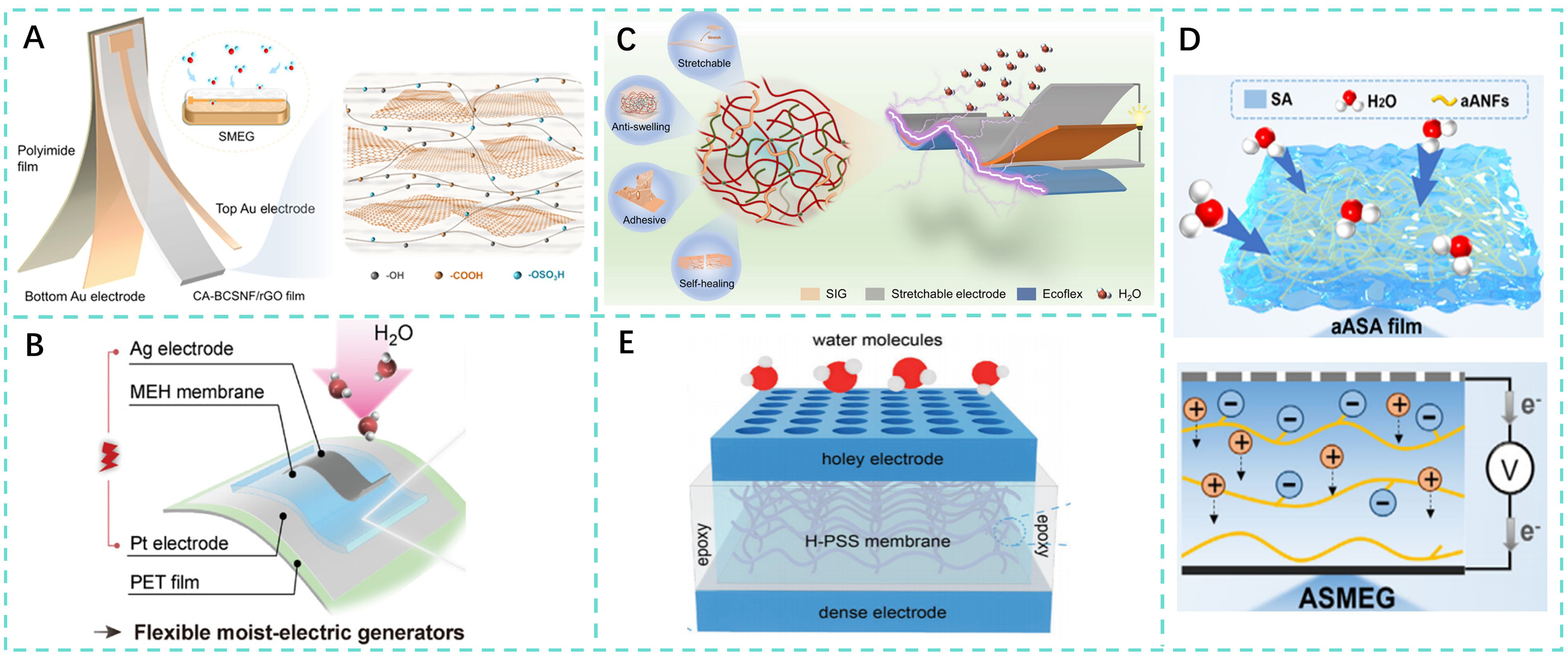
Figure 9. 2D structure of MEGT. (A) Structure diagram of flexible device composed of composite film[142]. Reproduced with permission. Copyright 2024, American Chemical Society; (B) Flexible MEG based on PAM/AMPS/LiCl molecular-engineered hydrogels[148]. Reproduced with permission. Copyright 2023, John Wiley & Sons; (C) s-MEG structure: SIG is used as power generation layer, and conductive textiles coated with Ag nanoparticles are used as electrodes[149]. Reproduced with permission. Copyright 2024, American Chemical Society; (D) The dual hydrogen bond network structure within hydrogels and the ion migration process[152]. Reproduced with permission. Copyright 2025, John Wiley & Sons; (E) Soft hydrophilic H-PSS film-based moisture electric generation device[153]. Reproduced with permission. Copyright 2023, John Wiley & Sons. 2D: Two-dimensional; MEGT: moisture-electric generation textile; MEG: moisture-electric generator; PAM: polyacrylamide; AMPS: 2-acrylamide-2-methyl propane sulfonic acid; s-MEG: stretchable moisture electric generator; SIG: stretchable ionic gel; H-PSS: poly(4-styrene sulfonic acid); CA-BCSNF: CA-crosslinked bacterial cellulose sulfate nanofiber; rGO: reduced graphene oxide; MEH: molecular-engineered hydrogel; PET: poly (ethylene terephthalate); SA: sodium alginate; aANFs: activated aramid nanofibers; aASA: activated aramid nanofiber; ASMEG: moisture-electric generator based on the activated aramid nanofiber film.
3D structure
In the structure of MEGT electric generation layers, 3D configurations are also common, primarily including porous and heterogeneous structures. The high porosity and interconnected channels of 3D porous structures significantly enhance the material’s moisture absorption capacity and establish a stable internal humidity gradient. Multi-layer heterostructures support functional layer integration and are compatible with fibers, films, printed electrodes, and other processes, promoting the development of flexible, wearable, and miniaturized devices. Shuang et al. constructed [metal N/O] water-absorption active sites based on chemical coordination between metals and hydroxyl or amino groups, enabling efficient capture of water from air and its conversion to liquid water for storage[154]. Kim et al. developed a functional Fumion FAA-3 porous hydrogel hygroscopic electrolyte with a salt concentration gradient, leveraging the synergistic effects of water flow, auxiliary anion migration, and cationic gels[155]. Using the ultra-low density, high-efficiency water transport, and sustainability of CNF aerogels, Zhu et al. introduced Al(III) to prepare water-driven devices, improving overall hygroscopicity and stability[156]. Similarly, the porous structure of CNFs/SA@Ca/moisture adsorption complex-photothermal modification (MAC-P) aerogels prepared by Wang et al. provides strong capillary forces and effectively retains water[157]. Additionally, Zhang et al. fabricated a double-gradient aerogel power generation layer using single-walled CNTs (SWNTs) and polymer dendrimers, simultaneously enhancing power density and output duration[158].
Combined with the synergistic effect of multi-layer material structures in the 3D power generation layer, device stability is enhanced, enabling improved performance output. Zhao et al. prepared a superhydrophilic 3D GO structure based on a preformed oxygen-containing group gradient, effectively promoting the formation of an ion gradient[159]. For GO recombination, Feng et al. designed an ionic hydrogel/GO double-layer porous heterogeneous film, providing abundant channels for ion migration and achieving a wide-range, high-power device [Figure 10A][160]. For the development of highly stable devices, as shown in Figure 10B, Shin et al. used CA as a cross-linking agent to form a CNF/CNT network structure, constructing a strong, environmentally friendly, and highly stable CNF/CNT/CA (CCA) electric generation layer[161]. Through compounding with 2D materials, Zhao et al. fabricated a double-layer structure composed of hydrophilic MXene (Ti3C2Tx) aerogels with negatively charged surfaces and PAM ionic hydrogels (MAH-MEG) [Figure 10C][162]. The unique microstructure of organic polymer composites facilitates efficient ion transport. Inspired by plant transpiration, a 3D self-maintaining MEG (3D-SMEG) was developed [Figure 10D][34]. By regulating the adsorption–desorption cycle of water through a biomimetic hydrophobic microporous layer, an optimized spatial electric field forms internally, generating a strong concentration gradient of ionized radicals and significantly enhancing electrical output. In Figure 10E, Song et al. superimposed a layer of Berlin Green (BG)/GO/CNF (BGC) on a NaCl/cellulose nanofiber (NC) composite layer to create a double-layer water-induced generator, enabling high ion concentration supply, charge separation, and directional migration within the power generation layer[163]. In the PSSA-PVA aerogel double-layer device constructed by Zhao et al., micropores are oriented along the surface normal, aligning with the water evaporation direction[164]. Cao et al. designed a multilayer ionic hydrogel MEG (IH-MEG) based on PAM, LiCl, and CMC [Figure 10F]; performance can be doubled by constructing ionized hydrogel heterojunctions with cations and anions[165]. Furthermore, Zhang et al. developed a MEG using integrated ion exchange films (IEM-MEG), enhancing selective ion transport and enabling continuous energy output under low RH[166].
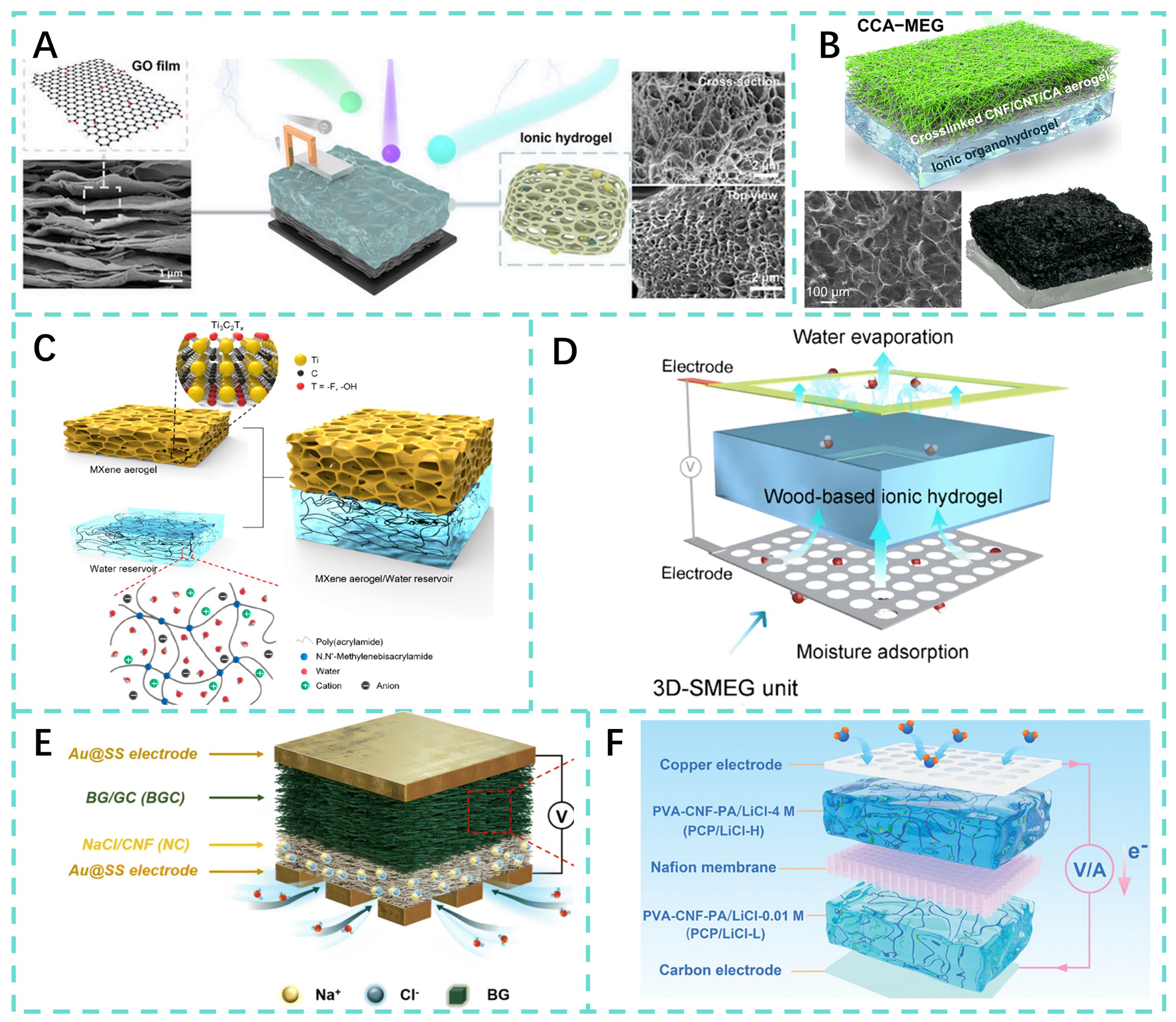
Figure 10. 3D structure of MEGT. (A) Internal structure diagram of two functional layers in the device[160]. Reproduced with permission. Copyright 2025, John Wiley & Sons; (B) Schematic diagram of the CCA power generation layer[161]. Reproduced with permission. Copyright 2024, Royal Society of Chemistry; (C) Internal structure diagram of MAH-MEG functional layer[162]. Reproduced with permission. Copyright 2023, American Chemical Society; (D) The structural composition of 3D-SMEG unit[34]. Reproduced with permission. Copyright 2025, Royal Society of Chemistry; (E) A MEG device consisting of a BGC-NC bilayer membrane and a pair of Au@SS electrodes[163]. Reproduced with permission. Copyright 2024, Royal Society of Chemistry; (F) Structural composition diagram of IEM-MEG device[166]. Reproduced with permission. Copyright 2024, John Wiley & Sons. 3D: Three-dimensional; MEGT: moisture-electric generation textile; CCA: CNF/CNT/CA (CNF: cellulose nanofiber; CNT: carbon nanotube; CA: citric acid); MAH-MEG: MXene aerogel-on-hydrogel moisture electric generator; 3D-SMEG: 3D self-maintaining moisture-electric generator; BGC-NC: Berlin Green (BG)/graphene oxide (GO)/cellulose nanofiber (CNF); SS: silk fibroin/sericin; IEM-MEG: ion-exchange membrane-moisture-electric generator; GO: graphene oxide; CNF: cellulose nanofiber; CNT: carbon nanotube; CA: citric acid; BG: Berlin Green; GC: graphene oxide/cellulose nanofiber; PVA: polyvinyl alcohol; PA: phytic acid.
LARGE-SCALE MANUFACTURING TECHNOLOGY
For the large-scale design and fabrication of MEGT, the preparation of the electric generation layer and electrodes can be considered separately. The electric generation layer can be efficiently produced over large areas using spinning processes and coating techniques, which improve uniformity and reduce cost. Electrodes can be precisely customized with complex patterns through screen printing and digital manufacturing technologies, meeting the requirements of diverse applications.
Manufacturing of electric generation layer
Wet spinning and electrostatic spinning are common technologies for preparing electric generation layers, enabling stable production of large-area fiber films. Both methods can optimize material structure and improve the hygroscopicity and ionic conductivity of fiber films through process parameter tuning. These technologies provide technical support for the industrialization of MEGT devices.
Spinning technology
Wet spinning enables continuous production via solution extrusion and solidification, making it suitable for fabricating large-area, uniform fiber films. It is compatible with various functional materials, achieving efficient and low-cost fiber production. Zan et al. prepared high-performance core-shell fibers via wet spinning, with PEDOT nanobelts as the core and complex coacervate gel formed from CaCl2 solution and PDDA/NaAlg mixture as the shell [Figure 11A][50]. The fiber device can be used in self-driven artificial synapse systems to simulate biological neuroplasticity. Using SA and PEDOT:PSS materials, Zhang et al. employed a simple coaxial wet-spinning technique to fabricate a skin-core structure: SA/(PEDOT:PSS) as the outer layer containing hygroscopic oxygen groups, and MWCNT as the inner layer [Figure 11B][131]. This design enhances internal moisture migration, providing strong charge mobility in both the radial and axial directions of the fiber. Zhang et al. also injected two solutions with different SA/MWCNT ratios into a 5% CaCl2 coagulation bath using coaxial needles to form coaxial fibers[130]. The core layer was connected to the test electrode with conductive silver glue, demonstrating excellent wet electrical properties. Liu et al. prepared a high-performance fiber by compounding PVA, MWCNTs, and sodium dodecyl benzene sulfonate (SDBS) (PMS)[167]. A 1-cm-long fiber can continuously output voltage for more than 80 h, providing a sustainable energy solution for smart textiles and wearable technology via water-induced power generation.
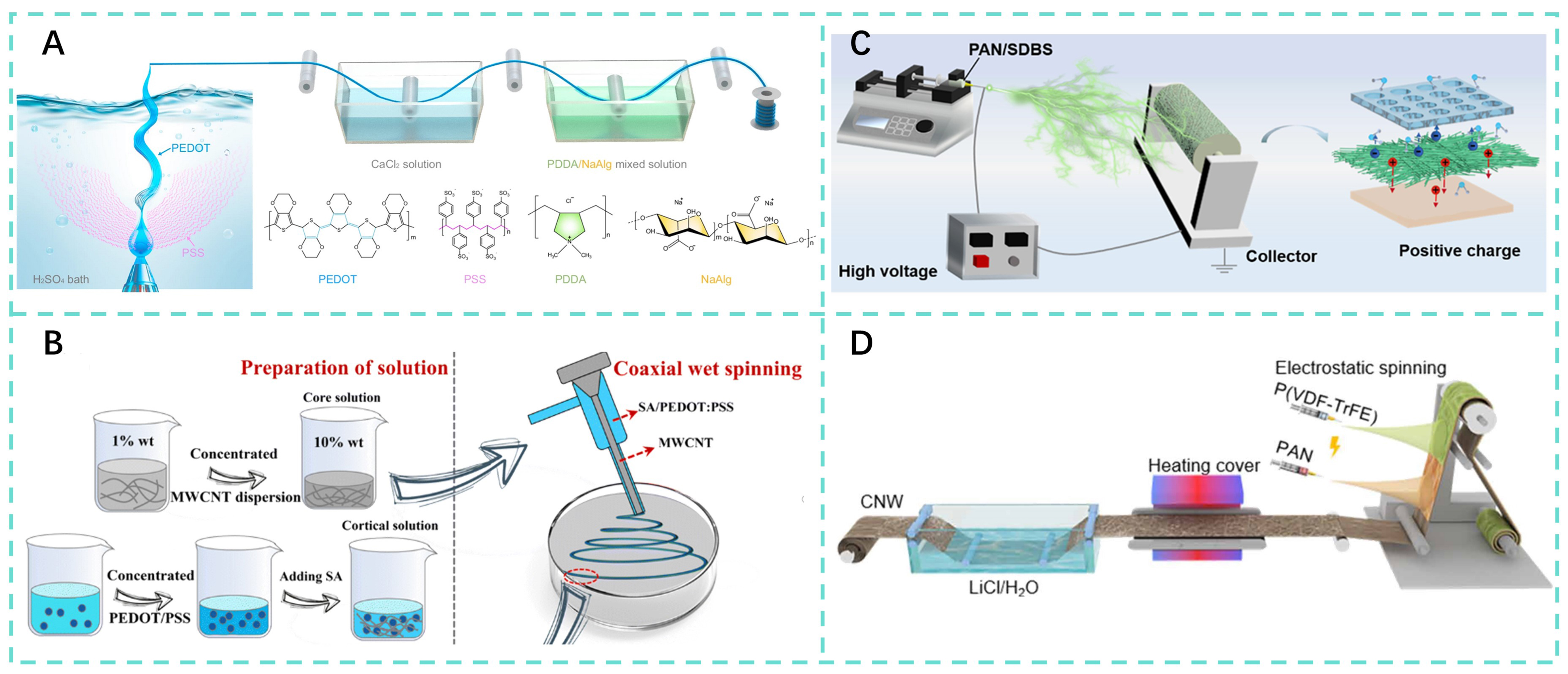
Figure 11. Large-scale manufacturing of electric generation layer by spinning technology. (A) Scheme of the wet spinning to prepare PEDOT-PDDA/NaAlg core shell fiber[50]. Reproduced under CC-BY-NC-ND license from Guangtao Zan, 2024, Nature Communications. No modifications were made to the original work; (B) Schematic diagram of wet spinning process for SA-based coaxial fibers[131]. Reproduced with permission. Copyright 2023, Royal Society of Chemistry; (C) Preparation of nanofiber membrane containing electrolyte by electrospinning and its structural schematic diagram[169]. Reproduced with permission. Copyright 2022, Royal Society of Chemistry; (D) PAN and P(VDF-TrFE) films prepared on CNW/LiCl substrates by electrospinning[49]. Reproduced under CC-BY-NC 4.0 license from Yunhao Hu, 2024, Science Advances. PEDOT-PDDA: Poly (3,4-ethynedioxythiophene)-poly(diallyl dimethyl ammonium chloride); SA: sodium alginate; PAN: polyacrylonitrile; P(VDF-TrFE): poly(vinylidene fluoride-trifluoroethylene); CNW: cellulose nonwoven; PSS: polystyrene sulfonate; MWCNT: multi-walled carbon nanotube; SDBS: sodium dodecyl benzene sulfonate.
Electrospinning uses a high-voltage electric field to produce nanofiber films with high specific surface area and porous structures, enhancing ion transport. As a power generation layer material, nanofiber films prepared by electrospinning exhibit high moisture absorption capacity and excellent electrical properties. Sun et al. applied electrospun polymer nanofiber fabrics to wearable MEGTs, in which PEO nanofiber fabrics provided a high output voltage of 0.83 V and excellent air permeability[168]. In Figure 11C, Sun et al. prepared a nanofiber film containing electrolyte from PAN/SDBS solution[169]. This device could continuously and stably output a voltage of 0.7 V and a current of 3 mA for 120 h, demonstrating outstanding stability and durability. By optimizing its structure, Zhang et al. introduced a CA nanofiber film with a tree-like structure obtained by electrospinning[170]. A single device generated approximately 700 mV, with a maximum output power density of 2.45 μW·cm-2. Sun et al. employed coaxial conjugate electrospinning to form a core-shell structure by winding PAN nanofibers around a zinc wire[171]. The PAN nanofibers provide a high specific surface area and porous structure, while the zinc wire core electrode ensures good conductivity. Subsequently, as shown in Figure 11D, Hu et al. successively deposited PAN and poly(vinylidene fluoride-trifluoroethylene) [P(VDF-TrFE)] nanofibers onto a cellulose nonwoven (CNW)/LiCl layer via electrospinning, constructing a multi-layer fabric structure with unidirectional moisture conductivity[49]. Owing to the structure and material properties of the nanofiber layer, the device operates stably across 15%-80% RH and -10 to 55 °C.
Coating technology
Spraying, drop-casting, and impregnation methods can be used for large-area preparation of power generation layers. The spraying method is fast and uniform; drop casting allows the solution to diffuse naturally by capillary action, and impregnation immerses the substrate in solution. These methods are convenient for integrated design, and the uniformity and performance of the power generation layer can be optimized by controlling process parameters. Wang et al. used casting and spraying strategies to combine a PDDA layer with a PSSA layer to prepare a BPF [Figure 12A][105]. The material exhibits good mechanical flexibility along with high voltage output and maintains excellent performance and stability even under bending or pressing. Poly(vinylidene fluoride)-hexafluoropropylene (PVDF-HFP) can form a network-like support structure in a nano-alumina composite film. Yao et al. therefore used patterned coating technology to prepare devices with a nano-alumina self-supporting film as the power generation layer [Figure 12B][172]. This method allows the simultaneous fabrication of hundreds of series and parallel devices, enabling scalable and customizable output voltage and current. As shown in Figure 12C, Zhu et al. evenly coated protein dispersion with an adjusted pH onto a substrate by a scraping method and dried it to form a protein film power generation layer[40]. The protein film exhibits self-healing ability, and its electrical output can be restored after scratches through water treatment. The thickness of the power generation layer is controlled by repeated dip-coating, allowing the electric output to be tuned by humidity changes. Gao et al. immersed pretreated cotton yarn in a PSSA/PVA solution[129]. Using a spinning machine, they produced high-performance MEGTs with radial PSSA/PVA gradients under centrifugal force [Figure 12D]. This structural design maintains a continuous moisture gradient between the yarn’s interior and exterior, while the use of PSS and aluminum electrodes enhances proton diffusion efficiency. Shao et al. explored a coaxial fiber based on GO material, in which a silver wire was immersed in GO suspension, allowing GO to adhere to its surface[52]. Later, He et al. developed a double asymmetric structure MEGT to optimize electrical output by varying the soaking time[141]. The device exhibits high flexibility, large-scale integrability, strong environmental adaptability, and a simple, low-cost preparation process, making it suitable for large-scale production and applications.
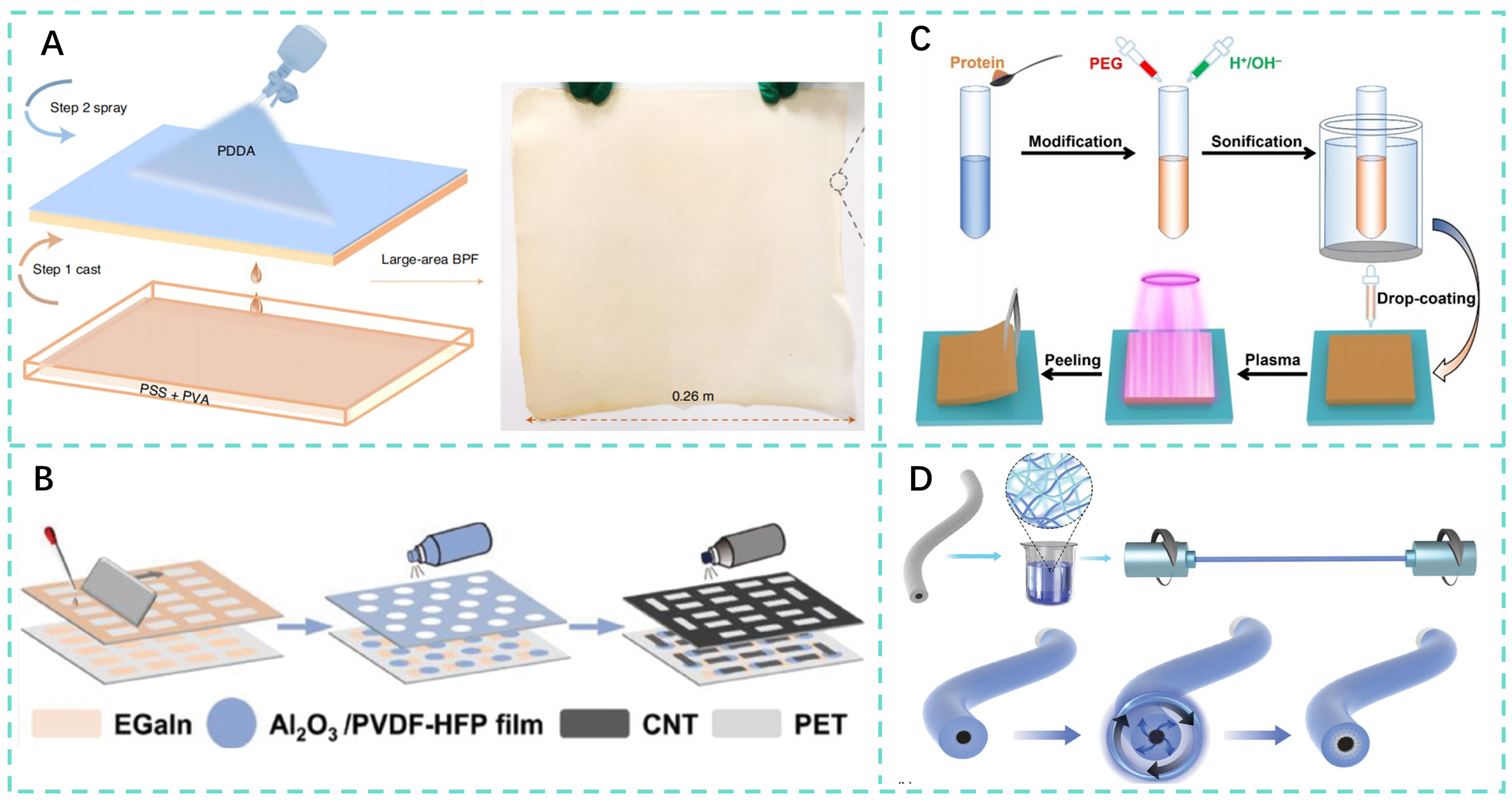
Figure 12. Large-scale manufacturing of electric generation layer by coating technology. (A) BPF prepared by casting and spraying process[105]. Reproduced with permission. Copyright 2021, Springer Nature Limited; (B) Large-scale manufacturing of array electric generation layers by scrape coating method[172]. Reproduced with permission. Copyright 2023, John Wiley & Sons; (C) Large-area protein film obtained by drop coating strategy[40]. Reproduced with permission. Copyright 2023, Royal Society of Chemistry; (D) Preparation process of coaxial yarns with radial gradient of PSSA/PVA[129]. Reproduced with permission. Copyright 2025, John Wiley & Sons. BPF: Bilayer polymer film; PSSA: poly(4-benzenesulfonic acid); PVA: polyvinyl alcohol; PDDA: poly(diallyl dimethyl ammonium chloride); PSS: polystyrene sulfonic acid; PVDF-HFP: poly(vinylidene fluoride)-hexafluoropropylene; CNT: carbon nanotube; PET: poly (ethylene terephthalate); PEG: polyethylene glycol.
Manufacturing of electrodes
Electrodes need to provide electrical conductivity and strong adhesion to the power generation layer. Screen-printing and digital manufacturing technologies are important methods for achieving large-area electrode fabrication. These techniques enable efficient large-scale production of electrodes, providing critical technical support for the development and application of MEGTs.
Screen printing
Screen-printing technology has been widely used for the fabrication of flexible electrodes. Conductive materials are printed onto the substrate through a screen template, offering advantages such as reduced production cost and the ability to prepare large-area electrode patterns to meet diverse application needs. Liang et al. achieved large-scale array integration of GO-based power generation devices using screen printing, sequentially printing the bottom electrode, GO active layer, and top electrode to complete a single unit[173]. Similarly, Li et al. printed conductive silver paste and molten LM alloy successively onto a flexible paper substrate to form the bottom and top electrodes, with a PA-CPDs layer as the power generation layer[43]. He et al. further printed C and C-Al composite electrodes on a poly (ethylene terephthalate) (PET) substrate, followed by PDDA and PSSA in the inter-electrode region[174]. Printed planar device arrays not only enable scalability and customization but can also be integrated with flexible circuits. A three-step screen-printing process was employed to sequentially deposit the bottom electrode, GO active layer, and top electrode onto paper[173]. An end-to-end stacking design allowed large-scale series connection of the devices [Figure 13A]. In addition, Li et al. scrape-coated the bottom electrode, power generation layer, and top electrode in sequence onto a flexible substrate, simplifying the fabrication process and enabling large-scale production[47]. Recently, inspired by arid plants, Yu et al. developed a 3D self-sustaining device capable of continuously delivering high voltage [Figure 13B][34]. The bottom electrode was prepared via screen printing, followed by hydrogel assembly and top electrode printing, creating a series-parallel integrated system for 3D-MEG with high-performance output and minimal loss.
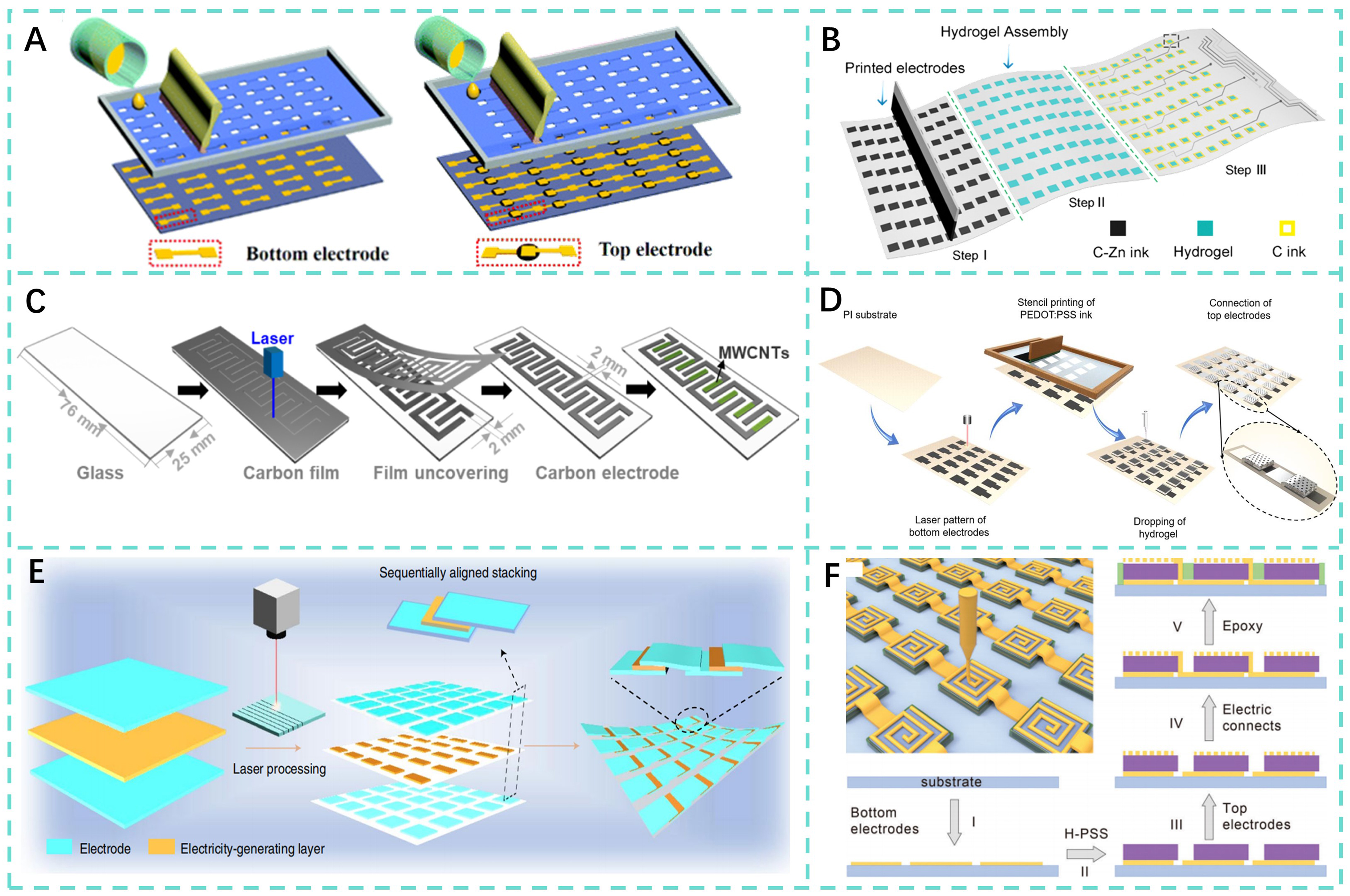
Figure 13. Strategies for large-scale manufacturing of electrodes. (A) GO-based MEG can be produced at scale using screen printing technology[173]. Reproduced with permission. Copyright 2018, Royal Society of Chemistry; (B) Screen printing technology for integrated electrodes[34]. Reproduced with permission. Copyright 2025, Royal Society of Chemistry; (C) Circuit made by laser etching carbon film technology[33]. Reproduced with permission. Copyright 2025, American Chemical Society; (D) Electrodes prepared by laser printing on PI substrate[109]. Reproduced under CC BY license from Su Yang, 2024, Nature Communications; (E) Manufacturing of electrode arrays by nano-ultraviolet laser processing[105]. Reproduced with permission. Copyright 2021, Springer Nature Limited; (F) Schematic diagram of mass production by 3D printing technology[153]. Reproduced with permission. Copyright 2023, John Wiley & Sons. GO: Graphene oxide; MEG: moisture-electric generator; PI: polyimide; 3D: three-dimensional; MWCNTs: multi-walled carbon nanotubes; PEDOT:PSS: poly(3,4-ethylenedioxythiophene):poly(styrenesulfonate); H-PSS: poly(4-styrene sulfonic acid).
Digital manufacturing
Digital manufacturing technology for electrode preparation primarily includes laser printing and 3D printing. Laser printing can directly ablate or induce electrode patterns on a substrate using laser beams, enabling high-precision and complex pattern fabrication. 3D printing can construct 3D electrode structures, improving the electrode’s specific surface area and conductivity. Laser printing enhances the accuracy and flexibility of electrode preparation, while 3D printing optimizes electrode design and improves device performance. Yu et al. cut carbon film according to a pre-designed circuit pattern using laser engraving, removed redundant parts to obtain the circuit layout, and subsequently coated MWCNTs to enhance performance [Figure 13C][33]. Laser cutting achieves high-precision patterns and allows rapid modification, offering significant flexibility for circuit design. Yang et al. applied laser direct induction to generate graphene on a polyimide (PI) substrate and carve the bottom electrode pattern, as shown in Figure 13D, illustrating the workflow for large-scale device fabrication[109]. Laser printing does not require molds, reducing manufacturing cost and time. Wang et al. fabricated the upper electrode, lower electrode array, and power generation array automatically using an ultraviolet laser with nanometer wavelength, facilitating scalability and industrial production [Figure 13E][105]. Currently, examples of large-scale electrode fabrication using 3D printing remain limited. Huang et al. directly printed a bottom electrode on a substrate according to a designed pattern, precisely depositing electrode material at predetermined positions [Figure 13F][153]. 3D printing eliminates the need for molds, reducing cost and time while supporting the development of high-performance moisture power generation devices.
APPLICATIONS OF MOISTURE ELECTRIC GENERATION WEARABLE ENERGY
With the continuous in-depth study of green energy wet power generation technology, it has demonstrated remarkable advantages in aspects such as device size, material structure, and energy utilization. Currently, MEGTs reconstruct the flow of water molecules at the microscale, enhancing output voltage and current density, and they show broad application prospects across multiple fields. The inherent flexibility, breathability, and biocompatibility of textiles allow them to conform comfortably and snugly to the human body or curved surfaces, making them an ideal medium for wearable power-generating devices[149,171]. Mature textile manufacturing processes enable the integration of functional materials and support large-scale, low-cost production[49,130]. These synergistic advantages make textiles an excellent platform for constructing the next generation of green, sustainable, wearable humidity-powered devices[141,167]. The following sections will introduce applications in wearable energy, collaborative performance improvement, energy storage, and data monitoring.
Energy supply for wearable devices in normal environment
MEGT devices are small, flexible, foldable, and stretchable, and can be embedded in fabrics and ornaments, providing continuous power support for wearable electronic devices, which gives them great potential in this field. By harnessing moisture from human skin or the surrounding environment, they can continuously supply energy to smartwatches, Bluetooth headsets, sports bracelets, and other devices, reducing dependence on traditional batteries[175]. Figure 14A shows a self-powered wearable electronic device with an integrated structure that generates a stable voltage output by collecting moisture on the skin surface to supply energy to the electronic device[148]. This technology enables wearable devices to operate continuously without an external power source. Stretchable MEGT units can amplify voltage and current by connecting them in series or parallel, and can be integrated into a stretchable oversleeve to form a “humidity power supply sheath”[167]. As shown in Figure 14B, a pedometer generates electricity by capturing humidity changes during walking and displays the number of steps[149]. The device design offers good flexibility and stretchability, allowing for ultra-thin and ultra-light structures that minimally increase the volume and weight of wearable devices, while providing high wearing comfort. Yarn-based MEGTs are particularly suitable for weaving and integration into fabrics, offering excellent flexibility and deformability. Flexible MEGTs adapt to human movement and bending while simultaneously providing sensing and power supply functions[171]. Certain electronic systems enable wireless transmission of monitored physiological parameters to smartphones[176]. In Figure 14C, the electrical energy generated by the protein MEG can charge commercial capacitors and power wearable wireless electronic devices, enabling simultaneous sensing and power delivery while adapting to body movement and bending[40]. MEGT generators with wireless sensors can be integrated into clothing to collect real-time human activity data [Figure 14D][137]. Under different operating conditions, the wireless monitoring system tracks and responds to varying signals in real time. Users can view and analyze these data through mobile applications to better understand their health status and sports performance. This energy supply technology allows wearable electronic equipment to achieve energy self-sustainability, improves portability, and prolongs service life. Furthermore, these devices can also be integrated into masks[124], providing basic protection while powering built-in sensors or other electronic modules. This approach not only addresses the power supply bottleneck of wearable devices but also has strong potential for wide application in self-powered body monitoring systems due to its flexibility, wireless capability, and motion adaptability.
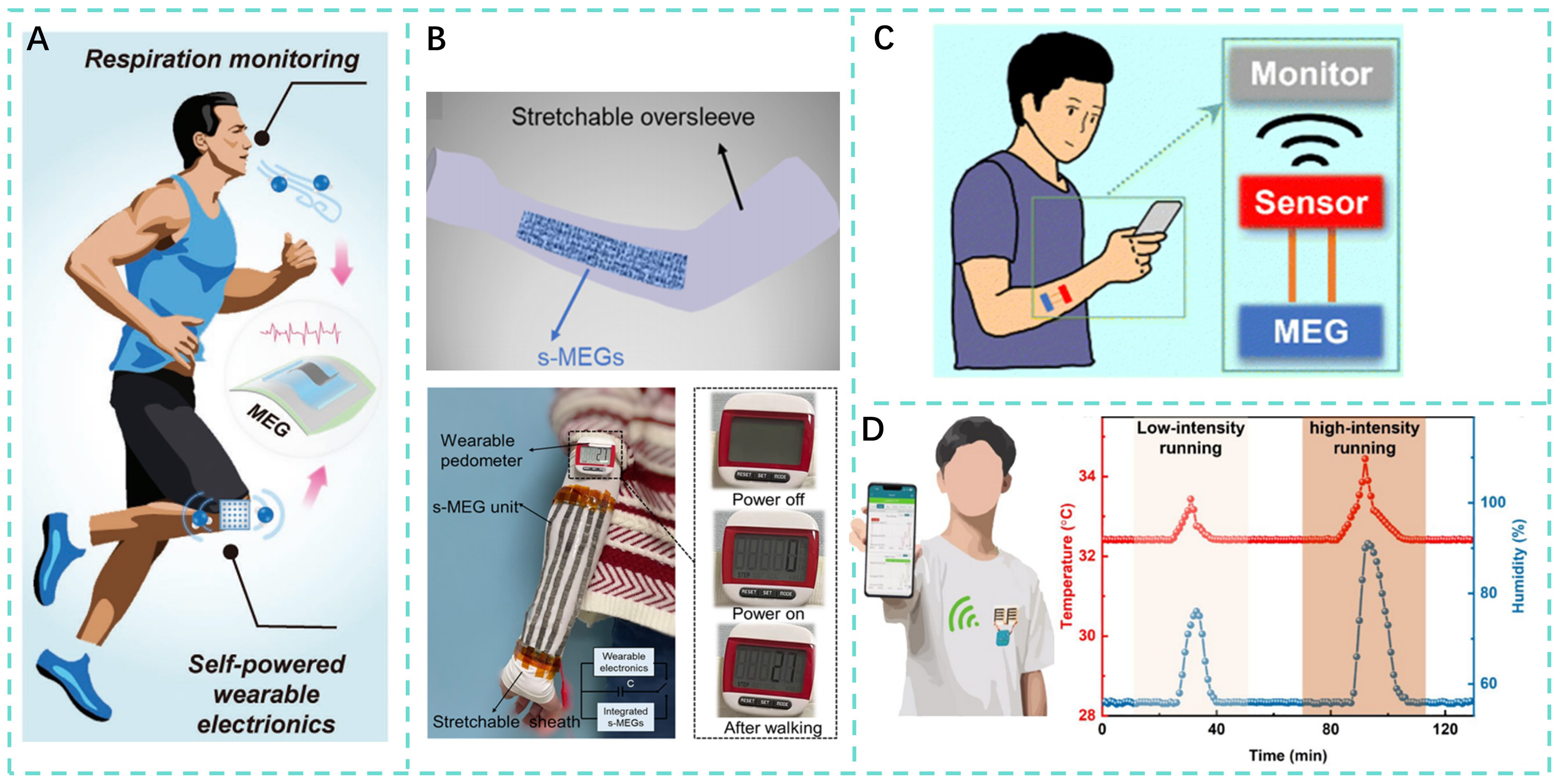
Figure 14. Applications of wearable devices in energy supply. (A) Powering wearable flexible electronics[148]. Reproduced with permission. Copyright 2023, John Wiley & Sons; (B) “Moisture-powered sleeve” supplies electricity to wearable pedometers[149]. Reproduced with permission. Copyright 2024, American Chemical Society; (C) Protein-based devices are applied in wearable and wireless sensors[40]. Reproduced with permission. Copyright 2023, Royal Society of Chemistry; (D) Wearable MEGT devices are used in systems for monitoring bodily signals[137]. Reproduced under CC BY license from Renbo Zhu, 2025, Advanced Materials. MEGT: Moisture-electric generation textile; MEG: moisture-electric generator; s-MEGs: stretchable moisture electric generators.
Emergency energy supply in extreme environments
In some extreme environments, such as marine areas with high humidity or regions with extremely low temperatures and low humidity, traditional power supplies may struggle to meet demand. MEGT can generate electricity from moisture in these special environments, providing stable power support for monitoring equipment and exhibiting excellent environmental adaptability. This enables devices to operate reliably under extreme conditions and natural environmental fluctuations, offering continuous power support for electronic devices. Such capability is particularly valuable in remote or inaccessible areas. As shown in Figure 15A, the device can generate electricity by exploiting humidity differences in underwater environments to supply power to sensors and communication equipment, ensuring effective monitoring[54]. It can act as an “infinite tracker” to transmit real-time position information to underwater monitors, improving positioning reliability. For wireless communication and data transmission in extreme conditions, MEGT can operate in thunderstorms, snowy mountains, and deserts[177]. In Figure 15B, the device charges commercial capacitors to power practical electronic equipment[40]. In arid deserts, charged capacitors can drive wireless trackers and transmit location data in real time, providing a reliable solution for emergency rescue operations. MEGT also supplies energy under low temperature, high temperature, and low-humidity conditions, with minimal dependence on illumination or wind energy [Figure 15C][35]. It can collect data by detecting human movement and strain, providing real-time feedback for exercise monitoring and health tracking. In Figure 15D, hydrogel-based devices can absorb environmental water and convert it into electrical energy at temperatures as low as -30 °C[178]. This ensures continuous power supply for various electronic devices, including temporary power for communication tools and lighting, supporting basic survival and communication needs. Importantly, these devices maintain operation in extreme cold, overcoming the limitations of traditional batteries or energy-harvesting equipment at low temperatures. Information can also be encrypted and transmitted using a Humidity Electronic Information Interface (HEII) in combination with Morse code[179]. This approach leverages the simplicity and universality of Morse code along with the humidity-sensing capability of HEII, enabling efficient and secure information transmission in special environments. The stable power supplied by MEGT ensures reliable operation of signal acquisition devices and provides a practical scheme for high-security, high-reliability information transfer in challenging conditions.
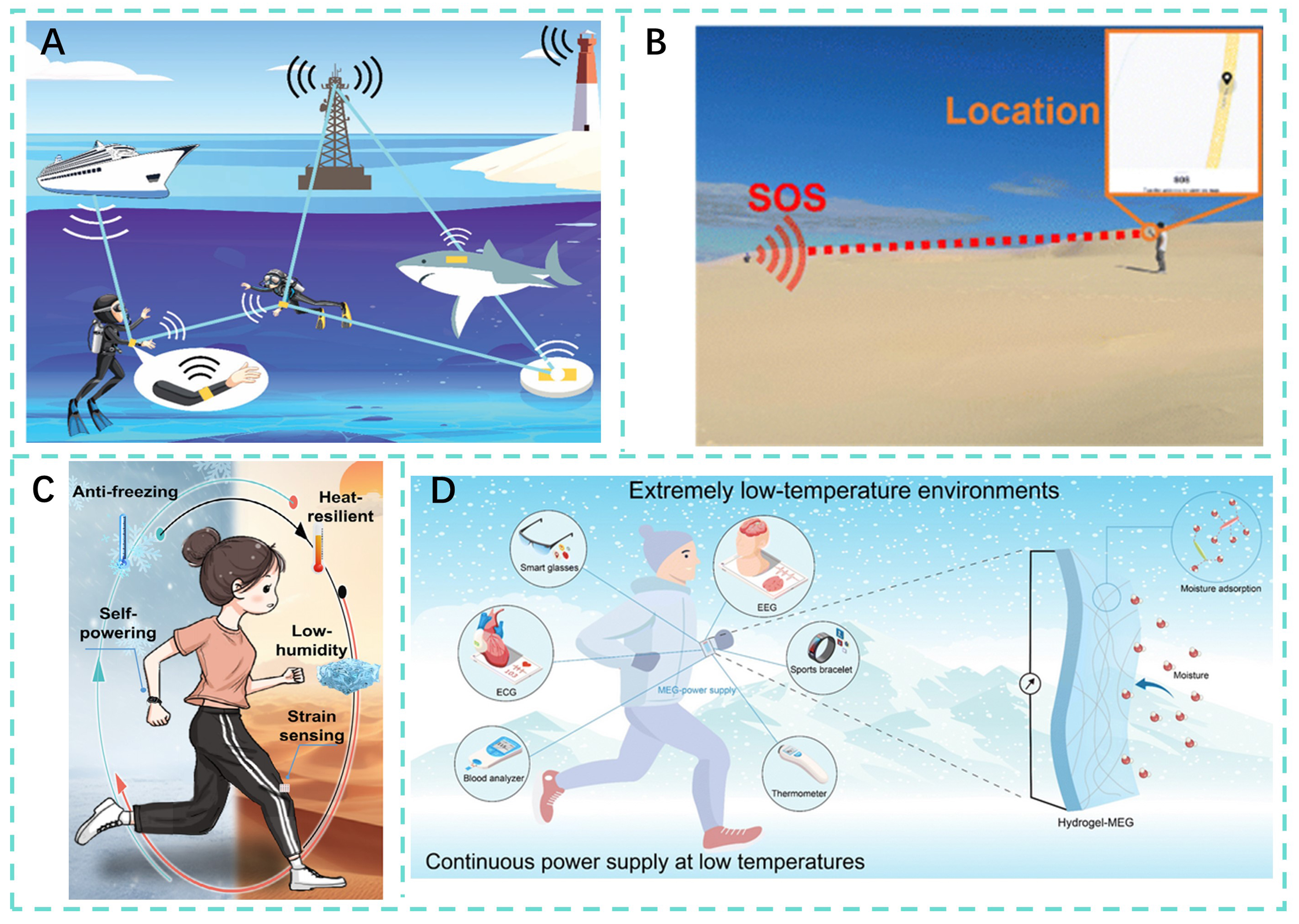
Figure 15. Applications as emergency energy supply in extreme environments. (A) Integrated arrays used for underwater communication and monitoring[54]. Reproduced under CC BY license from Daozhi Shen, 2024, Advanced Science; (B) In the arid desert, the wireless tracker sends real-time location data to the display[40]. Reproduced with permission. Copyright 2023, Royal Society of Chemistry; (C) Self-powered devices driven under various climatic conditions[35]. Reproduced with permission. Copyright 2025, John Wiley & Sons; (D) Power supply for electronic devices in low-temperature environments[178]. Reproduced with permission. Copyright 2025, Royal Society of Chemistry. ECG: electrocardiogram; EEG: electroencephalogram; MEG: moisture-electric generator.
Hybrid electricity energy harvesting
As mentioned above, moisture-electric-generation wearable energy devices can generate electricity under both normal and extreme conditions. In complex and dynamic application scenarios, relying on a single energy source often results in inefficiency or unstable power supply. Therefore, hybrid energy harvesting can integrate multiple energy sources into stable, efficient, and high-quality energy packages through multi-energy complementarity and intelligent management. It can also synergize with energy storage systems to enhance capacity utilization, ensuring that users receive continuous and reliable power support in a variety of complex scenarios.
In recent years, wet-gas power generation technology has demonstrated unique advantages when developed in coordination with other energy sources. When MEGT is combined with triboelectric generators (TEGs), power generation efficiency is greatly enhanced, while simultaneously opening new avenues for efficient and sustainable energy utilization. The synergistic effect of the two allows for efficient multi-source energy collection and conversion, demonstrating significant advantages in performance complementarity, environmental adaptability, and application potential. Li et al. designed a flexible and efficient hybrid generator that harnesses both water droplets and friction energy[180]. In Figure 16A, the upper TEG consists of a waterproof porous capacitor expanded polytetrafluoroethylene (E-PTFE), and the lower device comprises a PGA hydrogel with water-absorbing CA as the medium, separated by an electrically insulating PET film with a hole array and electrodes. Under water droplet stimulation, a single device can output 0.55 V and
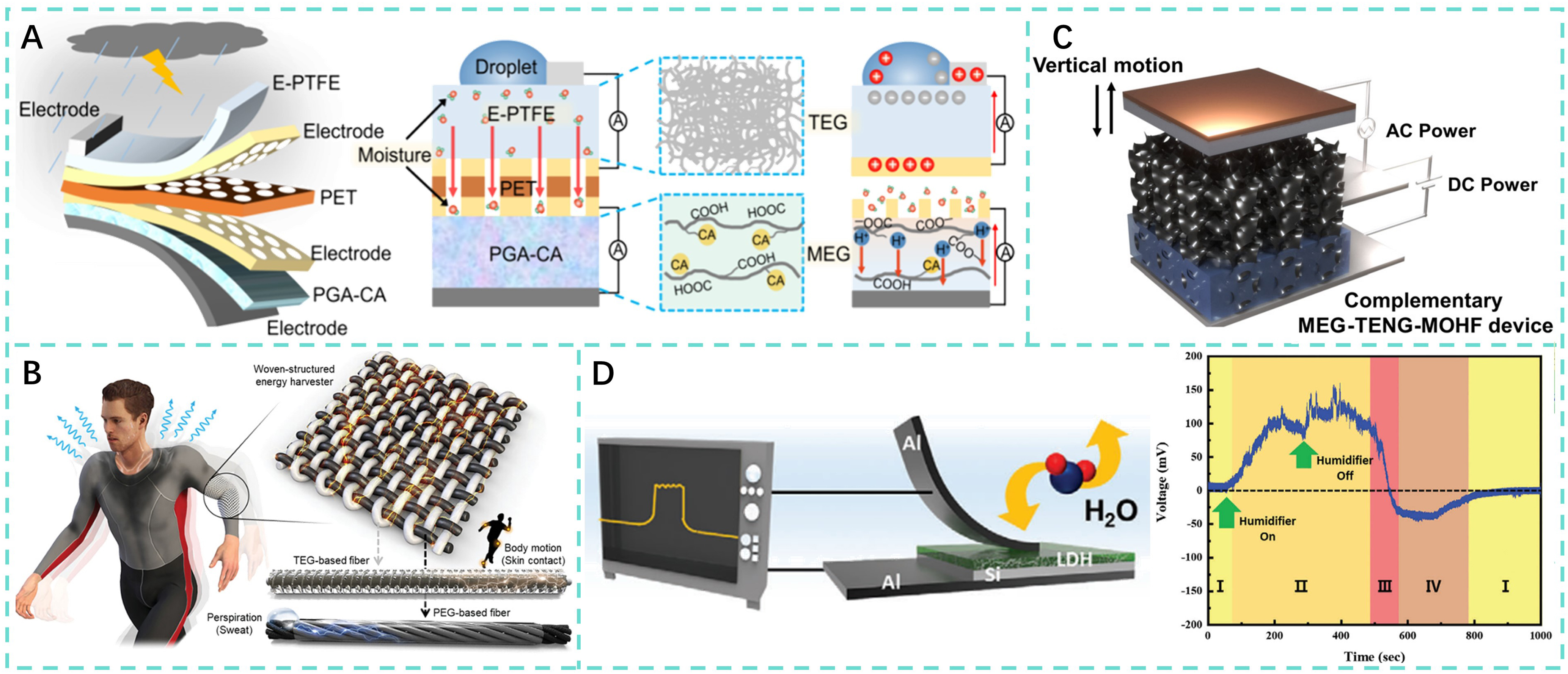
Figure 16. Applications in hybrid electricity energy harvesting. (A) Structure and working principle of the friction and moisture hybrid generator[180]. Reproduced with permission. Copyright 2024, American Chemical Society; (B) Efficiently collects energy simultaneously through sweat and friction[42]. Reproduced under CC-BY-NC license from Jiwon Park, 2023, Advanced Energy Materials; (C) Schematic diagram of the hybrid energy harvester[181]. Reproduced with permission. Copyright 2023, Royal Society of Chemistry; (D) Performance output of LDH through synergistic power generation via friction and humidity[182]. Reproduced with permission. Copyright 2024, John Wiley & Sons. LDH: Layered double hydroxide; E-PTFE: expanded polytetrafluoroethylene; PET: poly (ethylene terephthalate); PGA-CA: polyglutamic acid-citric acid; TEG: triboelectric generator; MEG: moisture-electric generator; PEG: polyethylene glycol; AC: alternating current; DC: direct current; TENG: triboelectric nanogenerator; MOHF: MXene/organo-ionic hydrogel foam.
Wearable integrated energy storage systems
The combination of MEGT and energy storage devices can effectively store and utilize electric energy, reducing waste. MEGTs can be directly connected to energy storage units to store generated electricity, or excess energy produced under high-humidity conditions can be stored for use in low-humidity environments, thereby improving energy efficiency and system stability. Tang et al. proposed a device using CMCs/CNF aerogels with large specific surface area and porous structure as the power generation layer [Figure 17A][183]. According to cyclic voltammetry (CV) analysis, the CMCs/CNF aerogel itself functions as a supercapacitor carrier, and the electric energy generated by the device can be stored in the capacitor through electrode transmission, realizing energy self-sufficiency. Guo et al. employed the unique structure of hygroscopic iron hydrogel and fallen leaves to transform the leaves into energy collectors, enabling continuous electricity harvesting from environmental humidity[184]. The hydrogel was synthesized via the reaction of ferric chloride hexahydrate (FeCl3·6H2O) and ethanolamine (EA), and conductive ink was applied to the surface of treated leaves. The EDL formed on the leaf surface after moisture absorption can store electric energy and supply power to external devices when connected to a circuit [Figure 17B]. This device demonstrates efficient integration with energy storage for continuous humidity-driven power harvesting. For wearable printed fabric-based devices, Zhu et al. developed a green device with high current density by printing functional materials[137]. On a PLA fabric substrate, a hydrogel power generation layer made of PAAS and NaCl was applied [Figure 17C]. The device maintained stable electrical performance for at least 120 days, demonstrating excellent long-term reliability. Wang et al. designed a flexible moisture self-charging and voltage-stabilizing supercapacitor that absorbs ambient moisture to achieve continuous and stable self-charging[79]. In Figure 17D, the device combines a polyelectrolyte-based power generation layer with a graphene-based electrochemical capacitor (EC), integrating energy conversion and storage functions. This collaborative design enhances system energy efficiency while ensuring stable self-charging and voltage output.
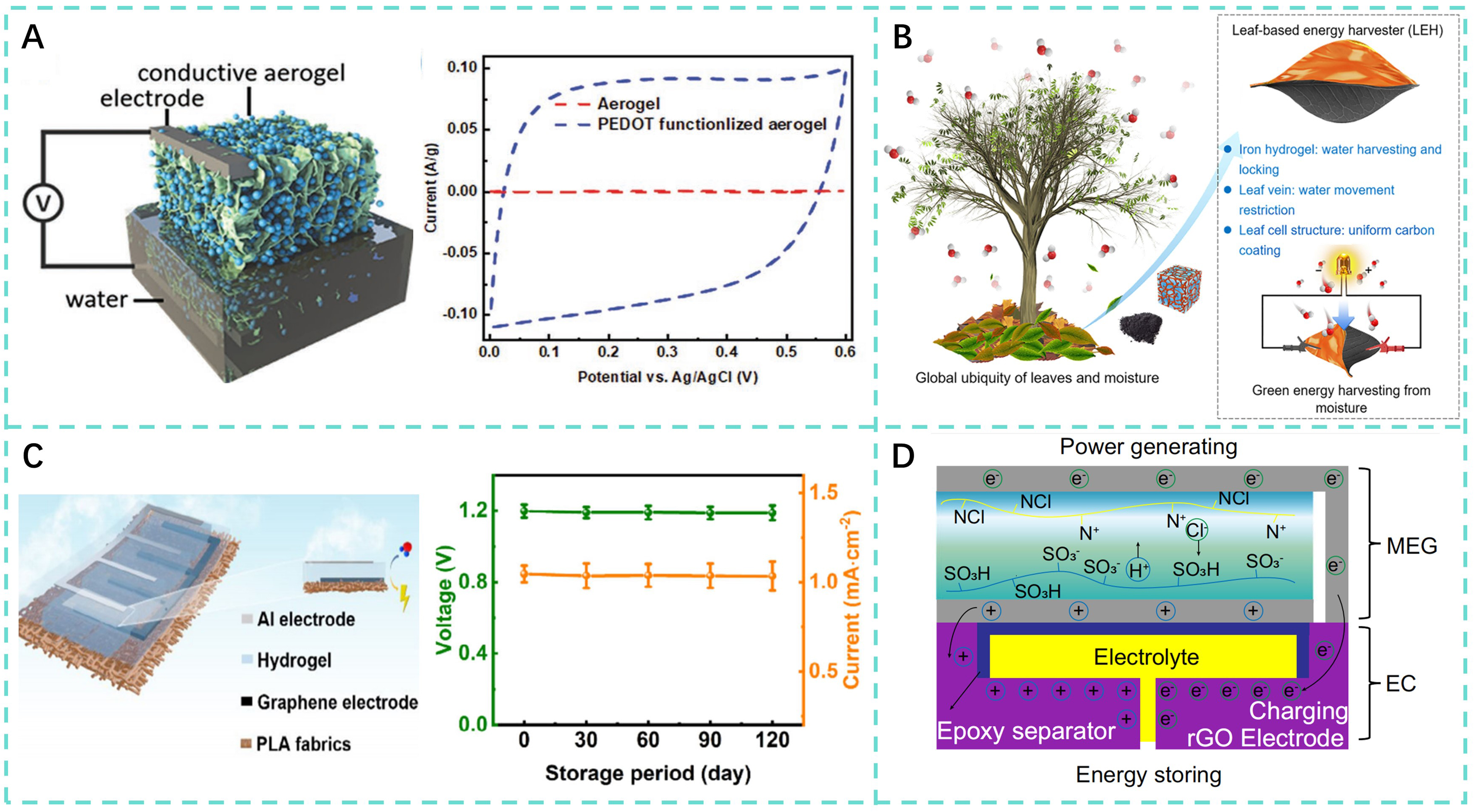
Figure 17. Applications in wearable energy storage. (A) Device structure diagram and two aerogel CV curves[183]. Reproduced with permission. Copyright 2022, John Wiley & Sons; (B) Self-powered energy harvester and its energy storage advantages[184]. Reproduced under CC BY license from Shuai Guo, 2025, Nature Communications; (C) Device structure composition and performance output of individual MEGT units under different storage periods[137]. Reproduced under CC BY license from Renbo Zhu, 2025, Advanced Materials; (D) Charging process of flexible moisture-powered supercapacitor[79]. Reproduced under CC BY license from Lifeng Wang, 2024, Nature Communications. CV: Cyclic voltammetry; MEGT: moisture-electric generation textile; PEDOT: poly (3,4-ethynedioxythiophene); PLA: polylactic acid; rGO: reduced graphene oxide; MEG: moisture-electric generator; EC: ethyl cellulose.
Wearable healthcare and agriculture monitoring
Because of their wearable, self-powered, and multifunctional advantages, MEGTs are widely used in health monitoring equipment to track and analyze human health[36]. This addresses the limitation of traditional heart rate monitoring devices, which require frequent charging or battery replacement, and is especially suitable for long-term, continuous health monitoring. In Figure 18A, multiple-unit MEGT devices power a heart rate sensor to collect user heart rate data, opening new possibilities for multifunctional applications[48]. The device integrates a self-powered energy supply, multi-modal physiological signal monitoring, and human-computer interaction, demonstrating its advanced application in health monitoring and intelligent control [Figure 18B][185]. The wristband incorporates temperature, humidity, and pressure sensors, enabling real-time monitoring of skin temperature, humidity, and pulse waveform. This helps users detect abnormal body temperature, dehydration risk, and cardiovascular issues promptly, supporting early warning and intervention. Additionally, the inclusion of gesture recognition significantly expands application scenarios and enhances user interaction and convenience. Devices based on film-like functional layers can be cut and recombined according to specific needs, allowing flexible adaptation to wearable devices of different sizes and power requirements[186]. A device with a fabric-shaped functional layer can embed MEGTs into masks to collect sweat during exercise for power generation, serving as a self-powered respiratory monitoring device [Figure 18C][59]. Distinct respiratory signal frequencies can differentiate breathing patterns, demonstrating their potential in self-powered health monitoring. Figure 18D illustrates the broad application of wet electrosensors in monitoring human physiological and sports states, such as respiration, joint activity, and walking[187]. With comprehensive sensing capabilities, these devices enable long-term, comfortable, and accurate health data collection, providing strong support for personal health management, disease prevention, and rehabilitation training. Functional layer composite materials can also be applied to medical paper towels for health detection and sensing[188]. Humidity changes near the device, caused by exhalation, allow the thin, foldable tissue to monitor respiratory rate, cough, or speech patterns in real time, offering medical-grade safety along with wearability and durability. Its small, portable, and wearable form factor gives such devices a clear advantage in intelligent health care applications.
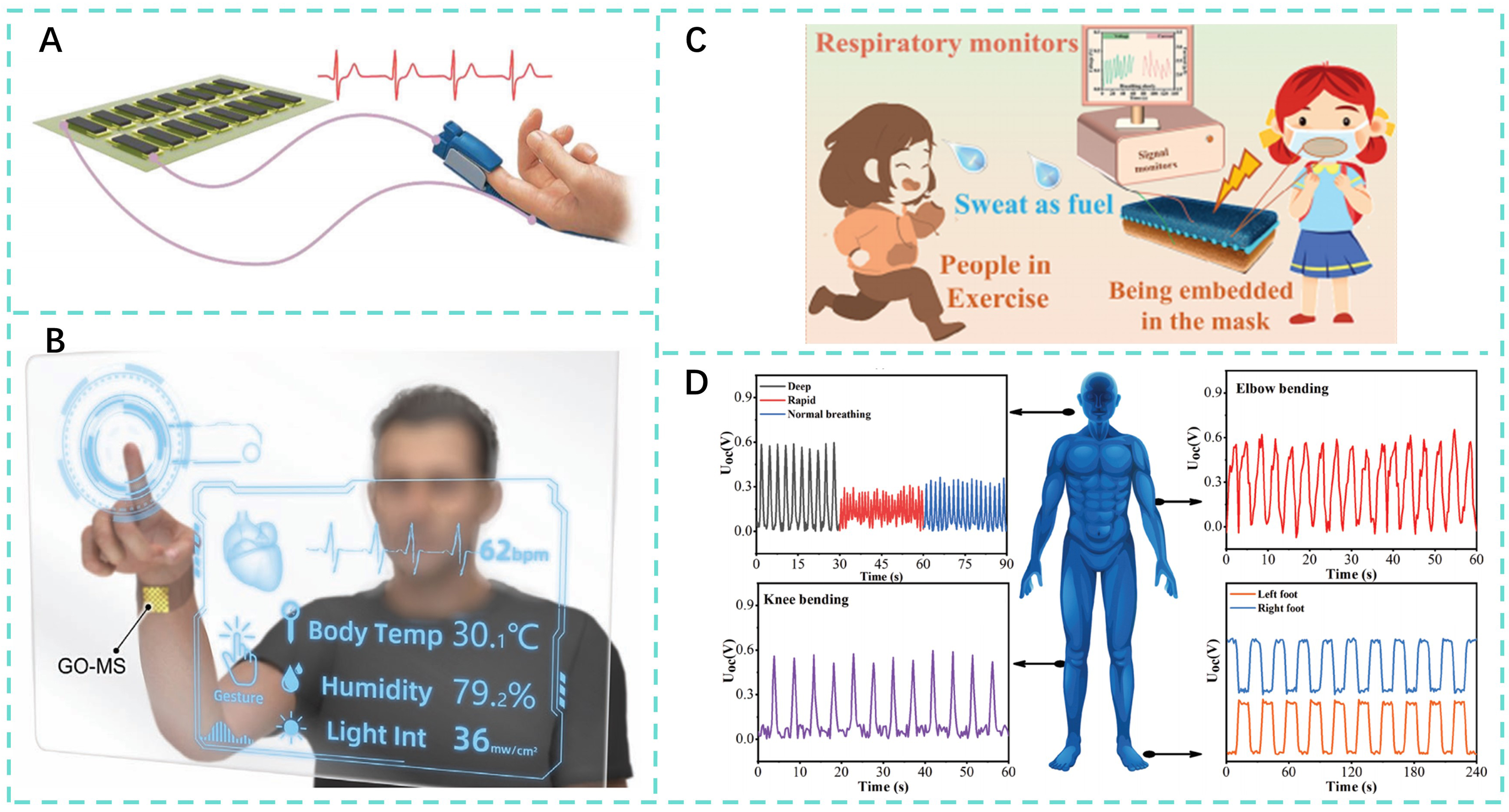
Figure 18. Applications for healthcare monitoring. (A) Heart rate monitoring system[48]. Reproduced under CC-BY-NC-ND license from Fandi Chen, 2023, Small. No modifications were made to the original work; (B) Real-time tracking and monitoring functionality driven by the device wristband[185]. Reproduced with permission. Copyright 2022, John Wiley & Sons; (C) MEGT harvests electricity from sweat and can also detect human respiration[59]. Reproduced with permission. Copyright 2024, John Wiley & Sons; (D) Detect human activities such as breathing, elbow and knee bending, and walking[187]. Reproduced with permission. Copyright 2022, John Wiley & Sons. MEGT: Moisture-electric generation textile; GO-MS: graphene oxide single-component multimodal sensor.
Similarly, certain MEGT devices can power various environmental monitoring sensors, enabling real-time monitoring and data analysis. This provides data support for crop and food preservation, growth monitoring, and greenhouse cultivation, facilitating a better understanding of crop growth conditions and environmental changes. Consequently, it enables more scientifically informed operational decisions. In smart packaging boxes for food preservation, a smart encapsulation structure that drives polymer-dispersed liquid crystals (PDLC) under a specific voltage can monitor the freshness of the contents [Figure 19A][161]. A self-powered humidity sensor harnesses ambient humidity for operation, allowing real-time monitoring of soil moisture and ambient temperature without an external power source. It transmits data to mobile devices via Wi-Fi, enhancing agricultural efficiency and crop quality[189,190]. In Figure 19B, the power provided by the device array can supply a plant sensor all day, monitoring various environmental indicators in real time, including temperature, humidity, light, and soil fertility, which benefits plant growth[191]. Combined with a humidity power generation device and soil humidity sensor, an intelligent irrigation system can automatically adjust the irrigation amount according to the actual water demand of plants, improving water resource utilization efficiency. Moreover, the temperature and humidity detection system can achieve self-power supply using SMEG, as shown in Figure 19C, efficiently monitoring agricultural environments and packaging[142]. By tracking temperature and humidity changes in real time, farmers can better control greenhouse conditions, optimize crop growth, and improve yield and quality [Figure 19D][190]. The application of MEGT in agriculture promotes sustainable development, supports green agriculture by reducing dependence on traditional energy sources, and provides an efficient and economical method for monitoring soil and environmental conditions. It delivers comprehensive data that help optimize crop growth environments and improve the quality of agricultural products.
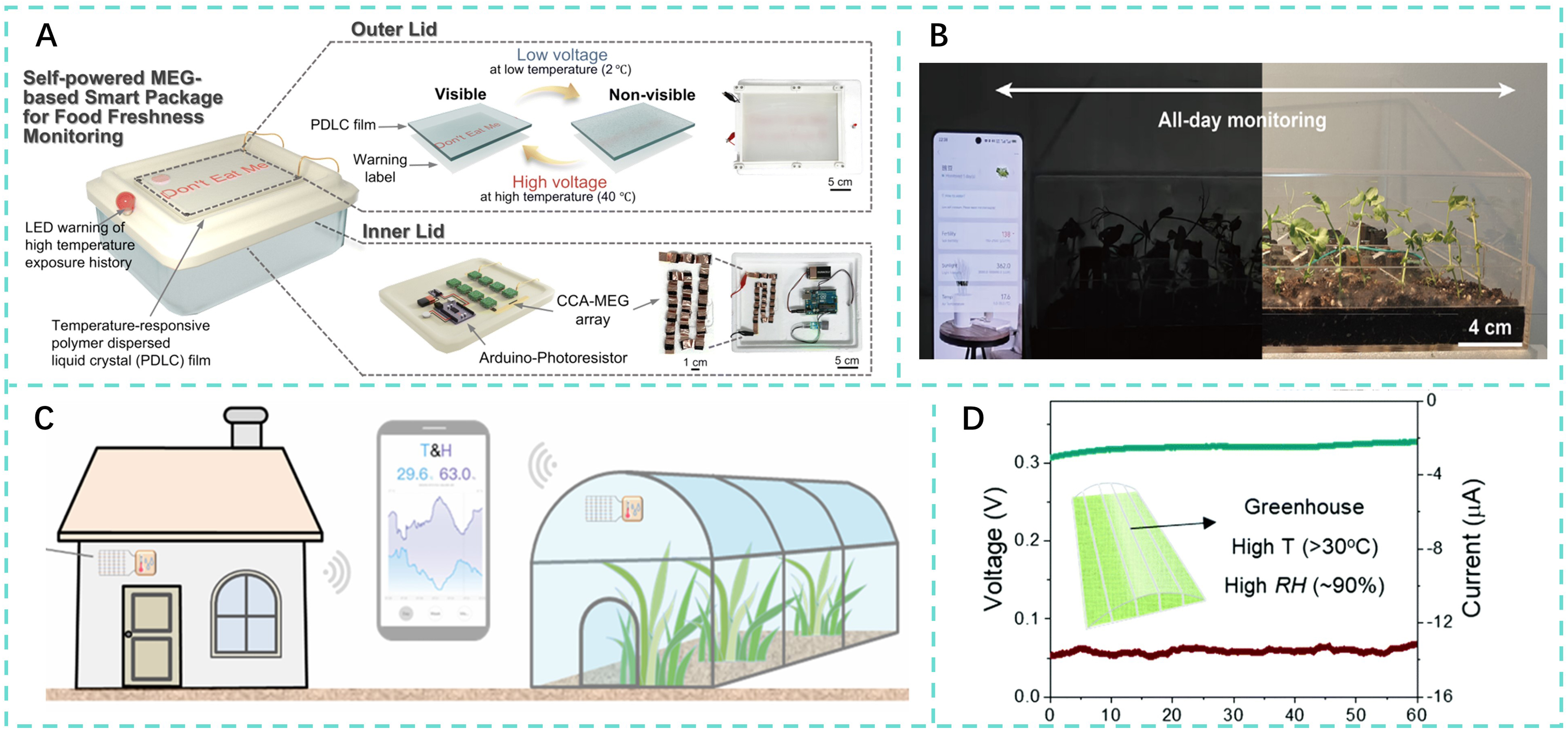
Figure 19. Applications in agriculture monitoring. (A) Self-powered smart delivery lockers[161]. Reproduced with permission. Copyright 2024, Royal Society of Chemistry; (B) Monitor plant growth conditions around the clock[191]. Reproduced with permission. Copyright 2025, John Wiley & Sons; (C) Wireless temperature and moisture monitoring system for agriculture and smart packaging[142]. Reproduced with permission. Copyright 2024, American Chemical Society; (D) For use in greenhouses, it can serve as a smart sensor[190]. Reproduced with permission. Copyright 2022, Royal Society of Chemistry. MEG: Moisture-electric generator; LED: light-emitting diode; CCA: CNF/CNT/CA (CNF: cellulose nanofiber; CNT: carbon nanotube; CA: citric acid); RH: relative humidity.
Wearable MEGT-based displays and biomedical applications
Wearable MEGTs can convert environmental or skin surface moisture into electrical energy. This process is continuous and requires no user intervention, providing an in-situ, self-sustaining power solution for fiber-based displays[92,130]. Fiber-shaped MEGs can be woven into integrated arrays to enhance energy and power density, driving motors and illuminating light-emitting diode (LED) lights [Figure 20A][129]. Individual unit devices can be connected in series, parallel, or combined configurations to power various commercial electronic equipment. In Figure 20B, scalable connections enable power delivery to dynamic electronic ink displays and LED arrays[88]. The integration of moisture-powered electricity generation with fiber textiles eliminates the need for wearable devices to rely on traditional rigid power sources, laying the foundation for truly comfortable, self-powered smart display textiles. Display devices based on textile structures possess the same flexibility, stretchability, and breathability as ordinary fabrics, ensuring comfortable wear without interfering with daily activities[90]. They can also directly convert physiological changes in human perspiration and respiration into visual information[128,192]. The manufacturing process can be integrated with established weaving techniques, facilitating future large-scale, low-cost production and lowering commercialization barriers[171]. These devices integrate energy harvesting, information sensing, and visual display into daily clothing, opening a promising field for wearable electronics and smart textiles.
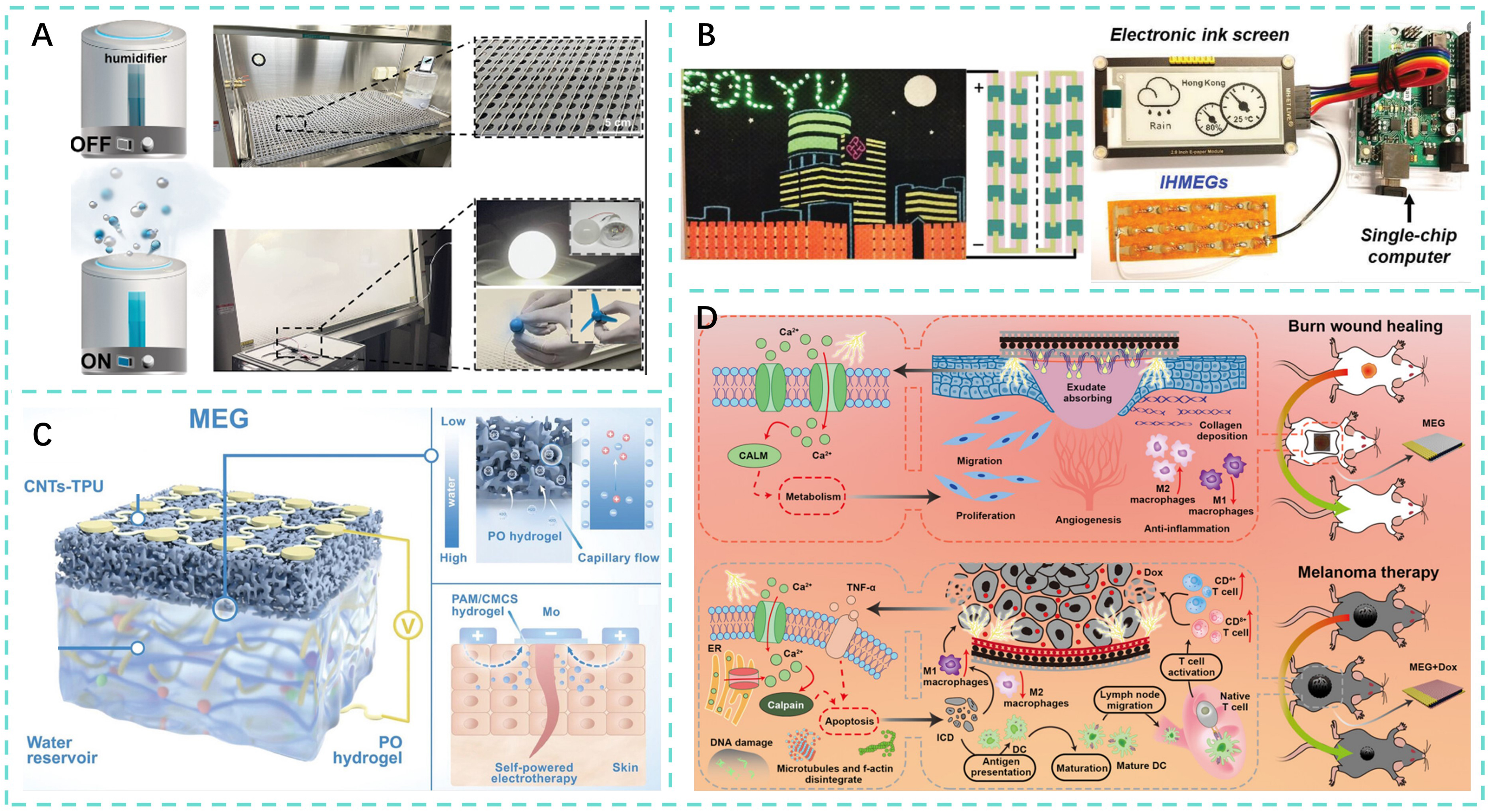
Figure 20. (A) Fiber-based MEG lights LED lamps through series integration[129]. Reproduced with permission. Copyright 2025, John Wiley & Sons; (B) The device array drives serial “POLYU” LEDs and electronic ink displays[88]. Reproduced under CC BY license from Su Yang, 2022, Advanced Materials; (C) Working mechanism of self-powered flexible power-generating dressings driven by moisture[195]. Reproduced with permission. Copyright 2025, John Wiley & Sons; (D) Schematic diagram of a device enabling adaptive wound healing and tumor therapy[196]. Reproduced with permission. Copyright 2025, John Wiley & Sons. MEG: Moisture-electric generator; LED: light-emitting diode; IHMEGs: ionic hydrogel moisture-electric generators; CNTs: carbon nanotubes; TPU: thermoplastic polyurethane; PO: PAM/CMCS organic-ionic; CALM: calmodulin; ER: endoplasmic reticulum; TNF-α: tumor necrosis factor-alpha; DC: dendritic cell.
MEGT devices can directly drive biosensors under humidity or sweat activation. When connected to wireless network modules, they transmit monitored health signals in real time to mobile phones or computing terminals, enabling remote diagnosis and intelligent intervention[193,194]. Electrotherapy has garnered attention for its ability to accelerate wound healing. As shown in Figure 20C, an autonomous moisture-driven flexible power-generating dressing combines antimicrobial therapy with exogenous electrical stimulation to promote tissue regeneration[195]. This innovation provides a novel platform for chronic wound repair by integrating moisture-driven electrical stimulation with antimicrobial treatment. Further, Shi et al. developed a self-powered, adaptive humidity-responsive bioelectronic device that achieves dual-mode electrical stimulation therapy in two physiological environments: wound healing and tumor treatment [Figure 20D][196]. As a device in direct contact with skin, long-term stability under biocompatibility, repeated
MEGT wearable energy technology is transitioning from a phase of basic material exploration toward higher goals of efficiency, stability, and multi-application capabilities. However, low power density, strong dependence on environmental humidity, and insufficient long-term stability of materials and interfaces limit the practical application of MEGT devices in commercialization and wearable fields. The primary reason for these performance limitations lies in the reliance of energy harvesting on the chemical potential energy of water molecule diffusion. At the same time, inherent material-level constraints also affect energy density. Functional layer mechanisms exhibit varying sensitivity to ambient humidity: low humidity results in insufficient ion concentration, whereas high humidity diminishes the chemical potential gradient. Long-term operation further contributes to irreversible performance degradation through polymer substrate hydrolysis, oxidation and agglomeration of functional materials, and delamination at electrode interfaces.
CHALLENGES
Ideal MEGTs integrate multiple functions, such as energy self-sufficiency, signal sensing, flexibility, and biodegradability. However, current technology remains constrained by low power density and bottlenecks in process stability, long-term reliability, and arrayed manufacturing. To advance development toward high-performance, low-cost, large-scale production, and broad applications - and to propel practical implementation in smart electronic textiles - it is essential to systematically address the following four challenges.
High performance and low cost
How to significantly reduce manufacturing costs while maintaining high output power, high energy density, and long-term stability remains a core challenge restricting the practical implementation of MEGTs. Table 2 summarizes the performance parameters of several MEG devices. It can be seen that various materials are used in the electric generation layer, with research most concentrated on 2D configurations. The power density of existing devices is insufficient to drive high-power electronics directly, although performance can be enhanced through device integration. The effective reaction area of a single fiber is small, and the ion migration gradient is limited, leading to low Voc and current density. Additionally, transient fluctuations in ambient humidity and temperature significantly affect output stability. If the moisture absorption-desorption cycle is unbalanced, water content tends to saturate, the ion gradient dissipates, and power generation ceases. Intrinsic limitations on power output arise from finite ion concentration within the power generation layer, slow ion migration through nanoscale channels, and high internal resistance. These factors collectively constrain device current and power. Long-term stability is challenged by repeated swelling and shrinkage during moisture absorption and drying cycles, which can induce structural fatigue and failure. Irreversible consumption of active ions and chemical degradation of materials also contribute to performance decline. Breaking the power bottleneck is fundamental to driving electronic devices, while resolving stability issues is critical to ensuring practical application. Device cost is mainly determined by material selection, manufacturing processes, and assembly. High-cost or brittle materials are prone to uneven thickness, cracks, wrinkles, and other defects during large-area spinning, coating, or printing, deteriorating performance output. Therefore, under the premise of high performance, process complexity should be reduced and costs controlled, enabling economical, large-scale fabrication of high-performance devices.
Summary of performances of MEG devices with different structural types
| Material for power generation | Structure | Electrode | RH (%) | Electrical property | Ref. |
| GO | 1D | Ag | 70 | 0.3 V, 0.7 μA·cm-1 | [52] |
| PDDA/NaAlg | 1D | PEDOT, Au | 20 | 0.8 V, 1.05 mA·cm-2, 1.84 W·m-2 | [50] |
| Alg/MWCNTs | 1D | / | 90-95 | 0.51 V, 1.45 μA, 3.23 × 10⁻² W·cm-2 | [132] |
| PSSA/PVA | 1D | C, Al | 80 | 1.38 V, 460 μA·cm-2 | [129] |
| PVA/MWCNTs/SDBS | 1D | Cu, Al | 95 | 0.6 V, 200 μA·cm-2 | [167] |
| MWNT | 1D | MWNT | 70 | 80 mV, 6 mA·m-2, 2.5 × 10⁻³ W·m-2 | [135] |
| SA/MWCNT | 1D | Au, Cu | 90 | 0.274 W·m-2 | [133] |
| GO/PAAS | 2D | Au, Ag | 80 | 0.6 V | [82] |
| PVA/SCNF | 2D | Cu, Pt | 80 | 0.9 V, 92 μA·cm-2 | [126] |
| PVA/SA | 2D | Al | 80 | 1.30 V, 1.31 mA·cm-2, 1.1 W·m-2 | [109] |
| PSSA | 2D | Au | 80 | 0.8 V, 0.1 mA·cm-2 | [108] |
| PSSA/PDDA | 2D | C | 25 | 0.95 V, 7.6 × 10⁻² W·m-2 | [105] |
| SA-SiO2-rGO | 2D | Au, C | 80 | 0.6 V, 2.24 mA, 0.14 mA·cm-2 | [125] |
| PAN | 2D | Zn, Ag | 90 | 0.8 V, 60 μA | [171] |
| H-PSS | 2D | Au | 90 | 0.8 V, 20 μA | [153] |
| PSS/PVA/LiCl | 2D | Cu, Al | 90 | 0.7 V, 56.39 μA·cm-2 | [148] |
| rc-PSS | 2D | MoS2, MnO2 | 95 | 0.72 V, 9.2 mA·cm-2, 6.7 W·m-2 | [198] |
| GO/PVA/PEG | 2D | Ag | 90 | 0.625 mA·cm-2, 3 W·m-2 | [43] |
| PA/CPDs | 2D | Ag, LM | 15 | 0.65 V, 12 μA·cm-2 | [47] |
| MoS2 | 2D | Al | 95 | 0.8 V, 0.4 mA, 0.27 mA·cm-2 | [98] |
| BP | 2D | Carbon cloth | 80 | 0.25 V, 0.16 μA·cm-2 | [62] |
| LS-H | 2D | C, Zn | 73 | 1.21 V, 76.80 μA | [113] |
| Lactoalbumin | 2D | FTO, CNTs | 40 | 1.45 V, 113 mA·cm-2 | [40] |
| G.S. | 2D | ITO | 75 | 0.3 V, 0.3 μA, 2.5 × 10⁻² W·m-2 | [117] |
| CA-BCSNF/rGO | 2D | Au | 63 | 0.54 V, 0.35 μA, 1.89 × 10⁻⁶ W·m-2 | [142] |
| PVA/PAN/GI/EC/terpineol | 2D | MWCNTs, NiO/ZnO@C3N4 | 16 | 0.58 V, 14.35 μA | [33] |
| CNT/SP | 2D | Ag/AgCl, Pt | 80 | 102 mV, 1.75 mA·m-2, 8.25 × 10⁻⁴ W·m-2 | [199] |
| Al2O3/PVDF-HFP | 2D | CNT/CaCl2, gallium-indium | 93 | 1.03 V, 47.77 μA·cm-2 | [172] |
| TiO2/Co | 2D | MWCNT | 50-80 | 0.95 V, 0.1 mA | [103] |
| CB@Cotton | 2D | Al, 1T-WS2@CSilk | 30 | 0.65 V, 0.51 mA, 4.8 μW | [136] |
| CNF/PIL | 2D | Ag/AgCl | / | 0.3 V, 10 μA, 5.16 × 10⁻² W·m-2 | [200] |
| CNW-PAN/LiCl-P(VDF-TrFE) | 2D | C, Al | 40 | 0.85 V, 0.144 W·m-2, 5.77 × 10² W·m-3 | [49] |
| GO | 3D | Ag, Au | 80 | 1.5 V, 3.2 W·m-2 | [87] |
| MXene-Licl | 3D | / | 77 | 0.12 V | [100] |
| CNF/CNT/CA | 3D | Pt, Cu | / | 0.25 V, 38 μA, 289 W·m-2 | [161] |
| PVA/MXene | 3D | Au | 45 | 0.8 V, 1.46 W·m-2 | [121] |
| BG/GO/CNF-NaCl/CNF | 3D | Au@SS | 90 | 1.17 V, 2,770 μA·cm-2 | [163] |
| MXene/PAM | 3D | Cu | 20 | 0.45 mV, 0.248 W·m-2 | [162] |
| PAM-LiCl/CMC | 3D | C, Al | 90 | 1.8 V, 1.2 mA, 1.13 W·m-2 | [165] |
| ([EMIM+]Cl-)/PAM/PVA/SDBS | 3D | C-Zn | 25-70 | 1.4 V, 0.1 mA | [34] |
In the development of MEGT devices, low power density constitutes the core bottleneck for practical applications, constrained by both the energy characteristics of environmental moisture and the intrinsic properties of the material system. Poor long-term stability primarily manifests as ion gradient decay and material interface failure, which may not be evident under low-power operation. High cost becomes an obstacle during industrialization, typically emerging as a consideration after successful proof-of-concept and performance validation. Power density is the fundamental prerequisite that determines whether an energy-harvesting technology can be useful. Only after overcoming this challenge and enabling the device to generate sufficient electrical energy does addressing long-term stability and reducing costs become practical. Based on a comprehensive comparison of device output performance in Table 2, structural analysis indicates that among various design approaches, 3D porous structures constructed from organic-inorganic composite materials exhibit the greatest potential for breakthrough, compared to 1D yarns and 2D membrane structures. Organic--inorganic composite systems, through interfacial synergistic effects, retain the processability and abundant functional groups of polymers while also providing the high conductivity and mechanical strength of inorganic materials. This represents the most viable technical pathway for simultaneously overcoming challenges in power, stability, and cost.
Material and device structure designs
For an efficient wet gas power generation system, the power generation layer must satisfy three core criteria: high hygroscopicity, a significant ion gradient, and stable cycling performance. Material selection should first ensure a high density of controllable hydrophilic functional groups and the construction of continuous ion transport channels. Secondly, priority should be given to environmentally friendly, process-compatible materials to guarantee the reliability of large-scale fabrication and long-term operation. Prolonged exposure to high humidity and high salt concentrations can induce hydrolysis and oxidation of active functional groups, reduce material hydrophilicity, and hinder charge separation, resulting in gradual output degradation and extended recovery times. When the interfacial energy difference between the hydrophilic power generation layer and the hydrophobic electrode is large, adhesion is weakened, leading to delamination during wet cycling and reduced charge transfer efficiency. To address these challenges, heterogeneous micro–nano structures and integrated assembly strategies are employed to achieve conformal bonding between the power generation layer and electrode interface, while maximizing moisture contact area. This approach simultaneously enhances interfacial stability and electrical output performance.
Large-scale industrialized manufacturing
Despite the promising prospects of MEGT technology, its transition from laboratory research to mass production remains constrained by systemic challenges in materials, fabrication processes, and device integration. First, large-scale fabrication of the power-generating layer remains immature. For example, spinning techniques often struggle to simultaneously achieve high ionic content, fine fiber diameters, and sufficient mechanical strength during continuous production[201]. Most existing material systems are limited to small-area synthesis, and scalable fabrication methods are frequently cost-prohibitive, impeding industrial feasibility. Second, in device assembly, processes such as layer-by-layer self-assembly, spraying, and immersion coating can introduce weak interfacial bonding and inconsistent packaging, leading to performance fluctuations and reduced long-term stability[32,68]. Furthermore, when devices are integrated into arrays via series-parallel connections, wire impedance and inter-cell coupling errors accumulate with increasing scale, further raising system costs and failure risks. Nevertheless, studies have demonstrated that certain device structures possess significant potential for large-scale integration[34,49]. Future efforts must prioritize synergistic innovations in material systems, interface engineering, and integration processes to establish MEGT systems that are high-performance, low-cost, and reproducible. As wearable energy devices, MEGTs must also satisfy practical requirements for mechanical durability, environmental stability, and system integration. Devices must withstand repeated bending, stretching, and sweat exposure, with a particular focus on maintaining strong interfacial adhesion among the power generation unit, electrodes, and packaging layer to prevent delamination and performance degradation. At the industrialization level, achieving seamless integration of power generation units, electronic modules, and energy storage systems - while maintaining compatibility with existing textile production lines - remains a challenge. Additionally, complex, high-cost post-processing further restricts large-scale applications. Therefore, MEGT systems must enable conformal integration of power generation, energy storage, and management modules, while ensuring long-term operational reliability, commercial feasibility, wearing comfort, and aesthetic appeal.
In the large-area integration of MEGT devices, textile technology and array integration represent the primary technical strategies for overcoming the inherent performance limitations of 1D fiber-based devices. However, these approaches also introduce new challenges. Mechanical stresses from bending, stretching, and interweaving during conventional weaving and knitting processes can easily induce microcracks in brittle functional materials, leading to localized power loss and individual cell failure. While array integration can improve system-level output and textile-based architectures can enhance overall device performance, these strategies alone cannot address the insufficient output of individual units. Optimizing the composition and structural design of individual devices is therefore critical for enhancing their intrinsic output performance. Achieving consistent performance and reliable interconnection across thousands of micro-units in mass production constitutes the most significant engineering challenge, requiring incremental innovations in materials, fabrication processes, and integrated packaging. Within fabric structures, point contacts or short-segment contacts between fibers are inherently unstable and prone to energy loss, with performance further degrading in humid environments due to corrosion at contact interfaces. To address these issues, standardized functional materials and interface-compatible bonding agents can be used to construct coaxial or core-shell architectures on individual fibers, providing protection for the power-generating layer. Advanced manufacturing techniques, such as precision printing or laser-assisted patterning, enable uniform production and secure interconnections, while a waterproof, breathable, and flexible encapsulation at the connection points safeguards the entire power generation array. Through such multi-level, system-level packaging strategies, it is possible to ensure consistency, reliability, and high performance in mass-produced, fiber-based power-generating textiles.
Practical application limitations
Currently, the practical deployment of MEGTs remains limited due to low Isc, insufficient power density, material aging, and defects in the fabrication process. Microampere-level currents and microwatt-level power are often inadequate to drive external loads independently. Repeated moisture absorption-desorption cycles accelerate material degradation and structural loosening, thereby shortening device lifespan. Additionally, the lack of efficient array integration hinders the simultaneous optimization of integration density and energy conversion efficiency. The fundamental mechanisms of ion migration and flow potential in MEGTs are not yet fully unified, and no universal model exists to guide the coordinated design of materials and device architectures. Device configuration strongly influences application scenarios: thin, flexible films prioritize mechanical compliance and are suited for low-power, wearable applications, whereas 3D porous or microchannel structures leverage high specific surface area and gradient apertures, making them more appropriate for distributed energy harvesting in high-humidity or static environments. Therefore, broadening the practical applicability of MEGTs requires the synchronous optimization of material systems, structural design, and fabrication processes tailored to the specific requirements of each application scenario.
CONCLUSION AND OUTLOOK
MEGTs represent a convergence of clean energy technology with multidisciplinary knowledge spanning materials science, biology, and physical chemistry, embedding complex mechanisms within miniature textile devices. This integration provides a novel technological pathway for advancing sustainable societal development. In recent years, MEGTs have demonstrated broad application potential in self-powered wearable devices, smart sensor networks, and biomedical systems. As research progresses, their functional and application boundaries continue to expand, with numerous innovative scenarios yet to be explored. Based on current development trends, this paper outlines future research directions from several key perspectives.
In-depth mechanism research
The electric generation mechanism of MEGTs relies on the adsorption of gaseous water molecules onto the surface of the power-generating layer. This adsorption induces dissociation of functional groups, resulting in directional ion migration driven by concentration gradients. However, a comprehensive theoretical model for ion transport within nanopores is still lacking. Integrating molecular dynamics simulations with multiphysics coupling could quantitatively elucidate how pore size distribution and surface charge density affect ion migration rates. Concurrently, designing multiple energy conversion mechanisms to operate synergistically can create diverse pathways, enhancing both energy density and stability. To overcome the low power output of individual MEGTs, in situ tracking of the chemical structure evolution of the active layer and optimization of internal mass transfer pathways are essential. Future research should aim for coordinated breakthroughs across three dimensions: intrinsic material properties, microstructure design, and environmental adaptability, thereby advancing the practical application of MEGTs in smart wearable electronics.
Innovation of materials and optimization of device structures
Current research has established diverse active material systems for MEGTs; however, iterative optimization of the power generation layer and electrode materials, alongside systematic refinement of device structures, remains a critical focus for future development. Achieving an ideal balance among output stability, economic cost, and service life has yet to be realized. Future work should integrate molecular-level chemical modifications with macroscale composite structures. By employing genetically engineered synthesis and controlled functionalization, reversible moisture-responsive oxygen-containing group gradients can be incorporated into the material to enable efficient charge separation and collection, even under low-humidity conditions. Beyond material innovation, structural design is a core determinant of overall device performance and practical applicability. 1D linear fiber structures enhance single-fiber output and support continuous spinning processes; 2D fiber-membrane structures utilize gradient pore sizes to improve water gradient retention and ion transport; and 3D multilayer composite architectures optimize interlayer bonding, thereby enhancing cycle stability, mechanical strength, and long-term reliability.
Synergy with other energy technologies
Another core advantage of MEGTs lies in their capacity to establish multi-source synergistic energy systems, achieving “multi-energy complementarity” that enhances energy utilization efficiency, system stability, and adaptability to diverse application scenarios. Existing research demonstrates that MEGs, when operating synergistically with technologies such as TEGs, solar thermal evaporation, and energy storage devices, can substantially improve overall performance. Integration with flexible energy storage units, including micro-supercapacitors and solid-state batteries, enables the construction of a fully integrated “generation-storage-consumption” system, addressing inherent output instability. Building on this foundation, the development of multi-physics active layers capable of simultaneous responses to humidity, temperature, and light can enable electronic textiles to monitor multiple environmental parameters in real time. This approach accelerates the evolution of wearable electronics toward a new generation of self-powered, battery-free ecosystems with instantaneous response, intelligent connectivity, and multifunctional sensing capabilities.
Expansion of application scenarios
With ongoing innovations in materials and device structures, MEGTs have expanded into a wide range of real-world applications. Integration of MEGTs into clothing and shoe insoles enables self-powered health monitoring systems driven by environmental or skin humidity. Biocompatible MEGT-based devices are incorporated into wound dressings and electrostimulation platforms, promoting healing and facilitating smart dressings that are biodegradable, antimicrobial, and capable of controlled drug release. Humidity-responsive fibers are also employed in touch sensing and gesture recognition, enabling the development of chip-free, self-powered flexible interactive interfaces. Overall, through the convergence of materials science, textile engineering, and flexible electronics, MEGTs are emerging as a core energy technology for next-generation self-powered wearable systems. This progress paves the way for a new era of electronic textiles, providing seamless, continuous, and battery-free energy solutions for biomonitoring, personalized healthcare, and intelligent wearable devices.
DECLARATIONS
Authors’ contributions
Wrote the original draft: Zhou, Q.
Supervised, revised and edited the manuscript: Chen, W.; Du, M.; Zhao, Z.
Availability of data and materials
Not applicable.
Financial support and sponsorship
This work was supported by the National Natural Science Foundation of China (Grant Nos. 24210005-N and 21975214) and the Science Foundation of Zhejiang Sci-Tech University (Grant Nos. 23212091-Y and 25212209-FZ).
Conflicts of interest
All authors declared that there are no conflicts of interest.
Ethical approval and consent to participate
Not applicable.
Consent for publication
Not applicable.
Copyright
© The Author(s) 2026.
REFERENCES
1. Potrč, S.; Nemet, A.; Čuček, L.; Varbanov, P. S.; Kravanja, Z. Synthesis of a regenerative energy system - beyond carbon emissions neutrality. Renew. Sustain. Energy. Rev. 2022, 169, 112924.
2. Huang, J.; Hu, B.; Meng, J.; et al. Highly efficient sustainable strategies toward carbon-neutral energy production. Energy. Environ. Sci. 2024, 17, 1007-45.
3. Bui, T.; Tseng, J.; Tsai, F. M.; Ali, M. H.; Lim, M. K.; Tseng, M. Energy security challenges and opportunities in the carbon neutrality context: a hierarchical model through systematic data-driven analysis. Renew. Sustain. Energy. Rev. 2023, 187, 113710.
4. Zhao, N.; You, F. Can renewable generation, energy storage and energy efficient technologies enable carbon neutral energy transition? Appl. Energy. 2020, 279, 115889.
5. Zhang, Z.; Li, X.; Yin, J.; et al. Emerging hydrovoltaic technology. Nat. Nanotechnol. 2018, 13, 1109-19.
6. Jiao, S.; Li, Y.; Li, J.; et al. Water-enabled electricity generation on film structures: from materials to applications. Renew. Sustain. Energy. Rev. 2024, 199, 114461.
7. Khare, V.; Nema, S.; Baredar, P. Solar–wind hybrid renewable energy system: a review. Renew. Sustain. Energy. Rev. 2016, 58, 23-33.
8. Simshauser, P. Competition vs. coordination: optimising wind, solar and batteries in renewable energy zones. Energy. Econ. 2025, 143, 108279.
9. Rahman, A.; Farrok, O.; Haque, M. M. Environmental impact of renewable energy source based electrical power plants: solar, wind, hydroelectric, biomass, geothermal, tidal, ocean, and osmotic. Renew. Sustain. Energy. Rev. 2022, 161, 112279.
10. Hussain, A.; Arif, S. M.; Aslam, M. Emerging renewable and sustainable energy technologies: state of the art. Renew. Sustain. Energy. Rev. 2017, 71, 12-28.
12. Zan, G.; Li, S.; Zhao, K.; et al. Emerging bioinspired hydrovoltaic electricity generators. Energy. Environ. Sci. 2025, 18, 53-96.
13. Lim, H.; Kim, M. S.; Cho, Y.; et al. Hydrovoltaic electricity generator with hygroscopic materials: a review and new perspective. Adv. Mater. 2024, 36, e2301080.
14. Wang, J.; Cao, X.; Cui, X.; et al. Recent advances of green electricity generation: potential in solar interfacial evaporation system. Adv. Mater. 2024, 36, e2311151.
15. Fang, S.; Chu, W.; Tan, J.; Guo, W. The mechanism for solar irradiation enhanced evaporation and electricity generation. Nano. Energy. 2022, 101, 107605.
16. Zheng, C.; Chu, W.; Fang, S.; Tan, J.; Wang, X.; Guo, W. Materials for evaporation‐driven hydrovoltaic technology. Interdiscip. Mater. 2022, 1, 449-70.
17. Tan, J.; Wang, X.; Chu, W.; et al. Harvesting energy from atmospheric water: grand challenges in continuous electricity generation. Adv. Mater. 2024, 36, e2211165.
18. Xu, J.; Wang, P.; Bai, Z.; et al. Sustainable moisture energy. Nat. Rev. Mater. 2024, 9, 722-37.
19. Xu, T.; Ding, X.; Cheng, H.; Han, G.; Qu, L. Moisture-enabled electricity from hygroscopic materials: a new type of clean energy. Adv. Mater. 2024, 36, e2209661.
20. Cheng, T.; Shao, J.; Wang, Z. L. Triboelectric nanogenerators. Nat. Rev. Methods. Primers. 2023, 3, 230.
21. Song, Y.; Wang, N.; Wang, Y.; Zhang, R.; Olin, H.; Yang, Y. Direct current triboelectric nanogenerators. Adv. Energy. Mater. 2020, 10, 2002756.
22. Ayachi, S.; He, X.; Yoon, H. J. Solar thermoelectricity for power generation. Adv. Energy. Mater. 2023, 13, 2300937.
23. Lin, J.; Zhang, Z.; Lin, X.; et al. All wood‐based water evaporation‐induced electricity generator. Adv. Funct. Mater. 2024, 34, 2314231.
24. Onggowarsito, C.; Mao, S.; Zhang, X. S.; Feng, A.; Xu, H.; Fu, Q. Updated perspective on solar steam generation application. Energy. Environ. Sci. 2024, 17, 2088-99.
25. Baburaj, A.; Naveen Kumar, S.; Aliyana, A. K.; Banakar, M.; Bairagi, S.; Stylios, G. Factors affecting the performance of flexible triboelectric nanogenerators (F-TENGs) and their sensing capabilities: a comprehensive review. Nano. Energy. 2023, 118, 108983.
26. Ye, Z.; Liu, T.; Du, G.; et al. Bioinspired superhydrophobic triboelectric materials for energy harvesting. Adv. Funct. Mater. 2025, 35, 2412545.
27. Yu, Y.; Gao, Q.; Zhang, X.; et al. Contact-sliding-separation mode triboelectric nanogenerator. Energy. Environ. Sci. 2023, 16, 3932-41.
28. Shrestha, K.; Pradhan, G. B.; Asaduzzaman, M.; et al. A breathable, reliable, and flexible siloxene incorporated porous SEBS‐based triboelectric nanogenerator for human–machine interactions. Adv. Energy. Mater. 2024, 14, 2302471.
29. Wu, X.; Lu, Y.; Ren, X.; et al. Interfacial solar evaporation: from fundamental research to applications. Adv. Mater. 2024, 36, e2313090.
30. Liu, X.; Gao, H.; Sun, L.; Yao, J. Generic air-gen effect in nanoporous materials for sustainable energy harvesting from air humidity. Adv. Mater. 2024, 36, e2300748.
31. Chen, J.; Zhang, X.; Cheng, M.; et al. A self-sustained moist-electric generator with enhanced energy density and longevity through a bilayer approach. Mater. Horiz. 2025, 12, 2309-18.
32. Zang, S.; Chen, J.; Yamauchi, Y.; et al. Moisture power generation: from material selection to device structure optimization. ACS. Nano. 2024, 18, 19912-30.
33. Yu, F.; Wang, L.; Yang, X.; et al. Moisture-electric generators working in subzero environments based on laser-engraved hygroscopic hydrogel arrays. ACS. Nano. 2025, 19, 3807-17.
34. Chen, Y.; Ye, C.; He, J.; Guo, R.; Qu, L.; Tang, S. Achieving persistent and ultra-high voltage output through an arid-adapted plant-inspired high-performance moisture-electric generator. Energy. Environ. Sci. 2025, 18, 6063-75.
35. Wen, X.; Sun, Z.; Cho, Y.; et al. Climate‐adaptive high‐performance moisture‐induced electric generator utilizing electric double‐layer gradient. Adv. Funct. Mater. 2025, 35, e06700.
36. Maity, D.; Fussenegger, M. An efficient ambient-moisture-driven wearable electrical power generator. Adv. Sci. 2023, 10, e2300750.
37. Tang, W.; Chen, B. D.; Wang, Z. L. Recent progress in power generation from water/liquid droplet interaction with solid surfaces. Adv. Funct. Mater. 2019, 29, 1901069.
38. Huang, L.; Zhang, Y.; Song, X.; Li, D.; Chen, X.; Yuan, Q. A moist-electric generator based on oxidized and aminated regenerated cellulose. Nano. Energy. 2023, 118, 108973.
39. Lu, J.; Xu, B.; Huang, J.; Liu, X.; Fu, H. Charge transfer and ion occupation induced ultra‐durable and all‐weather energy generation from ambient air for over 200 days. Adv. Funct. Mater. 2024, 34, 2406901.
40. Zhu, R.; Zhu, Y.; Hu, L.; et al. Lab free protein-based moisture electric generators with a high electric output. Energy. Environ. Sci. 2023, 16, 2338-45.
41. Cheng, W.; Xu, C.; Zhang, Q.; et al. Ion concentration gradient induced efficient ion migration in hydrogen-bonded organic frameworks for high-performance, self-powered humidity sensing. Small 2025, 21, e2412497.
42. Park, J.; Chang, S.; Shin, J.; et al. Bio‐physicochemical dual energy harvesting fabrics for self‐sustainable smart electronic suits. Adv. Energy. Mater. 2023, 13, 2300530.
43. Li, Y.; Tian, S.; Chen, X.; et al. A high-current and tunable moisture-enabled electric generator for wireless wearable electronics. J. Mater. Chem. A. 2024, 12, 33039-52.
44. Sun, S.; Li, H.; Zhang, M.; et al. A multifunctional asymmetric fabric for sustained electricity generation from multiple sources and simultaneous solar steam generation. Small 2023, 19, e2303716.
45. Sun, Z.; Wen, X.; Wang, L.; et al. Emerging design principles, materials, and applications for moisture-enabled electric generation. eScience 2022, 2, 32-46.
46. Yan, H.; Liu, Z.; Qi, R. A review of humidity gradient-based power generator: devices, materials and mechanisms. Nano. Energy. 2022, 101, 107591.
47. Li, Q.; Qin, Y.; Cheng, D.; et al. Moist‐electric generator with efficient output and scalable integration based on carbonized polymer dot and liquid metal active electrode. Adv. Funct. Mater. 2023, 33, 2211013.
48. Chen, F.; Zhang, S.; Guan, P.; et al. High-performance flexible graphene oxide-based moisture-enabled nanogenerator via multilayer heterojunction engineering and power management system. Small 2024, 20, e2304572.
49. Hu, Y.; Yang, W.; Wei, W.; et al. Phyto-inspired sustainable and high-performance fabric generators via moisture absorption-evaporation cycles. Sci. Adv. 2024, 10, eadk4620.
50. Zan, G.; Jiang, W.; Kim, H.; et al. A core-shell fiber moisture-driven electric generator enabled by synergetic complex coacervation and built-in potential. Nat. Commun. 2024, 15, 10056.
51. Zheng, H.; Zhou, A.; Li, Y.; et al. A sandwich-like flexible nanofiber device boosts moisture induced electricity generation for power supply and multiple sensing applications. Nano. Energy. 2023, 113, 108529.
52. Shao, C.; Gao, J.; Xu, T.; et al. Wearable fiberform hygroelectric generator. Nano. Energy. 2018, 53, 698-705.
53. Cheng, Y.; Zhu, T.; He, Q.; et al. Hydrogel‐based moisture electric generator with high output performance induced by proton hopping. Adv. Funct. Mater. 2025, 35, 2500186.
54. Shen, D.; Li, F.; Zhao, J.; et al. Ionic hydrogel-based moisture electric generators for underwater electronics. Adv. Sci. 2024, 11, e2408954.
55. Cheng, Y.; Yang, C.; Zhu, T.; Wu, C.; Huang, J.; Lai, Y. Light‐assisted polyproton dissociated PAAm‐PA hydrogel‐based moisture‐driven electricity generator with a broad operating range. Adv. Funct. Mater. 2025, 35, 2415533.
56. Yu, R.; Wu, L.; Yang, Z.; et al. Dynamic liquid metal-microfiber interlocking enables highly conductive and strain-insensitive metastructured fibers for wearable electronics. Adv. Mater. 2025, 37, e2415268.
57. Li, S.; Zhang, Y.; Liang, X.; et al. Humidity-sensitive chemoelectric flexible sensors based on metal-air redox reaction for health management. Nat. Commun. 2022, 13, 5416.
58. Song, Y.; Shu, C.; Song, Z.; et al. Self-powered health monitoring with ultrafast response and recovery enabled by nanostructured silicon moisture-electric generator. Chem. Eng. J. 2023, 468, 143797.
59. Liu, Y.; Li, Z.; Yang, X.; et al. Multifunctional power generators beyond moisture limitation. Adv. Funct. Mater. 2024, 34, 2407204.
60. Liu, C.; Wang, S.; Wang, X.; et al. Hydrovoltaic energy harvesting from moisture flow using an ionic polymer–hydrogel–carbon composite. Energy. Environ. Sci. 2022, 15, 2489-98.
61. Han, M.; Shen, W.; Corriou, J. Polydopamine-modified MXene/cellulose nanofibers composite film for self-powered humidity sensing and humidity actuating. Nano. Energy. 2024, 123, 109445.
62. Liang, J.; Wang, Y.; Ma, X.; et al. Directional oxygen defect engineering in black phosphorus aerogel for flexible and stable moisture‐electric generators. Adv. Funct. Mater. 2025, 35, 2418834.
63. Guo, H.; Luo, Q.; Liu, D.; et al. Super moisture-sorbent sponge for sustainable atmospheric water harvesting and power generation. Adv. Mater. 2024, 36, e2414285.
64. Lu, W.; Ong, W. L.; Ho, G. W. Advances in harvesting water and energy from ubiquitous atmospheric moisture. J. Mater. Chem. A. 2023, 11, 12456-81.
65. Wang, X.; Lin, F.; Wang, X.; et al. Hydrovoltaic technology: from mechanism to applications. Chem. Soc. Rev. 2022, 51, 4902-27.
66. Shao, B.; Song, Y.; Song, Z.; et al. Electricity generation from phase transitions between liquid and gaseous water. Adv. Energy. Mater. 2023, 13, 2204091.
67. Yang, L.; Zhang, L.; Sun, D. Energy harvesting technology based on moisture-responsive actuators. J. Mater. Chem. A. 2023, 11, 18530-60.
68. Ge, C.; Xu, D.; Feng, X.; et al. Recent advances in fibrous materials for hydroelectricity generation. Nanomicro. Lett. 2024, 17, 29.
69. Kim, C.; Yang, E.; Karnik, R.; et al. Transition of water transport mechanism in laminar graphene membrane with increasing thickness: influence of strong cohesive interaction among water molecules. Chem. Eng. J. 2025, 505, 158366.
70. Li, X.; Zhang, K.; Nilghaz, A.; Chen, G.; Tian, J. A green and sustainable water evaporation-induced electricity generator with woody biochar. Nano. Energy. 2023, 112, 108491.
71. Han, C.; Bai, Z.; Sun, H.; Mi, L.; Sun, Z. Bioinspired gradient-structured wood interfaces achieving efficient ion diffusion to generate electricity from natural evaporation. J. Mater. Chem. A. 2024, 12, 723-30.
72. Wang, Z.; He, Y.; Wang, C.; et al. A moisture-absorbing cellulose nanofibril-based foam via ambient drying for high-performance dehumidification. Chem. Eng. J. 2024, 486, 150063.
73. Guo, C.; Tang, H.; Wang, P.; et al. Radiative cooling assisted self-sustaining and highly efficient moisture energy harvesting. Nat. Commun. 2024, 15, 6100.
74. Zhong, H.; Wang, S.; Wang, Z.; Jiang, J. Asymmetric self-powered cellulose-based aerogel for moisture-electricity generation and humidity sensing. Chem. Eng. J. 2024, 486, 150203.
75. Liu, C.; Wan, T.; Guan, P.; et al. Unveil the triple roles of water molecule on power generation of MXene derived TiO2 based moisture electric generator. Adv. Energy. Mater. 2024, 14, 2400590.
76. Lin, X.; Tao, S.; Mo, J.; et al. Cellulose hydrogel with in-situ confined nanopores for boosting moist-electric conversion. Nat. Commun. 2025, 16, 7527.
77. Li, X.; Wang, Z. L.; Wei, D. Scavenging energy and information through dynamically regulating the electrical double layer. Adv. Funct. Mater. 2024, 34, 2405520.
78. Shen, D.; Duley, W. W.; Peng, P.; et al. Moisture-enabled electricity generation: from physics and materials to self-powered applications. Adv. Mater. 2020, 32, e2003722.
79. Wang, L.; Wang, H.; Wu, C.; et al. Moisture-enabled self-charging and voltage stabilizing supercapacitor. Nat. Commun. 2024, 15, 4929.
80. Huang, Y.; Cheng, H.; Qu, L. Emerging materials for water-enabled electricity generation. ACS. Mater. Lett. 2021, 3, 193-209.
81. Sun, Z.; Feng, L.; Wen, X.; Wang, L.; Qin, X.; Yu, J. Nanofiber fabric based ion-gradient-enhanced moist-electric generator with a sustained voltage output of 1.1 volts. Mater. Horiz. 2021, 8, 2303-9.
82. Huang, Y.; Cheng, H.; Yang, C.; Yao, H.; Li, C.; Qu, L. All-region-applicable, continuous power supply of graphene oxide composite. Energy. Environ. Sci. 2019, 12, 1848-56.
83. Liu, Y.; Du, H.; You, W.; et al. High-output, stretchable, moisture-electric generator enabled by tailored acrylic acid/choline chloride eutectogel. ACS. Appl. Mater. Interfaces. 2025, 17, 61218-28.
84. Yan, H.; Li, L.; Dong, C.; Wu, H.; Qi, R. Uncovering internal water-flux and surface-potential dominance in hydrogel-based moisture-enabled power generation: mechanistic insights and performance enhancement. Mater. Horiz. 2025, 12, 10357-69.
85. Yang, T.; Han, Z.; Su, B.; Lin, X. Hygroscopic-evaporative generator for multiform energy harvesting from environment and food storage. Adv. Mater. 2026, 38, e11885.
86. Xu, T.; Ding, X.; Shao, C.; et al. Electric power generation through the direct interaction of pristine graphene-oxide with water molecules. Small 2018, 14, e1704473.
87. Huang, Y.; Cheng, H.; Yang, C.; et al. Interface-mediated hygroelectric generator with an output voltage approaching 1.5 volts. Nat. Commun. 2018, 9, 4166.
88. Yang, S.; Tao, X.; Chen, W.; et al. Ionic hydrogel for efficient and scalable moisture-electric generation. Adv. Mater. 2022, 34, e2200693.
89. Sun, Z.; Wen, X.; Kim, J.; et al. Moisture‐driven hydrogel power source with asymmetric ion adsorption for flexible electronics. Adv. Funct. Mater. 2026, 36, e18814.
90. Xiao, R.; Zhou, X.; Yang, T.; et al. Biomimetic gradient aerogel fibers for sustainable energy harvesting from human sweat via the hydrovoltaic effect. Nano. Energy. 2025, 136, 110759.
91. Xing, R.; Liu, Y.; Yan, J.; Wang, R.; Zhuang, X.; Yang, G. High-performance, breathable and flame-retardant moist-electric generator based on asymmetrical nanofiber membrane assembly. J. Colloid. Interface. Sci. 2024, 671, 205-15.
92. Chen, P.; He, G.; He, B.; et al. Long-term and high electric output moist-electric generator driven by all electrospun nanofiber-based Janus architecture. J. Mater. Sci. Technol. 2025, 225, 31-9.
93. Ni, K.; Ren, Q.; Zhang, X.; Liu, R. A trilayer nanofluidic ionic diode for high-performance moisture-enabled energy harvesting and ionic logic operations. Adv. Mater. 2026, 38, e13405.
94. Zhao, F.; Cheng, H.; Zhang, Z.; Jiang, L.; Qu, L. Direct power generation from a graphene oxide film under moisture. Adv. Mater. 2015, 27, 4351-7.
95. Cheng, H.; Huang, Y.; Zhao, F.; et al. Spontaneous power source in ambient air of a well-directionally reduced graphene oxide bulk. Energy. Environ. Sci. 2018, 11, 2839-45.
96. Gao, Y.; Cai, X.; Zhao, Y.; et al. Scalable preparation of flexible heterogeneous graphene oxide structures for high-performance wet power generation. J. Mater. Chem. A. 2024, 12, 12216-24.
97. Tang, X.; Jiang, B.; Zhu, Q.; et al. A novel wood-based multifunctional composites incorporating with piezoelectric and moist-electric performance. Nano. Energy. 2024, 130, 110159.
98. Cao, Y. M.; Su, Y.; Zheng, M.; et al. Vertical phase-engineering MoS2 nanosheet-enhanced textiles for efficient moisture-based energy generation. ACS. Nano. 2024, 18, 492-505.
99. He, D.; Yang, Y.; Zhou, Y.; et al. Electricity generation from phase-engineered flexible MoS2 nanosheets under moisture. Nano. Energy. 2021, 81, 105630.
100. Cai, C.; Chen, Y.; Cheng, F.; Wei, Z.; Zhou, W.; Fu, Y. Biomimetic dual absorption-adsorption networked MXene aerogel-pump for integrated water harvesting and power generation system. ACS. Nano. 2024, 18, 4376-87.
101. Wu, Y.; Shao, B.; Song, Z.; et al. A hygroscopic Janus heterojunction for continuous moisture-triggered electricity generators. ACS. Appl. Mater. Interfaces. 2022, 14, 19569-78.
102. Shen, D.; Xiao, M.; Zou, G.; Liu, L.; Duley, W. W.; Zhou, Y. N. Self-powered wearable electronics based on moisture enabled electricity generation. Adv. Mater. 2018, 30, e1705925.
103. Yan, H.; Liu, Z.; Qi, R. Development and mechanism investigation of TiO2/Co hydrogel microgenerator utilizing humidity gradient. Energy. Convers. Manag. 2023, 291, 117256.
104. Zhang, Y.; Yang, T.; Shang, K.; et al. Sustainable power generation for at least one month from ambient humidity using unique nanofluidic diode. Nat. Commun. 2022, 13, 3484.
105. Wang, H.; Sun, Y.; He, T.; et al. Bilayer of polyelectrolyte films for spontaneous power generation in air up to an integrated 1,000 V output. Nat. Nanotechnol. 2021, 16, 811-9.
106. Wu, J.; Zhang, Y.; Pei, D.; et al. A waterborne epoxy vitrimer: enabling moisture-driven actuation, continuous moist-electric generation, and water-assisted degradation. Adv. Sci. 2026, 13, e13579.
107. Pan, X.; Wang, Q.; Jin, L.; Ni, Y.; Rosei, F. Integrated paper-hydrogel structure for spontaneous and ultra-durable eco-friendly electricity generation. Nano. Energy. 2025, 136, 110730.
108. Xu, T.; Ding, X.; Huang, Y.; et al. An efficient polymer moist-electric generator. Energy. Environ. Sci. 2019, 12, 972-8.
109. Yang, S.; Zhang, L.; Mao, J.; et al. Green moisture-electric generator based on supramolecular hydrogel with tens of milliamp electricity toward practical applications. Nat. Commun. 2024, 15, 3329.
110. Zhang, Y.; Guo, S.; Yu, Z. G.; et al. An asymmetric hygroscopic structure for moisture-driven hygro-ionic electricity generation and storage. Adv. Mater. 2022, 34, e2201228.
111. Li, M.; Zong, L.; Yang, W.; et al. Biological nanofibrous generator for electricity harvest from moist air flow. Adv. Funct. Mater. 2019, 29, 1901798.
112. Liao, G.; Sun, E.; Kana, E. B. G.; et al. Renewable hemicellulose-based materials for value-added applications. Carbohydr. Polym. 2024, 341, 122351.
113. You, S.; Chen, M.; Ren, H.; et al. A robust lignin-derived moisture-enabled electric generator with sustained and scalable power output. ACS. Appl. Mater. Interfaces. 2025, 17, 12034-42.
114. Gao, X.; Xu, T.; Shao, C.; et al. Electric power generation using paper materials. J. Mater. Chem. A. 2019, 7, 20574-8.
115. Liu, J.; Huang, L.; He, W.; et al. Moisture-enabled hydrovoltaic power generation with milk protein nanofibrils. Nano. Energy. 2022, 102, 107709.
116. Liu, X.; Gao, H.; Ward, J. E.; et al. Power generation from ambient humidity using protein nanowires. Nature 2020, 578, 550-4.
117. Ren, G.; Wang, Z.; Zhang, B.; et al. A facile and sustainable hygroelectric generator using whole-cell Geobacter sulfurreducens. Nano. Energy. 2021, 89, 106361.
118. Ren, G.; Hu, Q.; Ye, J.; Liu, X.; Zhou, S.; He, Z. Hydrovoltaic effect of microbial films enables highly efficient and sustainable electricity generation from ambient humidity. Chem. Eng. J. 2022, 441, 135921.
119. Ren, G.; Hu, Q.; Ye, J.; Hu, A.; Lü, J.; Zhou, S. All-biobased hydrovoltaic-photovoltaic electricity generators for all-weather energy harvesting. Research 2022, 2022, 9873203.
120. Chen, T.; Zhang, D.; Tian, X.; et al. Highly ordered asymmetric cellulose-based honeycomb membrane for moisture-electricity generation and humidity sensing. Carbohydr. Polym. 2022, 294, 119809.
121. Wang, C.; Duan, P.; Huang, Y.; et al. Micro-meso-macroporous channels finely tailored for highly efficient moisture energy harvesting. Nat. Commun. 2025, 16, 6568.
122. Ying, W.; Huang, Z.; Liu, Z.; et al. High-power hydrogel-based moisture-electric generators. Energy. Environ. Sci. 2025, 18, 9457-67.
123. Zhu, R.; Feng, Z.; Hu, L.; et al. Synergistic effect of hydrophilic layers for moisture-introduced hybrid power generation. Adv. Mater. 2026, 38, e15133.
124. Guo, S.; Patel, S.; Wang, J.; et al. Self-powered green energy-harvesting and sensing interfaces based on hygroscopic gel and water-locking effects. Sci. Adv. 2025, 11, eadw5991.
125. Huang, Z.; Li, C.; Ying, W.; et al. A hydrogel-based moist-electric generator with superior energy output and environmental adaptability. Nano. Energy. 2024, 126, 109673.
126. Mo, J.; Wang, X.; Lin, X.; et al. Sulfated cellulose nanofibrils-based hydrogel moist-electric generator for energy harvesting. Chem. Eng. J. 2024, 491, 152055.
127. Zhang, J.; Zhuang, J.; Lei, L.; Hou, Y. Rapid preparation of a self-adhesive PAA ionic hydrogel using lignin sulfonate–Al3+ composite systems for flexible moisture-electric generators. J. Mater. Chem. A. 2023, 11, 3546-55.
128. Liang, Y.; Zhao, F.; Cheng, Z.; et al. Self-powered wearable graphene fiber for information expression. Nano. Energy. 2017, 32, 329-35.
129. Gao, W.; Liu, F.; Zheng, Y.; et al. Long-lasting and high-power-density yarn-based moisture-enabled electric generator for self-powered electronic textiles. Small 2025, 21, e2409438.
130. Zhang, R.; Wang, H.; Qu, M.; et al. Sodium alginate based energy harvesting fibers: multiscale structure and moist-electrical properties. Chem. Eng. J. 2023, 473, 145325.
131. Zhang, R.; Qu, M.; Wang, H.; et al. Sodium alginate based skin-core fibers with profoundly enhanced moisture-electric generation performance and their multifunctionality. J. Mater. Chem. A. 2023, 11, 3616-24.
132. Zhang, R.; Li, X.; Du, W.; et al. Alginate/multi-wall carbon nanotube fiber-based moist-electric generator with enhanced performance by constructing radial heterogenous structure. Chem. Eng. J. 2024, 496, 153925.
133. Zhang, R.; Li, J.; Yin, Y.; et al. Sodium alginate/carbon nanotube energy harvesting fibers: axial functional group gradient and moist-electric performance. J. Mater. Sci. Technol. 2025, 208, 67-77.
134. Zhou, X.; Zhan, Y.; Zhou, J.; et al. Plant‐inspired high‐performance hydrovoltaic electricity generation in Janus aerogel fibers with gradient nanostructures. Adv. Funct. Mater. 2025, 35, e10747.
135. Sim, H. J.; Gwac, H.; Kim, S. J.; Oh, J.; Choi, C. Soft and elastic hygroelectric fiber for wearable human monitoring textiles. Chem. Eng. J. 2024, 495, 153486.
136. Han, B. B.; Luo, P.; Xue, Y. B.; et al. Hydrophilic 1T-WS2 nanosheet arrays toward conductive textiles for high-efficient and continuous hydroelectric generation and storage. Small 2024, 20, e2308527.
137. Zhu, R.; Liu, T.; Balilonda, A.; Luo, Y.; Ma, K.; Tao, X. Green, safe, durable, printed fabric hygroelectric generators for wearable systems. Adv. Mater. 2025, 37, e2502091.
138. Su, L.; Zhang, C.; Tang, W.; et al. Moist-electric generators using biomass Juncus effusus fibers with 3D microchannels for wearable applications. Chem. Eng. J. 2024, 499, 156106.
139. He, H.; Zhang, J.; Pan, J.; et al. Moisture-enabled electric generators based on electrospinning silk fibroin/poly(ethylene oxide) film impregnated with gradient-structured sericin. ACS. Appl. Energy. Mater. 2024, 7, 2980-8.
140. Yang, L.; Zhang, L.; Sun, D. Harvesting electricity from atmospheric moisture by engineering an organic acid gradient in paper. ACS. Appl. Mater. Interfaces. 2022, 14, 53615-26.
141. He, W.; Wang, H.; Huang, Y.; et al. Textile-based moisture power generator with dual asymmetric structure and high flexibility for wearable applications. Nano. Energy. 2022, 95, 107017.
142. Yang, L.; Zhang, L.; Yong, Y. C.; Sun, D. A direct current self-sustained moisture-electric generator with 1D/2D hierarchical nanostructure for continuous operation of off-grid electronics. ACS. Nano. 2024, 18, 28956-67.
143. Zhang, R.; Zheng, R.; Zheng, Z.; et al. Bacterial cellulose/multi-walled carbon nanotube composite films for moist-electric energy harvesting. Int. J. Biol. Macromol. 2024, 263, 130022.
144. Li, X.; Zhang, R.; Ai, X.; Tang, P.; Wang, H.; Bin, Y. Bacterial cellulose/reduced graphene oxide bilayer films for moist-electric power generation. J. Mater. Chem. A. 2025, 13, 8571-9.
145. Li, Z.; Wang, J.; Dai, L.; et al. Asymmetrically patterned cellulose nanofibers/graphene oxide composite film for humidity sensing and moist-induced electricity generation. ACS. Appl. Mater. Interfaces. 2020, 12, 55205-14.
146. Yan, Z.; Li, N.; Chang, Q.; Xue, C.; Yang, J.; Hu, S. Enhancing moisture-electric power generation through in situ incorporation of carbon dots into polyelectrolyte membrane. Chem. Eng. J. 2023, 467, 143443.
147. Saikia, B.; Dey, M.; Garg, P.; Gogoi, R.; Manik, R.; Raidongia, K. Heterojunction of natural clay minerals and carbon nanotubes as robust moisture electric generator. Chem. Eng. J. 2024, 497, 154840.
148. Zhang, H.; He, N.; Wang, B.; et al. High-performance, highly stretchable, flexible moist-electric generators via molecular engineering of hydrogels. Adv. Mater. 2023, 35, e2300398.
149. He, W.; Li, P.; Wang, H.; et al. Robustly and intrinsically stretchable ionic gel-based moisture-enabled power generator with high human body conformality. ACS. Nano. 2024, 18, 12096-104.
150. Wu, P.; Chen, Y.; Luo, Y.; et al. Hierarchical bilayer polyelectrolyte ion paper conductor for moisture-induced power generation. ACS. Appl. Mater. Interfaces. 2024, 16, 32198-208.
151. Liu, J.; Wang, Y.; Zhou, L.; Yu, Z.; Yuan, Y. Hydrogel-integrated waste activated sludge for reliable moisture-driven electrical power generation under low and fluctuating humidity conditions. Chem. Eng. J. 2025, 513, 162880.
152. Zhou, J.; Ren, Z.; Cui, X.; Liu, X.; Lu, X. Bioinspired interfacial design of robust aramid nanofiber composite films for high‐performance moisture‐electric generators. Adv. Energy. Mater. 2025, 15, 2404840.
153. Huang, Y.; Zhou, K.; Cheng, H.; et al. Three‐dimensional printing of high‐performance moisture power generators. Adv. Funct. Mater. 2024, 34, 2308620.
154. Chen, S.; Chen, S.; Liu, X.; Liu, X.; Zhang, Q.; Gao, G. Liquid-free antibacterial ionic conductive elastomer for moisture-electric generator. Chem. Eng. J. 2025, 515, 163789.
155. Kim, E.; Ma, X.; Zhou, J.; et al. Long‐lasting moisture energy scavenging in dry ambient air empowered by a salt concentration‐gradient cationic hydrogel. Adv. Funct. Mater. 2025, 35, 2419710.
156. Zhu, L.; Li, X.; Huang, Y.; Ishioka, S.; Kasuga, T.; Koga, H. Hygroscopic and moisture-stable cellulose nanofiber aerogel for effective and repeatable moisture-enabled electricity generation. Chem. Eng. J. 2025, 511, 162246.
157. Wang, J.; Wei, Z.; Ren, C.; et al. Ficus aerial root-inspired photothermal hygroscopic cellulose-based aerogel with capillarity-hydrated hydrogen bonds water retention structure for atmospheric water harvesting and power generation. Chem. Eng. J. 2025, 512, 162724.
158. Zhang, X.; Dai, Z.; Chen, J.; et al. Double-gradient-structured composite aerogels for ultra-high-performance moisture energy harvesting. Energy. Environ. Sci. 2023, 16, 3600-11.
159. Zhao, F.; Liang, Y.; Cheng, H.; Jiang, L.; Qu, L. Highly efficient moisture-enabled electricity generation from graphene oxide frameworks. Energy. Environ. Sci. 2016, 9, 912-6.
160. Feng, Z.; Wan, T.; Yin, T.; et al. Constructing water-retaining/ion-regulating Bi-layers for highly durable, all-climate, efficient moisture electric generators. Adv. Mater. 2025, 37, e2416008.
161. Shin, E.; Kim, G.; Zhao, K.; et al. Environmentally sustainable moisture energy harvester with chemically networked cellulose nanofiber. Energy. Environ. Sci. 2024, 17, 7165-81.
162. Zhao, K.; Lee, J. W.; Yu, Z. G.; et al. Humidity-tolerant moisture-driven energy generator with MXene aerogel-organohydrogel bilayer. ACS. Nano. 2023, 17, 5472-85.
163. Song, M.; Kim, D.; Lee, H.; Han, H.; Jeon, S. Synergistic effect of a Berlin green framework for highly efficient moisture-electric energy transformation. Energy. Environ. Sci. 2024, 17, 5421-8.
164. Zhao, K.; Li, S.; Zan, G.; et al. Moisture-driven energy generation by vertically structured polymer aerogel on water-collecting gel. Nano. Energy. 2024, 126, 109645.
165. Cao, F.; Sun, J.; Liu, S.; et al. Efficient energy harvesting: high power wearable humidity generators with PAM-LiCl/CMC structure. Nano. Energy. 2025, 134, 110590.
166. Zhang, H.; Qin, L.; Zhou, Y.; Huang, G.; Cai, H.; Sha, J. High-performance and anti-freezing moisture-electric generator combining ion-exchange membrane and ionic hydrogel. Small 2025, 21, e2410609.
167. Liu, R.; Li, H.; Fu, Z.; et al. Weavable composite filament for sustained electricity generation from multiple sources. Chem. Eng. J. 2025, 503, 158410.
168. Sun, Z.; Feng, L.; Xiong, C.; et al. Electrospun nanofiber fabric: an efficient, breathable and wearable moist-electric generator. J. Mater. Chem. A. 2021, 9, 7085-93.
169. Sun, Z.; Wen, X.; Wang, L.; Yu, J.; Qin, X. Capacitor-inspired high-performance and durable moist-electric generator. Energy. Environ. Sci. 2022, 15, 4584-91.
170. Zhang, J.; Hou, Y.; Lei, L.; Hu, S. Moist-electric generators based on electrospun cellulose acetate nanofiber membranes with tree-like structure. J. Membr. Sci. 2022, 662, 120962.
171. Sun, Z.; Wen, X.; Guo, S.; et al. Weavable yarn-shaped moisture-induced electric generator. Nano. Energy. 2023, 116, 108748.
172. Yao, Y.; Lu, X.; Fu, C.; et al. Patterned coating of ionic diode arrays toward flexible moist‐electric generators to power wireless sensor nodes. Adv. Funct. Mater. 2024, 34, 2311465.
173. Liang, Y.; Zhao, F.; Cheng, Z.; et al. Electric power generation via asymmetric moisturizing of graphene oxide for flexible, printable and portable electronics. Energy. Environ. Sci. 2018, 11, 1730-5.
174. He, T.; Wang, H.; Lu, B.; et al. Fully printed planar moisture-enabled electric generator arrays for scalable function integration. Joule 2023, 7, 935-51.
175. Huang, G.; Liu, J.; Zhang, H.; Zhang, W.; Deng, Y.; Sha, J. A double-gradient structured hydrogel for an efficient moisture-electric generator. Chem. Eng. J. 2025, 504, 158878.
176. Zhang, R.; Chen, X.; Wan, Z.; et al. High-performance, flexible moist-electric generator for self-powered wearable wireless sensing. Chem. Eng. J. 2024, 502, 157695.
177. Zhao, G.; Li, F.; Guo, L.; et al. Cellulose/ionic hydrogel moisture electric generators with enhanced output and stability. Chem. Eng. J. 2025, 518, 164788.
178. Li, L.; Dong, F.; Miao, P.; et al. High-efficiency moisture energy harvesting at -30 °C via hybrid solute engineering. Energy. Environ. Sci. 2025, 18, 2985-94.
179. Zhang, Y.; Yu, Z.; Qu, H.; et al. Self-sustained programmable hygroelectronic interfaces for humidity-regulated hierarchical information encryption and display. Adv. Mater. 2024, 36, e2208081.
180. Li, F.; Zhao, J.; Li, B.; et al. Water-triboelectrification-complemented moisture electric generator. ACS. Nano. 2024, 18, 30658-67.
181. Kim, G.; Lee, J. W.; Zhao, K.; et al. A deformable complementary moisture and tribo energy harvester. Energy. Environ. Sci. 2024, 17, 134-48.
182. Sohn, S.; Choi, G.; On, B.; Park, I. Synergistic coupling of tribovoltaic and moisture‐enabled electricity generation in layered‐double hydroxides. Adv. Energy. Mater. 2024, 14, 2304206.
183. Tang, S.; Ma, M.; Zhang, X.; et al. Covalent cross‐links enable the formation of ambient‐dried biomass aerogels through the activation of a triazine derivative for energy storage and generation. Adv. Funct. Mater. 2022, 32, 2205417.
184. Guo, S.; Zhang, Y.; Yu, Z.; et al. Leaf-based energy harvesting and storage utilizing hygroscopic iron hydrogel for continuous power generation. Nat. Commun. 2025, 16, 5267.
185. Yang, C.; Wang, H.; Yang, J.; et al. A machine-learning-enhanced simultaneous and multimodal sensor based on moist-electric powered graphene oxide. Adv. Mater. 2022, 34, e2205249.
186. Liu, G.; An, Z.; Lu, Y.; et al. High-output moisture-enabled electricity generator for fully self-powered wearable physical and biochemical monitoring. Nano. Energy. 2024, 119, 109098.
187. Zhang, X.; Wang, M.; Wu, Y.; et al. Biomimetic aerogel for moisture‐induced energy harvesting and self‐powered electronic skin. Adv. Funct. Mater. 2023, 33, 2210027.
188. Lal, S.; Re, G. L.; Hwang, B. Surface charge-enhanced cellulose nanocrystal/polyvinyl alcohol/carbon nanotube composite for high-efficiency hydrovoltaic power generation and durable wearable health monitoring sensor. Nano. Energy. 2025, 142, 111269.
189. Zhang, R.; Chen, X.; Wan, Z.; Yin, M.; Ma, L.; Xiao, X. Moisture electricity generation based self-powered humidity sensor for smart agriculture. Mater. Today. Chem. 2024, 42, 102416.
190. Lv, D.; Zheng, S.; Cao, C.; et al. Defect-enhanced selective ion transport in an ionic nanocomposite for efficient energy harvesting from moisture. Energy. Environ. Sci. 2022, 15, 2601-9.
191. Ming, Z.; Zhang, J.; Li, W.; et al. Photothermal-responsive aerogel-hydrogel binary system for efficient water purification and all-weather hydrovoltaic generation. Adv. Mater. 2025, 37, e2501809.
192. Zhang, M.; Duan, Z.; Yuan, Z.; Jiang, Y.; Tai, H. Observing mixed chemical reactions at the positive electrode in the high-performance self-powered electrochemical humidity sensor. ACS. Nano. 2024, 18, 34158-70.
193. Cao, Y.; Tan, J.; Sun, T.; et al. Gas-liquid two-phase bubble flow spinning for hydrovoltaic flexible electronics. Nat. Commun. 2025, 16, 4397.
194. Xin, J.; Gao, L.; Zhang, W.; et al. A thermogalvanic cell dressing for smart wound monitoring and accelerated healing. Nat. Biomed. Eng. 2026, 10, 80-93.
195. Yan, R.; Zhang, X.; Wang, H.; et al. Autonomous, moisture-driven flexible electrogenerative dressing for enhanced wound healing. Adv. Mater. 2025, 37, e2418074.
196. Shi, J.; Kuang, M.; Liu, X.; et al. Humidity-gated moisture-electric therapy via dual-modal eelectrostimulation for adaptive bioelectronic interventions. Adv. Mater. 2026, 38, e09865.
197. Li, N.; He, J. Ambient moisture as energy source: MEG technology toward self-powered wearable sensors. Small 2025, 21, e07958.
198. Li, P.; Hu, Y.; Wang, H.; He, T.; Cheng, H.; Qu, L. Interfacial ion-electron conversion enhanced moisture energy harvester. Nat. Commun. 2025, 16, 6600.
199. Son, W.; Kim, J.; Kim, J. H.; et al. Stretchable micro-wrinkled carbon nanotube-assembled skin-adhesive patches with suction-cup patterns for human breath-derived moisture energy harvesting. ACS. Nano. 2025, 19, 20729-43.
200. Li, X.; Lv, D.; Ai, L.; et al. Superstrong ionogel enabled by coacervation-induced nanofibril assembly for sustainable moisture energy harvesting. ACS. Nano. 2024, 18, 12970-80.
Cite This Article
 Open Access
How to Cite
Download Citation
Export Citation File:
Type of Import
Tips on Downloading Citation
Citation Manager File Format
Type of Import
Direct Import: When the Direct Import option is selected (the default state), a dialogue box will give you the option to Save or Open the downloaded citation data. Choosing Open will either launch your citation manager or give you a choice of applications with which to use the metadata. The Save option saves the file locally for later use.
Indirect Import: When the Indirect Import option is selected, the metadata is displayed and may be copied and pasted as needed.
About This Article
Special Topic
Copyright

Data & Comments
Data
0











Comments
Comments must be written in English. Spam, offensive content, impersonation, and private information will not be permitted. If any comment is reported and identified as inappropriate content by OAE staff, the comment will be removed without notice. If you have any queries or need any help, please contact us at [email protected].