
fig4
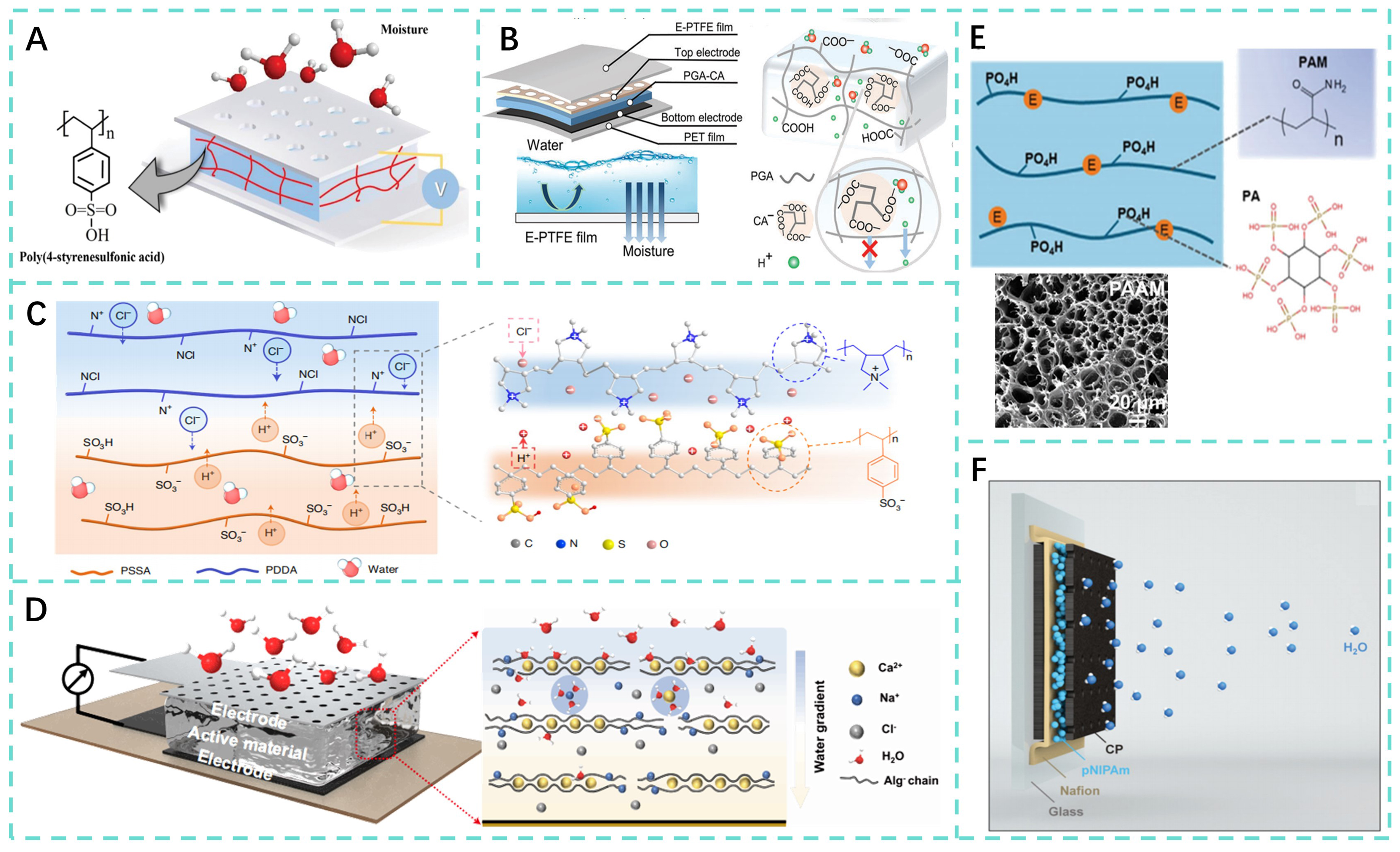
Figure 4. Organic materials for MEGT. (A) PMEG based on PSSA[108]. Reproduced with permission. Copyright 2019, Royal Society of Chemistry; (B) Schematic illustration of engineered hydrogel-based device and molecular structure and ion confinement in PGA-CA hydrogel[54]. Reproduced under CC BY license from Daozhi Shen, 2024, Advanced Science; (C) Moisture electric generation process inside BPFs structure[105]. Reproduced with permission. Copyright 2021, Springer Nature Limited; (D) Structure of green device based on supramolecular hydrogel[109]. Reproduced under CC BY license from Su Yang, 2024, Nature Communications; (E) Structure of electric generation hydrogel and SEM image of PAM hydrogel[55]. Reproduced with permission. Copyright 2024, John Wiley & Sons; (F) Schematic diagram of device based on the IPHC structure[60]. Reproduced with permission. Copyright 2022, Royal Society of Chemistry. MEGT: Moisture-electric generation textile; PMEG: polymer moisture electric generator; PSSA: poly(4-benzenesulfonic acid); PGA-CA: polyglutamic acid-citric acid; BPFs: bilayer polymer films; SEM: scanning electron microscopy; IPHC: ionic polymer-hydrogel-carbon composite; E-PTFE: expanded polytetrafluoroethylene; PET: poly (ethylene terephthalate); PAM: polyacrylamide; PA: phytic acid; CP: carbon paper.