




Tuning hydride stability in TiVZrNb high-entropy hydrogen storage alloys via alloy-hydrogen electronegativity difference
 0
0 Abstract
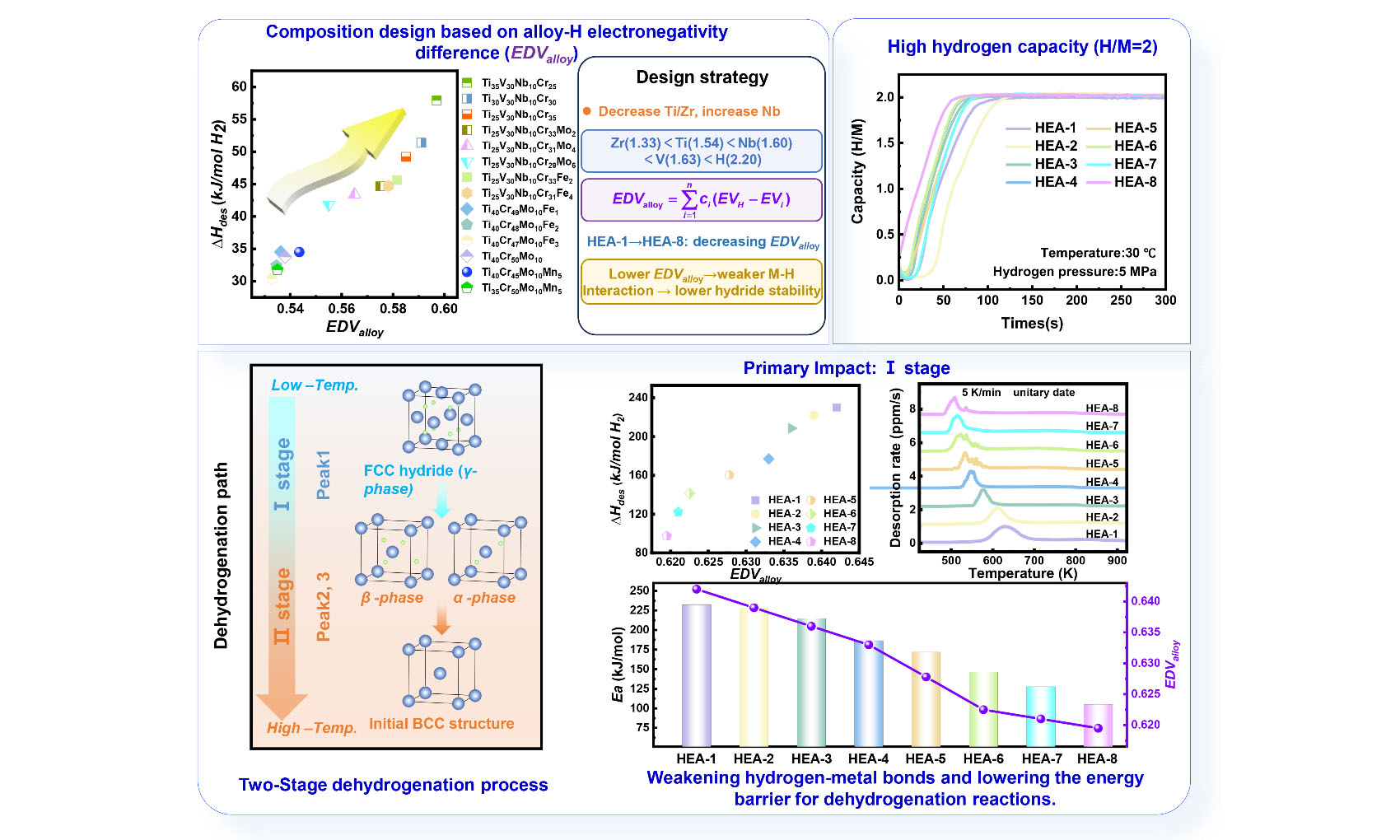
TiVZrNb-based body-centered cubic (BCC) hydrogen-storage high-entropy alloys (HEAs) possess high hydrogen storage capacity. However, the high thermodynamic stability of their hydrides results in elevated dehydrogenation temperatures, limiting their practical applications. Microstructural parameter tuning offers a powerful route to optimize hydrogen storage behavior. To achieve effective thermodynamic control of hydrogen desorption, this study, based on statistical analysis of previous data on single-phase BCC hydrogen storage HEAs, found that compared to valence electron concentration (VEC), lattice constants, and lattice distortion (δ), the average electronegativity difference between the alloy and hydrogen (EDValloy) exhibits a clearer positive correlation with desorption enthalpy (ΔHdes). Based on this, the HEA-1 to HEA-8 series of hydrogen storage alloys were designed using EDValloy as the compositional parameter for thermodynamic control of hydrogen desorption. The results show that all alloys exhibit a single-phase BCC structure and maintain a high hydrogen storage capacity (H/M = 2). As the EDValloy of the alloys decreased from 0.6420 to 0.6195, ΔHdes decreased from 230.3 kJ/mol H2 to 97.3 kJ/mol H2, indicating a significant reduction in the thermodynamic stability of the hydride. Thermal desorption spectroscopy (TDS) analysis further revealed that the reduction in EDValloy shifts the main dehydrogenation peak toward lower temperatures and lowers the apparent activation energy (Ea) for the decomposition of hydrogen-rich dihydrides. The results confirm the feasibility of using EDValloy to control the thermodynamic parameters of hydrogen release in single-phase BCC hydrogen-storage HEAs and provide a viable approach for designing low-temperature hydrogen-releasing high-entropy hydrogen-storage alloys.
Keywords
INTRODUCTION
Due to its high energy density, clean nature, and wide availability, hydrogen is considered one of the key enablers of the transition to a low-carbon energy system[1-3]. However, hydrogen is highly flammable and has a low volumetric density at room temperature and standard pressure, making safe and efficient hydrogen storage and transportation technologies critical challenges to its widespread adoption[4,5]. Compared to high-pressure gaseous and cryogenic liquid hydrogen storage, metal hydride hydrogen storage offers advantages such as high volumetric hydrogen storage density, good safety, and reversible hydrogen absorption and desorption, making it a subject of widespread attention in the field of solid-state hydrogen storage[6]. Compared to traditional hydrogen storage alloys, hydrogen-storage high-entropy alloys (HEAs) possess high configurational entropy and a broad range of compositional control, providing new insights into metal hydride hydrogen storage materials[7,8]. Among these, BCC hydrogen-storage HEAs, due to their lattice chemical disorder and diverse local chemical environments, can provide abundant tetrahedral and octahedral voids for hydrogen atoms, thereby offering the potential for higher hydrogen storage capacities than traditional BCC alloys[9-11]. Consequently, BCC high-entropy hydrogen storage alloys are considered a significant research direction for high-capacity solid-state hydrogen storage materials.
The TiVZrNb-based BCC HEA is a typical high-capacity hydrogen-storage alloy system[12]. All elements in this system are strong hydride-forming elements that readily form a body-centered cubic (BCC) solid solution structure. After hydrogen absorption, they can form hydrogen-rich hydrides with a hydrogen-to-metal atom ratio (H/M) approaching 2, thereby exhibiting a high theoretical hydrogen storage capacity[13-15]. At the same time, the elemental composition of this system can be continuously adjusted over a wide range, providing an excellent platform for studying the relationships between alloy composition, phase structure, and hydride stability. For example, the multi-component alloy Ti0.325V0.275Zr0.125Nb0.275 reported by Montero et al.[16] can form a single-phase BCC structure and exhibits reversible hydrogen absorption and desorption behavior, demonstrating that the TiVZrNb system has good potential for hydrogen storage applications. However, while strong metal-hydrogen interactions endow the alloy with high hydrogen absorption capacity, they also lead to excessive thermodynamic stability of the hydrides, manifested as a high desorption enthalpy, a low plateau pressure, and a high desorption temperature[17-19]. This issue limits the practical application of TiVZrNb-based BCC hydrogen-storage HEAs for reversible hydrogen storage at low and medium temperatures. Therefore, effectively regulating the thermodynamic stability of hydrides while maintaining a single-phase BCC structure and high hydrogen storage capacity is a key issue in the composition design of this system.
Currently, semi-empirical parameters of some HEAs, such as VEC[20], lattice constants[21], and δ[22], are closely related to their hydrogen storage performance. Among these, VEC is commonly used to assess the tendency for phase formation[23,24]; the atomic size difference reflects the ability to form a solid solution and the degree of lattice distortion[25,26]. Lattice constants are closely related to interstitial size and the space occupied by hydrogen[21,27]. Somo et al.[28] reported that the hydrogen storage performance of BCC-structured hydrogen storage alloys shows a relatively weak correlation with atomic size difference but exhibits a certain degree of correlation with the alloy’s VEC. Nygård et al.[20] proposed that the hydride stability of high-entropy alloys can be regulated via VEC, providing an important basis for designing the electron concentration of hydrogen-storage HEAs. Furthermore, Jiang et al.[29] proposed that hydrogen affinity (ΔHaff) can serve as a physical descriptor for high-entropy hydrogen storage alloys. They demonstrated that it correlates well with the hydrogen binding energy, hydride formation enthalpy, and dehydrogenation temperature of BCC high-entropy alloys. However, these parameters mainly describe hydrogen storage behavior from the aspects of average electron concentration, lattice geometry, and atomic-size mismatch, and their ability to directly describe the thermodynamic stability of hydrides is still limited. Specifically, VEC mainly reflects the overall electron concentration and phase-forming tendency of the alloy, but it cannot directly describe the strength of metal-hydrogen bonding. The δ and lattice constants can reflect lattice distortion and the available interstitial space for hydrogen atoms, but they do not directly characterize the electronic interaction and charge-transfer tendency between alloy elements and hydrogen. Therefore, although these parameters are useful for alloy design, it remains difficult to use them alone to directly evaluate hydride stability and hydrogen desorption thermodynamics. Recently, Zhai et al.[21] summarized the research progress on BCC hydrogen storage alloys, concluding that electronegativity is a key factor influencing hydrogen storage performance, with the electronegativity difference serving as a measure of the strength of interactions between alloy elements and hydrogen. Since charge transfer during hydrogen absorption primarily occurs between alloy elements and H atoms, the EDValloy serves as a key indicator for understanding the alloy’s hydrogen storage behavior[30,31]. However, research on systematically regulating the thermodynamic stability of hydrides in BCC hydrogen storage HEAs based on the EDValloy remains relatively limited. Therefore, understanding the influence of the electronegativity difference on hydride stability is of great significance for guiding the design of hydrogen storage alloys.
This paper first compiles data on previously reported single-phase BCC hydrogen storage HEAs and compares the relationships between EDValloy, VEC, lattice parameters, and δ with the enthalpy of ΔHdes to identify compositional descriptors that more effectively reflect thermodynamic trends in hydrogen desorption. The results indicate that EDValloy exhibits a clearer positive correlation with ΔHdes. Based on these findings, the HEA-1 to HEA-8 series of hydrogen storage alloys were designed and prepared using EDValloy as the thermodynamic control parameter for hydrogen desorption. All these alloys exhibit a single-phase BCC structure and maintain a high hydrogen storage capacity (H/M = 2). A decrease in EDValloy weakens the metal-hydrogen bond while simultaneously lowering the Ea of the dihydride decomposition, thereby reducing the hydride’s stability. Based on these findings, the feasibility of using EDValloy to regulate the thermodynamic parameters of hydrogen release in single-phase BCC high-entropy hydrogen storage alloys was confirmed, providing valuable guidance for the design of low and medium-temperature high-entropy hydrogen storage alloys.
EXPERIMENTAL
Sample preparation
The raw materials selected for this work (Ti, V, Zr, Nb) were small metal ingots, each with a purity better than 99.99 wt.% and purchased from Hebei Ancai New Material Technology Co., Ltd., China. Under an argon-protected atmosphere (99.999%, Linde Gas, China), a series of alloys with different compositions was prepared using the non-consumable vacuum arc melting method (SKY08K-102, Shenyang Scientific Instrument Research Center Co., Ltd., Chinese Academy of Sciences, China). To ensure compositional homogeneity, each ingot underwent at least four cycles of inversion and remelting. Subsequently, the as-cast alloy ingots were vacuum-sealed in quartz tubes, annealed at 1473 K for 2 h, and then water-quenched to obtain a uniform microstructure. The alloys are designated as HEA-1 to HEA-8 in descending order of their electronegativity difference. The physical parameters of the elements used in the calculations in this paper are shown in Supplementary Table 1[32].
Microstructural characterization
The heat-treated samples were cut into 5 mm × 5 mm × 3 mm specimens, and the test surfaces were polished with sandpaper to remove the oxide layer. The crystal structure and lattice parameters of the alloy were analyzed using an X-ray diffractometer (Rigaku SmartLab SE, Cu Kα radiation, Japan) with a 2θ range of 20-90°. These XRD patterns were mainly used for phase identification and comparison of the overall phase constitution. For lattice-constant refinement of HEA-1 to HEA-8, additional XRD patterns were collected at a slower scan rate of 2°/min. The diffraction data collected at 2°/min were refined using GSAS-II software with Rietveld refinement, incorporating instrument parameters, lattice constants, and preferred orientations. The XRD patterns of the hydrogenated samples with different hydrogen contents were also collected at a scan rate of 2°/min. To further characterize the microstructure and composition distribution, the heat-treated specimens were hot-embedded and polished to a mirror finish. Subsequently, observation and analysis were performed using a scanning electron microscope (Sigma 300 Carl Zeiss Microscopy GmbH, Germany) equipped with an energy-dispersive spectrometer (EDS, Oxford Instruments, United Kingdom). Imaging employed a backscattered electron (BSE) detector at 20 kV acceleration voltage, 15 spot size, and 10 mm working distance to clearly reveal grains and grain boundaries.
Hydrogen storage measurements
The heat-treated samples were cut into 4 mm × 4 mm × 4 mm specimens and polished with sandpaper to remove the oxide layer, preparing them for subsequent hydrogen storage performance testing. High-purity H2 gas (99.999%, Linde Gas, China) was used for all hydrogen absorption/desorption and pressure-composition isotherm (PCT) measurements. Alloy activation, hydrogen absorption/desorption kinetics, and PCT tests were conducted using a fully automated Sieverts-type apparatus (H2PCT-22101, GASTOUCH, Yangzhou University, China). The hydrogen uptake/release amount was calculated from the pressure-volume-temperature data obtained using the Sieverts-type apparatus. To improve the accuracy of the hydrogen capacity calculation, the system’s dead volume was calibrated before measurement, and the amount of hydrogen gas was calculated using the real-gas equation n = PV/(ZRT), where Z is the compressibility factor of hydrogen at the corresponding temperature and pressure. The specific experimental procedure is as follows: First, approximately 1.0 g of alloy sample was used for each PCT measurement. The sample was weighed and dynamically evacuated at 673 K for 2 h under a dynamic vacuum level of 10-4 MPa (approximately 100 Pa) for activation. After cooling to 303 K, the initial hydrogen-uptake kinetics test was conducted at 5 MPa hydrogen pressure. Following hydrogen uptake, the sample was heated to 773 K for high-temperature dehydrogenation to prepare for subsequent PCT testing at different temperatures. To eliminate residual hydrogen effects on test results, the high-temperature dehydrogenation step was repeated before each PCT test. Due to significant variations in plateau pressure among different alloy samples and the difficulty of hydrogen desorption below 0.001 MPa, the PCT test temperature was controlled to maintain the hydrogen absorption/desorption plateau pressure within approximately 0.001-10 MPa for each sample, ensuring a complete PCT curve (actual test temperature was determined by the plateau region temperature due to potential fluctuations during testing). Additionally, a thermal desorption spectrometer (TDS: G8 GALILEO, Bruker, AXS GmbH, Germany) was used to perform programmed-temperature desorption tests on samples after the initial hydrogen-uptake kinetics. For each TDS measurement, approximately 0.1 g of hydrogenated sample was used according to the standard sample-mass requirement of the instrument. The heating rates were set at 5 K/min, 10 K/min, 15 K/min, and 20 K/min to analyze their hydrogen desorption behavior.
RESULTS
Alloy composition design based on the control of the electronegativity difference
The primary issue facing TiVZrNb-based hydrogen-storage HEAs is excessively high hydrogen-release temperatures, a problem fundamentally caused by the alloy’s hydrides’ high stability[33]. Therefore, effectively regulating the thermodynamic behavior of hydrogen release is crucial for the practical application of these alloys. In hydrogen-storage HEAs, the equilibrium pressure for hydrogen absorption and desorption is a key parameter that describes the thermodynamic properties of hydrogen desorption. It is typically obtained by testing PCT curves at different temperatures. At a given temperature, a higher equilibrium pressure for hydrogen absorption and desorption indicates that the alloy is more difficult to hydrate and that the hydride is more prone to decomposition. However, for alloys with significant differences in hydrogen release thermodynamics, it is difficult to directly compare equilibrium pressures at the same temperature. Therefore, the relationship between temperature and decomposition pressure is typically derived by fitting the Van’t Hoff equation to equilibrium pressure data at different temperatures, which is then used to calculate the reaction entropy and enthalpy of hydride formation[34]. The Van’t Hoff equation is given in[22]:
where P is the equilibrium pressure for hydrogen absorption/desorption, T is the test temperature, R is the ideal gas constant [8.314 J/(mol·K)], and ΔS and ΔH are the reaction entropy and reaction enthalpy of the corresponding hydrogen absorption or desorption process, respectively. A larger absolute value of ΔH indicates that the hydride is more stable and that the energy required for dehydrogenation is higher. Therefore, ΔH can accurately reflect the thermodynamic performance of the alloy during hydrogen desorption. However, determining ΔH typically relies on lengthy PCT testing or complex theoretical calculations. Therefore, it is necessary to identify empirical parameters that predict thermodynamic trends in hydrogen release as a function of alloy composition to guide the design of hydrogen-storage HEAs with a BCC structure.
Previous studies have shown that several key parameters of high-entropy alloys, such as electronegativity difference[21], VEC[35], lattice constants[21], and lattice distortion (δ)[36], are closely related to their thermodynamic properties of hydrogen release. Among these, the average electronegativity difference between the alloy and hydrogen can be used to describe the average electronic interaction between them. EDValloy can be calculated using[21]:
where ci is the concentration of element i in the alloy, and EVi and EVH are the Pauling electronegativities of element i and hydrogen, respectively. Since the electronegativities of the elements in this study are all lower than that of hydrogen, a larger EDValloy value indicates a greater average electronegativity difference between the alloy and hydrogen. VEC is the average valence electron count of each element, calculated as follows[35]:
The lattice distortion (δ) is calculated as given in[36]:
where ri is the atomic radius of element i, and is the average atomic radius. To investigate the relationship between the above parameters and the thermodynamics of hydrogen release, this section performs a statistical analysis of 14 hydrogen-storage HEAs previously reported by our research group. The selection criteria are as follows: (1) The alloy must have a single-phase BCC structure to eliminate the interference of multi-phase structures on the thermodynamics of hydrogen release; (2) Alloys previously reported by our research group were selected to ensure consistency in preparation processes and testing conditions, thereby reducing the impact of experimental errors on the correlation of parameters.
Based on the above selection criteria, the compiled data were plotted with the key parameters on the x-axis and the thermodynamic parameter ΔHdes on the y-axis. Linear fitting was then performed to quantitatively assess the correlations between different descriptors and ΔHdes; the results are shown in Figure 1. In Figure 1A, no clear pattern is observed in the variation of ΔHdes with lattice parameters. Figure 1B shows that lattice distortion exhibits a relatively weak correlation with ΔHdes compared with VEC and EDValloy. This indicates that lattice parameters or lattice distortion cannot accurately describe the thermodynamic changes in hydrogen release for these alloys. Figure 1D shows that ΔHdes decreases with increasing VEC. This suggests that a higher VEC reduces hydride stability to some extent, a trend consistent with the findings of Nygård et al.[20]. However, for some alloys, such as 3, 6, 7, and 8, the VEC values are all 5.1, yet the measured ΔHdes values differ significantly; similarly, alloys 9 and 13 both have a VEC of 5.25, yet their ΔHdes values differ. This indicates that a single global VEC parameter is insufficient to fully describe the thermodynamic differences in hydrogen release among alloys. This is because VEC is essentially the component-weighted average of the total valence-electron counts of the alloy’s elements, primarily reflecting the alloy’s overall average electron concentration. For hydrogen storage HEAs, even if different alloys have the same or similar global VEC values, their local chemical environments and d-orbital distributions may still differ significantly. Particularly in transition metal hydrides, the hybridization between the H 1s state and the metal d states has a significant impact on the M-H bond strength. In contrast, the global VEC struggles to distinguish the contributions of localized d states from different elements to hydrogen-occupancy stability[21,29,37]. Therefore, relying solely on the global VEC makes it difficult to accurately describe the thermodynamics of hydrogen release in alloys.
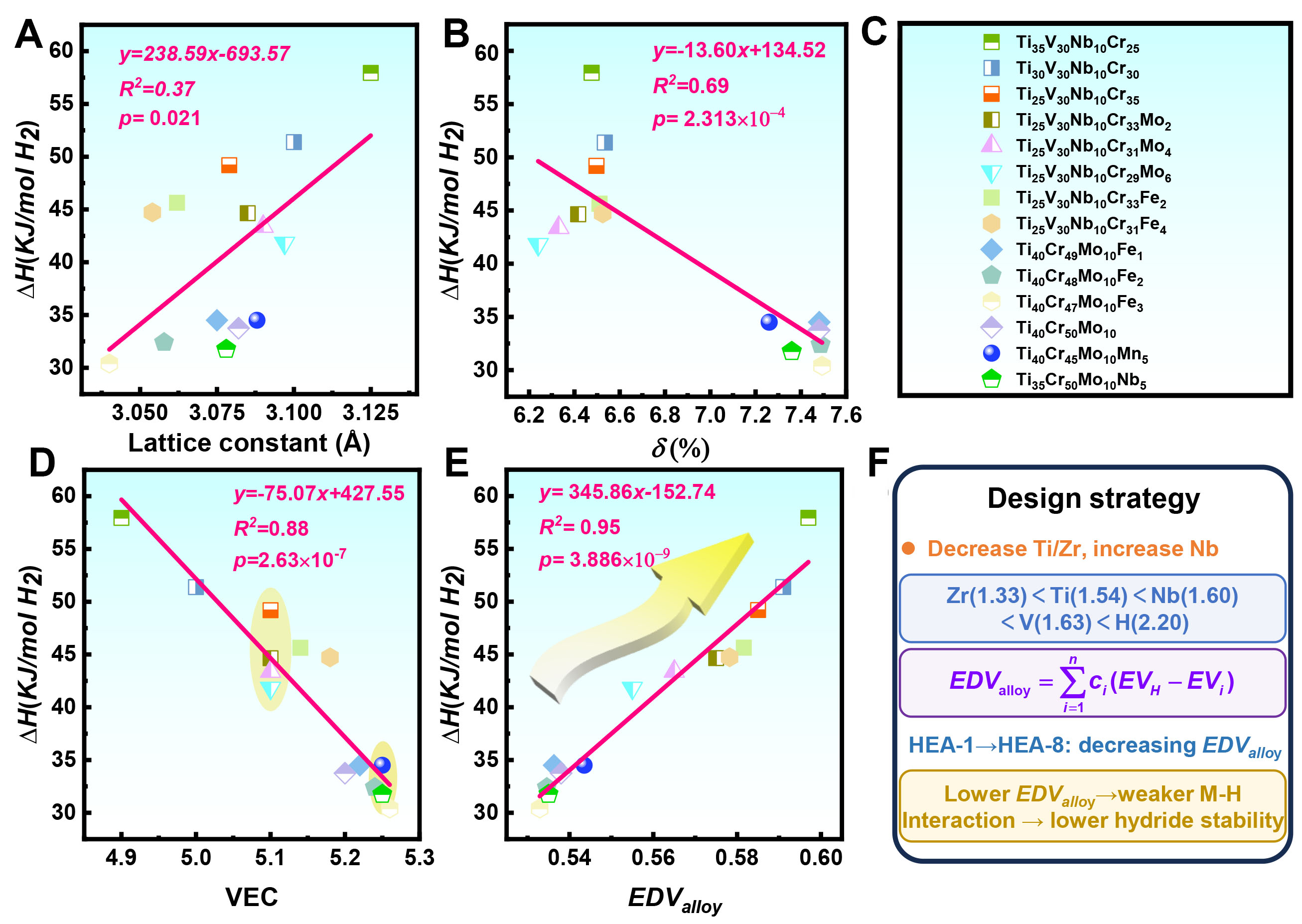
Figure 1. Correlation between the ΔHdes of single-phase BCC alloys reported in the literature and (A) lattice constants, (B) δ, (C) corresponding alloy composition, (D) VEC, and (E) EDValloy; (F) design strategy. The linear fitting results, including R2 and P-values, are shown in the corresponding panels. VEC: Valence electron concentration; ΔHdes: desorption enthalpy; EDValloy: electronegativity difference value of the alloy; HEA: high-entropy alloy; δ: lattice distortion; BCC: body-centered cubic.
In contrast, as shown in Figure 1E, ΔHdes increases almost monotonically with EDValloy and exhibits a higher correlation with the fitting than with the lattice constant, δ, and VEC. This quantitative comparison further indicates that EDValloy is more effective than the other descriptors in explaining alloys with similar VEC values but different hydride stability. The underlying physical mechanism can be explained in terms of charge transfer and M-H bonding: during hydrogen absorption and desorption, hydrogen interacts electronically with surrounding metal atoms, leading to partial charge transfer from the metal to hydrogen and the formation of M-H bonds that exhibit both ionic and covalent character. The greater the EDValloy, the stronger the driving force for electron transfer from the metal to hydrogen, the stronger the average M-H interaction, and the more stable the hydride; conversely, a smaller EDValloy indicates that the alloy’s average electronegativity is closer to that of hydrogen, weakening the driving force for electron transfer from the metal to hydrogen and reducing the average M-H bond strength, thereby promoting hydride destabilization[21,38,39]. Furthermore, hydrogen has an electronegativity of 2.2, while transition metals generally have electronegativities lower than 2.2; even among elements with the same VEC (such as V and Nb, both with VEC = 5), there are subtle differences in electronegativity[40]. Therefore, EDValloy can serve as an effective empirical parameter for describing the thermodynamic trends in hydrogen release in BCC hydrogen-storage HEAs. The phase structures, key parameters, and ΔHdes values of the 14 compiled alloys are summarized in Table 1.
The composition, phase structure, EDValloy, VEC, δ, and ΔHdes of the alloys reported in the literature
| Alloy | Composition (as reported) | Phase | EDValloy | VEC | a (Å) | δ (%) | ΔH [kJ/mol H2] | Ref. |
| 1 | Ti35V30Nb10Cr25 | BCC | 0.597 | 4.90 | 3.125 | 6.476 | 57.94 | [41] |
| 2 | Ti30V30Nb10Cr30 | BCC | 0.591 | 5.00 | 3.100 | 6.534 | 51.38 | [41] |
| 3 | Ti25V30Nb10Cr35 | BCC | 0.585 | 5.10 | 3.079 | 6.497 | 49.20 | [41] |
| 4 | Ti25V30Nb10Cr33Fe2 | BCC | 0.582 | 5.14 | 3.062 | 6.511 | 45.65 | [42] |
| 5 | Ti25V30Nb10Cr31Fe4 | BCC | 0.578 | 5.18 | 3.054 | 6.525 | 44.73 | [42] |
| 6 | Ti25V30Nb10Cr33Mo2 | BCC | 0.575 | 5.10 | 3.085 | 6.417 | 44.65 | [43] |
| 7 | Ti25V30Nb10Cr31Mo4 | BCC | 0.565 | 5.10 | 3.090 | 6.331 | 43.39 | [43] |
| 8 | Ti25V30Nb10Cr29Mo6 | BCC | 0.555 | 5.10 | 3.097 | 6.240 | 41.82 | [43] |
| 9 | Ti40Cr45Mo10Mn5 | BCC | 0.544 | 5.25 | 3.088 | 7.260 | 34.50 | [22] |
| 10 | Ti40Cr50Mo10 | BCC | 0.538 | 5.20 | 3.082 | 7.480 | 33.75 | [44] |
| 11 | Ti40Cr49Mo10Fe1 | BCC | 0.536 | 5.22 | 3.075 | 7.481 | 34.50 | [44] |
| 12 | Ti40Cr48Mo10Fe2 | BCC | 0.535 | 5.24 | 3.058 | 7.487 | 32.40 | [44] |
| 13 | Ti35Cr50Mo10Nb5 | BCC | 0.535 | 5.25 | 3.078 | 7.360 | 31.76 | [22] |
| 14 | Ti40Cr47Mo10Fe3 | BCC | 0.533 | 5.26 | 3.040 | 7.494 | 30.40 | [44] |
Based on the above analysis, thermodynamic control of BCC hydrogen storage HEAs in the TiVZrNb system was further conducted using EDValloy composition design parameters. The design objective was to moderately reduce the stability of alloy hydrides while maintaining a single-phase BCC structure and high hydrogen storage capacity, thereby improving hydrogen release performance. In the TiVZrNb quaternary system, the Pauling electronegativities of the elements are, in order: Zr = 1.33, Ti = 1.54, Nb = 1.60, and V = 1.63, all of which are lower than the electronegativity of H (2.20). Among these elements, Zr and Ti have relatively lower electronegativities and therefore contribute to a larger average electronegativity difference between the alloy and H. In contrast, Nb and V have relatively higher electronegativities, and increasing the Nb content raises the alloy’s average electronegativity and reduces EDValloy [Figure 1F]. Therefore, this study employs a method to reduce the Ti/Zr content and increase the Nb content, thereby continuously regulating the EDValloy composition. Concurrently, the V content was fixed at 30 at. % in all alloys to minimize the impact of V content variations on the stability of the BCC phase and hydrogen storage capacity. The specific compositions and key parameters are shown in Table 2. As the Ti and Zr contents decrease, the alloy’s electronegativity difference gradually decreases; it is anticipated that the stability of the alloy hydrides will consequently weaken, thereby improving hydrogen desorption performance. Since the second phase significantly affects the hydrogen storage plateau and thermodynamic parameters - for example, the C14 Laves phase, Zr-rich phase, or other intermetallic compounds may introduce additional hydrogen absorption and desorption reaction processes - this study first requires the designed alloys to possess a stable single-phase BCC region during the composition design stage. To this end, the TCHEA6 database in Thermo-Calc software was used to predict the equilibrium phase compositions of HEA-1 to HEA-8. The calculation results are shown in Figure 2, indicating that all alloys exhibit a wide single-phase BCC temperature range near 1,473 K. Therefore, in this study, the as-cast alloys were subjected to homogenization annealing at 1,473 K followed by water quenching to obtain a single-phase BCC solid solution with uniform composition, thereby eliminating the interference of the second phase on the subsequent thermodynamic analysis of hydrogen release and further verifying the regulatory effect of EDValloy on the thermodynamics of hydrogen release in TiVZrNb BCC hydrogen-storage HEAs.
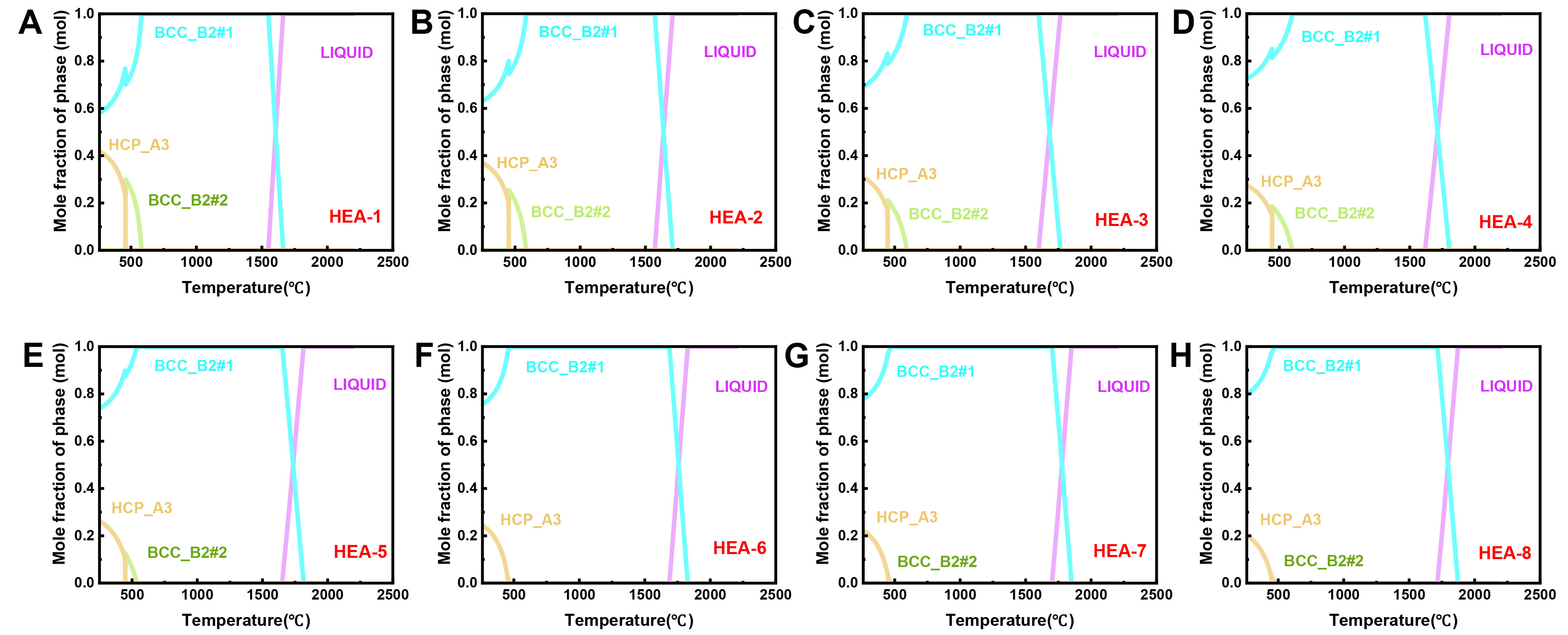
Figure 2. Phase diagrams for HEA-1 to HEA-8 alloys calculated using Thermo-Calc software: (A) HEA-1, (B) HEA-2, (C) HEA-3, (D) HEA-4, (E) HEA-5, (F) HEA-6, (G) HEA-7, and (H) HEA-8. BCC_B2#1 and BCC_B2#2 denote two distinct composition sets of the BCC/B2 thermodynamic phase model generated by Thermo-Calc; HCP_A3 denotes the hexagonal close-packed solid-solution phase; and LIQUID denotes the liquid phase. BCC: Body-centered cubic; HCP: hexagonal close-packed; HEA: high-entropy alloy.
Atomic ratios, EDValloy, VEC, and δ for alloys HEA-1 to HEA-8
| Alloy | Composition | EDValloy | VEC | δ (%) |
| HEA-1 | Ti40V30Zr10Nb20 | 0.6420 | 4.5 | 5.99 |
| HEA-2 | Ti35V30Zr10Nb25 | 0.6390 | 4.55 | 5.97 |
| HEA-3 | Ti30V30Zr10Nb30 | 0.6360 | 4.6 | 5.94 |
| HEA-4 | Ti25V30Zr10Nb35 | 0.6330 | 4.65 | 5.92 |
| HEA-5 | Ti27.5V30Zr7.5Nb35 | 0.6278 | 4.65 | 5.59 |
| HEA-6 | Ti30V30Zr5Nb35 | 0.6225 | 4.65 | 5.22 |
| HEA-7 | Ti27.5V30Zr5Nb37.5 | 0.6210 | 4.675 | 5.19 |
| HEA-8 | Ti25V30Zr5Nb40 | 0.6195 | 4.70 | 5.17 |
Phase structure and microstructure
Figure 3 and Supplementary Figures 1 and 2 show the X-ray diffraction (XRD) spectrum of alloys HEA-1 to HEA-8. As shown in the Figure 3A, all alloys exhibit only characteristic diffraction peaks of the BCC structure. The peaks at approximately 2θ = 40°, 56°, and 71° correspond to the (110), (200), and (211) crystal planes of the BCC structure, respectively; no diffraction peaks from a second phase were observed. The lattice parameters of the alloys were refined using the Rietveld method with GSAS-II software, and the results are listed in Supplementary Table 2. As the Nb content increased, and the Zr and Ti contents decreased, the lattice parameter a of the alloy decreased from 3.2594 Å to 3.2458 Å. This is because Nb partially substitutes for Zr and Ti, and the atomic radius of Nb (1.429 Å) is smaller than that of Zr (1.603 Å) and Ti (1.462 Å), resulting in a decrease in the average atomic radius of the alloy and a more compact lattice packing, thereby reducing the lattice parameters.
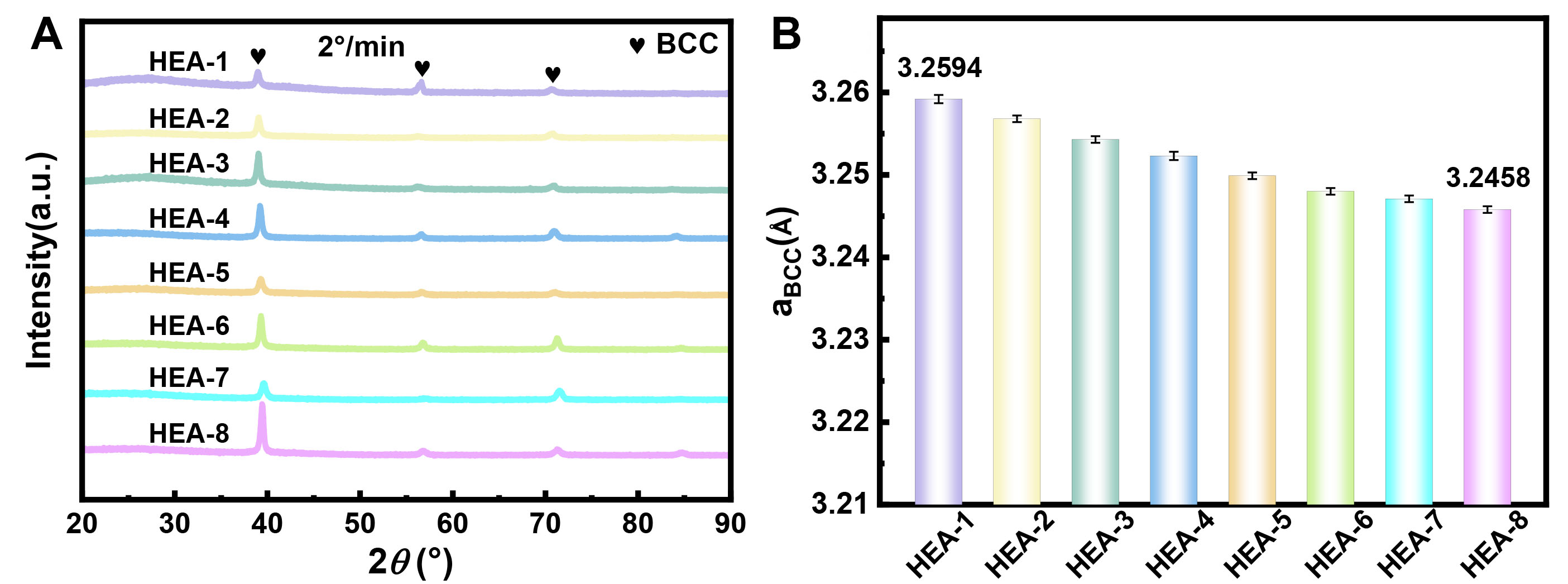
Figure 3. (A) XRD patterns of HEA-1 to HEA-8 collected at a scan rate of 2°/min; (B) corresponding lattice parameters obtained by GSAS-II refinement. Error bars in (B) represent the standard uncertainties obtained from GSAS-II refinement. BCC: Body-centered cubic; HEA: high-entropy alloy; XRD: X-ray diffraction; GSAS-II: General Structure Analysis System II.
To further characterize the microstructure of the alloys, BSE and energy-dispersive X-ray spectroscopy (EDS) analyses were performed on the heat-treated alloys; the results are shown in Figure 4. The microstructure of all alloys (HEA-1 to HEA-8) exhibited an approximately equiaxed grain structure. Due to differences in crystal orientation between grains, distinct contrast differences were observed in the backscattered electron images, allowing for clear identification of grain boundaries. No second phase was detected, further confirming that the alloys have a single-phase BCC structure, consistent with the XRD results. The corresponding EDS results
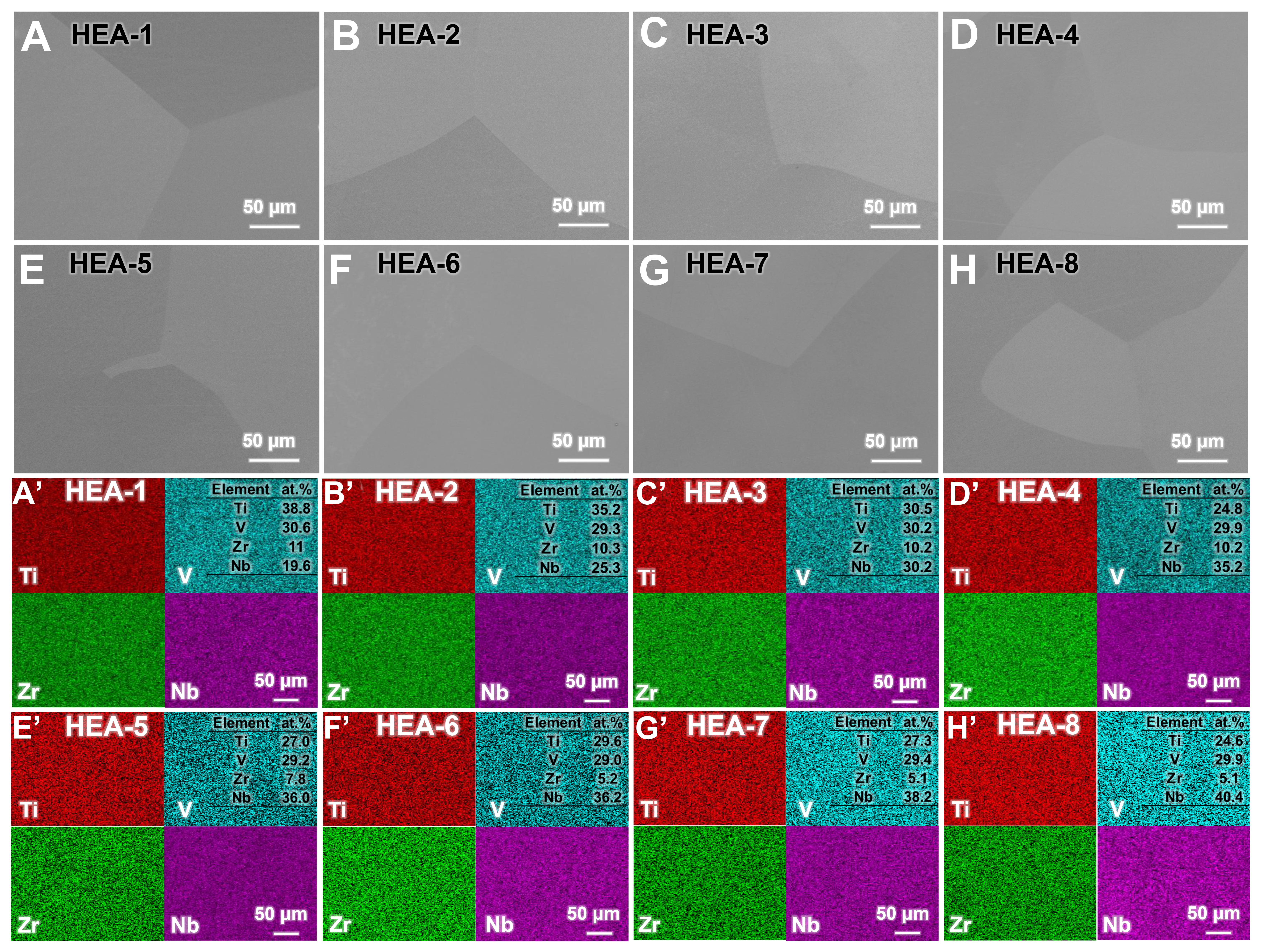
Figure 4. The BSE images (A-H) and the corresponding EDS maps (A’-H’) of HEA-1 to HEA-8 alloys. HEA: High-entropy alloy; BSE: backscattered electron; EDS: energy-dispersive X-ray spectroscopy.
Hydrogen absorption kinetics
To investigate the alloy’s hydrogen storage capacity, hydrogen absorption kinetics tests were conducted on heat-treated samples. Figure 5 shows the hydrogen absorption kinetics curves for the activated samples at 303 K and 5 MPa hydrogen pressure. As shown in the figure, all samples exhibited rapid hydrogen absorption kinetics, reaching their saturated hydrogen storage capacity within 150 s. Among them, HEA-8 demonstrated the most outstanding hydrogen absorption kinetics, reaching its saturated hydrogen storage capacity in just 75 s. It is worth noting that no significant correlation was observed between hydrogen absorption kinetics and the electronegativity difference, indicating that, within the composition range studied, reducing the EDValloy did not have a significant adverse effect on the alloy’s rapid hydrogen absorption behavior. Although some fluctuations were observed among the intermediate alloys, the gravimetric hydrogen storage capacity showed an overall decreasing trend from 3.12 wt.% for HEA-1 to 2.86 wt.% for HEA-8 as EDValloy decreased. This trend is primarily attributed to differences in the relative atomic masses of the elements. When the mass hydrogen storage capacity is converted to the hydrogen-to-metal atomic ratio (H/M), the H/M values for HEA-1 to HEA-8 were 2.00, 2.01, 2.01, 2.01, 2.02, 2.01, 2.02, and 2.02, respectively. The repeated initial hydrogen absorption measurements used to calculate the standard deviations of the H/M values in Figure 5B are shown in Supplementary Figure 5. These values are significantly higher than the H/M value (1.75) reported by Montero et al.[16] for the Ti0.325V0.275Zr0.125Nb0.275 alloy, reaching the theoretical maximum H/M value for high-entropy alloys with a BCC structure, indicating that the optimized alloys in this series possess excellent hydrogen storage capacity.
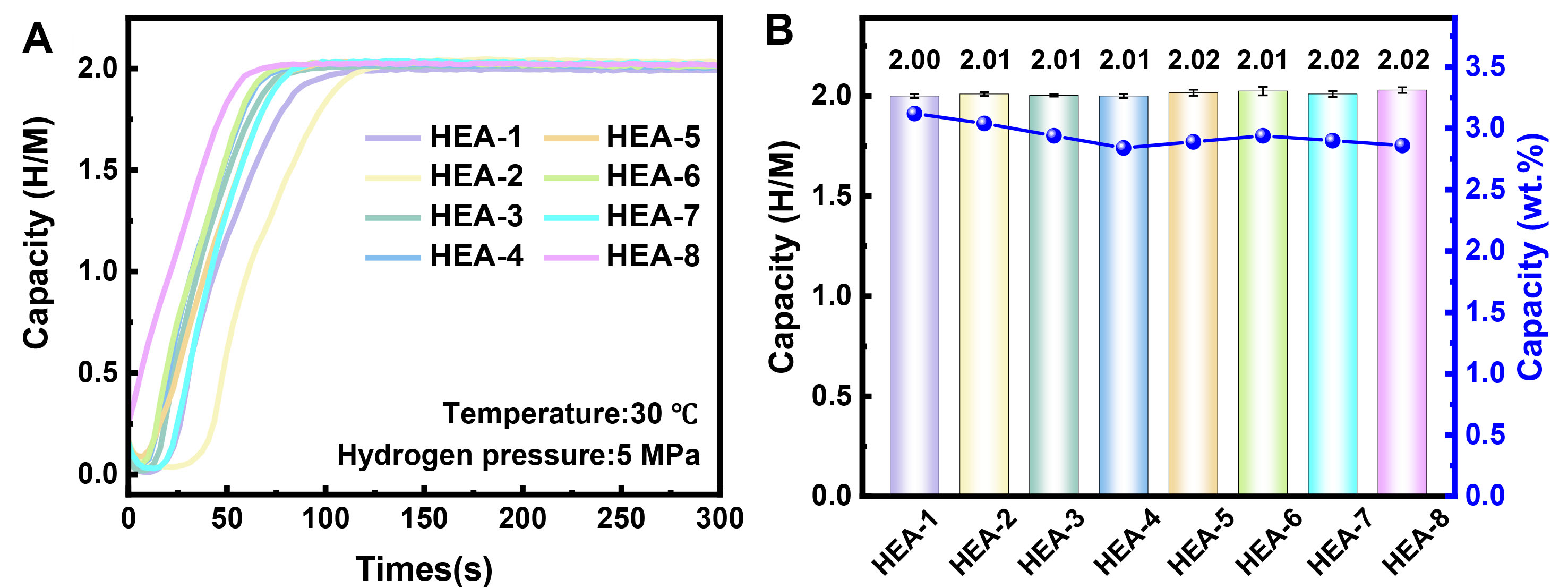
Figure 5. (A) Initial hydrogen absorption kinetics curves for activated alloys HEA-1 to HEA-8 at 303 K and 5 MPa hydrogen pressure, along with (B) their mass hydrogen storage capacity and H/M values. Error bars in (B) represent the standard deviations obtained from repeated Sievert measurements (n = 3 for HEA-1-HEA-5 and n = 2 for HEA-6-HEA-8). HEA: High-entropy alloy; H/M: hydrogen-to-metal atom ratio.
Hydrogen storage thermodynamics
To further investigate the thermodynamic properties of the alloy, PCT curves were measured at various temperatures [Figure 6] to verify whether EDValloy can effectively regulate hydride stability. Detailed thermodynamic parameters for hydrogen absorption and desorption are summarized in Supplementary Table 3. The PCT curves reveal that the thermodynamic behavior of the TiVZrNb alloy system is consistent with that of typical BCC hydrogen storage alloys, specifically exhibiting two plateau regions, indicating the presence of two hydrogen-induced phase transformations[11]. During the initial hydrogen absorption stage, hydrogen exists in the alloy’s interstitial sites in the form of a solid solution (α phase). When the hydrogen concentration reaches the alloy’s solubility limit, a hydrogen-induced phase transformation occurs, forming the β1 phase; at this point, the alloy enters the first plateau region (where the α phase and β1 phase coexist). Since the plateau pressure in this region is extremely low, exceeding the detection range of the instrument’s pressure accuracy, its plateau characteristics are not observed in Figure 6. As the hydrogen absorption process continues, the β1 phase gradually transforms into the β2 phase. Once the β1 phase has completely converted to the β2 phase, a further increase in hydrogen concentration initiates the formation of the γ phase, at which point the alloy enters the second plateau region (where the β2 and γ phases coexist)[45]. This plateau primarily reflects the alloy’s thermodynamic properties. It can also be observed that as the temperature rises, the alloy’s plateau pressure increases accordingly. This is because the hydrogen absorption process is exothermic, while the hydrogen desorption process is endothermic. The hydrogen absorption and desorption reactions are reversible; increasing temperature favors hydrogen desorption but hinders absorption. Therefore, for hydrogen absorption, a higher hydrogen pressure is required to drive the reaction forward, resulting in a higher plateau pressure. For hydrogen desorption, high temperatures are favorable, promoting hydride decomposition and hydrogen release[22,46]. Meanwhile, the absorption and desorption plateau pressures are clearly separated, indicating pronounced absorption-desorption hysteresis in this alloy series. This hysteresis is mainly associated with the β monohydride-γ dihydride transformation, which involves the structural transition between the BCC-type monohydride-related state and the hydrogen-rich face-centered cubic (FCC) dihydride state. During forward and reverse transformations, lattice expansion/contraction, lattice mismatch, elastic strain, interfacial energy, and distinct nucleation/interface migration barriers can lead to distinct driving forces for hydrogen absorption and desorption, resulting in separate absorption and desorption plateau pressures[47,48]. In addition, local lattice distortion and heterogeneous hydrogen site energies in the TiVZrNb solid solution may also contribute to plateau slope and hysteresis[49]. Additionally, the PCT curves show that the maximum hydrogen storage capacity (H/M) for all alloys is 2, consistent with the results of kinetic tests.
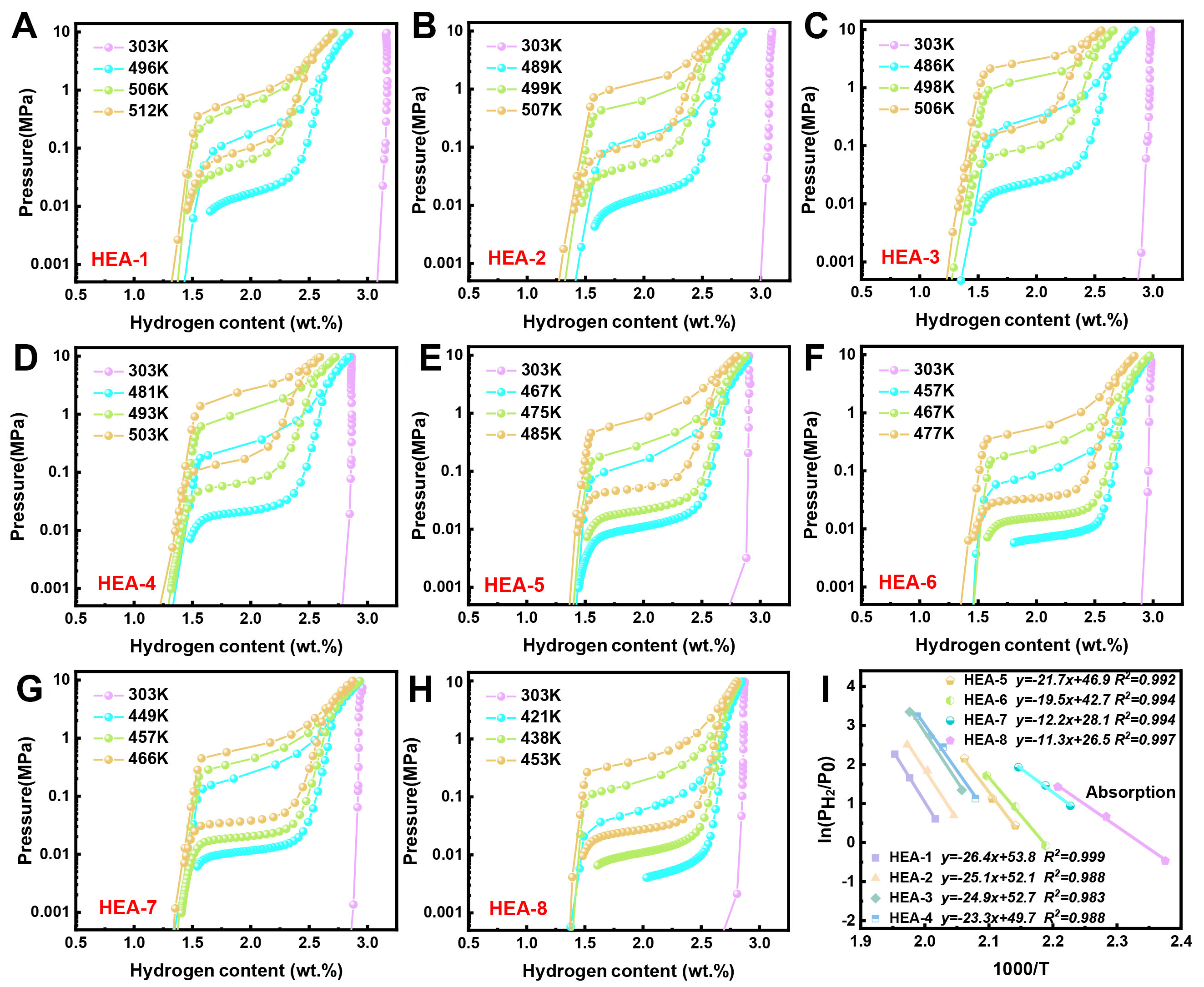
Figure 6. Complete hydrogen absorption-desorption PCT curves of (A) HEA-1, (B) HEA-2, (C) HEA-3, (D) HEA-4, (E) HEA-5, (F) HEA-6, (G) HEA-7, and (H) HEA-8 at different temperatures, together with (I) the Van’t Hoff fitting results obtained from the hydrogen absorption plateau pressures. HEA: High-entropy alloy; PCT: pressure-composition isotherm.
Due to significant differences in the thermodynamic parameters across all alloys, it is difficult to directly compare their pressure parameters at a given temperature. To more reasonably compare the relative stability of alloy hydrides, the enthalpy change (ΔH) and entropy change (ΔS) during the hydrogen absorption/desorption reactions were calculated using the Van’t Hoff equation (Equation 1). The actual PCT temperatures used for the Van’t Hoff analysis are listed in Supplementary Table 3 for each alloy. The 303 K curves shown in Figure 6 were used to illustrate the initial hydrogen absorption behavior and were not included in the Van’t Hoff fitting. Only the plateau pressures measured at the temperatures listed in Figures 6I and 7A show the Van’t Hoff fitting results for the hydrogen absorption and desorption processes, respectively. The entropy and enthalpy changes for the hydrogen absorption and desorption reactions were obtained from the slopes and intercepts of the linear fits [Supplementary Table 3]. Figure 7B further illustrates the relationship between the ΔHdes values of the HEA-1 to HEA-8 alloys and EDValloy. As EDValloy decreases from 0.6420 to 0.6195, ΔHdes decreases from 230.3 kJ/mol H2 to 97.3 kJ/mol H2, demonstrating a clear positive correlation between the two. Figure 7C summarizes the corresponding enthalpy changes for hydrogen absorption and desorption. This trend indicates that as the alloy composition is adjusted, hydride stability gradually decreases, the heat required for hydride decomposition decreases, and hydrogen desorption becomes increasingly thermodynamically favorable. This result is consistent with the earlier composition design prediction based on the electronegativity difference: reducing the average electronegativity difference between the alloy and H weakens the average M-H interaction, thereby reducing the thermodynamic stability of the hydride. From a compositional perspective, the Ti/Zr content gradually decreases from HEA-1 to HEA-8, while the Nb content gradually increases. Since Nb has a higher Pauling electronegativity than Ti and Zr, increasing the Nb content raises the alloy’s average electronegativity, thereby reducing the average electronegativity difference between the alloy and H. A smaller EDValloy value indicates a weakened driving force for average charge transfer from the metal to hydrogen and reduced M-H bond strength; consequently, the hydrogen-rich hydride phase decomposes more readily, as evidenced by a lower ΔHdes. To further compare the influence of different descriptors within the designed HEA-1 to HEA-8 series, the correlations between ΔHdes and EDValloy, VEC, lattice constant, and δ were analyzed by linear fitting, as shown in Figure 8. The corresponding R2 and p values were added to each panel to provide a quantitative comparison rather. Compared to VEC, lattice constant, and δ, EDValloy exhibits a clearer positive correlation with ΔHdes. This indicates that the alloy-hydrogen average electronegativity difference can effectively reflect the trend in the average M-H interaction strength in single-phase BCC alloys and serves as an effective empirical parameter for guiding the thermodynamic regulation of hydrogen release in BCC high-entropy hydrogen storage alloys. However, it must be noted that hydride stability is not determined solely by the EDValloy factor. In the HEA-1 to HEA-8 series, EDValloy changes together with VEC, δ, lattice parameter, Ti/Zr content, and Nb content, indicating that the effect of EDValloy is inevitably coupled with compositional and structural factors. In particular, the alloy’s lattice parameters can influence ΔHdes by affecting the interstitial space available for hydrogen occupation, the stability of hydrogen in interstitial sites, and the repulsive interactions between neighboring hydrogen atoms. In both the statistical data and the experimental results for HEA-1 to HEA-8 in this study, ΔHdes shows the strongest monotonic correlation with EDValloy. Meanwhile, the strong correlation between lattice constant and ΔHdes in Figure 8 also indicates that the lattice-size effect cannot be ignored in this composition series. Therefore, EDValloy is more suitable as a first-order empirical descriptor in composition design than as the sole parameter to completely replace structural and electronic factors. A more rigorous distinction between the contributions of EDValloy and lattice-related factors requires the design of control alloy series with decoupled electronegativity and lattice-size parameters. This will be an important direction for future work to further clarify the relative contribution of EDValloy to hydride stability.
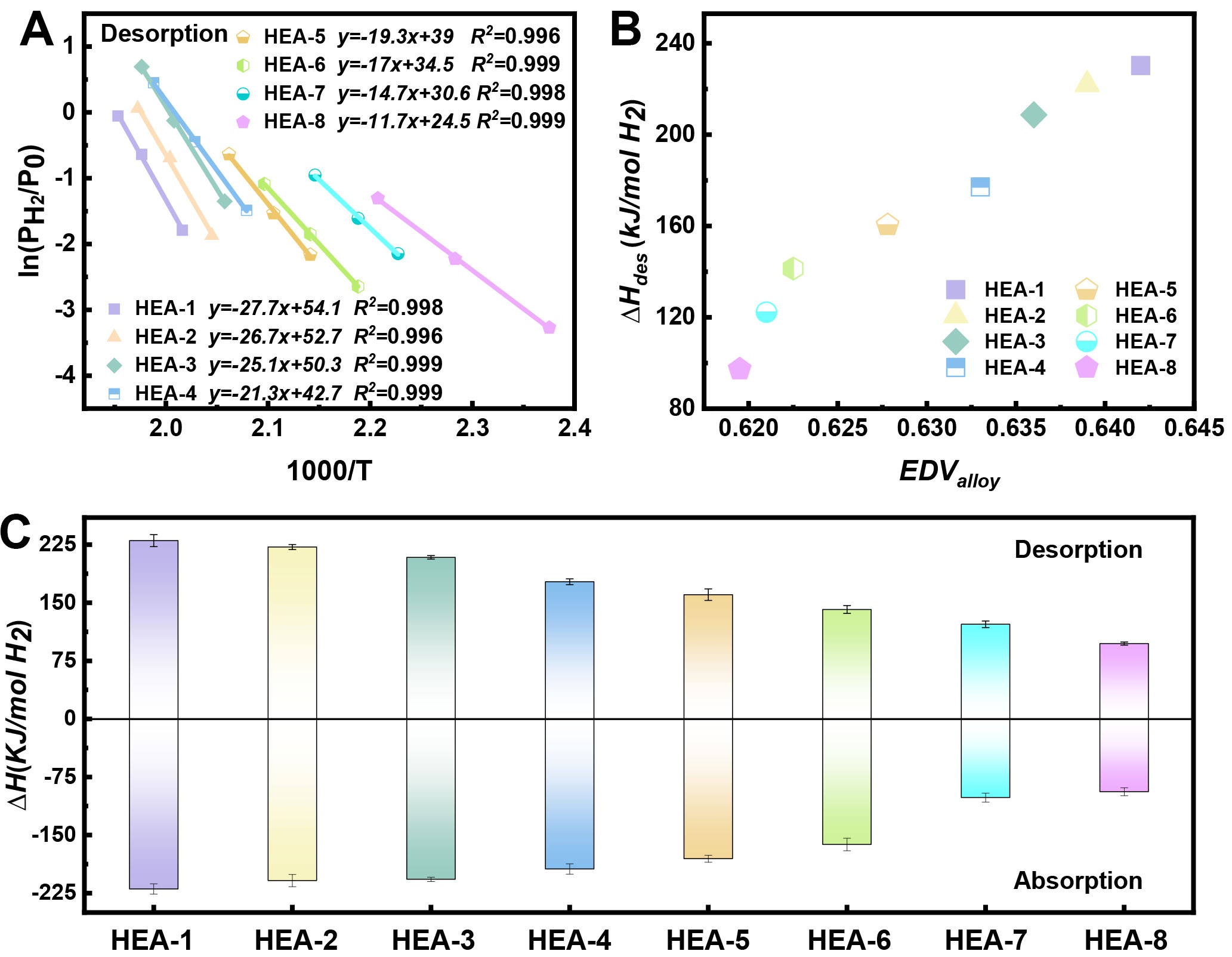
Figure 7. Van’t Hoff fitting of the hydrogen desorption process (A), the correlation between ΔHdes and EDValloy (B), and the corresponding enthalpy changes for hydrogen absorption and desorption (C) for alloys HEA-1 to HEA-8. Error bars represent the uncertainties calculated from the standard errors of the Van’t Hoff linear fittings. EDValloy: Electronegativity difference value of the alloy; HEA: high-entropy alloy; ΔHdes: desorption enthalpy.
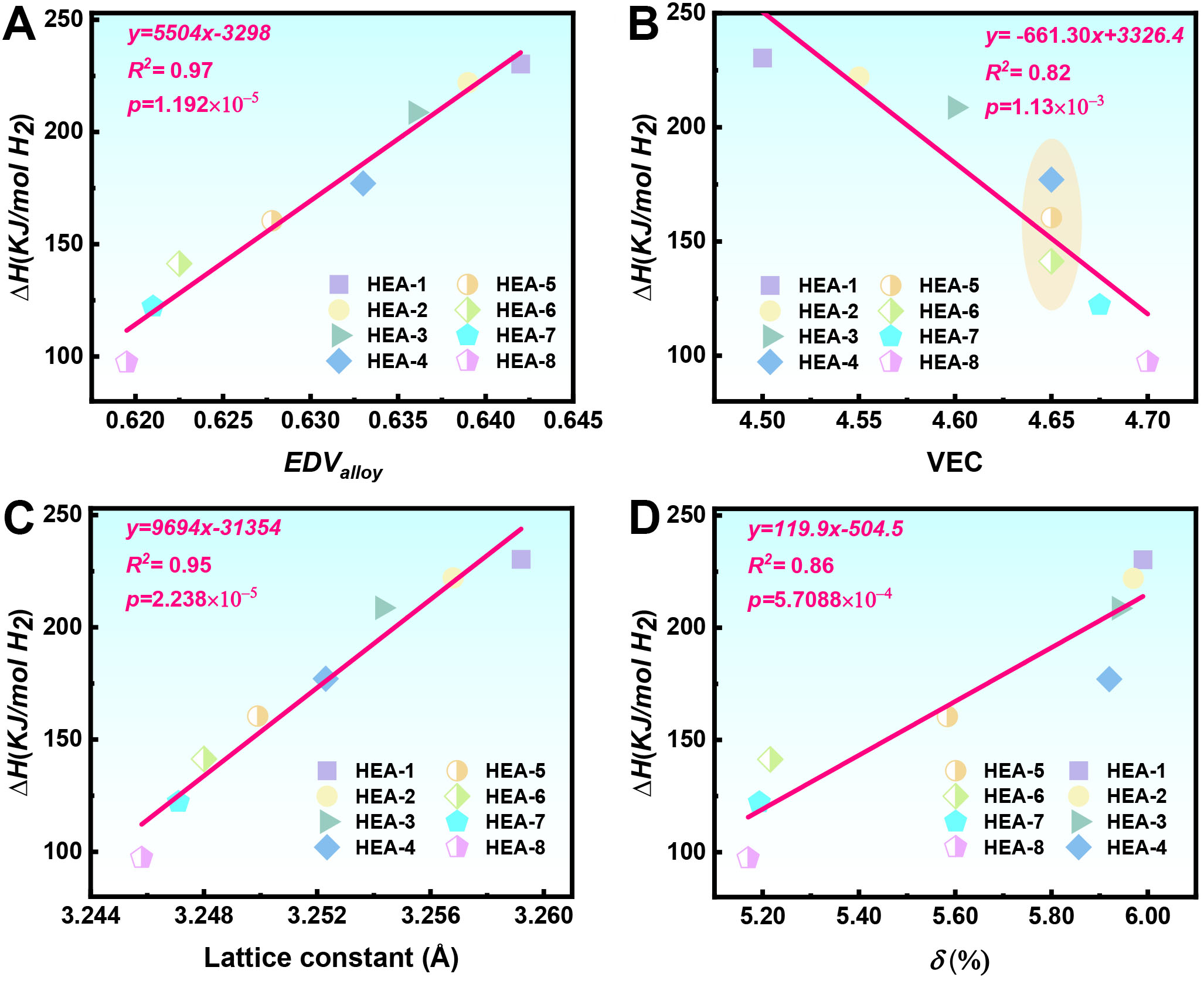
Figure 8. Correlation between the ΔHdes in HEA-1 to HEA-8 alloys, and their EDValloy (A), VEC (B), lattice constants (C), and δ (D). The linear fitting results, including R2 and P-values, are shown in the corresponding panels. HEA: High-entropy alloy; ΔHdes: desorption enthalpy; EDValloy: electronegativity difference value of the alloy; VEC: valence electron concentration; δ: lattice distortion.
Analysis of alloy dehydrogenation behavior
To further verify the influence of EDValloy on actual dehydrogenation behavior, TDS curves for alloys HEA-1 through HEA-8 were measured at a heating rate of 5 K/min [Figure 9], and all results were subjected to Gaussian peak deconvolution analysis. The results show that the TDS curves of all alloys can be decomposed into three hydrogen desorption peaks: a low-temperature peak (Peak 1) and high-temperature peaks (Peak 2 and Peak 3). This indicates that HEA-1 to HEA-8 exhibit similar multi-stage dehydrogenation processes, corresponding to the gradual decomposition of different hydride phases or distinct hydrogen-occupation states following hydrogen absorption.
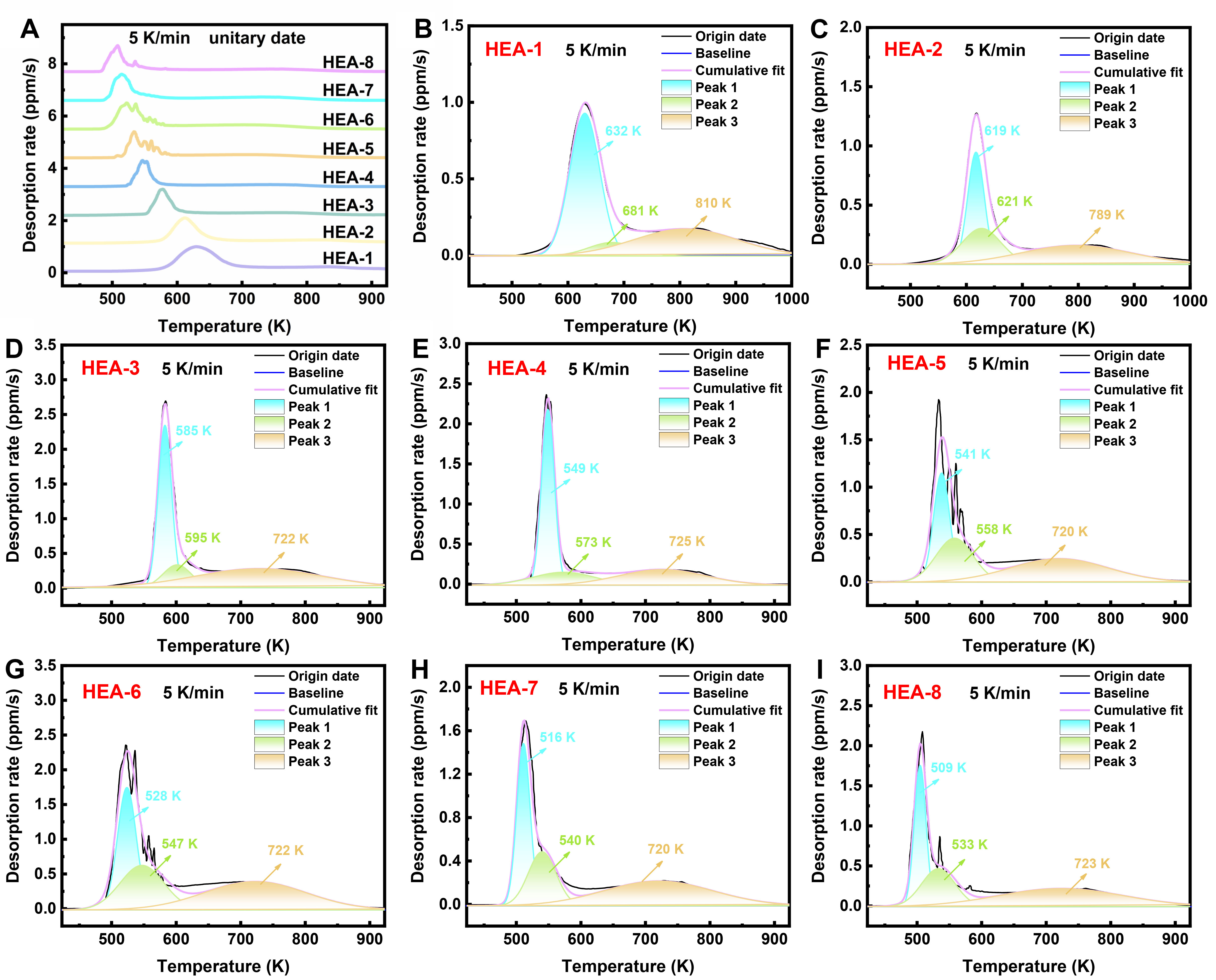
Figure 9. TDS of alloys HEA-1 to HEA-8 at a heating rate of 5 K/min: (A) comparison of TDS curves for different alloys; (B-I) peak fitting analysis of hydrogen desorption peaks. The curves in (A) are vertically offset for clarity. HEA: High-entropy alloy; TDS: thermal desorption spectroscopy.
It should be noted that the three-peak deconvolution was applied to the entire HEA-1 to HEA-8 alloy series, rather than being established solely from the hydrogen-content-dependent analysis of HEA-8. Since these alloys share the same constituent elements and differ primarily in their relative compositions, their principal hydrogen-induced phase transformations and dehydrogenation processes are expected to be similar, whereas hydride stability varies systematically with composition. The small sharp features observed near the low-temperature peak in HEA-5 to HEA-8 were not treated as independent desorption peaks. Since the TDS signal reflects the hydrogen release rate, these features may be related to transient fluctuations in the desorption rate caused by reduced hydride stability and accelerated low-temperature dehydrogenation. Therefore, the deconvolution focuses on the main desorption contributions rather than on every minor local fluctuation. As EDValloy decreases, the peak temperature of Peak 1 gradually decreases from 632 K in HEA-1 to 509 K in HEA-8, and the peak temperature of Peak 2 decreases from 681 K (HEA-1) to 533 K (HEA-8). This indicates that reducing EDValloy can significantly lower the dehydrogenation temperature of the main hydride phase, consistent with the observed reduction in ΔHdes in the Van’t Hoff analysis. In other words, as the average electronegativity difference between the alloy and H decreases, the average M-H interaction weakens, making the hydride more prone to decomposition during heating. In contrast, the peak temperature of Peak 3 shows little change from HEA-3 to HEA-8, indicating that the hydrogen release process corresponding to this peak is relatively insensitive to EDValloy.
To further clarify the structural transformation processes corresponding to each dehydrogenation peak in the TDS, HEA-8 - which exhibits the lowest thermodynamic stability for hydrogen release and the lowest dehydrogenation peak temperature - was selected as the representative sample for stepwise dehydrogenation analysis. Figure 10A shows the PCT curve of HEA-8 at 453 K. By controlling the cutoff hydrogen pressure during PCT testing, samples with hydrogen contents of 2.83, 1.88, 1.32, and 1.18 wt.% were obtained. TDS measurements determined the actual hydrogen content of the samples at each stage [Supplementary Figure 6], with the vertical axis representing the hydrogen release rate (ppm/s) and the horizontal axis representing time. By integrating over time, the actual hydrogen contents of the samples at each stage were determined to be 28,340, 18,840, 13,230, and 11,750 ppm (weight ppm, unless otherwise mentioned), with corresponding H/M atomic ratios of 2.00, 1.31, 0.92, and 0.81. At a heating rate of 5 K/min, TDS testing and Gaussian peak deconvolution were performed on samples with varying hydrogen content, and the results are shown in Figure 10B. The TDS curve of the MH2.00 sample can be decomposed into three hydrogen release peaks with peak temperatures of 509, 533, and 723 K; the MH1.31 sample also exhibits three hydrogen release peaks with peak temperatures of 551, 570, and 721 K; the MH0.92 sample decomposed into two hydrogen release peaks with peak temperatures of 586 and 725 K; the MH0.81 sample also exhibited two hydrogen release peaks with peak temperatures of 598 and 723 K. It can be seen that as the hydrogen content decreases, the peak hydrogen release rates gradually decrease. The areas of the hydrogen release peaks correspondingly shrink.
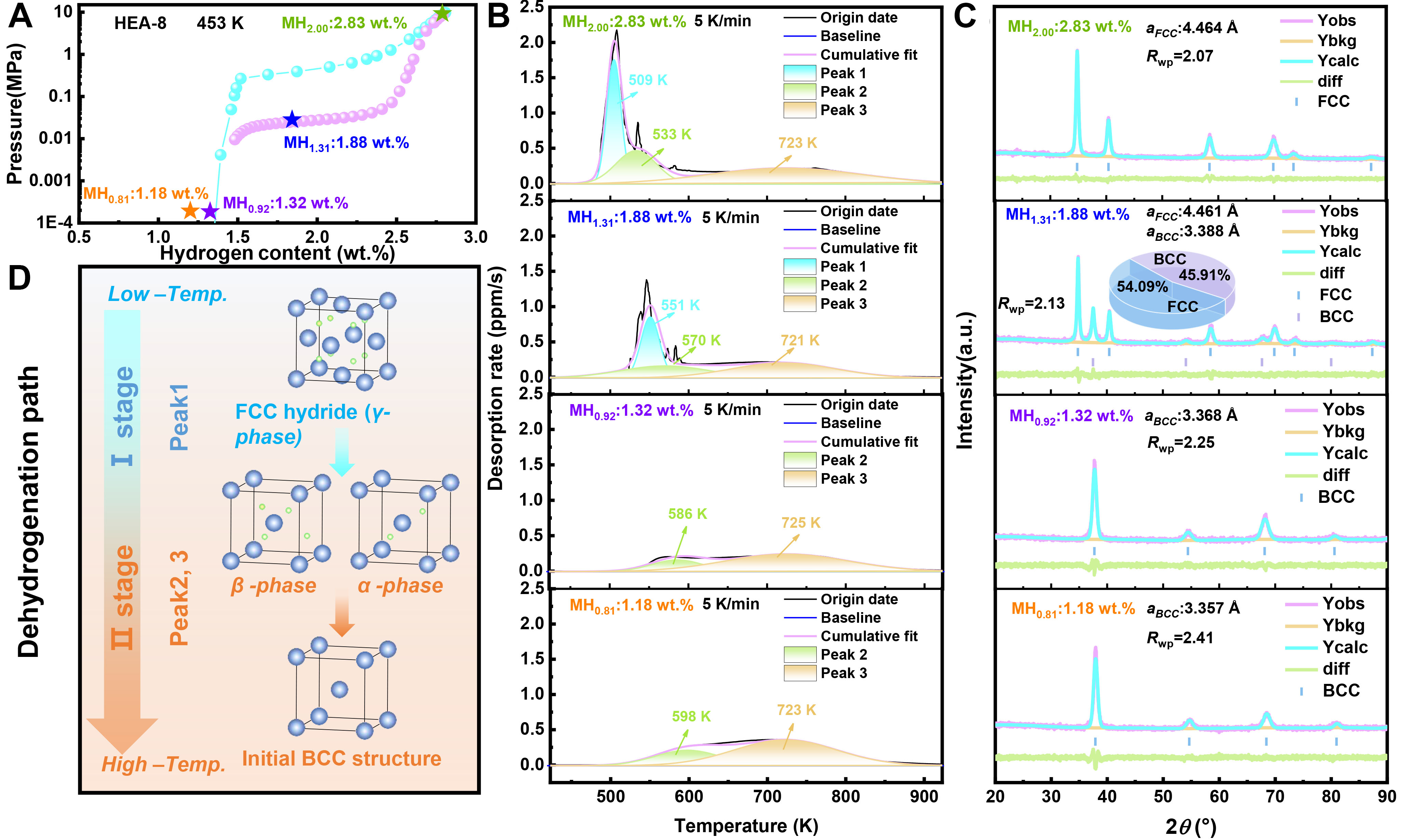
Figure 10. Analysis of the hydrogen absorption and desorption behavior of the HEA-8 alloy: (A) PCT curve at 453 K, (B) TDS spectra at different hydrogen contents, (C) corresponding XRD patterns, and (D) proposed hydrogen desorption processes corresponding to the different fitted peaks. HEA: High-entropy alloy; FCC: BCC: body-centered cubic; PCT: pressure-composition isotherm; TDS: thermal desorption spectroscopy; XRD: X-ray diffraction.
To further establish the correlation between the dehydrogenation peak and structural transitions, XRD measurements at a scan rate of 2°/min were performed on samples with different hydrogen contents, and the results are shown in Figure 10C. The diffraction pattern of the MH2.00 sample exhibits a single FCC structure with a lattice constant a = 4.464 Å, indicating that the sample is a dihydride (γ phase), consistent with previous reports[50]. Upon dehydrogenation to MH1.31, the sample exhibited coexistence of FCC and BCC phases, with the BCC phase having a lattice constant of 3.388 Å and the FCC phase’s lattice constant decreasing slightly to 4.461 Å. For BCC-based hydrogen storage alloys, the stability of the dihydride (FCC) is typically much lower than that of the monohydride (BCC); therefore, Peak 1 can be attributed to the dehydrogenation peak of the dihydride to the monohydride. Upon further hydrogen release to MH0.92, the sample’s FCC diffraction peak completely disappeared, transforming into a single BCC structure corresponding to the monohydride phase (β phase), with a lattice constant of a = 3.368 Å. At this point, Peak 1 completely disappeared, further confirming that it corresponds to the dehydrogenation of the dihydride. When hydrogen was released to MH0.81, the sample retained a single BCC structure, but the lattice constant decreased from 3.368 Å to 3.357 Å, due to lattice contraction caused by hydrogen release. By subjecting the sample to dynamic vacuum pumping at 773 K, a fully dehydrogenated sample can be obtained [Supplementary Figure 7], which reversibly recovers to the initial BCC structure, with a lattice constant similar to that of the original, hydrogen-unabsorbed sample. Based on the above results, Peak 2 is primarily attributed to hydrogen desorption from the monohydride (β phase). In contrast, Peak 3 may be associated with the further release of more stable residual hydrogen from the β phase and/or the BCC solid-solution α phase. Combining the above analyses, the hydrogen release pathway of the HEA-8 alloy can be qualitatively described as shown in Figure 10D: the low-temperature Peak 1 is mainly associated with the transformation of the FCC hydride (γ phase) to the BCC-type intermediate hydride (β phase), while the higher-temperature Peaks 2 and 3 are related to the further dehydrogenation of the β phase and/or BCC α phase[13]. This interpretation is consistent with the typical stepwise dehydrogenation behavior of BCC hydrogen storage alloys and related BCC high-entropy hydrides, in which the dehydrogenation process proceeds from a hydrogen-rich FCC dihydride to an intermediate monohydride and finally to a BCC structure. However, conventional ex-situ XRD cannot accurately quantify the hydrogen content or phase fraction in each phase, nor can it directly determine hydrogen occupation. Therefore, the present peak assignment should be regarded as a qualitative interpretation based on ex-situ XRD, TDS peak evolution, and reported in-situ results, rather than a definitive phase-resolved quantification. Further in situ XRD or neutron diffraction would be required to directly validate the high-temperature desorption contribution, especially for Peak 3.
Combining the changes in TDS peak temperatures for HEA-1 to HEA-8 reveals that the reduction in EDValloy primarily affects Peak 1 and Peak 2, corresponding to the stability of the hydrogen-rich FCC dihydride and BCC intermediate hydride phases. This indicates that reducing the average electronegativity difference between the alloy and hydrogen primarily weakens the average M-H interactions in high-hydrogen-content hydride phases, thereby increasing their susceptibility to dehydrogenation and decomposition. In contrast, the effect of EDValloy on Peak 3 is relatively weak. To further analyze the influence of EDValloy on the dehydrogenation process from a kinetic perspective, TDS curves for alloys HEA-1 to HEA-8 were measured at different heating rates, and the corresponding Gaussian deconvolution results are shown in Supplementary Figures 8-15, respectively. The apparent dehydrogenation activation energies were calculated using the Kissinger method, and the corresponding peak temperatures and activation energies are summarized in Supplementary Table 4. The Kissinger equation is as follows[44]:
where Tm is the peak temperature, θ is the heating rate, Ea is the dehydrogenation activation energy, and R is the ideal gas constant. Figure 11 shows the TDS curves for HEA-1 to HEA-8 at different heating rates, along with the corresponding Kissinger fitting results. As the heating rate increases, Peak 1 consistently shifts toward higher temperatures for all alloys, while Peaks 2 and 3 generally exhibit an overall shift toward higher temperatures, with minor deviations for individual samples. This behavior is characteristic of a thermally activated dehydrogenation process. The Kissinger fitting results indicate that as the EDValloy decreases, the apparent dehydrogenation activation energy corresponding to Peak 1 gradually decreases. This suggests that the kinetic resistance to the transition from the FCC dihydride γ phase to the BCC intermediate hydride phase decreases, consistent with the aforementioned trend of decreasing Peak 1 temperature and ΔHdes in the PCT. Therefore, TDS and Kissinger analyses further support, from a kinetic perspective, the regulatory role of EDValloy on hydride stability. As EDValloy decreases, the average electronegativity difference between the alloy and hydrogen decreases, and the average M-H bond strength decreases, making the hydrogen-rich FCC dihydride phase more prone to decomposition, as evidenced by the decrease in the Peak 1 dehydrogenation peak temperature and the apparent dehydrogenation activation energy. Combined with the decrease in ΔHdes obtained from the PCT/Van’t Hoff equation, this indicates that composition regulation based on EDValloy not only reduces the thermodynamic stability of the hydride but also lowers the kinetic resistance of the primary dehydrogenation process, thereby improving the hydrogen release performance of high-entropy BCC hydrogen storage alloys in the TiVZrNb system.
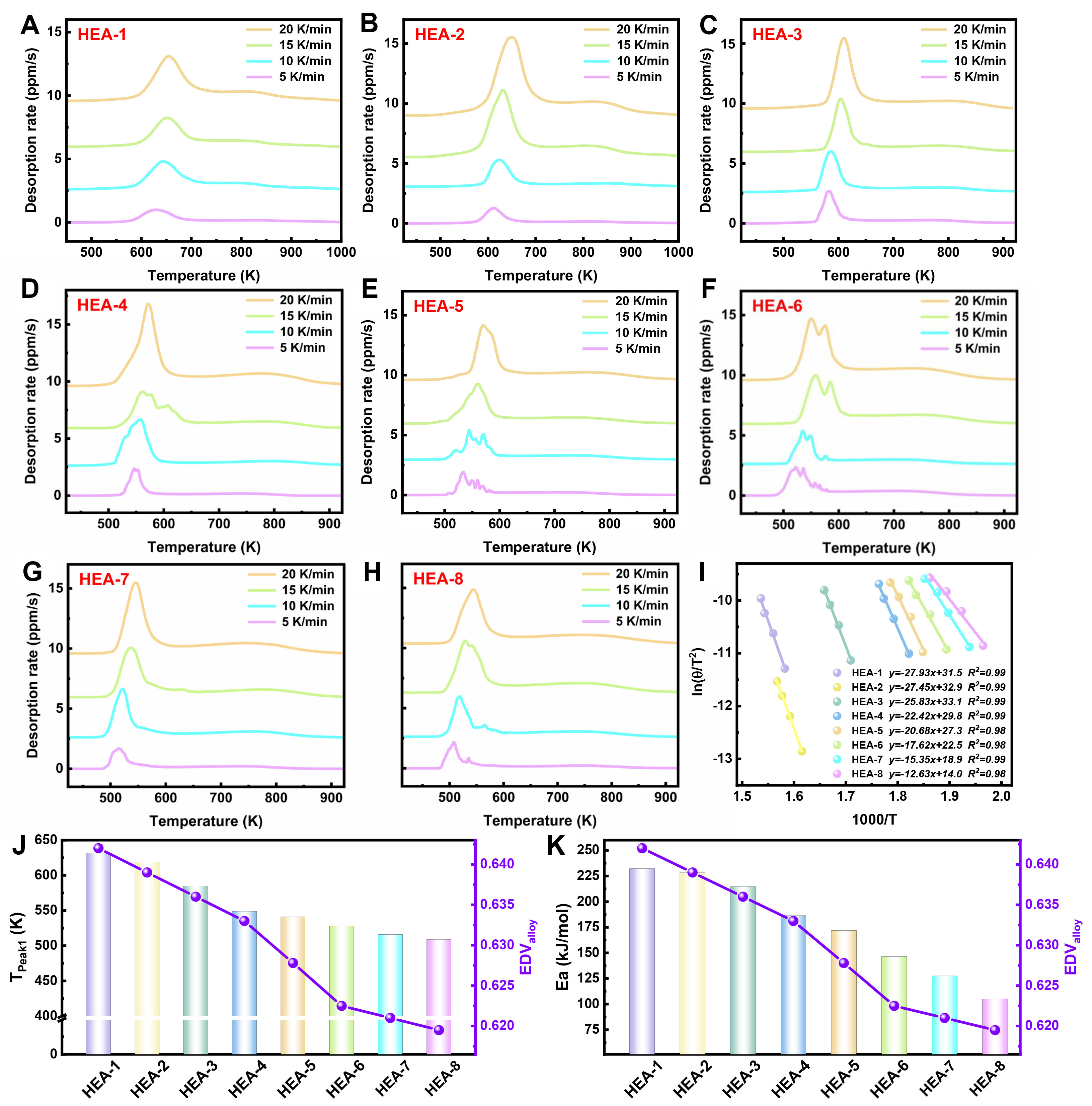
Figure 11. TDS curves for HEA-1 to HEA-8 alloys at different heating rates (5, 10, 15, 20 K/min) (A-H), corresponding Kissinger fitting results (I), the correlation between hydrogen release temperature and EDValloy (J), and the relationship between Ea and EDValloy (K). The TDS curves in (A-H) are vertically offset for clarity. HEA: High-entropy alloy; EDValloy: electronegativity difference value of the alloy; TDS: thermal desorption spectroscopy.
DISCUSSION
EDValloy as a thermodynamic descriptor for single-phase BCC hydrogen-storage HEAs
TiVZrNb-based BCC high-entropy hydrogen storage alloys possess high hydrogen storage capacity; however, the key issue limiting their practical application is their excessively high hydride stability. Therefore, it is crucial to reduce hydride stability while maintaining a single-phase BCC structure and a high H/M ratio. The results of this study indicate that, compared to VEC, lattice parameters, and δ, EDValloy shows a stronger correlation with ΔHdes. This suggests that EDValloy can more directly reflect the trend in hydride stability in single-phase BCC high-entropy hydrogen storage alloys. Furthermore, in the HEA-1 to HEA-8 series of alloys designed in this study, ΔHdes decreases correspondingly as EDValloy decreases. This result further validates the effectiveness of EDValloy as a thermodynamic control parameter: reducing the average electronegativity difference between the alloy and hydrogen can significantly lower the enthalpy of hydrogen desorption from hydrogen-rich hydrides, thereby thermodynamically destabilizing the hydrides. Existing first-principles calculations indicate that chemical contributions primarily govern changes in the dehydrogenation enthalpy of TiVZrNb-based hydrides; that is, the metal matrix’s affinity for H is a key factor determining hydride stability, while structural and elastic contributions have a relatively minor impact on the differences in dehydrogenation enthalpy among various hydrides[39]. Therefore, the decrease in ΔHdes observed in this study, driven by the reduction in EDValloy, is likely primarily due to weakening of metal-hydrogen chemical interactions. From a bonding perspective, the electronegativity of Ti, V, Zr, and Nb is lower than that of H. After hydrogen absorption, H atoms enter the interstitial sites of the metal lattice and form a local M-H coordination environment with surrounding metal atoms. Existing first-principles studies of TiVZrNb-based hydrides further indicate that hybridization occurs between the H s state and the metal sp/d states, forming M-H bonding states. Meanwhile, Bader charge analysis reveals charge transfer from metal atoms to H atoms, suggesting that M-H interactions exhibit charge-transfer characteristics and ionic components[39]. Based on the above understanding, the results of this study can be interpreted from the perspective of electronegativity differences: a larger EDValloy corresponds to a stronger trend of charge transfer from the metal to H and a stronger average M-H interaction, making H more stable at the interstitial sites, thus resulting in a higher ΔHdes. Conversely, when EDValloy decreases, the alloy’s average electronegativity approaches that of H, the average charge-transfer driving force may weaken, and the M-H bond strength decreases accordingly, thereby reducing the energy required for hydride decomposition.
It should be noted that EDValloy is an average composition descriptor whose validity depends on a single-phase BCC structure and a relatively uniform elemental distribution. For alloy systems containing a second phase, significant segregation, or complex multi-phase reactions, local hydrogen-occupancy environments and hydrogen absorption/desorption reactions involving the second phase may weaken the correlation between EDValloy and ΔHdes. Therefore, EDValloy is more suitable as an effective empirical descriptor for regulating the thermodynamic stability of hydrogen desorption in single-phase BCC hydrogen storage HEAs, rather than as the sole parameter independently determining all hydrogen storage behavior.
Microscopic dehydrogenation behavior regulated by EDValloy
The decrease in ΔHdes indicates a decline in the overall thermodynamic stability of the hydride; however, it is difficult to determine which stage of the dehydrogenation process EDValloy affects solely from a Van’t Hoff analysis. Based on the aforementioned multi-peak characteristics observed in the TDS and XRD analyses of samples with different hydrogen contents, it can be concluded that the dehydrogenation process of TiVZrNb-based alloys is not a single-step reaction. Specifically, hydrogen-rich FCC dihydrides first decompose and transform into BCC-type intermediate hydrides; subsequently, the intermediate hydrides undergo further dehydrogenation, ultimately reverting to a low-hydrogen BCC solid solution or the initial BCC alloy structure. Therefore, the different dehydrogenation peaks in the TDS do not merely reflect hydrogen released at different temperatures, but rather correspond to the gradual release of hydrogen from different hydride phases, hydrogen occupation states, or local binding strengths. As EDValloy decreases, the main dehydrogenation peaks shift toward lower temperatures overall, indicating that the stability of hydrogen-rich hydrides and some intermediate hydrides is weakened. In particular, the low-temperature dehydrogenation peaks are relatively sensitive to changes in EDValloy, suggesting that electronegativity-driven regulation primarily acts on the hydrogen-rich dihydride phase. In this phase, H atoms extensively occupy interstitial sites in the metal lattice, and M-H interactions significantly contribute to the stability of the hydrides. As EDValloy decreases, the average M-H bond strength weakens, and the ability of FCC hydrides to maintain a high hydrogen content declines, increasing the likelihood of decomposition at lower temperatures. From a microscopic perspective, the hydrogen occupancy environment in high-entropy alloys exhibits significant diversity. Even when the alloy as a whole consists of a single-phase BCC solid solution, the coordination environments of Ti, V, Zr, and Nb around different interstitial sites vary, leading to a distribution of local M-H bond strengths and hydrogen-occupancy stabilities. A decrease in EDValloy does not imply that all local M-H bonds weaken proportionally; rather, it is more likely to manifest as a shift in the overall distribution of hydrogen binding energies toward lower stability. Specifically, this involves a reduction in the proportion of strongly bound H sites or a decrease in H stability in Ti/Zr-rich local environments. This overall decline in local stability can explain why the TDS main peak temperature shifts toward lower values as EDValloy decreases.
Furthermore, some high-temperature dehydrogenation peaks exhibit a relatively weak response to EDValloy, suggesting that this stage may be governed not only by average M-H bonding but also by factors such as residual hydrogen in low-hydrogen BCC solid solutions, the local interstitial environment, H diffusion pathways, lattice contraction, and defect confinement. Consequently, the influence of EDValloy on dehydrogenation pathways exhibits phase selectivity: it is more sensitive to the decomposition processes of hydrogen-rich hydrides and major intermediate hydrides, while local structural factors may limit its ability to describe low-hydrogen residual states.
Thermodynamic and kinetic effects of EDValloy
Both thermodynamic and kinetic factors govern the hydrogen release process. As the EDValloy content decreases, the alloy’s ΔHdes drops significantly, indicating reduced thermodynamic stability of the hydride and making the hydrogen release reaction thermodynamically more favorable. Concurrently, the main dehydrogenation peak in the TDS curve shifts toward lower temperatures, and the apparent activation energy for the decomposition of hydrogen-rich dihydrides obtained from the Kissinger fit also decreases. This indicates that the reduction in EDValloy not only weakens the equilibrium stability of the hydrides but also reduces the kinetic resistance during the actual dehydrogenation process.
This simultaneous thermodynamic and kinetic change may stem from the weakening of the average M-H interaction. When EDValloy is high, the average electronegativity difference between the alloy and H is large, the driving force for electron transfer from the metal to H is strong, and H atoms are more strongly bound by M-H bonding at interstitial sites. Consequently, hydride decomposition requires overcoming a larger thermodynamic energy difference, reflected in a higher ΔHdes; simultaneously, when H atoms detach from their local coordination environment to participate in subsequent diffusion, phase transition, and desorption processes, they must also overcome a higher energy barrier, reflected in a higher Ea. When EDValloy is reduced, the alloy’s average electronegativity becomes closer to that of H, the average charge transfer driving force weakens, and the M-H bond strength decreases, reducing the stability of H atoms in hydrogen-rich hydrides. Consequently, the heat required for hydride decomposition decreases, and the combined kinetic energy barrier that must be overcome for H to escape interstitial sites and for the hydrogen-rich phase to decompose decreases as well.
From the perspective of dehydrogenation pathways, the decrease in Ea primarily reflects the improved kinetics of the decomposition process of the hydrogen-rich dihydride. In hydrogen-rich FCC dihydrides, the high hydrogen content causes H atoms to occupy a large number of interstitial sites in the metal lattice, making their stability highly sensitive to M-H interactions. When EDValloy decreases, the local confinement of H in the hydrogen-rich phase weakens, making it easier for the FCC dihydride to transform into intermediate hydrides or low-hydrogen BCC solid solutions. Consequently, the low-temperature dehydrogenation peak in the TDS shifts toward lower temperatures, and the corresponding apparent activation energy decreases. This indicates that the reduction in EDValloy not only lowers the thermodynamic stability of hydrogen-rich hydrides but also reduces the kinetic resistance to their decomposition and phase transformation.
CONCLUSION
In this study, based on the EDValloy, we designed and prepared TiVZrNb-based BCC hydrogen storage HEAs. We systematically investigated their phase structure, hydrogen storage capacity, hydrogen release thermodynamics, and dehydrogenation kinetics. The main conclusions are as follows:
(1) EDValloy shows a clearer correlation with ΔHdes than VEC, lattice parameters, and δ do for single-phase BCC hydrogen storage HEAs, indicating that EDValloy is more suitable as a first-order empirical descriptor for describing the variation trend of hydride stability in BCC hydrogen storage HEAs, rather than as the only parameter that completely replaces lattice structure, compositional effects, and electronic-structure factors.
(2) By reducing the Ti/Zr content and increasing the Nb content, the EDValloy of the HEA-1 to HEA-8 alloys decreased from 0.6420 to 0.6195. All alloys maintained a compositionally homogeneous single-phase BCC structure and exhibited high hydrogen storage capacities approaching H/M = 2, indicating that this compositional control strategy did not compromise the alloys’ phase stability or high-capacity hydrogen storage characteristics.
(3) As EDValloy decreased, the alloy’s ΔHdes decreased from 230.3 kJ/mol H2 to 97.3 kJ/mol H2, and the main dehydrogenation peak shifted to lower temperatures. This indicates that reducing the average electronegativity difference between the alloy and hydrogen weakens M-H interactions, thereby destabilizing hydrogen-rich hydrides thermodynamically.
(4) TDS, structural analysis of samples with different hydrogen contents, and Kissinger analysis indicate that the reduction in EDValloy primarily affects the dehydrogenation behavior of hydrogen-rich FCC dihydrides and certain BCC intermediate hydride phases, while also lowering the apparent activation energy of the hydrogen-rich dihydride decomposition process. This suggests that it not only reduces the thermodynamic stability of the hydrides but also decreases the kinetic resistance of the main dehydrogenation stages. The above results provide an effective design strategy for reducing the stability of hydrides in TiVZrNb-based BCC hydrogen storage HEAs while maintaining high hydrogen storage capacity.
DECLARATIONS
Authors’ contributions
Investigation: Zha, L.; Liu, L; Wang, Y.; Cai, H.; Zhang, Y.; Du, H.
Data curation: Zha, L.; Liu, L; Wang, Y.; Cai, H.; Zhang, Y.; Du, H.; Dou, B.; Xue, L.; Zhao, Y.
Formal analysis: Zha, L.
Writing - original draft: Zha, L.
Methodology: Dou, B.; Xue, L.; Zhao, Y.; Wan, D.
Conceptualization: Dou, B.; Xue, L.; Zhao, Y.; Wan, D.; Xue, Y.
Writing - review & editing: Wan, D.
Visualization: Wan, D.
Validation: Wan, D.; Xue, Y.
Resources: Wan, D.; Xue, Y.
Project administration: Wan, D.; Xue, Y.
Supervision: Xue, Y.
Funding acquisition: Xue, Y.
Availability of data and materials
The data supporting the findings of this study are available within this Article and its Supplementary Materials. Further data are available from the corresponding authors upon request.
AI and AI-assisted tools statement
Not applicable.
Financial support and sponsorship
This work is supported by the National Natural Science Foundation of China (Grant No. 52301128) and the Fundamental Research Funds for the Central Universities, Beijing Institute of Technology (Grant No. XSQD-6120220309).
Conflicts of interest
All authors declared that there are no conflicts of interest.
Ethical approval and consent to participate
Not applicable.
Consent for publication
Not applicable.
Copyright
© The Author(s) 2026.
Supplementary Materials
REFERENCES
1. Lenis, J. A.; Arias, Velandia. J.; Aguirre, Ocampo. R.; et al. Challenges and potential future trends on high entropy alloy for solid hydrogen storage: systematic review. J. Power. Sources. 2025, 656, 238011.
2. Allendorf, M. D.; Stavila, V.; Snider, J. L.; et al. Challenges to developing materials for the transport and storage of hydrogen. Nat. Chem. 2022, 14, 1214-23.
3. Paul, A. R.; Mehla, S.; Bhargava, S. Intermetallic compounds for hydrogen storage: current status and future perspectives. Small 2025, 21, e2408889.
4. Gao, S.; Qi, J.; Jia, K.; Zhang, L.; Wu, F.; Xiao, X. A review of high-entropy alloys for next-generation solid-state advanced hydrogen storage materials. Compos. Pt. B-Eng. 2026, 312, 113340.
5. Liu, J.; Huang, P.; Xia, Y.; et al. High-entropy alloys for hydrogen storage, separation, and detection: Recent progress and prospects. eScience 2026, 6, 100506.
6. Luo, L.; Chen, L.; Li, L.; et al. High-entropy alloys for solid hydrogen storage: a review. Int. J. Hydrog. Energy. 2024, 50, 406-30.
7. Ramatsoma, B.; Makhatha, M.; Klenam, D.; Bodunrin, M. Role of compositionally complex and high entropy alloys for hydrogen storage: a bibliometric and mechanistic assessment. Renew. Sust. Energ. Rev. 2025, 222, 115903.
8. Amiri, A.; Shahbazian-Yassar, R. Recent progress of high-entropy materials for energy storage and conversion. J. Mater. Chem. A. 2021, 9, 782-823.
9. Hu, H.; Zhang, X.; Li, S.; Yi, L.; Chen, Q. A review of body‐centered cubic‐structured alloys for hydrogen storage: composition, structure, and properties. Rare. Metals. 2025, 44, 1497-521.
10. Halpren, E.; Yao, X.; Chen, Z. W.; Singh, C. V. Machine learning assisted design of BCC high entropy alloys for room temperature hydrogen storage. Acta. Mater. 2024, 270, 119841.
11. Shen, S.; Li, Y.; Ouyang, L.; Zhang, L.; Zhu, M.; Liu, Z. V-Ti-based solid solution alloys for solid-state hydrogen storage. Nanomicro. Lett. 2025, 17, 175.
12. Bouzidi, A. Hydrogen absorption properties in high entropy alloys containing refractory elements, Université Paris-Est Créteil Val-de-Marne-Paris 12, 2023. Available from: https://hal.science/tel-04671333.
13. Greaves, F.; Bouzidi, A.; Perrière, L.; et al. Hydrogen induced phase transition in TiZrNbHfV1-xTax high entropy alloys. J. Phys. Chem. C. 2025, 129, 2904-12.
14. Bouzidi, A.; Laversenne, L.; Nassif, V.; Elkaim, E.; Zlotea, C. Hydrogen storage properties of a new Ti-V-Cr-Zr-Nb high entropy alloy. Hydrogen 2022, 3, 270-84.
15. Montero, J.; Ek, G.; Laversenne, L.; Nassif, V.; Sahlberg, M.; Zlotea, C. How 10 at% Al addition in the Ti-V-Zr-Nb high-entropy alloy changes hydrogen sorption properties. Molecules 2021, 26, 2470.
16. Montero, J.; Zlotea, C.; Ek, G.; Crivello, J. C.; Laversenne, L.; Sahlberg, M. TiVZrNb multi-principal-element alloy: synthesis optimization, structural, and hydrogen sorption properties. Molecules 2019, 24, 2799.
17. Bouzidi, A.; Laversenne, L.; Zepon, G.; Vaughan, G.; Nassif, V.; Zlotea, C. Hydrogen sorption properties of a novel refractory Ti-V-Zr-Nb-Mo high entropy alloy. Hydrogen 2021, 2, 399-413.
18. Agafonov, A.; Greaves, F.; Perrière, L.; Nassif, V.; Zlotea, C. Effective destabilization of both mono- and dihydride phases in TiVZrNbHf by Mo addition. Scripta. Materialia. 2026, 275, 117161.
19. Mayer, G. C.; Silva, B. H.; Botta, W. J.; Zepon, G. Effect of cycling conditions on hydride stability of the Ti11Nb61Cr28 alloy. J. Mater. Chem. A. 2026, 14, 7596-607.
20. Nygård, M. M.; Ek, G.; Karlsson, D.; Sørby, M. H.; Sahlberg, M.; Hauback, B. C. Counting electrons - a new approach to tailor the hydrogen sorption properties of high-entropy alloys. Acta. Mater. 2019, 175, 121-9.
21. Zhai, Y.; Li, Y.; Wei, S.; Tolj, I.; Kennedy, J.; Yang, F. Progress in V-BCC based solid solution hydrogen storage alloys. J. Energy. Storage. 2025, 109, 115103.
22. Cai, H.; Zhang, Y.; Wang, H.; Wan, D.; Zhao, Y.; Xue, Y. Trace Nb and Mn regulation of hydrogen storage capacity and cyclic stability of BCC-type TiCrMo alloys. ACS. Appl. Energy. Mater. 2026, 9, 1834-44.
23. Guo, S.; Ng, C.; Lu, J.; Liu, C. T. Effect of valence electron concentration on stability of fcc or bcc phase in high entropy alloys. J. Appl. Phys. 2011, 109, 103505.
24. Guo, S.; Liu, C. Phase stability in high entropy alloys: formation of solid-solution phase or amorphous phase. Prog. Nat. Sci. 2011, 21, 433-46.
25. Zhang, Y.; Zhou, Y.; Lin, J.; Chen, G.; Liaw, P. Solid-solution phase formation rules for multi-component alloys. Adv. Eng. Mater. 2008, 10, 534-8.
26. Yang, X.; Zhang, Y. Prediction of high-entropy stabilized solid-solution in multi-component alloys. Mater. Chem. Phys. 2012, 132, 233-8.
27. Westlake, D. Stabilities, stoichiometries and site occupancies in hydrides of intermetallic compounds. In: Electronic structure and properties of hydrogen in metals; Springer, 1983; pp 85-96.
28. Somo, T. R.; Lototskyy, M. V.; Yartys, V. A.; Davids, M. W.; Nyamsi, S. N. Hydrogen storage behaviours of high entropy alloys: a review. J. Energy. Storage. 2023, 73, 108969.
29. Jiang, M.; Song, A.; Yan, Y.; Feng, W.; Li, H.; Liang, B. Applicability and limitations of hydrogen affinity as a descriptor for designing high-entropy alloys for hydrogen storage. Chem. Mater. 2026, 38, 3666-75.
30. Jang, S. H.; Zhang, D.; Tran, H. B.; et al. Physically interpretable descriptors drive the materials design of metal hydrides for hydrogen storage. Chem. Sci. 2025, 16, 23111-20.
31. Metal-hydrogen system under extended p, T conditions. In Fukai, Y., editor. The metal-hydrogen system: basic bulk properties; Springer Berlin Heidelberg, 2005; pp 91-145.
32. Somo, T. R. High entropy hydrogen storage alloys and perspectives of their application in hydrogen storage systems operating at near-ambient temperatures. University of the Western Cape, 2024. https://hdl.handle.net/10566/21454.
33. Zlotea, C.; Bouzidi, A.; Montero, J.; Ek, G.; Sahlberg, M. Compositional effects on the hydrogen storage properties in a series of refractory high entropy alloys. Front. Energy. Res. 2022, 10, 991447.
34. Ponsoni, J. B.; Aranda, V.; Nascimento, T. D. S.; Strozi, R. B.; Botta, W. J.; Zepon, G. Design of multicomponent alloys with C14 laves phase structure for hydrogen storage assisted by computational thermodynamic. Acta. Mater. 2022, 240, 118317.
35. Chen, K.; Lau, M. Y.; Luo, X.; Huang, J.; Ouyang, L.; Yang, X. Research progress in solid-state hydrogen storage alloys: a review. J. Mater. Sci. Technol. 2026, 246, 256-89.
36. Suarez-Alcantara, K.; Torres-Garcia, N. L.; del, Carmen. Cintron-Nuñez. P. HEAs with Ti - V - Zr for hydrogen storage, a verification of the predictability of VEC (valence electron concentration) and electronegativity difference over the hydriding temperature. J. Alloy. Compd. 2025, 1046, 184794.
37. Hassan, N. O.; Ghais, A.; Ahmed, M. H.; et al. Density functional theory insights into the structure, electronic and mechanical properties, thermodynamics, and diffusion of high-entropy alloys for hydrogen storage: a review. Int. J. Hydrog. Energy. 2026, 217, 153928.
38. Matumura, T.; Yukawa, H.; Morinaga, M. Alloying effects on the electronic structures of VH2 and V2H. J. Alloy. Compd. 1999, 284, 82-8.
39. Hu, J.; Li, X.; Vitos, L.; Schönecker, S. Effects of Mg and Al doping on the desorption energetics and electronic structure of a Ti-V-Zr-Nb alloy hydride. Acta. Mater. 2024, 277, 120198.
41. Cheng, B.; Kong, L.; Li, Y.; Wan, D.; Xue, Y. Hydrogen desorption kinetics of V30Nb10(TixCr1-x)60 high-entropy alloys. Metals 2023, 13, 230.
42. Cheng, B.; Dou, B.; Kong, L.; Wan, D.; Xue, Y. Synergistic and competing effects of iron in TiVNbCr-based high-entropy alloys for reversible hydrogen storage. Small 2025, 21, e08310.
43. Cheng, B.; Kong, L.; Cai, H.; et al. Pushing the boundaries of solid-state hydrogen storage: a refined study on TiVNbCrMo high-entropy alloys. Int. J. Hydrog. Energy. 2024, 60, 282-92.
44. Cai, H.; Dou, B.; Xue, L.; et al. Engineering Ti-Cr-Mo-based alloys for hydrogen storage: Fe doping as a strategy for improved reversibility and stability. Int. J. Hydrog. Energy. 2025, 128, 499-510.
45. Huang, Z.; Li, C.; Chu, Y.; et al. Potential and challenges for V-based solid solution hydrogen storage alloys. Energy 2025, 316, 134574.
46. Sandrock, G. A panoramic overview of hydrogen storage alloys from a gas reaction point of view. J. Alloy. Compd. 1999, 293-295, 877-88.
47. Esayed, A. The use of the half cycle technique to examine hysteresis in Zr(FexCr1-x)2 (x = 0.55 and 0.75) - H systems. Int. J. Hydrog. Energy. 2000, 25, 151-6.
48. Weadock, N. J.; Voorhees, P. W.; Fultz, B. Interface pinning causes the hysteresis of the hydride transformation in binary metal hydrides. Phys. Rev. Materials. 2021, 5, 013604.
49. Nygård, M. M.; Ek, G.; Karlsson, D.; Sahlberg, M.; Sørby, M. H.; Hauback, B. C. Hydrogen storage in high-entropy alloys with varying degree of local lattice strain. Int. J. Hydrog. Energy. 2019, 44, 29140-9.
Cite This Article
 Open Access
How to Cite
Download Citation
Export Citation File:
Type of Import
Tips on Downloading Citation
Citation Manager File Format
Type of Import
Direct Import: When the Direct Import option is selected (the default state), a dialogue box will give you the option to Save or Open the downloaded citation data. Choosing Open will either launch your citation manager or give you a choice of applications with which to use the metadata. The Save option saves the file locally for later use.
Indirect Import: When the Indirect Import option is selected, the metadata is displayed and may be copied and pasted as needed.
About This Article
Special Topic
Copyright

Data & Comments
Data
0










Comments
Comments must be written in English. Spam, offensive content, impersonation, and private information will not be permitted. If any comment is reported and identified as inappropriate content by OAE staff, the comment will be removed without notice. If you have any queries or need any help, please contact us at [email protected].