


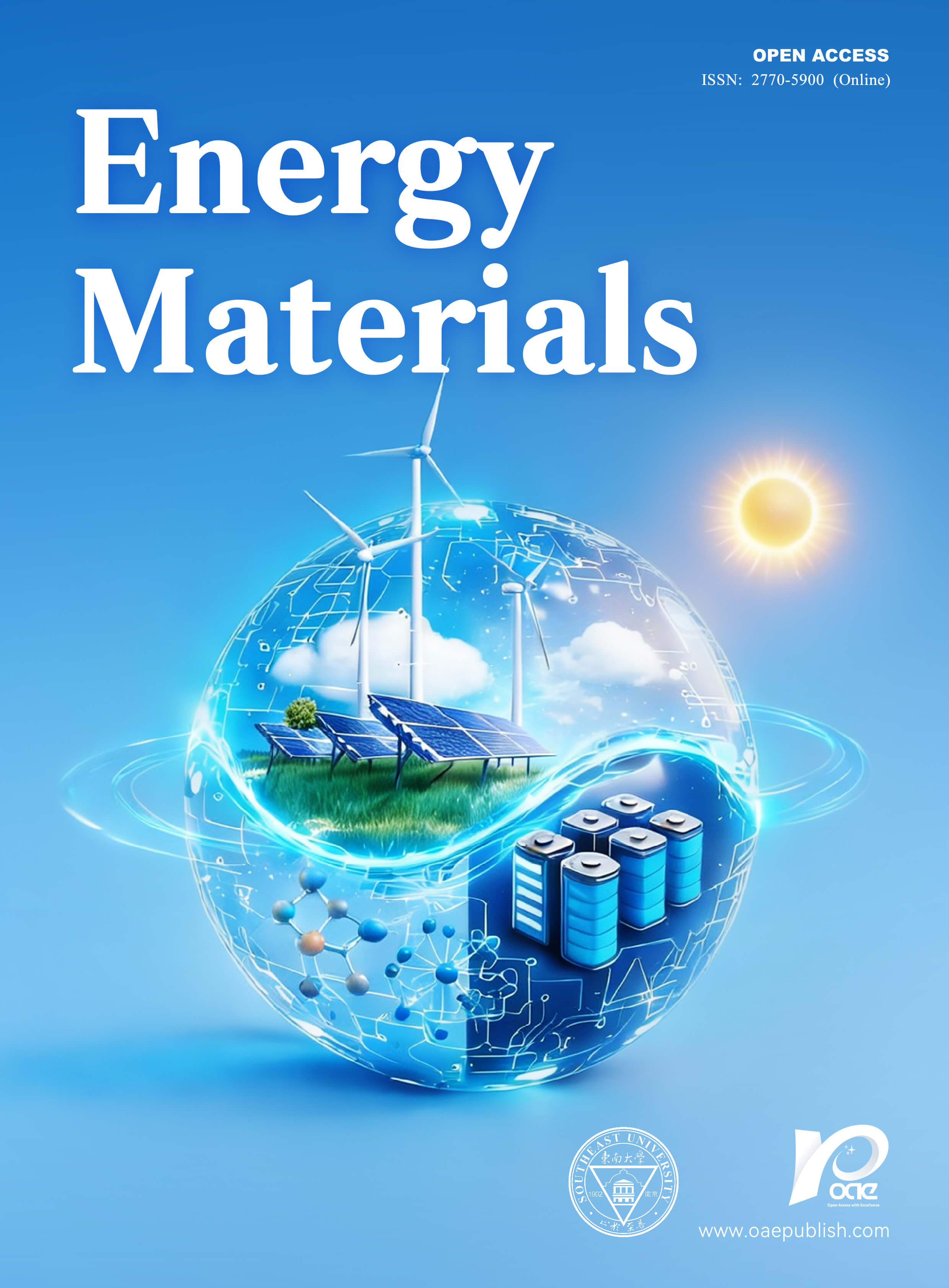
Triboelectric-memristive coupling for self-powered neuromorphic computing: mechanisms, devices, and systems
 0
0 
Abstract
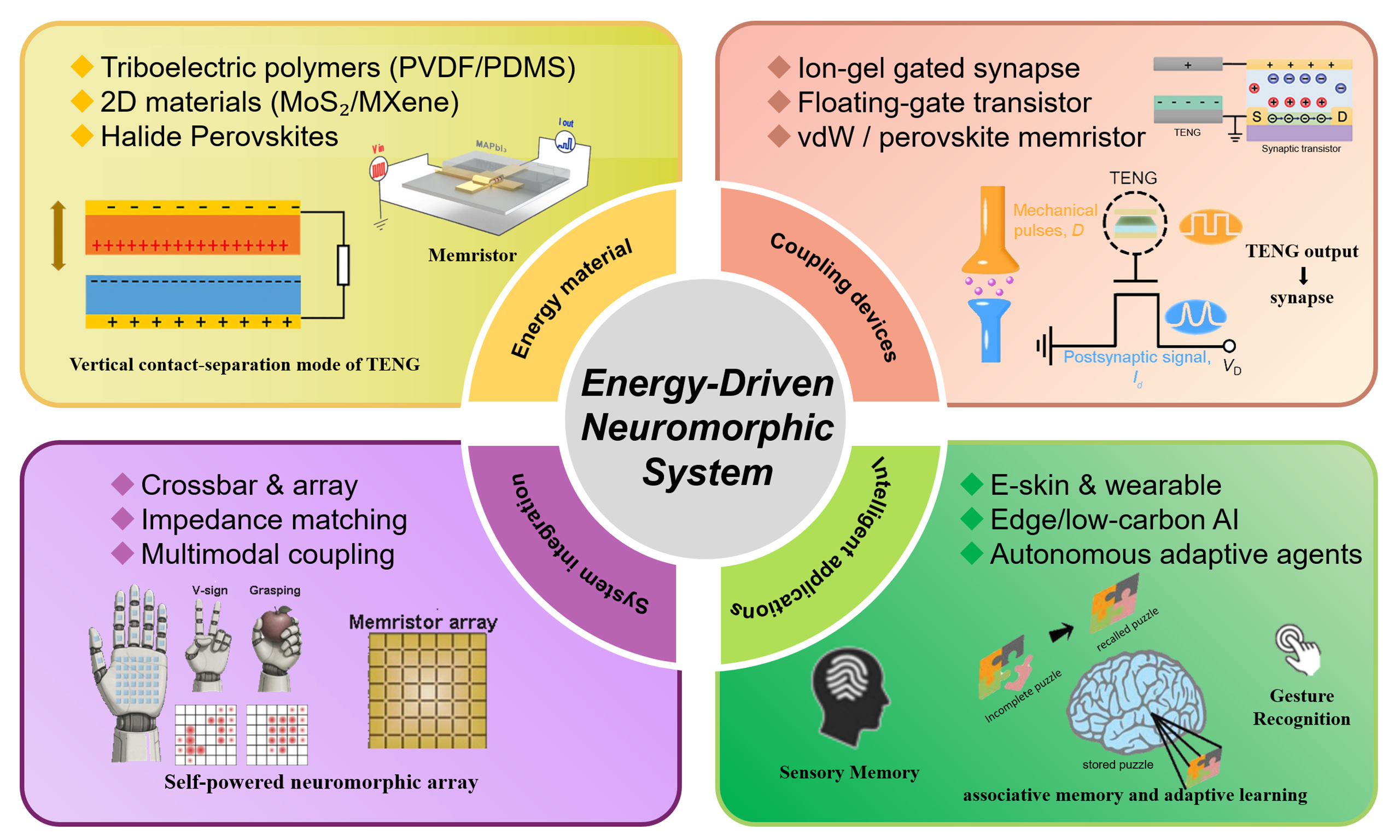
Coupling triboelectric nanogenerators (TENGs) with memristors offers a direct route to integrating energy harvesting and adaptive learning within a single physical substrate, thereby enabling self-powered neuromorphic systems driven by ubiquitous mechanical stimuli. Unlike conventional electronics that rely on external power rails, triboelectric-memristive hybrids transduce mechanical excitations into programmable resistive states, supporting synaptic functions such as short-term plasticity, long-term plasticity, and spike-timing-dependent plasticity. This review synthesizes the physical mechanisms of triboelectric-memristive coupling and clarifies how charge transfer, interfacial electron-ion interactions, and device-level state dynamics collectively enable energy-to-information transduction for signal processing and learning. In contrast to previous surveys that focus on TENGs or memristors in isolation, we establish a unified transduction framework that links mechanical stimulus statistics to TENG waveform characteristics and further to memristive state-variable evolution, which serves as the organizing principle throughout the paper. We then present (ⅰ) a mechanism-guided taxonomy of representative device architectures and their achievable plasticity modes; and (ⅱ) a system-level perspective on the integration of self - powered sensing, in-memory learning, and multimodal data fusion. Finally, we summarize key challenges - including charge stability, humidity tolerance, device variability, and scalable integration - and discuss emerging directions such as large-area triboelectric materials for improved array uniformity, multiphysics co-learning for enhanced in-sensor intelligence, and physics-informed compact models to support device-circuit-algorithm co-design under stochastic energy inputs.
Keywords
INTRODUCTION
Biological nervous systems perform perception, learning, and decision making with extraordinary energy efficiency — orders of magnitude lower than conventional von Neumann machines[1,2,3,4,5,6]. This capability for online signal processing and continual adaptation at ultra-low power has motivated neuromorphic electronics for decades. Although algorithmic and architectural advances have driven striking gains in artificial neural networks—spanning speech, vision, reinforcement learning, and intelligent control[7,8,9,10,11,12,13,14]—most systems still rely on externally powered electronic platforms whose hardware incurs persistent power-delivery overheads, a separation between computation and memory, and complex control circuitry[15,16,17,18,19,20,21]. The resulting limitations—energy cost, latency, and restricted integration density—constrain "low-energy intelligence'' at the edge, in wearables, and in autonomous sensing.
A materials-centered approach to energy-efficient intelligence is to co-design energy transduction and adaptive computation, so that the input energy itself directly participates in sensing and learning, rather than being first conditioned by dedicated power-management peripherals. Triboelectric nanogenerators (TENGs) provide a particularly compelling input pathway[22]: they convert ubiquitous mechanical stimuli (micro-vibrations[23], touch[24], airflow[25], and human motion[26,27,28,29]) into low-frequency electrical signals[30,31,32] with high open-circuit voltages and pulsed profiles that resemble neuronal dynamics[33]. In this sense, TENGs act simultaneously as energy modules and information sources—a natural "mechanical-to-neural'' interface for brain-inspired systems. Complementarily, memristors—the fourth fundamental circuit element alongside R, C, and L[34]—offer reversible, finely tunable, non-volatile state updates and are widely viewed as a key device platform for neuromorphic hardware[35,36,37]. Under pulse-driven operation, memristors support dynamic state evolution via mechanisms such as filament formation/rupture, oxygen-vacancy drift, and charge trapping/de-trapping, enabling event-driven operation with high integration density and low power consumption. Together, TENGs and memristors enable self-powered neuromorphic electronics in which energy harvesting, signal regulation, and adaptive learning are unified within a single physical framework.
Pairing triboelectric outputs with memristive control elevates mechanical energy from a passive supply to an active component in computation: high-voltage, low-current TENG pulses drive ionic drift and carrier trapping in memristors, translating motion into synaptic-weight updates and enabling genuine energy-information coupling[38,39,40,41,42]. This framework replaces the conventional "energy-in/computation-out" pipeline with a unified stack in which transduction, conversion, and computation co-occur, yielding event-driven sensor computing systems. In practice, ambient vibration and pressure directly trigger neuron-like state transitions at the device level, enabling low-power and autonomous intelligence while keeping the learning loop tied to harvested energy.
The triboelectric-memristive stack has progressed into a programmable platform that tightly couples energy harvesting with learning across materials, devices, and networks[43,44]. Early demonstrations in anti-ambipolar/ vertical electrochemical transistors, all-polymer electrochemical transistors, and functionalized organic thin-film transistors established rich charge-ion interaction channels and robust non-volatile control[45,46,47,48,49,50]. Subsequent advances extend to van der Waals (vdW) heterostructure memristors and photodetect-memristors[51,52,53], as well as halide-perovskite devices engineered for diffusive or optoelectronic switching[54,55,56] [Figure 1A]. These material systems offer distinct drift/trap kinetics, interfacial polarization control, and retention characteristics that enable tribo-pulsed multi-level states and hierarchical memory in time. Two-dimensional (2D) channels (MoS2, WSe2, graphene) and perovskites (PEA2Csn-1 PbnI3n+1, CsPbBr3) further strengthen the coupling between energy harvesting and state programming, yielding compact and reconfigurable energy-information modules [Figure 1B and C].
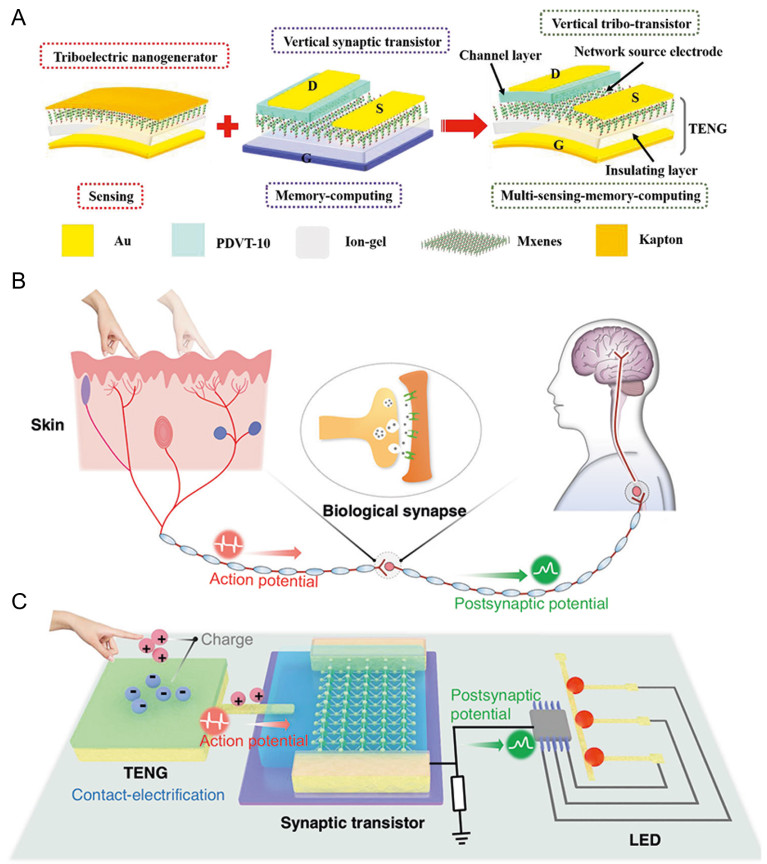
Figure 1. Platform concept and operation. (A) Integration of a TENG with a synaptic transistor to realize on‐device energy harvesting, sensing, and learning[43]. (B) Biological analog of tactile afferent signaling, from presynaptic spikes (action potentials) to postsynaptic responses. (C) TENG‐driven synaptic transistor, in which triboelectric pulses emulate presynaptic spikes to modulate postsynaptic current and plasticity[44]. Reproduced with permission from Springer Nature (A-C).
Functionally, TENG-driven inputs express short-term plasticity (STP), long-term plasticity (LTP), and spike-timing-dependent plasticity (STDP); parts of the stack reproduce Hebbian-like learning and pattern recognition without external bias[57,58]. At the system level, arrays and crossbars integrating TENGs with memristive networks enable self-powered sensing-inference pipelines for touch, vibration, and flow, with demonstrations of associative memory and binocular orientation selectivity[59,60,61,62,63]. Mechanisms such as triboiontronic gating, ion-gel capacitive coupling, mechanoplastic programming, and mechano-photonic hybrids bring harvested energy directly into the learning loop[64,65,66,67], pointing toward deployable, multimodal neuromorphic systems that remain adaptive under varying ambient stimuli. For clarity, the key terms (tribopotential, tribotronic, triboiontronic, and mechanoplastic programming) are defined in Section "Intrinsic coupling between triboelectric excitation and memristive dynamics" and used consistently throughout the manuscript.
Despite this rapid progress, the literature remains fragmented across communities that separately emphasize triboelectric energy harvesting, memristive switching physics, and neuromorphic learning demonstrations. What is still lacking is a transduction-oriented view that systematically links mechanical excitation statistics to triboelectric waveform characteristics, and further to the dominant memristive state variables and plasticity outcomes (e.g., STP/LTP/STDP) under zero-bias operation. This gap becomes increasingly important as the field shifts from single-device proof-of-concept demonstrations toward scalable, multimodal, and deployable systems. Accordingly, this review aims to consolidate triboelectric-memristive coupling as a mechanics-to-memory pathway, and to organize representative advances within a unified framework spanning mechanisms, device archetypes, and system-level co-design. We first map how tribo-induced voltage/current waveforms condition memristive state evolution—linking electromechanical drive to ionic drift, trapping, and interfacial barrier modulation. We then compare coupling strategies that confer complementary programmability, including electrochemical/ionic control and anti-ambipolar electrochemical transistors, floating-gate (FG) memories, ferroelectric-assisted gating, and vdW heterostructures that integrate sensing, energy harvesting, and resistive switching.
Looking forward, three issues define the co-design agenda: (ⅰ) materials durability and charge stability under humidity/temperature cycling; (ⅱ) interface chemistry and variability control for low-energy, low-loss alternating current-direct current (AC-DC) conditioning of tribo pulses; and (ⅲ) compact models that connect tribovoltage waveforms to ionic dynamics for array-level prediction[68].
FUNDAMENTALS OF TRIBOELECTRIC-MEMRISTIVE TRANSDUCTION
Energy-driven neuromorphic hardware necessitates a clear understanding of how harvested energy is transformed into controllable information states. Beyond material-level polarization and interfacial phenomena, the key is an explicit mapping between mechanical excitation, electrical waveforms, and conductance updates across domains and scales. In this context, a TENG converts stochastic motion into voltage/current pulses, while a memristor translates these pulses into continuous and retainable state changes. Coupled together, they form a closed loop from energy capture to signal processing and learning.
Although rooted in different physical principles—surface charge transfer and electrostatic induction for the triboelectric source, and field-assisted ionic migration and filament formation/rupture for the memristive element —the two devices share common stimulus-response characteristics that can be co-designed. Mechanical parameters (amplitude, frequency, and duty cycle) govern the pulse statistics at the triboelectric stage, whereas thresholding, nonlinearity, and temporal integration at the memristor convert those statistics into synaptic functions such as potentiation, depression, and short-to-long-term memory. The time constants of state evolution align with neuron-like membrane dynamics, enabling direct mechanical-to-neural programming without intermediate power rails.
Functionally, the memristor plays a dual role: as a synaptic element that records history in conductance, and as a rectifying/buffering front end that conditions triboelectric pulses into usable charge packets—an "energy-as-memory" pathway that preserves information after the stimulus is removed. This framework provides a bridge from materials to systems: it explains how energy is transformed into actionable signals, how signals feed back to modulate energy flow, and how integrated structures can realize energy-autonomous, event-driven intelligence. Array-level demonstrations point to the scalability of this system.
Functionally, the memristor plays a dual role: a synaptic element that records history in conductance and a rectifying/buffering front end that conditions triboelectric pulses into usable charge packets - an "energy-as memory" pathway that preserves information after stimulus removal. This framework provides a materials-to systems bridge: it explains how energy becomes actionable signals, how signals feed back to modulate energy flow, and how integrated structures can realize energy-autonomous, event-driven intelligence, with array-level demonstrations pointing to scalability.
Mechanisms and materials foundation of triboelectric nanogenerators
A TENG operates through the synergy of contact electrification and electrostatic induction: interfacial charge transfer during contact/separation creates a potential difference that drives the current in the external load. Typical outputs span ~ 100-1, 000 V open-circuit voltage, µA cm-2 current density, and power densities on the order of tens of mW m-2, with the precise values set by the charge density, dielectric constant, and interfacial structure of the contacting media. Four canonical configurations—vertical contact-separation, lateral sliding, single-electrode, and free-standing layer—provide complementary trade-offs in terms of packaging and application scenarios[69] [Figure 2A].
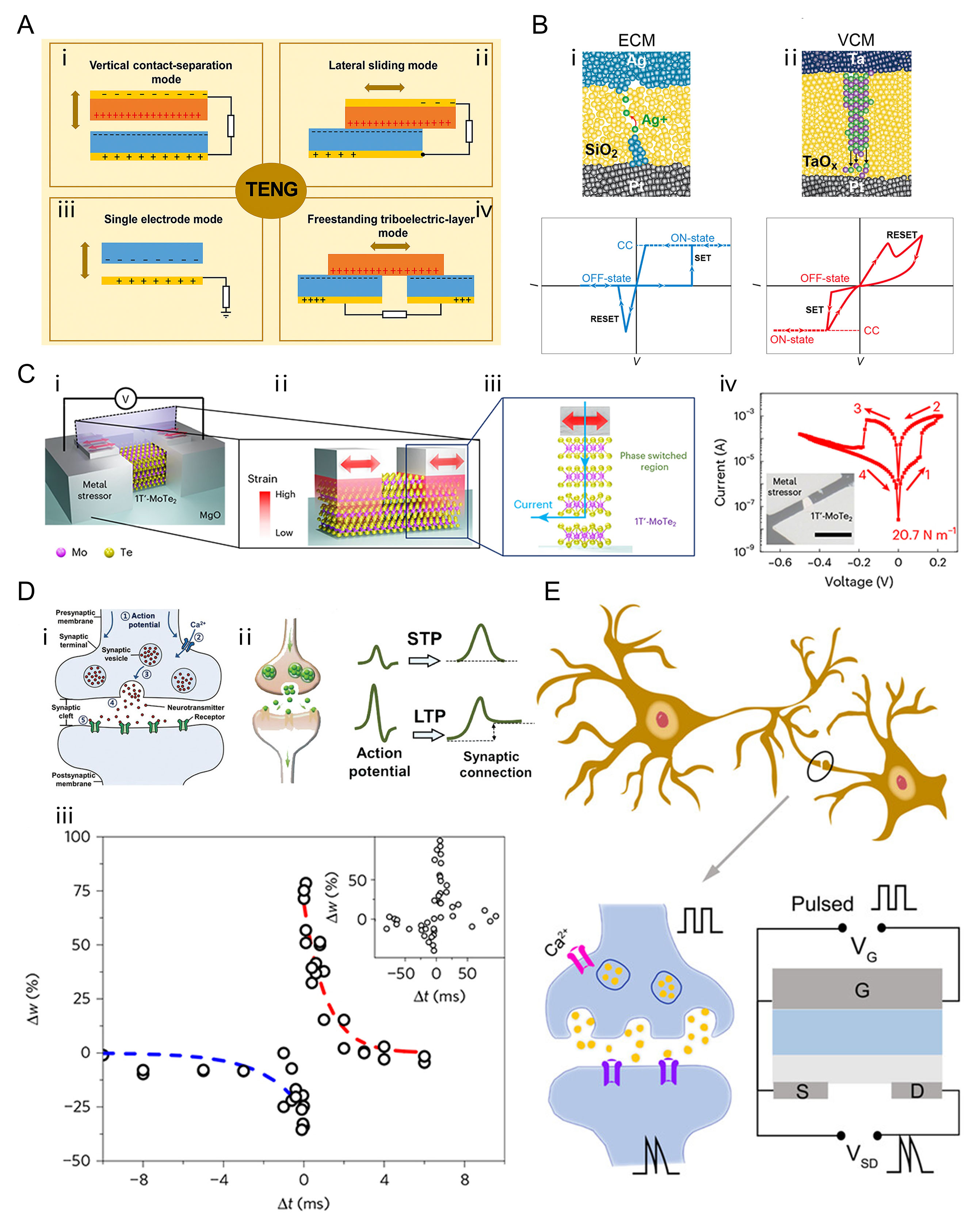
Figure 2. Overview of triboelectric-memristive coupling. (A) Working modes of a TENG, including vertical contact-separation, lateral sliding, single-electrode, and freestanding modes, redrawn from[69]. (B) Representative current-voltage (Ⅰ-Ⅴ) characteristics and switching mechanisms of memristors, including electrochemical metallization (ECM; Ag in SiO2) and the valence-change mechanism (VCM; TaOx), showing typical SET/RESET processes, adapted from[64]. (C) Mechanistic illustration related to 1T'-MoTe2, including tip-induced mechanical loading/phase tuning, local band/phase modulation, band alignment-assisted channel switching, and the resulting evolution of Ⅰ-Ⅴ characteristics, adapted from[65]. (D) Bioplasticity metrics under triboelectric stimulation, including demonstrations of STP/LTP and a spike-timing-dependent plasticity (STDP) timing curve showing the change in synaptic weight (△W) as a function of spike timing difference (△t) compiled from[82,83]. (E) Conceptual schematic of a synaptic transistor driven by triboelectric signals, illustrating network coupling and pulse-conditioned gating behavior with gate voltage (VG) and source-drain voltage (VSD), redrawn after[84]. Reproduced with permission from MDPI (A), Institute of Physics (B), Springer Nature (C and D(ⅲ)), Wiley (D(ⅰ, ⅱ) and E).
Material choice and surface morphology play crucial roles in performance. Beyond lab-scale micro/nanotexturing, scalable and manufacturing-friendly strategies are gaining emphasis for large-area, arrayed, self-powered sensing applications. Representative approaches include hierarchical microstructures replicated through molding/printing, and composite triboelectric films that combine robust mechanical compliance with enhanced surface charge density (e.g., conductive fillers or carbon-based additives in elastomer matrices). Notably, scalable fabrication of hierarchically structured composite films (e.g., graphite/polydimethylsiloxane (PDMS)-based triboelectric elastomer composites) has enabled large-area TENGs and self-powered tactile sensing with improved output stability[70] and manufacturability[71]. Such scalable methods are particularly important for TENG-memristor co-integration, as they reduce device-to-device variation across large arrays and provide more uniform tribo-pulse statistics for downstream synaptic programming. Polymer dielectrics such as PDMS[72], polyvinylidene fluoride (PVDF)[73], polytetrafluoroethylene (PTFE)[74], and nylon[75] remain common choices. Micro/nanotexturing (e.g., random-height micropillars[76], pyramids/ridges, grooves, and nanopores[77]) enhances effective area, charge trapping, and mechanical compliance[78], thereby boosting output and stability[76,77,78]. Hybridizing these materials with low-dimensional conductors and dielectrics further expands the design space. For instance, integrating MoS2[79], MXene[80], or graphene improves charge transport and environmental robustness, enabling triboiontronic gating and direct signal conditioning[81].
Compositionally engineered composites provide additional pathways to achieving high surface charge density and durable performance[68]. Recent advances in flexible and stretchable architectures have reduced the mechanical trigger to sub-newton levels, while maintaining stable output under bending, twisting, and cyclic strain, which is essential for wearables and biointerfaces[78]. In neuromorphic contexts, these micro-vibration harvesters supply pulsatile waveforms that are well-matched to synapse-like devices, forming a natural bridge between ambient mechanical stimuli and energy-aware sensing, memory, and computation.
Memristors and resistive-switching mechanisms
Memristors are nonlinear two-terminal devices whose conductance can be bidirectionally programmed by voltage or current pulses, providing a physical substrate for synaptic functions[82,83,84] [Figure 2B and C]. The state evolution is governed by nanoscale ion/electron transport and interfacial chemistry, most commonly through: (ⅰ) the formation/rupture of conductive filaments[85,86]; and (ⅱ) field-assisted defect or ionic drift with charge accumulation[87,88]. According to the dominant mechanism, three archetypes are recognized: valence change mechanism (VCM), electrochemical metallization (ECM)[64], and phase change memory (PCM)[65].VCM-based devices employ wide-bandgap oxides in which oxygen-vacancy migration modulates local conductivity. Representative systems include TiO2[89], HfO2, and Hf0.5Zr0.5O2 multilayers[59], and ZnO composites with enhanced stability[90]. ECM devices use active metals (Ag, Cu) as ion sources to electrochemically grow and dissolve metallic filaments, enabling low set voltages and rich analog plasticity[64]. PCM devices switch between amorphous and crystalline phases in chalcogenides (e.g., Ge2Sb2Te5) and, more recently, 2D phase-change platforms such as MoTe2[65,91].
Typical operating windows span Vset/reset ~ 1-3 V, µW-level programming power, and endurance exceeding 104 cycles. Selector elements (e.g., Ti/TiO2/Ti or ultrathin 2D heterojunctions) suppress sneak currents in crossbar arrays[88,89]. Emerging materials further lower voltage and expand multilevel states: halide perovskites (CsPbBr3 and quasi-2D PEA2Csn-1PbnI3n+1) demonstrate diffusive/digital bimodal responses and operation below 1 V[54,55,56,92], and vdW heterostructures (e.g., WS2/WSe2; GeTe/MoTe2) offer ultralow thresholds and tunable interlayer coupling[51,53]. Compared with field-effect transistor (FET)-based synapses, memristors provide intrinsically nonvolatile, compact, and energy-efficient state storage with analog programmability, making them central building blocks for dense neuromorphic fabrics and in-memory learning engines.
Intrinsic coupling between triboelectric excitation and memristive dynamics
Terminology note: In this review, tribopotential refers to the effective electrostatic potential generated by triboelectric charge separation that modulates device electrostatics. Tribotronic regulation denotes tribopotential-enabled modulation of channel/barrier states (i.e., tribopotential acting as an effective "gate" or barrier-tuning field in semiconductor junctions or transistor-like stacks). Triboiontronic coupling refers to triboelectric-pulse-driven ion-assisted gating, typically mediated by electric double layer (EDL) formation and ion migration/relaxation at electrolyte/ion-gel interfaces. Mechanoplastic programming describes mechanically assisted (often deformation-coupled) programming of a persistent or semi-persistent conductance state, in which mechanical stimuli contribute to stabilizing internal state variables (e.g., ionic redistribution, defect configuration, or interfacial polarization).
Although these two elements arise from distinct physical mechanisms—surface charge transfer in a triboelectric source and field-assisted ion/defect drift in a memristor—their information flow is mediated at interfaces and evolves on commensurate time scales. To connect the above interfacial picture to system-level behavior, it is useful to introduce a minimal (physics-grounded) compact description that links mechanical excitation to synaptic weight updates across different device archetypes. Specifically, a mechanical stimulus sequence s(t) (force, displacement, or sliding speed) generates a triboelectric waveform vTENG(t) (or transferred charge q(t)) under a given load. The memristive/synaptic element can then be described by a state variable x(t) (e.g., ionic distribution, trapped charge, interfacial barrier height, or filament length), whose evolution can be expressed as
where T and H denote temperature and humidity (or other environmental factors) that influence drift and relaxation. The observable synaptic weight (conductance) can be written as G(t)=g(x(t)), and different plasticity modes (STP/LTP/STDP) can be interpreted as the balance between tribo-driven updates and intrinsic relaxation with characteristic time constants (e.g., EDL back-diffusion or charge detrapping). In this sense, Eq. (1) provides a unifying framework to relate device time constants to the statistics of tribo-pulse trains discussed below. Within this compact framework, pulses generated by a TENG modulate interfacial potentials on the millisecond (ms) scale, aligning with the formation/rupture dynamics of conductive paths and defect redistribution in memristive stacks[22,64,87]. As a result, tribovoltage waveforms can gate local electric fields and enable bias-free switching, thereby linking mechanical events to state updates.
In energy-driven heterogeneous platforms, TENG pulses can directly program resistive states, achieving a compact "mechanical→electrical→memory" conversion[61,93]. Representative demonstrations include oxide- and halide perovskite-based devices, in which high peak amplitudes promote oxygen vacancy drift or redox-mediated filament control, enabling short-term and long-term plasticity under repetitive weak stimulation[56,92]. By engineering pulse width and inter-spike interval, STDP emerges with a characteristic timing kernel (\(\Delta W\!\propto\!\Delta t\))[58,83]. Beyond direct electrical biasing, triboiontronic coupling through ionic gels and van der Waals interfaces provides field-effect pathways to modulate channel conductance and synaptic weight with high fidelity[60,67,94] [Figure 2D]. This intrinsic coupling therefore establishes a bridge from materials to systems: mechanical stimuli are transduced into synaptic rules and memory consolidation without the need for auxiliary power supplies, offering a unified physical framework for autonomous, multimodal neuromorphic architectures[44,95] [Figure 2E]. To provide an early and unified overview of how triboelectric outputs are transduced into memristive state variables and synaptic behaviors, we summarize the major coupling pathways and their corresponding functions in Table 1.
Overview of triboelectric-memristive coupling pathways and corresponding synaptic functions
| Coupling pathway | State variable | Key transduction mechanism | Synaptic functions | Refs. |
| Direct electrical coupling | Ionic distribution profile; conductive filament state | Electric-field-assisted ion migration; conductive filament formation and rupture (ECM/VCM) under tribo-pulses | STP, LTP, STDP | [91,94] |
| Electrolyte-gated coupling | EDL charge density | Charging and discharging of the electric double layer at the electrolyte/channel interface; incomplete relaxation under repeated pulse stimulation | STP | [44,96] |
| Floating-gate coupling | Stored charge (floating gate/deep trap states) | Tribo-induced carrier injection/storage; capacitive programming enabling multilevel and nonvolatile modulation | multilevel LTP, nonvolatile state update | [76,97] |
| Interface barrier modulation | Barrier height; trap occupancy | Modulation of interfacial barrier height/trap states via tribo-potential; analog conductance tuning with partial relaxation | Analog conductance update, STP | [78,98] |
| Hybrid mechano-ionic coupling | Strain-assisted ion redistribution | Deformation-coupled ion transport/redistribution; co-modulation of tribo-voltage under multiphysics interaction | Multimodal STP/LTP | [79,99] |
TENG-DRIVEN ARTIFICIAL SYNAPTIC DEVICES
Guided by the coupling map summarized in Table 1, we next discuss representative device architectures and operational principles that realize these transduction pathways and synaptic functions. Coupling triboelectric energy harvesters with synaptic electronics provides a practical route toward self-powered neuromorphic systems at the materials level. When a TENG is mechanically stimulated, it produces neuron-like voltage/current pulses within milliseconds[22,43]; these pulses can directly bias synaptic elements, in contrast to conventional peripheral circuits that require dedicated power supplies and timing control. Such event-driven inputs feature high voltage, low current, and sparse duty cycles, which naturally match the dynamic range of bio-inspired signaling. With appropriate device/circuit co-design, TENG excitation has been shown to realize STP/LTP and STDP in compact platforms[58,61]. To avoid ambiguity, STP is used to describe volatile, transient conductance modulation that relaxes after stimulation due to rapid recovery of internal state variables (e.g., ionic back-diffusion, trap discharge). whereas LTP refers to persistent or quasi-nonvolatile conductance change enabled by stabilized internal states (e.g., accumulated ionic redistribution, deeper trapping, or filament consolidation). Under triboelectric driving, the STP-to-LTP transition is typically governed by the accumulated pulse dose and the relaxation time constant of the dominant mechanism. In the following subsections, each representative demonstration is therefore categorized as STP-dominant, LTP-dominant, or exhibiting STP-to-LTP conversion, and the corresponding relaxation/retention window is reported when available.
Reported TENG-driven synapses largely fall into three classes that differ by charge-transport pathway and memory mechanism:
1. Electrolyte-gated/ion-gel devices that exploit ion migration and EDL capacitance to achieve voltage-programmable plasticity and reversible memory updates[60,93].
2. FG devices in which TENG-induced pulses generate capacitive coupling and charge trapping/de-trapping in the FG stack, enabling nonvolatile retention and multilevel conductance control[66,67].
3. vdW heterojunction and perovskite-memristive devices that rely on Schottky barrier modulation and/or ionic migration (e.g., in halide perovskites) to produce multi-bit states and opto-mechanical synergy under triboelectric stimulation[92,100].
Structurally, these platforms range from minimal (single EDL interfaces) to hybrid stacks that combine charge storage with ion transport. Across this spectrum, the transient conversion from tribo-stimulus to programmable conductance reveals a continuum from weak to strong coupling, governed by interface kinetics and resistance-capacitance (RC) integration[44,66,93]. Beyond reproducing canonical synaptic behaviors, such coupling maps mechanical excitation to learning rate and bandwidth, pointing to a scalable pathway where "energy harvesting" feeds "energy-aware computation." To guide device selection, Table 2 summarizes the three archetypes, representative materials, coupling mechanisms, and demonstrated functions[67,100,101].
Comparison of representative TENG-driven synaptic devices based on different coupling mechanisms
| Structure type | Representative materials | Coupling mechanism | Synaptic functions | Refs. |
| Electrolyte-gated | MoS2/ion-gel; PDVT-10/gel | Ion migration; EDL capacitance | STP, LTP (reversible) | [44,93] |
| Floating-gate | MoS2/Au nanoparticles (Au NPs); Gr/h-BN/InSe | Capacitive coupling; charge trapping | PPF, long-term depression (LTD), STDP | [66,67] |
| vdW heterojunction & perovskite-memristive | Graphene/MoS2; MoS2/WSe2; MAPbI3 | Barrier modulation; ion migration | LTP; opto-mechanical synergy | [100,101] |
TENG-driven electrolyte-gated synapses
Electrolyte-gated artificial synapses rely on electric-double-layer (EDL) coupling, which can form highly efficient ionic channels at low bias and is therefore a key route for converting mechanical energy into learnable electrical states. A TENG provides alternating high-impedance voltage pulses and dynamic pressure. Under such excitation, ions in the electrolyte migrate and accumulate near the channel/dielectric interface, yielding quasi-half-cycle charging/discharging that modulate channel conductance. Typical EDL capacitance approaches ~ 10 µFcm−2, enabling robust gating at voltages below 2-3 V and supporting energy-efficient spike programming. Low-frequency or sparse pulses mainly induce STP. As the pulse frequency and number of pulses increase, residual ionic accumulation leads to LTP. In this context, STP mainly corresponds to the rapid decay of excitatory postsynaptic current (EPSC) governed by ionic relaxation, whereas LTP is associated with a more persistent conductance shift sustained by accumulated ionic redistribution under repeated stimulation. The relevant relaxation time constants (charge retention and ionic back-diffusion) are on the order of ~ 10-100 ms, which are comparable to biological synaptic time scales and well suited for event-driven learning.
Yu et al.[44] demonstrated a MoS2-based triboiontronic (EDL/ion-assisted gated) synaptic transistor in which TENG pulses with amplitudes ranging from sub-volt to a few volts trigger synchronous ion-electron coupling at the EDL, enabling paired-pulse facilitation (PPF), LTP, and STDP. The output current correlates with both the stimulation amplitude and repetition rate, enabling self-powered learning modes [Figure 3A]. In addition, Yang et al.[60] employed a proton-conducting solid-state electrolyte (PSSH) integrated with MoS2 to verify that mechanically induced ionic drift can be rectified into an effective gating current and stored as nonvolatile conductance, while preserving device-to-device reproducibility [Figure 3B].
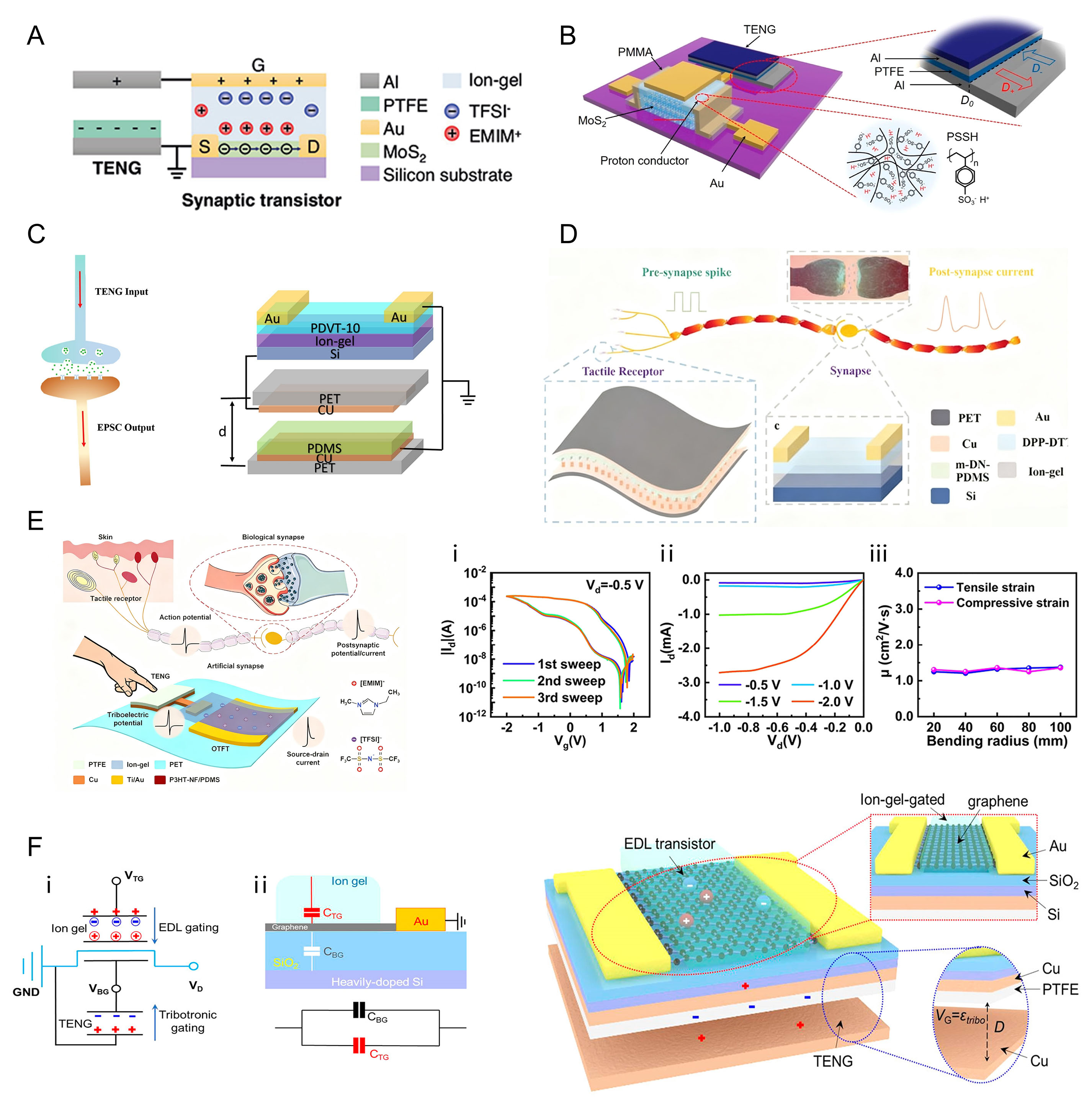
Figure 3. TENG-memristor coupling: device schematics, operation, and performance metrics. (A) Concept of a triboelectric-pulse-driven electrolyte-gated synaptic transistor[44], where mechanical pulses act as dynamic gate biases to trigger ion migration and modulate channel conductance. (B) Representative triboiontronic (EDL/ion-assisted gated) MoS2 device architecture and working principle, in which interfacial ion motion regulates the channel, adapted from[60]. (C) A TENG-driven PDVT-10/ion-gel synaptic transistor showing stepwise increases in excitatory postsynaptic current (EPSC) under repeated mechanical stimulation, adapted from[93]. (D) A flexible tactile sensor integrated with an artificial synapse to map stimulus-to- postsynaptic response relationships for self-powered perception and learning, adapted from[93]. (E) Typical electrical performance metrics measured under cyclic operation: (ⅰ) transfer/output characteristics and memory window, (ⅱ) hysteresis/retention under repeated biasing, and (ⅲ) stability under tensile/compressive strain. Equivalent circuit representations for EDL-based gating driven by a triboelectric source, including impedance conditioning via an external capacitor, are also shown, adapted from[95]. (F) Equivalent circuit model for EDL-based gating driven by a triboelectric source, including impedance conditioning via an external capacitor and resistor, adapted from[94]. Reproduced with permission from Springer Nature (A and E), American Chemical Society (B and F), and Elsevier (C and D).
On the flexible and system-integration side, Liu et al.[93] reported a PDVT-10/ion-gel-based soft synaptic transistor [Figure 3C], in which tactile perception was synchronously coupled with updates of EPSC weights. The device maintained stable responses under repeated bending and stretching, demonstrating excellent mechanical adaptability. The same group subsequently proposed an integrated "triboelectric sensor-artificial synapse" scheme[61] for real-time neuromorphic computation [Figure 3D]. Inspired by biological tactile pathways, this system establishes a sensing-memory signal pathway from mechanical stimulation to synaptic current, along with stable online learning behavior.
Wearable applications have also been demonstrated. Zeng et al.[95] processed biopotentials in a flexible system and showed that serpentine interconnects preserved ion-transport stability under large deformations, demonstrating system-level reliability of electrolyte-gated coupling [Figure 3E]. These results indicate the applicability of electrolyte-gated synaptic devices at both the device and system levels. To further improve signal consistency and controllability, Zhang et al.[94] introduced a step-down capacitor [Figure 3F] to tailor the EDL time constant, thereby improving impedance matching between the TENG and the synaptic gate. This strategy effectively suppresses pulse overshoot/undershoot and significantly enhances write consistency.
Triboelectrically driven floating-gate synapses combine ultra-low power consumption, non-volatile weight storage, and support for multimodal learning, making them particularly attractive for energy-constrained neuromorphic platforms. However, their charge retention performance remains sensitive to dielectric stability and ambient humidity, and non-uniform TENG pulse outputs can induce synaptic weight drift. Promising future directions include engineering the band structure of floating-gate dielectrics, reinforcing interfacial insulation, and exploiting flexible, stretchable materials to stabilize mechano-electrical cooperative memory. Such advances will provide a robust device-level basis for self-powered neuromorphic perception and high-dimensional learning systems.
TENG-pulse-driven floating-gate synapses
Floating-gate transistors (FGTs) provide a compact approach for converting triboelectric pulses into programmable conductance states through capacitive charge trapping and release. Under high-voltage, millisecond-to-second (ms-s) TENG waveforms, rapid modulation of the channel potential drives carrier injection across tunneling dielectrics and subsequent de-trapping, translating pulse amplitude, frequency, and duty cycle into synaptic weight updates. The dispersive trapping kinetics naturally yield STP, with transitions to long-term potentiation (STP → LTP), and retention times ranging from seconds to minutes, thereby enabling event-driven learning without auxiliary power supplies. For clarity, STP is attributed to shallow/fast trapping-detrapping-dominated responses, while LTP-like behavior arises when repeated tribo-pulses populate deeper traps or strengthen electrostatic charge storage, leading to prolonged retention.
Representative implementations span 2D semiconductors and hybrid stacks. Yang et al. used a MoS2 channel with engineered tunneling and blocking layers to realize a tribotronic (tribopotential-gated) FGT [Figure 4A]. Here, "tribotronic" indicates that the triboelectric potential serves as the effective gate bias in a transistor configuration, consistent with the terminology defined in the Introduction. TENG pulses gate the channel via capacitive coupling, enabling efficient write/erase operations and synaptic functionalities, including STP, LTP, and PPF[60]. Gao et al. demonstrated a self-powered floating-gate memory based on a Gr/h-BN/InSe heterostructure [Figure 4B]. In this system, contact-separation excitation converts TENG output directly into channel current for near-zero-energy writing and reliable erasing, with complementary I-V measurements confirming trap-mediated storage[67]. Khan et al. developed a MoS2-based tribotronic (tribopotential-modulated) tactile memory [Figure 4C], in which polarization-modulated barriers induce periodic trapping-detrapping cycles. Positive pulses promote carrier injection, while negative bias accelerates charge release, resulting in semi-permanent "write-once" behavior under external bias[99]. Extending to opto-tribotronics (photo-tribopotential co-modulation), Zhao et al. correlated the TENG time-voltage integral with the optical-assisted writing dose (150 V mm-1) [Figure 4D], enabling photo-tribo coupled learning and robust state retention[98]. A system-level survey further concluded that three-terminal stacks (floating gate / tunneling barrier / blocking dielectric) built on 2D materials constitute a scalable core architecture for triboelectric-memristive hybrid systems[96].
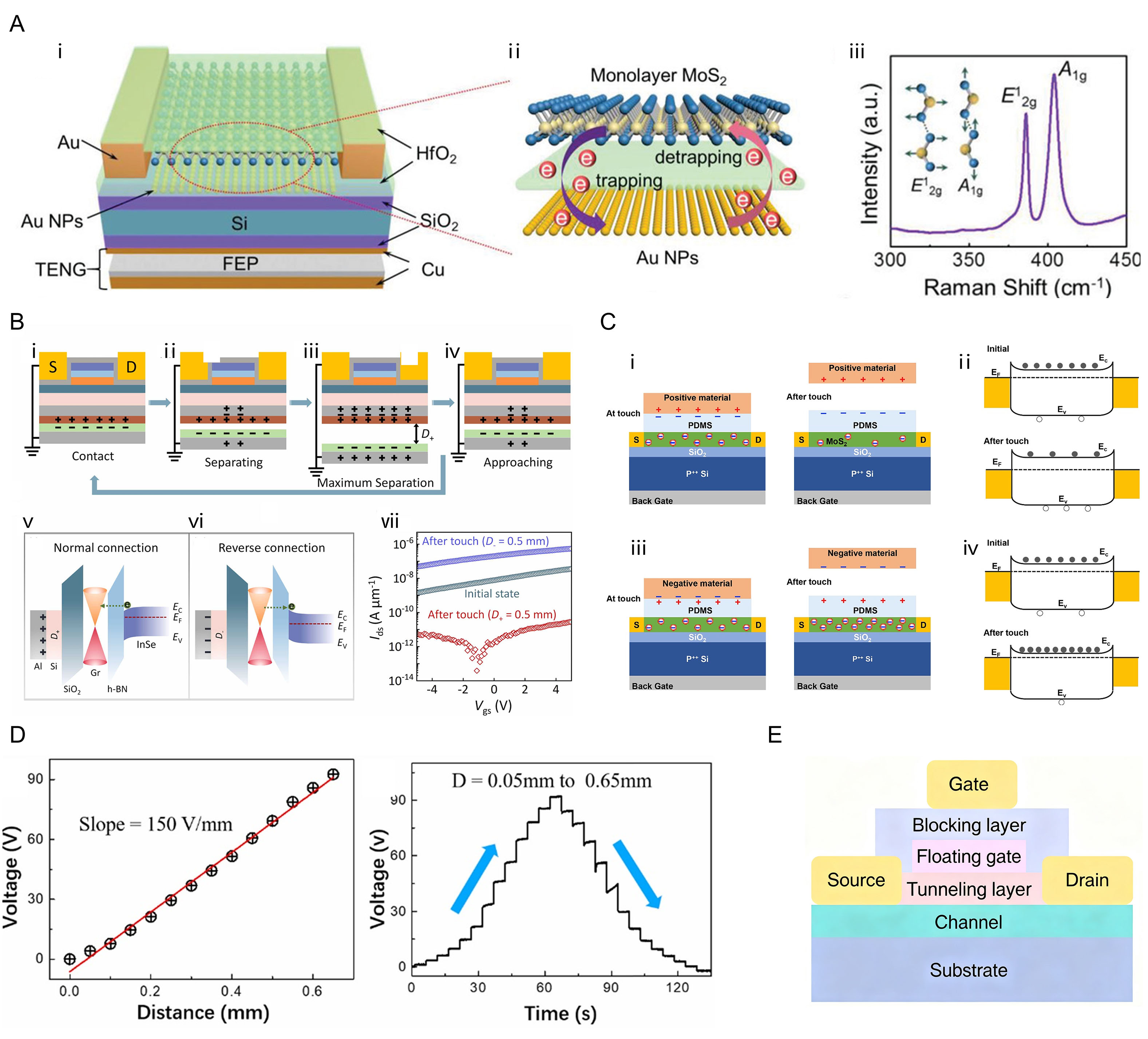
Figure 4. TENG-driven floating-gate synapse: structure, operation, and waveforms. (A) Device architecture and materials: (ⅰ) overall schematic; (ⅱ) MoS2 channel with an Au nanoparticle (Au NP) hybrid stack illustrating charge trapping/detrapping pathways; (ⅲ) Raman spectroscopy verification of the MoS2 layer number, adapted from[66]. (B) Operating principle under TENG pulsing: bias-dependent charge accumulation and release in the floating gate, adapted from[67]. (C) Polarity-tunable band diagrams in a tribotronic tactile memory: (ⅰ and ⅱ) positive tribopotential lowers the injection barrier and promotes charge trapping; (ⅲ and ⅳ) negative tribopotential raises the barrier and accelerates charge detrapping, adapted from[99]. (D) TENG output as a function of mechanical displacement: left—open-circuit voltage varies linearly with distance (150 V mm-1); right—pulse envelope as a function of excitation frequency, adapted from[98]. (E) Canonical three-terminal floating-gate stack (gate/blocking dielectric/FG/tunneling dielectric/channel) as a scalable core for triboelectric-memristive hybrid systems, adapted from[96]. Reproduced with permission from Wiley (A), Elsevier (B-D), Nature (E).
Despite their low operating energy and rich plasticity, several practical hurdles remain. Retention and endurance are sensitive to interface quality and ambient humidity, while non-uniform pulse trains generated by TENGs can induce weight drift. Promising directions include dielectric/interface engineering to control barrier heights and trap distributions, pulse-conditioning front-end circuits to homogenize tribo-waveforms, and mechanically compliant (stretchable) stacks to sustain performance under deformation. These developments are expected to advance stable, multimodal, self-powered neuromorphic learning systems. As shown in Figure 4, TENG pulses gate the floating-gate synapse and enable bias-polarity-selective trapping/detrapping.
vdW heterostructures and perovskite memristors
The incorporation of 2D semiconductors and hybrid perovskites elevates triboelectrically driven synaptic devices to a regime characterized by high sensitivity and rich multimodal dynamics. Prototypical vdW heterostructures — such as MoS2/WSe2 and graphene/MoS2—exploit interfacial Schottky barrier engineering and exciton coupling to realize dynamic carrier injection and extraction under triboelectric bias. When the periodic output potential of a TENG interacts with the heterojunction interface, the barrier height is synchronously modulated by mechanical excitation, inducing conductance changes that resemble biological synaptic potentiation.
Yu et al.[100] realized a triboelectrically driven optoelectronic synaptic transistor by engineering a graphene/MoS2 vdW heterostructure [Figure 5A and B]. In this architecture, the alternating potential supplied by the TENG periodically modulates the interfacial Schottky barrier, enabling dynamic control of electron-hole recombination and separation. Under concurrent optical illumination and mechanical excitation, the device delivers a stable photoresponse together with reversible conductance tuning, and can execute image recognition tasks at ultralow power, evidencing self-powered learning that tightly couples optical, mechanical, and electrical signals. These results show that triboelectric potentials not only initiate synaptic plasticity, but also support programmable coupling between photonic and mechanical inputs, thereby establishing a physical foundation for multimodal, energy-driven neuromorphic vision.
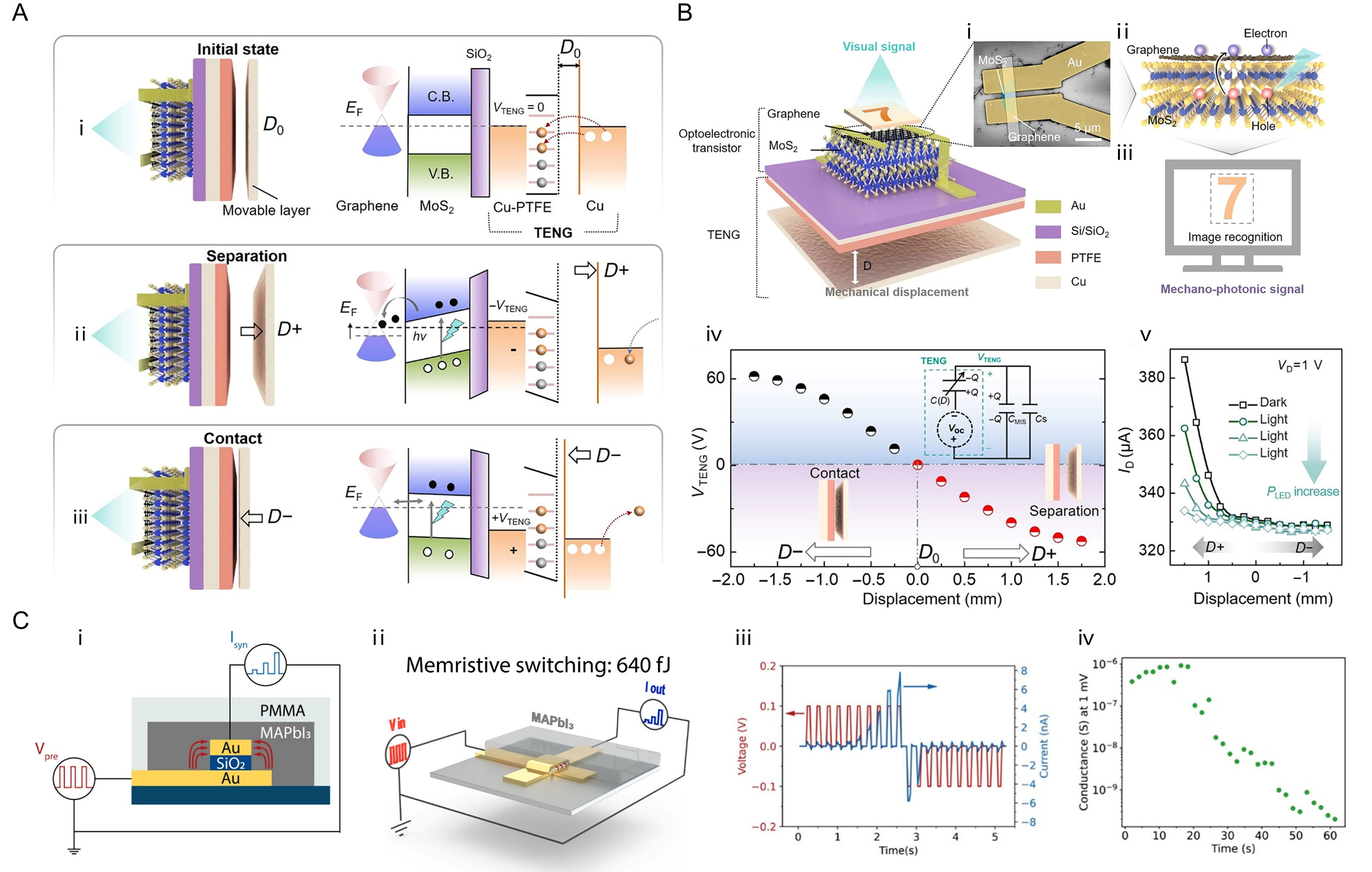
Figure 5. (A) Operation of a MoS2/graphene van der Waals (vdW) heterojunction under triboelectric bias: (ⅰ-ⅲ) band alignment and carrier distribution during the approach/separation processes, where the TENG-induced potential sweep enables reversible electron-hole transfer. (B) Optomechanical co-modulation in vdW stacks: (ⅰ) schematic of a MoS2/graphene optoelectronic synaptic transistor; (ⅱ) photogating-controlled carrier generation/transport; (ⅲ) mechanically driven image recognition demonstration; (ⅳ and ⅴ) channel current variations as a function of TENG output/displacement and illumination, evidencing device-level learning behavior, redrawn from[100]. (C) Perovskite memristor (Au/MAPbI3/Au): (ⅰ) device structure; (ⅱ) single-spike programming energy ≈ 640fJ; (ⅲ and ⅳ) TENG pulse-induced transition from short-term to long-term plasticity, with characteristic conductance-time traces, adapted from[101]. Reproduced with permission from American Association for the Advancement of Science (A and B), American Chemical Society (C).
Beyond 2D heterostructures, halide perovskites are emerging as powerful building blocks for triboelectric synapses because their soft lattices support pronounced ion migration and tunable band structures. de Boer and Ehrler[101] demonstrated a methylammonium lead iodide (MAPbI3)-based perovskite memristor [Figure 5C], in which TENG-driven voltage pulses produce robust resistive switching with four discrete conductance states. Under periodic mechanical stimulation, the device exhibits a diverse range of synaptic functions—including STP, LTP, and STDP—while maintaining stable conductance evolution over repeated cycles. These results show that triboelectric pulses can efficiently trigger ion migration and carrier trapping within the perovskite, thereby directly encoding mechanical energy into synaptic weights. When combined with periodic modulation of the TENG output, the platform further enables cooperative mechano-opto-electronic responses, highlighting new opportunities for the design of flexible, self-powered neuromorphic electronics.
The integration of vdW heterostructures with perovskite materials establishes, at the materials level, a bridge from electron-exciton control to coupled ion-electron, multi-field regulation. Interfacial engineering and band structure tailoring can further enhance the conversion efficiency from triboelectric energy to synaptic signals, driving devices toward higher sensitivity, ultralow power consumption, and intrinsically multimodal operation. Future efforts aimed at elucidating interfacial charge-coupling mechanisms, stabilizing perovskite phases, and scaling to dense arrays will be crucial for realizing high-performance, self-powered synaptic networks tailored for flexible neuromorphic electronics and environment-adaptive intelligent sensing.
Design principles and brain-inspired integration strategies
Realizing triboelectric synapses requires not only material-level energy-information transduction, but also the co-optimization of device structures and signal orchestration. A practical stack should establish a direct linkage from energy harvesting to computation, so that mechanical excitation is converted into learnable electrical stimuli and then into low-power neuromorphic states.
High and stable surface charge density, together with band-edge tunability, is central to robust TENG sensing and programming. Two-dimensional vdW heterostructures and perovskite/2D hybrids offer large band-offset windows for Schottky or tunneling modulation. Interfacial engineering can align trap/ion kinetics with tribovoltage waveforms to control state retention and volatility. Practical strategies include the use of dipole-rich interlayers, ionic gels/electrets, defect and grain-boundary control, and hydrophobic encapsulation to suppress humidity-induced leakage. In addition, thin dielectrics and distributed microcapacitors can increase coupling without sacrificing breakdown margin[60].
Three-terminal synaptic transistors and arrayed layouts are favored for system scalability because they decouple sensing (input) and plasticity (gate) from readout, enabling closed-loop control between TENG input and channel conductance[35]. Time-domain programmability can be achieved by modulating pulse amplitude, width, duty cycle, and inter-spike intervals. Compact rectifiers/charge pumps and mini-capacitors buffer the high-voltage, low-current TENG output and provide impedance matching. Array-level tiling permits in-sensor aggregation (e.g., light, force, temperature, humidity) and event-driven multiplexing, thereby supporting multidomain perception under nanowatt-to-microwatt power budgets[36,37].
A bidirectional loop between energy and information converts harvested pulses into synaptic updates and, reciprocally, uses local device states to regulate subsequent encoding[102]. Spike shaping and asynchronous coding map mechanical events directly onto learning rules (STP/LTP/STDP) without the need for intermediate power supplies. Array calibration compensates for device variability. At the network level, lightweight local rules (e.g., activity-dependent retention, threshold adaptation) maintain an optimal balance between accuracy and energy consumption under stochastic tribovoltage conditions, while co-integrated rectification and storage support "sense-compute-power" integration for autonomous neuromorphic systems.
Future triboelectric neuromorphic systems are expected to evolve toward tightly coupled multi-physics, multimodal, and multiscale operation. Cross-layer co-optimization — from materials and interfaces to devices, circuits, and system architecture — will be essential to further reduce energy consumption while improving plasticity precision, retention control, and signal fidelity. Embedding neuromorphic learning rules directly into hardware, rather than applying them only at the algorithm level, may enable adaptive networks capable of real-time updating, self-calibration after perturbation, and robust operation under variable environmental conditions (temperature, humidity, strain, illumination). Such energy-adaptive networks could integrate perception, actuation, and power management within a single physical platform, enabling soft human-machine interfaces, intelligent electronic skin, and distributed sensor networks that operate without a continuous external power supply. This hardware-algorithm co-design paradigm outlines a pathway toward autonomous, self-healing, and context-aware intelligent surfaces and wearable neuromorphic systems.
ENERGY-DRIVEN NEUROMORPHIC COMPUTING WITH TRIBOELECTRIC-MEMRISTIVE COUPLING
Realizing self-powered neuromorphic computing requires a system-level perspective that extends beyond single-device stimulus-response behavior[22,75]. The key is to establish a closed-loop system in which harvested energy is converted into informative electrical pulses and directly written into nonvolatile states, thereby enabling in situ learning and memory with co-evolution of energy and information[33,44]. In parallel, progress in synaptic transistors, 2D material-based neuromorphic platforms, and flexible multimodal artificial synapses has provided scalable circuit primitives and integration strategies that inform the system-level coupling frameworks discussed in this section.
In this context, coupling a TENG to a memristive element provides the necessary physical foundation[66,101]. The TENG converts mechanical perturbations into voltage/current spikes, while the memristive device translates these spikes into conductance updates via field-assisted ionic transport processes (filament nucleation/rupture, vacancy drift, charge trapping/de-trapping), thereby enabling synaptic weight plasticity. This hybrid system achieves both energy-to-information transduction and event-driven, temporal-dependent learning dynamics (STP→LTP conversion, PPF, STDP) under nanowatt-to-microwatt power consumption.
With appropriate circuit co-design—high-impedance rectification, passive buffering, and pulse shaping—TENG-generated bursts can trigger deterministic state programming without an external power supply, thereby converting environmental mechanical stimuli into controlled conductance modulation with retention capability. This physical integration of energy harvesting, sensing, and learning lays the groundwork for arrays and networks that support on-node adaptation and multimodal data fusion[43,96,100].
From a system-level perspective, triboelectric-memristive implementations can be organized into three tiers: (ⅰ) device-level coupling strategies (electrolyte-gated, floating-gate, vdW/perovskite stacks) that realize synaptic functions; (ⅱ) circuit/array-level modules that enable event encoding and local learning; and (ⅲ) system-level demonstrations that integrate perception and computation powered by harvested energy. Representative examples and performance summaries are detailed in Table 3.
System-level performance and energy efficiency of triboelectric-memristive architectures
| System level | Energy input | Key materials | Realized function | Energy per event | Refs. |
| Single synaptic device | Triboelectric pulses (contact-separation) | MoS2/ion-gel; proton-/ion-conducting electrolytes | STP, LTP, STDP; event-driven learning | fJ-pJ | [44,60,93] |
| Crossbar / small array | Distributed mechanical pressure or vibration | Oxide-/perovskite-based memristor crossbars | Pattern recognition; associative memory; image reconstruction | 10-100 pJ per pixel-equivalent update | [97,103] |
| Multimodal/system level | Light + mechanical ± humidity (multi-field coupling) | 2D heterostructures; perovskites; MoWS2/VOx hybrids | Optomechanical/humidity-vision co-learning; orientation selectivity | fJ-nJ (depending on the integration scale) | [62,101,104] |
Table 3 consolidates energy footprints, response modalities, and representative demonstrations across triboelectric-memristive architectures. As structural complexity increases, the per-event energy scales down to the femtojoule regime, while functionality progresses from single-synapse primitives to multimodal sensing and autonomous learning. This progression motivates the organization of Sections "Energy-coupled memristors: from voltage pulses to synaptic plasticity" - "Multiphysics co-design and adaptive energy-information coupling", moving from device-level mechanisms to cooperative learning at the array level, culminating in cross-modal, self-powered intelligent systems.
Energy-coupled memristors: from voltage pulses to synaptic plasticity
In energy-coupled devices, high-voltage/low-current pulses produced by a TENG replace external bias and directly program the conductance of a memristive element, thereby mapping mechanical events to synaptic weight updates. A single mechanical spike generates a transient interfacial potential that drives ionic/defect migration and induces the formation of conductive filaments. Repetitive or high-frequency pulsing accumulates these changes, transforming STP into LTP. This temporal dependence represents the physical analog of biological learning-memory processes.
A ZnO/SnO2 heterojunction tactile memristive transistor[63] demonstrates self-powered conductance tuning under TENG excitation [Figure 6A-D]. TENG-induced interfacial band bending reversibly modulates carrier injection and recombination, resulting in potentiation or depression under opposite polarities. Under pulsed excitation, the device exhibits PPF and durable LTP over hundreds of cycles, validating the integration of energy harvesting, signal transduction, and synaptic updating within a single platform.
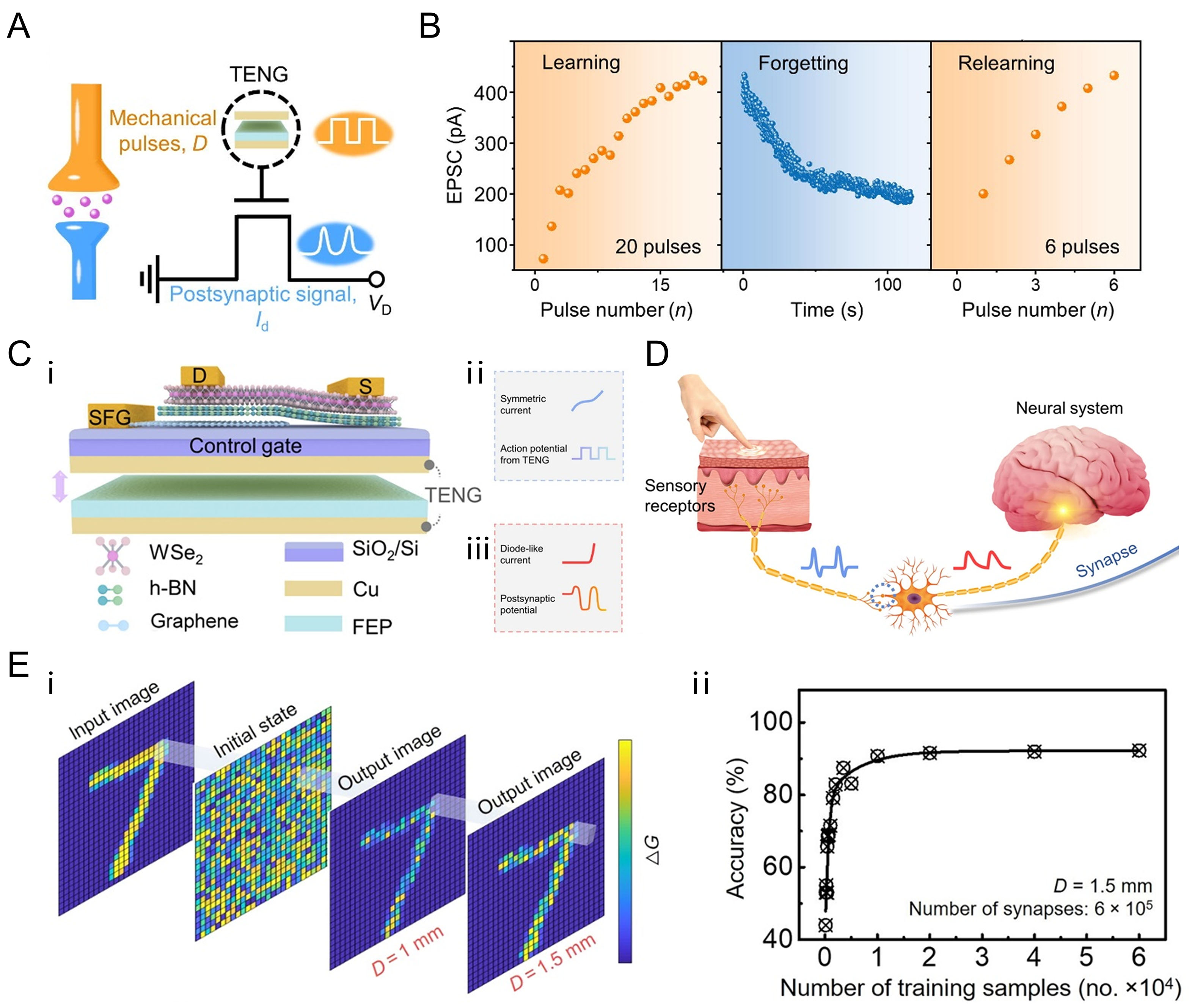
Figure 6. (A) Schematic of an energy-coupled memristor driven by TENG pulses: mechanical stimulation produces a high-voltage, low-current signal that modulates the formation/rupture of conductive filaments. (B) Memristive learning behavior under periodic mechanical excitation, illustrating learning, forgetting, and relearning processes. (C) TENG-gated WSe2/h-BN/graphene vdW synaptic device: (ⅰ) device structure; (ⅱ) mechanically induced current response; (ⅲ) device-level potentiation. (D) Biological analogy of continuous tactile receptors and synaptic transmission, mapping triboelectric action-potential-like pulses to synaptic responses, adapted from[63]. (E) Pattern recognition using a TENG-driven synaptic array: (ⅰ) evolution from a random/initial state to a stable image for D=1 mm and 1.5 mm; (ⅱ) recognition accuracy as a function of training-set size for ≈ 6×10⁵ synapses at D=1.5 mm, adapted from[100]. Reproduced with permission from Elsevier (A-D) and American Association for the Advancement of Science (E).
Complementarily, a graphene/MoS2 vdW optomechanical synaptic transistor [Figure 6E and F] uses periodic TENG-induced potentials to temporally modulate barrier dynamics, enabling precise control over attention-forgetting processes[100]. Coupled mechanical-optical stimulation reproduces both short-term and long-term memory behaviors, enables tunable coupling/quantized conductance states, and supports low-voltage (< 3 V) pattern recognition for energy-efficient co-learning between photonic and mechanical inputs. The synergy between tribovoltage and photoexcitation increases modulation sensitivity and memory retention, providing a pathway toward multimodal perception with on-node power.
These results indicate that TENG-driven memristors establish a direct bridge between ambient energy and synaptic computation: event timing naturally encodes the update rule, while interface-level band engineering enhances memory depth and selectivity. Device-level "harvest-modulate-learn" primitives thus provide a foundation for array-scale cooperative learning and, ultimately, system-level multimodal, self-powered intelligence.
Mixed synaptic arrays and crossbar integration
Transitioning from single devices to arrays, triboelectric outputs can be spatially multiplexed to drive many memristive nodes, thereby enabling self-powered, locally coordinated learning. In crossbar architecture, TENG pulses are distributed across rows/columns to realize multi-channel weighted updates. Array-level plasticity then couples temporal dynamics with energy allocation, enabling on-array perception, associative recall, and modular cognition under ultralow energy consumption.
Kim et al.[97] mapped TENG pulses onto a memristive network [Figure 7A and B], where friction-induced interfacial charge transfer deterministically tuned synaptic conductance. Controlled pulse amplitude/frequency produced five-level nonvolatile states with pJ-class update energy. With sparse coding, the array recognized handwritten digits from tactile inputs, establishing a repeatable, self-powered pathway from contact mechanics to image memory. Zhou et al.[103] injected TENG-based tactile events into a perovskite memristor crossbar [Figure 7C-F], achieving stable associative recall of grayscale images without external power supplies. A 28 × 28 network reconstructed images from pixel-equivalent updates, while array-level weighted summation compensated for device non-uniformity and preserved grayscale fidelity. Ren et al.[62] realized a multimodal synaptic array [Figure 7G and H] that co-encodes mechanical and visual inputs. Orientation selectivity emerged from asymmetries between left and right channel pulses, while maintaining energy consumption below 10-12 J per event, demonstrating task-dependent learning and symmetric plasticity in a self-powered sensory fusion platform.
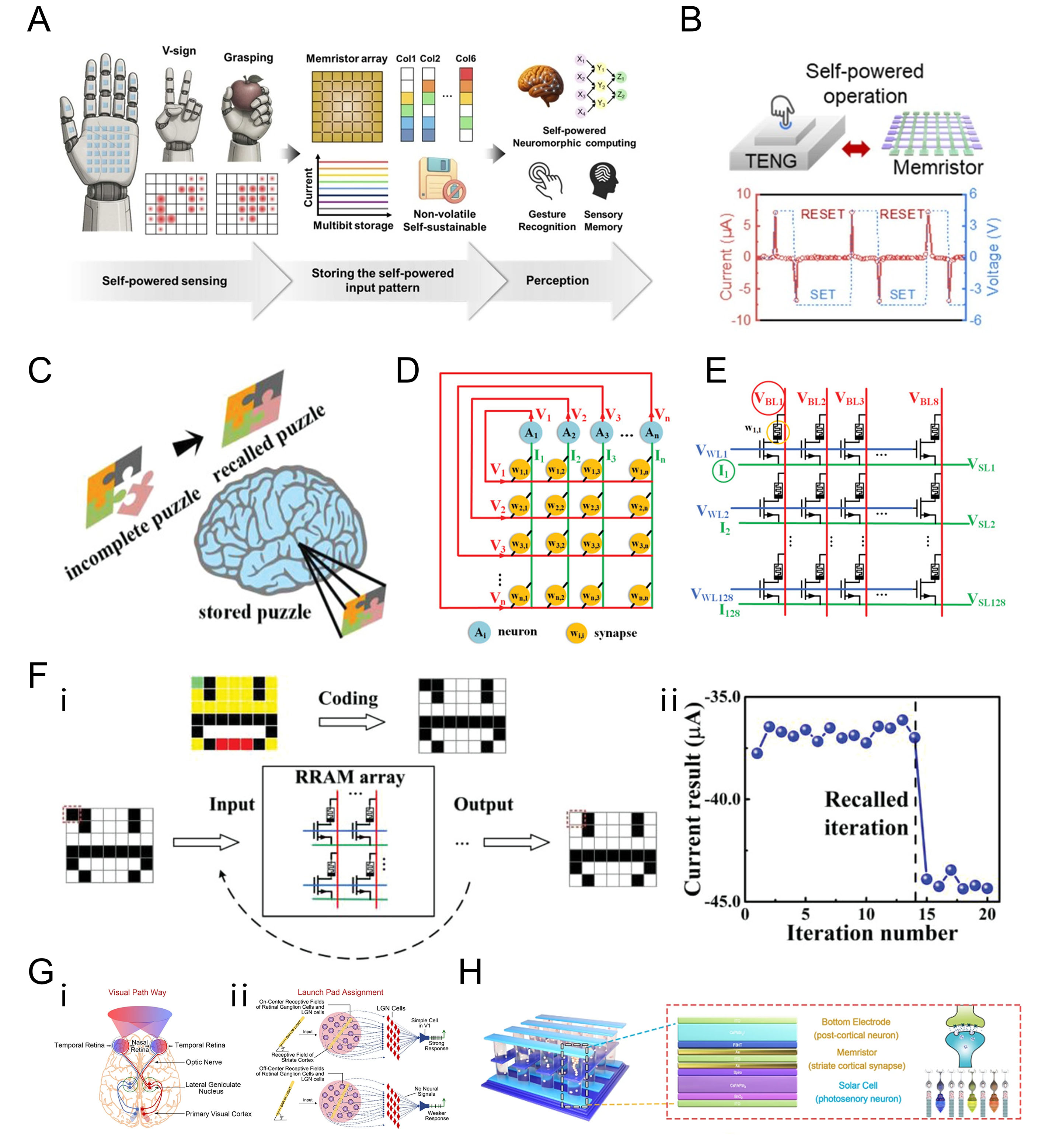
Figure 7. (A) Concept of a self-powered neuromorphic system integrating TENG-based sensory units with memristive crossbars for storage-perception-recognition (gesture sensing and memory). (B) TENG-driven memristor switching under pulsed excitation, showing nonvolatile SET/RESET[97]. (C) Associative learning and memory recall, illustrating the transition from incomplete cues to a recovered memory-mode representation. (D) Hybrid TENG-memristor crossbar architecture composed of artificial neuron/synapse unit cells. (E) Circuit model of energy-matrix multiplication realized via interconnected memristive synapses driven by TENG-generated signal sequences. (F) Resistive random-access memory (RRAM)-based image storage and recall: (ⅰ) array-level broadcast of input/output signals; (ⅱ) iterative update dynamics converging to the stored pattern[103]. (G) Visual cortex-inspired system: (ⅰ) biological visual pathway; (ⅱ) mapping from the retina to cortical layers. (H) Opto-memristive heterogeneous architecture in which integrated self-powered memristor arrays implement visual signal processing[62]. Reproduced with permission from Elsevier (A and B), Wiley (C-F), Springer Nature (G and H).
Mixed arrays provide a scalable bridge from energy harvesting to energy-aware learning, progressing from single synapses to cooperative multi-node inference. Priorities include: robust pulse coding for variable tribo-waveforms, interconnect designs that suppress parasitic effects and latency, variability-tolerant local learning rules, and tight integration with on-chip perception—ultimately enabling large-scale, self-powered neuromorphic systems.
Multiphysics co-design and adaptive energy-information coupling
At the array level, co-learning in self-powered synaptic networks naturally extends from single-mode operation to multimodal responses. A unifying strategy is to close the energy-information loop: harvested stimuli (e.g., pressure, vibration, illumination) drive sensory computing at each node, while the learned state feeds back to regulate transduction and signal routing. Realizing adaptive energy-information coupling is therefore central—systems that combine triboelectric and piezoelectric harvesting with resistive/ionic switching elements can operate without external power, enable cross-modal signal fusion with high fidelity, and align device dynamics with environmental conditions.
Mallik et al. reported a mixed electron-ion WS2 memtransistor that maintains stable state updates at 100 ℃ and exhibits both short- and long-term plasticity via field-assisted ion migration and interfacial gating[102] [Figure 8A and B]. The device preserves 6-bit retention under thermal stress, demonstrating robust neuromorphic adaptation and supporting temporally dependent learning in harsh environments.
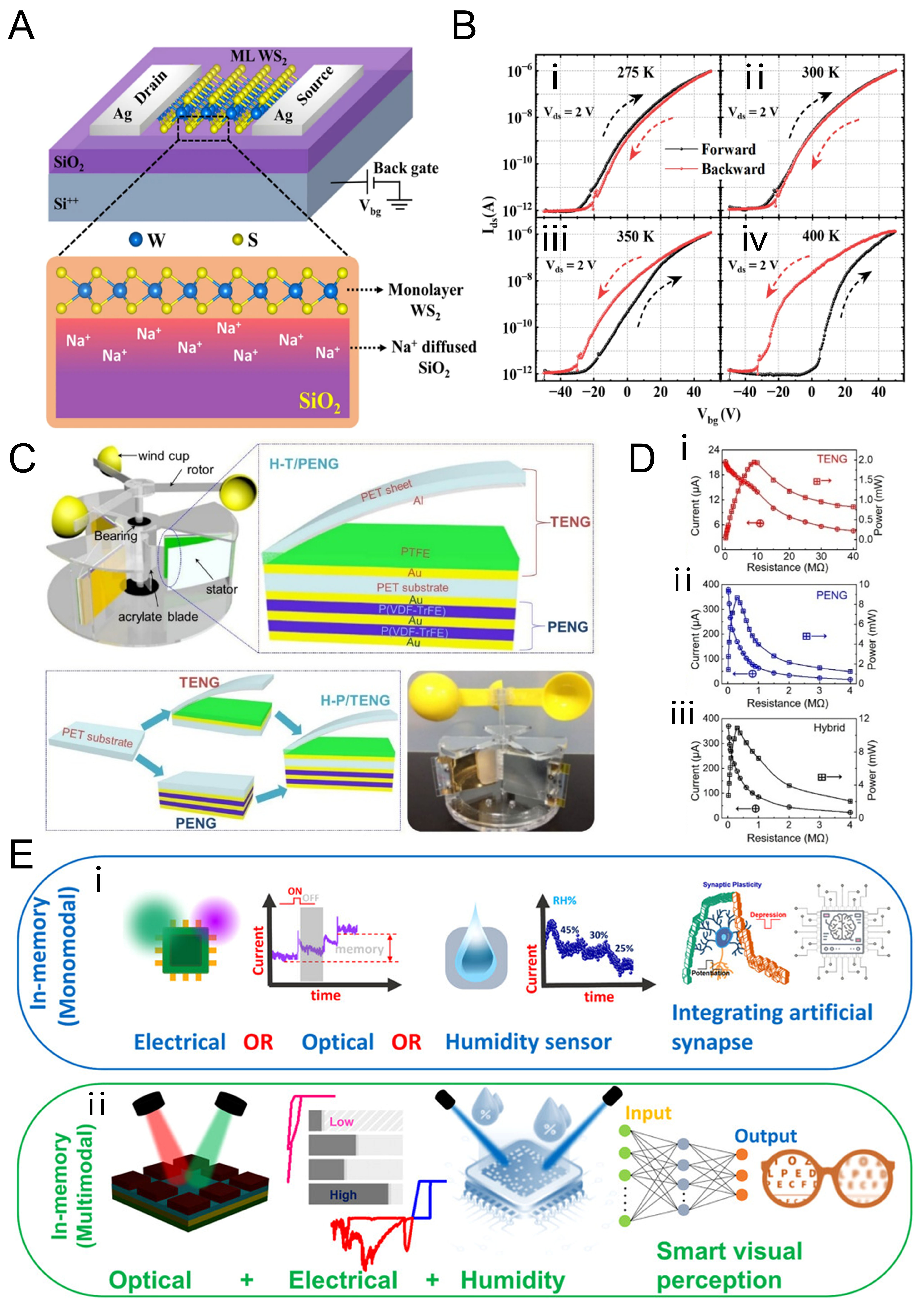
Figure 8. Multiphysics hybrid transduction and memory-in-sensor demonstrations. (A) Na+-doped WS2 transistor showing multiphysics coupling mediated by ion transport in the porous layer; (B) (ⅰ-ⅳ) Temperature-activated hopping behavior in the range of 275-400 K, adapted from[102]. (C) Hybrid triboelectric/piezoelectric nanogenerator (TENG/PENG): structure and working principle, where triboelectric and piezoelectric mechanisms cooperate to enhance mechano-electric conversion efficiency, adapted from[105]. (D) Output characteristics comparing (ⅰ) pure TENG, (ⅱ) pure PENG, and (ⅲ) hybrid operation, evidencing reduced source impedance and increased power density in the hybrid mode, adapted from[105]. (E) Memory-in-sensor and on-sensor learning framework integrating sensing, energy harvesting, and data storage on a single platform[104]. Demonstrations include (ⅰ) single-modality synaptic plasticity under light, electrical, or humidity stimuli, and (ⅱ) multimodal fusion of light-electric-humidity signals for autonomous computation and intelligent vision. Reproduced with permission from Springer Nature (A and B), Elsevier (C and D), Wiley (E).
To improve system efficiency, Zhao et al. developed a hybrid piezo/triboelectric nanogenerator (H-PTENG) that achieves high-voltage, low-loss energy conversion during motion and delivers conditioned signals that can directly program memristive synapses as event-driven learning pulses[105] [Figure 8C and D]. This approach reduces buffering overhead while preserving pattern separability in downstream arrays.
Advancing toward fully multiphysics artificial neurons, Syed et al. demonstrated a MoWS2/VOx heterojunction device that couples humidity and optical (vision) channels[104] [Figure 8E]. TENG-derived mechanical excitation modulates the VOx layer, humidity influences interfacial ionic transport, and light perturbs photocarrier populations. Together, these effects enable adaptive co-learning (orientation selectivity, self-calibration) and robust recognition under time-varying environments. These studies provide device-level evidence that environment-aware, self-powered neuromorphic systems can be realized through co-design of energy harvesters, transducers, and memory elements to natively integrate energy flow with learning rules.
Outlook
Self-powered neuromorphic systems that couple TENGs with memristive elements are progressing from single-stimulus devices toward multimodal, networked architectures that close the loop from energy harvesting to information encoding and learning/memory functions. Recent demonstrations have combined ion-electron coupling, energy conditioning, and multiphysics co-modulation to realize continuous "sense-learn-remember" pipelines. Remaining challenges include: (ⅰ) robust interfacial chemistry to ensure long-term charge stability, (ⅱ) low-loss power conditioning under variable loads, and (ⅲ) materials-circuit co-design strategies that maintain on-device learning across diverse environments.
To make this field more comparable and benchmarkable, future studies may report a minimal yet comprehensive set of cross-layer parameters: (ⅰ) tribo-waveform statistics under realistic stimuli (amplitude distribution, repetition rate, and load dependence), (ⅱ) dominant device time constants (relaxation/retention and their environmental sensitivities), and (ⅲ) learning-rule-aligned update metrics (e.g., per-event conductance change, drift, and variability across arrays). Such standardized reporting, together with physics-based compact models, will enable fair comparisons across material platforms and accelerate the translation from single-device demonstrations to scalable, multimodal, deployable energy-adaptive neuromorphic systems.
First, interfacial charge stability should be evaluated not only in terms of retention time but also in drift, hysteresis, and cycle-to-cycle variability under realistic mechanical excitations. For tribo-programmed synapses, it is particularly important to decouple "useful" state updates from parasitic charge leakage or unintentional programming caused by irregular pulse trains. Second, power-conditioning circuits must balance energy efficiency with programming controllability: overly aggressive rectification/filtering can suppress informative temporal features of tribo-pulses, whereas insufficient conditioning can lead to stochastic state updates and poor reproducibility. Third, a practical co-design strategy should explicitly link harvester statistics (pulse amplitude distribution and repetition rate), transducer time constants (e.g., EDL relaxation or charge trapping kinetics), and the targeted learning rules (STP/LTP/STDP), ensuring consistent functionality across varying environmental conditions (humidity, temperature, mechanical frequency, and loading conditions). Clearer reporting of these cross-layer parameters will facilitate fair benchmarking and support system-level adoption of TENG-memristor neuromorphic architectures.
From a materials/device viewpoint, interfacial design and band/defect engineering are key to achieving high energy-information conversion efficiency. High dielectric constant high-K materials and 2D vdW stacks with stable ionic conductors can reduce variability and stabilize switching thresholds. Electron-ion co-transport channels and programmable interfacial dipoles can deliver dynamic plasticity without compromising retention. In TENG-memristor hybrid systems, compact rectifiers, mini-capacitors, and adaptive charge-pump front-end circuits should convert irregular tribo-pulses into controllable programming waveforms while preserving event-driven operation.
At the system level, triboelectric-driven synapses should evolve from isolated units into intelligent, self-organizing ensembles. Cross-domain integration of mechanical, optical, and humidity inputs will enable energy-information closed-loop systems for edge inference. Soft, stretchable platforms and bio-interfaced layouts can support artificial skin and implantable modalities. Concurrently, physics-informed compact models that link tribo-voltage statistics to ionic kinetics are essential for design-space exploration and algorithm-hardware co-training.
Looking ahead, triboelectric neuromorphic networks point toward a paradigm in which energy flow itself acts as both the carrier and regulator of computation—an "energy → information → intelligence" continuum. We anticipate systems that autonomously balance harvested energy with task demands, achieving long-term, low-power learning in real-world environments. As materials continue to mature and array-scale learning strategies co-evolve, self-powered neuromorphic skins and soft robotic perception systems are expected to transition from laboratory prototypes to robust platforms for adaptive operation.
CHALLENGES AND FUTURE DIRECTIONS
Although triboelectric-memristive neuromorphic systems have shown rapid progress in materials, device structures, and prototype architectures, the pathway from laboratory validation to practical deployment remains nontrivial. Current bottlenecks are primarily concentrated in: (ⅰ) interface robustness under humidity, temperature variations, and cyclic mechanical loading (long-term charge retention and drift control); (ⅱ) energy management for irregular triboelectric pulses (low-loss rectification, buffering, regulation, and impedance matching); (ⅲ) device-circuit-algorithm co-design that ensures consistent timing/impedance across the hierarchy from single devices to large-scale arrays; and (ⅳ) multiphysics integration spanning electrical, mechanical, optical, and ionic processes.
As summarized in Table 4, these challenges arise from the coupling of materials physics (stability of contact electrification, interfacial defect control, built-in field engineering), system engineering (array variability, sneak paths, synchronization), and theoretical frameworks (compact models and learning rules that connect energy flow to state evolution). Accordingly, a three-layer program is required:
Multilevel summary of energy-driven neuromorphic systems
| Level | Focus | Key challenges | Current progress | Future trends |
| Material | Charge generation and ion transport | Interface stability and defect control | Hybrid perovskite-MXene material stacks | Self-healing and eco-friendly tribo-active materials |
| Device | Energy-information transduction and synaptic plasticity | Impedance matching and architectural design | Demonstrated TENG-memristive co-functionality (STP/LTP/STDP) | Heterogeneous integration and structural flexibility |
| System | Energy distribution and parallel learning | Non-uniform signal pathways and timing synchronization | Self-powered memristive arrays and prototype modules | Distributed neuromorphic networks with multimodal data fusion |
| Theory | Multiphysics and compact modeling | Nonlinear stochasticity and parameter identifiability | Initial coupled energy-state (waveform-state variable) models | Physics-informed machine learning for energy-learning co-design |
| Application | Perception-learning-cognition | Trade-off between power consumption and robustness and deployment stability | Electronic skin and edge-computing demonstrators | Energy-autonomous intelligent ecosystems |
● Materials layer: development of robust electrification layers and humidity-tolerant ion conductors, along with engineered interfaces/band alignment strategies to suppress drift and variability.
● System layer: implementation of low-loss AC-DC front-end circuits and micro-scale energy storage, together with variability-aware peripheral circuits and array-level calibration for reliable large-scale operation.
● Theory/modeling layer: construction of physics-informed compact models that map tribo-pulse statistics to ionic kinetics, as well as energy-aware learning rules to realize closed-loop energy ↔ information co-optimization.
Pursuing multiscale, multimodal, and multiphysics co-design will enable triboelectric-memristive platforms to evolve from benchtop demonstrations into robust, energy-autonomous neuromorphic networks capable of physically constrained learning under real-world conditions.
CONCLUSION
Energy-adaptive neuromorphic electronics are emerging at the intersection of triboelectric energy harvesting and memristive state programming. By co-locating energy acquisition, signal conditioning, and synaptic plasticity within a single materials-device stack, triboelectric-memristive hybrid systems establish a direct energy-to-memory pipeline: harvested mechanical stimuli are converted into voltage/current pulses that deterministically update synaptic weights. These systems can express short- and long-term plasticity under zero external bias while supporting tunable temporal dynamics and multimodal sensing.This review has summarized progress from device physics to system-level implementations, including electrolytic-gated and floating-gate frameworks, vdW and perovskite-memristive heterostructures, and their extension to arrays and multimodal, self-powered platforms. Comparative analysis clarifies the evolution from single-synapse demonstrations to array-level cooperative learning, thereby enabling energy-signal closed-loop operation for event-driven perception and computation.Remaining challenges include interfacial stability under repeated cycling and humidity, defect/ion migration management, flexible/biocompatible integration, and the development of predictive multiphysics models that couple tribo-electro-ionic transport with plasticity dynamics. Addressing these barriers will facilitate the translation of laboratory prototypes into robust and scalable systems. Looking ahead, co-design across materials, transduction mechanisms, and learning strategies is expected to enable energy-adaptive intelligence, wherein harvested energy simultaneously serves as both a computational carrier and a regulatory input. Such architectures offer a pathway toward autonomous, low-carbon, and sustainable intelligent electronics capable of continuous adaptation and long-term evolution.
DECLARATIONS
Acknowledgments
The authors sincerely thank Dr. Dongzhu Lu and Prof. Jianxin Lin for their valuable guidance, insightful discussions, and continuous encouragement throughout this work.
Authors' contributions
Conceived the review and wrote the manuscript: Qin, H.; Li, Q.; Lu, D.; Lin, J.; Gao, W.; Wang, H.
Availability of data and materials
Not applicable.
AI and AI-assisted tools statement
Not applicable.
Financial support and sponsorship
This work was financially supported by the National Natural Science Foundation of China (No. 52302171), the Shandong Provincial Natural Science Foundation (ZR2023QF005), the Youth Innovation and Technology Support Program for Colleges of Shandong Province (2024KJH050), and the Fundamental Research Funds for the Central Universities (3072025YC0401, 3072025YC0402).
Conflicts of interest
All authors declared that there are no conflicts of interest.
Ethical approval and consent to participate
Not applicable.
Consent for publication
Not applicable.
Copyright
© The Author(s) 2026.
REFERENCES
2. Indiveri, G.; Liu, S. Memory and information processing in neuromorphic systems. Proc. IEEE 2015, 103, 1379-97.
3. Maher, M.; Deweerth, S.; Mahowald, M.; Mead, C. Implementing neural architectures using analog VLSI circuits. IEEE Trans. Circuits Syst. 1989, 36, 643-52.
4. Zhou, Q.; Du, C.; He, H. Exploring the brain-like properties of deep neural networks: a neural encoding perspective. Mach. Intell. Res. 2022, 19, 439-55.
5. Schuman, C. D.; Kulkarni, S. R.; Parsa, M.; Mitchell, J. P.; Date, P.; Kay, B. Opportunities for neuromorphic computing algorithms and applications. Nat. Comput. Sci. 2022, 2, 10-9.
7. Chicca, E.; Stefanini, F.; Bartolozzi, C.; Indiveri, G. Neuromorphic electronic circuits for building autonomous cognitive systems. Proc. IEEE 2014, 102, 1367-88.
8. Indiveri, G.; Chicca, E.; Douglas, R. J. Artificial cognitive systems: from VLSI networks of spiking neurons to neuromorphic cognition. Cogn. Comput. 2009, 1, 119-27.
9. Musalia, M.; Laha, S.; Cazalilla-Chica, J.; et al. A user evaluation of speech/phrase recognition software in critically ill patients: a DECIDE-AI feasibility study. Crit. Care 2023, 27, 277.
10. Silver, D.; Huang, A.; Maddison, C. J.; et al. Mastering the game of Go with deep neural networks and tree search. Nature 2016, 529, 484-9.
11. Rowley, A. G. D.; Brenninkmeijer, C.; Davidson, S.; et al. SpiNNTools: the execution engine for the SpiNNaker platform. Front. Neurosci. 2019, 13, 231.
12. Roy, K.; Jaiswal, A.; Panda, P. Towards spike-based machine intelligence with neuromorphic computing. Nature 2019, 575, 607-17.
13. Davies, M.; Srinivasa, N.; Lin, T.; et al. Loihi: a neuromorphic manycore processor with on-chip learning. IEEE Micro 2018, 38, 82-99.
14. Friedmann, S.; Schemmel, J.; Grubl, A.; Hartel, A.; Hock, M.; Meier, K. Demonstrating hybrid learning in a flexible neuromorphic hardware system. IEEE Trans. Biomed. Circuits Syst. 2017, 11, 128-42.
15. Granter, S. R.; Beck, A. H.; Papke, D. J.; J., R. AlphaGo, deep learning, and the future of the human microscopist. Arch. Pathol. Lab. Med. 2017, 141, 619-21.
16. Cheng, G.; Jiang, C.; Yue, B.; Wang, R.; Alzahrani, B.; Zhang, Y. AI-driven proactive content caching for 6G. IEEE Wireless Commun. 2023, 30, 180-8.
17. Wu, H.; Fan, Y.; Jin, J.; Ma, H.; Xing, L. Social-aware decentralized cooperative caching for internet of vehicles. IEEE Internet Things J. 2023, 10, 14834-45.
18. Yan, G.; Vértes, P. E.; Towlson, E. K.; et al. Network control principles predict neuron function in the Caenorhabditis elegans connectome. Nature 2017, 550, 519-23.
19. Shen, J.; Zhao, Y.; Liu, J. K.; Wang, Y. HybridSNN: combining bio-machine strengths by boosting adaptive spiking neural networks. IEEE Trans. Neural Netw. Learn. Syst. 2023, 34, 5841-55.
20. Spagnolo, M.; Morris, J.; Piacentini, S.; et al. Experimental photonic quantum memristor. Nat. Photonics 2022, 16, 318-23.
21. Li, Q.; Wu, X.; Liu, T. Differentiable neural architecture search for optimal spatial/temporal brain function network decomposition. Med. Image Anal. 2021, 69, 101974.
23. Wen, H.; Yang, X.; Huang, R.; et al. Universal energy solution for triboelectric sensors toward the 5G era and internet of things. Adv. Sci. 2023, 10, e2302009.
24. He, S.; Dai, J.; Wan, D.; et al. Biomimetic bimodal haptic perception using triboelectric effect. Sci. Adv. 2024, 10, eado6793.
25. Bae, J.; Lee, J.; Kim, S.; et al. Flutter-driven triboelectrification for harvesting wind energy. Nat. Commun. 2014, 5, 4929.
26. Duo, H.; Wang, H.; Shima, S.; Takamura, E.; Sakamoto, H. Hydrogen-bond enhanced interior charge transport and trapping in all-fiber triboelectric nanogenerators for human motion sensing and communication. Nano Energy 2024, 131, 110297.
27. Li, C.; Luo, R.; Bai, Y.; et al. Molecular doped biodegradable triboelectric nanogenerator with optimal output performance. Adv. Funct. Mater. 2024, 34, 2400277.
28. Ding, P.; Ge, Z.; Yuan, K.; et al. Muscle-inspired anisotropic conductive foams with low-detection limit and wide linear sensing range for abnormal gait monitoring. Nano Energy 2024, 124, 109490.
29. Cai, C.; Meng, X.; Zhang, L.; et al. High strength and toughness polymeric triboelectric materials enabled by dense crystal-domain cross-linking. Nano Lett. 2024, 24, 3826-34.
30. Gao, G.; Yu, J.; Yang, X.; et al. Triboiontronic transistor of MoS2. Adv. Mater. 2019, 31, e1806905.
31. Gao, G.; Wan, B.; Liu, X.; et al. Tunable tribotronic dual-gate logic devices based on 2D MoS2 and black phosphorus. Adv. Mater. 2018, 30, e1705088.
32. Zhang, C.; Tang, W.; Zhang, L.; Han, C.; Wang, Z. L. Contact electrification field-effect transistor. ACS Nano 2014, 8, 8702-9.
33. Demming, A.; Gimzewski, J. K.; Vuillaume, D. Synaptic electronics. Nanotechnology 2013, 24, 380201.
35. Dai, S.; Zhao, Y.; Wang, Y.; et al. Recent advances in transistor-based artificial synapses. Adv. Funct. Mater. 2019, 29, 1903700.
36. Park, H. L.; Lee, Y.; Kim, N.; Seo, D. G.; Go, G. T.; Lee, T. W. Flexible neuromorphic electronics for computing, soft robotics, and neuroprosthetics. Adv. Mater. 2020, 32, e1903558.
37. Yu, J.; Wang, Y.; Qin, S.; et al. Bioinspired interactive neuromorphic devices. Mater. Today 2022, 60, 158-82.
38. Fu, Y.; Zhang, M.; Dai, Y.; et al. A self-powered brain multi-perception receptor for sensory-substitution application. Nano Energy 2018, 44, 43-52.
39. Guan, H.; Lv, D.; Zhong, T.; et al. Self-powered, wireless-control, neural-stimulating electronic skin for in vivo characterization of synaptic plasticity. Nano Energy 2020, 67, 104182.
40. Zhong, T.; Zhang, M.; Fu, Y.; et al. An artificial triboelectricity-brain-behavior closed loop for intelligent olfactory substitution. Nano Energy 2019, 63, 103884.
41. Rajalingham, R.; Sorenson, M.; Azadi, R.; Bohn, S.; DiCarlo, J. J.; Afraz, A. Chronically implantable LED arrays for behavioral optogenetics in primates. Nat. Methods 2021, 18, 1112-6.
42. Lee, H. E.; Park, J. H.; Jang, D.; et al. Optogenetic brain neuromodulation by stray magnetic field via flash-enhanced magneto-mechano-triboelectric nanogenerator. Nano Energy 2020, 75, 104951.
43. Liu, Y.; Liu, D.; Gao, C.; et al. Self-powered high-sensitivity all-in-one vertical tribo-transistor device for multi-sensing-memory-computing. Nat. Commun. 2022, 13, 7917.
44. Yu, J.; Gao, G.; Huang, J.; et al. Contact-electrification-activated artificial afferents at femtojoule energy. Nat. Commun. 2021, 12, 1581.
45. Deng, Z.; Yu, Y.; Zhou, Y.; et al. Ternary logic circuit and neural network integration via small molecule-based antiambipolar vertical electrochemical transistor. Adv. Mater. 2024, 36, e2405115.
46. Wang, W.; Li, Z.; Li, M.; et al. High-transconductance, highly elastic, durable and recyclable all-polymer electrochemical transistors with 3D micro-engineered interfaces. Nanomicro. Lett. 2022, 14, 184.
47. Wang, N.; Yang, A.; Fu, Y.; Li, Y.; Yan, F. Functionalized organic thin film transistors for biosensing. Acc. Chem. Res. 2019, 52, 277-87.
48. Park, H. L.; Kim, H.; Lim, D.; et al. Photonic synapses: retina-inspired carbon nitride-based photonic synapses for selective detection of UV light (Adv. Mater. 11/2020). Adv. Mater. 2020, 32, 2070080.
49. Wang, H.; Lu, Y.; Liu, S.; et al. Adaptive neural activation and neuromorphic processing via drain-injection threshold-switching float gate transistor memory. Adv. Mater. 2023, 35, e2309099.
50. Wang, H.; Guo, H.; Guzman, R.; et al. Ultrafast non-volatile floating-gate memory based on all-2D materials. Adv. Mater. 2024, 36, e2311652.
51. Wang, Z.; Peng, B.; Huang, X.; et al. Nonvolatile memristor based on WS2/WSe2 van der Waals heterostructure with tunable interlayer coupling. Adv. Funct. Mater. 2025, 35, 2501372.
52. Lin, Z.; Chen, J.; Zheng, Z.; et al. Multifunctional UV photodetect-memristors based on area selective fabricated Ga2S3/graphene/GaN van der Waals heterojunctions. Mater. Horiz. 2025, 12, 3091-104.
53. Khot, A. C.; Nirmal, K. A.; Dongale, T. D.; Kim, T. G. GeTe/MoTe2 Van der Waals heterostructures: enabling ultralow voltage memristors for nonvolatile memory and neuromorphic computing applications. Small 2024, 20, e2400791.
54. Im, I. H.; Baek, J. H.; Kim, S. J.; et al. Halide perovskites-based diffusive memristors for artificial mechano-nociceptive system. Adv. Mater. 2024, 36, e2307334.
55. Qin, H.; Wang, Z.; Li, Q.; et al. Interstitial Ag+ engineering enables superior resistive switching in quasi-2D halide perovskites. Nanomaterials 2025, 15, 1267.
56. Cao, F.; Hu, Z.; Yan, T.; et al. A dual-functional perovskite-based photodetector and memristor for visual memory. Adv. Mater. 2023, 35, e2304550.
57. Bian, H.; Goh, Y. Y.; Liu, Y.; Ling, H.; Xie, L.; Liu, X. Stimuli-responsive memristive materials for artificial synapses and neuromorphic computing. Adv. Mater. 2021, 33, e2006469.
58. Babacan, Y.; Yesil, A.; Tozlu, O. F.; Kacar, F. Investigation of STDP mechanisms for memristor circuits. Int. J. Electron. Commun. 2022, 151, 154230.
59. Tong, R.; Jiang, Y.; Tang, X.; et al. Bipolar resistive switching and optoelectronic synaptic behavior in an Au/HfO2/Hf0.5Zr0.5O2/HfO2/FTO multilayer memristor. Mater. Sci. Semicond. Process. 2025, 197, 109719.
60. Yang, X.; Han, J.; Yu, J.; et al. Versatile triboiontronic transistor via proton conductor. ACS Nano 2020, 14, 8668-77.
61. Liu, Y.; Yang, W.; Yan, Y.; et al. Self-powered high-sensitivity sensory memory actuated by triboelectric sensory receptor for real-time neuromorphic computing. Nano Energy 2020, 75, 104930.
62. Ren, Y.; Bu, X.; Wang, M.; et al. Synaptic plasticity in self-powered artificial striate cortex for binocular orientation selectivity. Nat. Commun. 2022, 13, 5585.
63. Jia, M.; Guo, P.; Wang, W.; et al. Tactile tribotronic reconfigurable p-n junctions for artificial synapses. Sci. Bull. 2022, 67, 803-12.
64. Valov, I. Interfacial interactions and their impact on redox-based resistive switching memories (ReRAMs). Semicond. Sci. Technol. 2017, 32, 093006.
65. Hou, W.; Azizimanesh, A.; Dey, A.; et al. Strain engineering of vertical molybdenum ditelluride phase-change memristors. Nat. Electron. 2023, 7, 8-16.
66. Yang, X.; Yu, J.; Zhao, J.; et al. Mechanoplastic tribotronic floating-gate neuromorphic transistor. Adv. Funct. Mater. 2020, 30, 2002506.
67. Gao, C.; Nie, Q.; Lin, C.; et al. Touch-modulated van der Waals heterostructure with self-writing power switch for synaptic simulation. Nano Energy 2022, 91, 106659.
68. Xiao, Y.; Lu, J.; Xu, B. Synergistic effect study of g-C3N4 composites for high-performance triboelectric nanogenerators. Energy Mater. 2025, 5, 500057.
69. Lee, J. P.; Lee, J. W.; Baik, J. M. The progress of PVDF as a functional material for triboelectric nanogenerators and self-powered sensors. Micromachines 2018, 9, 532.
70. Sun, Q. J.; Zhao, X. H.; Zhou, Y.; et al. Fingertip-skin-inspired highly sensitive and multifunctional sensor with hierarchically structured conductive graphite/polydimethylsiloxane foams. Adv. Funct. Mater. 2019, 29, 1808829.
71. Jia, Z.; Zhong, W.; Zhou, K.; et al. Two-dimensional zeolitic imidazolate framework based optoelectronic synaptic transistor. J.. Phys. Chem. Lett. 2025, 16, 3012-21.
72. Zhang, X.; Xu, J.; Zhang, X.; et al. Simultaneous evaporation and foaming for batch coaxial extrusion of liquid metal/polydimethylsiloxane porous fibrous TENG. Adv. Fiber Mater. 2023, 5, 1949-62.
73. Venkatesan, H. M.; Woo, I.; Yoon, J. U.; Gajula, P.; Arun, A. P.; Bae, J. W. Unveiling the latent potential: Ni/CoFe2O4-loaded electrospun PVDF hybrid composite-based triboelectric nanogenerator for mechanical energy harvesting applications. Adv. Compos. Hybrid Mater. 2025, 8, 221.
74. Wang, Z.; Di, B.; Gong, S.; Li, H.; Min, Y.; Zheng, L. Piezoelectric field and TENG co-promoted photocatalytic degradation of HCHO on BaTiO3/g-C3N4/PTFE/Cu for self-cleaning and air-purification. Appl. Catal. B Environ. Energy 2025, 364, 124859.
75. Choi, G.; Sohn, S.; Park, I. Diminish charge loss by mica incorporation into nylon nanofibers for performance enhancement of triboelectric nanogenerators operating in harsh ambient. Chem. Eng. J. 2024, 493, 152314.
76. Li, M.; Yi, P.; Li, X.; et al. High-output-performance TENG based on random-height micropillar structures. ACS Appl. Mater. Interfaces 2025, 17, 58947-55.
77. Li, T.; Duan, R.; Li, Z.; et al. A fluorinated anodic aluminum oxide nanopores coating triboelectric nanogenerator for self-healing triboelectrification and anti-corrosion. Chemistry 2025, 31, e01886.
78. Haghayegh, M.; Bagherzadeh, R.; Cao, R.; et al. Macro- and micro-wrinkled conductors and multi-scale wrinkled nanofibers for omnidirectional stretchable wearable triboelectric nanogenerators. Sensors Actuat. B Chem. 2025, 439, 137813.
79. Li, J.; Guo, J.; Zhang, Y.; et al. Epitaxial growth of aligned MoS2 via One-step CVD method for realizing the ultrasonic field-driven direct current nanogenerators. Energy Mater. 2025, 5, 500138.
80. Zhao, Z.; Cao, X.; Wang, N. Beyond energy harvesting: a review on the critical role of MXene in triboelectric nanogenerator. Energy Mater. 2024, 4, 400035.
81. Pace, G.; Del Rio Castillo, A. E.; Lamperti, A.; Lauciello, S.; Bonaccorso, F. 2D materials-based electrochemical triboelectric nanogenerators. Adv. Mater 2023, 35, e2211037.
82. Yu, H.; Wei, H.; Gong, J.; et al. Evolution of bio-inspired artificial synapses: materials, structures, and mechanisms. Small 2021, 17, e2000041.
83. Wang, Z.; Joshi, S.; Savel'ev, S. E.; et al. Memristors with diffusive dynamics as synaptic emulators for neuromorphic computing. Nat. Mater. 2017, 16, 101-8.
84. Li, X.; Liu, Y.; Zhang, J.; Wu, F.; Hu, M.; Yang, H. Flexible artificial synapses based on field effect transistors: from materials, mechanics towards applications. Adv. Intell. Syst. 2022, 4, 2200015.
85. Tang, P.; Jing, P.; Luo, Z.; et al. Constructing a supercapacitor-memristor through non-linear ion transport in MOF nanochannels. Natl. Sci. Rev. 2024, 11, nwae322.
86. Li, P.; Feder-Kubis, J.; Kunigkeit, J.; et al. Bioactive ion-confined ultracapacitive memristors with neuromorphic functions. Angew. Chem. Int. Ed. 2024, 63, e202412674.
87. Zhu, S.; Chen, Y.; Zhou, G.; et al. In-depth conduction mechanism analysis of programmable memristor and its biosynaptic applications. Mater. Today Nano 2024, 28, 100543.
88. Chen, H.; Wan, T.; Zhou, Y.; et al. Highly nonlinear memory selectors with ultrathin MoS2/WSe2/MoS2 heterojunction. Adv. Funct. Mater. 2023, 34, 2304242.
89. Samsonova, A.; Sukhomlin, D.; Klimenko, O.; Brilliantov, N.; Antonov, V. N. Study of Ti/TiO2/Ti selector for the memristive crossbar array. J. Appl. Phys. 2025, 137, 224502.
90. Cao, B.; Liu, H.; Li, T.; Gong, J.; Zhang, S.; Dove, M. T. Synthesis of composite films for ZnO-based memristors with superior stability. Mater. Res. Express 2024, 11, 056302.
91. Jaafar, A. H.; Meng, L.; Zhang, T.; et al. Flexible memristor devices using hybrid polymer/electrodeposited GeSbTe nanoscale thin films. ACS Appl. Nano Mater. 2022, 5, 17711-20.
92. Chen, D.; Zhi, X.; Xia, Y.; et al. A digital-analog bimodal memristor based on CsPbBr3 for tactile sensory neuromorphic computing. Small 2023, 19, e2301196.
93. Liu, Y.; Zhong, J.; Li, E.; et al. Self-powered artificial synapses actuated by triboelectric nanogenerator. Nano Energy 2019, 60, 377-84.
94. Zhang, H.; Yu, J.; Yang, X.; et al. Ion gel capacitively coupled tribotronic gating for multiparameter distance sensing. ACS Nano 2020, 14, 3461-8.
95. Zeng, J.; Zhao, J.; Bu, T.; et al. A flexible tribotronic artificial synapse with bioinspired neurosensory behavior. Nanomicro. Lett. 2022, 15, 18.
96. Zhang, F.; Li, C.; Li, Z.; Dong, L.; Zhao, J. Recent progress in three-terminal artificial synapses based on 2D materials: from mechanisms to applications. Microsyst. Nanoeng. 2023, 9, 16.
97. Kim, D.; Ra, Y.; Lee, Y. M.; et al. Fully self-powered memristor crossbar array with pressure-driven multilevel switching and pattern encoding. Nano Energy 2025, 146, 111497.
98. Zhao, J.; Wei, Z.; Yang, X.; Zhang, G.; Wang, Z. Mechanoplastic tribotronic two-dimensional multibit nonvolatile optoelectronic memory. Nano Energy 2021, 82, 105692.
99. Khan, U.; Kim, T.; Khan, M. A.; Kim, J.; Falconi, C.; Kim, S. Zero-writing-power tribotronic MoS2 touch memory. Nano Energy 2020, 75, 104936.
100. Yu, J.; Yang, X.; Gao, G.; et al. Bioinspired mechano-photonic artificial synapse based on graphene/MoS2 heterostructure. Sci. Adv. 2021, 7, eabd9117.
101. de Boer, J. J.; Ehrler, B. Scalable microscale artificial synapses of lead halide perovskite with femtojoule energy consumption. ACS Energy Lett. 2024, 9, 5787-94.
102. Mallik, S. K.; Padhan, R.; Sahu, M. C.; et al. Ionotronic WS2 memtransistors for 6-bit storage and neuromorphic adaptation at high temperature. NPJ 2D Mater. Appl. 2023, 7, 63.
103. Zhou, Y.; Wu, H.; Gao, B.; et al. Associative memory for image recovery with a high-performance memristor array. Adv. Funct. Mater. 2019, 29, 1900155.
104. Syed, A. M.; Kumbhar, D. D.; Li, H.; et al. A multimodal humidity adaptive optical neuron based on a MoWS2/VOx heterojunction for vision and respiratory functions. Adv. Mater. 2025, 37, e2417793.
Cite This Article
 Open Access
How to Cite
Download Citation
Export Citation File:
Type of Import
Tips on Downloading Citation
Citation Manager File Format
Type of Import
Direct Import: When the Direct Import option is selected (the default state), a dialogue box will give you the option to Save or Open the downloaded citation data. Choosing Open will either launch your citation manager or give you a choice of applications with which to use the metadata. The Save option saves the file locally for later use.
Indirect Import: When the Indirect Import option is selected, the metadata is displayed and may be copied and pasted as needed.
About This Article
Copyright

Data & Comments
Data
0











Comments
Comments must be written in English. Spam, offensive content, impersonation, and private information will not be permitted. If any comment is reported and identified as inappropriate content by OAE staff, the comment will be removed without notice. If you have any queries or need any help, please contact us at [email protected].