

Figure8
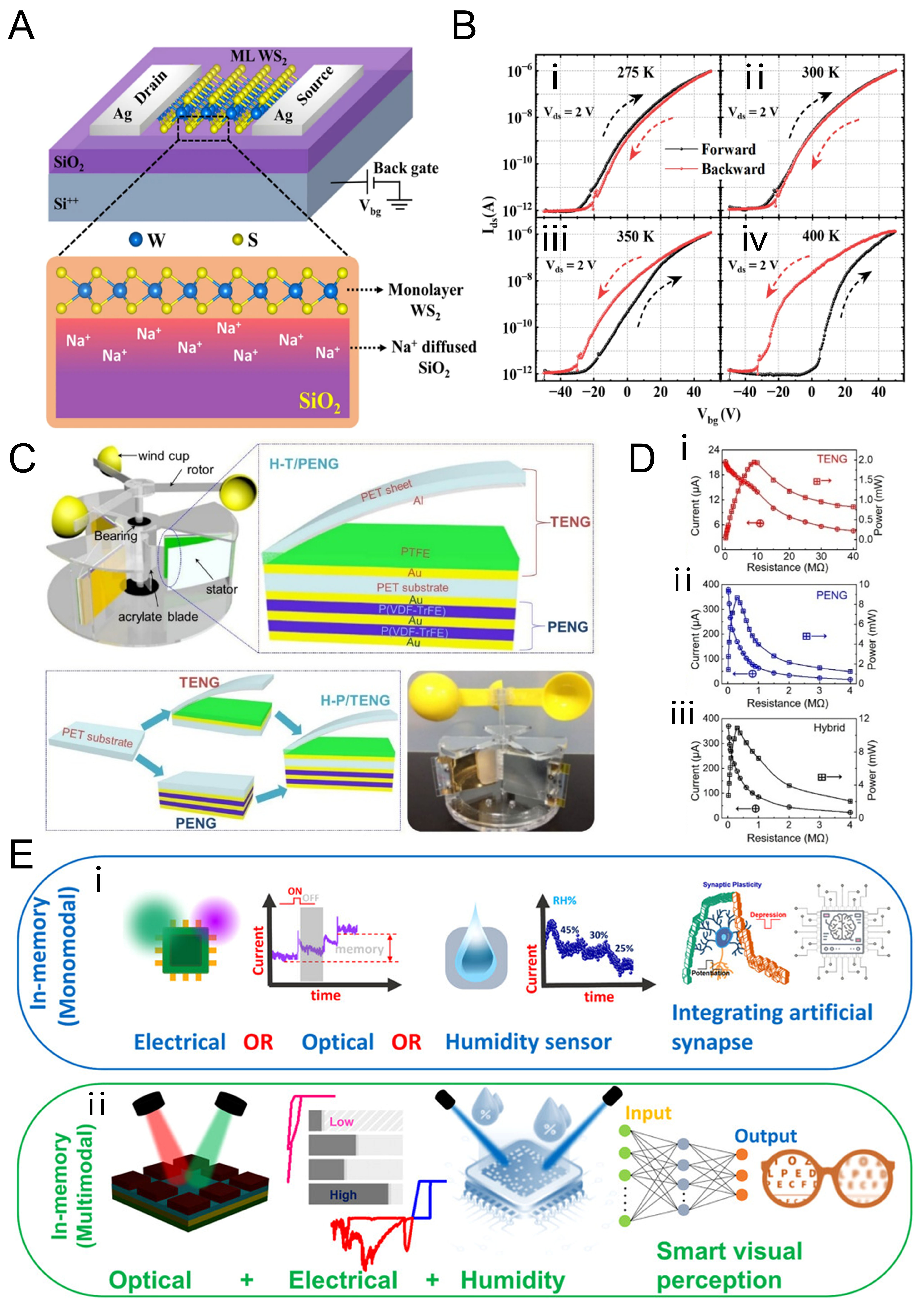
Figure 8. Multiphysics hybrid transduction and memory-in-sensor demonstrations. (A) Na+-doped WS2 transistor showing multiphysics coupling mediated by ion transport in the porous layer; (B) (ⅰ-ⅳ) Temperature-activated hopping behavior in the range of 275-400 K, adapted from[102]. (C) Hybrid triboelectric/piezoelectric nanogenerator (TENG/PENG): structure and working principle, where triboelectric and piezoelectric mechanisms cooperate to enhance mechano-electric conversion efficiency, adapted from[105]. (D) Output characteristics comparing (ⅰ) pure TENG, (ⅱ) pure PENG, and (ⅲ) hybrid operation, evidencing reduced source impedance and increased power density in the hybrid mode, adapted from[105]. (E) Memory-in-sensor and on-sensor learning framework integrating sensing, energy harvesting, and data storage on a single platform[104]. Demonstrations include (ⅰ) single-modality synaptic plasticity under light, electrical, or humidity stimuli, and (ⅱ) multimodal fusion of light-electric-humidity signals for autonomous computation and intelligent vision. Reproduced with permission from Springer Nature (A and B), Elsevier (C and D), Wiley (E).