
Figure2
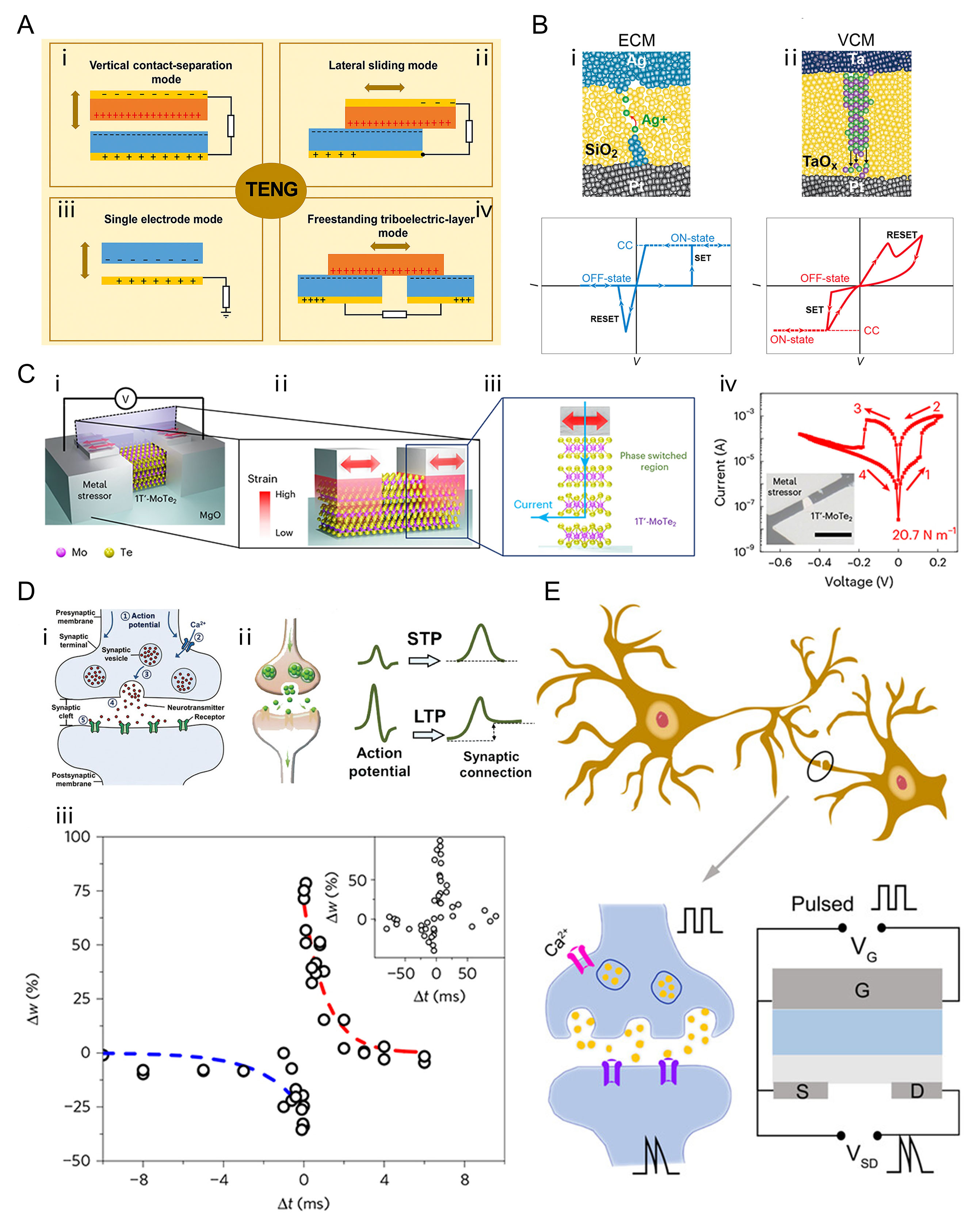
Figure 2. Overview of triboelectric-memristive coupling. (A) Working modes of a TENG, including vertical contact-separation, lateral sliding, single-electrode, and freestanding modes, redrawn from[69]. (B) Representative current-voltage (Ⅰ-Ⅴ) characteristics and switching mechanisms of memristors, including electrochemical metallization (ECM; Ag in SiO2) and the valence-change mechanism (VCM; TaOx), showing typical SET/RESET processes, adapted from[64]. (C) Mechanistic illustration related to 1T'-MoTe2, including tip-induced mechanical loading/phase tuning, local band/phase modulation, band alignment-assisted channel switching, and the resulting evolution of Ⅰ-Ⅴ characteristics, adapted from[65]. (D) Bioplasticity metrics under triboelectric stimulation, including demonstrations of STP/LTP and a spike-timing-dependent plasticity (STDP) timing curve showing the change in synaptic weight (△W) as a function of spike timing difference (△t) compiled from[82,83]. (E) Conceptual schematic of a synaptic transistor driven by triboelectric signals, illustrating network coupling and pulse-conditioned gating behavior with gate voltage (VG) and source-drain voltage (VSD), redrawn after[84]. Reproduced with permission from MDPI (A), Institute of Physics (B), Springer Nature (C and D(ⅲ)), Wiley (D(ⅰ, ⅱ) and E).