

Figure3
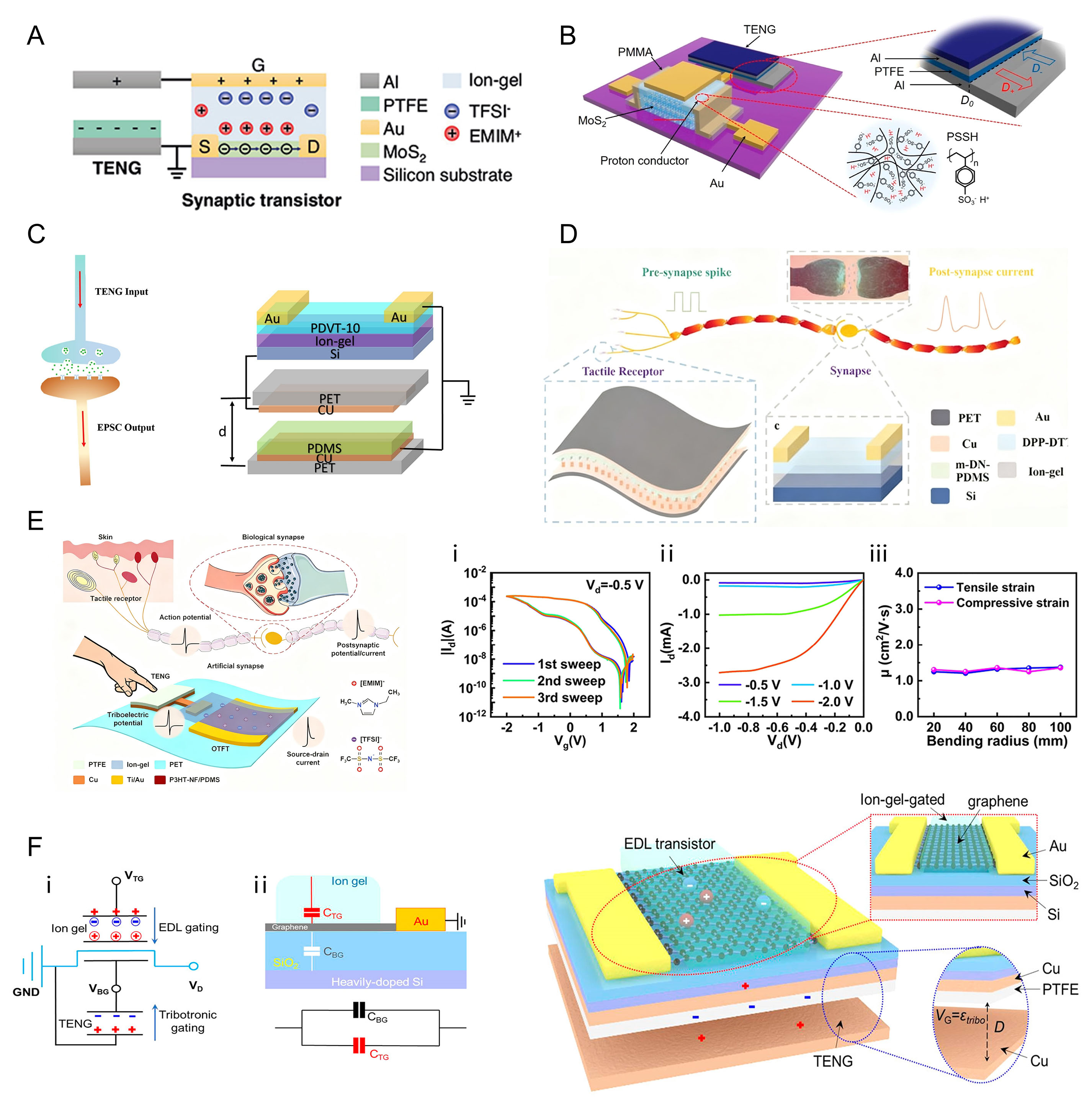
Figure 3. TENG-memristor coupling: device schematics, operation, and performance metrics. (A) Concept of a triboelectric-pulse-driven electrolyte-gated synaptic transistor[44], where mechanical pulses act as dynamic gate biases to trigger ion migration and modulate channel conductance. (B) Representative triboiontronic (EDL/ion-assisted gated) MoS2 device architecture and working principle, in which interfacial ion motion regulates the channel, adapted from[60]. (C) A TENG-driven PDVT-10/ion-gel synaptic transistor showing stepwise increases in excitatory postsynaptic current (EPSC) under repeated mechanical stimulation, adapted from[93]. (D) A flexible tactile sensor integrated with an artificial synapse to map stimulus-to- postsynaptic response relationships for self-powered perception and learning, adapted from[93]. (E) Typical electrical performance metrics measured under cyclic operation: (ⅰ) transfer/output characteristics and memory window, (ⅱ) hysteresis/retention under repeated biasing, and (ⅲ) stability under tensile/compressive strain. Equivalent circuit representations for EDL-based gating driven by a triboelectric source, including impedance conditioning via an external capacitor, are also shown, adapted from[95]. (F) Equivalent circuit model for EDL-based gating driven by a triboelectric source, including impedance conditioning via an external capacitor and resistor, adapted from[94]. Reproduced with permission from Springer Nature (A and E), American Chemical Society (B and F), and Elsevier (C and D).