

Figure5
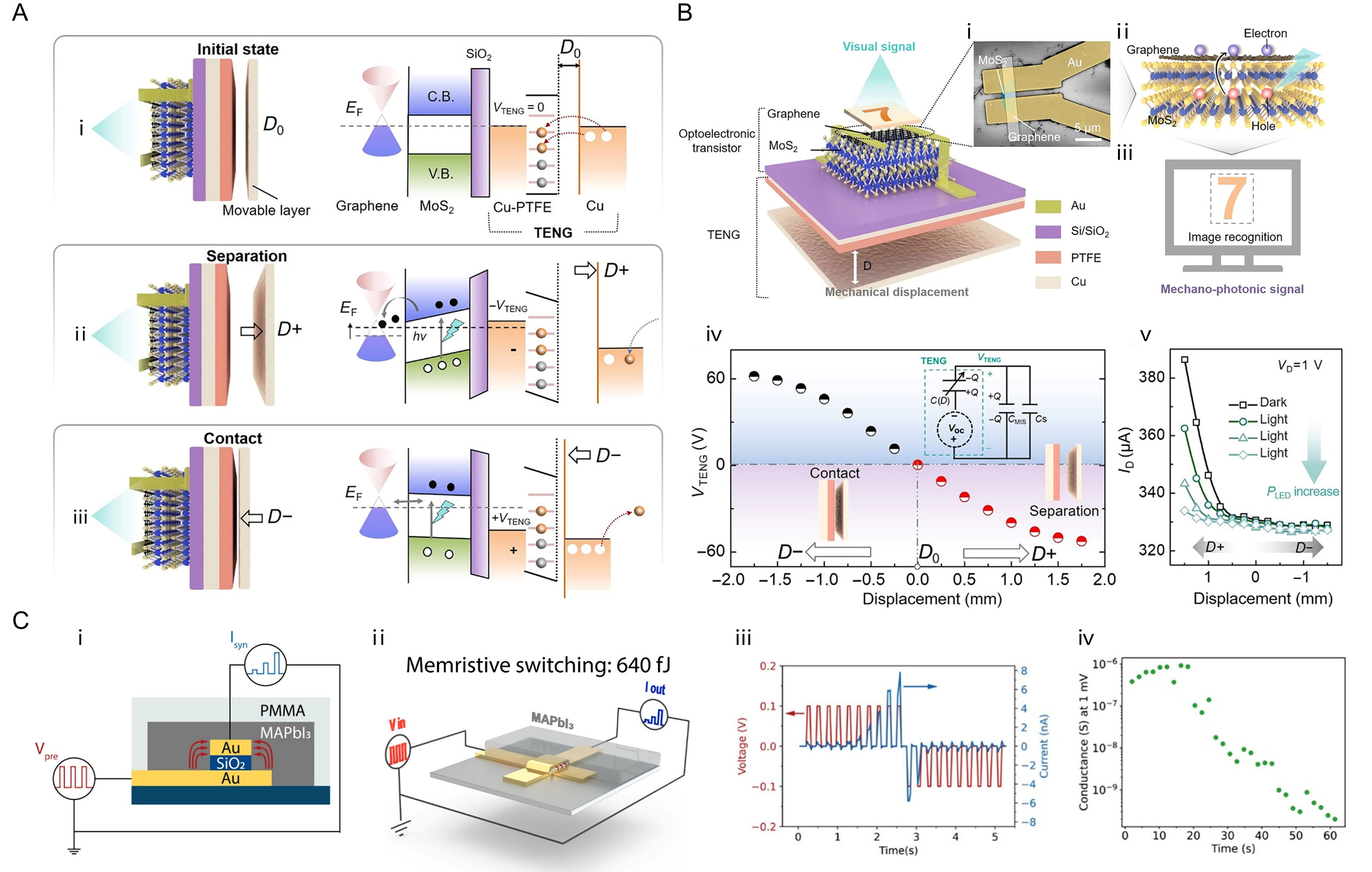
Figure 5. (A) Operation of a MoS2/graphene van der Waals (vdW) heterojunction under triboelectric bias: (ⅰ-ⅲ) band alignment and carrier distribution during the approach/separation processes, where the TENG-induced potential sweep enables reversible electron-hole transfer. (B) Optomechanical co-modulation in vdW stacks: (ⅰ) schematic of a MoS2/graphene optoelectronic synaptic transistor; (ⅱ) photogating-controlled carrier generation/transport; (ⅲ) mechanically driven image recognition demonstration; (ⅳ and ⅴ) channel current variations as a function of TENG output/displacement and illumination, evidencing device-level learning behavior, redrawn from[100]. (C) Perovskite memristor (Au/MAPbI3/Au): (ⅰ) device structure; (ⅱ) single-spike programming energy ≈ 640fJ; (ⅲ and ⅳ) TENG pulse-induced transition from short-term to long-term plasticity, with characteristic conductance-time traces, adapted from[101]. Reproduced with permission from American Association for the Advancement of Science (A and B), American Chemical Society (C).