

Electrocatalytic CO2 reduction to multi-carbon products with copper-based materials: from mechanistic understanding to selectivity control
 0

Graphical Abstract
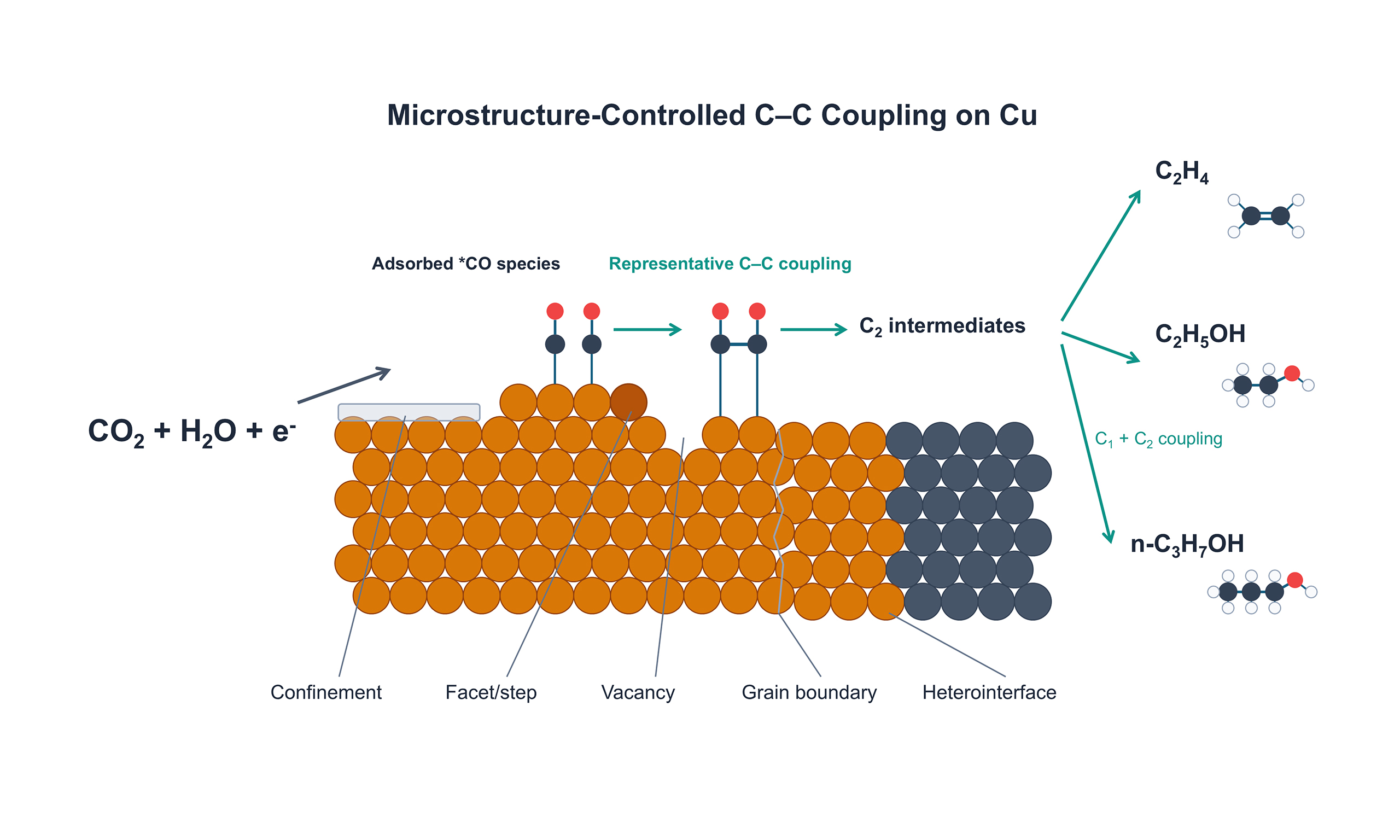
Abstract
Coupling electrocatalytic CO2 reduction reaction (eCO2RR) with renewable electricity enables the synthesis of multi-carbon (C2+) products—including ethylene, ethanol, and acetate—under mild conditions. Despite the ability of copper (Cu)-based catalysts to yield a diverse array of carbonaceous products, the concurrent occurrence of multi-electron transfer, C-C coupling, and the hydrogen evolution reaction makes it challenging to simultaneously achieve high activity, single-product selectivity, and long-term stability. Therefore, this review summarizes recent advances in Cu-based catalysts for the electrosynthesis of C2+ products based on eCO2RR from a multi-scale perspective, followed by a critical evaluation of crystal facet engineering, defect engineering, oxidation state modulation, bimetallic synergy, and interfacial microenvironment regulation. Additionally, we highlight the application of in situ/operando characterization techniques and theoretical modeling to identify reaction intermediates and track their dynamic evolution throughout the catalytic process. Finally, we discuss the challenges and prospects facing the field of eCO2RR to C2+ products, and offer nuanced insights for the future design of high-efficiency Cu-based catalysts.
Keywords


 Download PDF
INTRODUCTION
Renewable electricity, particularly from wind and solar sources, is inherently intermittent; converting it into chemical energy offers a viable pathway to balance supply and demand while reducing carbon emissions from chemical manufacturing[1-4]. Electrocatalytic CO2 reduction reaction (eCO2RR) employs water and CO2 as feedstocks to yield carbon monoxide, formate, methane, and a variety of hydrocarbons and oxygenates under near-ambient conditions[5-7]. Compared with two-electron C1 products, multi-carbon (C2+) products such as ethylene, ethanol, acetate, and n-propanol possess higher energy densities and are better aligned with existing market demands[2,8-11]. However, the practical value of C2+ products depends strongly on product identity, outlet concentration, and separation requirements. Gaseous ethylene benefits from established gas-separation technologies, whereas dilute liquid oxygenates such as ethanol and acetate require energy-intensive concentration, recovery, and electrolyte management. Moreover, synthesizing C2+ chemicals requires neighboring carbon intermediates to encounter one another for C-C bond formation prior to sequential proton-electron transfers, all under the practical constraints of single-pass carbon efficiency (SPCE) and cell voltage[2,10,12,13]. Thermodynamic feasibility does not guarantee kinetic accessibility; on practical electrodes, competing processes such as the hydrogen evolution reaction (HER), CO desorption, and deep reduction of C1 intermediates coexist[14,15].
Among elemental metals, Cu is the most widely established catalyst capable of producing diverse C2+ products at appreciable rates and selectivities under suitable conditions[16-19]. Early comparative studies by Hori et al.[5,6] on product distributions over pure metal electrodes revealed that Ag and Au predominantly produce CO, Cd, In, Sn, and Pb favor formate, whereas Cu and its alloys can further produce methane and multi-carbon products. Subsequently, Kuhl et al.[8] systematically quantified 16 distinct eCO2RR products on metallic Cu, revealing a potential-dependent product distribution. It does not inherently favor C2+ formation under all conditions; rather, the moderate *CO binding on Cu—neither readily desorbing nor over-stabilized—merely establishes the prerequisite for continued coupling[2,12,20]. Whether coupling proceeds depends on working-state *CO coverage, adjacent site geometry, local water and proton activity, and the competing HER kinetics[20-22].
Another distinctive feature of Cu is its dynamic instability under operating conditions. Nanoparticles (NPs) undergo coarsening, fragmentation, dissolution-migration-redeposition, and facet reconstruction under cathodic bias, *CO adsorption, local OH- accumulation, and electric field effects[9,23,24]; whereas oxide-derived Cu may additionally undergo rapid reduction during the initial reaction stage[25]. These structural complexities have fueled a long-standing debate over whether high C2+ selectivity originates from residual Cu+ species, Cu+/Cu0 adjacent sites, or low-coordination metallic Cu sites formed after reduction and reconstruction. Comparison of X-ray photoelectron spectra (XPS) or crystal phases acquired before and after reaction alone is insufficient to address this issue, as the structure may evolve through entirely distinct transient states that are inaccessible to ex situ characterization. A recent review[26] further categorizes Cu deactivation into atomic-scale dissolution, migration, and redeposition, along with micrometer-scale reconstruction amplified by these processes. This framework underscores that the “active structure” and the “stable structure” cannot be discussed in isolation.
Existing regulation strategies can be broadly classified into two categories. The first category pertains to modifications of the Cu sites themselves, encompassing crystal facets, particle size, defects, strain, oxidation state, and alloying with a second metal[23-25,27-30]. The second category involves alterations to the reaction environment surrounding the sites, including molecular modifiers, confined spaces, local pH, cations, electric fields, wettability, and three-phase mass transport[10,14,31-34]. Recent reviews have compiled fairly comprehensive material taxonomies from perspectives, including catalyst architecture, surface engineering, working-state valence, facet morphology, device scaling, and ethanol-directed synthesis[1,2,13,15-19,22,35-41], yet these categories are rarely isolated in practice: For example, oxide reduction not only alters the oxidation state but also generates grain boundaries and rough surfaces; hydrophobic modification modulates water and CO2 accessibility as well as local salt concentration; bimetallic systems may modulate adsorption via ligand or strain effects while the secondary component generates *CO in situ to feed Cu[20,21,33,42-45]. When Faradaic efficiency (FE) is compared solely based on material identity, such comparisons risk misattributing mass-transport effects to intrinsic activity, or conflating an overall C2+ enhancement with selective synthesis of a specific product. This also explains why performance metrics reported in different studies cannot be interpreted without reference to the testing conditions. H-type cells are limited by dissolved CO2 mass transport and are therefore suited for comparing potential-dependent behavior and surface reaction mechanisms; gas-diffusion flow cells supply gaseous CO2 directly, enabling substantially higher current densities, yet they introduce pronounced local alkalinization and carbonate formation; in membrane electrode assemblies (MEAs), the distributions of water, ions, and CO2 differ again from those in the preceding two configurations[37,41]. The choice of reference electrode, geometric area normalization, catalyst loading, and crossover of liquid products can all alter the reported values. A rigorous review should first compare quantities of the same dimensionality within a given reactor configuration before discussing catalyst structure, rather than pooling peak FEs from disparate platforms into an unconditional performance ranking[2,13,22].
Although numerous reviews have summarized progress in Cu-based catalysts for the eCO2RR, existing studies have largely focused on isolated material design strategies or collated performance data obtained across different electrolytic cell configurations. As a result, a unified framework integrating reaction mechanisms, working-state structures, and device-level microenvironments remains absent. In this Review, we start with an overview of CO2 activation and *CO formation, and elucidate *CO-*CO, *CO-*CHO, and alternative C-C coupling pathways, alongside the competing HER that limits C2+ product formation. We then follow the causal chain of “structural variables → working-state active sites → intermediate coverage → product distribution” to conduct a critical assessment of facet engineering, defect engineering, oxidation-state regulation, bimetallic catalyst design, dynamic reconstruction regulation, and interfacial microenvironment engineering [Figure 1]. We place particular emphasis on how local pH, cations, water activity, and three-phase mass transport collectively determine the reaction pathway. Finally, to address the long-standing challenge of simultaneously achieving high C2+ selectivity, high operating current density, high carbon utilization, and long-term operational stability, we outline key unresolved challenges and future research directions, including dynamic active-site identification, standardized performance evaluation protocols, device upscaling, and machine-learning-assisted catalyst design.
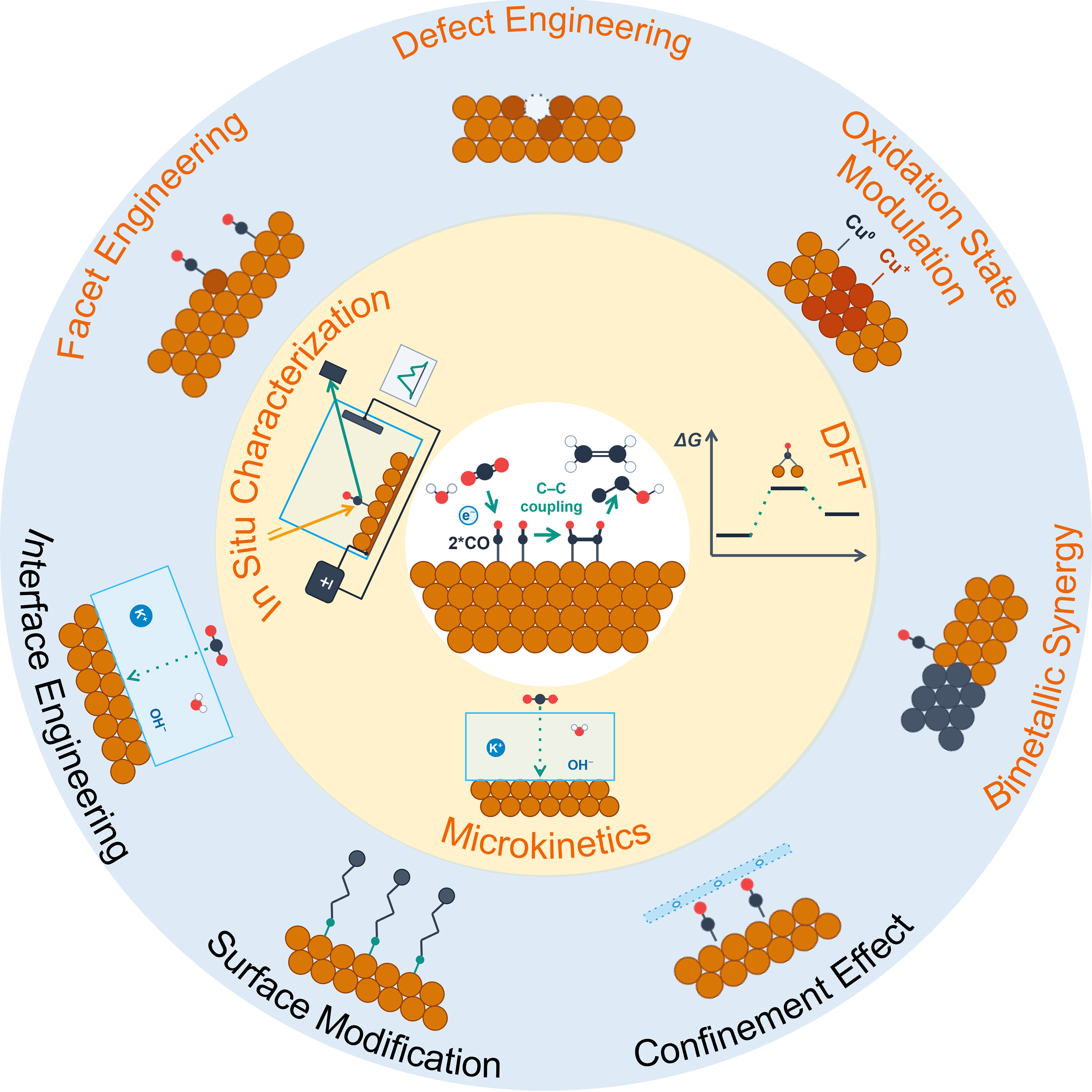
Figure 1. Strategies for designing and analyzing copper-based electrocatalysts for C2+ products.
REACTION MECHANISM OF C2+ FORMATION: FROM CO2 TO C2+ PRODUCTS
Thermodynamically, the equilibrium potentials of most common C2+ products are not extremely negative, yet their formation demands surmounting kinetic barriers associated with CO2 activation, C-C coupling, and multiple proton-electron transfers[10,13,21]. The applied overpotential serves primarily to accelerate these sluggish steps without altering the conservation of carbon, electrons, and protons[46-49]. Quantum-mechanical free-energy calculations with explicit water describe CO formation on Cu(100) through a carboxyl (*COOH) intermediate before the formation of adsorbed *CO[50]. C-C bond formation is not an isolated elementary step but rather a pathway network jointly dictated by *CO supply, surface coverage, adjacent site availability, and protonation kinetics[51,52]. Although most evidence converges on *CO as the key intermediate for C2+ formation on Cu, competing routes—including direct *CO dimerization, *CO coupling with hydrogenated intermediates, and *CO insertion—may switch as a function of potential, crystallographic facet, and local environment[53-55]. Critically, even after the first C-C bond is forged, ethylene, ethanol, and acetate continue to share common intermediates, so that elevating total C2+ selectivity does not necessarily translate into enhanced selectivity toward any single product. As depicted in Figure 2, the diverse pathways of the CO2 reduction reaction give rise to a variety of intermediates, including C1 and C2+, and entail multiple electron- and proton-transfer steps.
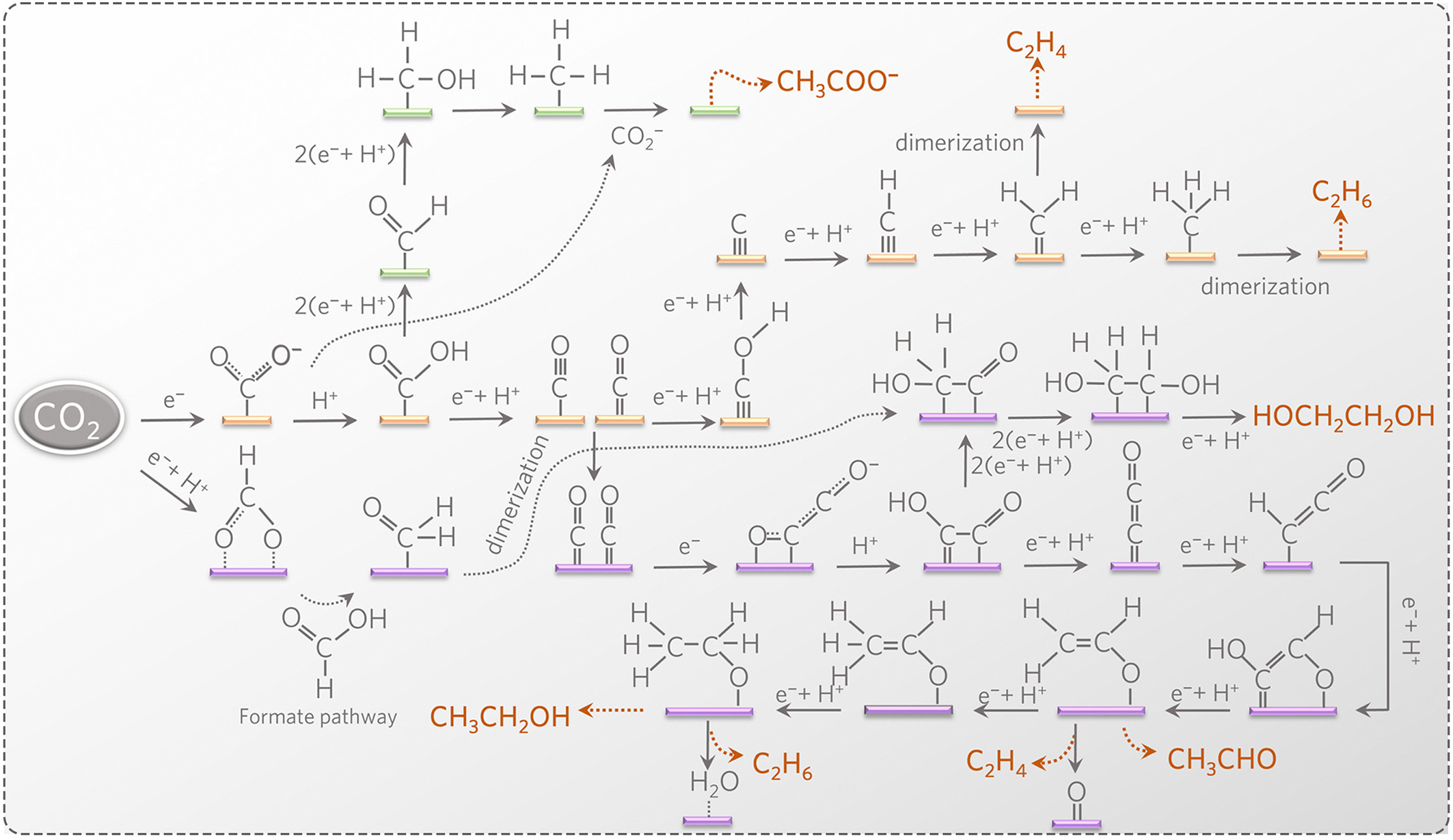
Figure 2. Overview of reaction pathways for eCO2RR toward different C2+ products. Reproduced with permission[13]. Licensed under CC BY-NC 3.0.
Key intermediates
In eCO2RR, C-C coupling requires an appropriate balance between *CO binding strength, surface coverage, and adjacent-site availability[12]. However, excessively strong *CO adsorption may over-saturate and block contiguous active sites, thereby impeding subsequent C-C coupling and proton-coupled electron-transfer steps; conversely, overly weak interaction promotes premature *CO desorption to yield C1 products instead of further C2+ product formation[2,13]. Selectivity between CO2 reduction and the HER is thus governed not merely by adsorption energy, but by applied potential, local water activity[45], site geometry, and steady-state coverage[20-22]. C-C bond formation requires at least two carbon-containing species to occupy adjacent sites in a suitable configuration. Thus, actual selectivity correlates more closely with *CO coverage, the ratio of atop- to bridge-site adsorption, surface site density, and the supply rate and residence time of *CO than with a single adsorption energy[20,21].
Modulating the *CO intermediate is a key strategy for enhancing C2+ selectivity. At insufficient *CO coverage, the encounter probability of two surface species is too low, whereas at excessive coverage, the depletion of vacant sites impedes the participation of water and protons in subsequent steps[22]. Under elevated *CO coverage, two *CO species couple to form *OCCO, which is protonated to *OCCOH and undergoes further dehydration and hydrogenation[49,56,57]. Huang et al.[58] systematically examined C2H4 formation across Cu single crystals, confirming its correlation with *CO coverage and demonstrating that increased coverage lowers the *CO coupling barrier. In situ infrared and surface-enhanced Raman spectroscopies (SERS) have captured vibrational signatures consistent with hydrogenated *CO dimers, providing direct evidence for the involvement of *OCCOH in the C2 pathway. Zhan et al.[20] further combined in situ SERS with theoretical calculations, proposing that *OC-CO(H) formed on undercoordinated Cu sites favors the ethylene route, whereas *OCHCH2 stabilized on compressed or distorted Cu domains correlates with ethanol formation. This work elevates the concept of domain-dependent post-coupling branching to the realm of observable intermediates; these vibrational signatures are nonetheless influenced by local electric fields, coverage, solvent environment, and adsorption geometry, necessitating corroboration from both computed vibrational frequencies and concomitant product formation rates.
The intermediates formed after C-C bond formation govern the competition between oxygen retention and deoxygenation[59-61]. *COCOH, *COCHO, *CCO, and *CH2CHO are commonly invoked to depict the shared network leading to ethylene, ethanol, and minor oxygenated C2 products[28]. In general, C-O bond cleavage and dehydration favor ethylene formation, whereas stabilization of the oxygen-containing terminus and suppression of premature deoxygenation direct selectivity toward ethanol or acetate[62,63]. Zhuang et al.[24] constructed a Cu2S-Cu vacancy core-shell structure that did not simply enhance all C2+ products but instead redirected the post-coupling branch toward multi-carbon alcohols, experimentally demonstrating that “promoting coupling” and “tuning post-coupling selectivity” are two distinct challenges. For C3+ products, an existing C2 intermediate must further couple with *CO, a step whose probability is further constrained by intermediate residence time and spatial adjacency. Consequently, beyond the pivotal intermediate *CO, the reaction pathway following *CO formation must also be rationally tuned to predict the catalytic activity and C2 product selectivity of Cu-based catalysts.
Competing pathways in C-C coupling
C-C bond formation during eCO2RR toward C2+ products has been proposed to proceed through multiple pathways, predominantly involving the coupling of *CO-derived intermediates, with their relative contributions depending on catalyst structure, electrolyte, and interfacial reaction conditions[13]. The most widely discussed routes include direct dimerization of two *CO species and asymmetric coupling between *CO and hydrogenated intermediates such as *CHO or *COH. Additional system-specific routes, including asymmetric coupling between *CHx and *CO, have also been proposed[2,12,13,24]. These proposed pathways are not necessarily mutually exclusive, and their relative contributions may vary with applied potential, *CO coverage, crystal facet, local pH, and interfacial microenvironment. Consequently, an increase in total C2+ selectivity neither uniquely identifies the operative coupling pathway nor demonstrates selective enhancement of a particular product branch.
In general, direct *CO dimerization is one of the most widely accepted mechanisms for C-C coupling[20,64]. Cu(100)/Cu(111) interfacial sites provide distinct ensembles that facilitate CO dimerization during CO2 electroreduction relative to the individual low-index surfaces[65]. Based on the potential and pH dependence of single-crystal electrodes, Schouten et al.[12] proposed that C1 products form via *CHO, whereas C2 products arise from *CO dimerization and its subsequent enediol/oxametallacycle intermediates. Following protonation of *OCCO to *OCCOH, the intermediate can undergo dehydration, hydrogenation, or C-O bond cleavage, leading to ethylene, ethane, or minor oxygenated C2 products. Nevertheless, idealized surface models do not adequately incorporate high coverage, explicit solvation, cations, and adsorption-induced reconstruction; accordingly, “Cu(100) promotes dimerization” should be regarded only as a structural trend valid under specific conditions[27,51].
The second pathway involves asymmetric coupling of *CO with hydrogenated species such as *CHO or *COH[66]. Combined theoretical and experimental evidence suggests that direct *CO dimerization may prevail at lower overpotentials and higher *CO coverage, whereas at more negative potentials, where *CHO formation accelerates, the relative contribution of the *CO-*CHO pathway increases[56,67]. In Ag single-atom alloys [Figure 3A and B], Wang et al.[67] showed that isolated Ag promotes water dissociation and *CHO formation, thereby enhancing *CO-*CHO asymmetric coupling and increasing the ethanol-to-ethylene ratio from 0.41 to 4.26. This result supports the interpretation that modulating the first protonation step can alter the coupling mode; although the second metal may simultaneously modify local CO supply, such that isotope-labeling and site-spacing experiments are still required to rule out alternative explanations. On histidine-modified Cu, Lim et al.[32] proposed coupling between histidine-bound CO and *CHO. Following *CO-*CHO coupling, the *COCHO intermediate can undergo further hydrogenation while retaining the oxygenated terminus, thereby favoring ethanol over ethylene.
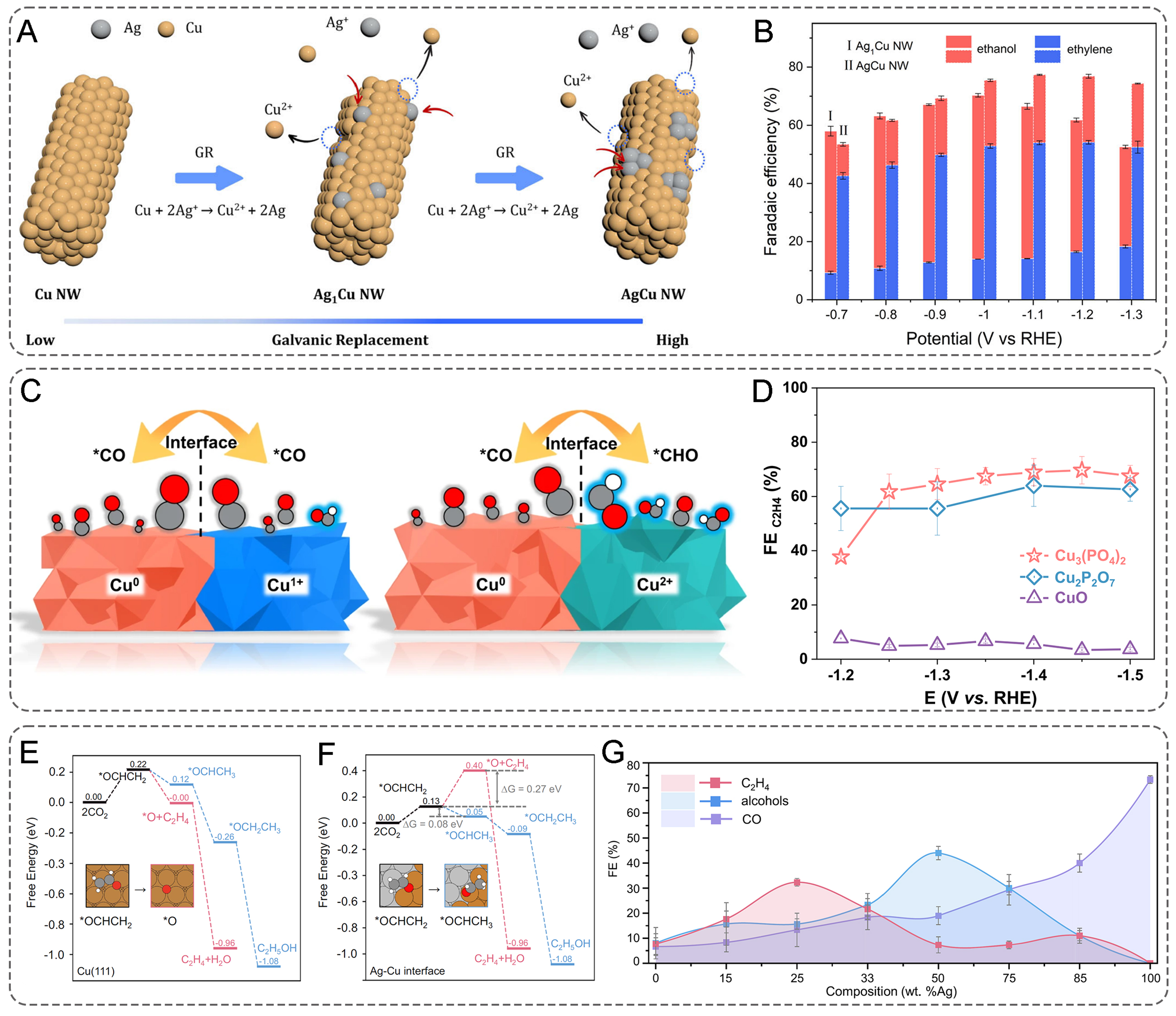
Figure 3. (A) Schematic illustration showing synthesis of Ag1Cu NW and AgCu NW (Ag (gray) and Cu (yellow)); (B) FEs of ethanol and ethylene on Ag1Cu NW and AgCu NW at various applied potentials. (A and B) Reproduced with permission[67]. Licensed under CC BY-NC-ND 4.0; (C) Schematic diagram of different intermediates (CO or CHO) on the Cu0/Cu+ and Cu0/Cu2+ interfaces; (D) FEs of C2H4 of catalysts at different applied potentials in CO2-saturated 0.1 M KHCO3, suggesting the superior C2H4 selectivity for CuPO. (C and D) Reproduced with permission[68]. Licensed under CC BY 4.0; Reaction profiles for C2H4 and C2H5OH pathways on (E) Cu(111) and (F) the Ag-Cu interface; (G) The FEs of C2H4, alcohols and CO as a function of Ag fraction. Error bars represent the standard deviation based on three separate measurements. (E-G) Reproduced with permission[69]. Licensed under CC BY-NC-ND 4.0. NW: Nanowires; FE: Faradaic efficiency.
As a catalyst- and condition-specific alternative to symmetric *CO dimerization, asymmetric coupling between *CH3 and *CO can contribute to multi-carbon oxygenates. Isotope-labeled co-reduction experiments on Cu detected labeled acetaldehyde, ethanol, acetic acid, and acetone when 13CH3I and 12CO were supplied as the methyl and carbonyl sources, respectively, providing experimental evidence for *CH3-*CO coupling under the tested conditions[70]. In contrast, co-reduction of 13CH3I with 12CO2 did not yield labeled acetate, arguing against direct coupling of *CH3 with CO2 or *CO2- in that system. The Cu2S-Cu vacancy core-shell catalyst directs the post-coupling branch toward higher alcohols rather than ethylene, indicating that “promoting coupling” and “tuning post-coupling selectivity” are two separable objectives[24]. Recent studies on CO2-to-ethanol conversion have demonstrated efficient ethanol production by suppressing deoxygenation steps[14]. This observation supports the view that competition between oxygen retention and deoxygenation of post-coupling intermediates can influence product branching. Unlike direct dimerization, asymmetric coupling does not require site-adjacency of identical species, and downstream product selectivity remains constrained by the generation of key intermediates and post-coupling branching[46].
Operando studies have identified potential-dependent surface OH/CO populations, whereas ketene-like *CH2CO intermediates have been implicated in product branching at low-coordinated Cu sites[71,72]. More broadly, these observations, together with catalyst-specific studies of atomically dispersed Cu sites under acidic conditions, indicate that interfacial species and local coordination environments can influence C2+ selectivity[71-73]. None of these reports, however, establishes a generally applicable formate-derived *OCH2 dimerization pathway. Acetaldehyde has also been observed over Cu cluster catalysts under conventional conditions[74], illustrating that C2 oxygenate branching may extend beyond ethanol and acetate. Selective C-O bond cleavage in *CH2CHO is an important step governing ethylene selectivity[46], while direct *OC-CHO coupling at Cu0/Cu2+ interfaces has been proposed to promote C2+ formation [Figure 3C and D][68]. Cu-vacancy-containing heterostructures further illustrate how site heterogeneity can redirect post-coupling pathways toward oxygenated products[24].
The branch among different C2 products is also condition-dependent. Ethylene and ethanol can share intermediates such as *CH2CHO, and the relative affinity of the catalytic surface for the C- and O-termini, the availability of protons, and water activity jointly determine the subsequent hydrogenation site[13,24,45]. The Ag-Cu biphasic system provides a representative example of how interfacial composition regulates this post-coupling branch. Relative to Cu(111), the Ag-Cu interface suppresses O-C bond cleavage of *OCHCH2 and favors its further hydrogenation to *OCHCH3, thereby shifting selectivity from ethylene toward ethanol [Figure 3E and F][69]. Consistently, the product distribution evolves from ethylene-rich at Cu-rich compositions to alcohol-rich at an intermediate Ag fraction and finally to CO-dominated on Ag-rich surfaces [Figure 3G][69]. By contrast, acetate formation is frequently linked to the hydrolysis of ketene-like intermediates in solution or surface oxygen-retention pathways, making its selectivity particularly sensitive to local pH and interfacial residence time[14,68]. The formation of C3+ products requires an additional coupling step beyond the initial C-C bond formation. For n-propanol, undercoordinated Cu sites have been demonstrated to strengthen the adsorption of key surface C2 intermediates, thereby facilitating the subsequent C-C coupling steps required for C3 synthesis. Accordingly, C3 selectivity depends on generating and stabilizing the C2 intermediate sufficiently on the catalyst surface[75]. Extending the pore residence time may favor the second coupling, yet it may also promote the re-adsorption of intermediates such as acetaldehyde[76]. Critically, while initial C-C coupling establishes the overall capacity for C2+ formation, subsequent intermediate branching determines product-specific selectivity—governing whether the reaction channels toward deoxygenated gaseous ethylene or oxygen-retaining liquid products such as ethanol and acetate.
HER competition
HER is an inevitable competing pathway in aqueous eCO2RR, as both reactions compete for electrons, interfacial water, and surface adsorption sites[34,73,77]. In the low-overpotential regime, sluggish CO2 activation and insufficient *CO coverage cause HER to dominate the current partition; as the potential shifts more negative, *CO accumulation and the probability of C-C coupling increase, thereby enhancing C2+ selectivity. However, further polarization accelerates water reduction and deep hydrogenation of *CO, causing H2 and CH4 selectivities to rise. This non-monotonic behavior implies that C2+ selectivity typically reaches a peak within a specific potential window rather than increasing continuously with cathodic bias[2,8].
The competition is governed not only by potential but also by the local microenvironment. At high current densities, proton consumption at the interface is accompanied by OH- generation, causing the local pH to rise to alkaline levels[78,79]. This shift can suppress the HER that directly involves protons and provide more favorable *CO coverage for C-C coupling. However, OH- simultaneously captures CO2 to form carbonates, reducing the SPCE[80]. SPCE quantifies the fraction of inlet carbon incorporated into specified products during a single pass, a feature that is not captured by FE alone[81,82]. The SPCE toward C2+ products is defined as the fraction of carbon in the inlet CO2 stream that is incorporated into C2+ products during a single pass. Based on carbon balance and Faraday’s law, it can be calculated as follows:
where ji is the partial current density of product i in A cm-2, A is the geometric electrode area in cm2, and |ji|A is the corresponding partial current in A; zi is the number of electrons transferred per molecule of product i; ci is the number of carbon atoms in product i; F is Faraday’s constant (96,485 C mol-1); QCO2,in is the inlet CO2 volumetric flow rate in L min-1; and Vm is the molar gas volume evaluated at the temperature and pressure used for flow calibration. The factor of 60 converts the electrochemical product formation rate from mol s-1 to mol min-1, allowing it to be compared with QCO2,in/Vm in mol min-1. This formulation generalizes the product-specific Faradaic-law SPCE expression established by Chen et al.[83] into a carbon-balanced multi-product form across all C2+ species. Experimentally, high SPCE values in acidic media have been demonstrated by Zhu et al.[84], who reported an empirical SPCE of 51.8% for C2+ products on a hollow-fiber Cu penetration electrode. However, da Cunha and Resasco[85] showed that maximizing single-pass conversion does not necessarily yield concentrated product streams or indicate practical electrolyzer readiness; they therefore recommended reporting outlet product concentrations rather than treating single-pass conversion alone as an overall performance indicator.
Water-activity experiments further demonstrate that proton supply is not “the less, the better”: When the water activity is decreased from 0.97 to 0.47, the C2+/C1 ratio can be tuned between approximately 1 and 20, yielding a C2+ FE of ~73% and a C2+ partial current density of ~-110 mA cm-2 at a water activity of 0.66[45]. This indicates a narrow window among suppressing HER, sustaining C-C coupling, and completing post-coupling hydrogenation, such that merely reducing water content does not guarantee an increase in the target product.
To resolve reporting ambiguities across different electrolysis frameworks, key operational carbon and energy metrics are defined as follows: (1) single-pass CO2 consumption:
where 1.23 V is the thermodynamic equilibrium potential for the OER vs. the reversible hydrogen electrode (RHE); Ei0 is the standard thermodynamic equilibrium potential for the formation of eCO2RR product i vs. RHE; FEi must be substituted as a dimensionless decimal fraction between 0 and 1; and Vcell is the actual measured full-cell operating voltage absolute value, containing all real cell losses (including cathodic and anodic overpotentials, membrane/electrolyte Ohmic resistances, and transport polarizations), and cannot be replaced by an iR-corrected cathode potential. As a practical device-level example, Chen et al.[87] reported stable operation for over 300 h at 10 A with a measured full-cell voltage of 4.2-5.0 V without iR compensation. This study is cited here as an empirical high-current device example rather than as the derivation source of Equation (2).
STRATEGIES FOR CATALYST STRUCTURAL ENGINEERING
The structure and composition of a catalyst play a decisive role in substrate activation and reduction processes, thereby profoundly influencing the selectivity of the final products[59-61,88-90]. Structural regulation aims to establish a sustainable “site-intermediate-microenvironment” ensemble that persists under the operating potential. Crystal facets, defects, oxidation states, and bimetallic components primarily modulate the geometric and electronic structures of active sites; confinement effects, molecular modifiers, and the electrode-electrolyte interface directly alter reactant supply, local electric fields, and proton transfer[91-93]. It should be noted that there may be some overlap of different categories of methods and very often more than one strategy is needed to design and synthesize a catalyst with a desirable structure.
Facet engineering
Facet engineering primarily alters the arrangement of adjacent Cu atoms and the configuration of adsorption sites, with Cu crystal facets exhibiting clear structure sensitivity toward C1/C2 products[27,51,65]. Single-crystal experiments and theoretical studies by Koper et al. revealed that Cu(100) more readily accommodates adjacent *CO to form *OCCO, leading to ethylene production, whereas Cu(111) tends to favor methane or partially oxygenated products[12,20,48,89,90,94]. Step sites and heterogeneous facet boundaries can also stabilize asymmetric intermediates such as *CHO, thereby shifting the distribution between ethylene and oxygenated C2+ products[91]. The geometric basis lies in the differing adsorption sites for *CO, the distances between neighboring Cu atoms, and the constraints imposed on *OCCO configurations across different facets[95]. However, elevated *CO coverage can alter the ratio of atop to bridge-bonded *CO, and adsorption-induced reconstruction may transform the initial facets into steps, island-like, or mixed orientation structures[96].
Nanocubes (NCs) are commonly employed to enrich (100) facets, yet particle size and the proportion of edge/corner sites vary concurrently with the exposed facet. Loiudice et al.[23] compared Cu NCs of 24, 44, and 63 nm and observed a non-monotonic size effect, with the 44 nm sample exhibiting the highest CO2 reduction FE of 80% and an ethylene FE of 41% [Figure 4A-G]. On the other hand, Reske et al.[9] found that smaller Cu particles tend to promote H2 and CO generation. These results indicate that excessively large particles reduce the number of exposed active sites per unit mass, while excessively small particles increase the fraction of undercoordinated edge/corner sites and disrupt contiguous Cu site ensembles. Therefore, C-C coupling requires an optimal balance between continuous terrace sites and low-coordination boundary sites, rather than simply pursuing the smallest possible particle size.
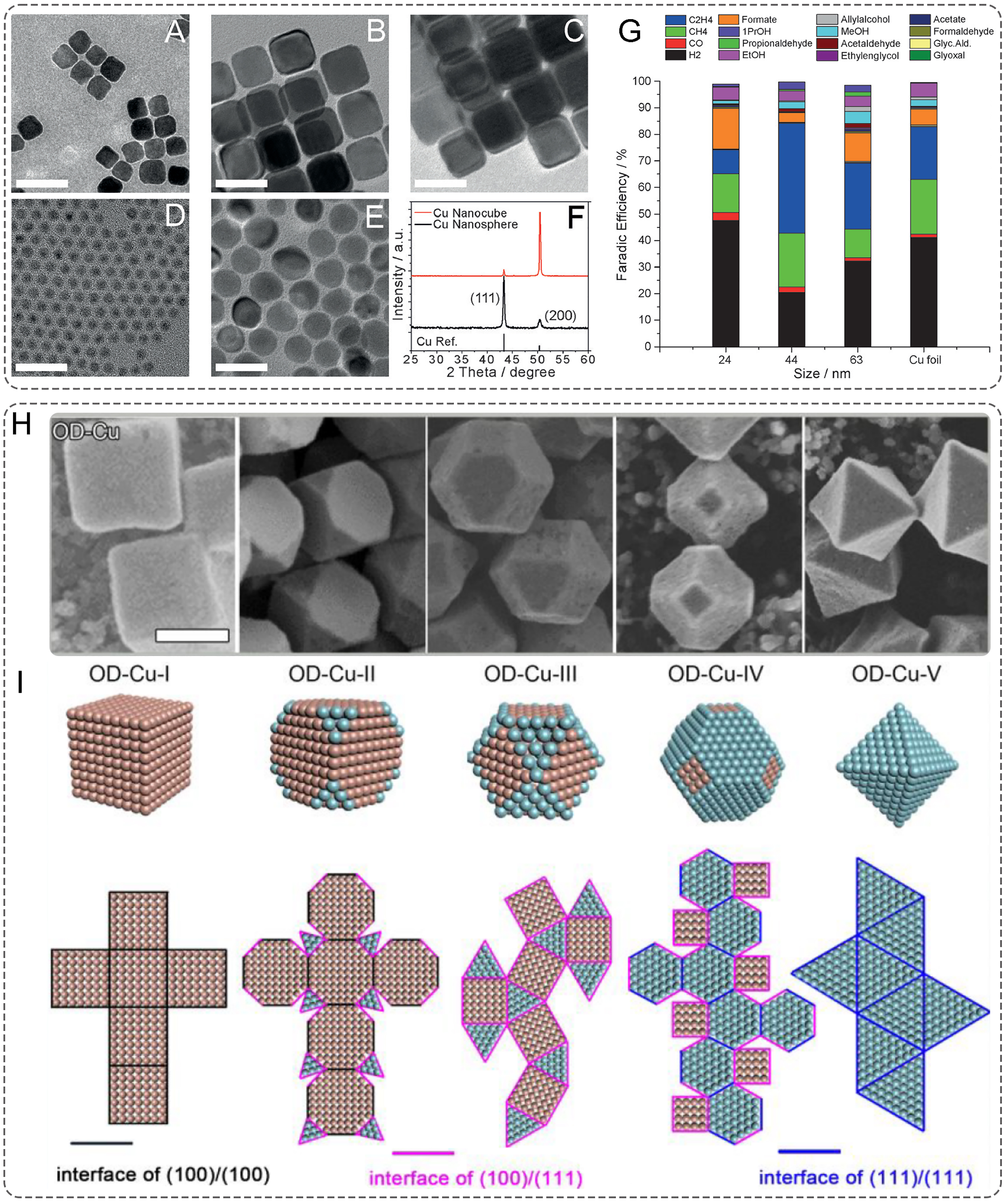
Figure 4. (A-C) TEM images of Cu cubes with an average edge length of 24, 44, 63 nm, respectively; (D and E) TEM images of Cu spheres with an average diameter of 7.5 and 27 nm, respectively. Scale bar 50 nm; (F) Typical XRD patterns of the Cu spheres (black line) and Cu cubes (red line); (G) Bar graph reporting the FEs for each product in the different sizes of Cu cubes and in the Cu foil at -1.1 V vs. RHE. (A-G) Reproduced with permission[23]. Copyright 2016, Wiley-VCH; (H) SEM images and (I) corresponding structure of OD-Cu derived from Cu2O crystals. Scale bar, 400 nm. (H and I) Reproduced with permission[65]. Copyright 2022, American Chemical Society. TEM: Transmission electron microscopy; FEs: Faradaic efficiencies; XRD: X-ray diffraction; SEM: Scanning electron microscopy.
The actual performance differences attributable to the crystal planes can only hold true when the working state structure and mass transfer conditions are comparable. Cu cubes can undergo edge disintegration, pitting, coarsening, and grain rotation during reaction; consequently, the pre-reaction proportion of (100) facets cannot represent the steady-state surface[25,62,63,97-102]. Yao et al.[51] directly exploited CO/OH- co-adsorption to induce working-state faceting and form a Cu(100)-rich surface. In addition, Zhao and Ren[27] compared the facet response of different derived Cu catalysts under unified mass transport conditions. These studies demonstrate that facet-related conclusions must be evaluated in conjunction with potential, coverage, and reaction time. More specifically, the Cu(100)/Cu(111) interface constructed by Wu et al.[65] achieved a C2+ FE of 74.9% ± 1.7% and a current density of 300 mA cm-2 in 1 M KHCO3, with continuous operation for 50 h [Figure 4H and I]; this result supports heterogeneous facet boundaries as candidate coupling sites, yet cannot exclude contributions from local roughness and mass transport. More reliable attribution requires identical electrolyte, potential, and time scales, along with simultaneous correlation of crystal structure changes with partial product rates. Consequently, when translating single-crystal trends to powder
Defect engineering
The core function of defect engineering is to establish low-coordination sites and asymmetric adjacency relations on the Cu surface that are absent from conventional low-index facets[31,103]. Grain boundaries, vacancies, and strained sites can all enhance *CO coverage and create asymmetric coupling sites, but such defects simultaneously strengthen *H adsorption, disrupt contiguous Cu site ensembles, and accelerate dissolution and reconstruction[104-113]. Fang et al.[107] prepared Cu2O catalysts with varying degrees of roughness by tuning the dosage of surfactant and structure-directing agents; the catalyst with the optimal roughness achieved a C2+ FE of 84.2%, an ethylene selectivity of 56.3%, and a C2+ partial current density of 416.4 mA cm-2 at -1.4 V vs. RHE, significantly outperforming the rougher counterparts. This finding suggests that defect identity, rather than roughness alone, contributes substantially to the observed performance differences.
A complementary example is provided by hydrothermal synthesis of CuO nanosheets followed by electrochemical reduction, which produces defect-rich porous Cu nanosheets (pCu NS) [Figure 5A] that expose prominent Cu(200) lattice fringes with 0.18 nm spacing corresponding to preferentially exposed Cu(100) facets alongside abundant surface defect sites [Figure 5B][114]. When evaluated in an acidic membrane electrode assembly (0.05 M H2SO4 + 0.4 M K2SO4), pCu NS achieved a C2+ FE of 75.01% at
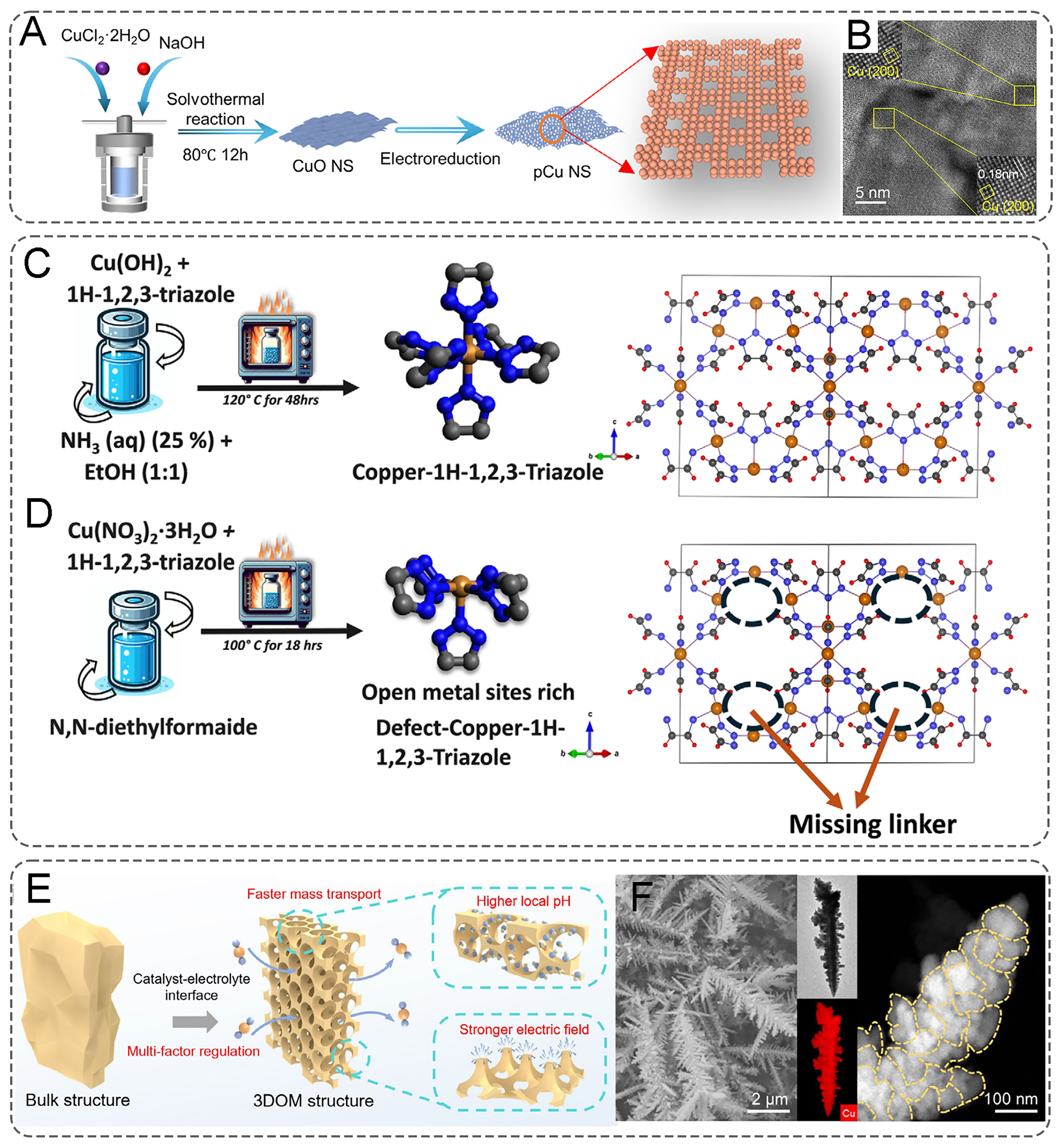
Figure 5. (A) Schematic illustration of the preparation procedure of pCu NS; (B) HRTEM image of pCu NS. (A and B) Reproduced with permission[114]. Licensed under CC BY 4.0; Synthesis scheme for (C) Cu-1H-1,2,3-triazole (Cu-triazole) and (D) defect-Cu-1H-1,2,3-triazole (D-Cu-triazole) with their corresponding crystal structure. (C and D) Reproduced with permission[115]. licensed under CC BY 4.0; (E) Schematic illustration on multi-factor interfacial regulation with 3DOM structure, giving faster mass transport, higher local pH, and stronger electric field at the catalyst-electrolyte interface; (F) SEM, TEM, STEM images, and EDS mapping of dendritic Cu0 in 3DOM-La2CuO4-P. (E and F) Reproduced with permission[116]. Copyright 2026, Wiley-VCH. NS: nanosheet; HRTEM: High-Resolution Transmission Electron Microscopy; SEM: Scanning electron microscopy; TEM: Transmission electron microscopy; STEM: Scanning Transmission Electron Microscope; EDS: Energy-dispersive X-ray spectroscopy.
Cu vacancies modulate product branching beyond merely promoting C-C coupling[117]. Zhuang et al.[24] reported a Cu2S-Cu vacancy core-shell catalyst that, under flow-cell conditions, delivered a C2+ alcohol partial current density of 126 ± 5 mA cm-2 and a FE of 32% ± 1%, both approximately twice those of the vacancy-free Cu2S and pure Cu controls, and enhanced the alcohol-to-olefin ratio more than sixfold. By comparison, Ni atomic cluster decoration of defect-rich Cu primarily improved *CO supply: The C2+ FE increased to 44% in H-type cells and further to 62% in flow cells[118]. Cu vacancies modulate the oxygen-retention versus deoxygenation branching, whereas Ni clusters reinforce upstream *CO generation, demonstrating that “defect-promoted C2+ production” can correspond to entirely different rate-limiting steps.
Vacancies formed during the reaction can also enable high-current performance. Cu1.8Se reconstructed at -450 mA cm-2, accompanied by Se leaching and Cu vacancy formation, achieving a C2+ FE of
Beyond inorganic lattices, molecular coordination vacancies provide an alternative route to modulate interfacial reactivity. Defect-rich Cu-1H-1,2,3-triazole (D-Cu-triazole) synthesized with ligand-vacancy defects and coordinatively unsaturated Cu sites exhibits open metal sites that alter the local coordination environment compared to pristine Cu-triazole [Figure 5C and D][115]. During CO2 electroreduction in 1.0 M KOH at -200 mA cm-2, D-Cu-triazole achieved approximately 78.4% C2+ FE, markedly suppressing C1 and H2 generation. Importantly, post-electrolysis X-ray diffraction (XRD), XPS, and transmission electron microscopy (TEM) demonstrate that D-Cu-triazole operates as a dynamic precatalyst that undergoes reductive reconstruction under cathodic potential, suggesting that the catalytically relevant working state is associated with nitrogen-containing ligand-functionalized Cu nanoclusters rather than the intact initial framework.
Furthermore, defect density and active phase stability can be directed by the structural microenvironment. Constructing a three-dimensionally ordered macroporous (3DOM) architecture from layered perovskite La2CuO4 establishes a multi-factor interfacial microenvironment that concurrently accelerates mass transport, elevates local pH, and intensifies the surface electric field [Figure 5E][116]. This tailored local environment drives an accelerated and complete reconstruction of the initial 3DOM-La2CuO4-P precatalyst into dendritic metallic Cu rich in strained grain boundaries, as characterized by scanning electron microscopy, TEM, energy-dispersive X-ray spectroscopy elemental mapping, and high-angle annular dark-field scanning transmission electron microscopy (STEM) [Figure 5F]. Theoretical and electrochemical analyses indicate that undercoordinated and compressively strained Cu atoms at grain boundaries facilitate *COH formation and stabilize *OCCOH intermediates while suppressing the competing HER. Consequently, the catalyst delivers a C2+ partial current density of 585 mA cm-2 in a flow cell, and sustains continuous operation for approximately 200 h at 600 mA cm-2 in a membrane electrode assembly.
In addition, strain and grain boundaries determine whether defects can persist over the long term. Derived Cu develops local strain during reduction, yet this strain can be relieved through coarsening[28,88]; nano-focused X-ray studies on the Cu-Ag system revealed that Ag-induced strain and corrosion-resistant stability evolve concurrently[117]. Consequently, adsorption energy changes arising from strain need to be verified under identical size and defect density conditions. Strain is frequently coupled with defects. Compressive or tensile strain can shift the electronic states of Cu and alter the adsorption of *CO, *H, and oxygenated intermediates, but strain distribution in NPs is inherently non-uniform and can also be relieved through reconstruction during the reaction. Attributing performance entirely to the average lattice constant risks overlooking local boundaries that are mechanistically relevant[1,2,103].
Oxidation state modulation: dynamic equilibrium at the Cu+/Cu0 interface
Beyond facet and defect engineering, oxide-derived Cu catalysts significantly improve eCO2RR performance by creating mixed valence states and inducing synergistic interactions between Cu0 and Cu+ species[119-125]. Some density functional theory (DFT) models suggest that Cu0 facilitates electron transfer while Cu+ enhances *CO adsorption and stabilizes *OCCO, thereby lowering the coupling free energy; various oxide-derived Cu catalysts have also shown residual Cu+ in ex situ characterization correlated with elevated C2+ selectivity[68,126-134]. de Ruiter et al.[25] observed that Cu2O was fully converted to metallic Cu within 40 s after the onset of cathodic bias; subsequently, the surface continued to coarsen, accompanied by a decline in C2 hydrocarbon selectivity over approximately 30 min [Figure 6A-D]. This result indicates that the higher initial C2+ performance may originate from oxide-inherited porosity and low-coordinated metallic Cu, and does not necessarily imply the presence of steady-state bulk Cu+. In parallel, the soluble Cu+ carbonyl species detected by Vavra et al.[135] were identified as transient intermediates involved in subsequent dissolution, migration, and redeposition processes. Thus, the initial oxidation state, reconstruction transients, and steady-state surface species must be distinguished from one another.
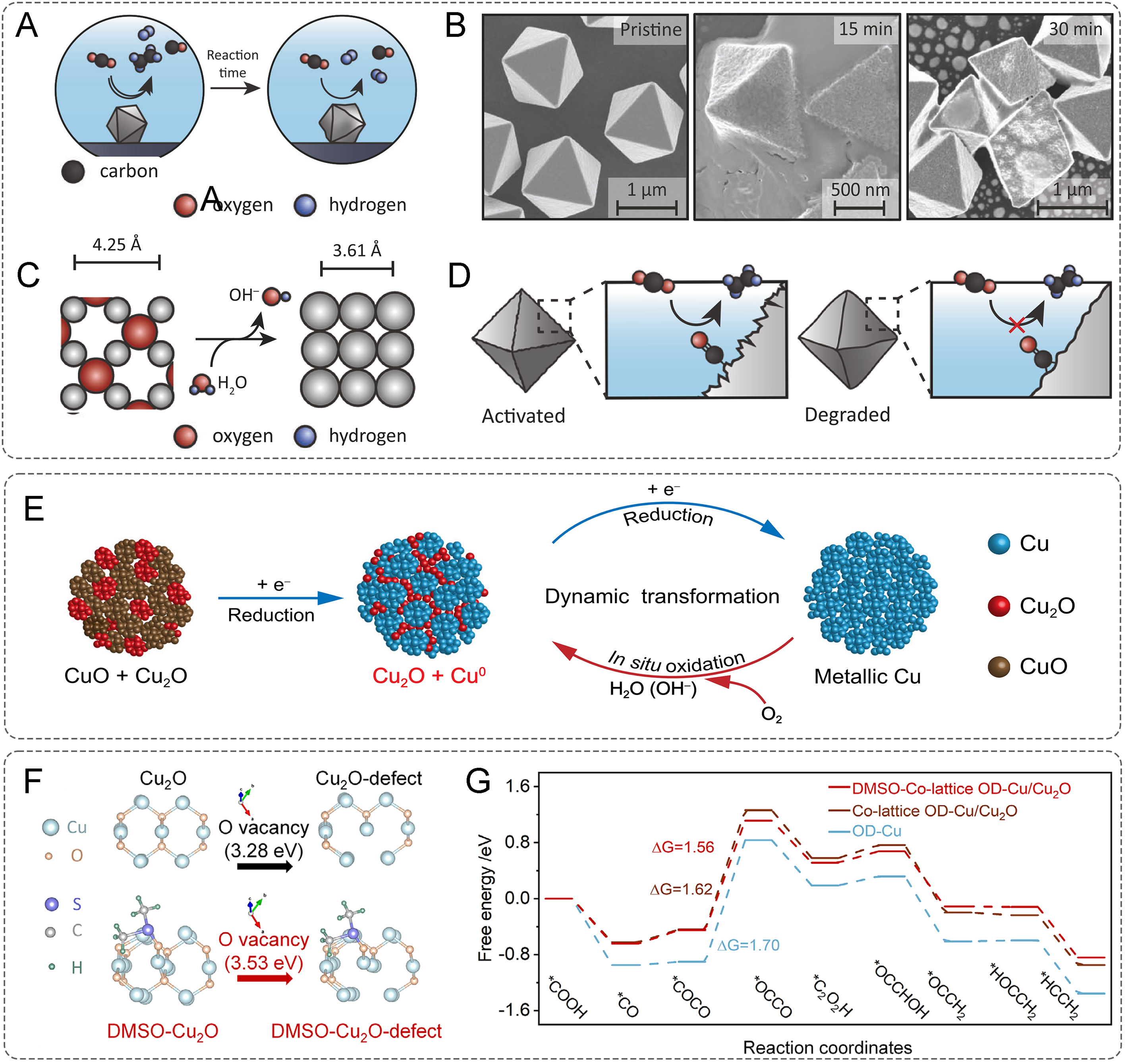
Figure 6. (A) Main products formed during electrochemical CO2 reduction over octahedral Cu2O electrocatalyst particles at early stages of cathodic bias (left) and after prolonged operation up to 30 min (right); (B) Representative ex situ SEM images of pristine Cu2O, and electrolysis of Cu after 15 and 30 min (from left to right) at -1.0 V vs. RHE; (C) The shrinkage effect of electrochemical reduction on the unit cell of Cu2O and Cu; (D) Structural changes observed with in situ X-ray scattering. (A-D) Reproduced with permission[25]. Licensed under CC BY-NC-ND 4.0; (E) Dynamic reduction and re-oxidation mechanism of Cu for the Cu2O-Cu0 catalyst during eCO2RR. (E) Reproduced with permission[96]. Licensed under CC BY-NC-ND 4.0; (F) Oxygen vacancy formation energy of Cu2O and DMSO-Cu2O; (G) Gibbs free energy diagrams of CO2RR pathways on different catalysts. (F and G) Reproduced with permission[136]. Copyright 2026, Wiley-VCH. SEM: Scanning electron microscopy; eCO2RR: Electrocatalytic CO2 reduction reaction; DMSO: dimethyl sulfoxide.
In systems capable of maintaining mixed valence states, Cu+/Cu0 adjacency sites can be correlated with significant performance enhancements[137]. He et al.[96] demonstrated that abundant Cu2O-Cu0 interfaces in a well-designed nanocomposite electrocatalyst are critical for significantly promoting C2+ production within a MEA, achieving a current density of 1.0 A cm-2, a C2+ FE of 80%, and a single-pass C2+ yield of 19%, whereas the pure Cu0 counterpart showed virtually no C2+ enhancement [Figure 6E]. Wu et al.[130] used aryl diazonium salt functionalization to tune the Cu valence to approximately Cu0.26+, achieving an ethylene FE and partial current density of 83% ± 2% and 212 mA cm-2, respectively; after perfluorinated sulfonic acid ionomer addition, the functionalized Cu exhibited an ethylene FE and partial current density of 89% ± 3% and 536 mA cm-2, vs. 48% ± 4% and 269 mA cm-2 for unfunctionalized Cu with the same ionomer. Cao et al.[138] constructed a Cu0/Cu+/Cu0 interface in situ via comproportionation, achieving a C2+ FE of 92.3% and a C2+ partial current density of 276.9 mA cm-2 in a flow cell, and sustained over 90% C2+ FE for more than 50 h in an MEA. Recently, Cui et al.[136] demonstrated that strong additive-oxide interactions can regulate the dynamic reconstruction of metastable Cu oxidation states under strongly acidic conditions. Coordination between the S=O group of dimethyl sulfoxide and surface Cu sites suppressed the complete reduction of Cu2O, enabling controlled in situ reconstruction into a co-lattice OD-Cu/Cu2O heterostructure. The resulting catalyst exhibited a C2H4 FE of 67.5% and an H2 FE of 16.8% at -1.5 V vs. RHE [Figure 6F and G]. These results support the design value of interfacial valence states, though the functional layers, local alkalinity, and mass transport are simultaneously modified.
In summary, the practical objective of oxidation state modulation should not be framed as “the more Cu+, the better”. Excessive Cu+ may compromise electrical conductivity or impede further hydrogenation and coupling of *CO, and pure Cu+ models have also been found inferior to mixed-valence interfaces in certain computational studies. Rigorous attribution requires experiments that probe different valence responses under comparable roughness and mass transport conditions, with transient products measured at each pulse stage. Otherwise, all performance improvements of oxide-derived Cu should not be uniformly attributed to Cu+/Cu0 synergy[95,135].
Bimetallic synergy
Bimetallic regulation is commonly employed to alter the activity and selectivity of eCO2RR. The apparent synergy should not be assigned to a single universal origin. Depending on the spatial arrangement, surface composition, and working-state reconstruction, three non-mutually exclusive contributions may operate: (i) tandem CO supply, in which a CO-selective secondary component increases the local *CO availability at nearby Cu sites; (ii) electronic or strain effects, which modify the adsorption and hydrogenation energetics of key intermediates; and (iii) geometric ensemble or site-dilution effects, which alter the number and continuity of adjacent Cu sites required for C-C coupling and competing hydrogenation reactions[139-146].
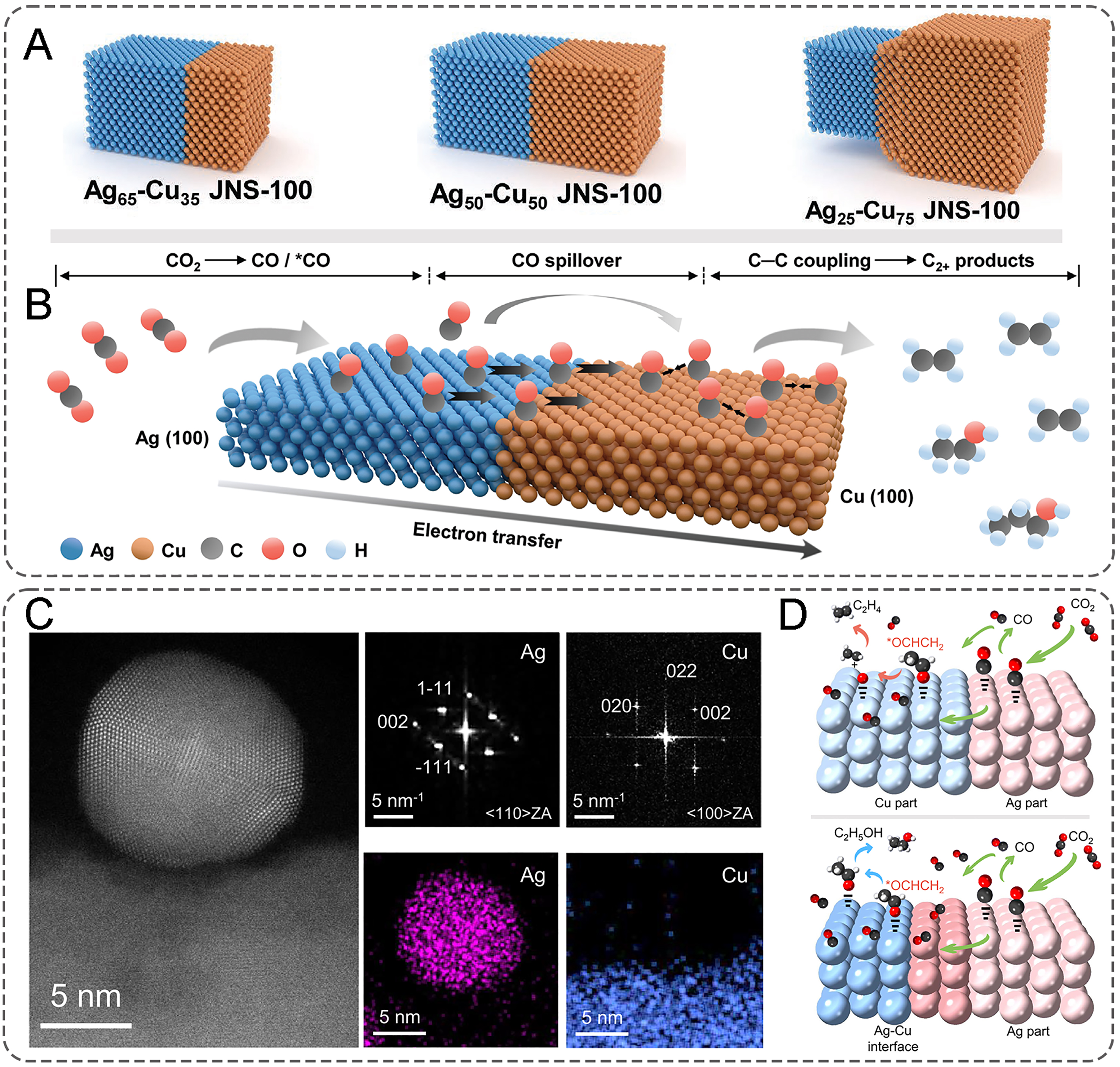
Figure 7. (A) The synthesis of three kinds of Ag-Cu JNS-100 via confined growth of Cu on Ag NCs; (B) Schematic illustration of a plausible eCO2RR mechanism on Ag65-Cu35 JNS-100. (A and B) Reproduced with permission[29]. Copyright 2022, Wiley-VCH; (C) HAADF-STEM images of Ag-Cu biphasic heterostructure (left), FFT patterns taken from Ag and Cu regions in (C) and corresponding EDS elemental maps at Ag-Cu interface; (D) Schematic illustration of the electrocatalytic pathway for C2H4 (left) and C2H5OH (right). (C and D) Reproduced with permission[69]. Licensed under CC BY-NC-ND 4.0. NCs: Nanocubes; eCO2RR: Electrocatalytic CO2 reduction reaction; HAADF-STEM: High-angle annular dark-field scanning transmission electron microscopy; FFT: Fast Fourier transform; EDS: Energy-dispersive X-ray spectroscopy; NPs: Nanoparticles; FEs: Faradaic efficiencies. JNS: janus nanostructures.
The atomic-scale dispersion state of Ag can steer selectivity toward different products. Wang et al.[67] compared Ag NP-decorated Cu (nanoparticulate Ag) with Ag single-atom alloys (atomically dispersed Ag): Nanoparticulate Ag predominantly produced ethylene, with a FE of 54.9% and a partial current density of 156.0 mA cm-2; atomically dispersed Ag redirected the product toward ethanol via water dissociation and a *CHO-related pathway, achieving a FE of 56.3% and a partial current density of 172.8 mA cm-2. This indicates that the secondary metal not only alters the overall C2+ selectivity but also modulates the initial coupling configuration and post-coupling hydrogenation through its spatial distribution.
Bimetallic composition and reconstruction also exert a considerable influence on performance. Gao et al.[69] designed a well-defined Ag-Cu biphasic heterostructure to tune product selectivity via interfacial structure regulation: The Cu-rich interface (Ag0.25-Cu0.75) favored ethylene production; as the Ag atomic fraction increased (Ag0.5-Cu0.5), the major product gradually shifted toward alcohols, and ultimately yielded CO when Ag dominated the surface [Figure 7C and D]. Extended operando studies showed that in Cu-Zn systems, the ethanol-to-ethylene FE ratio increased from 1.25 to 3.54 as the Zn content rose from 9 to 28 at.%, while the CO FE concomitantly increased sharply once Zn exceeded 9 at.%[76]. These results suggest that the optimal composition results from a trade-off among CO supply, dilution of Cu sites, and working-state phase distribution.
Core-shell thickness serves as a tunable parameter to investigate the cascade from *CO generation to C-C coupling[112]. In Ag@C@Cu[149] tested at 400 mA cm-2, as the Cu shell became thinner, ethanol production first increased before shifting toward CO; at the optimal Ag/Cu mass ratio of 0.1, the ethanol FE reached 31.5% and a partial current density of 126 mA cm-2. In an electrodeposited 3Cu:1Ag system[150], the addition of Ag raised the ethylene FE from approximately 7.9% for pure Cu to approximately 18%, yet the intrinsic partial current density did not increase proportionally, indicating that HER suppression and surface area changes also contributed to the FE improvement. Therefore, assessments of sequential CO conversion should simultaneously report CO utilization and product-specific partial current densities.
For oxygenated products such as ethanol, it is also necessary to determine whether the secondary metal influences the first C-C coupling step or the subsequent oxygen-retention step[24]. If the total C2 rate remains largely unchanged while the ethanol-to-ethylene ratio increases, this suggests modulation of the adsorption of oxygenated intermediates and C-O bond cleavage; if CO and all C2 products increase simultaneously, *CO supply is likely the dominant factor. Analysis based on product-specific partial current densities and surface *CO coverage, rather than FE alone, avoids artifacts caused by changes in total current[1]. Notably, a high total C2+ FE frequently conceals divergent product branching rather than a single dominant product. For example, framework-regulated pentyl-CuCP delivers a total C2+ FE of 73.4% ± 2.9% with an ethylene FE of 40.9% ± 1.2% at 260 mA cm-2[151]. In bimetallic nanowire catalysts, single-atom Ag1Cu nanowires achieve an ethanol FE of 56.3% with an ethanol-to-ethylene ratio of 4.26, whereas nanoparticle-decorated AgCu nanowires promote ethylene formation with an FE of 54.9% and an ethanol-to-ethylene ratio of 0.41[67]. Reporting product-specific FE and partial current densities alongside total C2+ FE is therefore essential to clarify whether a catalytic strategy directs the reaction toward a specific target molecule.
Microenvironment modulation
Microenvironment modulation reconfigures the reaction network by altering local CO2, CO, H2O, OH-, and cation activities, without necessitating substantial changes to the Cu lattice itself[79,80,152,153]. Confined structures can prolong intermediate residence times; surface molecules can modulate the electric field, wettability, as well as hydrogen bonding; and the electrode-electrolyte structure governs three-phase mass transport[151,154,155]. Analogous to crystal facets or oxidation states, microenvironment optimization is subject to trade-offs: Overly thick overlayers block adjacent Cu sites, insufficient water activity limits proton transfer, and excessive hydrophobicity reduces ion accessibility[156,157]. Therefore, evaluations should simultaneously compare FE, partial current densities, and stability, rather than ascribing performance improvements exclusively to contact angle or bulk pH.
Confinement effect
Carbon-layer confinement can simultaneously enhance ethanol selectivity and structural stability.
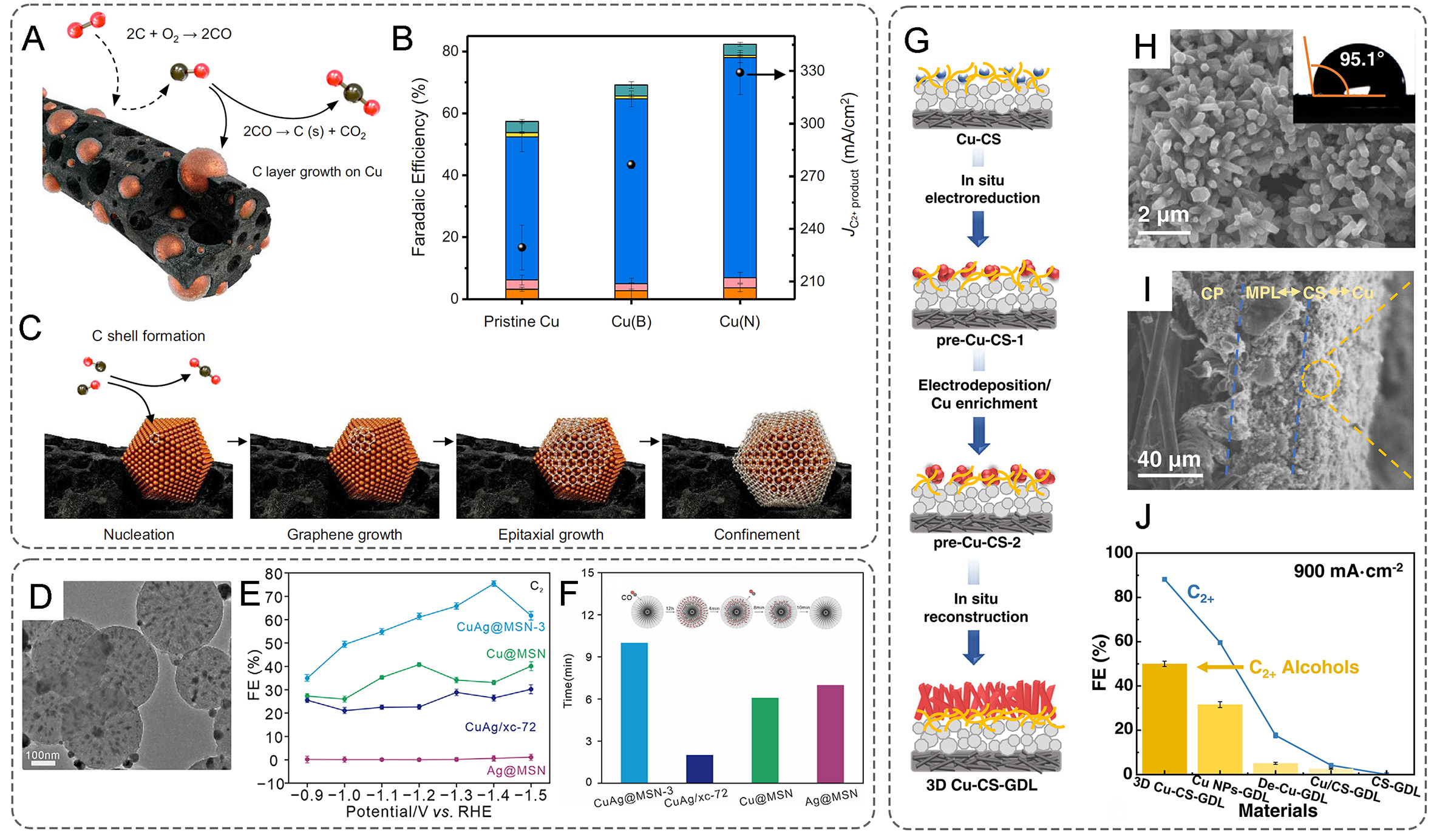
Figure 8. (A) Schematic illustration of the CO-mediated reaction in the Cu-C-O system. The C matrix was nanocarved, forming inner pores by C combustion and generating CO-confined Cu nanoparticles in a quasi-graphitic C shell. The dotted line shows nanocarving, and the solid line shows the Boudouard reaction; (B) FE and partial current density for C2+ products at 400 mA cm-2; (C) Formation mechanism of the quasi-graphitic C shell on Cu nanoparticles through the disproportionation of CO. (A-C) Reproduced with permission[112]. Licensed under CC BY 4.0; (D) The TEM image of the CuAg@MSN sample; (E) The FE of C2 products on CuAg@MSN-3, Cu@MSN, Ag@MSN and CuAg/xc-72 catalysts; (F) The retention times of CO in CuAg@MSN-3, Cu@MSN, Ag@MSN and CuAg/xc-72 catalysts. (D-F) Reproduced with permission[158]. Licensed under CC BY 4.0.; (G) Schematic of the preparation of the 3D Cu-CS-GDL electrode; (H) top-view SEM image and water-contact-angle measurement; (I) cross-sectional SEM image of the 3D Cu-CS-GDL electrode; (J) FEs of C2+ products and C2+ alcohols over different GDEs. (G-J) Reproduced with permission[159]. Licensed under CC BY 4.0. FE: Faradaic efficiency; TEM: Transmission electron microscopy; SEM: Scanning electron microscopy; GDL: Gas diffusion layer.
Confining dual-metal tandem sites within a mesoporous architecture provides an effective strategy to regulate intermediate residence times. Zhang et al.[158] encapsulated Cu and Ag NPs within mesoporous nanospheres derived from self-polymerized dopamine using a dual-phase template and gas-phase reduction method, achieving uniform spatial confinement of metallic sites within mesopores as evidenced by TEM [Figure 8D]. When evaluated in an H-type cell with 0.1 M KHCO3 under identical metal loadings, CuAg@MSN-3 exhibited outstanding multi-carbon selectivity across a wide potential range (-0.9 to -1.5 V vs. RHE), delivering a peak C2 FE of 75.4% at -1.4 V vs. RHE, which substantially exceeds the 30.1% achieved by the unconfined carbon-supported counterpart CuAg/xc-72 [Figure 8E]. In situ attenuated total reflection Fourier transform infrared spectroscopy CO-desorption measurements reveal that the mesoporous channels prolong the local CO retention time to 10 min for CuAg@MSN-3 compared to 7 min for Cu@MSN, 6 min for Ag@MSN, and only 2 min for CuAg/xc-72 [Figure 8F]. This extended residence time enriches local *CO concentration and enhances *CO re-adsorption, thereby increasing intermediate coverage on neighboring Cu sites and promoting C-C coupling.
Porous coordination frameworks and three-dimensional electrodes further extend confinement to high-current-density operation. The CuBPZ-CH3 metal-azole framework achieved a C2+ FE of 52.5% and a total current density of 660 mA cm-2 at -1.2 V vs. RHE, whereas its electronically distinct counterpart CuBPZ-NO2 yielded only a C2+ FE of 20.8%; CuBPZ-CH3 maintained stable operation for over 70 h[160]. Separately,
Surface modification
Molecular or polymer modification of Cu-based catalysts can regulate product distribution by tuning diffusion behavior and reactant adsorption strength, which promotes CO2 activation while influencing reaction pathways and energy barriers[80,154]. Organic modification can alter the reaction network on Cu through coordination, hydrogen bonding, interfacial charge, and wettability[151,161,162]. Histidine-modified Cu maintained a maximum C2+ FE of 76.6% across a potential window exceeding 1 V, while the C2+ partial current density increased by more than 20-fold relative to unmodified Cu and stable operation was maintained for 48 h [Figure 9A][32]. Polymer-anchored pyridine poly-4-vinylpyridine (P4VP) increased the C2+ FE to 47.1% ± 3.9% at 60 mA cm-2, more than three times the value for bare oxide-derived Cu; at
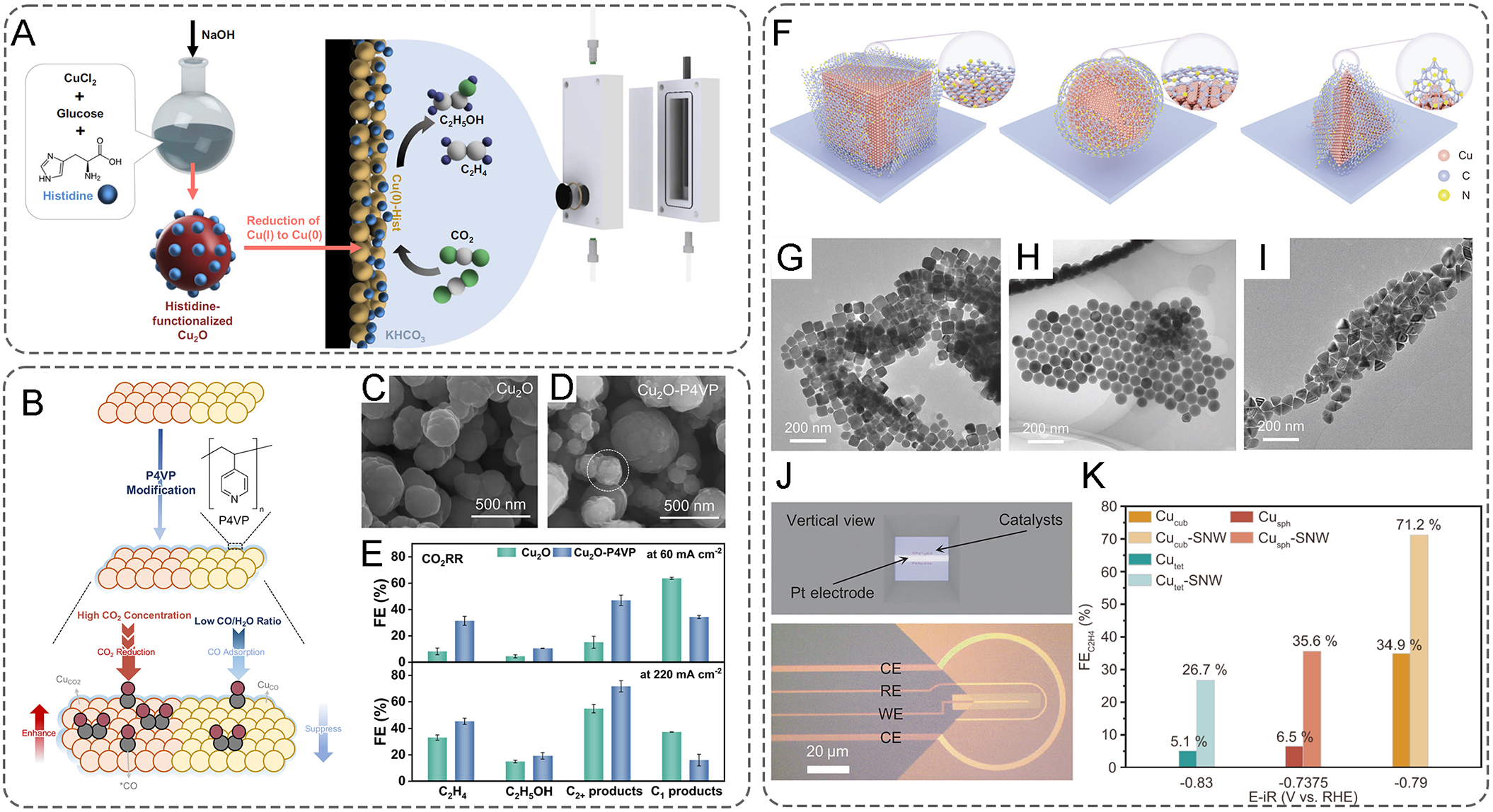
Figure 9. (A) Preparation of histidine-functionalized Cu2O and its subsequent use in eCO2RR. (A) Reproduced with permission[32]. Licensed under CC BY 4.0; (B) Schematic diagram of the impact of P4VP on the C2+ formation activities of the two distinct Cu sites; SEM images of (C) Cu2O and (D) Cu2O-P4VP; (E) FEs of C1 (CO and formate) and C2+ products for Cu2O and Cu2O-P4VP in the eCO2RR at 60 and 220 mA cm-2, respectively. (B-E) Reproduced with permission[155]. Licensed under CC BY-NC-ND 4.0; (F) Structural models of Cunps and Cunps-SNW; TEM images of (G) Cucub, (H) Cusph, and (I) Cutet, respectively; (J) Layout of single-particle electrochemical platform with microelectrodes for eCO2RR; (K) C2H4 FE values for Cunps and Cunps-SNW at different potentials. (F-K) Reproduced with permission[154]. Licensed under CC BY-NC-ND 4.0. SEM: Scanning electron microscopy; NW: Nanowire; TEM: Transmission electron microscopy; FE: Faradaic efficiency; NPs: Nanoparticles; eCO2RR: Electrocatalytic CO2 reduction reaction.
The gain imparted by the same modifier differs across Cu morphologies. A Schiff-base network increased the ethylene FE by approximately 2.0-, 5.5-, and 5.2-fold for cubic, spherical, and tetrahedral Cu, respectively, with the Cu(200)-rich cubic Cu reaching an ethylene FE of 71.2% ± 2.0% and a current density of
To establish causality, molecular modification studies should compare structurally analogous molecules at identical coverage and contact angle. If C2+ selectivity varies only with wettability, the effect is most likely attributable to CO2/H2O mass transport; only when selectivity changes with the anchoring group or electron-donating/withdrawing substituent at comparable wettability can a direct intermediate or valence-state mechanism be invoked[32,154]. The persistence of the molecular overlayer and ECSA should also be reported, because the overlayer may either stabilize Cu or block contiguous Cu sites[155].
Electrode-electrolyte interface engineering
Local alkalinity, cations, anions, water activity, and wetting state collectively constitute the electrode-electrolyte interface, and interface-induced performance variations can far exceed material-intrinsic effects[164-166]. Larger alkali-metal cations can stabilize dipolar or negatively charged intermediates via the interfacial electric field while enhancing *CO coverage; Monteiro et al.[33] found that in metal-cation-free electrolytes, no detectable CO2 reduction occurs on Cu, Au, or Ag, indicating that partially desolvated cations play an essential role in stabilizing early CO2--type intermediates. Anions modulate pH buffering, participate in specific adsorption, and may induce Cu reconstruction. Identical bulk pH does not guarantee identical interfacial conditions: At high current densities, the reaction-diffusion balance generates substantial gradients[167-171].
Engineering an abrupt alkaline interface demonstrates the synergy between local OH- and CO2 flux.
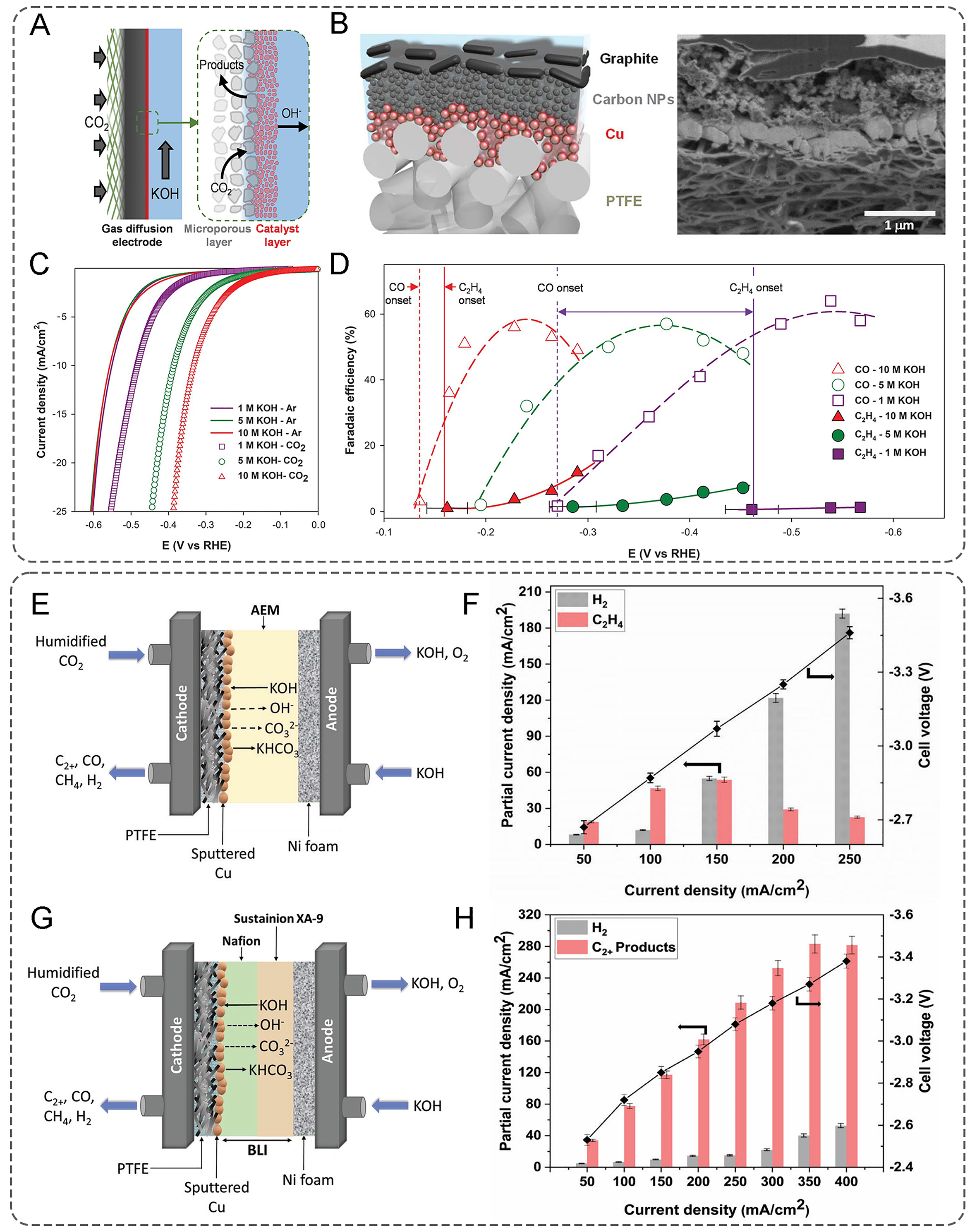
Figure 10. (A) Schematic of the cathode portion of a gas diffusion electrode for CO2; (B) Schematic illustration and Cross-sectional SEM image of the graphite/carbon NPs/Cu/PTFE electrode, (C) LSV scan in various KOH electrolytes; (D) C2H4 and CO FEs with increasing KOH concentrations. (A-D) Reproduced with permission[10]. Copyright 2018, AAAS; eCO2RR using Sustainion X37-50 Grade RT AEM and 1 M KOH as anolyte: (E) schematic diagram of the MEA system; (F) partial current density of C2H4 and H2 and cell voltage at different current density; (G) schematic diagram of the MEA system using BLI-25:25 on Cu catalyst in reverse bias mode; (H) partial current density toward C2+ and H2 at different current density; using 100 mL of 1 M KOH as anolyte. (E-H) Reproduced with permission[172]. Licensed under CC BY 4.0. LSV: Linear sweep voltammetry; FEs: Faradaic efficiencies; eCO2RR: Electrocatalytic CO2 reduction reaction; AEM: Anion exchange membrane; MEA: Membrane electrode assembly; BLI: Bilayer ionomer. PTFE: polytetrafluoroethylene.
Ionomer bilayers can independently regulate the CO2/H2O ratio and local pH. A Nafion/Sustainion bilayer increased the C2+ FE from 61% to 80% while suppressing H2 evolution from 18% to 5%; combination with pulsed electrolysis enhanced the C2+ partial current density by 250% relative to static bare Cu, with a total C2+ FE of 90% and H2 at only 4%[164]. Rashid et al.[172] compared a commercial anion-exchange-membrane electrode with bilayer ionomer configurations [Figure 10E-G]. Infusing the Nafion layer with KOH further increased C2+ production: the optimized bilayer reached a C2+ partial current density of approximately
IN SITU CHARACTERIZATION AND THEORETICAL SIMULATION
The pre-reaction structure of Cu-based catalysts can only describe the starting point of the reaction and cannot represent the true active state during C2+ product formation[13]. Under the concerted action of cathodic bias, adsorbates, and the local electric field, Cu undergoes valence-state reduction, facet rearrangement, defect formation, particle migration, and redeposition; concurrently, the coverages of *CO, OH-, and oxygen-containing C2 intermediates evolve continuously[48]. This chapter follows the progression from “static structure” through “operando evolution” to “dynamic reaction network”: In situ and operando characterization captures structural and intermediate changes over time; DFT compares candidate sites and elementary steps; and microkinetic modeling translates energies, coverages, and mass transport into measurable product-specific rates. These three approaches are not interchangeable but rather complement one another in sequentially reducing uncertainty regarding the true structure and reaction pathway[25,62,69,77,95,96,99,117]. Here, a working-state active site is defined as the potential- and environment-dependent atomic ensemble that exists during catalytic turnover and directly governs a measurable elementary step; it includes the local Cu coordination and valence environment together with the relevant adsorbate coverage, rather than the as-synthesized structure alone.
In situ characterization
Conventional ex situ characterization is typically performed under open-circuit, potential-off, or ambient conditions. It is therefore suitable for confirming precursor composition and overall post-reaction changes, yet prone to missing rapid reduction, short-lived species, and reversible reconstruction. For example, the detection of Cu+ by post-reaction XPS does not prove that Cu+ persistently participates in turnover at the target potential; similarly, the observation of Cu(100) cubes before reaction does not guarantee that intact terraces are preserved under high current densities[25,62,63,97-100]. The core value of in situ characterization lies in recording structure while applying potential and maintaining reactant supply[175]; operando characterization further requires that the catalyst layer, flow rate, electrolyte, and current density approach actual working conditions as closely as possible.
In situ Raman and infrared spectroscopy are well suited for identifying surface adsorbates. SERS can cover low-wavenumber vibrations such as Cu-O and Cu-ligand modes, and the Raman scattering of water is relatively weak[71,176]. By contrast, surface-enhanced infrared absorption spectroscopy and attenuated total reflection infrared spectroscopy are more sensitive to *CO, *OCCO, and oxygen-containing intermediates. Both techniques can track changes in peak intensity and position as a function of potential, yet peak intensity is not equivalent to surface coverage, because enhancement factors, molecular orientation, and the local electric field all influence the signal. By combining SERS, isotope labeling, and DFT analysis,
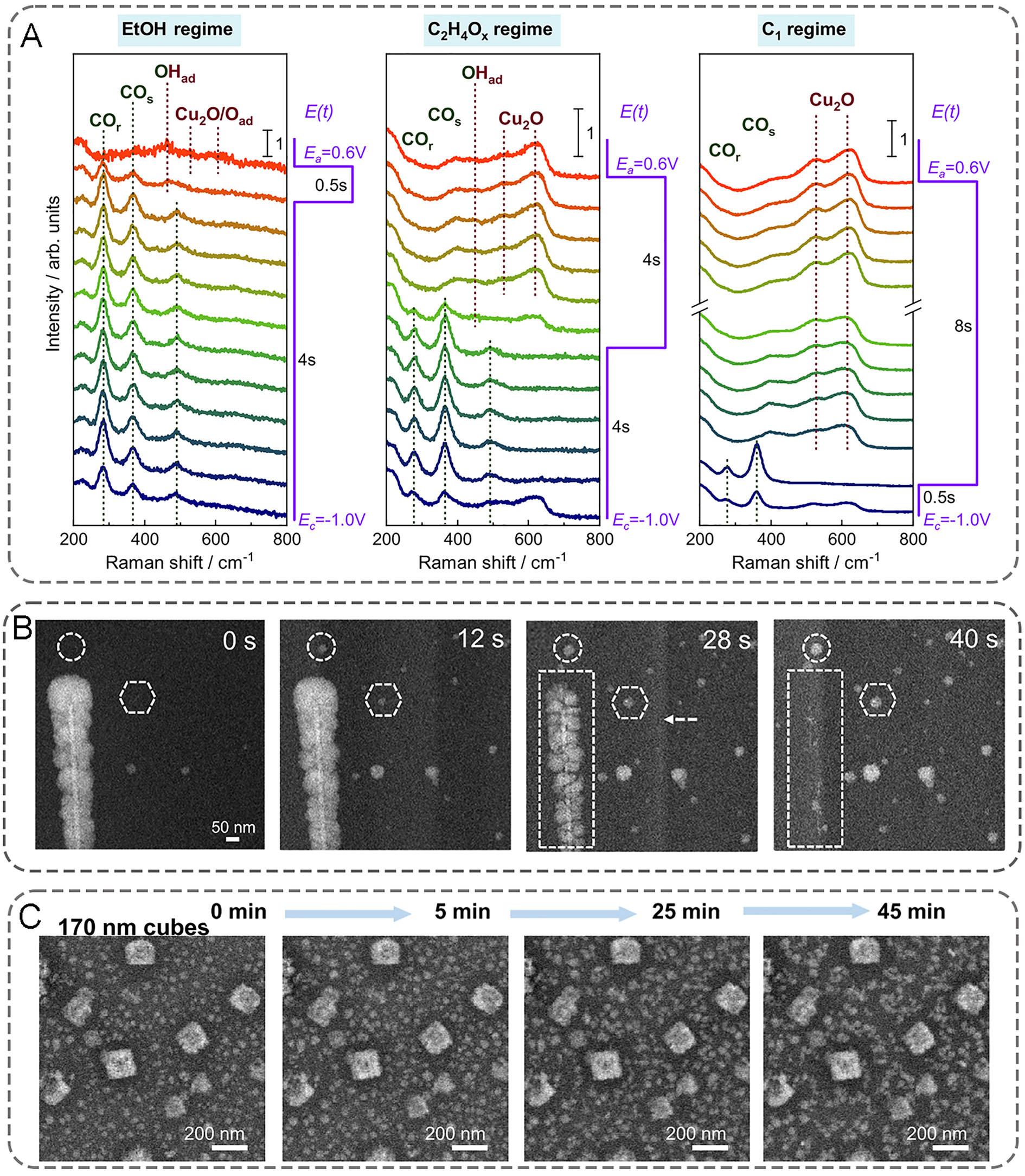
Figure 11. (A) Normalized SERS spectra from bottom to top with highlighted characteristic SERS bands during pulsed eCO2RR with varying pulse lengths. (A) Reproduced with permission[71]. Licensed under CC BY 4.0; (B) Operando EC-STEM images of dynamic evolution of Cu NWs, nucleation of initial growth of Cu nanograins from a metallic Cu NW core surrounded by the spongy Cu shell (Cu@CuS) from 0 to 20 s with two Cu nanograin seeds in dashed boxes; significant Cu migration from Cu NWs to form Cu nanograins at adjacent locations from 20 to 40 s. (B) Reproduced with permission[177]. Copyright 2024, American Chemical Society; (C) Snapshots extracted from the videos tracking the evolution of 170 nm cubes at 0, 5, 25, and 45 min after applying a potential of -0.9 V vs. RHE by EC-TEM. (C) Reproduced with permission[101]. Licensed under CC BY 4.0. SERS: Surface-enhanced Raman spectroscopy; eCO2RR: Electrocatalytic CO2 reduction reaction; EC-STEM: Electrochemical scanning transmission electron microscopy; LSV: Linear sweep voltammetry; CA: chronoamperometry.
Complementing these spectroscopic approaches, microscopic methods have revealed the transformation of Cu morphology from static particles to a dynamic nanocrystalline network. Using operando electrochemical liquid-cell STEM, 4D-STEM, and time-resolved X-ray absorption spectroscopy (XAS), Yang et al.[97] found that 7 nm Cu particles coalesce during electrolysis into grain-boundary-rich metallic Cu nanocrystallites; the sample with an active nanocrystallite fraction approaching unity exhibited a sixfold higher C2+ selectivity relative to 18 nm samples with a nanocrystallite fraction of approximately one-third. In a separate Cu-nanowire study, Yang et al.[177] directly observed nanograin nucleation during the first 20 s of operando liquid-cell EC-STEM imaging, followed by Cu migration and fragmentation of the spongy Cu shell between 20 and 40 s [Figure 11B]. Complementary 4D-STEM identified differently oriented grains and their boundaries in the reconstructed metallic Cu.
X-ray techniques extend structural characterization to crystal phase, valence state, and local coordination. XAS can track the average oxidation state and electronic structure via X-ray absorption near edge structure, and yields local coordination numbers and bond lengths via extended X-ray absorption fine structure, rendering it well suited for examining Cu2O reduction, Cu-Cu coordination formation, and bimetallic interface evolution. Its limitation lies in its large penetration depth and bulk-averaged signal, so that minor surface-active species may be overwhelmed by the bulk signal. De Ruiter et al.[25] employed wide-angle X-ray scattering and small-angle X-ray scattering to observe that Cu2O is fully converted to metallic Cu within 40 s of applying cathodic bias, followed by coarsening and increased bridging *CO, accompanied by a decline in C2 hydrocarbon selectivity over ~30 min. Vavra et al.[135] detected soluble Cu+ carbonyl species, which belong to transient intermediates in the dissolution-migration-redeposition process rather than stable lattice sites. Attribution of dynamic processes also depends on time resolution. Cu2O reduction and particle migration can occur within seconds, pulsed adsorbates vary on sub-second timescales, whereas liquid products are typically integrated over several minutes[71].
In situ XRD is advantageous for identifying crystal phases and average grain-size changes, yet it struggles to detect amorphous layers and low-concentration species. The transition from a single in situ technique to multimodal correlative characterization is a necessary development for identifying dynamic active sites. Surface-enhanced spectroscopy emphasizes local hotspots; XAS reflects the average coordination within the irradiated volume; XRD is sensitive only to long-range ordered phases; and electron microscopy can observe only a limited field of view. Applying spectroscopy, microscopy, and diffraction to the same pulsed Cu(100) system, Tanase et al.[95] found that (n10) facets, surface or subsurface oxide species, and an ultrathin metallic layer form simultaneously, each of which may influence ethylene and ethanol selectivity. Therefore, discrepancies among multimodal results are not necessarily contradictory; one should first compare probing depth, detection limit, and sampling region before judging whether they describe the same working-state structure.
DFT
The development of first-principles methods for simulating electrochemical reactions has made it possible to investigate reaction mechanisms theoretically and to inform catalyst design. DFT provides atomic-scale interpretation of static experimental structures; the most common application is to compare adsorption configurations, reaction free energies, and transition states on ideal crystal surfaces[169]. The computational hydrogen electrode model links the chemical potential of proton-electron pairs to the applied potential, thereby enabling rapid comparison of pathways such as *CO dimerization, *CO hydrogenation, and post-coupling deoxygenation[12,13]. Such static energy diagrams are suitable for screening clearly unfavorable steps, but cannot directly yield operando coverages or product formation rates. In particular, when two pathways differ by only 0.1-0.3 eV, uncertainties in the choice of functional, dispersion correction, coverage, and solvation treatment may alter the predicted pathway hierarchy[48]. Static DFT therefore provides candidate mechanisms rather than definitive ones.
The transition from static surface models to a dynamic electrochemical interface requires explicit consideration of potential, solvent, and the electric double layer[170]. Implicit solvation models allow continuous variation of the surface charge but cannot describe explicit hydrogen-bonding networks or water participation in the reaction; explicit-solvent ab initio molecular dynamics (AIMD) can resolve the local water network but remains limited by cell size and sampling time. Zhang et al.[43] employed explicit-solvent AIMD to demonstrate that alkali-metal cations, *CO2, and interfacial water collectively stabilize the early activation configuration, a finding consistent with the experimental observation that no CO2 reduction is detected on Cu in the absence of metal cations [Figure 12A and B]. Constant-charge models additionally suffer from potential drift arising from work-function changes upon adsorption and reaction; accordingly, charged intermediates and transition states are more appropriately described within a constant-potential or grand-canonical framework[13,33].
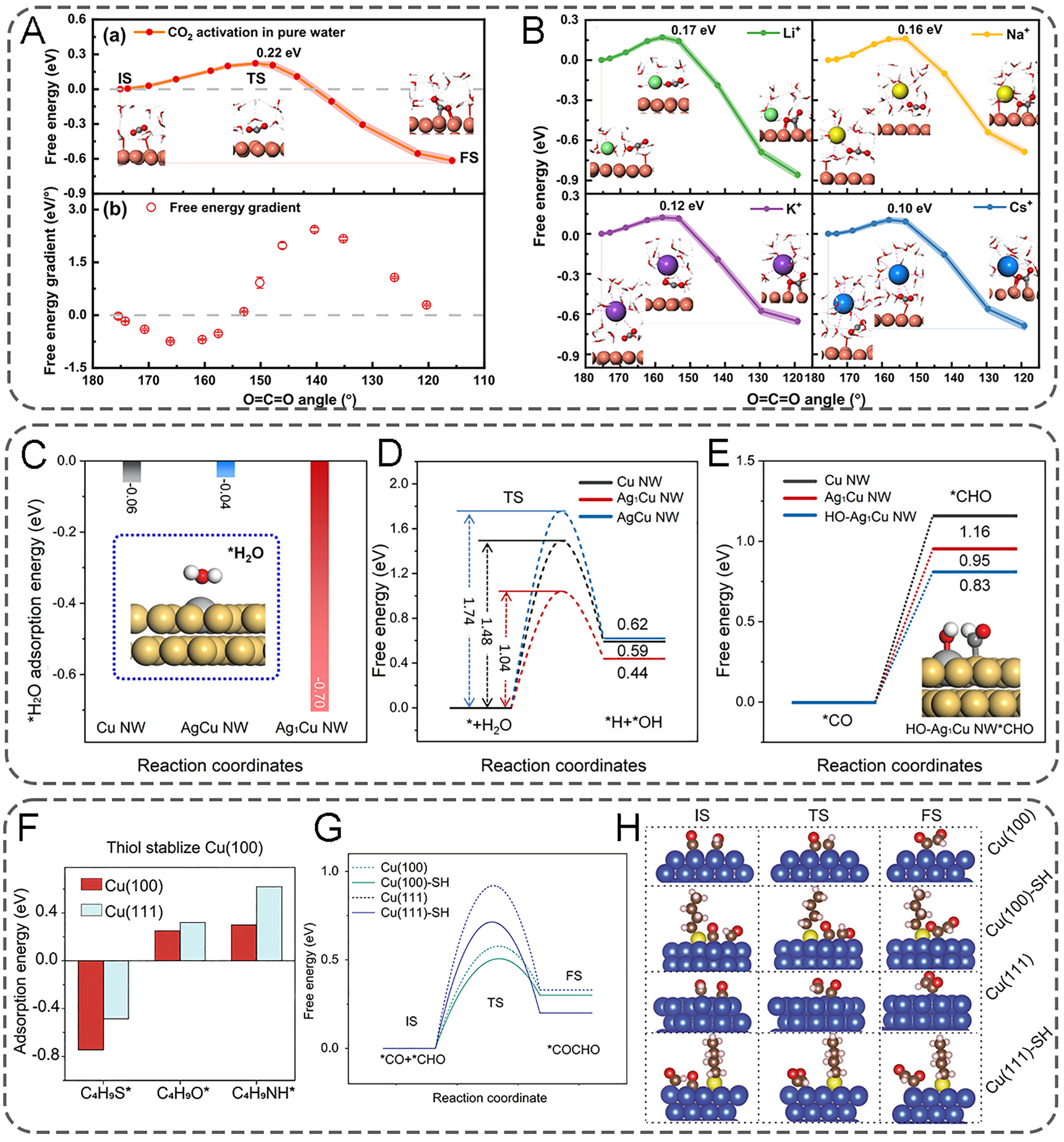
Figure 12. (A) Free energy profile and representative IS, TS, and FS structures for the CO2 adsorption process in the pure water system without M+; (B) Free energy profiles and representative structures at IS, TS, and FS for CO2 adsorption with different cations of Li+, Na+, K+, and Cs+. (A and B) Reproduced with permission[43]. Licensed under CC BY 4.0; (C and D) The adsorption and dissociation energies of H2O on Cu NW, AgCu NW and Ag1Cu NW. (E) Gibbs free energy diagrams for *CO hydrogenation to *CHO over Cu NW, Ag1Cu NW and HO-Ag1Cu NW. (C-E) Reproduced with permission[67]. Licensed under CC BY-NC-ND 4.0. (F) DFT calculations of the adsorption energies of various alcohols, thiols, and amines with alkyl chains; The free energy diagram (G) and optimized structures (H) of the CO-CHO coupling process on the Cu(100), Cu(100) with *C4H9S, Cu(111) and Cu(111) with *C4H9S surfaces. (F-H) Reproduced with permission[178]. Licensed under CC BY 4.0. NW: Nanowires; IS: initial state; TS: transition state; FS: final state; DFT: Density functional theory.
Operando characterization also reshapes the structural models adopted in DFT calculations. Using pre-reaction Cu2O, Cu NCs, or bimetallic alloys directly as computational starting points risks overlooking rapid reduction, adsorption-induced faceting, and elemental migration[25,51,69]. Single-crystal facet studies have established a relatively complete predictive-validative cycle: Cu(100)/Cu(111) interface models predict that such boundaries enhance *CO adsorption and lower the C-C coupling barrier, a prediction subsequently corroborated by a C2+ FE of 74.9% ± 1.7% at 300 mA cm-2[65]; calculations incorporating co-adsorbed CO/OH- further predict the formation of Cu(100)-rich surfaces, which was verified by in situ faceting experiments and ultimately led to a C2+ FE of 83% at 500 mA cm-2[51]. At this stage, the computational object is no longer the as-synthesized facet but the experimentally confirmed operando structure.
Studies on defect and bimetallic systems demonstrate that dynamic models must encompass multiple sites and the migration of intermediates. Calculations on Cu2S-Cu vacancy systems indicate that vacancies and subsurface sulfur primarily alter the oxygen-retention versus deoxygenation branching following C-C coupling, consistent with a C2+ alcohol FE of 32% ± 1% and a partial current density of
Organic modification and the local microenvironment further expand the configurational space of the dynamic interface. Aryl diazonium salt functionalization establishes a continuously tunable series of Cuδ+ states; the computationally predicted valence-ethylene trend was corroborated by synthesis and MEA testing, with the optimal sample reaching an ethylene FE of 83% ± 2% and an ethylene partial current density of
The evolution of DFT from static to dynamic does not imply that models can be made arbitrarily complex; rather, each added layer of complexity must address a testable question. High-level embedded cluster calculations can correct the bias of commonly used functionals toward CO/Cu adsorption sites[48]; constant-potential models can examine the potential response of charged transition states; and AIMD can predict the instantaneous structure of cations or water networks. Theoretical predictions should be translated into isotope effects, peak shifts, reaction orders, or turning points in product ratios, for subsequent experimental verification. If different reasonable models yield opposite orderings, or if the results are highly sensitive to coverage and solvation, uncertainty intervals should be reported, and researchers should explicitly acknowledge that current calculations cannot yet distinguish between candidate pathways.
Microkinetics
Static free-energy diagrams can identify thermodynamically favorable steps but cannot directly indicate which step controls the rate at a given potential and coverage. Microkinetic modeling combines adsorption equilibria, elementary reaction rates, and site conservation to compute steady-state coverages and product-specific formation rates. For Cu-based C2+ reactions, the model must minimally include the pathway from CO2 to *CO, *CO desorption and re-adsorption, various C-C coupling channels, hydrogen evolution, the methane pathway, and the ethylene/ethanol branching[2,13]. Because potential, local pH, and CO partial pressure simultaneously alter multiple steps, no single step remains rate-determining across all conditions.
The transition from mean-field microkinetics to a dynamic surface requires consideration of coverage-dependent interactions, surface diffusion, and site size. Li et al.[47] employed kinetic Monte Carlo simulations to study the diffusion of carbon-containing intermediates on Cu surfaces and used isotope mixing responses to constrain the surface ensemble required for C-C coupling. Experimentally, the conversion from CO2 to CO and from CO to C2+ products proceed on different Cu sites, and subsequent C2+ conversion on CO-rich sites is enhanced by approximately sixfold[21]. These findings demonstrate that models should not rely solely on low-coverage adsorption energies but must also incorporate *CO interactions, site blocking, and the probability of *CO migrating from generation sites to coupling sites.
The dynamic variation of potential and microenvironment requires that models be established jointly with systematic condition-variation experiments. Reducing the water activity from 0.97 to 0.72 increased the C2 FE from 10% to 66% and approximately tripled the current density; the product-specific reaction orders for the C1, C2, and H2 pathways also changed markedly as a function of water activity[45]. Pulsed electrolysis periodically alters *OH, *CO, and the Cu surface state[71]. These data can test whether the performance enhancement originates from increased *CO coverage, altered proton transfer, or structural regeneration. Only when a model reproduces the FE, product-specific partial currents, reaction orders, and dynamic responses does it possess greater mechanistic discriminatory power than merely fitting a single polarization curve.
Under high-current conditions, surface reactions must be integrated with mass transport within the catalyst layer. Adesina et al.[173] combined DFT, acid-base equilibria, and multiscale transport to predict that through-plane gradients of K+, carbonate, pH, and potential develop within the Nafion layer. In dual-layer ionomer experiments, the C2+ FE increases from 61% to 80%; combination with pulsing further raises this to 90% while suppressing H2 to 4%[164]. This demonstrates that the local CO2/H2O ratio and pH can significantly alter the apparent kinetics. In zero-gap electrolyzers, even a change in anolyte KOH concentration can shift the cathode products from CO-dominated to ethylene/H2-dominated through cation crossover across the membrane[156]. Therefore, device-level transport cannot be reduced to a vague “effective barrier”.
The goal of microkinetic modeling is to form a predictive and correctable reaction network under dynamic conditions. CO versus CO2 feed comparisons can distinguish upstream CO generation from subsequent C2 conversion[57]; isotope mixing can constrain surface diffusion[47]; and water activity and pulse frequency separately perturb solvation and transient coverage. A more complete iterative workflow should proceed as follows: Operando characterization provides the working-state structure, DFT generates candidate steps and energy ranges, microkinetics predicts the response of multiple product channels, and new-condition experiments then eliminate models inconsistent with the results. If different networks yield identical predictions for the existing data, multiple possibilities should be retained rather than asserting a unique mechanism based solely on a best-fit curve.
CHALLENGES AND OUTLOOK
Cu is currently the central metal capable of electrochemically reducing CO2 at appreciable rates to form a variety of C2+ products, yet its advantage does not stem from any fixed structure but rather from the synergy between adjacent Cu sites and carbon-containing intermediate coverage, modulated by the local solvation environment under working conditions. The mechanisms described in this review indicate that *CO coverage, the geometric relationship between neighboring Cu sites, local strain, OH- co-adsorption, and proton supply govern C-C coupling; the subsequent oxygen retention or removal of the coupled intermediate then directs selectivity toward ethanol, ethylene, and other C2+ products[12,20,65,71]. Structural regulation can be organized into hierarchical levels: (i) crystal facet and morphology, (ii) defects and valence state, (iii) bimetallic and single-atom alloys, (iv) confinement and molecular interfaces, and (v) the catalyst-layer microenvironment. Operando Cu(100) faceting, Cu+/Cu0 interfaces, and geometrically adjacent sites all enhance the probability of C-C coupling. However, bimetallic and confinement designs simultaneously alter the local pH, ion distribution, and mass transport; consequently, structural factors and interfacial factors cannot be discussed in isolation[51,65,67]. In situ spectroscopy, XAS, microscopy, and isotope experiments should therefore be cross-validated against DFT, microkinetic modeling, and multiscale transport models, rather than treating a single characterization technique or single-step energy barrier as sufficient causal evidence. From a device perspective, interfacial alkalinity, water activity, cation crossover across the membrane, ionomer, and GDL collectively shape the high-current interface[10,45,156,164]. The demonstration of ethylene operation exceeding 150 h under strongly acidic conditions, together with the C2+ performance of ampere-level channeled electrodes, indicates that catalyst design must be integrated with the membrane, electrode pore structure, CO2 recycling, and product separation[78,153]. In summary, the key to Cu-based C2+ electrosynthesis is not the mere superposition of structural features but the establishment of verifiable connections from working-state active sites to product-specific fluxes and further to device-level CE and lifetime. Moreover, significant challenges remain in both the exploration and practical implementation of electrochemical CO2 conversion to C2+ products. We summarize the following outlook to address the current challenges facing electrochemical CO2-to-C2+ conversion.
Causal identification of working-state C-C coupling sites
The central challenge is that pre-reaction descriptors such as crystal facet, defect density, or Cu+ fraction merely label the precursor; they do not identify the active site operative during C2+ formation. Cu2O is reduced within ~40 s, Cu particles fragment and redeposit, and soluble Cu+ may exist only as a fleeting intermediate of structural reconstruction. Meanwhile, the surface coverages of *CO, OH-, and oxygenated C2 intermediates shift rapidly with applied potential[25,71,97,135]. As a result, a given performance gain can reflect simultaneous changes in site geometry, oxidation state, and local microenvironment. Current evidence is generally sufficient to establish correlation, showing that certain features appear together, but falls short of proving that any single structural motif is causally responsible.
Future studies would benefit from moving beyond static structural comparisons toward dynamic perturbation-and-recovery experiments that can help establish causality. Ideally, this would involve simultaneously tracking working-state structure, intermediate coverages, and product-specific rates on a common time axis, while selectively perturbing candidate sites through potential pulses, compositional gradients, or reversible ligand exchange. A more convincing active-site assignment could be made when the structural change precedes the rate response, performance recovers upon structural restoration, and variations in ECSA, local pH, and mass transport have been accounted for as potential confounding factors. It would also be desirable to resolve stability assessment into distinct phases—startup reconstruction, quasi-steady-state operation, and irreversible failure—so that Cu dissolution, catalyst-layer degradation, and membrane/GDE failure can be quantified independently[26,95].
From total C2+ to single-product selectivity and unified evaluation
A high total C2+ FE often reflects the combined contributions of multiple product channels—ethylene, ethanol, acetate, and others—each carrying distinct implications for downstream separation costs and product value. It would therefore be beneficial for future studies to report product-specific FE, partial current density, SPCE, and long-term stability concurrently, thereby providing a more comprehensive assessment of CO2 electroreduction performance.
H-type cells are well suited for mechanistic dissection, whereas flow cells and zero-gap MEAs are designed for high-rate and device-level performance evaluation; the three platforms serve complementary purposes and should not be ranked solely by peak FE. Cross-platform comparisons could be made more meaningful by employing the same catalyst batch, unified potential calibration, and consistent product quantification protocols, with explicit reporting of catalyst-layer loading, ionomer content, membrane type, and CO2 flow rate.
Moving beyond C-C coupling toward downstream selectivity control is a necessary step if single-product targeting is to be achieved. The ethylene/ethanol ratio can serve as a useful diagnostic for the competition between deoxygenation and oxygen retention, while acetate formation calls for simultaneous consideration of both surface pathways and solution-phase reactions. Confinement effects, oxophilic sites, and local water activity may each be tuned toward specific product branches, though such design strategies would need to be validated through in situ spectroscopy, isotopic labeling, and microkinetic modeling.
Deactivation mechanisms across length scales
Beyond activity and C2+ selectivity, long-term stability remains a central bottleneck for Cu-based eCO2RR catalysts. Experimentally, oxide-derived and mixed-valence Cu surfaces often reconstruct under cathodic bias: residual Cu+/oxide domains are reduced, NPs agglomerate or sinter through migration-coalescence and Ostwald ripening, and the ensembles responsible for *CO adsorption and C-C coupling are altered, shifting products toward CO, H2, or methane[179]. Analogous dynamic active-site restructuring and potential-dependent degradation have been reported during alkaline CO reduction[180]. Electrolyte- and operation-related processes may further contribute to performance decay, including metallic impurity deposition, localized carbonate precipitation, and potential catalyst fouling by carbonaceous residues[181]. These pathways are strongly device-dependent because mass transport in H-cells, flow cells, and MEAs affects local pH, *CO coverage, and the balance between restructuring and productive turnover[100].
Theoretically, deactivation is linked to the potential-dependent stability of surface phases and adsorbates. Computational Pourbaix analyses and grand-canonical DFT indicate that Cu+/oxide motifs often invoked for selective C-C coupling may be metastable under strongly reducing conditions, consistent with the frequently observed Cu+ → Cu0 conversion[182,183]. Potential- and adsorbate-dependent reconstruction of Cu(100) can modify the surface ensembles responsible for C-C coupling[184], while evolving adsorption energies of *CO, *H, and oxygenates provide a microscopic basis for selectivity drift. Most DFT models remain static and therefore cannot fully capture coupled reconstruction-reaction kinetics; operando-constrained structural models, microkinetic analyses, and kinetic Monte Carlo simulations that include site conversion—together with explicit treatment of water activity, cations, and carbonate equilibria—are therefore needed[185,186]. Looking forward, rigorous stability studies should report not only FE retention but also time-resolved structural metrics and carbon-efficiency losses so that specific deactivation channels can be correlated with performance decay[181].
Toward standardized performance evaluation across H-cells, flow cells, and MEAs
H-type cells, gas-diffusion flow cells, and zero-gap MEAs operate under markedly different mass-transport characteristics, interfacial ionic environments, and ohmic-loss regimes, and therefore cannot be meaningfully ranked by peak FE alone. H-type cells are limited by the modest aqueous solubility of CO2 (~30-35 mM) and relatively long diffusion distances, often limiting attainable geometric current densities under ambient, unpressurized conditions. Their well-controlled three-electrode configuration, however, makes them useful for low-current mechanistic and kinetic studies, provided that mass-transport limitations, local pH changes, and iR losses are carefully evaluated. Gas-diffusion flow cells overcome these mass-transfer constraints by delivering gaseous CO2 through a porous GDE, enabling current densities of hundreds of
These differences necessitate a standardized evaluation framework that separates catalyst-level kinetics from device-level performance. Measurements intended to approximate intrinsic kinetics should be performed under well-calibrated three-electrode conditions with appropriate potential calibration and iR correction, while explicitly assessing mass-transport and local-environment effects. For dynamically reconstructing Cu catalysts, ex situ or pre-steady-state ECSA values may not accurately represent the working-state active surface. ECSA-normalized results should therefore be accompanied by geometric- and, where appropriate, mass-normalized metrics, together with a clear description of the ECSA measurement method. Device-level assessments in flow cells or MEAs should report both total C2+ FE and product-specific metrics (individual FE and partial current densities) together with SPCE, full-cell energy efficiency, and long-term stability, under consistently documented conditions, including CO2 flow rate and pressure, electrolyte composition, membrane characteristics, catalyst loading, geometric electrode area, and cell configuration. Integrated CO2-capture and electrolysis systems additionally require clear reporting of the capture medium, release or regeneration conditions, and their effects on the electrochemical reaction environment and system-level carbon balance[187]. High FE or partial current density obtained in flow cells or MEAs should therefore not be interpreted as intrinsic catalytic activity without accounting for mass-transport and device architecture. Such reporting will help distinguish catalyst-intrinsic activity from reactor- and operating-condition-dependent effects, providing a more reliable basis for benchmarking eCO2RR systems.
Techno-economic indicators and core engineering bottlenecks for industrial C2+ electrosynthesis
High FE measured in laboratory half-cells is not by itself a sufficient criterion for commercial viability. Recent techno-economic analyses of CO2/CO electrolysis to C2+ products show that plant economics remain highly sensitive to electrolyzer performance, capital cost, electricity price, and downstream separation, and may face unfavorable economic margins under conventional baseline assumptions[188]. At industrially relevant current densities, full-cell energy efficiency is constrained by cathodic and anodic overpotentials, membrane and electrolyte ohmic losses, and mass-transport polarization. Techno-economic analyses of acidic-media ethylene electrosynthesis, for example, emphasize the need for low cell voltage, high selectivity, and durable membranes/catalysts to approach market competitiveness[189]. Assessments of polymer-membrane CO2 electrolyzers further indicate that single-pass conversion and product concentration represent critical scenario-dependent targets: gaseous products may require sufficiently high single-pass conversion, whereas liquid products have been identified as requiring elevated outlet concentrations (e.g.,
Carbon management and product recovery impose additional systems-level bottlenecks. In neutral and alkaline low-temperature electrolyzers, (bi)carbonate formation and crossover reduce carbon utilization, promote salt precipitation and electrode flooding, and introduce large energy penalties for CO2 and electrolyte regeneration[191]. Process- and techno-economic analyses of carbonate-fed or bipolar-membrane-based architectures are therefore being developed to mitigate the alkaline carbon penalty and improve overall CE[192]. From a scale-up perspective, durable high-rate operation in MEA and stack configurations remains essential: long-term stability targets are typically discussed on the order of multi-thousand hours, whereas laboratory demonstrations more often report hundreds of hours under controlled conditions[193,194]. Accordingly, future progress will require concurrent advances in full-cell efficiency, SPCE, concentrated product recovery, and industrially relevant durability—not peak half-cell FE alone.
From catalyst performance to CE and lifetime in high-current devices
During ampere-level operation, gradients in local pH, K+ and carbonate migration, salt precipitation, electrode flooding, ionomer coverage, and CO2 crossover across the membrane can either mask or amplify intrinsic material differences[10,45,156,164]. It would therefore be preferable to compare catalysts at matched current density, gas utilization, and electrolyzer boundary conditions, within a unified framework that incorporates CE, cell voltage, energy efficiency, product separation load, and degradation rate. The demonstration of ethylene operation exceeding 150 h under strongly acidic conditions, together with the C2+ performance of channelized La-Cu hollow spheres approaching 1 A cm-2, attests to the engineering feasibility; however, sustained long-term operation still requires addressing Cu migration, membrane fouling, salt management, and mechanical degradation[26,78,153]. Ultimately, catalyst, ionomer, membrane, pore architecture, and operating strategy would benefit from joint optimization guided by mass- and energy-balance models, rather than from isolated pursuit of peak FE.
Machine learning-assisted precise design and C2+ product prediction
Artificial intelligence can be embedded within the material-interface-device iterative framework described above, but it should not replace working-state validation. The first step is to establish a traceable database that jointly records structural descriptors—including working-state Cu coordination, facet/defect ratios, valence-state lifetimes, adjacent-site distances, and in situ Raman/XAS signals—and operational parameters such as potential, cation identity, water activity, ionomer type, and mass-transport conditions. Prediction labels should be recorded separately for ethylene, ethanol, acetate, and C3+ species in terms of FE, partial current density, energy efficiency, and degradation rate, rather than collapsed into a single total C2+ figure[13].
As working-state atomic structures and spectroscopic time series gradually accumulate, graph neural networks can represent Cu-site adjacency and heteroatom environments, while temporal models can identify reconstruction states. Multi-task architectures may predict individual product branches such as ethylene and ethanol simultaneously, provided that FE sum rules and carbon-conservation constraints are enforced. High-accuracy molecule-Cu adsorption benchmarks, single-atom-alloy DFT calculations, and microkinetic or multiscale mass-transport models can each contribute distinct physical features spanning adsorption energies, site geometries, coupling barriers, intermediate coverages, and local pH[48,49,173]. For the time being, these algorithms are best regarded as promising but unvalidated methodological routes whose transferability needs to be tested through prospective experiments across different materials, research groups, and electrolyzer configurations.
Automated electrocatalysis platforms offer a practical entry point for active learning. Recent work has demonstrated rapid screening of rare-earth-modified Cu bimetallic systems via automated synthesis and testing[168], confirming that composition, operating conditions, and product analysis can indeed form a closed loop. However, if the platform optimizes solely for the highest total C2+ FE under fixed flow rates, fixed cell geometry, and short-duration steady state, the algorithm risks conflating apparatus-specific bias with intrinsic material trends. A more informative next step would be to reformulate the objective function as a multi-objective Pareto front that simultaneously constrains single-product partial current, cell voltage, CE, and degradation rate, while allowing the model to actively select replicate experiments for noise estimation. In this framing, machine learning serves to narrow the search space and quantify uncertainty, whereas mechanistic experiments and engineering evaluation remain the arbiters of whether a given structure is truly effective.
CONCLUSION
In summary, the design target for Cu-based C2+ electrosynthesis should shift from “the catalyst as prepared” to “the catalytic interface under operation”. Crystal facets, defects, valence states, and secondary metals become meaningful only insofar as they sustain adjacent Cu sites and establish appropriate intermediate coverages; confinement, surface modification, and electrolyte engineering are productive only when they simultaneously accommodate adequate transport of CO2, ions, and water. These structural and interfacial features can continuously evolve under applied bias; reliable structure-selectivity relationships should therefore be established using operando measurements and models that account for surface reconstruction. Moreover, promoting initial C-C bond formation must be distinguished from controlling subsequent branching toward ethylene, ethanol, acetate, or C3+ products.
Performance evaluation should accordingly extend beyond total C2+ FE. Product-specific Faradaic efficiencies and partial current densities should be reported together with SPCE, full-cell energy efficiency, product concentration, and long-term stability. H-cells, flow cells, and MEAs serve complementary purposes and should not be compared solely through their peak Faradaic efficiencies. At industrially relevant current densities, catalyst reconstruction, carbonate formation, salt precipitation, electrode flooding, and catalyst-layer degradation further require coordinated optimization of the catalyst, ionomer, membrane, pore architecture, and operating conditions. By integrating operando characterization, theory, and standardized performance evaluation together with device-level engineering within a common workflow, empirical screening can be progressively transformed into testable design rules, moving the field closer to the selective, stable and predictable synthesis of individual multi-carbon products[26,168].
DECLARATIONS
Authors’ contributions
Literature collection, critical analysis, drafting, and revision of the manuscript: Chen, Y.; Wang, Z.; Li, Y.
Availability of data and materials
Not applicable.
AI and AI-assisted tools statement
Not applicable.
Financial support and sponsorship
This work was financially supported by the Key R&D Program of Zhejiang (No. 2024C03136).
Conflicts of interest
All authors declared that there are no conflicts of interest.
Ethical approval and consent to participate
Not applicable.
Consent for publication
Not applicable.
Copyright
© The Author(s) 2026.
REFERENCES
1. Xiao, C.; Zhang, J. Architectural design for enhanced C2 product selectivity in electrochemical CO2 reduction using Cu-based catalysts: a review. ACS. Nano. 2021, 15, 7975-8000.
2. Yan, T.; Chen, X.; Kumari, L.; et al. Multiscale CO2 electrocatalysis to C2+ products: reaction mechanisms, catalyst design, and device fabrication. Chem. Rev. 2023, 123, 10530-83.
3. Li, L.; Li, X.; Sun, Y.; Xie, Y. Rational design of electrocatalytic carbon dioxide reduction for a zero-carbon network. Chem. Soc. Rev. 2022, 51, 1234-52.
4. Wan, C.; Fang, Y.; Li, L.; et al. Molecular bridge enables dual-intermediate synergy for selective CO2 electroreduction to multicarbon products. Angew. Chem. Int. Ed. 2026, 65, e6511351.
5. Hori, Y.; Kikuchi, K.; Suzuki, S. Production of CO and CH4 in electrochemical reduction of CO2 at metal electrodes in aqueous hydrogencarbonate solution. Chem. Lett. 1985, 14, 1695-8.
6. Hori, Y.; Wakebe, H.; Tsukamoto, T.; Koga, O. Electrocatalytic process of CO selectivity in electrochemical reduction of CO2 at metal electrodes in aqueous media. Electrochim. Acta. 1994, 39, 1833-9.
7. Wan, C.; Qiao, P.; Zhou, Y.; et al. Programming reaction-network bifurcations for selective amino acid electrosynthesis. J. Am. Chem. Soc. 2026, 148, 32528-41.
8. Kuhl, K. P.; Cave, E. R.; Abram, D. N.; Jaramillo, T. F. New insights into the electrochemical reduction of carbon dioxide on metallic copper surfaces. Energy. Environ. Sci. 2012, 5, 7050-9.
9. Reske, R.; Mistry, H.; Behafarid, F.; Roldan, Cuenya. B.; Strasser, P. Particle size effects in the catalytic electroreduction of CO2 on Cu nanoparticles. J. Am. Chem. Soc. 2014, 136, 6978-86.
10. Dinh, C. T.; Burdyny, T.; Kibria, M. G.; et al. CO2 electroreduction to ethylene via hydroxide-mediated copper catalysis at an abrupt interface. Science 2018, 360, 783-7.
11. Li, L.; Wan, C.; Wang, S.; Li, X.; Sun, Y.; Xie, Y. Tandem dual-site PbCu electrocatalyst for high-rate and selective glycine synthesis at industrial current densities. Nano. Lett. 2024, 24, 2392-9.
12. Schouten, K. J. P.; Kwon, Y.; van der Ham, C. J. M.; Qin, Z.; Koper, M. T. M. A new mechanism for the selectivity to C1 and C2 species in the electrochemical reduction of carbon dioxide on copper electrodes. Chem. Sci. 2011, 2, 1902-9.
13. Chang, B.; Pang, H.; Raziq, F.; et al. Electrochemical reduction of carbon dioxide to multicarbon (C2+) products: challenges and perspectives. Energy. Environ. Sci. 2023, 16, 4714-58.
14. Wang, X.; Wang, Z.; García de Arquer, F. P.; et al. Efficient electrically powered CO2-to-ethanol via suppression of deoxygenation. Nat. Energy. 2020, 5, 478-86.
15. Wang, F.; Lu, Z.; Guo, H.; Hao, G.; Jiang, W.; Liu, G. Copper-based catalysts for CO2 electroreduction to C2/2+ products: advance and perspective. Coord. Chem. Rev. 2024, 515, 215962.
16. Woldu, A. R.; Huang, Z.; Zhao, P.; Hu, L.; Astruc, D. Electrochemical CO2 reduction (CO2RR) to multi-carbon products over copper-based catalysts. Coord. Chem. Rev. 2022, 454, 214340.
17. Liu, S.; Zhang, B.; Zhang, L.; Sun, J. Rational design strategies of Cu-based electrocatalysts for CO2 electroreduction to C2 products. J. Energy. Chem. 2022, 71, 63-82.
18. Niu, Y.; Zhang, J.; Tang, X.; et al. Recent advances in Cu-based catalysts for electrocatalytic CO2 reduction reaction to C2+ products: oxidation state of metal centers, crystal facet and micro morphology of catalyst structure. Coord. Chem. Rev. 2025, 540, 216763.
19. Hussain, M. S.; Ahmed, S.; Irshad, M.; et al. Recent engineering strategies for enhancing C2+ product formation in copper-catalyzed CO2 electroreduction. Nano. Mater. Sci. 2026, 8, 207-33.
20. Zhan, C.; Dattila, F.; Rettenmaier, C.; et al. Key intermediates and Cu active sites for CO2 electroreduction to ethylene and ethanol. Nat. Energy. 2024, 9, 1485-96.
21. Gao, W.; Xu, Y.; Fu, L.; Chang, X.; Xu, B. Experimental evidence of distinct sites for CO2-to-CO and CO conversion on Cu in the electrochemical CO2 reduction reaction. Nat. Catal. 2023, 6, 885-94.
22. Tan, X.; Yu, C.; Ren, Y.; Cui, S.; Li, W.; Qiu, J. Recent advances in innovative strategies for the CO2 electroreduction reaction. Energy. Environ. Sci. 2021, 14, 765-80.
23. Loiudice, A.; Lobaccaro, P.; Kamali, E. A.; et al. Tailoring copper nanocrystals towards C2 products in electrochemical CO2 reduction. Angew. Chem. Int. Ed. 2016, 55, 5789-92.
24. Zhuang, T. T.; Liang, Z. Q.; Seifitokaldani, A.; et al. Steering post-C–C coupling selectivity enables high efficiency electroreduction of carbon dioxide to multi-carbon alcohols. Nat. Catal. 2018, 1, 421-8.
25. de Ruiter, J.; Benning, V. R. M.; Yang, S.; et al. Multiscale X-ray scattering elucidates activation and deactivation of oxide-derived copper electrocatalysts for CO2 reduction. Nat. Commun. 2025, 16, 373.
26. Kok, J.; Albertini, P. P.; Leemans, J.; Buonsanti, R.; Burdyny, T. Overcoming copper stability challenges in CO2 electrolysis. Nat. Rev. Mater. 2025, 10, 550-63.
27. Zhao, Z. H.; Ren, D. Unravelling the effect of crystal facet of derived-copper catalysts on the electroreduction of carbon dioxide under unified mass transport condition. Angew. Chem. Int. Ed. 2025, 64, e202415590.
28. Lei, Q.; Huang, L.; Yin, J.; et al. Structural evolution and strain generation of derived-Cu catalysts during CO2 electroreduction. Nat. Commun. 2022, 13, 4857.
29. Ma, Y.; Yu, J.; Sun, M.; et al. Confined growth of silver–copper Janus nanostructures with {100} facets for highly selective tandem electrocatalytic carbon dioxide reduction. Adv. Mater. 2022, 34, 2110607.
30. Cai, Z.; Cao, N.; Zhang, F.; et al. Hierarchical Ag-Cu interfaces promote C-C coupling in tandem CO2 electroreduction. Appl. Catal. B. 2023, 325, 122310.
31. Luo, T.; Liu, K.; Fu, J.; et al. Tandem catalysis on adjacent active motifs of copper grain boundary for efficient CO2 electroreduction toward C2 products. J. Energy. Chem. 2022, 70, 219-23.
32. Lim, C. Y. J.; Yilmaz, M.; Arce-Ramos, J. M.; et al. Surface charge as activity descriptors for electrochemical CO2 reduction to multi-carbon products on organic-functionalised Cu. Nat. Commun. 2023, 14, 335.
33. Monteiro, M. C. O.; Dattila, F.; Hagedoorn, B.; García-Muelas, R.; López, N.; Koper, M. T. M. Absence of CO2 electroreduction on copper, gold and silver electrodes without metal cations in solution. Nat. Catal. 2021, 4, 654-62.
34. Zou, H.; Cheng, D.; Tang, C.; et al. Electronic perturbation of Cu nanowire surfaces with functionalized graphdiyne for enhanced CO2 reduction reaction. Natl. Sci. Rev. 2024, 11, nwae253.
35. Wu, Z.; Yang, P.; Gao, M. Dynamic evolution of copper-based catalysts during CO2 electroreduction. Nano. Mater. Sci. 2026, 8, 687-702.
36. Sakshi; Rana, S. P. S.; Abahussain, A. A. M.; Singh, L. Advances in copper-based electrocatalysts for electrochemical reduction of CO2 to ethanol: operando, theoretical, and empirical perspectives. Coord. Chem. Rev. 2025, 535, 216672.
37. Tabassum, H.; Yang, X.; Zou, R.; Wu, G. Surface engineering of Cu catalysts for electrochemical reduction of CO2 to value-added multi-carbon products. Chem. Catal. 2022, 2, 1561-93.
38. Peng, J.; Sun, L.; Li, Y.; et al. Engineering Cu-based catalysts for CO2 electroreduction: from catalyst design to practical applications. Electrochem. Energy. Rev. 2025, 8, 16.
39. Wang, X.; Hu, Q.; Li, G.; Yang, H.; He, C. Recent advances and perspectives of electrochemical CO2 reduction toward C2+ products on Cu-based catalysts. Electrochem. Energy. Rev. 2022, 5, 28.
40. Ye, W.; Guo, X.; Ma, T. A review on electrochemical synthesized copper-based catalysts for electrochemical reduction of CO2 to C2+ products. Chem. Eng. J. 2021, 414, 128825.
41. Zhang, W.; Yang, Y.; Guo, D.; Liu, L. Recent progress on copper catalysts with different surface states for CO2 electroreduction. J. Energy. Chem. 2024, 88, 10-27.
42. Vos, R. E.; Sun, P.; Schauermann, D.; et al. CO2 electroreduction on Cu operates via an alternative chain growth mechanism to form C–C bonds at elevated temperature and pressure. Nat. Catal. 2025, 8, 1338-47.
43. Zhang, Z.; Li, H.; Shao, Y.; et al. Molecular understanding of the critical role of alkali metal cations in initiating CO2 electroreduction on Cu(100) surface. Nat. Commun. 2024, 15, 612.
44. Deacon-Price, C.; Changeur, L.; Santana, C. S.; Garcia, A. C. The effect of the tetraalkylammonium cation in the electrochemical CO2 reduction reaction on copper electrode. ACS. Catal. 2024, 14, 12928-39.
45. Zhang, H.; Gao, J.; Raciti, D.; Hall, A. S. Promoting Cu-catalysed CO2 electroreduction to multicarbon products by tuning the activity of H2O. Nat. Catal. 2023, 6, 807-17.
46. Zhang, H.; Wang, X.; Sun, Y.; et al. Targeted C-O bond cleavage of *CH2CHO at copper active sites for efficient electrosynthesis of ethylene from CO2 reduction. Appl. Catal. B. Environ. Energy. 2024, 351, 123992.
47. Li, J.; Maresi, I.; Lum, Y.; Ager, J. W. Effects of surface diffusion in electrocatalytic CO2 reduction on Cu revealed by kinetic Monte Carlo simulations. J. Chem. Phys. 2021, 155, 164701.
48. Chen, Z.; Liu, Z.; Xu, X. Accurate descriptions of molecule-surface interactions in electrocatalytic CO2 reduction on the copper surfaces. Nat. Commun. 2023, 14, 936.
49. Liu, T.; Song, G.; Liu, X.; et al. Insights into the mechanism in electrochemical CO2 reduction over single-atom copper alloy catalysts: a DFT study. iScience 2023, 26, 107953.
50. Cheng, T.; Xiao, H.; Goddard, W. A. Reaction mechanisms for the electrochemical reduction of CO2 to CO and formate on the Cu(100) surface at 298 K from quantum mechanics free energy calculations with explicit water. J. Am. Chem. Soc. 2016, 138, 13802-5.
51. Yao, K.; Li, J.; Ozden, A.; et al. In situ copper faceting enables efficient CO2/CO electrolysis. Nat. Commun. 2024, 15, 1749.
52. Chuai, H.; Liu, S.; Liang, Z.; Liu, H.; Zhao, Q.; Zhang, S. Identification of the C1/C2-forming dynamic active sites in CO2 electroreduction on copper oxide. Chem. Eng. J. 2025, 518, 164497.
53. Choi, M.; Bae, S.; Kim, Y.; et al. Selective formaldehyde condensation on phosphorus-rich copper catalyst to produce liquid C3+ chemicals in electrocatalytic CO2 reduction. Nat. Catal. 2025, 8, 476-86.
54. Zhang, Y.; Zhao, X.; Lang, X.; et al. Electrochemical CO2 reduction to ethylene or ethanol via regulating Cu geometric structure. Appl. Surf. Sci. 2025, 712, 164233.
55. Zou, T.; Veenstra, F. L. P.; Ibáñez-Alé, E.; et al. Chlorine-promoted copper catalysts for CO2 electroreduction into highly reduced products. Cell. Rep. Phys. Sci. 2023, 4, 101294.
56. Kurihara, R.; Nagita, K.; Ohashi, K.; et al. Carbon monoxide reduction reaction to produce multicarbon products in acidic electrolytes using gas diffusion electrode loaded with copper nanoparticles. Adv. Mater. Interfaces. 2023, 11, 2300731.
57. Mustafa, A.; Lougou, B. G.; Shuai, Y.; et al. Analyzing the electrochemical reduction of CO and CO2 as reactants to C1 and C2 products on copper-based flow-through gas diffusion electrodes. J. Environ. Chem. Eng. 2023, 11, 111528.
58. Huang, Y.; Handoko, A. D.; Hirunsit, P.; Yeo, B. S. Electrochemical reduction of CO2 using copper single-crystal surfaces: effects of CO* coverage on the selective formation of ethylene. ACS. Catal. 2017, 7, 1749-56.
59. Yang, F.; Jiang, S.; Liu, S.; et al. Dynamics of bulk and surface oxide evolution in copper foams for electrochemical CO2 reduction. Commun. Chem. 2024, 7, 66.
60. Lian, Z.; Dattila, F.; López, N. Stability and lifetime of diffusion-trapped oxygen in oxide-derived copper CO2 reduction electrocatalysts. Nat. Catal. 2024, 7, 401-11.
61. Albertini, P. P.; Newton, M. A.; Wang, M.; et al. Hybrid oxide coatings generate stable Cu catalysts for CO2 electroreduction. Nat. Mater. 2024, 23, 680-7.
62. Deng, B.; Zhao, X.; Li, Y.; Huang, M.; Zhang, S.; Dong, F. Active site identification and engineering during the dynamic evolution of copper-based catalysts for electrocatalytic CO2 reduction. Sci. China. Chem. 2022, 66, 78-95.
63. Cheng, D.; Nguyen, K. L. C.; Sumaria, V.; et al. Structure sensitivity and catalyst restructuring for CO2 electro-reduction on copper. Nat. Commun. 2025, 16, 4064.
64. Wei, M.; Li, J.; Zhao, J.; et al. Stabilization of oxidized Cu species via CeOx nano-islands for enhanced CO2 reduction to C2+ products. Natl. Sci. Rev. 2025, 12, nwaf351.
65. Wu, Z. Z.; Zhang, X. L.; Niu, Z. Z.; et al. Identification of Cu(100)/Cu(111) interfaces as superior active sites for CO dimerization during CO2 electroreduction. J. Am. Chem. Soc. 2022, 144, 259-69.
66. Li, L.; Zhou, Y.; Wan, C.; et al. Neighboring nonmetal site as an intermediate modulator switching CO2 electroreduction pathway toward multicarbons. Joule 2025, 9, 101926.
67. Wang, S.; Li, F.; Zhao, J.; et al. Manipulating C-C coupling pathway in electrochemical CO2 reduction for selective ethylene and ethanol production over single-atom alloy catalyst. Nat. Commun. 2024, 15, 10247.
68. Zhang, X. Y.; Lou, Z. X.; Chen, J.; et al. Direct OC-CHO coupling towards highly C2+ products selective electroreduction over stable Cu0/Cu2+ interface. Nat. Commun. 2023, 14, 7681.
69. Gao, X.; Jiang, Y.; Liu, J.; et al. Intermediate-regulated dynamic restructuring at Ag-Cu biphasic interface enables selective CO2 electroreduction to C2+ fuels. Nat. Commun. 2024, 15, 10331.
70. Chen, C.; Yu, S.; Yang, Y.; et al. Exploration of the bio-analogous asymmetric C–C coupling mechanism in tandem CO2 electroreduction. Nat. Catal. 2022, 5, 878-87.
71. Herzog, A.; Lopez Luna, M.; Jeon, H. S.; et al. Operando Raman spectroscopy uncovers hydroxide and CO species enhance ethanol selectivity during pulsed CO2 electroreduction. Nat. Commun. 2024, 15, 3986.
72. Zhang, Y.; Chen, Y.; Wang, X.; et al. Low-coordinated copper facilitates the *CH2CO affinity at enhanced rectifying interface of Cu/Cu2O for efficient CO2-to-multicarbon alcohols conversion. Nat. Commun. 2024, 15, 5172.
73. Fan, L.; Li, F.; Liu, T.; et al. Atomic-level Cu active sites enable energy-efficient CO2 electroreduction to multicarbon products in strong acid. Nat. Synth. 2024, 4, 262-70.
74. Koolen, C. D.; Pedersen, J. K.; Zijlstra, B.; et al. Scalable synthesis of Cu-cluster catalysts via spark ablation for the electrochemical conversion of CO2 to acetaldehyde. Nat. Synth. 2025, 4, 336-46.
75. Long, C.; Liu, X.; Wan, K.; et al. Regulating reconstruction of oxide-derived Cu for electrochemical CO2 reduction toward n-propanol. Sci. Adv. 2023, 9, eadi6119.
76. Kim, I.; Lee, G. B.; Kim, S.; et al. Unveiling the reconstruction of copper bimetallic catalysts during CO2 electroreduction. Nat. Catal. 2025, 8, 697-713.
77. Wang, S.; Fang, Z.; Yu, C.; et al. Securing interfacial cationic copper for acidic CO2 reduction to ethylene. Nat. Commun. 2025, 16, 10727.
78. Feng, J.; Wu, L.; Song, X.; et al. CO2 electrolysis to multi-carbon products in strong acid at ampere-current levels on La-Cu spheres with channels. Nat. Commun. 2024, 15, 4821.
79. Qian, Z.; Han, G.; Tan, Y.; et al. σ-π dative bond stabilizing copper active site drives CO2 electrocatalysis to hydrocarbon. Nat. Commun. 2025, 16, 11265.
80. Shen, Y.; Fang, N.; Liu, X.; et al. Observation of metal-organic interphase in Cu-based electrochemical CO2-to-ethanol conversion. Nat. Commun. 2025, 16, 2073.
81. Yu, X.; Xu, Y.; Li, L.; et al. Coverage enhancement accelerates acidic CO2 electrolysis at ampere-level current with high energy and carbon efficiencies. Nat. Commun. 2024, 15, 1711.
82. Chen, Y.; Li, X. Y.; Chen, Z.; et al. Efficient multicarbon formation in acidic CO2 reduction via tandem electrocatalysis. Nat. Nanotechnol. 2023, 19, 311-8.
83. Chen, J.; Qiu, H.; Zhao, Y.; et al. Selective and stable CO2 electroreduction at high rates via control of local H2O/CO2 ratio. Nat. Commun. 2024, 15, 5893.
84. Zhu, C.; Wu, G.; Chen, A.; et al. Selective CO2 electroreduction to multicarbon products exceeding 2 A cm−2 in strong acids via a hollow-fiber Cu penetration electrode. Energy. Environ. Sci. 2024, 17, 510-7.
85. da Cunha, S. C.; Resasco, J. Maximizing single-pass conversion does not result in practical readiness for CO2 reduction electrolyzers. Nat. Commun. 2023, 14, 5513.
86. Moore, T.; Oyarzun, D. I.; Li, W.; et al. Electrolyzer energy dominates separation costs in state-of-the-art CO2 electrolyzers: implications for single-pass CO2 utilization. Joule 2023, 7, 782-96.
87. Chen, D.; Liu, J.; Yuan, Y.; et al. Electrocatalytic CO2 reduction to ethylene in an acid-fed membrane electrode assembly at 10 A. Nat. Commun. 2025, 16, 10783.
88. Zhong, D.; Cheng, D.; Fang, Q.; Liu, Y.; Li, J.; Zhao, Q. Understanding the restructuring and degradation of oxide-derived copper during electrochemical CO2 reduction. Chem. Eng. J. 2023, 470, 143907.
89. Zhang, G.; Zhao, Z. J.; Cheng, D.; et al. Efficient CO2 electroreduction on facet-selective copper films with high conversion rate. Nat. Commun. 2021, 12, 5745.
90. Zhang, H.; He, C.; Han, S.; et al. Crystal facet-dependent electrocatalytic performance of metallic Cu in CO2 reduction reactions. Chin. Chem. Lett. 2022, 33, 3641-9.
91. Qiao, Y.; Seger, B. Recent advances in single crystal and facet dependency of copper electrodes on electrochemical CO2 reduction. Curr. Opin. Chem. Eng. 2024, 43, 100999.
92. Xue, L.; Qi, Y.; Li, Z.; Yang, H.; Liu, R.; Zhang, B. Rational design of copper alloy electrocatalysts for electrocatalytic CO2 reduction. J. Energy. Chem. 2025, 110, 88-108.
93. Chen, P.; Wu, Y.; Rufford, T. E.; Wang, L.; Wang, G.; Wang, Z. Organic molecules involved in Cu-based electrocatalysts for selective CO2 reduction to C2+ products. Mater. Today. Chem. 2023, 27, 101328.
94. Castro-Castillo, C.; Nanda, K. K.; Mardones-Herrera, E.; et al. Growth direction and exposed facets of Cu/Cu2O nanostructures affect product selectivity in CO2 electroreduction. Mater. Chem. Phys. 2022, 278, 125650.
95. Tănase, L. C.; Prieto, M. J.; de Souza Caldas, L.; et al. Morphological and chemical state effects in pulsed CO2 electroreduction on Cu(100) unveiled by correlated spectro-microscopy. Nat. Catal. 2025, 8, 881-90.
96. He, X.; Lin, L.; Li, X.; et al. Roles of copper(I) in water-promoted CO2 electrolysis to multi-carbon compounds. Nat. Commun. 2024, 15, 9923.
97. Yang, Y.; Louisia, S.; Yu, S.; et al. Operando studies reveal active Cu nanograins for CO2 electroreduction. Nature 2023, 614, 262-9.
98. Amirbeigiarab, R.; Tian, J.; Herzog, A.; et al. Atomic-scale surface restructuring of copper electrodes under CO2 electroreduction conditions. Nat. Catal. 2023, 6, 837-46.
99. Cheng, D.; Zhao, Z. J.; Zhang, G.; et al. The nature of active sites for carbon dioxide electroreduction over oxide-derived copper catalysts. Nat. Commun. 2021, 12, 395.
100. Choi, W.; Chae, Y.; Liu, E.; et al. Exploring the influence of cell configurations on Cu catalyst reconstruction during CO2 electroreduction. Nat. Commun. 2024, 15, 8345.
101. Grosse, P.; Yoon, A.; Rettenmaier, C.; Herzog, A.; Chee, S. W.; Roldan Cuenya, B. Dynamic transformation of cubic copper catalysts during CO2 electroreduction and its impact on catalytic selectivity. Nat. Commun. 2021, 12, 6736.
102. Han, Z.; Han, D.; Chen, Z.; et al. Steering surface reconstruction of copper with electrolyte additives for CO2 electroreduction. Nat. Commun. 2022, 13, 3158.
103. Yang, C.; Liang, S.; Zhang, C.; et al. Cu vacancies in in-situ reconstructed CuxSe catalysts enhancing C2+ production in CO2 electroreduction. J. Energy. Chem. 2025, 111, 354-64.
104. Mu, S.; Lu, H.; Wu, Q.; et al. Hydroxyl radicals dominate reoxidation of oxide-derived Cu in electrochemical CO2 reduction. Nat. Commun. 2022, 13, 3694.
105. Li, G.; Liu, H.; Yang, H.; et al. Tuning product distributions of CO2 electroreduction over copper foil through cathodic corrosion. Chem. Eng. Sci. 2022, 263, 118142.
106. Yu, H.; Zhao, W.; Dong, X.; et al. Revisiting the origin of enhanced C2+ selectivity on oxide-derived copper toward CO2 electroreduction. Appl. Catal. B. Environ. Energy. 2025, 363, 124805.
107. Fang, Q.; Zhang, Z.; Yang, X.; Cheng, T.; Ma, X.; Tang, J. Cu2O nanoparticles with controlled surface roughness for CO2 electroreduction towards C2+ products. Chem. Eng. J. 2025, 515, 163293.
108. Wang, X.; Klingan, K.; Klingenhof, M.; et al. Morphology and mechanism of highly selective Cu(II) oxide nanosheet catalysts for carbon dioxide electroreduction. Nat. Commun. 2021, 12, 794.
109. Ren, X.; Wang, J.; Wu, H.; et al. Cu–O geometric coordination induced facet evolution of derived Cu catalysts for efficient CO2 electroreduction. Sci. China. Mater. 2025, 68, 3322-31.
110. Wu, Q.; Chen, R.; Zhu, J.; Wang, S.; Wu, Y.; Sun, Y. In situ reconstructed interface-engineered Cu nanosheets for industrial-current-density CO2 electroreduction to C2+ products. Sci. China. Mater. 2025, 68, 2358-64.
111. Yang, R.; Zeng, Z.; Peng, Z.; Xie, J.; Huang, Y.; Wang, Y. Amorphous urchin-like copper@nanosilica hybrid for efficient CO2 electroreduction to C2+ products. J. Energy. Chem. 2021, 61, 290-6.
112. Kim, J. Y.; Hong, D.; Lee, J. C.; et al. Quasi-graphitic carbon shell-induced Cu confinement promotes electrocatalytic CO2 reduction toward C2+ products. Nat. Commun. 2021, 12, 3765.
113. Ma, L.; Liu, H.; Mei, B.; et al. Cu supraparticles with enhanced mass transfer and abundant C-C coupling sites achieving ampere-level CO2-to-C2+ electrosynthesis. Nat. Commun. 2025, 16, 3421.
114. Fang, Q.; Jia, Y.; Lang, X.; et al. Defect-rich porous Cu with abundant Cu(100) for acidic CO2 electroreduction in membrane electrode assembly. Adv. Sci. 2025, 12, e10161.
115. Shekhawat, A.; Das, D.; Zerdoumi, R.; et al. Defect-induced selectivity modulation using copper triazole molecular frameworks for electrochemical CO2 reduction. Adv. Funct. Mater. 2025, 35, 2506172.
116. Li, B.; Xue, X.; Hong, S.; et al. 3DOM perovskite enabled interfacial microenvironment regulation with accelerated complete reconstruction to grain-boundary-rich nano-copper for high-current C2+ electrosynthesis. Adv. Mater. 2026, 38, e73086.
117. Frisch, M. L.; Wu, L.; Atlan, C.; et al. Unraveling the synergistic effects of Cu-Ag tandem catalysts during electrochemical CO2 reduction using nanofocused X-ray probes. Nat. Commun. 2023, 14, 7833.
118. Zhang, X.; Liu, C.; Zhao, Y.; et al. Atomic nickel cluster decorated defect-rich copper for enhanced C2 product selectivity in electrocatalytic CO2 reduction. Appl. Catal. B. 2021, 291, 120030.
119. Wang, L.; Chen, Z.; Xiao, Y.; et al. Stabilized Cuδ+-OH species on in situ reconstructed Cu nanoparticles for CO2-to-C2H4 conversion in neutral media. Nat. Commun. 2024, 15, 7477.
120. Zhu, J.; Wang, S.; Zhang, J.; et al. Stabilizing Cu0/Cu2+ interface by hydroxy-rich amorphous SiO2 for enhanced electrocatalytic CO2 reduction to ethylene. Chem. Eng. J. 2024, 494, 153189.
121. Liu, Y.; Liu, H.; Wang, C.; Wang, Y.; Lu, J.; Wang, H. Reconstructed Cu/Cu2O(I) catalyst for selective electroreduction of CO2 to C2+ products. Electrochem. Commun. 2023, 150, 107474.
122. Yang, F.; Fang, W.; Wang, Q.; Deng, P.; Xia, B. Y. Optimizing copper oxidation state to promote ethylene generation in efficient carbon dioxide conversion. ACS. Sustain. Chem. Eng. 2022, 10, 4677-82.
123. Qu, Y.; Zheng, W.; Wang, P.; et al. Creating interfaces of Cu0/Cu+ in oxide-derived copper catalysts for electrochemical CO2 reduction to multi-carbon products. J. Colloid. Interface. Sci. 2023, 645, 735-42.
124. Wang, M.; Fei, X.; Ning, H.; Hu, H.; Wu, M. Transient thermal shock induced radial gradient Cu+-Ov-Ce3+/Ce4+ boosted CO2 electroreduction to C2 products. J. Energy. Chem. 2026, 114, 639-45.
125. Zhou, Z.; Liang, S.; Xiao, J.; et al. Surface modification of Cu2O with stabilized Cu+ for highly efficient and stable CO2 electroreduction to C2+ chemicals. J. Energy. Chem. 2023, 84, 277-85.
126. Yue, K.; Qin, Y.; Huang, H.; et al. Stabilized Cu0 -Cu1+ dual sites in a cyanamide framework for selective CO2 electroreduction to ethylene. Nat. Commun. 2024, 15, 7820.
127. Zhang, F.; Cao, N.; Wang, C.; et al. In situ stabilization of Cu+ for CO2 electroreduction via environmental-molecules-induced ZnO1-x shield. Nat. Commun. 2025, 16, 6082.
128. Wang, S.; Wang, D.; Tian, B.; et al. Synergistic Cu+/Cu0 on Cu2O-Cu interfaces for efficient and selective C2+ production in electrocatalytic CO2 conversion. Sci. China. Mater. 2023, 66, 1801-9.
129. Li, Y.; Shi, H.; Li, C.; et al. Shaping hollow spherical assemblies for enhanced Cu0/Cu+ interface to boost C2+ selectivity in CO2 electroreduction. Sci. China. Mater. 2024, 67, 3596-601.
130. Wu, H.; Huang, L.; Timoshenko, J.; et al. Selective and energy-efficient electrosynthesis of ethylene from CO2 by tuning the valence of Cu catalysts through aryl diazonium functionalization. Nat. Energy. 2024, 9, 422-33.
131. Liu, L.; Lv, Y.; Yue, M.; et al. Enhancing CO2 electroreduction to multi-carbon products via Ca-stabilized Cu0/Cu+ heterointerface. Appl. Catal. B. Environ. Energy. 2026, 388, 126550.
132. Lv, X.; Liu, Q.; Wang, J.; et al. Grain refining enables mixed Cu+/Cu0 states for CO2 electroreduction to C2+ products at high current density. Appl. Catal. B. 2023, 324, 122272.
133. Chen, H.; Wang, Z.; Wei, X.; et al. Promotion of electrochemical CO2 reduction to ethylene on phosphorus-doped copper nanocrystals with stable Cuδ+ sites. Appl. Surf. Sci. 2021, 544, 148965.
134. Chen, W.; Li, M.; Cheng, Y.; et al. Eu-doped Cu2O for tailored Cu+/Cu0 sites and enhanced C2 selectivity in CO2 electroreduction. Appl. Surf. Sci. 2025, 690, 162633.
135. Vavra, J.; Ramona, G. P. L.; Dattila, F.; et al. Solution-based Cu+ transient species mediate the reconstruction of copper electrocatalysts for CO2 reduction. Nat. Catal. 2024, 7, 89-97.
136. Cui, P.; Zou, Y.; Wang, J.; et al. In situ construction of Co-lattice OD-Cu/Cu2O heterostructure for highly active CO2-to-ethylene conversion via strong additive-metal oxide interaction. Adv. Funct. Mater. 2026, 36, e76245.
137. Yang, C.; Wang, R.; Yu, C.; et al. Engineering stable Cu+-Cu0 sites and oxygen defects in boron-doped copper oxide for electrocatalytic reduction of CO2 to C2+ products. Chem. Eng. J. 2024, 484, 149710.
138. Cao, X.; Ren, S.; Zhang, X.; et al. Identification of Cu0/Cu+/Cu0 interface as superior active sites for CO2 electroreduction to C2+ in neutral condition. Chem 2024, 10, 2089-102.
139. Zhang, L. L.; Wang, K. A.; Zhu, G. R.; Shi, J. Y.; Zhu, H. B. Assembly of colloidal Cu nanoparticles and Ni-N-C nanocarbons to electrochemically boost cascade production of ethylene from CO2 reduction. J. Mater. Sci. 2023, 58, 17200-10.
140. Li, X.; Wang, J.; Lv, X.; et al. Hetero-interfaces on Cu electrode for enhanced electrochemical conversion of CO2 to multi-carbon products. Nano. Micro. Lett. 2022, 14, 134.
141. Chhetri, M.; Wan, M.; Jin, Z.; et al. Dual-site catalysts featuring platinum-group-metal atoms on copper shapes boost hydrocarbon formations in electrocatalytic CO2 reduction. Nat. Commun. 2023, 14, 3075.
142. Möller, T.; Filippi, M.; Brückner, S.; Ju, W.; Strasser, P. A CO2 electrolyzer tandem cell system for CO2-CO co-feed valorization in a Ni-N-C/Cu-catalyzed reaction cascade. Nat. Commun. 2023, 14, 5680.
143. Zhao, Q.; Wang, J.; Zhuang, Y.; et al. In situ reconstruction of Bi nanoparticles confined within 3D nanoporous Cu to boost CO2 electroreduction. Sci. China. Mater. 2024, 67, 796-803.
144. Yang, Y.; Fu, H.; Xiao, C.; Du, X.; Song, Z. Efficient electrochemical CO2 reduction to C2+ hydrocarbons on Zn-doped Cu films. Appl. Surf. Sci. 2024, 646, 158866.
145. Chen, J.; Chowdhury, M. H.; Ghosh, S.; et al. Palladium-enhanced copper nitride anti-perovskite nanocrystals boosting CO2 electroreduction to C2 products. Chem. Eng. J. 2025, 522, 168044.
146. Shan, J.; Shi, Y.; Li, H.; et al. Effective CO2 electroreduction toward C2H4 boosted by Ce-doped Cu nanoparticles. Chem. Eng. J. 2022, 433, 133769.
147. da Silva, A. H. M.; Raaijman, S. J.; Santana, C. S.; Assaf, J. M.; Gomes, J. F.; Koper, M. T. M. Reprint of "electrocatalytic CO2 reduction to C2+ products on Cu and CuxZny electrodes: effects of chemical composition and surface morphology”. J. Electroanal. Chem. 2021, 896, 115609.
148. Luo, Y.; Yang, J.; Qin, J.; et al. Cobalt phthalocyanine promoted copper catalysts toward enhanced electro reduction of CO2 to C2: synergistic catalysis or tandem catalysis? J. Energy. Chem. 2024, 92, 499-507.
149. Zhang, J.; Pham, T. H. M.; Ko, Y.; et al. Tandem effect of Ag@C@Cu catalysts enhances ethanol selectivity for electrochemical CO2 reduction in flow reactors. Cell. Rep. Phys. Sci. 2022, 3, 100949.
150. Plaza-Mayoral, E.; Okatenko, V.; Dalby, K. N.; et al. Composition effects of electrodeposited Cu-Ag nanostructured electrocatalysts for CO2 reduction. iScience 2024, 27, 109933.
151. Deng, H.; Liu, T.; Zhao, W.; et al. Substituent tuning of Cu coordination polymers enables carbon-efficient CO2 electroreduction to multi-carbon products. Nat. Commun. 2024, 15, 9706.
152. Ding, M.; Tang, L.; Ma, X.; Song, C.; Wang, S. Effects of ligand tuning and core doping of atomically precise copper nanoclusters on CO2 electroreduction selectivity. Commun. Chem. 2022, 5, 172.
153. Chen, Q.; Tan, Y.; Wang, X.; et al. Long-term stable acidic electroreduction of CO2 to C2 products at industrial current density using passivated copper. Nat. Commun. 2025, 16, 8468.
154. Xie, W.; Tian, T.; Yue, S.; et al. Synergistic surface modification of Cu with Schiff-base networks for high selectivity and durability in CO2-to-C2H4 electroreduction. Nat. Commun. 2026, 17, 3968.
155. Zeng, F.; Wang, X.; Yin, T.; et al. Polymer-tethered pyridine tunes activities of the two distinct CO2 electroreduction sites on Cu. Nat. Commun. 2025, 16, 11511.
156. El-Nagar, G. A.; Haun, F.; Gupta, S.; Stojkovikj, S.; Mayer, M. T. Unintended cation crossover influences CO2 reduction selectivity in Cu-based zero-gap electrolysers. Nat. Commun. 2023, 14, 2062.
157. Zhang, Z. M.; Wang, T.; Cai, Y. C.; et al. Probing electrolyte effects on cation-enhanced CO2 reduction on copper in acidic media. Nat. Catal. 2024, 7, 807-17.
158. Zhang, J.; Huang, J.; Zhang, S.; et al. Confinement-driven CO spillover in CuAg@MSN tandem catalysts boosts C2 selectivity toward electrocatalytic CO2 reduction. Adv. Sci. 2026, 13, e76068.
159. Bi, J.; Li, P.; Liu, J.; et al. Construction of 3D copper-chitosan-gas diffusion layer electrode for highly efficient CO2 electrolysis to C2+ alcohols. Nat. Commun. 2023, 14, 2823.
160. Liu, Y. Y.; Zhu, H. L.; Liao, P. Q.; Chen, X. M. A stable copper-based metal-azolate framework for efficient electroreduction of CO2 to C2+ products. Chem. Res. Chin. Univ. 2024, 40, 664-9.
161. Tan, Z.; Zhang, J.; Yang, Y.; et al. Polymeric ionic liquid promotes acidic electrocatalytic CO2 conversion to multicarbon products with ampere level current on Cu. Nat. Commun. 2025, 16, 1843.
162. Chen, X.; Zhu, C.; Liu, Q.; et al. Simultaneous coating of benzotriazole and polyvinyl chloride on Cu for improved CO2 electroreduction toward C2 products. Chem. Eng. J. 2026, 529, 173047.
163. Zhao, T.; Zong, X.; Liu, J.; et al. Functionalizing Cu nanoparticles with fluoric polymer to enhance C2+ product selectivity in membraned CO2 reduction. Appl. Catal. B. 2024, 340, 123281.
164. Kim, C.; Bui, J. C.; Luo, X.; et al. Tailored catalyst microenvironments for CO2 electroreduction to multicarbon products on copper using bilayer ionomer coatings. Nat. Energy. 2021, 6, 1026-34.
165. Yu, J.; Zheng, Y.; Lv, B.; et al. Structural transformation of copper-coordinated COFs drives enhanced multi-carbon selectivity in CO2 electroreduction. Appl. Catal. B. Environ. Energy. 2025, 368, 125131.
166. Li, X. Q.; Duan, G. Y.; Chen, J. W.; Han, L. J.; Zhang, S. J.; Xu, B. H. Regulating electrochemical CO2RR selectivity at industrial current densities by structuring copper@poly(ionic liquid) interface. Appl. Catal. B. 2021, 297, 120471.
167. Zhang, H.; Zhu, C.; Liu, R.; Fang, Q.; Song, S.; Shen, Y. Insight into the island-sea effect of Cu−N−C for enhanced CO2 eletroreduction selectively towards C2H4. Appl. Catal. B. 2024, 343, 123566.
168. Shen, Y.; Wang, Z.; Wang, Y.; Wang, C. Rapid screening of copper-based bimetallic catalysts via automatic electrocatalysis platform: electrocatalytic reduction of CO2 to C2+ products on europium-modified copper. Artif. Intell. Chem. 2024, 2, 100056.
169. Huš, M.; Likozar, B. Reengineering the old wingmen: increasing K+ coverage to boost electrocatalytic CO2RR on Cu. Chem. Catal. 2023, 3, 100611.
170. Lin, S.; Fishler, Y.; Kwon, S.; et al. Cooperative effects associated with high electrolyte concentrations in driving the conversion of CO2 to C2H4 on copper. Chem. Catal. 2025, 5, 101338.
171. Lu, X.; Gankhuyag, T.; Obata, K.; Yu, Y.; Takanabe, K. Selectivity control by modifying pressure, temperature, and ionomer decoration for CO2 electroreduction using gas-diffusion Cu electrodes. Chem. Catal. 2024, 4, 101030.
172. Rashid, M.; Nabil, S. K.; Adnan, M. A.; Kannimuthu, K.; Kibria, M. G. Cation-infused bilayer ionomer coating enables high partial current density toward multi carbon products in CO2 electrolysis. Adv. Energy. Mater. 2024, 14, 2400570.
173. Adesina, P.; Elliott, J. A.; Lapkin, A. A. Multiscale modelling of species transport in hydrophilic Nafion®-coated Cu catalysts for CO2 electro-reduction. Chem. Eng. J. 2023, 478, 147461.
174. Girichandran, N.; Saedy, S.; Kortlever, R. Electrochemical CO2 reduction on a copper foam electrode at elevated pressures. Chem. Eng. J. 2024, 487, 150478.
175. Hasa, B.; Zhao, Y.; Jiao, F. In situ/operando characterization techniques of electrochemical CO2 reduction. Annu. Rev. Chem. Biomol. Eng. 2023, 14, 165-85.
176. Yang, H.; Hu, Y. W.; Chen, J. J.; et al. Intermediates adsorption engineering of CO2 electroreduction reaction in highly selective heterostructure Cu-based electrocatalysts for CO production. Adv. Energy. Mater. 2019, 9, 1901396.
177. Yang, Y.; Shi, C.; Feijóo, J.; et al. Dynamic evolution of copper nanowires during CO2 reduction probed by operando electrochemical 4D-STEM and X-ray spectroscopy. J. Am. Chem. Soc. 2024, 146, 23398-405.
178. Yao, Y.; Shi, T.; Chen, W.; et al. A surface strategy boosting the ethylene selectivity for CO2 reduction and in situ mechanistic insights. Nat. Commun. 2024, 15, 1257.
179. Lee, S. H.; Avilés Acosta, J. E.; Lee, D.; et al. Structural transformation and degradation of Cu oxide nanocatalysts during electrochemical CO2 reduction. J. Am. Chem. Soc. 2025, 147, 6536-48.
180. Liu, Q.; Jiang, Q.; Li, L.; Yang, W. Spontaneous reconstruction of copper active sites during the alkaline CORR: degradation and recovery of the performance. J. Am. Chem. Soc. 2024, 146, 4242-51.
181. Wu, H.; Yu, H.; Chow, Y. L.; Webley, P. A.; Zhang, J. Toward durable CO2 electroreduction with Cu-based catalysts via understanding their deactivation modes. Adv. Mater. 2024, 36, 2403217.
182. Nie, X.; Griffin, G. L.; Janik, M. J.; Asthagiri, A. Surface phases of Cu2O(111) under CO2 electrochemical reduction conditions. Catal. Commun. 2014, 52, 88-91.
183. Yang, Y.; Jiang, M.; Xiao, S.; et al. Quantifying the driving force for the surface reconstruction of copper under electrochemical reduction of CO2 by first-principles simulations. Langmuir 2025, 41, 14019-26.
184. Tang, Q.; Zhang, S.; Zhu, B.; Gao, Y. In situ reconstruction of a Cu(100) surface for promoted C-C coupling in CO2 electroreduction from first-principles multiscale modeling. ACS. Catal. 2026, 16, 1325-37.
185. Wei, S.; Luo, Y.; Zhang, H.; et al. Voltage-dependent electrochemical carbon dioxide reduction mechanism unveiled by kinetic Monte Carlo simulation. J. Phys. Chem. Lett. 2025, 16, 2896-904.
186. Zhang, S.; Tang, Q.; Zhu, B.; Gao, Y. Reaction-driven varieties of active sites on Cu(100) in electrochemical CO2 reduction reaction. ACS. Catal. 2025, 15, 6497-506.
187. Zhang, Z.; Li, Y.; Zhong, Y.; et al. sp2/sp3-hybridized nitrogen-mediated electrochemical CO2 capture and utilization. Sci. Adv. 2025, 11, eadw6592.
188. Sajeev, A.; Kroes, M.; Bagemihl, I.; Kortlever, R.; de Jong, W.; Ramdin, M. Process modeling and techno-economic analysis of an integrated large-scale CO2/CO electroreduction plant to produce C2+ products. Ind. Eng. Chem. Res. 2026, 65, 1716-33.
189. Ozden, A.; Huang, M.; Aldhanhani, S. Carbon dioxide electrolysis to ethylene - a techno-economic assessment for acidic-media systems. Energy. Convers. Manage. 2026, 348, 120710.
190. Deng, W.; Lee, A.; Dai, W.; et al. Techno-economics of polymer-membrane-based CO2 electrolysers. Nat. Rev. Clean. Technol. 2025, 1, 255-68.
191. Ramdin, M.; Moultos, O. A.; van den Broeke, L. J. P.; Gonugunta, P.; Taheri, P.; Vlugt, T. J. H. Carbonation in low-temperature CO2 electrolyzers: causes, consequences, and solutions. Ind. Eng. Chem. Res. 2023, 62, 6843-64.
192. Venkataraman, A.; Song, H.; Brandão, V. D.; et al. Process and techno-economic analyses of ethylene production by electrochemical reduction of aqueous alkaline carbonates. Nat. Chem. Eng. 2024, 1, 710-23.
193. Tavella, F.; Torre, M. F.; Rabino, F.; et al. Electrochemical CO2 reduction at scale: current status, technological readiness and industrial perspective. Chem. Eng. J. 2026, 537, 176357.
Cite This Article
 Open Access
How to Cite
Chen, Y.; Wang, Z.; Li, Y. Electrocatalytic CO2 reduction to multi-carbon products with copper-based materials: from mechanistic understanding to selectivity control. Microstructures 2026, 6, 20260143. https://dx.doi.org/10.20517/microstructures.2026.204
Download Citation
If you have the appropriate software installed, you can download article citation data to the citation manager of your choice. Simply select your manager software from the list below and click on download.
Export Citation File
Type of Import
Tips on Downloading Citation
Citation Manager File Format
Type of Import
Direct Import: When the Direct Import option is selected (the default state), a dialogue box will give you the option to Save or Open the downloaded citation data. Choosing Open will either launch your citation manager or give you a choice of applications with which to use the metadata. The Save option saves the file locally for later use.
Indirect Import: When the Indirect Import option is selected, the metadata is displayed and may be copied and pasted as needed.
About This Article
Copyright

Data & Comments
Data
0











Comments
Comments must be written in English. Spam, offensive content, impersonation, and private information will not be permitted. If any comment is reported and identified as inappropriate content by OAE staff, the comment will be removed without notice. If you have any queries or need any help, please contact us at [email protected].