
fig8
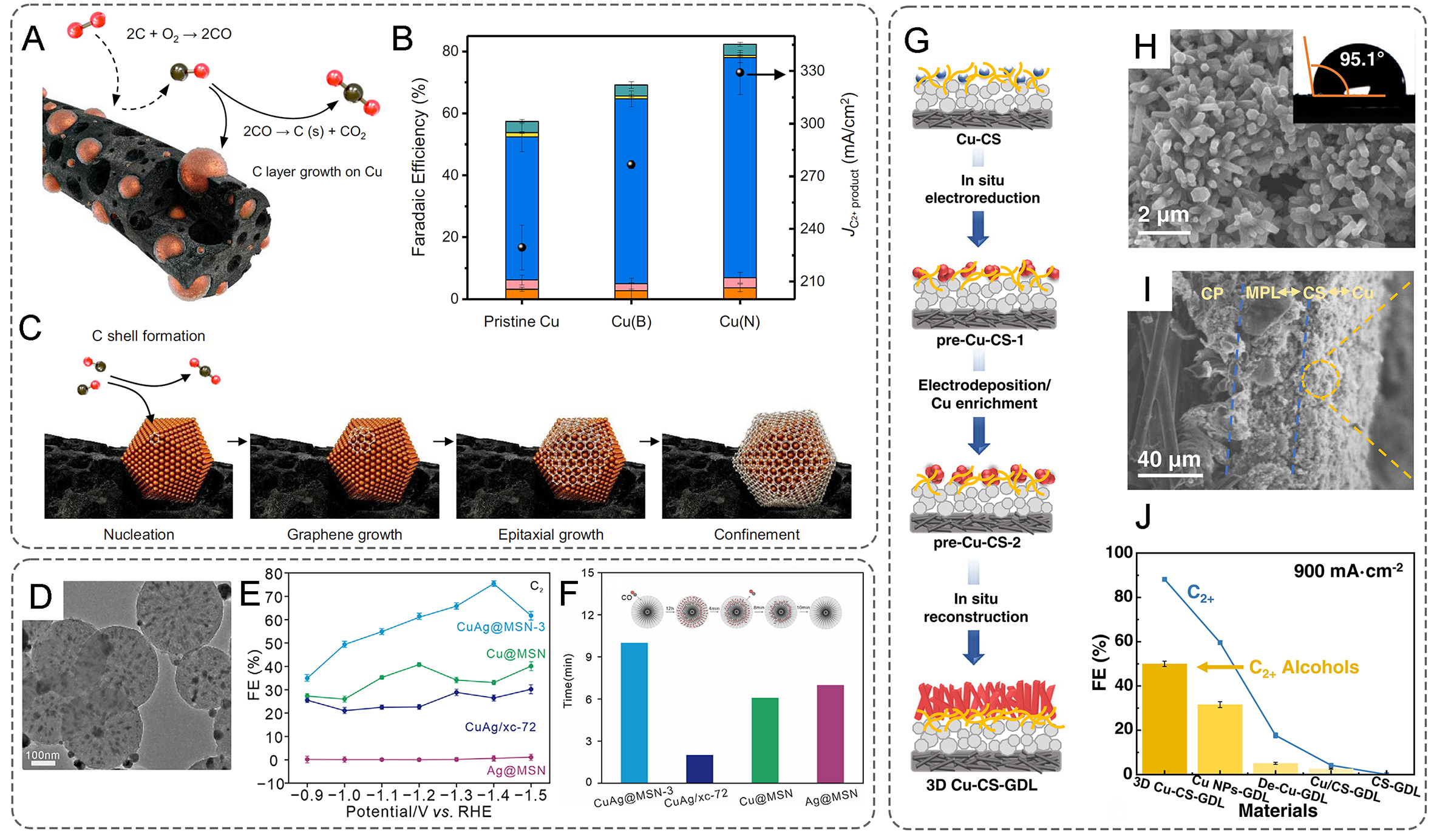
Figure 8. (A) Schematic illustration of the CO-mediated reaction in the Cu-C-O system. The C matrix was nanocarved, forming inner pores by C combustion and generating CO-confined Cu nanoparticles in a quasi-graphitic C shell. The dotted line shows nanocarving, and the solid line shows the Boudouard reaction; (B) FE and partial current density for C2+ products at 400 mA cm-2; (C) Formation mechanism of the quasi-graphitic C shell on Cu nanoparticles through the disproportionation of CO. (A-C) Reproduced with permission[112]. Licensed under CC BY 4.0; (D) The TEM image of the CuAg@MSN sample; (E) The FE of C2 products on CuAg@MSN-3, Cu@MSN, Ag@MSN and CuAg/xc-72 catalysts; (F) The retention times of CO in CuAg@MSN-3, Cu@MSN, Ag@MSN and CuAg/xc-72 catalysts. (D-F) Reproduced with permission[158]. Licensed under CC BY 4.0.; (G) Schematic of the preparation of the 3D Cu-CS-GDL electrode; (H) top-view SEM image and water-contact-angle measurement; (I) cross-sectional SEM image of the 3D Cu-CS-GDL electrode; (J) FEs of C2+ products and C2+ alcohols over different GDEs. (G-J) Reproduced with permission[159]. Licensed under CC BY 4.0. FE: Faradaic efficiency; TEM: Transmission electron microscopy; SEM: Scanning electron microscopy; GDL: Gas diffusion layer.