

Electrochemical-thermal model-driven topology optimization of liquid cooling structures for lithium-ion batteries
 0
Graphical Abstract
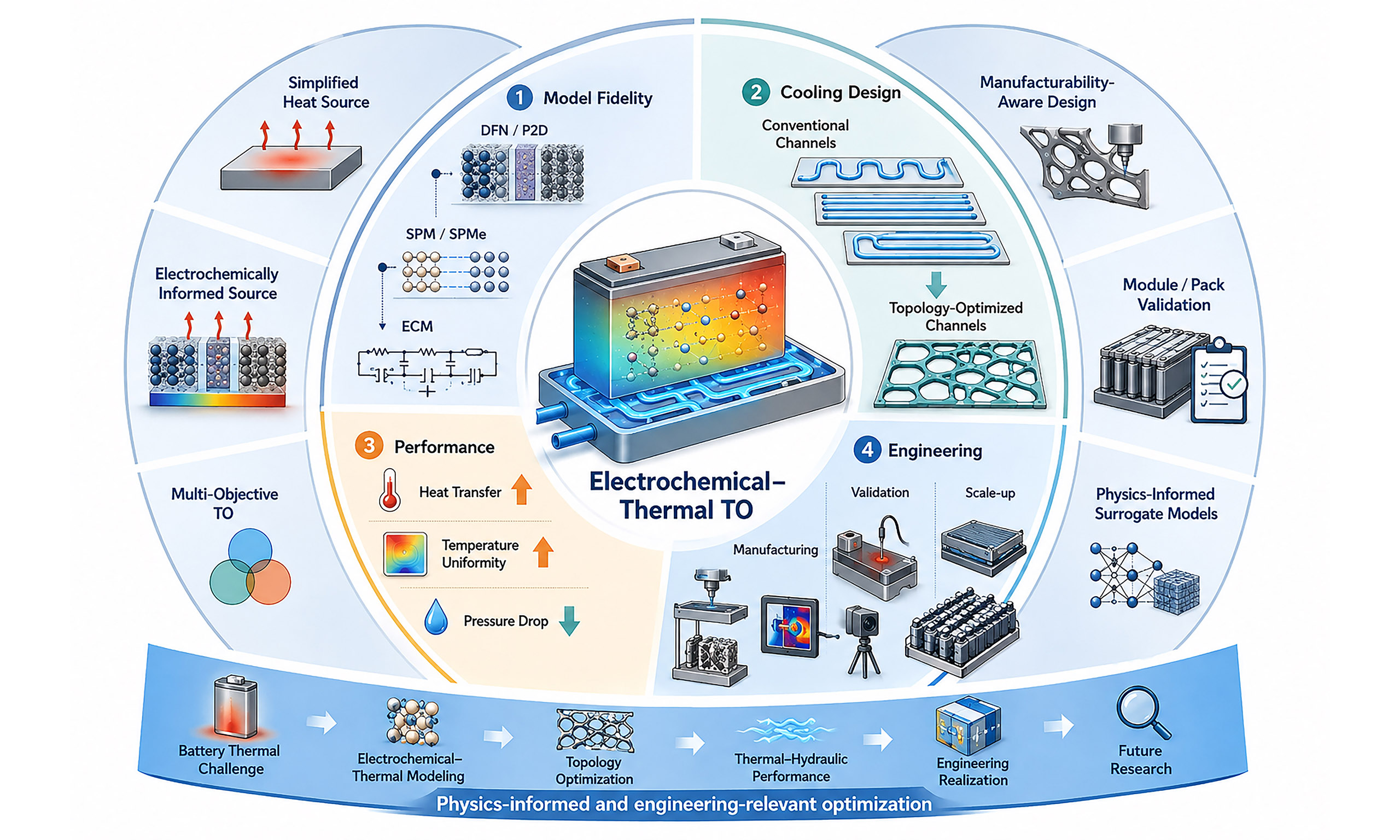
Abstract
Excessive heat generation and non-uniform temperature distributions during high-rate operation can compromise the safety, performance, and lifetime of lithium-ion batteries. Liquid cooling is an important thermal-management strategy for high-power battery systems, while topology optimization (TO) provides greater design freedom to balance heat transfer and hydraulic performance. However, many existing studies still rely on simplified or empirical heat-source models that may not capture the spatiotemporal characteristics of heat generation under varying electrochemical conditions. This review examines electrochemical-thermal model-driven TO of liquid-cooling structures for lithium-ion batteries. This review compares the applicability of pseudo-two-dimensional/Doyle-Fuller-Newman, single-particle, and equivalent-circuit models in terms of modeling fidelity and computational cost. The evolution from parameter and shape optimization to TO is discussed, emphasizing thermal-hydraulic trade-offs, optimization objectives, and engineering constraints. Representative topology-optimized cooling structures are quantitatively compared, where reported, in terms of thermal performance, temperature uniformity, pressure drop, operating conditions, and baseline configurations. Finally, remaining challenges in heat-source fidelity, electrochemical safety constraints, aging-related metrics, validation, manufacturability, and scale-up are identified. Future directions toward physics-informed surrogate models and progressively integrated electrochemical-thermal-fluid optimization are discussed.
Keywords


 Download PDF
INTRODUCTION
Driven by global carbon-neutrality goals and the rapid expansion of new-energy vehicles, grid-scale energy storage, and electric aviation, high-energy-density lithium-ion batteries (LIBs) have become central to modern electrochemical energy storage[1-3]. In electric vehicles (EVs), battery packs largely determine driving range, fast-charging capability, and operational safety[4]. Large-scale energy-storage and electric-propulsion systems impose additional requirements for power density, temperature uniformity, and long-term reliability[5,6]. As battery packs become more compact and power-dense, heat generation during charging and discharging increases. Insufficient heat dissipation can cause local temperature rise, temperature non-uniformity, and, in extreme cases, thermal runaway[7-9]. Battery temperature also affects power output, capacity retention, aging behavior, and cycle life[10,11]. High temperatures accelerate electrolyte decomposition, parasitic reactions, and solid-electrolyte interphase (SEI) growth. Low temperatures increase polarization and suppress lithium-ion diffusion, which can increase the risk of lithium plating and irreversible degradation[12,13]. Temperature gradients within a module can further produce cell-to-cell differences in state of charge (SOC) and internal resistance, compromising pack-level performance and lifetime consistency[14,15]. An effective battery thermal-management system (BTMS) should therefore limit both the maximum cell temperature and temperature gradients within the pack.
Currently, the most widely adopted battery thermal management technologies include air cooling, phase change material (PCM) cooling, heat pipe cooling, and liquid cooling[16-18]. Air cooling features a simple structure and is low-cost but provides limited heat dissipation under high-rate operating conditions. PCM cooling provides high latent heat storage capacity but is limited by its low thermal conductivity and heat accumulation. Heat pipe cooling offers excellent thermal conductivity; however, structural complexity and high manufacturing costs limit its practical application[19-21]. Among these approaches, liquid cooling has emerged as the dominant thermal management strategy for high-power battery packs because of its superior heat-transfer capability, excellent temperature uniformity, and mature engineering applicability[22-24]. For compact battery packs operating under high heat fluxes, liquid cold plates effectively reduce peak temperatures and improve temperature uniformity, attracting considerable research attention. Nevertheless, the thermal performance of a liquid cooling system depends not only on coolant properties and flow conditions but, more importantly, on the internal flow-channel geometry of the cold plate[25]. Different channel configurations directly influence coolant flow distribution, local heat-transfer coefficients, pressure drop, and pumping power consumption. For example, conventional serpentine channels provide excellent heat transfer but incur significant hydraulic resistance, whereas parallel channels exhibit lower pressure losses but are more susceptible to flow maldistribution and localized hot spots. Therefore, achieving an optimal balance among enhanced heat transfer, reduced pressure drop, and uniform temperature distribution has become a central challenge in liquid cold plate design. In recent years, emerging channel configurations, including biomimetic, fractal, and lattice-inspired designs, have accelerated the shift from empirical liquid-cooling design to intelligent optimization[26]. Conventional liquid cold plate design primarily relies on parametric optimization, whereby geometric parameters such as channel width, spacing, and quantity are adjusted to improve thermal performance[27]. However, such approaches are inherently constrained by predefined geometries, limiting design freedom and restricting the exploration of innovative flow-channel topologies[28]. Topology optimization (TO), an advanced computational design methodology that automatically distributes solid and fluid regions within a prescribed design domain, enables the generation of highly efficient flow-channel architectures while satisfying multiple design constraints. This methodology has shown strong potential to enhance heat transfer, reduce pressure loss, and improve temperature uniformity[29,30]. To date, TO has been widely applied to electronic cooling, heat exchanger design, and microchannel thermal management and is increasingly being extended to liquid cold plate design for lithium-ion battery thermal management. Notably, most existing TO studies assume uniform or empirical heat generation models, which fail to accurately capture dynamic heat generation under varying SOC, charge/discharge rates, and operating temperatures[30]. In contrast, electrochemical-thermal coupled models more realistically represent internal electrochemical reactions and spatiotemporal heat generation within LIBs, providing more reliable inputs for liquid-cooling structure optimization[31,32]. Meanwhile, the temperature field reciprocally influences electrochemical reaction kinetics, internal resistance, and degradation behavior. Therefore, an integrated thermo-fluid-electrochemical optimization framework is essential to improve the fidelity and predictive capability of battery thermal management design[33,34].
Motivated by these considerations, this review synthesizes TO for lithium-ion battery liquid-cooling structures from an electrochemical-thermal modeling perspective. Figure 1 summarizes the relationships among electrochemical processes, heat-generation mechanisms, electrochemical-thermal coupling, liquid-cooling design, TO, and battery thermal management. Table 1 compares the scope of representative previous reviews[35-39] with that of the present work, which emphasizes electrochemical-thermal-informed cooling-structure optimization, quantitative thermal-hydraulic comparison, manufacturability, and electrochemical safety. We first compare pseudo-two-dimensional/Doyle-Fuller-Newman (P2D/DFN), single-particle (SPM), and equivalent-circuit (ECM) models in terms of physical fidelity and computational cost, with emphasis on their use as heat-source inputs for cooling-structure optimization. We then examine the evolution from parameter and shape optimization to TO, together with the associated thermal-hydraulic trade-offs, objectives, and engineering constraints. Representative structures are quantitatively compared, where reported, using thermal performance, temperature uniformity, pressure drop, operating conditions, and baseline configurations. Finally, we discuss manufacturability, validation, scale-up, and emerging electrochemical safety and aging constraints, and assess the evidence for progressively integrating electrochemical, thermal, fluidic, and optimization models.
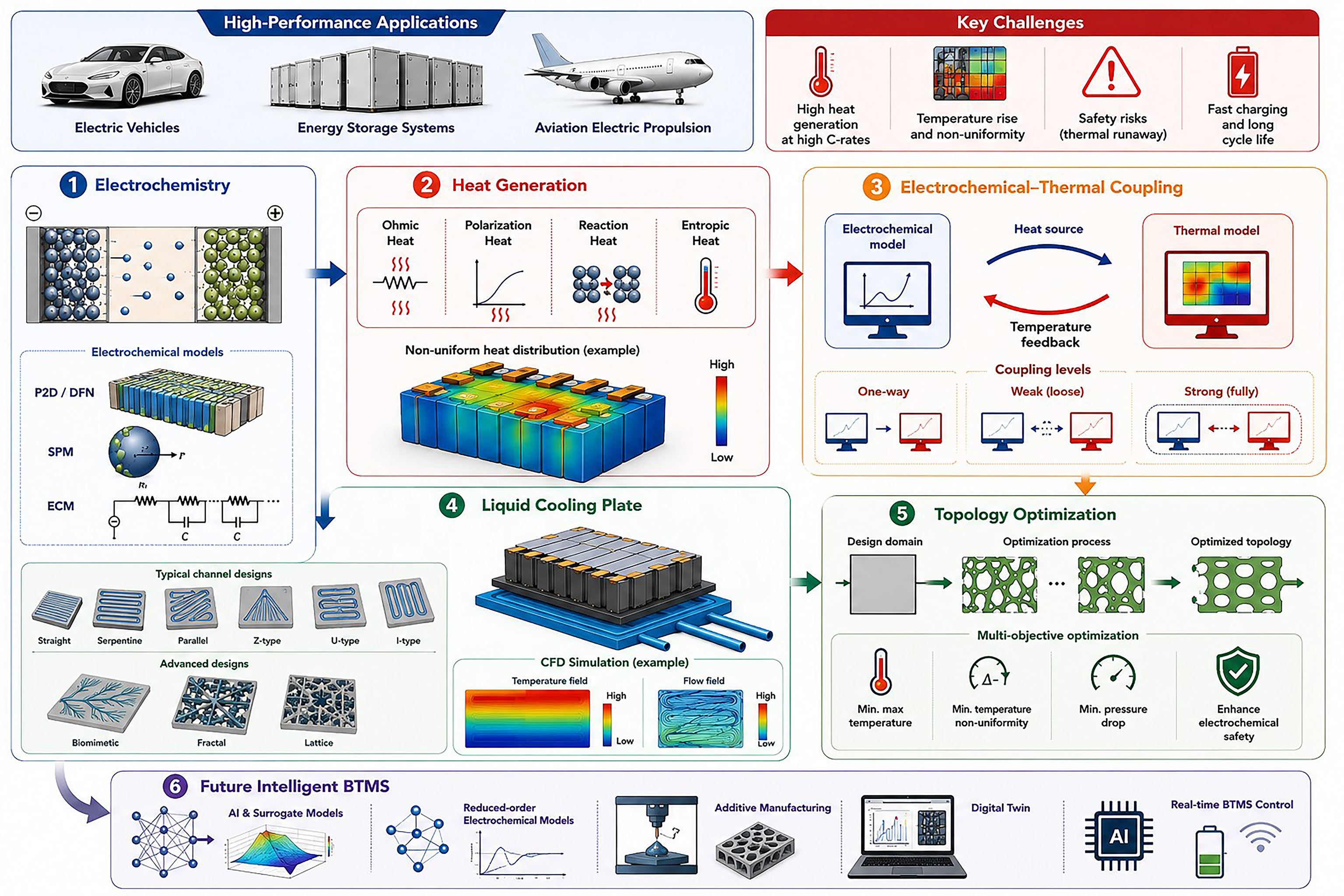
Figure 1. Schematic overview of electrochemical-thermal model-driven topology optimization for lithium-ion battery liquid cooling systems.
Comparison of representative review articles with the present work
| Review | Scope | Optimization method | Main contribution | Limitation/difference of present review |
| Ali (2023)[35] | Electrochemical and thermal models for BTMS | Model comparison and engineering applications | Broad model overview covering thermal runaway and aging | Does not focus on liquid-cooling TO |
| Brosa Planella et al., 2022[36] | Physics-based lithium-ion battery models | DFN/SPM model selection and thermal extensions | Systematic review of electrochemical-thermal model fidelity and cost | No cooling-structure design or TO linkage |
| Chen et al., 2023[37] | TO of battery liquid cooling plates | Thermal-hydraulic TO criteria | TO-centered review of cold-plate design | No systematic electrochemical-thermal or aging linkage |
| Wu et al., 2024[38] | Liquid-cooled BTMS | Channel configuration and system optimization | Comprehensive liquid-cooling review with Tmax, ΔT, Δp comparison | Limited linkage to electrochemical heat-source-driven TO |
| Liu et al., 2026[39] | Immersion cooling for BTMS | Cooling-mode and structural optimization | Immersion-cooling synthesis with safety considerations | Does not address indirect cold-plate TO framework |
| Present review | Electrochemical-thermal-informed liquid-cooling plates | Parameter, shape, and TO | Connects heat-source fidelity, TO objectives, manufacturability, and safety constraints | Evidence remains heterogeneous; several proposed links require future validation |
ELECTROCHEMICAL-THERMAL COUPLED MODELING OF LIBs
Accurate characterization of heat generation during charge-discharge operation, together with the reciprocal influence of temperature on electrochemical performance, is fundamental to high-performance liquid-cooling design for LIBs. This section reviews heat-generation mechanisms and heat-source models, then summarizes widely used electrochemical models and their applicability. It next introduces electrochemical-thermal coupling strategies and discusses the trade-offs among model fidelity, computational cost, and engineering implementation.
Heat generation mechanisms and heat source models
During charging and discharging, LIBs generate heat from electrochemical reactions, charge transport, and mass diffusion. The generated heat is generally classified into four components: ohmic heat, polarization heat, reaction heat, and entropic heat[40]. Ohmic heat arises from resistive losses associated with electron transport through the current collectors and active materials, as well as ionic migration within the electrolyte and separator. Polarization heat originates from activation and concentration polarization during electrochemical reactions at the electrodes. Reaction heat is associated with the enthalpy changes accompanying electrochemical reactions. Entropic heat results from entropy changes during reversible electrochemical reactions, and both its magnitude and sign strongly depend on the SOC and operating temperature[41,42]. For practical engineering analyses, the Bernardi equation is widely employed to estimate the heat generation rate of LIBs. The Bernardi equation accounts for both irreversible and reversible heat generation, and its simplified form is given as follows:
where I denotes the operating current (positive during discharge and negative during charge), U is the terminal voltage, E is the open-circuit voltage (OCV), and T represents the absolute temperature. The model provides reliable predictions of overall heat generation under various C-rates and operating temperatures and has therefore been widely applied in computational fluid dynamics (CFD)-based thermal analyses and liquid cooling structure optimization[43,44].
During low-rate discharge (< 0.5 C), entropic heat can contribute substantially to total heat generation and may be either endothermic or exothermic, depending on SOC. During fast-charging or high-rate discharge, irreversible heat, primarily ohmic and polarization heat, becomes dominant[45]. Heat-generation characteristics also vary across SOC ranges. At high SOC, intensified side reactions and polarization can increase heat generation and thermal-runaway risk[46]. Dynamic, physics-based heat-source models can therefore provide more physically resolved thermal inputs than uniform-heat-source assumptions because they represent operating-condition-dependent contributions and spatially uneven thermal loads[33,45]. Uniform heat-source models remain common in liquid-cold-plate studies because they are computationally efficient, but they cannot capture the spatiotemporal non-uniformity of heat generation within a cell. Electrochemical heat-source models account for the coupled effects of C-rate, temperature, and SOC, providing more informative thermal inputs for TO of liquid-cooling structures[47]. Recent multiscale models, from particle-scale to cell-scale simulations, and experimentally calibrated heat-source models further improve the reliability of thermal inputs for BTMS design[48].
Electrochemical models and their applicability
Electrochemical models constitute the foundation of electrochemical-thermal coupled analysis for LIBs. Depending on model dimensionality and the degree of physical simplification, the most widely adopted electrochemical models include the P2D, also known as the DFN model, the SPM, and the ECM[49,50].
The DFN model is derived from porous-electrode and concentrated-solution theories. It predicts lithium-ion transport in solid particles and the electrolyte, together with Butler-Volmer reaction kinetics at solid-electrolyte interfaces[51]. It can resolve concentration distributions, potential variations, and local heat-generation rates across the electrode thickness[52]. However, the DFN model requires multiple coupled partial differential equations, increasing computational cost and complicating parameter identification. These factors limit its use in large-scale CFD simulations and real-time control. The SPM is a reduced-order representation of the DFN model. It represents each electrode by a single spherical particle and neglects electrolyte diffusion and through-electrode concentration gradients[53]. Under the assumptions of relatively low current density and sufficiently high electrolyte conductivity, this simplification considerably reduces the complexity of the transport problem and computational cost; however, neglecting electrolyte dynamics may limit its accuracy for thick electrodes and high-rate operation[54]. This simplification reduces computational complexity and facilitates coupling with CFD and TO algorithms. Its accuracy decreases under high-rate operation (> 2 C) and in thin-electrode designs, and it cannot resolve spatially non-uniform internal heat generation[55]. Accordingly, the SPM provides an efficient alternative for liquid cold plate optimization when batteries operate under moderate C-rates (< 2 C) and only overall heat generation behavior is of interest[55]. The ECM reproduces the external electrical behavior of a battery using electrical components such as resistors, capacitors, and voltage sources[55]. Its parameters are commonly identified from offline or online tests, such as hybrid pulse power characterization (HPPC). Owing to its computational efficiency, the ECM is widely used for SOC and state of health (SOH) estimation and for real-time thermal management in battery-management systems (BMSs)[56]. However, it lacks explicit electrochemical mechanisms and cannot predict internal heat-generation distributions or temperature-dependent electrochemical behavior. Its applicability to high-fidelity liquid-cold-plate optimization is consequently limited[57]. As illustrated in
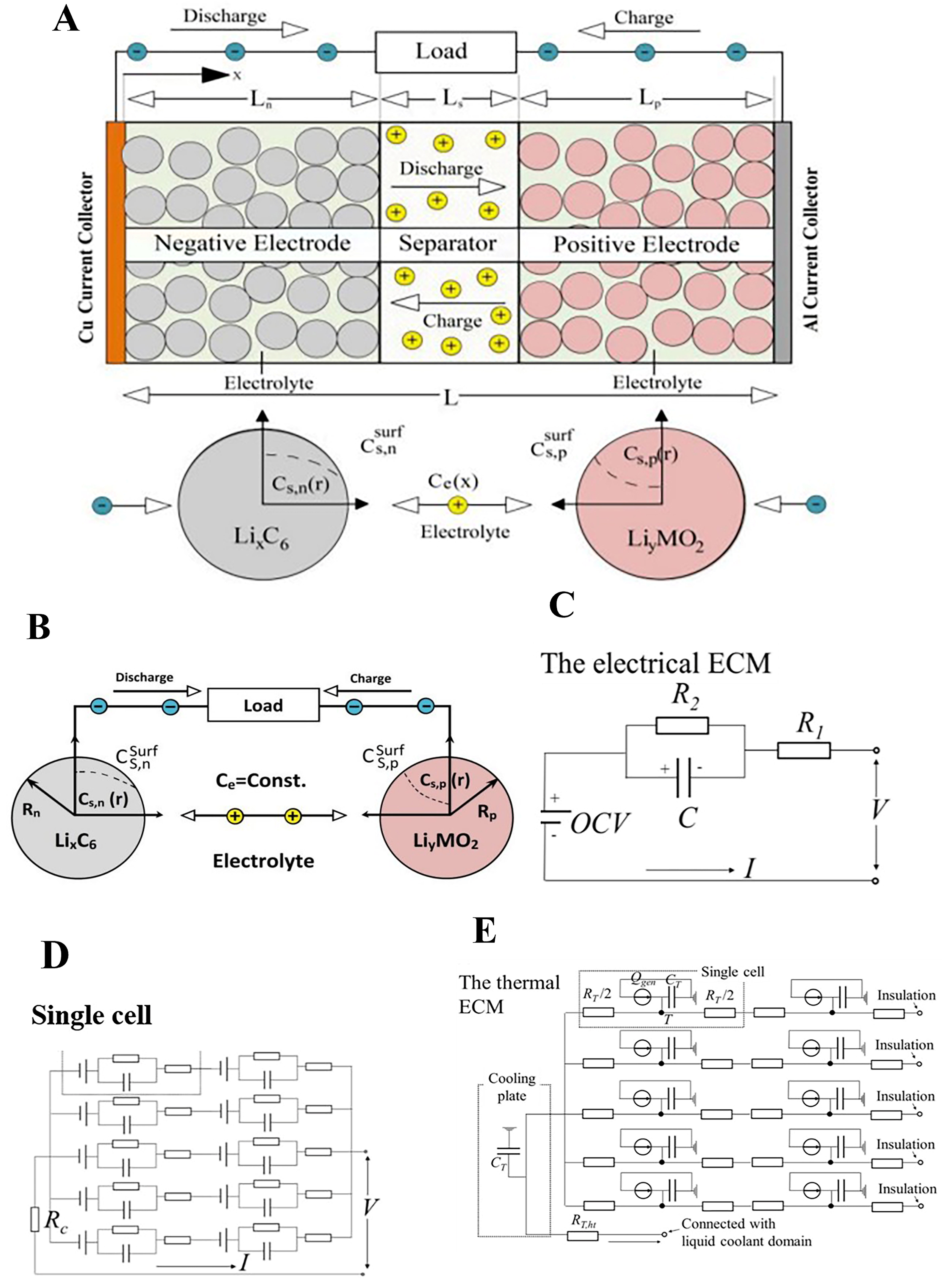
Figure 2. Comparison of electrochemical models for lithium-ion batteries used in electrochemical-thermal coupled simulations. (A) DFN model of lithium-ion batteries, (A) is reprinted with permission from Ref.[54], under the terms of the CC BY 4.0 license. (B) SPM representation of lithium-ion batteries, (B) is reprinted with permission from Ref.[54], under the terms of the CC BY 4.0 license. (C) schematic views of the ECM for a single cell, (D) pack-level electrical ECM constructed from repeated single-cell ECM units, and (E) the pack-level thermal ECM, (C-E) are reprinted with permission from Ref.[58], under the terms of the CC BY 4.0 license. DFN: Doyle-Fuller-Newman; SPM: single-particle model; ECM: equivalent circuit model.
Overall, electrochemical models involve inherent trade-offs among prediction accuracy, computational cost, and engineering applicability. Future research is expected to focus on reduced-order electrochemical models that combine high predictive accuracy with computational efficiency, including surrogate models based on proper orthogonal decomposition and deep neural networks[59].
Electrochemical-thermal coupling methods
Electrochemical-thermal coupled models predict battery operating states by linking electrochemical reactions with the temperature field[60]. In a typical coupling framework[61], the electrochemical model first calculates the spatiotemporal heat generation rate, which is subsequently introduced into the thermal model as a heat source term. The updated temperature field is then returned to the electrochemical model to update temperature-dependent parameters, including reaction-rate constants, solid- and electrolyte-phase diffusion coefficients, electrolyte conductivity, SEI resistance, and OCV. Depending on coupling strength and implementation, electrochemical-thermal models are commonly classified as unidirectional, weakly coupled, or strongly coupled. In unidirectional coupling, heat generation is transferred to the thermal model without temperature feedback[62]. In weak coupling, temperature-dependent parameters are updated at each iteration or time step, while the electrochemical and thermal equations are solved separately. Strong coupling solves the electrochemical and thermal governing equations simultaneously within each time step. Although strong coupling offers the highest physical consistency, it is computationally expensive, particularly under high-rate operation, large temperature gradients, or phase-change conditions[37].
From a spatial-dimensionality perspective, thermal models are generally categorized into three types. Lumped-parameter (0D) thermal models treat the battery as an isothermal body and solve only for its average temperature[63]. Two-dimensional (2D) and three-dimensional (3D) thermal models account for both in-plane and through-thickness heat conduction, enabling accurate prediction of local hot spots and temperature distributions. Consequently, they have become the mainstream choice for CFD analyses of liquid cold plates. Multiscale thermal models simultaneously consider particle-scale heat generation, cell-scale anisotropic heat conduction, and module-scale cooling structures[64]. By integrating multiple spatial scales, these models substantially improve predictive accuracy[65]. With the rapid adoption of high-rate fast-charging technologies, conventional thermal models based on constant or spatially uniform heat generation are no longer sufficient for optimizing liquid cooling structures. Consequently, electrochemical-thermal-fluid multiphysics coupling has emerged as a major research direction for liquid cooling optimization. This framework accurately captures the coupled effects of SOC, C-rate, and temperature on internal heat generation while simultaneously accounting for the influence of flow-channel structures on the temperature field. As a result, it provides a more reliable foundation for the design and TO of high-performance liquid cooling structures[66].
Table 2 summarizes representative electrochemical and electrochemical-thermal modeling studies by comparing the electrochemical model type, thermal model, coupling strategy, validation method, primary applications, and the respective advantages and limitations of each approach. Existing studies have generally sought to balance model accuracy, computational efficiency, and engineering applicability to varying degrees. Among these models, the DFN model offers the highest physical fidelity but at the cost of substantial computational resources. The SPM and single-particle model with electrolyte (SPMe) considerably reduce computational complexity while maintaining satisfactory predictive accuracy, whereas ECMs are widely used in BMSs because of their high computational efficiency. In recent years, driven by the increasing demand for high-rate fast charging and operation under complex working conditions, strongly coupled electrochemical-thermal models and multiphysics coupling approaches have emerged as key research directions for optimizing liquid-cooling structures.
Representative electrochemical and electrochemical-thermal modeling studies for LIBs
| Author (year) | Electrochemical model | Thermal model | Coupling strategy | Validation method | Primary application | Advantages | Limitations |
| He et al., 2018)[67] | Physics-based reduced-order electrochemical model | Not considered | Not applicable | Experimental SOC/voltage validation under a federal driving schedule | Real-time state-of-charge estimation | Projection-based reduction of solid-phase diffusion states | No thermal model; aging-parameter updating not included |
| Brosa Planella et al., 2022[36] | DFN, SPM, SPMe | 0D/1D thermal models | Strong coupling | Comparative analysis of published models | Electrochemical model analysis and electrochemical-thermal coupling | Comprehensive review of electrochemical models and their applicability | Primarily a review study with limited experimental validation |
| Yamanaka et al., 2020[58] | ECM | Thermal ECM | Weak coupling | Battery pack experiments | Battery thermal management and BMS | Simple model structure and fast computation | Unable to predict local internal heat generation |
| Doyle et al., 1993[50] | One-dimensional concentrated-solution porous-electrode model (DFN-type) | Not considered | Not applicable | Model simulation and parametric analysis | Galvanostatic charge/discharge and cell-design analysis | Accounts for solid diffusion, electrolyte transport, reaction kinetics, and variable properties | Isothermal electrochemical scope; film formation and volume changes omitted |
| Santhanagopalan et al., 2006[53] | P2D, SPM, PP | Not considered | Not applicable | Numerical validation against the P2D reference model | Cycling-performance prediction and model-reduction assessment | Compares rigorous and reduced electrochemical models and includes side-reaction-based capacity fade | No thermal or fluid-flow coupling; simplified-model validity is rate-dependent |
| Marquis et al., 2019[55] | SPM, SPMe, asymptotically derived from DFN | Not considered | Not applicable | Numerical benchmarking against DFN and reduced-order models | Asymptotic derivation and validity assessment of reduced-order electrochemical models | Derives an electrolyte correction and quantifies error and applicability | No thermal or degradation model; validity depends on asymptotic operating conditions |
| Hu et al., 2012[56] | ECM | Lumped thermal model | One-way coupling | HPPC-based parameter identification | BMS, SOC/SOH estimation | Efficient parameter identification and low computational cost | Lacks physical mechanisms and cannot predict local hot spots |
| Yang et al., 2019[57] | ECM, DFN | 0D-3D thermal models | Comparative analysis | Literature review | BTMS modeling | Comprehensive summary of thermal models and evaluation metrics | Mainly a review with limited development of new models |
| Liu et al., 2023[62] | Electrochemical model | Three-dimensional thermal model | Strong coupling | Temperature rise experiments | Electrochemical-thermal coupled simulation | Incorporates SOC-dependent dynamic heat generation and improves temperature prediction accuracy | Complex parameter identification and relatively high computational cost |
| Ali (2023)[35] | Multiple electrochemical models | Multidimensional thermal models | Comparative analysis | Literature review | BTMS design | Comprehensive overview of recent thermal modeling approaches and future trends | Focuses on engineering applications with limited implementation details |
Model validation and engineering applications
Systematic experimental validation is indispensable for ensuring the predictive reliability of electrochemical-thermal models. Experimental validation generally focuses on evaluating both the electrochemical and thermal prediction capabilities of the model under representative operating conditions. Common validation approaches include charge-discharge temperature-rise tests, in which batteries are cycled at different C-rates (e.g., 0.5, 1, 2, and 3 C) under controlled ambient conditions in a climatic chamber[35]. Surface temperatures at multiple locations are simultaneously measured using thermocouples or infrared thermal imaging to evaluate the battery's thermal response[35]. HPPC tests are widely employed to identify key parameters, including internal resistance and OCV under different SOC and temperatures, thereby facilitating the calibration of electrochemical and ECMs[68]. Internal temperature measurements are obtained either by embedding thermocouples within the battery (which requires destructive modification) or by using fiber Bragg grating sensors to characterize the internal temperature distribution, thereby validating the model's capability to predict localized temperature evolution[69]. Dynamic operating-condition validation typically uses standardized driving cycles, such as the urban dynamometer driving schedule and the worldwide harmonized light vehicles test procedure, to assess the accuracy of model predictions for transient voltage and temperature responses[70]. Common validation metrics include the root mean square error of voltage prediction, maximum and mean temperature errors, peak temperature, maximum temperature difference, and thermal response time[71]. For liquid-cooling plate design, accurate prediction of temperature uniformity and hotspot locations is particularly important. Errors in hotspot prediction may lead to suboptimal cooling configurations, thereby compromising the effectiveness of structural optimization[72].
Although high-fidelity electrochemical-thermal models, such as DFN models coupled with three-dimensional thermal models, provide superior predictive accuracy, their substantial computational cost limits their application to large-scale battery packs and real-time control[73]. A widely adopted strategy is to use high-fidelity models to generate offline datasets, which are subsequently employed to train reduced-order models (ROMs) or surrogate models. These lightweight models can subsequently be integrated into liquid-cooling plate optimization frameworks or BMSs to enable efficient real-time implementation[74,75]. Furthermore, advances in computational hardware, particularly graphics processing unit acceleration, together with the development of efficient parallel algorithms, are expected to enable rapid electrochemical-thermal-fluid coupled simulations in the near future[76,77].
Overall, the development of high-fidelity yet computationally efficient electrochemical-thermal models provides a solid foundation for TO of liquid cooling structures, where repeated multiphysics simulations are required during the optimization process.
LIQUID-COOLING STRUCTURE DESIGN AND THERMAL MANAGEMENT PERFORMANCE EVALUATION
LIBs generate substantial heat during high-rate operation and pack-level use. If this heat is not dissipated promptly, the maximum temperature may increase, local heat accumulation and non-uniform temperature distributions may develop, and performance degradation, lifetime loss, and thermal-safety risks may increase[78]. Because liquid working fluids provide strong heat-transfer capability and allow flexible design of flow rates, channels, and cold-plate structures, liquid-cooling systems have become an important technical route for battery thermal management in new-energy vehicles and energy-storage systems[38,79]. However, their performance depends not only on the coolant but also on the cooling mode, cold-plate arrangement, channel geometry, flow distribution, and thermo-fluid coupled evaluation method[38,64]. Therefore, before discussing optimization methods for liquid-cooling structures, it is necessary to review the main types and operating principles of liquid-cooling systems, compare the thermal-management performance of different liquid cold-plate channel structures, and analyze CFD modeling methods and evaluation metrics. This review provides a basis for subsequent studies on liquid cold-plate structural optimization and TO.
Types and operating principles of liquid-cooling systems
As LIBs for new energy vehicles and energy-storage systems move toward high energy density, fast charging/high-rate operation, and highly integrated pack-level applications, heat accumulation and temperature non-uniformity during operation have become increasingly prominent. Battery thermal management systems must limit the maximum temperature while also accounting for module-level temperature uniformity and thermal safety, thereby reducing intensified side reactions, performance degradation, and thermal-runaway risks under high-temperature conditions[78]. Compared with air cooling, liquid-cooling systems offer higher convective heat-transfer capability and heat capacity, enabling more effective temperature control and improved temperature uniformity under high thermal loads[80]. Their flow rates, channels, and cold-plate structures also provide substantial design flexibility[38]. Bianco et al.[79] compared natural air convection, forced air cooling, direct liquid cooling, indirect liquid cooling, PCM-based cooling, and topology-optimized cold plates, demonstrating marked differences in maximum temperature, temperature uniformity, and overall cooling effectiveness. Thus, liquid cooling should not be regarded as a single technical route. Its performance depends strongly on coolant-battery contact, heat-transfer structure, cold-plate channel layout, and coupling with passive thermal-control materials.
As shown in Figure 3, liquid-cooling systems can be interpreted from several perspectives, including contact mode, system coupling, heat-transfer phase state, and structural design method. Representative configurations include complete-immersion single-phase cooling under static-flow and forced-flow conditions summarized by Roe et al.[81]; an indirect-contact 6S2P battery module with alternating battery cells and cooling plates reported by Park et al.[82]; a hybrid liquid-cooling system in which batteries and liquid-cooling tubes are integrated within a composite phase change material (CPCM) module reported by
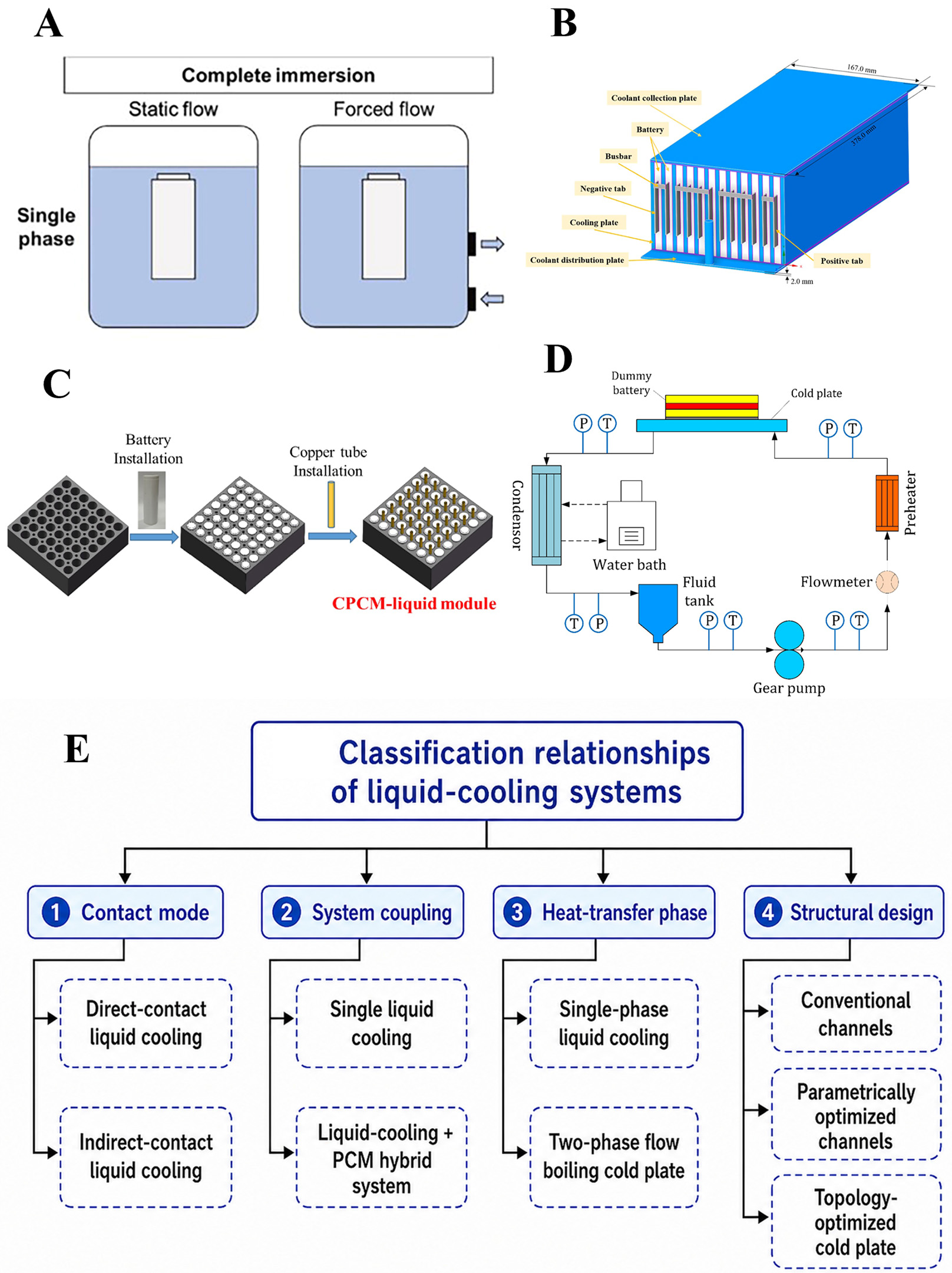
Figure 3. Representative liquid-cooling configurations and classification relationships for lithium-ion batteries. (A) Complete-immersion single-phase cooling under static-flow and forced-flow conditions; (A) is reprinted with permission from Ref.[81], under the terms of the CC BY 4.0 license. (B) indirect-contact cold-plate cooling with an alternating battery-cell/cold-plate arrangement; (B) is reprinted with permission from Ref.[82], under the terms of the CC BY 4.0 license. (C) hybrid CPCM-liquid cooling battery thermal management system; (C) is reprinted with permission from Ref.[83], under the terms of the CC BY 4.0 license. (D) pumped two-phase battery cooling system with flow boiling in the cold plate; (D) is reprinted with permission from Ref.[84], under the terms of the CC BY 4.0 license. (E) multidimensional classification relationships of liquid-cooling systems. CPCM: Composite phase change material.
According to the coolant-battery contact relationship, liquid-cooling systems are commonly classified as direct-contact or indirect-contact systems. Direct-contact liquid cooling is typically represented by immersion cooling, in which batteries are immersed directly in a non-conductive dielectric coolant so that heat is exchanged directly between the coolant and the battery surface[39]. Similarly, Bianco et al.[79] defined direct liquid cooling as a method in which the coolant directly contacts the battery surface without an intermediate medium such as a cold plate. Compared with indirect liquid cooling through cold plates, cooling tubes, or other intermediate structures, immersion cooling reduces intermediate heat-transfer steps, thereby lowering contact thermal resistance and improving temperature uniformity[39]. Nevertheless, this approach requires electrically insulating dielectric coolants and must address engineering constraints related to coolant properties, sealing reliability, circulation maintenance, environmental impact, and system cost[39].
Indirect-contact liquid cooling separates the coolant from the battery through heat-transfer structures such as liquid cold plates, cooling tubes, or cooling channels. Heat generated by the battery is conducted through the battery-cold-plate interface and the cold-plate substrate to the channel wall, where convective heat transfer removes it to the coolant. Because it provides electrical safety isolation and structural design flexibility, cold-plate liquid cooling has become a common engineering solution for battery-pack thermal management[38]. For instance, Lin et al.[64] developed an electrochemical-hydrodynamic-thermal coupled model for a 280 Ah prismatic energy-storage battery and combined cold-plate topology design with evaluations of temperature control, temperature uniformity, and flow resistance. Their results show that cold-plate performance depends on balancing heat-dissipation capability against flow-resistance penalties.
Beyond contact-mode classification, liquid-cooling systems can be coupled with phase-change materials or other passive thermal-control structures to form hybrid thermal management systems. Phase-change materials absorb heat generated during battery operation through latent heat, thereby buffering short-term temperature rise and improving local temperature distribution. However, many PCMs have limited thermal conductivity and may leak or deform after phase transition. When PCM is coupled with liquid cooling, the liquid-cooling loop can further remove the heat absorbed by the PCM, providing a secondary heat-removal pathway for continuous heat dissipation[80]. Sun et al.[85] proposed a hybrid battery thermal management system that couples active liquid cooling with passive materials such as expanded graphite-paraffin composite material (EG-PCM) and copper foam, and applied it to temperature regulation under normal conditions and to propagation suppression during thermal runaway. Therefore, liquid-cooling/PCM hybrid systems are more appropriately regarded as composite thermal management schemes that combine passive thermal buffering with active heat removal, rather than as a contact-mode category parallel to direct and indirect liquid cooling.
In recent years, researchers have investigated two-phase flow boiling cold plates as an enhanced cooling approach under high thermal loads. Unlike conventional single-phase water/ethylene glycol cold plates, which primarily rely on sensible heat transfer, two-phase flow boiling cold plates use refrigerants that undergo phase change under saturated or boiling conditions, thereby increasing heat-removal capacity through the latent heat of vaporization and improving battery temperature uniformity[86]. Ba et al.[86] proposed a topology-optimization framework for two-phase flow boiling cold plates in lithium-ion battery thermal management. Their framework combines a phase-change heat-transfer model with channel topology design to improve refrigerant flow distribution and reduce local dryout and overheating risks. However, these cold plates involve gas-liquid phase distribution, non-uniform flow and heat transfer, and dryout suppression. Consequently, their design and modeling are more complex than those of conventional single-phase liquid-cooling systems, and their engineering applicability requires further experimental and system-level validation[86].
In summary, direct liquid cooling emphasizes direct heat exchange between the coolant and the battery surface, whereas indirect cold-plate liquid cooling offers electrical safety isolation, structural design flexibility, and a strong basis for engineering integration. Liquid-cooling/PCM hybrid systems mainly represent the coupling of active liquid cooling with passive thermal-buffer materials, while two-phase flow boiling cold plates are a phase-change-enhanced cooling approach for high-thermal-load conditions[85,86]. Current studies suggest that topology-optimized cold plates should be understood as a structural optimization method for cold-plate channels and solid-liquid distributions, rather than as a new cooling-medium route distinct from direct, indirect, or two-phase cooling[79]. This method has been applied to single-phase indirect cold-plate design[64] and introduced into exploratory designs of two-phase boiling cold plates[86]. Given the clear geometric designability and engineering maturity of indirect cold-plate liquid cooling, the following section discusses liquid cold-plate channel structures and their thermo-fluid performance differences.
Liquid cold-plate channel structures and performance comparison
The cooling performance of a liquid cold plate depends not only on coolant properties and inlet flow rate but also on the internal channel structure. In indirect cold-plate liquid cooling, battery heat is typically transferred through the battery-cold-plate interface and cold-plate substrate to the coolant flowing in the channels. Thus, channel geometry affects heat-transfer area, coolant distribution, pressure loss, and pumping-power demand[38]. Chen et al.[87] compared rectangular channels, serpentine channels, and topology-optimized cold plates and showed that channel structure strongly influences battery temperature distribution, temperature difference, heat-transfer coefficient, and flow resistance. Guo et al.[88] further investigated a topology-optimized mini-channel cold plate using a three-dimensional electrochemical-thermal coupled model and compared the effects of cold-plate type, channel depth, and mass flow rate on cooling performance. These studies indicate that liquid cold-plate channel design should balance temperature control, temperature uniformity, and hydraulic cost rather than simply maximizing heat-transfer enhancement.
Regular channels commonly used in conventional liquid cold plates include straight-through, parallel, serpentine, and U- or Z-shaped configurations associated with inlet and outlet arrangements. Straight-through channels have short flow paths and simple structures, and are often used as conventional baselines for comparison with optimized designs[87]. However, their temperature uniformity also depends on cold-plate area, heat-source distribution, and coolant-flow conditions; therefore, geometry alone cannot determine performance. Parallel or multi-channel structures distribute coolant through multiple branches, and their thermo-fluid performance is sensitive to the mass-flow distribution among channels[89]. Sevilgen et al.[90] experimentally and numerically investigated multi-channel, serpentine, and bottom cold plates for an electric-vehicle battery module, providing a direct comparison of representative conventional cold-plate configurations. Karthik et al.[89] combined CFD, response-surface methodology, and multi-objective genetic algorithm (MOGA) optimization for multi-channel liquid cold plates and showed that different mass-flow combinations affect maximum temperature, maximum pressure, and pumping-power consumption. Thus, multi-channel structures must be evaluated together with flow-distribution and power-consumption constraints. Manifold-parallel combined channels further regulate coolant distribution through supply and collection manifolds. Sui et al.[91] developed a hybrid manifold cold-plate model for a 280 Ah battery pack and performed multi-objective optimization using parallel-channel width, manifold width, channel height, and inlet velocity as design variables, with pressure drop, cold-plate temperature difference, and module temperature difference as responses. Their findings indicate that channel geometry and inlet parameters should be jointly determined to balance temperature control and flow resistance. Serpentine channels are also widely used in battery cold plates. Their curved paths extend coolant residence and heat-transfer processes, but may increase local flow resistance and pressure loss[38,87]. Wang et al.[92] used a straight-channel cold plate and the GM Volt EV serpentine cold plate as baselines in a multi-objective topology-optimization study. The results showed that the conventional serpentine structure can still perform well in some thermal-control metrics; therefore, topology-optimized structures should not be assumed to outperform conventional channels in every individual metric. U-turn, U-shaped, and Z-shaped inlet/outlet arrangements mainly affect coolant distribution by changing inlet/outlet locations and flow organization, and their performance should be assessed with the specific geometry, inlet flow rate, and heat-source distribution[38].
Branched channels and streamlined mini-channels have been developed from regular channels to mitigate the trade-off between heat-transfer enhancement and pressure-drop reduction. Branched structures distribute coolant from a main channel to multilevel branches, improving coolant distribution within the cold plate. Streamlined mini-channels reduce sharp corners, abrupt transitions, and local flow separation, producing smoother pressure and velocity fields[93]. Wu et al.[93] used multi-objective TO to design an aluminum cold plate with branched and streamlined mini-channels and compared it with a conventional straight parallel mini-channel cold plate. The optimized structure increased the heat-transfer coefficient and Nusselt number (Nu) while reducing pressure loss and pumping-power demand. Lin et al.[64] similarly found that, for a 280 Ah prismatic energy-storage battery, the topology-optimized cold plate evolved from long inlet/outlet channels into secondary and tertiary branches toward the center. This root-like branched structure improves coolant distribution, expands the convective heat-transfer area, and promotes heat transfer between the battery and the coolant.
Biomimetic channels draw further inspiration from the branching and fractal-like characteristics of natural transport networks. Yang et al.[94] investigated a leaf-vein-structure liquid-cooling system for power batteries using a biomimetic cold-plate configuration inspired by a fir-leaf vein structure. Zhan et al.[95] proposed a biomimetic liquid cold plate initialized with a leaf-vein-shaped channel and performed TO to maximize heat transfer and minimize fluid dissipation. Their results showed that the leaf-vein configuration helps generate a channel structure that balances heat-transfer performance and flow resistance, and the optimized structure was validated experimentally[95]. Han et al.[96] introduced fractal geometry into liquid cold-plate TO by adding fractal-dimension-related design freedom within a density-method framework to better characterize the heat-transfer area. The results showed that fractal geometry can increase heat-transfer area, enhance flow disturbance, and reduce cold-plate temperature. However, increased structural complexity also causes larger pressure drops and greater manufacturing challenges[96]. Therefore, biomimetic and fractal channels improve transport organization, flow disturbance, and heat-transfer organization, but their application requires trade-offs among heat-transfer enhancement, pressure loss, and manufacturing complexity[95,96].
Topology-optimization-generated channels further overcome the constraints of predefined geometries. Unlike regular channels such as straight-through, serpentine, or U/Z-shaped configurations, TO determines the distribution of fluid and solid regions within a prescribed design domain under specified objectives and constraints. It can therefore generate channel structures tailored to particular evaluation targets[87,97].
In summary, liquid cold-plate channel structures fall into three categories: regular geometries, improved/biomimetic networks, and algorithm-generated structures. Conventional regular channels rely mainly on geometric experience and parameter adjustment for engineering applicability. Straight-through channels often serve as simple structural baselines; parallel or multi-channel structures require attention to flow-rate distribution and power-consumption constraints; serpentine structures may provide strong heat-transfer capability but also introduce flow resistance; and U- or Z-shaped inlet/outlet arrangements must be evaluated under specific geometries and operating conditions. Improved and biomimetic channels enhance flow organization and heat-transfer processes through branching, streamlining, and fractal-like features, whereas topology-optimized channels integrate thermal performance, flow resistance, and structural constraints into a unified optimization problem. Therefore, comparisons among channel structures must be tied to operating conditions, boundary conditions, and evaluation metrics. The following discussion of numerical modeling methods and thermo-fluid performance indicators is organized around this multi-objective evaluation logic[38,97-99].
As shown in Figure 4, representative liquid cold-plate channels include conventional parallel multi-channel and serpentine configurations, leaf-vein-type biomimetic configurations, and topology-optimized configurations generated under different thermal-hydraulic objective weightings. These configurations differ in flow path, heat-transfer area, flow distribution, and local flow resistance. Therefore, their thermo-fluid performance should be compared under defined boundary conditions and evaluation metrics.
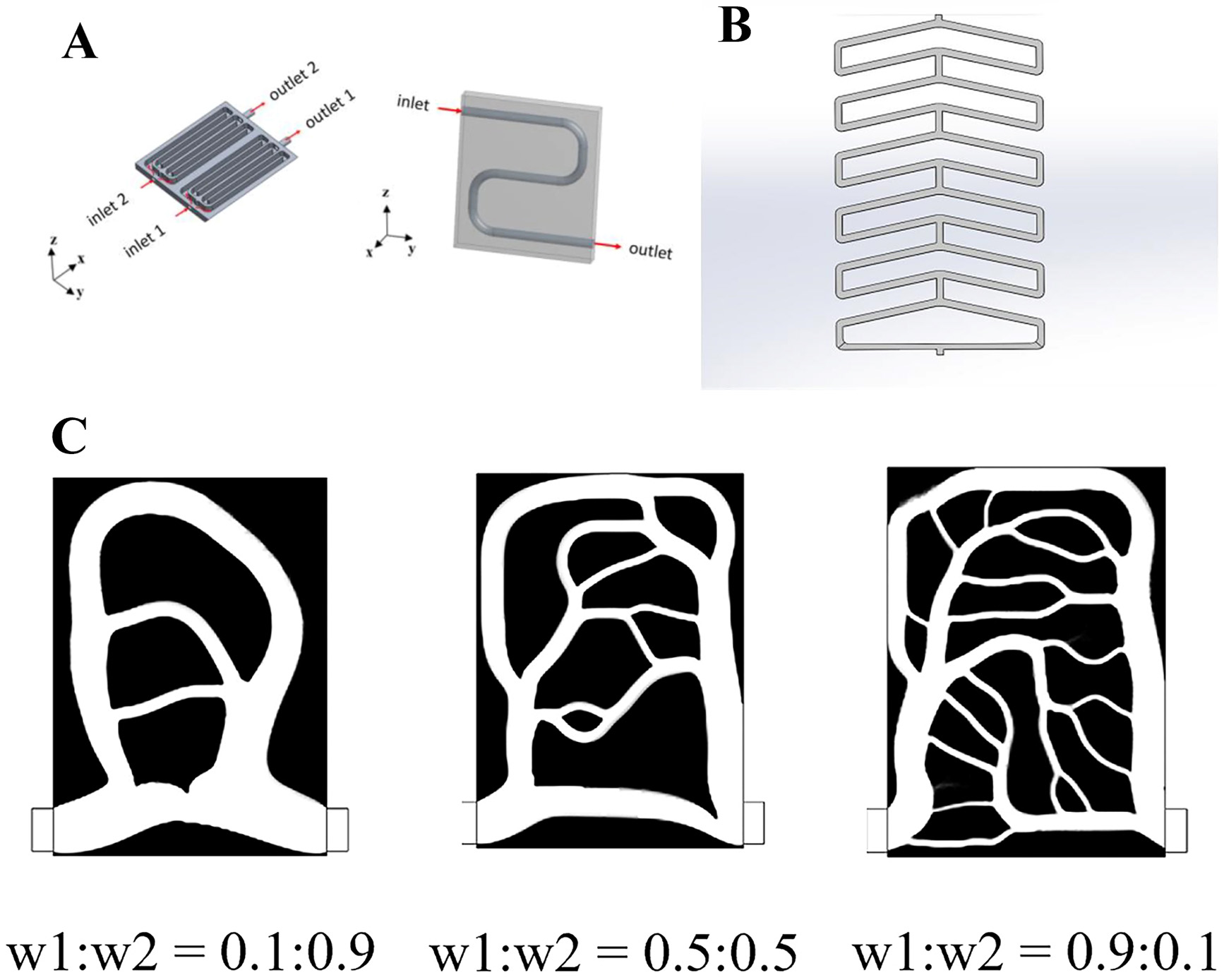
Figure 4. Representative liquid cold-plate channel configurations. (A) Parallel multi-channel and serpentine cold-plate configurations; (A) is reprinted with permission from Ref.[90], under the terms of the CC BY 4.0 license. (B) leaf-vein-type biomimetic liquid cold plate; (B) is reprinted with permission from Ref.[94], under the terms of the CC BY 4.0 license. (C) topology-optimized cold-plate layouts under different thermal-hydraulic objective weightings; (C) is reprinted with permission from Ref.[92], under the terms of the CC BY 4.0 license.
CFD modeling methods and evaluation metrics
In liquid cold-plate studies, CFD and thermo-fluid coupled numerical simulations are used not only to visualize temperature fields but also to describe battery heat generation, heat conduction in the cold plate, coolant flow, and convective heat transfer within a unified model. They also enable evaluation of pressure loss and hydraulic cost. Chen et al.[87] numerically compared rectangular channels, serpentine channels, and topology-optimized cold plates and showed that channel structure affects battery temperature distribution, temperature difference, heat-transfer coefficient, and flow resistance. Karthik et al.[89] combined CFD with response-surface methodology and a MOGA to analyze how mass-flow distribution affects maximum temperature, pressure, and pumping-power demand in multi-channel liquid cold plates. Therefore, CFD is an important thermo-fluid evaluation tool for comparing and optimizing liquid cold-plate structures[38].
Regarding geometry and physical domains, CFD models of liquid cold plates usually include the battery, cold-plate solid, and coolant regions in the channels. Depending on the research object, they may also include thermal interface materials, housings, or module structures. Single-cell or single-cold-plate models usually focus on how channel structure, inlet conditions, and cold-plate geometry affect local heat transfer and flow resistance. Module-level models must additionally consider battery arrangement, cold-plate placement, inlet/outlet positions, and thermal coupling among cells. Lin et al.[64] developed an electrochemical-hydrodynamic-thermal coupled model for a 280 Ah prismatic energy-storage battery to evaluate the combined effects of cold-plate structure on heat-dissipation capability, temperature uniformity, and flow resistance. Wu et al.[93] calculated velocity, temperature, and pressure fields for a lithium-ion battery module and compared branched/streamlined mini-channels with conventional channels. Thus, model scale affects the applicability of CFD conclusions: cold-plate-level models facilitate comparison of channel geometries, whereas module-level models better capture battery arrangement, thermal coupling, and flow distribution.
Boundary conditions and heat-source settings are critical to CFD result reliability. Common heat-source treatments in liquid cold-plate studies include constant heat flux or constant volumetric heat generation, operating-condition-based battery heat generation, and heat sources calculated using electrochemical-thermal coupled models. Constant heat sources facilitate comparison among channel structures under identical inputs, but they cannot adequately describe changes in battery heat generation with the discharge process, temperature feedback, or spatial position. By contrast, electrochemical-thermal coupled heat sources can represent heat-generation evolution during battery operation in greater detail, although they require more parameters and higher computational cost. Wang et al.[98] used an electrochemical-thermal coupled model to simulate battery heat generation when comparing laminar and turbulent cold plates, thereby avoiding full dependence on constant empirical heat sources. Guibert et al.[47] coupled a DFN electrochemical-model surrogate with flow and heat-transfer models and compared temperature-dependent and constant heat sources, showing that heat-source fidelity affects CFD and topology-optimization evaluations of liquid cold plates. In addition, Wang et al.[97] showed that objective-function selection changes optimized channel morphology and performance conclusions.
Mesh generation and mesh-independence verification also determine the reliability of CFD outputs. In liquid cold plates, velocity, pressure, and temperature gradients are often large near narrow channels, branch junctions, sharp turns, and solid-liquid interfaces. Complex channel models therefore require careful control of local mesh quality and convergence of key indicators. Chen et al.[87] performed mesh-independence analysis when comparing rectangular channels, serpentine channels, and topology-optimized cold plates, using average battery temperature as the criterion. Wu et al.[93] verified the accuracy of a module-level CFD model through mesh-independence testing based on changes in average battery temperature with increasing mesh count. Han et al.[96] further noted that complex topological structures in fractal-geometry-enhanced cold plates require more mesh elements to ensure computational accuracy, and they used objective-function deviation as the mesh-independence criterion. Deng et al.[99] also showed experimentally that complex channels require consideration of channel scale, manufacturability, and validation, rather than reliance on numerical results alone. Therefore, mesh counts should not be compared directly across studies; instead, the key issue is whether convergence was verified for the relevant research object and output indicators.
For flow modeling, select laminar or turbulent assumptions based on channel scale, flow velocity, and Reynolds-number range. Many battery liquid cold plates operate in laminar or low-Reynolds-number regimes because their channels are small and flow rates are constrained by pumping-power requirements. Under high-flow-rate or enhanced heat-transfer conditions, however, turbulence models may better capture flow mixing, vortex structures, and pressure loss. Wang et al.[98] compared topology-optimized cold plates generated using laminar and k-ε turbulence models and showed that the assumed flow regime affects the generated structure, velocity field, temperature field, pumping power, and PEC-based thermo-hydraulic performance. Conjugate heat transfer is also important for cold-plate liquid cooling because heat conduction in the solid cold plate and convective heat transfer in the coolant must be modeled simultaneously.
Regarding evaluation metrics, maximum temperature (Tmax) directly indicates the battery thermal-safety boundary and hotspot suppression capability. However, Tmax alone may overlook the overall temperature distribution and temperature consistency. Metrics such as maximum temperature difference, ΔT, temperature variance, and temperature standard deviation are appropriate for assessing temperature uniformity and can reflect cell consistency and local aging risks[38]. The average temperature, Tavg, indicates the overall heat-dissipation level but may mask local hotspots; it should therefore be analyzed together with maximum temperature, temperature distribution, or temperature-difference metrics[92]. Pressure drop, Δp, and pumping power quantify the hydraulic cost of a liquid-cooling system and are useful for comparing the energy requirements of different channel structures. For complex channels with branches, sharp bends, serpentine paths, or topology-optimized layouts, temperature reduction alone is insufficient to demonstrate engineering applicability; pressure loss and pumping power must also be evaluated[89,93]. The heat-transfer coefficient and Nu characterize convective heat-transfer enhancement, while PEC and other comprehensive thermo-fluid indicators account for both heat-transfer enhancement and flow-resistance variation, making them suitable for ranking multiple structures and operating conditions[96,98]. Thermal resistance may also be used as an equivalent heat-transfer-capacity metric under specific model definitions, but its definition and applicability vary across studies and should be interpreted in context[92].
In summary, CFD modeling provides a unified thermo-fluid evaluation platform for comparing liquid cold-plate structures, but its conclusions depend on geometric scale, heat-source model, boundary conditions, mesh quality, flow-regime assumptions, and evaluation metrics. Geometry and physical-domain settings determine whether the model captures heat-transfer paths among the battery, cold plate, channels, coolant, and interfaces. Heat-source settings determine the physical fidelity of the temperature-field input. Boundary conditions and mesh-independence verification affect comparability among structures. Laminar, turbulent, conjugate heat-transfer, and two-phase flow models correspond to different cooling conditions and levels of modeling complexity. For conventional regular channels, CFD is mainly used to compare temperature and pressure drop under different geometries[87]. For biomimetic and topology-optimized channels, CFD is further integrated with optimization algorithms to evaluate objective functions and to assess the thermo-fluid performance of the resulting structures[93]. Thus, reliable CFD evaluation of liquid cold plates depends on coordinated choices of physical domain, heat source, boundary conditions, mesh, flow-regime assumption, and metric system. Liquid cold-plate optimization likewise requires a comprehensive balance among thermal safety, temperature uniformity, and flow energy consumption.
TO METHODS FOR LIQUID-COOLING STRUCTURES
Evolution of liquid-cooling structure optimization methods
Optimization of liquid-cooling structures can be classified into parameter optimization, shape optimization, and TO by design variables. Parameter optimization adjusts geometric or operating variables within a predefined channel architecture, shape optimization modifies boundaries while preserving connectivity, and TO allows the distribution and connectivity of fluid and solid regions to evolve within a prescribed domain[28,30,100]. This progression increases design freedom from local adjustment to network reconstruction, but also increases the search space and the importance of numerical regularization, manufacturability, and post-processing. Therefore, these methods should be regarded as complementary rather than as an automatic hierarchy of engineering superiority.
Parameter optimization is attractive when a mature channel architecture is available and rapid engineering screening is required. Typical variables include channel width, height, number, spacing, inlet and outlet location, and coolant flow rate. Response surface methodology (RSM), design of experiments, surrogate models, genetic algorithms, and particle swarm optimization can be used to explore thermal-hydraulic trade-offs without changing channel connectivity[89,101]. Because the design variables remain tied to an established channel architecture, they are generally easier to interpret and implement than variables in fully free TO. This makes parameter optimization suitable for established layouts such as serpentine, parallel, and Z/U-shaped channels[22,28,101]. However, its solution remains restricted to the predefined design space and cannot introduce new branches, remove unfavorable connections, or reorganize the overall coolant-distribution network.
Shape optimization provides an intermediate approach by modifying channel boundaries, control points, or inlet/outlet geometry while retaining the original connectivity. It can improve local flow distribution, heat-transfer area, and pressure-loss characteristics, and adjoint-based methods can efficiently handle many boundary variables[102,103]. However, its performance remains dependent on the initial geometry and boundary parameterization, while mesh deformation, remeshing, step size, and gradient accuracy can affect numerical robustness. Thus, shape optimization is most suitable when the basic channel network is credible, but local geometric deficiencies require refinement.
TO offers the greatest design freedom by allowing new branches, flow passages, and heat-conduction paths to emerge within the design domain[28,30,100]. This capability is valuable when conventional connectivity limits the balance among maximum temperature, temperature uniformity, pressure drop, pumping power, and compactness. Studies of battery cold plates show that objective definitions, weighting strategies, and flow assumptions can materially affect the resulting topology and its performance[92,93,97,98]. However, the greater freedom also leads to higher computational cost, particularly for three-dimensional conjugate heat transfer, transient operation, turbulent flow, and electrochemical-thermal coupling[47,100,104]. Numerical robustness must also be evaluated beyond algorithmic convergence by considering mesh dependence, filtering, penalization, initialization, and sensitivity to operating conditions[97,98,105]. A topology that performs well under one nominal condition may not remain advantageous across realistic battery operating envelopes.
Manufacturability further distinguishes numerical optimization from practical implementation. Parameter optimization generally preserves established manufacturing routes, while shape optimization can often maintain smooth, computer-aided design (CAD)-compatible boundaries. In contrast, TO may generate narrow channels, sharp or highly curved features, and geometries that are difficult to seal, clean, inspect, or reproduce. Post-processing may therefore require smoothing, geometry reconstruction, CAD conversion, mesh regeneration, and CFD re-validation. Length-scale control has been shown to improve the manufacturability of topology-optimized battery cold plates[99], while additive manufacturing (AM) expands the feasible design space but does not eliminate concerns related to surface roughness, dimensional tolerance, sealing, and production consistency[106-108]. Manufacturing constraints such as minimum channel size and solid-feature dimensions should consequently be incorporated during optimization[109,110].
Overall, the choice among parameter, shape, and TO should depend on the design problem rather than on design freedom alone. Parameter optimization suits rapid refinement of established architectures, shape optimization suits local geometric improvement, and TO suits cases requiring substantial network reconstruction. The practical value of TO ultimately depends on whether its additional design freedom provides a robust performance gain that justifies the associated computational cost, manufacturing constraints, post-processing, and validation requirements.
Fundamental theory of TO
The central idea of TO for liquid-cooling plates is to reorganize the distribution of flow channels and solid skeletons within a prescribed design space so that coolant flow paths and heat-conduction paths more closely match thermal-management requirements. Unlike parameter and shape optimization, which mainly adjust existing configurations, TO provides a much larger open design space and does not impose a predetermined channel morphology. Instead, the structure can evolve progressively within the design domain, thereby offering substantially greater design freedom. For liquid-cooling plates, this approach can reduce the maximum temperature while simultaneously accounting for temperature uniformity and flow resistance, ultimately yielding designs with superior overall performance[93].
Problem formulation
TO of liquid-cooling plates typically begins with partitioning the design domain[111]. The inlet, outlet, heat-transfer region, and non-design region are first specified, after which design variables are introduced to describe whether each location is more likely to become a flow passage or a solid heat-conduction backbone. In this way, the optimization process is no longer restricted to a particular predefined channel shape but can instead search for a more suitable structural distribution across the entire design space. In terms of objective setting, liquid-cooling plate TO usually focuses on metrics such as maximum temperature, average temperature, temperature uniformity, pressure drop, and pumping power, while incorporating constraints associated with volume fraction, flow conditions, structural boundaries, and manufacturing requirements. In essence, the method seeks a balance among multiple performance criteria so that the resulting structure provides strong heat-dissipation capability without incurring excessive flow penalties or prohibitive manufacturing difficulty. The two principal topology-optimization formulations differ in their treatment of structural boundaries and consequently impose different requirements on post-processing and manufacturability, as summarized in Table 3.
Two major methods currently used in liquid-cooling plate TO
| Comparison dimension | SIMP/density method | Level-set method |
| Core concept | A continuous design variable is assigned to each element, and penalized interpolation drives the material distribution toward a binary 0/1 state | The fluid-solid boundary is described implicitly by a level-set function, and the boundary evolves according to the Hamilton-Jacobi equation |
| Boundary features | Gray transition zones are present and therefore require density filtering and Heaviside projection | Boundaries are sharp and smooth, facilitating CAD reconstruction |
| Topological variation | Strong; complex connected structures such as holes and branches can be generated freely | Relatively weak; the formation of new holes depends on the interface-evolution process |
| Typical applications | Exploration of highly flexible channel configurations with complex branching | Generation of smooth, manufacturing-friendly channel structures |
Coupled flow and heat-transfer solution
The solution of liquid-cooling plate TO is typically built on coupled flow and heat-transfer analysis. Because the coolant flow state affects heat transfer, and the temperature distribution in turn influences overall thermal-management performance, both the flow field and the temperature field must be considered simultaneously during optimization. Many density-based formulations represent fluid and solid regions within a common computational domain through interpolated material and flow properties, which can reduce the need for explicit boundary reconstruction during intermediate optimization iterations[28,87,88]. The design variables are linked to local flow resistance and heat conduction, allowing regions to evolve toward fluid-like or solid-like states. Sensitivity- or adjoint-based update schemes then modify the material distribution until the objective functions and constraints converge. Figure 5 presents three representative topology-optimization workflows relevant to liquid-cooling and multiphysics design[99,112,113].
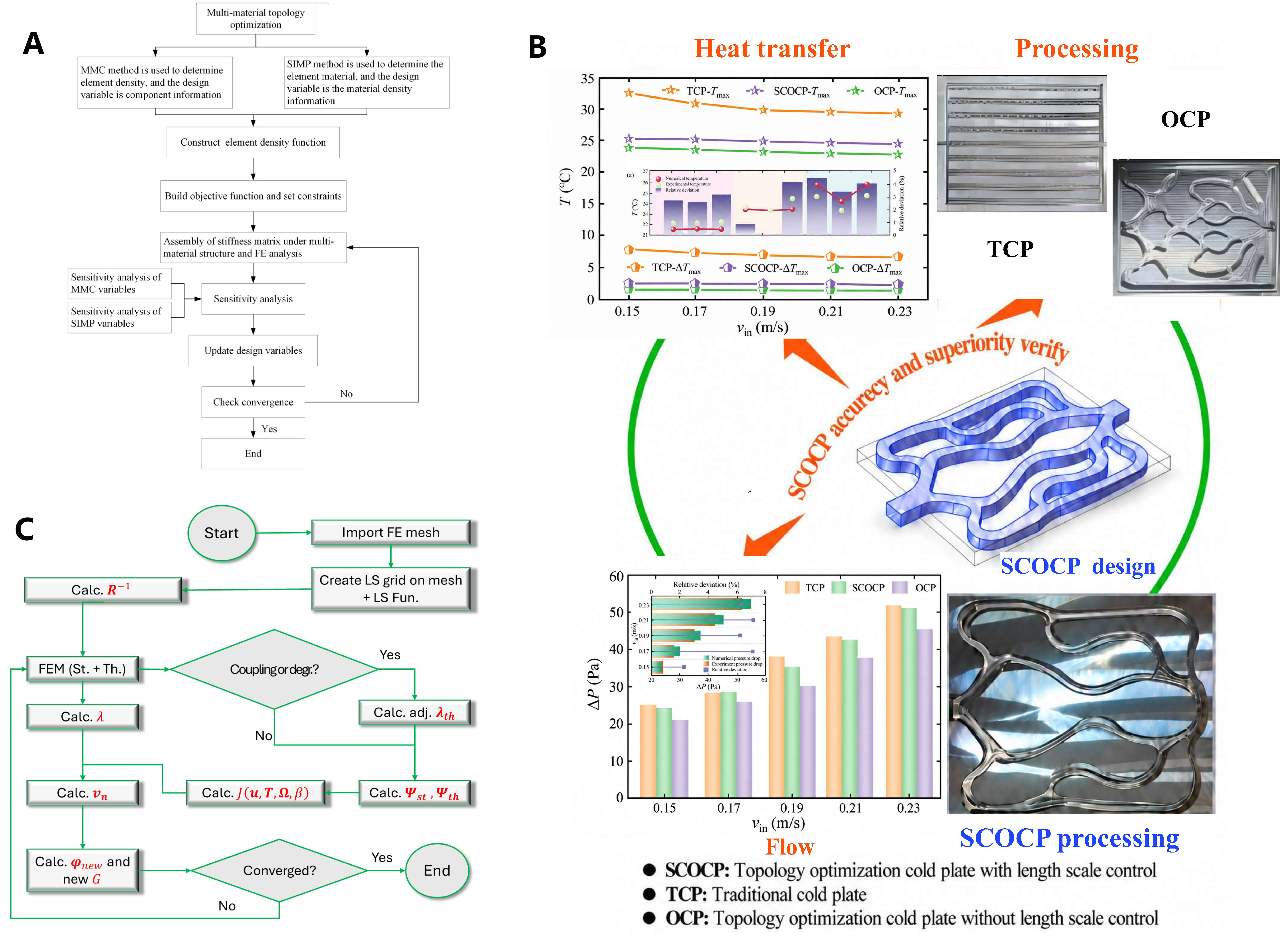
Figure 5. Representative TO workflows relevant to liquid-cooling and multiphysics design. (A) MMC-SIMP hybrid topology optimization process, including design-variable definition, element-density construction, objective and constraint formulation, finite-element analysis, sensitivity analysis, design-variable update, and convergence checking; (A) is reprinted with permission from Ref.[112]. Copyright © 2025 Springer Nature; (B) Framework for length-scale-controlled topology-optimized cold-plate design and fabrication, with validation of thermal and flow performance; (B) is reprinted with permission from Ref.[99], under the terms of the CC BY 4.0 license. (C) Immersed level-set thermo-mechanical TO workflow, integrating thermal and mechanical analyses, objective-function evaluation, sensitivity calculation, level-set evolution, constraint treatment, and convergence checking; (C) is reprinted with permission from Ref.[113], under the terms of the CC BY 4.0 license. TO: Topology optimization; MMC: moving morphable component; SIMP: solid isotropic material with penalization; MMA: method of moving asymptotes.
Overall, TO is a design methodology that enables high-degree-of-freedom, holistic reconstruction of the internal structure of liquid-cooling plates under coupled flow and heat-transfer constraints. For this reason, it offers a substantially larger optimization space than traditional experience-based design for complex thermal-management problems.
Research progress in liquid-cooling plate TO
TO of liquid-cooling plates was first developed largely in electronic cooling, where the heat source and operating conditions can often be prescribed more simply. It has since been extended to lithium-ion battery thermal management, where heat generation varies with SOC, current rate, temperature, cell architecture, and electrochemical state. Battery cold-plate design must therefore balance maximum temperature, temperature uniformity, hydraulic resistance, pumping power, operating-condition variability, and engineering constraints. The SIMP-Brinkman formulation and adjoint sensitivity methods provide established numerical foundations for fluid and conjugate-heat-transfer TO[100], but their battery application requires condition-aware heat sources and comparisons against realistic reference structures. Table 4 summarizes representative studies[47,64,86-88,92,93,95-98,100,101,114] using the quantitative information explicitly reported in the original publication.
Quantitative comparison of representative topology-optimized liquid-cooling structures for LIBs
| Reference | Battery/System | Heat load or C-rate | Coolant | Flow rate | Baseline | TO method | Tmax | ΔT | Δp | Cooling improvement | Optimization objective | Computational efficiency | Validation | Key limitation |
| Chen et al., 2022[87] | Prismatic battery pack; dimensions not reported | Not reported | Not reported | Inlet pressure varied; flow rate not reported | Rectangular-channel (RCP) and serpentine-channel (SCP) | 2D Brinkman/SIMP with 3D extrusion | 0.27% reduction vs. RCP; 1.08% vs. SCP | 19.50% reduction vs. RCP; 41.88% vs. SCP | Not reported | Tmax and ΔT reductions as reported | Fluid volume fraction; inlet/outlet positions; inlet pressure | Not reported | Numerical only | Simplified operating conditions and heat-source setting; no experimental validation |
| Guo et al., 2022[88] | 20 Ah, 3.3 V pouch LiFePO4 battery | 3C discharge | Water | 1-5 × 10⁻³ kg s-1; selected condition 3 × 10⁻³ kg s-1 per inlet | Straight mini-channel | SIMP/Brinkman density method; staggered multi-inlet channels | Not reported | Not reported | 17.5 Pa at selected condition | 61.82% higher cooling performance than straight mini-channel; h = 1,068.55 W m-2 K-1; j/f = 0.41 | Minimize weighted thermal objective and fluid dissipation power | Not reported | 3D-printed aluminum cold plate; thermocouple and pressure measurements | Small pouch-cell system; no pack-scale validation |
| Wang et al., 2023[97] | Prismatic battery pack; dimensions not reported | 3C discharge | Water | 0.002 kg s-1 | Rectangular channel cold plate (RCP) | TO with alternative thermal objectives (THP/TQP/TTP) | THP: 29.65 °C; 0.48 °C below RCP | THP: 4.65 °C; 0.46 °C below RCP | 7.79 Pa reduction vs. RCP (THP) | 0.48 °C Tmax reduction; 0.46 °C ΔT reduction; 7.79 Pa lower Δp | Compare outlet enthalpy, heat-transfer, solid-temperature, and thermo-fluid objectives | Not reported | Numerical only | Objective-function choice changes the selected topology and performance |
| Wu et al., 2023[93] | Module of 20 prismatic cells | 3C discharge | Water | 0.4 m s-1 comparison condition; 0.1 m s-1 also evaluated | Conventional parallel/straight-channel cold plate | Density-based multi-objective TO with adjoint sensitivity | Not reported | 59.4% reduction in maximum average temperature deviation between cells | 23.9% reduction vs. conventional plate at 0.4 m s-1 | 10.3% lower hottest-cell average temperature; 59.4% lower ΔT; 63.0% higher h/Nu; 23.9% lower Δp | Minimize temperature rise, inter-cell temperature deviation, and power dissipation | Not reported | Numerical; model compared with prior validated data | Empirical heat source; optimized plate not experimentally demonstrated |
| Gallorini et al., 2023[100] | Generic conjugate heat-transfer cold plate; not battery-specific | 22-55 W heat sources; total 440 W in one case | Water | 8 L min-1 | Reference cold-plate configurations | Multi-region continuous-adjoint TO in OpenFOAM | Not reported | Not reported | Not reported | 12% reduction in dissipated mechanical power in reported cases | Heat-source temperature and mechanical power dissipation | Not reported | Numerical only | Transferable solver demonstration; not a battery BTMS study |
| Wang et al., 2025[92] | EV battery cold plate; cell/pack dimensions not reported | Not reported | Water | Re = 100 and 2,100 reported | Straight-channel and GM Volt serpentine cold plates | RAMP/Brinkman density TO solved with GCMMA | GM serpentine maximum temperature 9% lower than TO design | Not reported | Friction-factor reduction 82% at Re = 100 and 75.6% at Re = 2,100 vs. GM model | PEC about 58% higher than baseline; lower friction factor but not lower Tmax than GM serpentine | Minimize average temperature and fluid power dissipation | Not reported | Numerical only | Serpentine baseline retained a thermal advantage under the reported conditions |
| Wang et al., 2025[98] | Battery pack; geometry not reported | 5 C discharge | Not reported | 0.5305 × 10⁻² kg s-1 (laminar); 2.122-8.488 × 10⁻² kg s-1 (turbulent) | Serpentine (SCP) and rectangular (RCP) cold plates | Laminar and k-ε turbulent TO with conjugate heat transfer | Not reported | TTCP gave the smallest temperature difference overall; numerical values not reported in the abstract | Not reported | At 8.488 × 10⁻² kg s-1, PEC improvement vs. RCP: TTCP 86.7%, LTCP 78.5%, SCP 85.4% | Minimize pressure drop and average temperature | Not reported | Numerical only | LTCP was slightly better at very low flow; regime strongly affected ranking |
| Zhan et al., 2025[101] | 30 Ah pouch lithium-ion battery | 3C discharge; heat flux 743.33 W m-2 | Water | 1-5 g s-1 | Optimized serpentine (OSCP), rounded serpentine (RSCP), and direct TO cold plate (TCP) | Parameter optimization followed by local TO (TSCP) | TSCP 29.17 °C; OSCP 29.04 °C; RSCP 29.11 °C; TCP 29.55 °C | Not reported | TSCP 122.39 Pa; OSCP 241.38 Pa; RSCP 200.41 Pa; TCP 32.97 Pa | TSCP pump power 49.3% lower than OSCP; j/f 69.76% higher than OSCP | Maximize heat transfer and minimize flow dissipation; NSGA-II for parameter stage | Mesh study reported; CPU time/speed-up not reported | Battery temperature and cold-plate experiments | Hybrid parameter/TO approach improves practicality but remains geometry-specific |
| Zhan et al., 2025[95] | 160 × 160 × 9 mm prismatic soft-pack automotive battery; 550 g | Not reported; discharge-current sweeps used | Water | 20 g s-1; Re = 2,030.33 | S-shaped and uniform-topology cold plates | Leaf-vein-initialized TO (LVTB topology) | 31.3 °C; 0.5 °C below S-shaped and 1.4 °C below uniform topology | 1.16 °C; 0.07 °C below S-shaped and 0.25 °C below uniform topology | 0.91 kPa; 11.66 kPa (92.76%) below S-shaped and 0.10 kPa (9.9%) below uniform topology | Tmax, ΔT, and Δp improvements as reported; experiments confirmed trends | Maximize heat transfer and minimize fluid dissipation; weight/Re/volume-fraction studies | Not reported | Machined 6061 aluminum plates; liquid-cooling experiments | Bionic initial morphology constrains the accessible design space |
| Lin et al., 2025[64] | Pack of 52 prismatic 280 Ah energy-storage cells | Not reported | Not reported | 1-15 × 10-3 kg s-1 | Straight, serpentine, and hexagonal cold plates | Multi-objective TO + RSM + NSGA-II + TOPSIS | Not reported | Thermal-uniformity improvement reported qualitatively; numerical ΔT not reported in abstract | Not reported | Nusselt-number difference vs. straight: 1.33-5.90; 15.6%-42.2% improvement | Heat dissipation, temperature uniformity, and flow resistance | RSM/NSGA-II workflow; CPU time not reported | Electrochemical/thermal model validated experimentally; optimized plate numerical | High-fidelity 3D pack validation remains limited |
| Han et al., 2026[96] | Generic high-performance liquid-cooling plate; battery-relevant cases but not battery-specific | Not reported; heat-flux cases reported in study | Water | 300-600 mL min-1 in 3D evaluation | Rectangular cooling plate and conventional TO | Fractal-geometry-enhanced density-based TO (FGTO) | 16.9 K reduction vs. conventional TO (reported maximum-temperature comparison) | Not reported | Not reported; increasing fractal parameter increased pressure drop | 46% larger heat-transfer area; average and maximum temperatures reduced by 15.6 and 16.9 K vs. conventional TO | Direct convective heat-transfer objective with hydraulic trade-off | Not reported | Numerical; 3D model checked against prior experimental/numerical data | Not battery-specific and primarily numerical |
| Guibert et al., 2026[47] | Six-cell 21700 module | 1.5C discharge used to generate DFN surrogate | Not reported | Not reported | Common design-domain reference; no serpentine baseline | Level-set TO with offline LASSO surrogate of DFN heat generation | 40.0-48.8 °C across three thermal-constraint cases | Temperature variance 62.0-102.6 °C2; ΔT not reported | 0.151-0.381 Pa across the three cases | Replacing temperature-dependent DFN heat source with constant bounds shifted global metrics by up to 20% | Minimize Δp subject to average-temperature, variance, or Tmax constraints | Offline surrogate queried during each nonlinear solve; negligible runtime overhead reported | Numerical; adjoint sensitivities checked against finite differences; DFN source grounded in prior cell experiments | No cooling-plate experiment and no long-term aging feedback |
| Ba et al., 2026[86] | Lithium-ion battery two-phase boiling cold plate; system dimensions not reported | Not reported | R134a | Not reported | Straight-rib boiling cold plate | SIMP with porous-medium hybrid and phase-change model | Not reported | Not reported | Not reported | Thermal performance reported as superior to straight-rib design; numerical values not reported here | Pressure drop, heating power, and phase-change coefficient constraints | Not reported | Numerical only | Two-phase flow/dryout complexity; experimental validation remains limited |
| Wu et al., 2026[114] | Generic cold plate with asymmetric/non-uniform heat sources; not battery-specific | Non-uniform heat source; magnitude not reported | Not reported | Not reported | Reference cold-plate designs | Physics-informed conditional diffusion model with surrogate-assisted TO | Not reported | Not reported | Not reported | Rapid generation of low-Δp Pareto candidates; quantitative improvement not reported | Pareto trade-off between thermal resistance and pressure drop | Rapid candidate generation reported; acceleration factor not reported | Numerical only | Generalization and experimental transfer to battery packs remain unverified |
Early studies mainly established the feasibility of TO relative to prescribed channel layouts. Chen et al.[87] compared topology-optimized cold plates with rectangular and serpentine references, while Guo et al.[88] coupled a P2D electrochemical heat source with a conjugate heat-transfer model and experimentally tested a selected multi-inlet design. The reported results support TO's ability to redistribute coolant toward thermally active regions. However, these studies also show why single-objective results should not be interpreted as universal rankings: a design optimized primarily for heat transfer may create narrow or branched passages, and the resulting thermal gain can come with a hydraulic penalty or increased geometric complexity.
Multi-objective formulations have therefore become a major direction. The commonly optimized quantities include maximum temperature, temperature uniformity, pressure drop, pumping power, and fluid-dissipation measures[93]. Wu et al.[93] reported simultaneous reductions in the hottest-cell temperature, inter-cell temperature deviation, and pressure drop for a twenty-cell module. Wang et al.[97] showed that changing the thermal objective from solid-domain temperature to outlet enthalpy changed the optimized topology and the thermal-hydraulic balance. Multi-objective studies also increasingly use the nondominated sorting genetic algorithm II, RSM, and technique for order preference by similarity to an ideal solution to organize Pareto candidates and support engineering decisions[64]. These methods broaden TO from geometric generation to explicit management of competing objectives, but results remain sensitive to objective normalization, weighting, and constraint selection.
The literature has also expanded from individual cold plates toward modules and large-format packs.
Electrochemical-informed TO addresses a separate limitation: the fidelity of the thermal load used during optimization. Many multi-objective studies still prescribe uniform or empirical heat sources. Guo et al.[88] used a P2D model to generate electrochemical heat, but the optimization heat field was not continuously updated through a full dynamic electrochemical feedback loop. Guibert et al.[47] advanced this link by embedding an offline least absolute shrinkage and selection operator surrogate trained from DFN simulations into a level-set thermo-fluid optimization for a six-cell 21700 module. Replacing the temperature-dependent source with constant bounds shifted reported global metrics by up to 20%, demonstrating that heat-source fidelity can change feasibility and design ranking. This supports electrochemical-informed TO, but not continuous aging-state feedback or a fully integrated long-term battery-pack optimization framework.
Data-assisted methods may reduce the computational cost of evaluating topology candidates. Wu et al.[114] used a physics-informed conditional diffusion model and a surrogate model to generate low-pressure-drop candidates for asymmetric heat sources. Such approaches may accelerate Pareto exploration, but their transferability to battery packs, robustness outside the training distribution, and experimental validation remain open questions. The current literature therefore supports a progressive combination of physics-based models, reduced-order surrogates, and data-assisted search, rather than treating artificial intelligence (AI) as a substitute for electrochemical or hydraulic fidelity. The progressive transition from simplified thermal-fluid optimization toward electrochemistry-informed TO is summarized in Figure 6.
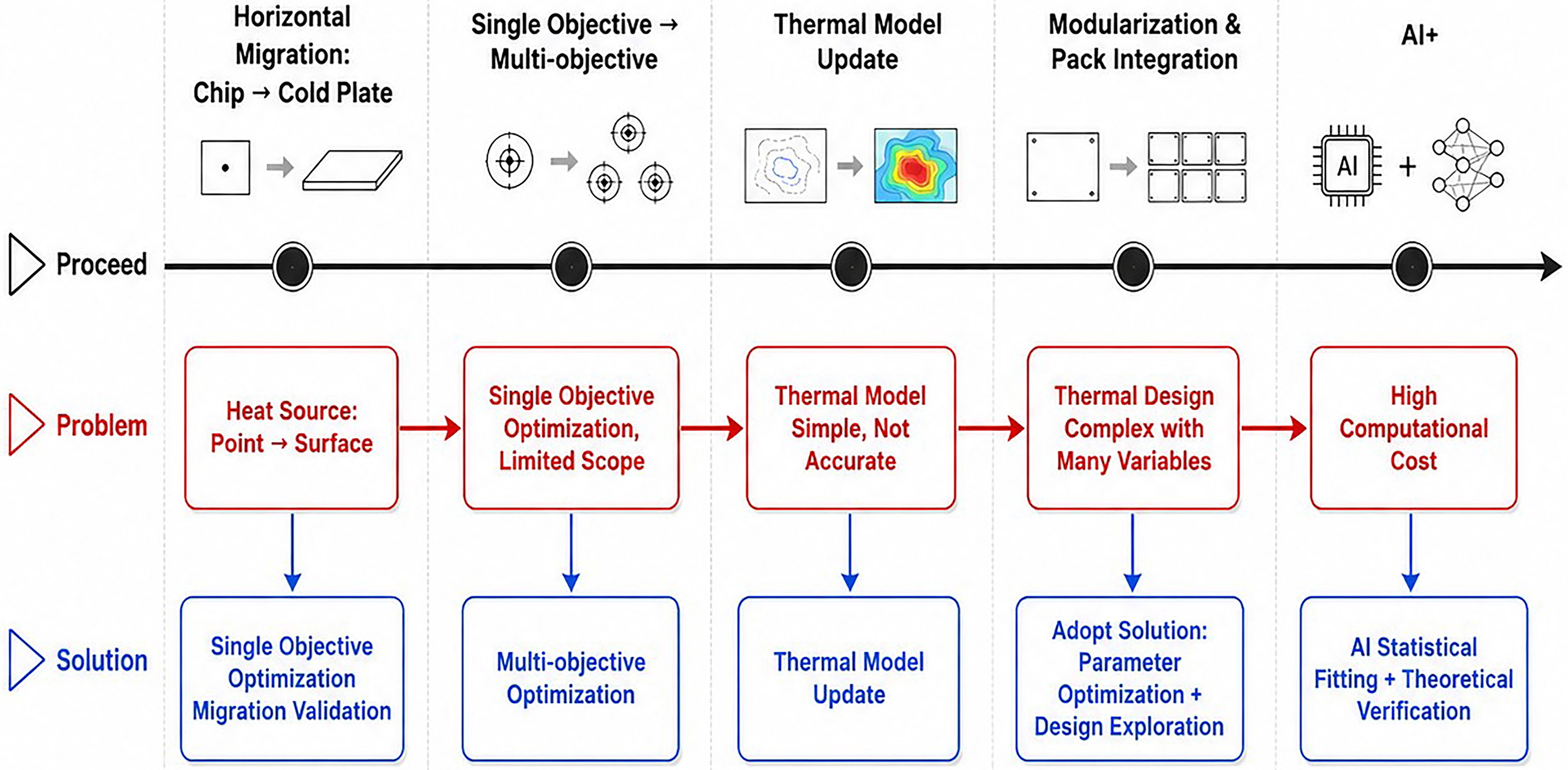
Figure 6. Development roadmap of liquid-cooling plate topology optimization.
The quantitative results in Table 4 indicate that TO can outperform straight or rectangular references under many reported conditions by redistributing flow, increasing effective heat-transfer area, or reducing flow resistance. Guo et al.[88] reported a 61.82% improvement in cooling performance relative to a straight mini-channel under the selected condition; Wu et al.[93] reported reductions of 10.3% in the hottest-cell average temperature, 59.4% in inter-cell temperature deviation, and 23.9% in pressure drop, and Wang et al.[97] reported a 0.48 °C reduction in maximum temperature for an outlet-enthalpy objective relative to a rectangular reference. These values are useful evidence of potential, but they do not establish a universal performance advantage because each percentage is tied to a particular baseline, heat load, flow rate, battery geometry, and objective formulation.
The comparison with serpentine plates is more conditional. Wang et al.[92] reported substantially lower friction relative to the GM Volt serpentine reference, but the serpentine plate retained a lower maximum temperature under the stated conditions. Wang et al.[98] found that a laminar topology design was slightly disadvantaged at very low flow rates, while the turbulent topology design became more competitive at high flow. Zhan et al.[95] reported lower pressure drop for a leaf-vein-initialized topology than for an S-shaped reference, whereas Zhan et al.[101] showed that a parameterized-and-topology-optimized serpentine design could retain a lower maximum temperature than a directly optimized channel while reducing pumping power relative to its parameter-optimized predecessor.
These differences reflect variations in battery size, C-rate or heat load, inlet temperature, coolant flow rate, flow regime, baseline definition, design domain, volume fraction, and objective function. In addition, the reported indicators are not identical: some studies use absolute maximum temperature or temperature difference, whereas others use temperature rise, inter-cell deviation, Nu, PEC, friction factor, or pumping power. Reported improvement percentages should therefore be interpreted within their respective operating and reference conditions rather than treated as directly comparable universal rankings.
Serpentine architectures may remain competitive when the heat load is moderate, when their established path already provides sufficient boundary-layer redevelopment, when the design domain is restricted by manifolds, plate thickness, minimum feature size, or manufacturing rules, or when a strict pressure-drop limit makes additional branching unattractive. Their repeated turns can provide strong heat transfer, but the associated hydraulic penalty becomes more important as flow rate increases. TO is more likely to add value when the heat flux is high or spatially non-uniform, when the design domain permits meaningful flow redistribution, and when pressure drop or pumping power is explicitly included in the objective. This conditional interpretation aligns better with the available evidence than a claim that topology-optimized plates always outperform mature serpentine or parallel architectures.
Finally, computational efficiency and validation are unevenly reported. Guo et al.[88] and Zhan et al.[95,101] provide experimental evidence, whereas several pack-level, fractal, two-phase, and AI-assisted studies remain numerical. Guibert et al.[47] demonstrate that a DFN-based surrogate can make temperature-dependent heat-source evaluation tractable, but no study in the comparison establishes continuous multi-timescale aging feedback within the complete electrochemistry-thermal-fluid-TO loop. Future studies should therefore report standardized operating conditions, baseline definitions, thermal and hydraulic metrics, computational cost, and validation status together, while progressively incorporating manufacturability, scale-up, and electrochemical-safety constraints.
Manufacturability constraints and engineering realization
TO can generate branched, sharply curved, thin-walled, overhanging, or labyrinthine passages that are difficult to obtain from experience-based channel design. Numerical optimality therefore does not by itself establish engineering feasibility. For liquid-cooling plates, assess a design against the manufacturing route, assembly sequence, inspection access, and service conditions alongside thermal and hydraulic performance. Post-processing a converged topology by rounding corners, truncating branches, or filling small passages can change the flow distribution and heat-transfer field; therefore, manufacturability is better treated as a design constraint during optimization iterations. This distinction is also relevant to battery cold plates because internal passages are difficult to inspect or repair after closure, and because the pressure drop measured in a prototype can differ from the idealized CFD prediction[87,99,109].
AM expands the feasible geometric design space for branched, lattice-like, and three-dimensional cooling channels that are difficult to fabricate using conventional manufacturing routes. However, the achievable channel morphology remains constrained by the AM process itself. For metal AM technologies such as selective laser melting and laser powder-bed fusion, overhang angle, minimum feature size, wall thickness, surface roughness, support placement, powder evacuation, and post-processing requirements must be considered when transferring a topology-optimized geometry to a physical prototype[106-108]. Lamarche-Gagnon et al.[108] showed that unconstrained TO can generate flattened channels near the heated boundary. Although these configurations can enhance heat extraction, their large overhangs may hinder self-supporting fabrication. When overhang constraints were incorporated into the optimization process, the channel cross-sections evolved toward self-supporting geometries, including teardrop-like sections, while largely preserving the thermal benefit of conformal channel placement[108]. This observation is directly relevant to additively manufactured battery cold plates, for which overhang angle, minimum channel width, wall thickness, and other process-dependent geometric limits should be incorporated as explicit manufacturing constraints rather than addressed only during post-processing. Experimental studies of metal 3D-printed cold plates further demonstrate that support configuration and internal geometry can affect cooling performance and pressure drop[107]. Moreover, the as-built surface and realized channel dimensions can deviate from the ideal geometries assumed in CFD; surface roughness can alter frictional behavior and heat-transfer predictions in additively manufactured cooling channels[106]. AM should therefore be regarded as an enabler of complex topology-optimized geometries that require process-aware design, rather than as a manufacturing route that automatically resolves manufacturability limitations.
For conventionally machined, extruded, brazed, welded, or roll-bonded cold plates, the feasible topology is restricted by tool accessibility, draft direction, minimum channel width and wall thickness, plate thickness, joining boundaries, bonding quality, and dimensional tolerance. These routes remain important options for cold-plate production, but their constraints should be represented explicitly in the design formulation rather than applied only after optimization. Manufacturing-constrained thermofluid TO of roll-bonded cold plates has demonstrated the value of embedding production rules in the design process[109], while automated optimization of extruded cold plates illustrates how a regular parametric architecture can be retained during geometry improvement[27]. For battery applications, a practical compromise is often to optimize local branches, manifolds, or heat-transfer regions within a regular primary topology, instead of allowing an entirely free labyrinthine geometry. Minimum feature size, length-scale control, curvature limits, and accessible sealing planes can thus be specified before convergence; the length-scale-controlled battery cold-plate experiments of Deng et al. provide direct support for this approach[99].
Manufacturing constraints must be considered together with service reliability. Coolant containment, joint design, and long-term sealing require attention because leakage can compromise electrical isolation, corrosion protection, and system reliability; coolant compatibility and the inspection or cleaning of internal passages are likewise system-level requirements for liquid-cooled battery packs[38]. Thin walls, sharp transitions, and highly concentrated manifolds should be checked under internal pressure, thermal cycling, vibration, and mechanical loading before pack-level implementation. A topology that lowers temperature or pumping power in an idealized model may therefore be unsuitable if it cannot satisfy structural, sealing, or assembly tolerances. Pressure loss and pumping power should remain explicit co-objectives with thermal performance, since a lower thermal resistance is not necessarily advantageous when it requires excessive auxiliary power[87,99]. Maintenance should be treated as an engineering consideration, particularly when complex passages are difficult to access and when the coolant or the operating environment may introduce fouling, particle deposition, corrosion, or degradation of sealing components[38].
Taken together, these considerations support a manufacturability-aware formulation of liquid-cooling-plate TO. In addition to temperature, temperature uniformity, and pressure-drop objectives, future formulations should impose minimum feature size and length-scale controls, curvature and pressure limits, structural and sealing constraints, tolerance allowances, and rules governing support removal, powder evacuation, joining, inspection, and cleaning. The optimization output should then be evaluated with prototype-level dimensional and hydraulic measurements, rather than judged only by idealized CFD results. Existing studies demonstrate important individual links—such as length-scale-controlled battery cold plates[99], manufacturing-constrained roll-bonding[109], and process-aware AM[106-108]—but these links do not yet constitute a universal route to commercial battery packs. Progress toward engineering deployment will require co-design of topology, manufacturing process, sealing architecture, structural reliability, validation, and maintenance over the intended service life.
ELECTROCHEMICAL-THERMAL-FLUID COUPLING-DRIVEN TO OF LIQUID COOLING PLATES
The direct objective of TO for liquid cooling plates is the design of cooling channels, thermally conductive solid regions, and coolant distribution pathways. However, the design space is governed not only by hydraulic resistance and heat transfer efficiency. Existing studies on lithium-ion battery cold plates commonly formulate TO around thermo-fluid objectives and performance metrics, including maximum or average temperature, temperature difference or variance, pressure drop, fluid dissipation, and pumping power[87,88,97,101]. The quantities treated as objectives, constraints, or post-optimization metrics vary among studies. Density-based methods, level-set approaches, adjoint sensitivity analysis, and multi-objective evolutionary algorithms have been widely employed to generate branched, streamlined, and biomimetic channel configurations, thereby shifting cooling plate design from empirical flow-channel layouts toward automated geometry generation[87,88,93,97]. These studies have demonstrated the effectiveness of TO in improving thermo-hydraulic performance and have established a conventional optimization paradigm in which a prescribed heat source is first specified, followed by thermal-field prediction and subsequent optimization of the coolant channel layout.
In recent years, research has gradually shifted from optimizing individual cold-plate geometries to thermal management of large-format prismatic cells, battery modules, and battery packs operating under dynamic conditions. Rather than focusing solely on temperature control, recent studies have incorporated cooling efficiency, temperature uniformity, pressure drop, structural mass, and manufacturing complexity into unified optimization frameworks, while employing genetic algorithms, surrogate models, and dynamic operating-condition evaluations to enable multi-objective TO[64,92,115,116]. Nevertheless, when the heat source is prescribed as a constant volumetric heat generation rate or a uniform heat-flux boundary, the resulting topology is fundamentally optimized only for a hypothetical thermal load and therefore cannot be expected to accurately represent realistic electrochemical operating conditions. In LIBs, heat generation arises from ohmic losses, reaction polarization, concentration polarization, and reversible entropic heat, all of which vary dynamically with current rate, SOC, temperature, aging state, and the spatial distribution of electrochemical reactions. Accordingly, this section discusses why future liquid-cooling structure optimization should be driven by electrochemical models rather than prescribed thermal boundary conditions. A complete electrochemical-thermal-fluid-topology feedback loop remains a prospective research direction rather than an established framework.
Influence of electrochemical heat sources on liquid cooling structure design
The fidelity of the battery heat generation model determines the thermal boundary conditions perceived by the liquid cooling plate TO. The energy balance model established by Bernardi et al.[9] relates the total heat generation of a lithium-ion battery to the operating current, terminal voltage, OCV, and reversible entropic heat, providing the classical semi-empirical foundation for battery thermal analysis. Building upon porous-electrode theory and concentrated-solution theory, the DFN/P2D model[50] further resolves the spatial and temporal distributions of ohmic heat, reaction heat, and reversible heat by explicitly describing solid-state diffusion, electrolyte transport, electric potential distribution, and interfacial electrochemical kinetics. Using a pseudo-three-dimensional electrochemical-thermal coupled model, Bahiraei et al.[117] demonstrated that current distribution, tab configuration, and localized reaction intensity produce pronounced spatial temperature non-uniformity in large-format LIBs. Yang et al.[118] further showed that the relative contributions of ohmic, reaction, and polarization heat vary with operating conditions, particularly under high discharge rates and severe polarization, thereby altering local temperature rise and thermal gradients within the battery. Consequently, electrochemical heat generation governs not only the overall heat generation rate but also the spatial distribution of heat sources, thereby determining the locations of thermal hot spots and the cooling demand perceived during liquid cooling plate TO.
From a model-hierarchy perspective, ECM, SPM/SPMe, and DFN/P2D represent a continuum that balances computational efficiency with physical fidelity. Liu et al.[119] systematically compared ECMs, white-box models, and grey-box thermal models, demonstrating that ECMs characterize battery behavior through the OCV, ohmic resistance, and resistance-capacitance networks. Although well suited for online BMS applications and rapid thermal prediction, ECMs cannot resolve local reaction currents, negative-electrode potentials, or the spatial distribution of heat generation. From a multiscale battery modeling perspective, Mama et al.[120] concluded that the SPM represents the positive and negative electrodes as equivalent spherical particles, thereby preserving solid-state diffusion and SOC evolution while offering substantially lower computational cost than DFN/P2D models. However, its neglect of electrolyte concentration and potential gradients reduces accuracy under high-rate, low-temperature, and highly polarized operating conditions. Based on a three-dimensional electrochemical-thermal coupled model, Li et al.[121] further demonstrated that incorporating electrolyte transport, electric potential distributions, and interfacial reaction kinetics enables DFN/P2D-type models to more accurately capture polarization behavior, localized heat generation, and temperature-field non-uniformity. Similarly, Wang et al.[122] showed that electrochemical reaction rates are inherently non-uniform and can be significantly redistributed across the electrode plane by cell geometry, current collector configuration, electrode architecture, and operating conditions. Consequently, the closer the heat-generation model approximates the actual spatial distribution of electrochemical reactions, the more substantially the predicted hot-spot locations, coolant distribution, and local cooling requirements may change during liquid cooling plate TO.
The influence of different heat-generation models on liquid-cooling structure design is reflected not only in the predicted temperature rise but also in the spatial characteristics of the optimization problem. A uniform heat source generally drives the optimizer toward channel configurations that maximize overall heat-transfer performance while minimizing pressure drop. The Bernardi model incorporates the effects of current rate, terminal voltage, and reversible entropic heat, enabling the cooling-plate design to respond more realistically to time-varying thermal loads. The SPM/SPMe framework further captures SOC evolution, solid-phase diffusion, and partial polarization effects, allowing heat-source estimation under fast-charging or pulse-operating conditions to better reflect the actual electrochemical state of the battery. The DFN/P2D model resolves local reaction-current, concentration, and potential fields, while coupled electrochemical-thermal studies show that electrochemical heat generation can be spatially non-uniform and affect predicted temperature distributions and hotspot locations[33,50]. It may also inform spatially adaptive cooling or TO, as illustrated by electrochemically informed level-set studies[47], but a complete causal demonstration that it directly determines locally enhanced cooling channels remains unestablished. Consequently, the choice of heat-generation model fundamentally determines whether TO is performed for a cooling plate with an assumed average thermal load or one constrained by realistic electrochemical states.
The uniform heat-source assumption remains widely adopted because it requires few input parameters, couples readily with CFD models, and provides stable optimization convergence, making it particularly suitable for preliminary channel-layout screening and early-stage conceptual design. Experimental and numerical investigations on pouch cells with non-uniform heat generation conducted by He et al.[123] demonstrated that when heat generation varies across the cell plane or through the thickness, the uniform heat-source assumption tends to underestimate local hot spots and temperature gradients, potentially leading to incorrect identification of optimal cooling regions. Wu et al.[114] further demonstrated, through digital-twin-assisted optimization of cold plates subjected to asymmetric heat sources, that when the thermal-load center shifts spatially or evolves with operating conditions, the optimizer naturally favors asymmetric channel layouts, locally enhanced heat-transfer regions, and non-uniform coolant distribution strategies. Xiang et al.[115] reported that the thermal boundary conditions of LIBs evolve continuously with operating conditions, implying that cooling-plate topologies optimized under steady-state assumptions may no longer remain optimal under dynamic thermal loads. Han et al.[96] showed that fractal-inspired flow channels can simultaneously improve heat transfer and coolant distribution; however, their performance remains strongly dependent on the underlying heat-generation pattern and operating conditions. Consequently, a single steady-state thermal boundary condition cannot capture the time-dependent heat-generation characteristics of fast charging, pulse discharge, and realistic driving cycles. Therefore, a high-fidelity electrochemical heat-generation model should not be treated as a secondary refinement of the thermal model; rather, it is a fundamental input that reshapes the optimization objectives, design constraints, and ultimately the optimal channel topology.
The prevailing research paradigm is gradually shifting from simplified heat-generation models aimed at improving optimization efficiency toward electrochemical heat-source models that more faithfully represent real battery behavior, thereby enhancing the robustness and transferability of optimized cooling structures across different operating conditions. This transition does not imply that every cooling-plate design must be coupled directly with a full DFN/P2D electrochemical model. Instead, select model fidelity based on the objectives and stage of the design process. During the conceptual design stage, uniform heat-source assumptions or the Bernardi model can be employed to rapidly compare alternative channel topologies. At the mechanism-analysis stage, SPM/SPMe or DFN/P2D models provide greater insight into the spatial distribution of heat generation and the underlying causes of hotspot formation. For engineering optimization, high-fidelity electrochemical models can be used offline to generate comprehensive heat-source databases, which can subsequently be integrated into multi-objective optimization through reduced-order or surrogate models. This hierarchical modeling strategy balances computational cost, model interpretability, and cooling-plate design reliability, facilitating practical application of electrochemical-driven TO.
Feedback mechanism of the temperature field on electrochemical performance
The temperature field formed through optimized liquid-cooling structures is not a one-way outcome; it can in turn influence and modify electrochemical processes within the battery. Research by Li et al.[124] on thermal gradient-induced inhomogeneous degradation showed that temperature discrepancies drive capacity fade by altering local impedance, reaction kinetics, and current distribution, thereby inducing spatial heterogeneity within individual cells. Naylor Marlow et al.[125] further found that thermal gradients in parallel battery packs amplify discrepancies in inter-cell current, SOC, and SOH, constraining usable capacity and lifespan by the most unfavorable cell. At the module scale, He et al.[126] indicated that coupled temperature gradients and electrical connection topology alter inter-cell current distribution and aging pathways. Mikheenkova et al.[127] showed in a study of aging in high-energy-density automotive batteries that temperature and SOC jointly determine parasitic reaction rates and capacity retention, and that merely reducing the average temperature is insufficient to fully characterize aging risks. These findings collectively indicate that temperature uniformity is not only a thermal management metric but also an indicator of electrochemical consistency.
Temperature feedback effects first manifest in reaction kinetics and transport processes. In a comprehensive review of lithium-ion battery degradation mechanisms, Edge et al.[128] highlighted that elevated temperature generally enhances reaction kinetics and ionic transport, but simultaneously accelerates SEI growth, electrolyte decomposition, and loss of active lithium. Chen et al.[129] demonstrated through electrochemical degradation modeling under high-temperature conditions that while elevated temperatures reduce certain transient impedances, they also intensify parasitic side reactions and capacity-fade trajectories. This indicates that optimizing liquid-cooling structures should not be guided solely by short-term impedance reductions or kinetic improvements, but must also account for long-term aging penalties. Duan et al.[130], in a fast-charging electrochemical modeling study, further showed that anode potential, solid-phase diffusion, liquid-phase transport, and local polarization jointly determine the safe charging limits, and that temperature variations modify the feasible operating domain of these boundaries. Therefore, liquid-cooling plate optimization should not simply assume that lower temperatures are always better. Excessive cooling may reduce Tmax but can increase diffusion limitations and polarization in low-temperature regions, thereby elevating the risk of lithium plating. Conversely, insufficient cooling may accelerate side reactions and aging in high-temperature regions.
Lithium plating risk directly reflects the influence of temperature-field feedback on fast-charging safety. Smith et al.[131] found that even under relatively mild cycling conditions, high-energy LIBs may still exhibit localized lithium plating, indicating that local electrochemical states and temperature fields can induce spatially non-uniform safety risks. Huang et al.[132], focusing on fast-charging scenarios, demonstrated that local low temperature, high charge rates, and strong polarization can drive the anode potential toward or below the Li/Li+ equilibrium potential, thereby increasing the risk of metallic lithium deposition.
In recent years, research on temperature feedback has increasingly been integrated with health-aware fast charging, machine learning, and thermal regulation strategies. Zhang et al.[134] proposed a machine-learning-based lithium plating propensity estimation method, providing an optimization-embeddable risk metric for electrochemical safety constraints during fast charging. Andersson et al.[135], in a study on electrochemical-model-based aging-adaptive fast charging, showed that charging strategies should be dynamically adjusted according to battery aging state, impedance, and temperature conditions. Kim et al.[136], through fast-charging optimization considering degradation and cell-to-cell variations, further demonstrated that intra-pack heterogeneity alters the optimal current trajectory and safety margin. Zeng et al.[137], in a study on ultrafast charging combining thermal switching and self-heating, showed that moderate preheating can improve low-temperature fast-charging kinetics, but must be co-designed with aging and safety constraints. These studies suggest that the objective functions for liquid-cooling plate TO should be extended beyond Tmax and ΔT to include electrochemical consistency metrics such as SOC uniformity, SOH dispersion, lithium plating risk, and capacity retention.
The feedback mechanism of the temperature field can be further summarized in Figure 7. Low temperature does not merely alter the thermal state of the battery; it directly suppresses Li+ transport and interfacial reaction kinetics, manifested as increased charge-transfer resistance, interfacial resistance, and SEI-related transport resistance[138], as shown in Figure 7A and B. Therefore, if a liquid-cooling structure induces local overcooling, it may reduce the maximum temperature while simultaneously increasing polarization levels and narrowing the safe fast-charging window. For fast-charging processes, Huang et al.[132] demonstrated via dP/dQ signals and anode morphology evidence that low-temperature conditions significantly increase the risk of lithium plating, while dynamically regulating the charging current can mitigate this risk
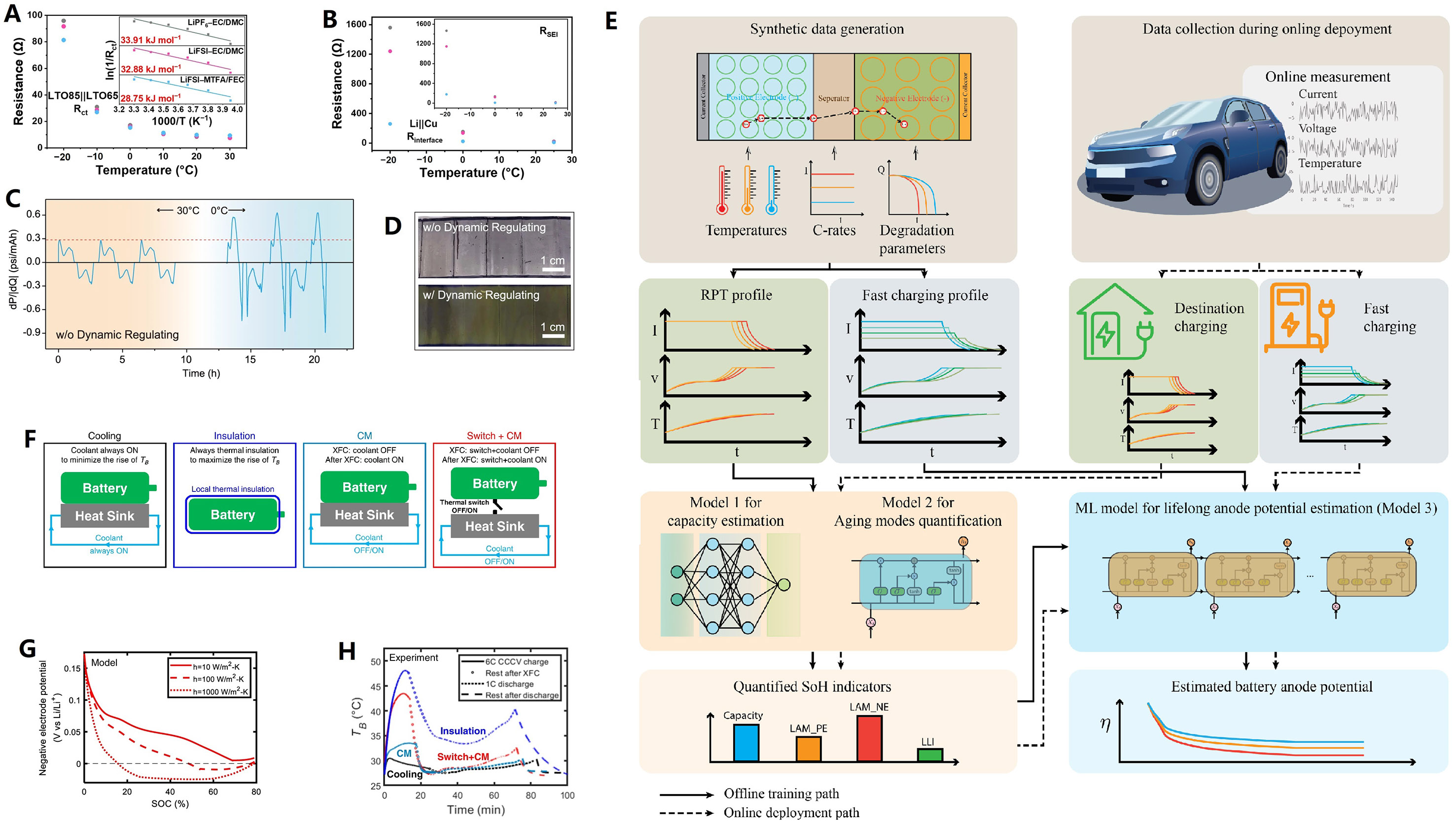
Figure 7. Temperature feedback effects on electrochemical performance, aging, and safety of lithium-ion batteries. (A and B) Temperature-dependent electrochemical kinetics: (A) charge-transfer resistance and Arrhenius behavior associated with Li+ desolvation and interfacial transport; (B) interfacial resistance and SEI-related resistance during Li deposition; (A and B) are reprinted with permission from Ref.[138], under the terms of the CC BY 4.0 license. (C and D) Lithium plating risk under low-temperature fast charging: (C) dP/dQ-based lithium plating detection under low-temperature charging; (D) optical images of graphite anodes after charging with and without dynamic regulation; (C and D) are reprinted with permission from Ref.[132], under the terms of the CC BY 4.0 license. (E) Health-aware fast-charging framework based on lifelong lithium-plating-potential estimation using current, voltage, temperature, and SOH-related information; (E) is reprinted with permission from Ref.[134], under the terms of the CC BY 4.0 license. (F-H) Thermal-regulation-assisted extreme fast charging: (F) schematic of thermal protocols for extreme fast charging; (G) predicted negative-electrode potential under different heat-transfer conditions; (H) representative battery-temperature evolution during extreme fast charging; (F-H) are reprinted with permission from Ref.[137], under the terms of the CC BY 4.0 license. SEI: Solid electrolyte interphase; SOH: state of health.
Electrochemical-thermal-fluid coupled optimization framework
Figure 8 presents a proposed closed-loop framework and research roadmap for liquid-cooling plate optimization. Several sub-links have been demonstrated independently, including bidirectional electrochemical-thermal coupling[117,121], electrochemically informed heat-source modeling for liquid-cooling simulations[123], and thermal-fluid TO of battery cooling systems[88,100]. Guo et al.[88] coupled electrochemical-thermal analysis with cold-plate TO. Guibert et al.[47] incorporated a temperature-dependent, DFN-trained heat-generation surrogate into level-set thermo-fluid TO. However, these studies did not incorporate evolving aging states or continuous aging feedback into topology updating. Earlier level-set work by
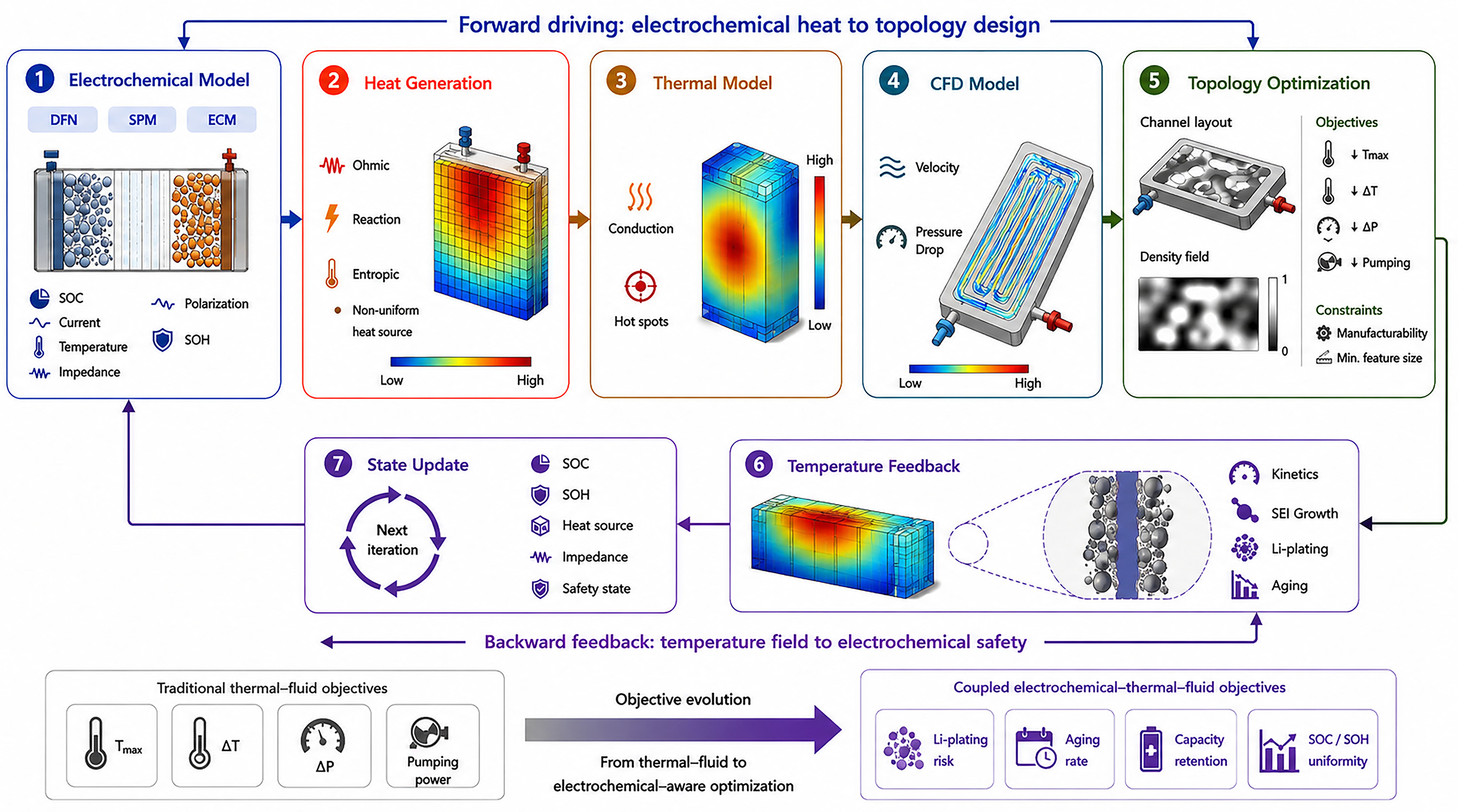
Figure 8. Proposed closed-loop electrochemical-thermal-fluid topology optimization framework for lithium-ion battery liquid cooling plates.
Aging-related electrochemical-thermal studies have shown that temperature histories influence degradation and health-aware operation[140,141], but continuously updating cooling topology with aging states has not yet been clearly demonstrated. Therefore, the integration of electrochemistry, thermal transport, coolant flow, topology updates, and multi-timescale aging feedback should be regarded as a prospective research roadmap rather than an established closed-loop framework.
According to coupling strength, existing methods can be classified into one-way coupling, weak coupling, and strong coupling. In one-way coupling, heat sources are first prescribed based on experiments, empirical models, or electrochemical models, followed by thermal-fluid simulation and TO. This approach has the lowest computational cost and is suitable for early-stage structural screening, but it cannot capture the feedback effect of cooling structures on heat generation after temperature changes. Weak coupling updates heat generation, internal resistance, reaction parameters, or aging states over several time steps or outer iterations, and can capture the main feedback effects under a controllable computational cost. Strong coupling simultaneously solves electrochemical behavior, heat conduction, fluid flow, and optimization sensitivities at each time step or optimization iteration. Although it provides the highest physical consistency, it significantly increases the complexity of parameter identification, mesh updating, and computational cost. Zhang et al.[142] proposed a design and multi-objective optimization framework for multi-surface cooling plates, demonstrating that complex cooling boundaries and multi-surface thermal coupling can significantly alter optimization objectives and structural layouts of cold plates. Wu et al.[143], from the perspective of battery digital twins, highlighted that the integration of models, data, and AI can provide a unified framework for intelligent battery management and optimization. Naseri et al.[144] further reviewed use cases, platforms, and implementation requirements of digital twins for EV battery systems, emphasizing the importance of model standardization, data closed-loop integration, and system-level validation.
The application scenarios of the three coupling approaches also differ significantly. One-way coupling is suitable for addressing which cold-plate channel performs better under a given known heat load. Its advantages lie in its stability, computational efficiency, and ease of engineering comparison. Weak coupling is appropriate for evaluating whether cold-plate performance remains reliable under dynamic loads and temperature-dependent parameters, with the key issue being the update frequency of heat sources and temperature-related variables. Strong coupling is suitable for investigating the co-evolution of cold-plate structure, electrochemical state, and heat generation distribution, making it more appropriate for mechanism studies, fast-charging safety analysis, and high-value battery system design. For liquid-cooling plate TO in the context of this review, the mainstream future direction is unlikely to pursue fully strong coupling alone; instead, a hierarchical coupling strategy based on design stages is more probable, where high-fidelity models define boundary conditions, weakly coupled models enable large-scale optimization, and strongly coupled models are reserved for validating key candidate structures.
From a software implementation perspective, COMSOL multiphysics is well suited to constructing unified multiphysics models that integrate DFN/SPM, heat conduction, and CFD, facilitating parameter sweeps and mechanism validation. ANSYS Fluent is commonly used for three-dimensional CFD of complex cold-plate channels, conjugate heat transfer analysis, and engineering pressure-drop evaluation. OpenFOAM and in-house codes are more suitable for incorporating adjoint solvers, level-set updates, density-based TO, and large-scale automated iterations. Alipour et al.[146] noted that surrogate-assisted uncertainty quantification and sensitivity analysis can reduce the computational burden of electrochemical-thermal aging models.
Existing TO studies generally formulate liquid-cooling plate design as a thermal-hydraulic trade-off by balancing temperature-related objectives against pressure drop or pumping power[97,148]. In a prospective coupled optimization framework, this formulation could be extended to include electrochemical-safety and degradation-related risk constraints, motivated by studies that incorporate lithium-plating limits, electrochemical-thermal aging, or aging-aware thermal-management control[139,140,149,150]. A future objective system could incorporate anode lithium-plating risk, SEI-growth indicators, capacity-retention metrics, SOC/SOH dispersion, and local temperature gradients as constraints or penalty terms, with weights assigned according to the application scenario. For energy storage batteries, lifetime consistency and low pumping power may take priority; for fast-charging EV batteries, lithium plating risk and local overcooling constraints are more critical; and for high-rate operation, transient hotspots and coolant distribution stability become key factors.
Research gaps and future roadmap
Gap 1
Heat-source fidelity and electrochemical consistency. Uniform, empirical, and lumped heat sources remain common because they are inexpensive to couple with CFD, but they can omit state- and location-dependent effects of current rate, SOC, temperature, polarization, and aging. Cross-scale and mechanistic studies link heat generation to electrochemical processes[151,152]. The gap is therefore not that every TO problem requires a DFN model, but that model-order selection is rarely tied to the required fidelity and computational budget. Future work should benchmark DFN/P2D, SPM/SPMe, reduced-order, and calibrated ECM sources under common transient cases and propagate source uncertainty into TO.
Gap 2
Electrochemical safety and aging constraints. Topology-optimization objectives remain dominated by maximum temperature, temperature difference, pressure drop, and pumping power, whereas explicit constraints on lithium plating, SEI growth, overpotential, capacity retention, and SOH are uncommon. Safety-constrained charging and degradation-oriented optimization show that these factors can change the preferred operating policy and the efficiency-reliability trade-off[153,154]. Health-aware charging provides a possible risk metric[155]. Future work should formulate duty-cycle-dependent penalties or constraints for plating, impedance growth, and capacity loss. Continuous aging feedback in a complete electrochemistry-thermal-fluid-TO loop remains an emerging direction, not an established capability[47].
Gap 3
Multi-objective optimization and condition robustness. Multi-objective studies increasingly balance thermal and hydraulic indicators[156], while bionic and constrained designs show that channel morphology affects this balance[95]. However, topology rankings remain sensitive to objective weights, baseline definition, flow
Gap 4
Module/pack validation and experimental verification. Single-cell and isolated cold-plate studies remain common, yet coolant distribution, electrical interconnections, assembly resistance, cell variation, and pack boundaries can change the value of a locally optimized channel. Module and layout studies show that architecture and cell arrangement affect temperature uniformity and flow behavior[157,158]. Experimental work further indicates that optimization needs prototype calibration and multi-condition testing[159]. The remaining gap is coupled validation of temperature fields and hydraulics with electrochemical state, impedance, and aging response. Staged cold-plate, module, and pack protocols would provide stronger evidence than surface-temperature agreement alone.
Gap 5
Manufacturability and structural reliability. TO can generate fine branches, narrow passages, sharp transitions, and high-curvature regions that complicate machining, AM, inspection, sealing, and cleaning. Experiments show that support strategy, internal geometry, and manufactured-wall roughness affect realized cooling and pressure loss[106-108]. The gap is that feature size, length scale, surface condition, sealing, pressure resistance, and maintenance access are often checked after convergence or only on a prototype. Future manufacturability-aware TO should embed these rules during optimization and verify tolerance, sealing, structural response, blockage susceptibility, and repeated thermal-mechanical loading.
Gap 6
Physics-informed AI and surrogate-assisted optimization. Surrogates and data-assisted methods can reduce repeated CFD or electrochemical solves[114,160]. A DFN-informed surrogate coupled to level-set optimization links electrochemical heat generation to structural design, but it does not establish dynamic aging feedback or a complete closed-loop framework[47]. Physical interpretability, training bias, extrapolation, uncertainty, and transfer across battery formats remain unresolved. Future work should combine physics-informed multi-fidelity models with active learning, out-of-distribution testing, and uncertainty-aware constraints. AI should remain an accelerator within a validated multiphysics workflow, not a substitute for electrochemical or hydraulic fidelity.
Taken together, the key limitation is the incomplete coordination of electrochemical, thermal, fluidic, optimization, manufacturing, and data-driven methods across scales and time horizons. Progress should focus on traceable heat sources, explicit safety and degradation metrics, robust multi-condition objectives, staged module-to-pack validation, manufacturing-aware design, and uncertainty-controlled surrogates. These steps can progressively integrate thermal, electrochemical, fluidic, and degradation-related considerations, while complete aging-aware closed-loop optimization remains a prospective roadmap rather than demonstrated state of the art. The resulting priorities and actions are summarized in Table 5.
Research gaps and future directions for electrochemical-thermal model-driven TO of battery liquid-cooling structures
| Research challenge | Current status | Remaining gap | Future direction |
| Heat-source fidelity | Uniform, empirical, and lumped heat sources remain common because of computational convenience | Limited dynamic consistency with current rate, SOC, temperature, polarization, and aging | Use physics-informed heat sources and select model order among DFN/P2D, SPM/SPMe, reduced-order, and ECM models |
| Electrochemical safety and aging | Thermal-hydraulic metrics dominate most TO formulations; safety and degradation are often evaluated after optimization | Few explicit plating, SEI, overpotential, capacity-retention, or SOH constraints; continuous aging feedback is unproven | Develop scenario-dependent safety and degradation penalties or constraints over relevant duty cycles |
| Multi-objective and robust optimization | Pareto optimization increasingly balances temperature and hydraulic metrics | Results remain sensitive to weights, baselines, flow regime, heat load, and operating conditions | Adopt robust, multi-condition, scenario-based, and adaptive objective formulations with Pareto-envelope reporting |
| Module/pack validation | Many studies emphasize cells or isolated cold plates; module studies show architecture-dependent behavior | Limited coupled validation of coolant distribution, assembly resistance, cell variation, electrochemical state, and pack boundaries | Use staged cold-plate, module, and pack protocols combining thermal, hydraulic, electrochemical, impedance, and aging measurements |
| Manufacturability and reliability | Manufacturing constraints and additive-manufacturing effects are increasingly recognized | Feature size, roughness, sealing, pressure resistance, inspection, cleaning, and long-term reliability are rarely embedded in TO | Implement manufacturability-, structural-, sealing-, and maintenance-aware TO before convergence and verify prototypes under repeated loading |
| Physics-informed AI and surrogate assistance | Surrogates and data-assisted methods can accelerate candidate evaluation and design exploration | Physical fidelity, uncertainty, training bias, extrapolation, and transfer to battery packs remain unresolved | Combine physics-informed multi-fidelity models, active learning, uncertainty quantification, and out-of-distribution validation |
CONCLUSION AND OUTLOOK
As LIBs advance toward higher energy and power densities and faster charging and discharging, battery thermal management remains essential for safety, cycle life, and operating performance. Liquid cooling is widely used in electric-vehicle and energy-storage batteries because it offers high heat-removal capability and good temperature uniformity. Electrochemical-thermal models provide a basis for predicting dynamic heat generation. P2D models offer high-fidelity mechanistic descriptions, SPMs balance accuracy and computational cost, and ECMs support engineering applications and real-time control. Liquid-cooling design has evolved from empirical approaches to parameter optimization, shape optimization, and TO. However, many studies still assume uniform heat generation, limiting optimized structures' ability to represent spatially non-uniform heat sources under complex operating conditions.
Future work should advance electrochemical-thermal-fluid coupling by incorporating dynamic heat-generation models into TO of liquid-cooling structures. Physics-informed neural networks, surrogate models, and ROMs may help reduce the computational burden of high-fidelity multi-objective optimization. Manufacturability-constrained optimization should be developed alongside AM to improve the engineering feasibility of complex channels. Research should also progress from single cells to modules and packs, with greater attention to thermal-runaway mitigation, safety-oriented design, and digital-twin technologies. Overall, electrochemical-thermal-model-driven TO provides a basis for progressively integrating electrochemical behavior, thermal transport, fluid dynamics, and engineering constraints in future BTMSs.
DECLARATIONS
Authors’ contributions
Data sourcing, collection, conceptualization, visualization, and original draft writing: Chang, Y.; Li, P.; Zhao, H.
Literature search, data curation, and original draft writing: Shi, A.; Liang, C.; Zhou, Y.; Hu, Z.
Supervision, original draft writing, and review: Bai, S.; Dang, H.
All authors reviewed and approved the final version of the manuscript.
Availability of data and materials
Not applicable.
AI and AI-assisted tools statement
During the preparation of this manuscript, the AI tool ChatGPT Images (version 2.0, released 2026-04-21) was used solely for creating the Graphical Abstract, Figures 1 and 8, and optimizing Figure 6. The tool did not influence the study design, data collection, analysis, interpretation, or the scientific content of the work. All authors take full responsibility for the accuracy, integrity, and final content of the manuscript.
Financial support and sponsorship
This research was supported by the Natural Science Foundation of Shaanxi Province (No. 2025JC-YBQN-671), the China Postdoctoral Science Foundation (Nos. 2025M770580, 2024M762593), Postdoctoral Research Project Funding of Shaanxi Province (2025BSHSDZZ257, 2025BSHSDZZ073), Natural Science Foundation of Sichuan Province (No. 2026NSFSC1218), and the Fundamental Research Funds for the Central Universities.
Conflicts of interest
All authors declared that there are no conflicts of interest.
Ethical approval and consent to participate
Not applicable.
Consent for publication
Not applicable.
Copyright
© The Author(s) 2026.
REFERENCES
1. Tarascon, J.; Armand, M. Issues and challenges facing rechargeable lithium batteries. Nature 2001, 414, 359-67.
2. Goodenough, J. B.; Park, K. The Li-ion rechargeable battery: a perspective. J. Am. Chem. Soc. 2013, 135, 1167-76.
3. Lu, L.; Han, X.; Li, J.; Hua, J.; Ouyang, M. A review on the key issues for lithium-ion battery management in electric vehicles. J. Power. Sources. 2013, 226, 272-88.
4. Feng, X.; Ouyang, M.; Liu, X.; Lu, L.; Xia, Y.; He, X. Thermal runaway mechanism of lithium ion battery for electric vehicles: A review. Energy. Storage. Mater. 2018, 10, 246-67.
5. Choi, S. S.; Lim, H. S. Factors that affect cycle-life and possible degradation mechanisms of a Li-ion cell based on LiCoO2. J. Power. Sources. 2002, 111, 130-6.
6. Wang, Q.; Ping, P.; Zhao, X.; Chu, G.; Sun, J.; Chen, C. Thermal runaway caused fire and explosion of lithium ion battery. J. Power. Sources. 2012, 208, 210-24.
7. Bandhauer, T. M.; Garimella, S.; Fuller, T. F. A critical review of thermal issues in lithium-ion batteries. J. Electrochem. Soc. 2011, 158, R1.
8. Pesaran, A. A. Battery thermal models for hybrid vehicle simulations. J. Power. Sources. 2002, 110, 377-82.
9. Bernardi, D.; Pawlikowski, E.; Newman, J. A general energy balance for battery systems. J. Electrochem. Soc. 2019, 132, 5-12.
10. Waldmann, T.; Wilka, M.; Kasper, M.; Fleischhammer, M.; Wohlfahrt-Mehrens, M. Temperature dependent ageing mechanisms in lithium-ion batteries - a post-mortem study. J. Power. Sources. 2014, 262, 129-35.
11. Leng, F.; Tan, C. M.; Pecht, M. Effect of temperature on the aging rate of Li ion battery operating above room temperature. Sci. Rep. 2015, 5, 12967.
12. Legrand, N.; Knosp, B.; Desprez, P.; Lapicque, F.; Raël, S. Physical characterization of the charging process of a Li-ion battery and prediction of Li plating by electrochemical modelling. J. Power. Sources. 2014, 245, 208-16.
13. Panchal, S.; Dincer, I.; Agelin-Chaab, M.; Fraser, R.; Fowler, M. Thermal modeling and validation of temperature distributions in a prismatic lithium-ion battery at different discharge rates and varying boundary conditions. Appl. Therm. Eng. 2016, 96, 190-9.
14. Chacko, S.; Chung, Y. M. Thermal modelling of Li-ion polymer battery for electric vehicle drive cycles. J. Power. Sources. 2012, 213, 296-303.
15. Chen, D.; Jiang, J.; Kim, G.; Yang, C.; Pesaran, A. Comparison of different cooling methods for lithium ion battery cells. Appl. Therm. Eng. 2016, 94, 846-54.
16. Ling, Z.; Chen, J.; Fang, X.; et al. Experimental and numerical investigation of the application of phase change materials in a simulative power batteries thermal management system. Appl. Energy. 2014, 121, 104-13.
17. Putra, N.; Ariantara, B.; Pamungkas, R. A. Experimental investigation on performance of lithium-ion battery thermal management system using flat plate loop heat pipe for electric vehicle application. Appl. Themr. Eng. 2016, 99, 784-9.
18. Kizilel, R.; Lateef, A.; Sabbah, R.; Farid, M.; Selman, J.; Al-Hallaj, S. Passive control of temperature excursion and uniformity in high-energy Li-ion battery packs at high current and ambient temperature. J. Power. Sources. 2008, 183, 370-5.
19. Rao, Z.; Wang, S. A review of power battery thermal energy management. Rene. Sustain. Energy. Rev. 2011, 15, 4554-71.
20. Javani, N.; Dincer, I.; Naterer, G.; Rohrauer, G. Modeling of passive thermal management for electric vehicle battery packs with PCM between cells. Appl. Therm. Eng. 2014, 73, 307-16.
21. Huo, Y.; Rao, Z.; Liu, X.; Zhao, J. Investigation of power battery thermal management by using mini-channel cold plate. Energy. Convers. Manag. 2015, 89, 387-95.
22. Jarrett, A.; Kim, I. Y. Design optimization of electric vehicle battery cooling plates for thermal performance. J. Power. Sources. 2011, 196, 10359-68.
23. Tong, W.; Somasundaram, K.; Birgersson, E.; Mujumdar, A. S.; Yap, C. Numerical investigation of water cooling for a lithium-ion bipolar battery pack. Int. J. Therm. Sci. 2015, 94, 259-69.
24. Qian, Z.; Li, Y.; Rao, Z. Thermal performance of lithium-ion battery thermal management system by using mini-channel cooling. Energy. Convers. Manag. 2016, 126, 622-31.
25. Xu, X.; He, R. Research on the heat dissipation performance of battery pack based on forced air cooling. J. Power. Sources. 2013, 240, 33-41.
26. Xia, G.; Chen, Z.; Cheng, L.; Ma, D.; Zhai, Y.; Yang, Y. Micro-PIV visualization and numerical simulation of flow and heat transfer in three micro pin-fin heat sinks. Int. J. Therm. Sci. 2017, 119, 9-23.
27. De Rosa, R.; Bernagozzi, M.; Georgoulas, A.; Romagnuolo, L.; Frosina, E.; Senatore, A. An open-source algorithm for automatic geometrical optimization of extruded liquid cold plates for enhanced thermal management in railway electronics. Appl. Therm. Eng. 2025, 260, 124873.
28. Sigmund, O.; Maute, K. Topology optimization approaches: a comparative review. Struct. Multidisc. Optim. 2013, 48, 1031-55.
29. Alexandersen, J.; Andreasen, C. S. A review of topology optimisation for fluid-based problems. Fluids 2020, 5, 29.
30. Borrvall, T.; Petersson, J. Topology optimization of fluids in Stokes flow. Int. J. Numer. Methods. Fluids. 2002, 41, 77-107.
31. Pals, C. R.; Newman, J. Thermal modeling of the lithium/polymer battery: I . discharge behavior of a single cell. J. Electrochem. Soc. 2019, 142, 3274-81.
32. Gu, W. B.; Wang, C. Y. Thermal-electrochemical modeling of battery systems. J. Electrochem. Soc. 2000, 147, 2910.
33. Wu, B.; Yufit, V.; Marinescu, M.; Offer, G. J.; Martinez-Botas, R. F.; Brandon, N. P. Coupled thermal-electrochemical modelling of uneven heat generation in lithium-ion battery packs. J. Power. Sources. 2013, 243, 544-54.
34. Zhong, M.; Chen, Y. A critical review of thermal management systems for lithium-ion batteries. Ionics 2025, 31, 10011-31.
35. Ali, H. M. Thermal management systems for batteries in electric vehicles: a recent review. Energy. Rep. 2023, 9, 5545-64.
36. Brosa Planella, F.; Ai, W.; Boyce, A. M.; et al. A continuum of physics-based lithium-ion battery models reviewed. Prog. Energy. 2022, 4, 042003.
37. Chen, P.; Li, W.; Gao, L.; Garg, A. Topology optimization of liquid cooling plates for lithium-ion battery packs. Annual. Rev. Heat. Transfer. 2023, 26, 177-209.
38. Wu, C.; Sun, Y.; Tang, H.; et al. A review on the liquid cooling thermal management system of lithium-ion batteries. Appl. Energy. 2024, 375, 124173.
39. Liu, J.; Tao, L.; Yang, Q.; Wang, J. Recent advances in immersion cooling for thermal management of lithium-ion batteries. Renew. Sustain. Energy. Rev. 2026, 226, 116492.
40. Sato, N. Thermal behavior analysis of lithium-ion batteries for electric and hybrid vehicles. J. Power. Sources. 2001, 99, 70-7.
41. Kim, G.; Pesaran, A.; Spotnitz, R. A three-dimensional thermal abuse model for lithium-ion cells. J. Power. Sources. 2007, 170, 476-89.
42. Thomas, K. E.; Newman, J. Thermal modeling of porous insertion electrodes. J. Electrochem. Soc. 2003, 150, A176.
43. Chen, S.; Wan, C.; Wang, Y. Thermal analysis of lithium-ion batteries. J. Power. Sources. 2005, 140, 111-24.
44. Forgez, C.; Vinh Do, D.; Friedrich, G.; Morcrette, M.; Delacourt, C. Thermal modeling of a cylindrical LiFePO4/graphite lithium-ion battery. J. Power. Sources. 2010, 195, 2961-8.
45. Drake, S.; Martin, M.; Wetz, D.; et al. Heat generation rate measurement in a Li-ion cell at large C-rates through temperature and heat flux measurements. J. Power. Sources. 2015, 285, 266-73.
46. Grandjean, T.; Barai, A.; Hosseinzadeh, E.; Guo, Y.; Mcgordon, A.; Marco, J. Large format lithium ion pouch cell full thermal characterisation for improved electric vehicle thermal management. J. Power. Sources. 2017, 359, 215-25.
47. Guibert, A. T.; Bookwala, M.; Pimanov, V.; Kim, H. A. Thermal-fluid-electrochemical topology optimization of lithium-ion cooling plates via a level-set approach. J. Energy. Storage. 2026, 141, 119242.
48. Bazinski, S. J.; Wang, X. Thermal effect of cooling the cathode grid tabs of a lithium-ion pouch cell. J. Electrochem. Soc. 2014, 161, A2168-74.
49. Newman, J.; Tiedemann, W. Porous-electrode theory with battery applications. AIChE. J. 2004, 21, 25-41.
50. Doyle, M.; Fuller, T. F.; Newman, J. Modeling of galvanostatic charge and discharge of the lithium/polymer/insertion cell. J. Electrochem. Soc. 2019, 140, 1526-33.
51. Fuller, T. F.; Doyle, M.; Newman, J. Simulation and optimization of the dual lithium ion insertion cell. J. Electrochem. Soc. 2019, 141, 1-10.
52. Ramadass, P.; Haran, B.; Gomadam, P. M.; White, R.; Popov, B. N. Development of first principles capacity fade model for Li-ion cells. J. Electrochem. Soc. 2004, 151, A196.
53. Santhanagopalan, S.; Guo, Q.; Ramadass, P.; White, R. E. Review of models for predicting the cycling performance of lithium ion batteries. J. Power. Sources. 2006, 156, 620-8.
54. Al-Gabalawy, M.; Hosny, N. S.; Hussien, S. A. Lithium-ion battery modeling including degradation based on single-particle approximations. Batteries 2020, 6, 37.
55. Marquis, S. G.; Sulzer, V.; Timms, R.; Please, C. P.; Chapman, S. J. An asymptotic derivation of a single particle model with electrolyte. J. Electrochem. Soc. 2019, 166, A3693-706.
56. Hu, X.; Li, S.; Peng, H. A comparative study of equivalent circuit models for Li-ion batteries. J. Power. Sources. 2012, 198, 359-67.
57. Yang, S.; Ling, C.; Fan, Y.; Yang, Y.; Tan, X.; Dong, H. A review of lithium-ion battery thermal management system strategies and the evaluate criteria. Int. J. Electrochem. Sci. 2019, 14, 6077-107.
58. Yamanaka, T.; Kihara, D.; Takagishi, Y.; Yamaue, T. Multi-physics equivalent circuit models for a cooling system of a lithium ion battery pack. Batteries 2020, 6, 44.
59. Wang, Y.; Zhang, X.; Liu, K.; et al. System identification and state estimation of a reduced-order electrochemical model for lithium-ion batteries. eTransportation 2023, 18, 100295.
60. Ren, J.; Qiu, X.; Wang, S. A liquid cooling plate based on topology optimization and bionics simplified design for battery cooling. J. Energy. Storage. 2024, 102, 114171.
61. Lin, X.; Zhou, Z.; Zhu, X.; et al. Non-uniform thermal characteristics investigation of three-dimensional electrochemical-thermal coupled model for pouch lithium-ion battery. J. Clean. Prod. 2023, 417, 137912.
62. Liu, W.; Teh, J.; Alharbi, B.; et al. An electric-thermal coupling modeling method for lithium-ion battery using the state of charge normalization calculation method. J. Energy. Storage. 2023, 72, 108724.
63. Zhan, S.; Liang, L.; Li, Z.; Yu, C.; Wang, F. Topology optimization of liquid cooling plate for lithium battery heat dissipation based on a bionic leaf-vein structure. Int. J. Heat. Mass. Transfer. 2024, 231, 125898.
64. Lin, X.; Shi, M.; Zhou, Z.; Chen, B.; Lu, Y.; Jing, D. Multi-objective topology optimization design of liquid-based cooling plate for 280 Ah prismatic energy storage battery thermal management. Energy. Convers. Manag. 2025, 325, 119440.
65. Chen, P.; Gao, L.; Li, W.; Zhao, J.; Garg, A.; Panda, B. A topology optimization-based-novel design and comprehensive thermal analysis of a cylindrical battery liquid cooling plate. Appl. Therm. Eng. 2024, 252, 123747.
66. Zhan, S.; Chen, Y.; Yin, Y.; Li, Z.; Yu, C. Examining the influence of number of inlets and outlets on the topology optimization design of battery liquid cooling plate. Appl. Therm. Eng. 2024, 252, 123691.
67. He, W.; Pecht, M.; Flynn, D.; Dinmohammadi, F. A physics-based electrochemical model for lithium-ion battery state-of-charge estimation solved by an optimised projection-based method and moving-window filtering. Energies 2018, 11, 2120.
68. Khoharo, H.; Selvaraj, J.; Hasanuzzaman, M.; et al. Global advancement, prospect and challenges of battery thermal management systems: a comprehensive review. Renew. Sustain. Energy. Rev. 2025, 222, 115923.
69. Togun, H. S.; Sultan Aljibori, H.; Biswas, N.; et al. A critical review on the efficient cooling strategy of batteries of electric vehicles: advances, challenges, future perspectives. Renew. Sustain. Energy. Rev. 2024, 203, 114732.
70. Rahmani, A.; Dibaj, M.; Akrami, M. Recent advancements in battery thermal management systems for enhanced performance of Li-ion batteries: a comprehensive review. Batteries 2024, 10, 265.
71. Wang, T.; Gasick, J.; Sun, S.; Qian, X. A comparison of manufacturing constraints in 3D topologically optimized heat sinks for forced air cooling. Eng. Comput. 2023, 39, 1711-33.
72. Ning, J.; Wang, X.; Huang, H.; Wang, S.; Yan, W. Topology optimized novel additively manufactured heat sink: experiments and numerical simulations. Energy. Convers. Manag. 2023, 286, 117024.
73. Yuan, H.; Li, S.; Zhu, T.; et al. A computational framework integrating physics-based model and equivalent circuit network model to simulate li-ion batteries. arXiv 2023, 2303.09838.
74. Liang, H.; Zhao, H.; Ye, H.; et al. Additively manufactured hybridized heat sinks co-optimized for simultaneous thermal enhancement and weight reduction. Appl. Therm. Eng. 2025, 269, 126135.
75. Shen, S.; Ye, H.; Wu, C.; Duan, F.; Ho, J. Y. Additively manufactured multi-material topology-optimized heat sink for advanced thermal management. Appl. Therm. Eng. 2026, 300, 131504.
76. Huang, Z.; Pu, J. H.; Ding, Z.; et al. Advanced thermal management of LiFePO4 battery modules: a liquid cold plate design via non-uniform heat source topology optimization. J. Power. Sources. 2026, 663, 238938.
77. Pan, C.; Wu, J.; Wang, J.; Wang, L.; Liu, L. Topology optimization-based design and performance analysis of liquid cooling plates for lithium-ion batteries. J. Energy. Storage. 2025, 124, 116842.
78. Lyu, P.; Liu, X.; Qu, J.; et al. Recent advances of thermal safety of lithium ion battery for energy storage. Energy. Storage. Mater. 2020, 31, 195-220.
79. Bianco, N.; Fragnito, A.; Iasiello, M.; Orlanducci, V.; Piccirillo, F. Numerical evaluation of different cooling strategies for cylindrical battery packs: from air natural convection to topology-optimized cold plates. Int. J. Therm. Sci. 2026, 225, 110773.
80. Weng, J.; Huang, Q.; Li, X.; et al. Safety issue on PCM-based battery thermal management: material thermal stability and system hazard mitigation. Energy. Storage. Mater. 2022, 53, 580-612.
81. Roe, C.; Feng, X.; White, G.; et al. Immersion cooling for lithium-ion batteries - A review. J. Power. Sources. 2022, 525, 231094.
82. Park, J.; Le, T. D.; Lee, M. Multi-objective optimization on enhanced heat transfer and pumping power of cooling plate-based indirect cooling system for 6S2P lithium-ion battery module. Energies 2026, 19, 2218.
83. Mo, C.; Zhang, G.; Yang, X.; Wu, X.; Li, X. A battery thermal management system coupling high-stable phase change material module with internal liquid cooling. Energies 2022, 15, 5863.
84. Fang, Y.; Ye, F.; Zhu, Y.; Li, K.; Shen, J.; Su, L. Experimental investigation on system performances and transient response of a pumped two-phase battery cooling system using R1233zd. Energy. Rep. 2020, 6, 238-47.
85. Sun, Z.; Guo, Y.; Zhang, C.; Xu, H.; Zhou, Q.; Wang, C. A novel hybrid battery thermal management system for prevention of thermal runaway propagation. IEEE. Trans. Transp. Electrific. 2023, 9, 5028-38.
86. Ba, J.; Li, B.; Sun, X.; et al. Topology optimization of two-phase flow boiling cold plates for lithium-ion battery thermal management. Appl. Therm. Eng. 2026, 300, 131482.
87. Chen, F.; Wang, J.; Yang, X. Topology optimization design and numerical analysis on cold plates for lithium-ion battery thermal management. Int. J. Heat. Mass. Transfer. 2022, 183, 122087.
88. Guo, C.; Liu, H.; Guo, Q.; Shao, X.; Zhu, M. Investigations on a novel cold plate achieved by topology optimization for lithium-ion batteries. Energy 2022, 261, 125097.
89. Karthik, A.; Kalita, P.; Garg, A.; Gao, L.; Chen, S.; Peng, X. A novel MOGA approach for power saving strategy and optimization of maximum temperature and maximum pressure for liquid cooling type battery thermal management system. Int. J. Green. Energy. 2020, 18, 80-9.
90. Sevilgen, G.; Dursun, H.; Kılıç, M. Experimental and numerical investigations on the thermal performance of three different cold plates designed for the electrical vehicle battery module. Sustainability 2023, 15, 14162.
91. Sui, Z.; Lin, H.; Sun, Q.; Dong, K.; Wu, W. Multi-objective optimization of efficient liquid cooling-based battery thermal management system using hybrid manifold channels. Appl. Energy. 2024, 371, 123766.
92. Wang, Y.; Yu, M.; Fan, H.; Chung, J. D. Multi-objective topology optimization of cold plates for enhanced battery thermal management in electric vehicles. Case. Stud. Therm. Eng. 2025, 66, 105794.
93. Wu, M. Multi-objective topology optimization of cold plates featuring branched and streamlined mini-channels for thermal management system of lithium-ion battery module. J. Energy. Storage. 2023, 72, 108362.
94. Yang, M.; Zhang, S.; Tian, H.; Lv, L.; Han, J. Research on thermal characteristics and algorithm prediction analysis of liquid cooling system for leaf vein structure power battery. Batteries 2025, 11, 326.
95. Zhan, S.; Shi, X.; Liu, Y.; Qin, D.; Xu, C. Topology optimization of a new leaf-vein type bionic channel liquid-cooling plate for lithium batteries. Int. J. Heat. Fluid. Flow. 2025, 116, 109932.
96. Han, Z.; Yang, K.; Zhang, P. A fractal geometry enhanced topology optimization design for high-performance liquid cooling plates. Appl. Therm. Eng. 2026, 297, 130859.
97. Wang, J.; Chen, F.; Shao, Z.; He, L. Study of the influence of objective functions on the topology optimization design of battery cold plate. Appl. Therm. Eng. 2023, 226, 120326.
98. Wang, Z.; Zou, Z.; Zhou, Y.; et al. Performance comparison of battery cold plates designed using topology optimization across laminar and turbulent flow regime. Int. J. Heat. Mass. Transfer. 2025, 238, 126450.
99. Deng, N.; Huang, Q.; Hou, P.; et al. Experimental study on topology-optimized cold plates for batteries considering length scale control. Trans. Tianjin. Univ. 2025, 31, 330-46.
100. Gallorini, E.; Hèlie, J.; Piscaglia, F. A multi region adjoint-based solver for topology optimization in conjugate heat transfer problems. Comput. Fluids. 2023, 266, 106042.
101. Zhan, S.; Zhao, X.; Zhao, S.; Dong, S.; Yin, Y. Optimization design method for serpentine cold plates combining structural parameter tuning and topology optimization. Appl. Therm. Eng. 2025, 275, 126868.
102. Gkaragkounis, K.; Papoutsis-Kiachagias, E.; Giannakoglou, K. The continuous adjoint method for shape optimization in Conjugate Heat Transfer problems with turbulent incompressible flows. Appl. Therm. Eng. 2018, 140, 351-62.
103. Anibal, J. L.; Martins, J. R. Adjoint-based shape optimization of a plate-fin heat exchanger using CFD. Appl. Therm. Eng. 2024, 252, 123570.
104. Gallorini, E.; Hèlie, J.; Piscaglia, F. An adjoint-based solver with adaptive mesh refinement for efficient design of coupled thermal-fluid systems. Int. J. Numer. Methods. Fluids. 2023, 95, 1090-116.
105. Sigmund, O.; Petersson, J. Numerical instabilities in topology optimization: A survey on procedures dealing with checkerboards, mesh-dependencies and local minima. Struct. Optim. 1998, 16, 68-75.
106. Kadivar, M.; Tormey, D.; Mcgranaghan, G. CFD of roughness effects on laminar heat transfer applied to additive manufactured minichannels. Heat. Mass. Transfer. 2022, 60, 1915-29.
107. Kanbur, B. B.; Seat, M. H.; Markussen, W. B.; Kærn, M. R.; Duan, F. Experimental indirect cooling performance analysis of the metal 3D-printed cold plates with two different supporting elements. Int. Commun. Heat. Mass. Transfer. 2023, 148, 107046.
108. Lamarche-Gagnon, M.; Molavi-Zarandi, M.; Raymond, V.; Ilinca, F. Additively manufactured conformal cooling channels through topology optimization. Struct. Multidisc. Optim. 2024, 67, 138.
109. Schewe, F.; Fleischer, D.; Elham, A. Industrial application of thermofluid topology optimization to rollbonding cold plates with dedicated manufacturing constraints. Struct. Multidisc. Optim. 2023, 66, 230.
110. Vatanabe, S. L.; Lippi, T. N.; Lima, C. R. D.; Paulino, G. H.; Silva, E. C. Topology optimization with manufacturing constraints: a unified projection-based approach. Adv. Eng. Software. 2016, 100, 97-112.
111. Shen, C.; Hou, L.; Zhang, E.; Lin, J. Topology optimization of three-phase interpolation models in Darcy-stokes flow. Struct. Multidisc. Optim. 2017, 57, 1663-77.
112. Li, Z.; Xu, H.; Zhang, S.; Cui, J.; Liu, X. Design of multiple materials structure based on an explicit and implicit hybrid topology optimization method. Sci. Rep. 2025, 15, 19591.
113. Tatar, F.; Monchetti, S.; Manconi, E.; Brighenti, R. Thermo-mechanical topology optimization: an immersed FEM level-set-based approach. Numer. Meth. Eng. 2026, 127, e70398.
114. Wu, H.; Coaty, J.; Zong, Y.; et al. Optimization of cold plates with asymmetric heat sources via a diffusion-model-driven digital twin. Struct. Multidisc. Optim. 2026, 69, 85.
115. Xiang, X.; Yang, R.; Tehrani, N. A.; Sun, H. Advanced topology design of cold plate for battery operating under dynamic conditions. Int. J. Heat. Mass. Transfer. 2026, 256, 128054.
116. Zhang, D.; Zhang, J.; Zheng, Y. Integrated multi-objective topology optimization and genetic algorithm for high-performance liquid-cooled plates in battery thermal management systems. J. Energy. Storage. 2026, 153, 121038.
117. Bahiraei, F.; Ghalkhani, M.; Fartaj, A.; Nazri, G. A pseudo 3D electrochemical-thermal modeling and analysis of a lithium-ion battery for electric vehicle thermal management applications. Appl. Therm. Eng. 2017, 125, 904-18.
118. Yang, J.; Zhang, H.; Xu, Y.; Li, P. Analysis of heat generation in lithium-ion battery components and voltage rebound based on electrochemical and thermal coupled model. J. Energy. Storage. 2023, 72, 108554.
119. Liu, J.; Yadav, S.; Salman, M.; Chavan, S.; Kim, S. C. Review of thermal coupled battery models and parameter identification for lithium-ion battery heat generation in EV battery thermal management system. Int. J. Heat. Mass. Transfer. 2024, 218, 124748.
120. Mama, M.; Solai, E.; Capurso, T.; Danlos, A.; Khelladi, S. Comprehensive review of multi-scale Lithium-ion batteries modeling: from electro-chemical dynamics up to heat transfer in battery thermal management system. Energy. Convers. Manag. 2025, 325, 119223.
121. Li, H.; Saini, A.; Liu, C.; et al. Electrochemical and thermal characteristics of prismatic lithium-ion battery based on a three-dimensional electrochemical-thermal coupled model. J. Energy. Storage. 2021, 42, 102976.
122. Wang, Z.; Danilov, D. L.; Eichel, R.; Notten, P. H. About the in-plane distribution of the reaction rate in lithium-ion batteries. Electrochim. Acta. 2024, 475, 143582.
123. He, C.; Yue, Q.; Wan, S.; Guo, Z.; Sun, J.; Zhao, T. Experimental and numerical investigations of liquid cooling plates for pouch lithium-ion batteries considering non-uniform heat generation. Appl. Therm. Eng. 2025, 258, 124777.
124. Li, S.; Zhang, C.; Zhao, Y.; Offer, G. J.; Marinescu, M. Effect of thermal gradients on inhomogeneous degradation in lithium-ion batteries. Commun. Eng. 2023, 2, 74.
125. Naylor Marlow, M.; Chen, J.; Wu, B. Degradation in parallel-connected lithium-ion battery packs under thermal gradients. Commun. Eng. 2024, 3, 2.
126. He, H.; Fly, A.; Barbour, E.; Chen, X. Numerical investigation of module-level inhomogeneous ageing in lithium-ion batteries from temperature gradients and electrical connection topologies. Commun. Eng. 2024, 3, 89.
127. Mikheenkova, A.; Smith, A. J.; Frenander, K. B.; et al. Ageing of high energy density automotive Li-ion batteries: the effect of temperature and state-of-charge. J. Electrochem. Soc. 2023, 170, 080503.
128. Edge, J. S.; O’kane, S.; Prosser, R.; et al. Lithium ion battery degradation: what you need to know. Phys. Chem. Chem. Phys. 2021, 23, 8200-21.
129. Chen, F.; Yang, F.; Chu, H.; et al. Electrochemical modeling and degradation analysis of lithium-ion batteries in high temperature environments. Battery. Energy. 2025, 5, e70050.
130. Duan, X.; Hu, D.; Chen, W.; et al. Electrochemical modeling of fast charging in batteries. Adv. Energy. Mater. 2024, 14, 2400710.
131. Smith, A. J.; Fang, Y.; Mikheenkova, A.; et al. Localized lithium plating under mild cycling conditions in high-energy lithium-ion batteries. J. Power. Sources. 2023, 573, 233118.
132. Huang, W.; Ye, Y.; Chen, H.; et al. Onboard early detection and mitigation of lithium plating in fast-charging batteries. Nat. Commun. 2022, 13, 7091.
133. Boveleth, L.; Lindner, A.; Menesklou, W.; Danner, T.; Latz, A. Material parameters affecting Li plating in Si/graphite composite electrodes. Electrochim. Acta. 2024, 506, 145010.
134. Zhang, Y.; Wik, T.; Bergström, J.; Zou, C. Machine learning-based lifelong estimation of lithium plating potential: a path to health-aware fastest battery charging. Energy. Storage. Mater. 2025, 74, 103877.
135. Andersson, M.; Streb, M.; Prathimala, V. G.; et al. Electrochemical model-based aging-adaptive fast charging of automotive lithium-ion cells. Appl. Energy. 2024, 372, 123644.
136. Kim, M.; Schaeffer, J.; Berliner, M. D.; et al. Fast charging of lithium-ion batteries while accounting for degradation and cell-to-cell variability. J. Electrochem. Soc. 2024, 171, 090517.
137. Zeng, Y.; Zhang, B.; Fu, Y.; et al. Extreme fast charging of commercial Li-ion batteries via combined thermal switching and self-heating approaches. Nat. Commun. 2023, 14, 3229.
138. Weng, S.; Zhang, X.; Yang, G.; et al. Temperature-dependent interphase formation and Li+ transport in lithium metal batteries. Nat. Commun. 2023, 14, 4474.
139. Guibert, A. T.; Cronk, A.; Bookwala, M.; et al. Thermo-electrochemical level-set topology optimization of a heat exchanger for lithium-ion batteries for electric vertical take-off and landing vehicles. Appl. Therm. Eng. 2024, 250, 123461.
140. Yin, L.; Björneklett, A.; Söderlund, E.; Brandell, D. Analyzing and mitigating battery ageing by self-heating through a coupled thermal-electrochemical model of cylindrical Li-ion cells. J. Energy. Storage. 2021, 39, 102648.
141. Mohajer, S.; Sabatier, J.; Lanusse, P.; Cois, O. Electro-thermal and aging lithium-ion cell modelling with application to optimal battery charging. Appl. Sci. 2020, 10, 4038.
142. Zhang, H.; Du, J.; Wang, T.; et al. A symmetric three-layer manifold cold plate enabling multi-surface cooling: design and multi-objective optimization. Appl. Therm. Eng. 2026, 300, 131327.
143. Wu, B.; Widanage, W. D.; Yang, S.; Liu, X. Battery digital twins: perspectives on the fusion of models, data and artificial intelligence for smart battery management systems. Energy. AI. 2020, 1, 100016.
144. Naseri, F.; Gil, S.; Barbu, C.; et al. Digital twin of electric vehicle battery systems: Comprehensive review of the use cases, requirements, and platforms. Renew. Sustain. Energy. Rev. 2023, 179, 113280.
145. Amiri, M. N.; Håkansson, A.; Burheim, O. S.; Lamb, J. J. Lithium-ion battery digitalization: combining physics-based models and machine learning. Renew. Sustain. Energy. Rev. 2024, 200, 114577.
146. Alipour, M.; Yin, L.; Tavallaey, S. S.; Andersson, A. M.; Brandell, D. A surrogate-assisted uncertainty quantification and sensitivity analysis on a coupled electrochemical-thermal battery aging model. J. Power. Sources. 2023, 579, 233273.
147. Luo, G.; Han, D.; Zhang, Y.; Ruan, H. A digital twin for advancing battery fast charging based on a Bayesian optimization-based method. J. Energy. Storage. 2024, 93, 112365.
148. Mo, X.; Zhi, H.; Xiao, Y.; Hua, H.; He, L. Topology optimization of cooling plates for battery thermal management. Int. J. Heat. Mass. Transfer. 2021, 178, 121612.
149. Shen, K.; Chen, L.; Feng, X.; et al. Non-destructive battery fast charging constrained by lithium plating and high temperature limit based on simulation. J. Energy. Storage. 2024, 84, 110896.
150. Wei, C.; Hofman, T.; Caarls, E. I.; Iperen, R. V. Zone model predictive control for battery thermal management including battery aging and brake energy recovery in electrified powertrains. IFAC-PapersOnLine 2019, 52, 303-8.
151. Li, X.; Zhao, S.; Gwan, C.; Wang, Z.; Jiao, S.; Zhu, Y. High-fidelity hierarchical modeling of lithium-ion batteries: a cross-scale electrochemical-mechanical framework. Commun. Eng. 2025, 5, 10.
152. Li, W.; Yanyachi, A.; Xia, J.; et al. Mechanistic considerations for battery charging protocol design. Adv. Energy. Mater. 2025, 16, e04499.
153. Liu, W.; Che, Y.; Zheng, Y.; et al. Optimal battery charging of electric flying cars considering quantified safety and economic costs. Energy. Convers. Manag. 2025, 327, 119576.
154. Jin, L.; Kazemi, M.; Comodi, G.; Papadimitriou, C. Assessing battery degradation as a key performance indicator for multi-objective optimization of multi-carrier energy systems. Appl. Energy. 2024, 361, 122925.
155. Bu, Y.; Luo, G.; Wang, M.; Yan, F. Adaptive health-aware fast charging strategy development for preventing lithium plating based on digital twin model. Energies 2025, 18, 6251.
156. Nie, J.; Liu, Z.; Su, J.; Zhang, C.; Li, Y. Multi-objective optimization of liquid cooling system for lithium-ion battery. J. Energy. Storage. 2024, 103, 114380.
157. Sharma, A.; Sreedhara, S.; Khatamifar, M.; Lin, W. Comparative investigation of different liquid-cooled battery thermal management systems (LC-BTMS) designs for battery module of electric vehicle. Appl. Therm. Eng. 2026, 292, 130436.
158. Talebizadehsardari, P.; Pacino, A.; Sen, S.; Ozek, A. E.; La, Rocca. A.; Cairns, A. Design exploration of cell and module layouts for immersion-cooled Li-ion battery packs. Appl. Therm. Eng. 2026, 300, 131401.
159. Rana, S.; Kumar, R.; Bharj, R. S. Experimental and numerical investigation on passive liquid thermal management system for lithium-ion batteries with multi-objective optimization and economic analysis. J. Energy. Storage. 2026, 160, 121730.
Cite This Article
 Open Access
How to Cite
Chang, Y.; Li, P.; Zhao, H.; Shi, A.; Liang, C.; Zhou, Y.; Hu, Z.; Bai, S.; Dang, H. Electrochemical-thermal model-driven topology optimization of liquid cooling structures for lithium-ion batteries. Energy Mater. 2026, 6, 600135. https://dx.doi.org/10.20517/energymater.2026.195
Download Citation
If you have the appropriate software installed, you can download article citation data to the citation manager of your choice. Simply select your manager software from the list below and click on download.
Export Citation File
Type of Import
Tips on Downloading Citation
Citation Manager File Format
Type of Import
Direct Import: When the Direct Import option is selected (the default state), a dialogue box will give you the option to Save or Open the downloaded citation data. Choosing Open will either launch your citation manager or give you a choice of applications with which to use the metadata. The Save option saves the file locally for later use.
Indirect Import: When the Indirect Import option is selected, the metadata is displayed and may be copied and pasted as needed.
About This Article
Copyright

Data & Comments
Data
0












Comments
Comments must be written in English. Spam, offensive content, impersonation, and private information will not be permitted. If any comment is reported and identified as inappropriate content by OAE staff, the comment will be removed without notice. If you have any queries or need any help, please contact us at [email protected].