



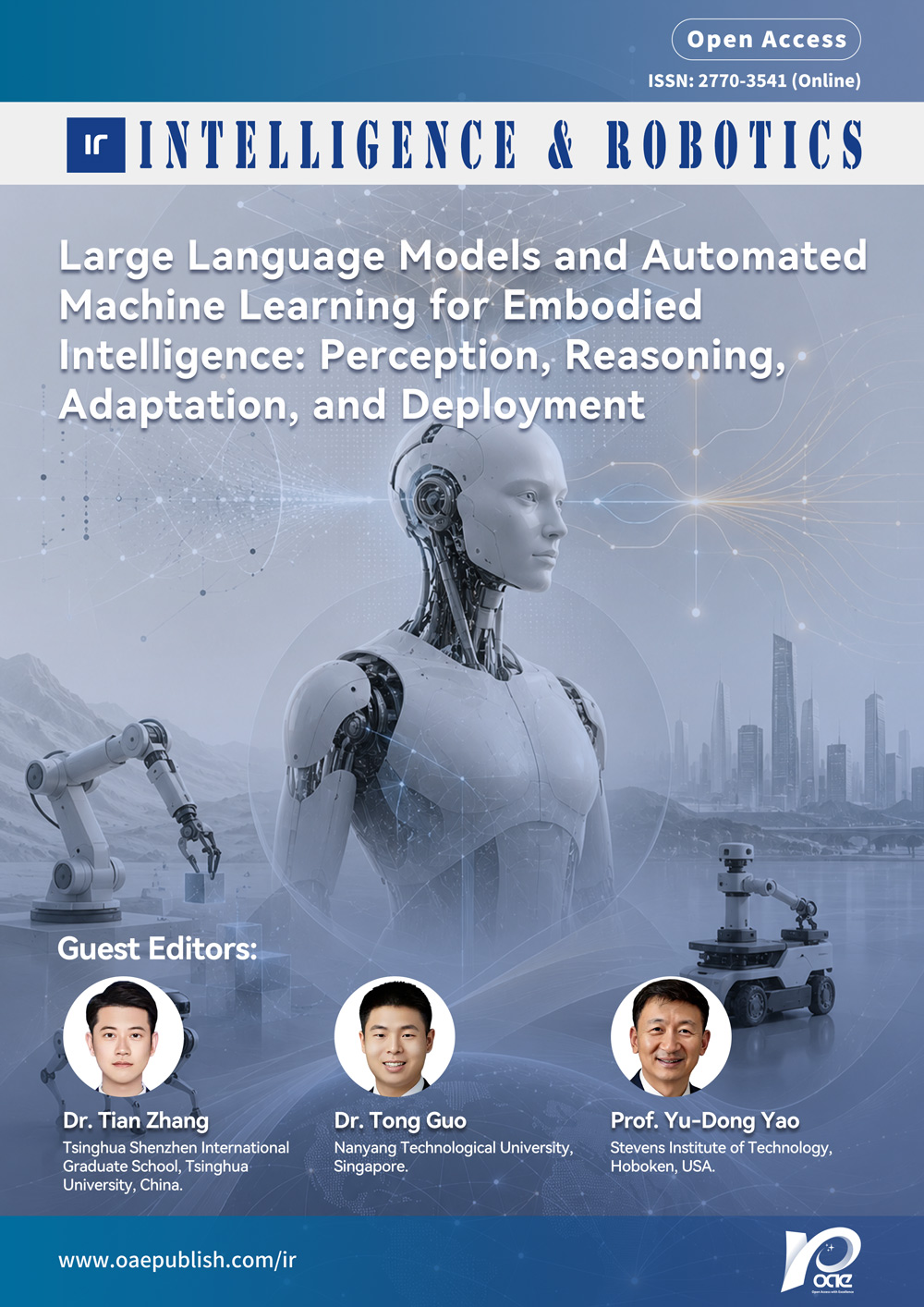
Topic: Large Language Models and Automated Machine Learning for Embodied Intelligence: Perception, Reasoning, Adaptation, and Deployment
Guest Editors
Special Topic Introduction
With the rapid advancement of robotics, multimodal artificial intelligence, and intelligent sensing technologies, embodied intelligence has emerged as a key paradigm for enabling intelligent agents to perceive, reason, interact with, and adapt to complex physical environments. Unlike conventional data-driven learning systems, embodied intelligent agents must operate under dynamic environmental conditions, partial observability, heterogeneous sensory inputs, limited computational resources, and realtime safety constraints. These characteristics create substantial challenges for developing robust, adaptive, and scalable embodied systems across applications such as autonomous robots, intelligent manufacturing, healthcare assistance, smart homes, autonomous driving, and human–robot collaboration.
The rapid progress of large language models (LLMs) and automated machine learning (AutoML) has opened new opportunities for advancing embodied intelligence. LLMs provide powerful capabilities for semantic understanding, multimodal reasoning, task planning, knowledge transfer, and human-centered interaction, enabling embodied agents to interpret high-level instructions and generate context-aware action strategies.
Meanwhile, AutoML and neural architecture search technologies can automatically optimize model architectures, learning strategies, sensor-fusion mechanisms, and deployment configurations according to task requirements and hardware constraints. By integrating LLM-driven reasoning with AutoML-enabled model design and optimization, embodied intelligent systems can achieve more efficient perception, adaptive decision-making, lifelong learning, trustworthy control, and resource-aware deployment in real-world environments.
This Special Issue aims to showcase state-of-the-art research advances, theoretical innovations, and practical applications of large language models and automated machine learning for embodied intelligence. It provides a dedicated forum for researchers, engineers, and industry practitioners to exchange ideas, share emerging findings, and explore new methodologies for building intelligent agents with enhanced perception, reasoning, interaction, adaptation, and deployment capabilities. The Special Issue will further promote the development of reliable, efficient, scalable, and humancentered embodied intelligence systems for next-generation real-world applications.
Topics of interest include, but are not limited to:
⚫ Systems, architectures, and computational frameworks for embodied intelligence;
⚫ Large language models and multimodal foundation models for embodied agents;
⚫ AutoML and neural architecture search for embodied perception, reasoning, and control;
⚫ Vision-language-action models for instruction understanding and embodied task execution;
⚫ Multi-modal perception and sensor-fusion methods for embodied intelligent systems;
⚫ LLM-driven task planning, decision-making, and tool use for autonomous robots;
⚫ Adaptive learning, continual learning, and self-evolution mechanisms for embodied agents;
⚫ Human-robot interaction and language-guided collaborative intelligence;
⚫ Safety, trustworthiness, interpretability, and robustness of LLM-enabled embodied systems;
⚫ Resource-aware deployment, edge intelligence, simulation-to-real transfer, and real-world validation of embodied intelligence systems, et al.
Keywords
Embodied intelligence, large language models, automated machine learning, neural architecture search, multimodal perception, vision-languageaction models, autonomous robots
Submission Deadline
Submission Information
For Author Instructions, please refer to https://www.oaepublish.com/ir/author_instructions
For Online Submission, please login at https://www.oaecenter.com/login?JournalId=ir&IssueId=ir26071510538
Submission Deadline: 31 May 2027
Contacts: Jenny Wang, Science Editor, [email protected]