


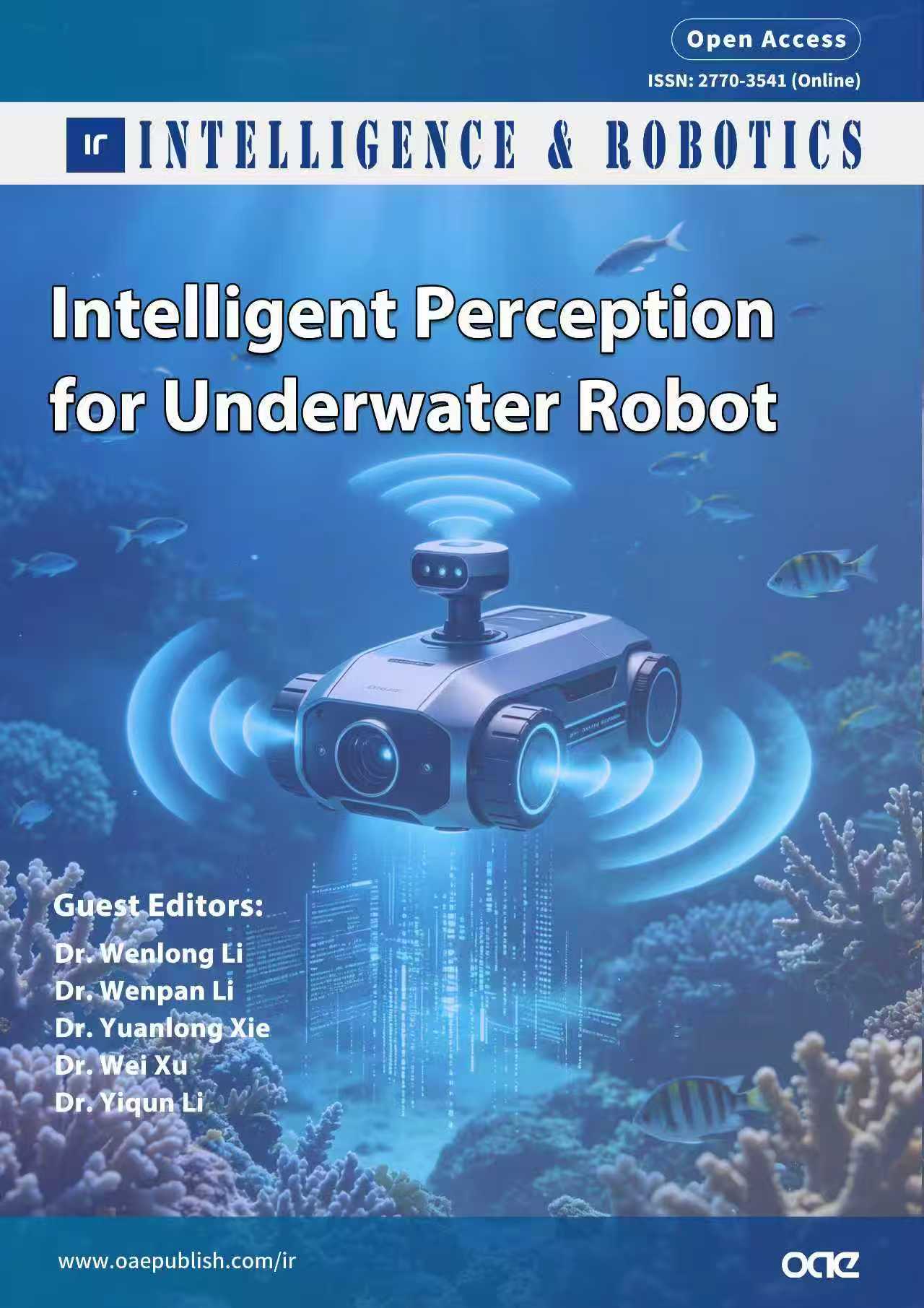
Topic: Intelligent Perception for Underwater Robots
Guest Editor
Assistant Guest Editor
Guest Editor Assistants
Special Topic Introduction
With the rapid advancement of robotics and cross-domain exploration, the application scenarios of robots have gradually expanded to underwater environments (e.g., oceans, ships, nuclear power facilities, and scientific exploration missions). The perception systems of underwater robots are inherently multi-modal, typically integrating optical imaging, sonar, light detection and ranging (LiDAR), and inertial measurement units (IMUs).
Multi-source data (e.g., optical, acoustic, and kinematic information) acquired by these sensors enable underwater robots to perceive underwater environments with improved accuracy and robustness. Recent breakthroughs in deep learning and embodied intelligence have further empowered underwater robots to perform key perception tasks (e.g., underwater three-dimensional (3D) reconstruction, simultaneous localization and mapping (SLAM)/structure from motion (SfM), and target detection/segmentation).
However, underwater environments present extreme challenges (e.g., signal attenuation, fluid disturbances, and light refraction/scattering effects), which often lead to image degradation, imaging distortion, and even sensor failure. Consequently, intelligent perception for underwater robots still faces numerous difficulties in data acquisition, multi-source data fusion, and theoretical, methodological, and practical aspects of perception systems.
This Special Issue aims to present the latest research on the theory, methodologies, systems, and applications of intelligent perception for underwater robots.
Topics of interest include, but are not limited to:
● Development of underwater sensors, including cameras, sonar systems, IMUs, and LiDAR;
● Calibration of single/multi-sensor underwater systems;
● Multi-source data collection, fusion, and post-processing;
● Enhancement of underwater data (e.g., optical, acoustic, and kinematic signals);
● Underwater SLAM, SfM, 3D reconstruction, and view rendering;
● Applications of deep learning in underwater robot perception;
● Embodied intelligence for underwater robots;
● Underwater object detection and segmentation;
● Robot perception in challenging underwater environments (e.g., high disturbance, radiation exposure, and extreme temperatures).
Keywords
Underwater robot perception, underwater sensor development, sensor calibration, underwater data enhancement, multi-source data fusion, underwater slam/sfm, underwater 3d reconstruction, underwater object detection/segmentation, deep learning, underwater embodied intelligence
Submission Deadline
Submission Information
For Author Instructions, please refer to https://www.oaepublish.com/ir/author_instructions
For Online Submission, please login at https://www.oaecenter.com/login?JournalId=ir&IssueId=ir26041610429
Submission Deadline: 15 May 2027
Contacts: Jenny Wang, Science Editor, [email protected]