


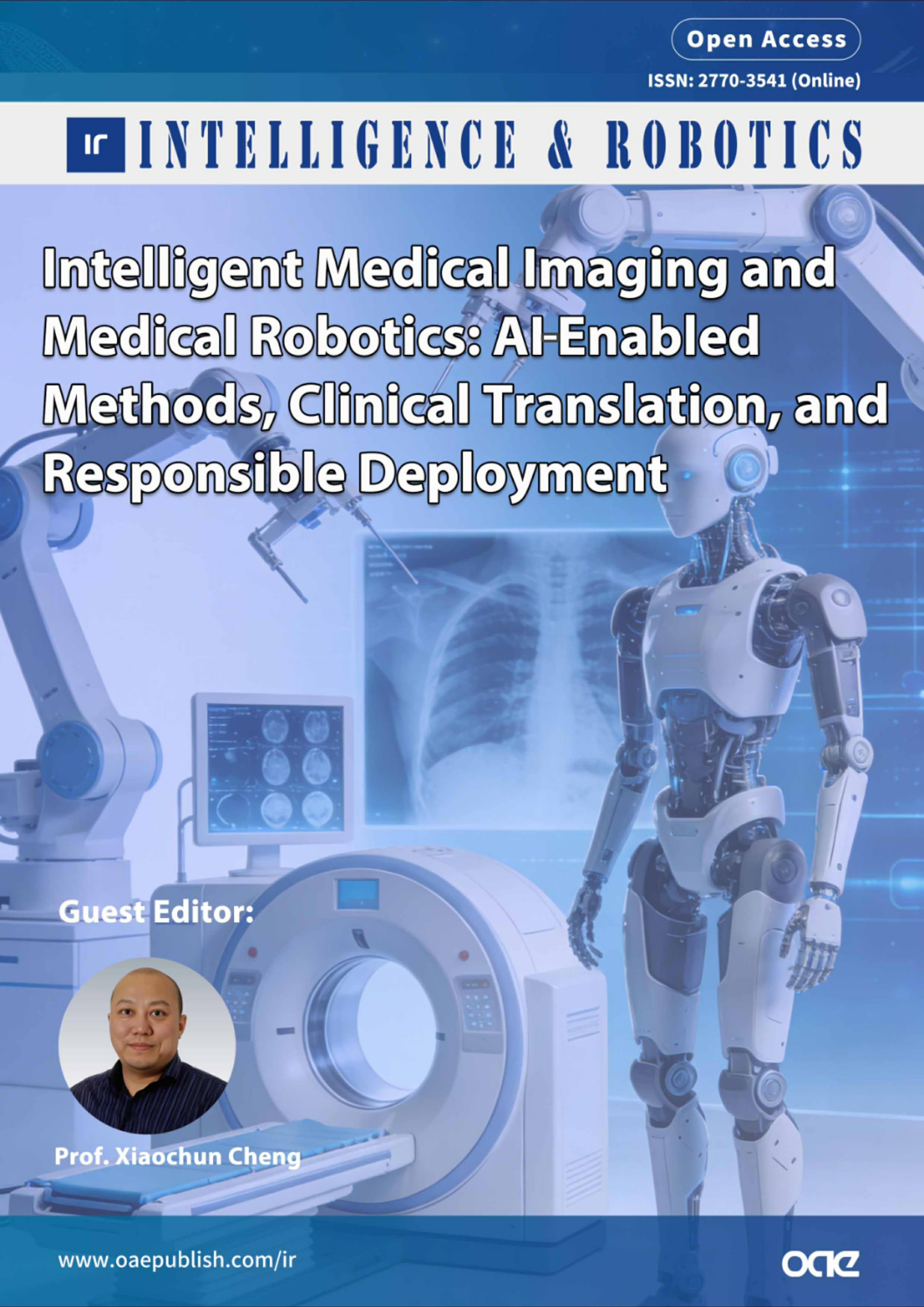
Topic: Intelligent Medical Imaging and Medical Robotics: AI Enabled Methods, Clinical Translation, and Responsible Deployment
Guest Editor
Special Topic Introduction
Medical image processing and medical robotics represent two foundational pillars of intelligent healthcare, jointly advancing clinical practice through complementary strengths in information acquisition and operative execution. Medical imaging underpins screening, diagnosis, disease staging, treatment planning, and outcome assessment. Core tasks such as image reconstruction, registration, segmentation, detection, and quantitative analysis demand robustness, interpretability, and rigorous validation to ensure clinical reliability. In parallel, surgical, interventional, and rehabilitation robotics are evolving from mechanically assisted devices toward intelligent systems with enhanced perception and decision-making capabilities. This evolution depends on the reliable integration of imaging-based perception, intraoperative navigation, surgical environment modeling, and safety-constrained control, enabling dependable human-machine collaboration.
This Special Issue focuses on the interdisciplinary frontier connecting medical imaging and medical robotics, with particular emphasis on end-to-end translation from methodological innovation to clinical deployment. Key themes include multimodal data fusion, closed-loop image-guided intervention, cross-site generalization, risk management, and compliance-oriented evaluation. The Special Issue aims to collect high-quality contributions that provide reproducible implementations and credible clinical evidence, thereby accelerating the practical and responsible adoption of intelligent imaging and robotic technologies in real-world healthcare settings.
Topics of interest include, but are not limited to:
● Medical image reconstruction and acceleration, including low-dose computed tomography (CT) reconstruction, fast magnetic resonance imaging (MRI), and optimized positron emission tomography (PET) reconstruction;
● Organ and lesion segmentation, detection, and quantitative measurement, including unified modeling for multitask settings;
● Cross-modality and multimodal learning, including PET/CT, PET/MRI, ultrasound, endoscopy, and related fusion paradigms;
● Image registration, motion compensation, and target tracking for preoperative planning and intraoperative navigation;
● Radiomics, imaging phenotypes, and clinical outcome prediction, including joint modeling with multiomics data;
● Self-supervised learning, weakly supervised learning, and foundation model adaptation, fine-tuning, and benchmarking for medical imaging;
● Uncertainty estimation, explainable methods, and trustworthy learning to improve clinical usability and risk controllability;
● Privacy-preserving learning, federated learning, and secure data sharing to support multi-institution collaboration and multicenter validation;
● Medical robot perception and control, including visual perception, force feedback, planning, control strategies, and safety constraints;
● Image-guided intervention and closed-loop systems, including navigation, localization, path planning, real-time correction, and control loop design;
● Human-machine collaboration and clinical workflow integration, including interaction design, usability evaluation, and team-centered deployment;
● Clinical trials and real-world validation, including data standardization, bias control, regulatory compliance, and reproducibility reporting.
Keywords
Medical image processing, image reconstruction, segmentation, registration, multimodal fusion, radiomics, foundation models, self-supervised learning, medical robotics, image-guided intervention, safety and validation, responsible artificial intelligence (AI)
Submission Deadline
Submission Information
For Author Instructions, please refer to https://www.oaepublish.com/ir/author_instructions
For Online Submission, please login at https://www.oaecenter.com/login?JournalId=ir&IssueId=ir26011910355
Submission Deadline: 31 Oct 2026
Contacts: Jenny Wang, Science Editor, [email protected]