


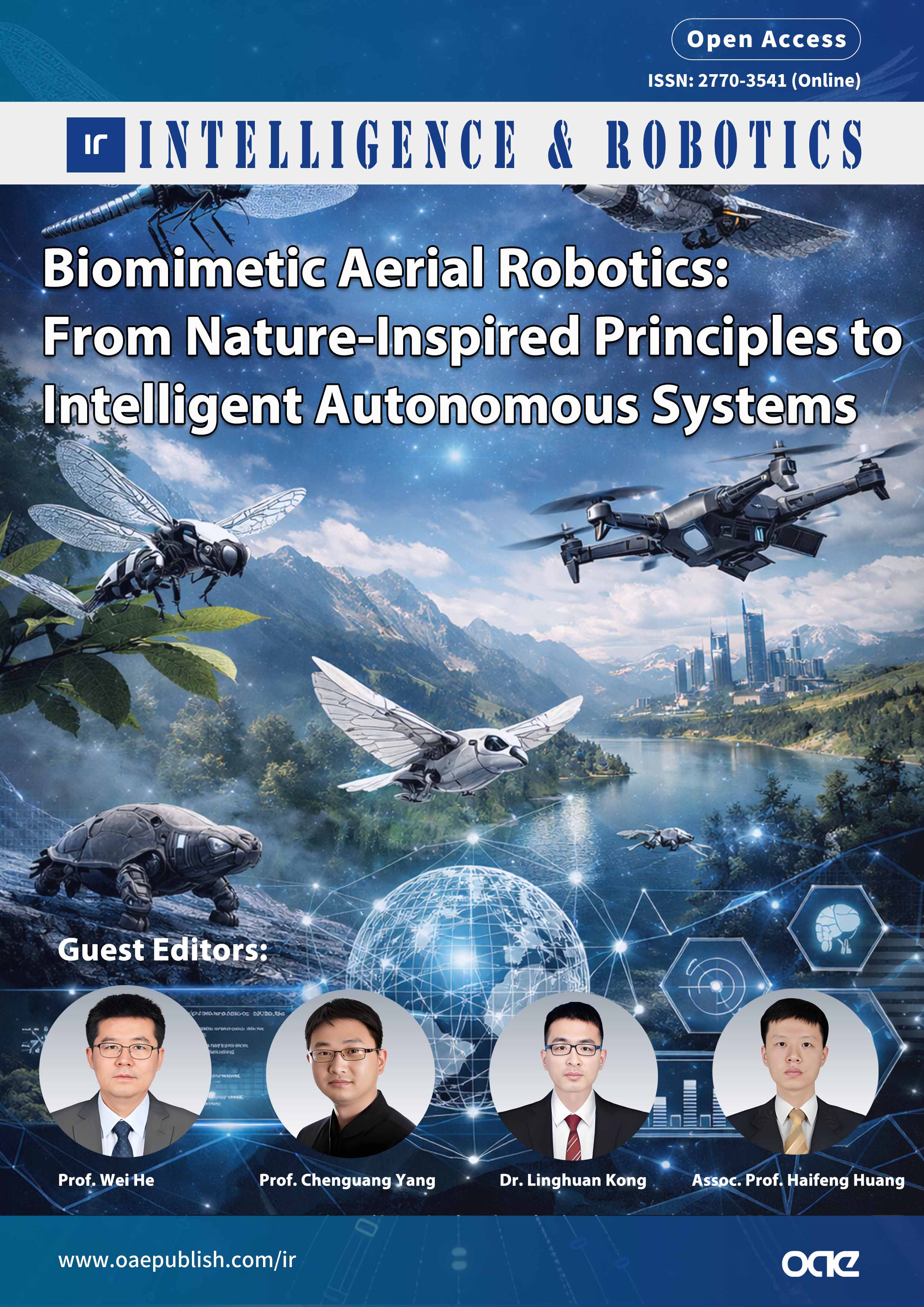
Topic: Biomimetic Aerial Robotics: From Nature-Inspired Principles to Intelligent Autonomous Systems
Guest Editors
Special Topic Introduction
Biomimetics has long served as a powerful paradigm for advancing aerial robotic systems, extending far beyond the simple imitation of biological flight mechanics. Natural organisms exhibit sophisticated solutions at multiple levels—including morphology, sensing, control, cognition, adaptation, and collective behavior—that enable robust, efficient, and intelligent operation in highly complex environments. These multifaceted and multi-scale biological principles not only provide crucial insights for the development of next-generation aerial robotic systems, but also establish a solid foundation for interdisciplinary research and practical applications. By leveraging such principles, researchers are driving the development of more flexible and adaptive aerial robots, thereby promoting continuous progress and innovation across the field.
Recent advances in artificial intelligence have significantly accelerated the translation of biomimetic principles into practical aerial robotic systems. Learning-based methods, adaptive control, neuromorphic sensing, and distributed intelligence offer new tools to capture, abstract, and implement biological strategies on aerial platforms. As a result, aerial robots are increasingly capable of autonomous perception, decision making, adaptive control, and coordinated behavior under uncertainty.
This Special Issue aims to bring together cutting-edge research that explores biomimetic principles across the full spectrum of aerial robotics, from physical embodiment and flight mechanisms to intelligent behavior and swarm systems. It focuses on the deep integration of nature-inspired principles and artificial intelligence technologies, providing a high-level academic exchange platform to promote the development of next-generation biomimetic aerial robots.
Topics of Interest
Topics include, but are not limited to, the following:
1. Biomimetic Structures, Materials, and Mechanisms for Aerial Robots
● Nature-inspired structural and morphological design for aerial robots;
● Compliant mechanisms, flexible and morphing wings;
● Bio-inspired actuation and smart materials;
● Embodied intelligence and structure–function co-design.
2. Bio-inspired Flight and Aerial Locomotion Mechanisms and Aerodynamics
● Flapping, gliding, hovering, and agile maneuvering inspired by biology;
● Unsteady and adaptive aerodynamics for aerial robots;
● Bio-inspired strategies for energy-efficient and robust flight;
● Multimodal and hybrid aerial locomotion mechanisms.
3. Bio-inspired Perception and Environmental Understanding for Aerial Robots
● Bio-inspired vision, optical flow, polarization, and acoustic sensing;
● Neuromorphic and event-based sensing for aerial platforms;
● Multimodal perception and sensor fusion in complex environments;
● Environment-aware perception for autonomous aerial operation.
4. Biomimetic Control and Intelligent Learning for Aerial Robots
● Bio-inspired control architectures and motor primitives;
● Adaptive, robust, and learning-based flight control;
● Reinforcement learning and bio-inspired learning strategies;
● Hybrid model-based and data-driven control methods.
5. Autonomy, DecisionMaking, and Cognitive Intelligence in Aerial Robots
● Bio-inspired autonomous decisionmaking and behavior generation;
● Planning, navigation, and task execution inspired by biological systems;
● Attention, memory, and cognitive architectures for aerial robots;
● Lifelong learning and adaptive autonomy.
6. Biomimetic Aerial Robot Swarms and Collective Intelligence
● Bio-inspired swarm coordination and self-organization;
● Distributed perception, learning, and control in aerial robot swarms;
● Collective decisionmaking and cooperative behaviors;
● Emergent intelligence in multi-aerialrobot systems.
Keywords
Biomimetic aerial robotics, nature-inspired flight and aerodynamics, bio-inspired perception and neuromorphic sensing, biomimetic control and learning-based autonomy, embodied intelligence and morphological design, cognitive decision making in aerial systems, swarm aerial robotics and collective intelligence
Submission Deadline
Submission Information
For Author Instructions, please refer to https://www.oaepublish.com/ir/author_instructions
For Online Submission, please login at https://www.oaecenter.com/login?JournalId=ir&IssueId=ir25123010340
Submission Deadline: 28 Mar 2026
Contacts: Jenny Wang, Assistant Editor, [email protected]