


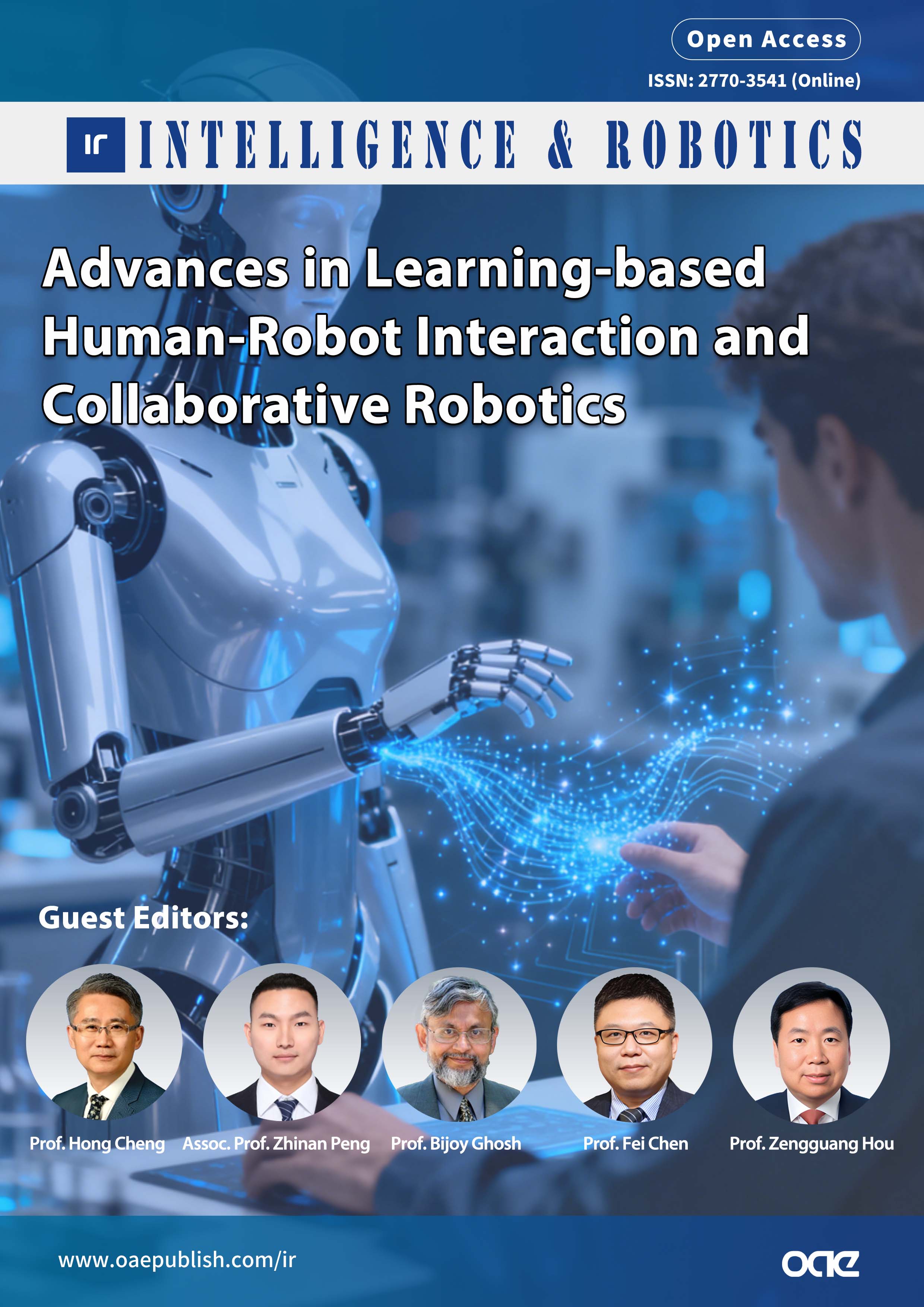
Topic: Advances in Learning-based Human-Robot Interaction and Collaborative Robotics
Guest Editors
Special Topic Introduction
Robotic technologies are rapidly advancing toward autonomous operation in unstructured and dynamic environments, redefining the traditional boundaries between humans and machines. These advancements are driving transformative changes across manufacturing, medical rehabilitation, service industries, and many other domains. Progress in this field relies on two closely intertwined pillars: embodied intelligence and learning-based methodologies. Embodied intelligence, which integrates physical and cognitive capabilities, plays a pivotal role in enabling robust, real-time decision making and autonomous operation. Learning-based approaches—leveraging recent breakthroughs in machine learning such as large language models (LLMs), vision-language models (VLMs), multimodal learning, reinforcement learning (RL), and imitation learning (IL)—have significantly enhanced robots’ abilities to adapt to complex environments.
Despite substantial advancements achieved independently through embodied intelligence and learning-based methods, integrating these two paradigms remains a major challenge. Critical issues persist in real-world human-robot interaction, including accurate understanding of human intent, transparent and intuitive interaction, and efficient collaborative decision making. This Special Issue aims to bridge these gaps by focusing on learning-enabled human-robot interaction and collaborative robotics. We welcome submissions presenting innovative approaches, advanced systems, and practical applications. Both original research articles and comprehensive reviews are encouraged.
Topics of interest include, but are not limited to:
● Learning-based human intent understanding and motion prediction;
● Reinforcement learning, imitation learning, and preference learning for human-robot collaboration;
● Foundation models for interactive and collaborative robots;
● Multimodal perception and sensor fusion for human-robot collaboration;
● Game-theoretic approaches to human-robot interaction and collaborative decision optimization;
● Human-in-the-loop learning and shared autonomy;
● Trustworthy and adaptive control for physical human-robot interaction;
● Collaborative manipulation and task planning;
● Human-centered robot learning and sim-to-real transfer;
● Safety, interpretability, and verifiability in human-robot systems;
● Applications of artificial intelligence in intelligent robotic rehabilitation.
Keywords
Human-robot collaboration, interactive robots, human-machine cooperation, robot learning; multimodal perception, human intent understanding, imitation learning, reinforcement learning, foundation models
Submission Deadline
Submission Information
For Author Instructions, please refer to https://www.oaepublish.com/ir/author_instructions
For Online Submission, please login at https://www.oaecenter.com/login?JournalId=ir&IssueId=ir25121610313
Submission Deadline: 15 May 2027
Contacts: Shine Wei, Assistant Editor, [email protected]