
Figure7
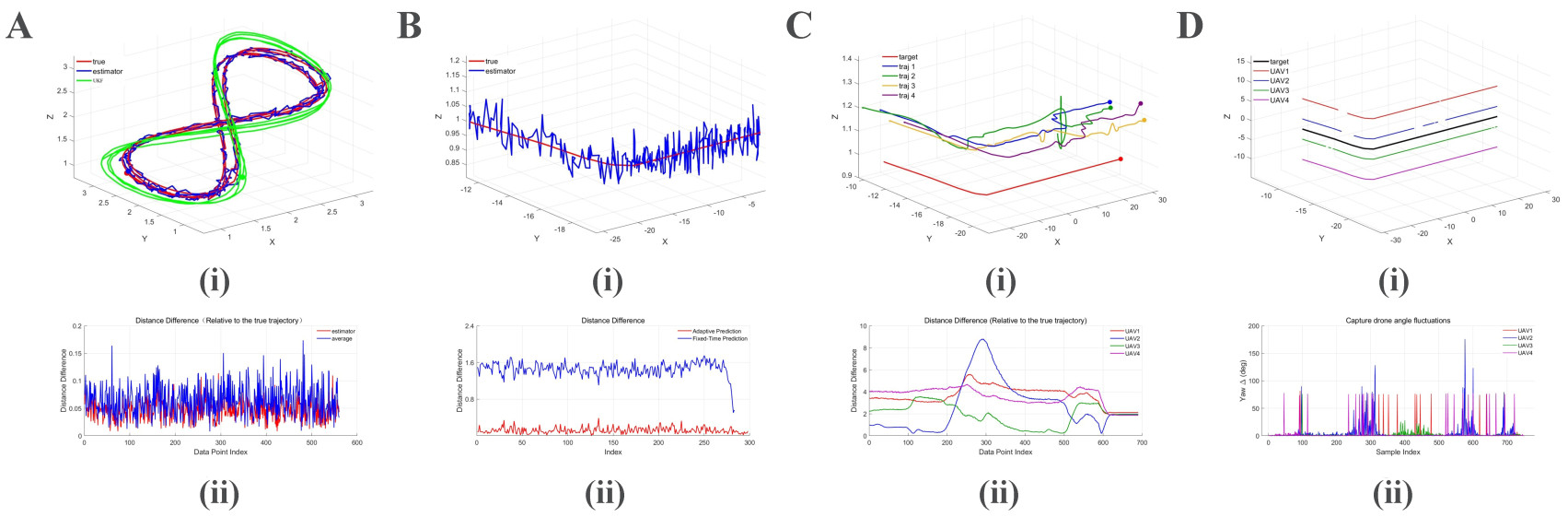
Figure 7. Metric validation. (A) show target position estimation results: [A(i)] compares the actual target trajectory, the proposed estimated trajectory, and the UKF estimated trajectory. [A(ii)] compares the estimation error of the proposed method and the average method; (B) show target state prediction results: [B(i)] compares the actual trajectory with the trajectory obtained by the adaptive prediction method. [B(ii)] compares the differences between adaptive prediction, current velocity fixed time difference prediction, and the actual trajectory; (C) show the trajectory status during the capture process: [C(i)] presents the historical trajectories of the drones, and [C(ii)] shows the distance between each drone and the target over time; (D) Visibility and yaw‑angle results during the capture process. [D(i)] Visibility status of each UAV with respect to the target: solid segments indicate that the target is visible, while blank gaps indicate that the target is not visible. [D(ii)] Yaw‑angle trajectories of all capturing UAVs over time. UKF: Unscented Kalman filter; UAV: unmanned aerial vehicle.