

Direct regeneration of degraded Ni-rich cathodes: coupled ion and electron transport perspectives
 0
0 Abstract
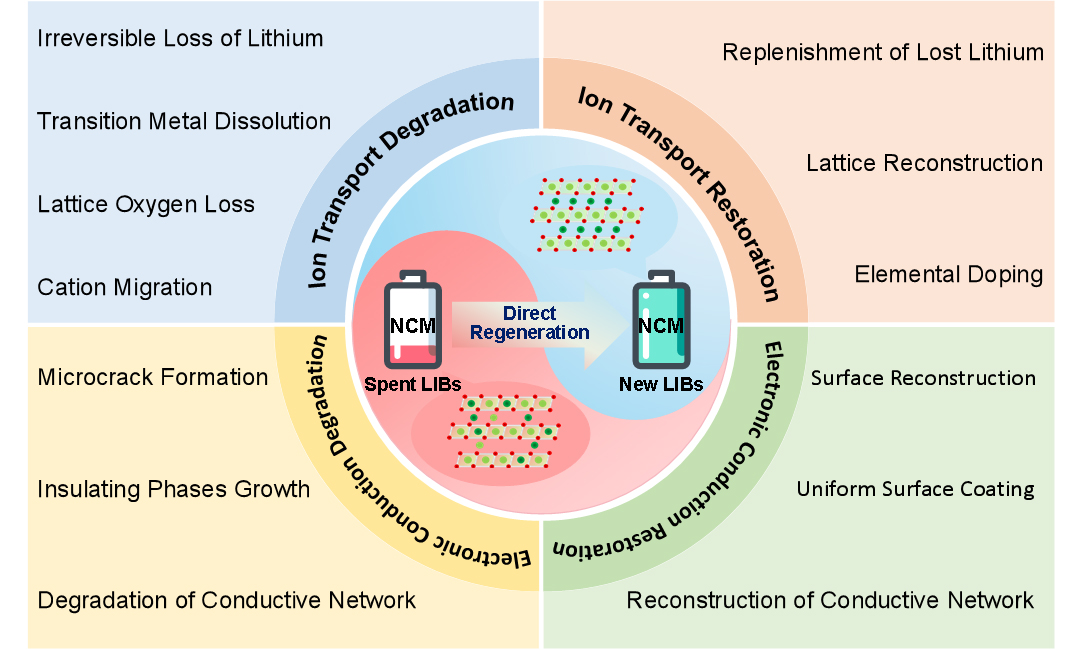
Ternary oxide cathode materials (LiNixCoyMn1-x-yO2, NCM) undergo multiscale structural and functional degradation during prolonged electrochemical cycling, driven by the coupled failure of lithium-ion transport pathways and electronic conduction networks. These degradations critically limit battery cycle life and sustainable utilization. This review systematically analyzes the dominant degradation mechanisms in NCM from two perspectives: ion transport and electronic conduction. For ion transport, the impacts of irreversible lithium loss, cation mixing, and transition-metal dissolution on Li⁺ diffusion are examined, alongside direct regeneration strategies such as relithiation and elemental doping. For electronic conduction, failure modes including microcrack formation, surface insulating layers, and electrode structural deterioration are discussed, with corresponding repair approaches encompassing surface reconstruction, coating engineering, multiscale conductive networks, and high-performance binders. By correlating degradation behaviors and regeneration strategies across multiple length scales, this work provides a unified mechanistic framework and practical guidance for the high-performance direct regeneration and sustainable reuse of degraded NCM cathodes.
Keywords
INTRODUCTION
The rapid expansion of electrified transportation and renewable energy storage systems has driven substantial growth in the lithium-ion battery (LIB) industry, accompanied by a corresponding surge in end-of-life LIBs. By 2030, the global volume of retired LIBs is projected to exceed 11 million metric tons[1]. Effectively managing this substantial waste stream necessitates the advancement of efficient and environmentally friendly battery recycling technologies, which are vital for critical material recovery, supply chain resilience, and the long-term sustainability of the new energy vehicle sector[2-5].
Among LIB components, cathode materials represent the most critical targets for recycling due to their high economic value and complex chemistry[6,7]. Nickel-cobalt-manganese ternary layered cathode materials (LiNixCoyMn1-x-yO2, NCM) are among the most widely developed cathodes in contemporary power batteries, owing to their high energy density, tunable operating voltage, and favorable rate capability. Consequently, NCM cathodes have become a central focus of recycling research[5,8]. Existing recycling strategies [Figure 1] are broadly categorize2d into pyrometallurgical, hydrometallurgical, and direct recycling approaches[9]. Pyrometallurgical processes recover metals by high-temperature reduction to alloys, offering simplified process flows but incurring substantial energy penalties[10]. Hydrometallurgical methods achieve high recovery efficiencies through selective leaching with acidic or alkaline reagents, yet often fall short of emerging requirements for environmentally sustainable processing[11]. By contrast, direct regeneration aims to restore, or even improve, the electrochemical performance of degraded cathode materials through targeted repair of structural defects while preserving the original crystal framework. This strategy enables efficient material-level recycling and has attracted growing interest from both academia and industry[12-14].
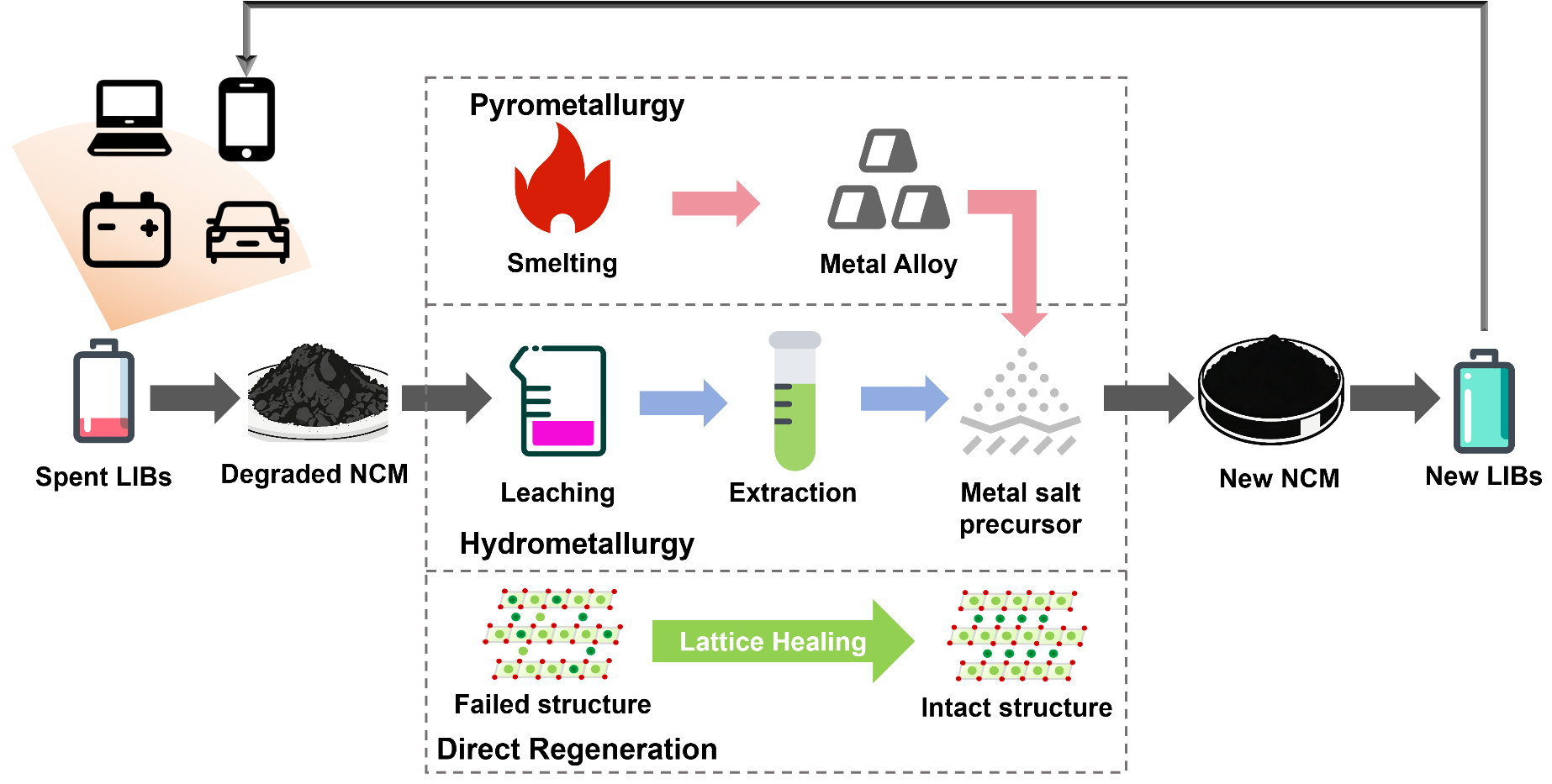
Figure 1. Schematic illustration of the recycling processes for spent NCM cathodes. LIB: Lithium-ion battery; NCM: LiNixCoyMn1-x-yO2.
The primary advantage of direct regeneration lies in its ability to preserve the intrinsic structure and value of cathode materials, thereby substantially reducing resource and energy consumption. However, its practical implementation remains constrained by several critical challenges[15,16]. On one hand, prolonged electrochemical cycling induces irreversible lithium loss, disrupting stoichiometric balance and generating bulk structural defects, such as Li/Ni cation mixing, which impedes lithium-ion transport. On the other hand, microcrack formation and the development of surface insulating layers progressively degrade electronic conduction pathways within and between particles. In addition, persistent side reactions at the electrode/electrolyte interface under high-voltage and chemically complex conditions promote uncontrolled passivation layer growth, further increasing charge-transfer resistance. These structural and interfacial degradation processes do not evolve independently but tend to interact and accumulate during cycling. Over time, they manifest as the coupled deterioration of ionic and electronic transport across both bulk and interfacial domains, which significantly limits the effectiveness of direct regeneration technologies.
Despite the growing body of literature addressing cathode degradation, most existing studies and review articles have analyzed ionic transport degradation and electronic conduction deterioration from isolated perspectives[16-19]. The intrinsic interdependence and cooperative evolution between these two transport processes remain insufficiently integrated into a unified analytical framework. Conventional approaches often treat lithium diffusion limitation and electronic conductivity loss as relatively independent phenomena, which restricts the comprehensive understanding of realistic multiscale degradation behavior in practical NCM systems. Therefore, establishing a coupled-failure framework that simultaneously integrates ionic and electronic transport degradation is critical to bridge the gap between single-mechanism interpretations and the complex synergistic degradation observed in real electrode systems. Such a perspective also provides a fundamentally new theoretical basis for developing more precise and efficient regeneration strategies.
Based on these considerations, this review focuses on the two fundamental bottlenecks of lithium-ion diffusion limitation and electronic conduction network deterioration. We systematically analyze their representative degradation modes and coupled evolution behaviors across particle, interfacial, and electrode scales. Furthermore, key regulation strategies, including bulk defect repair and reconstruction of electronic conduction pathways, are comprehensively summarized to establish a mechanistic linkage between degradation phenomena and regeneration approaches. These efforts aim to provide a unified theoretical framework and practical guidance for overcoming current recycling bottlenecks and enabling high-performance regeneration of spent NCM cathode materials.
DEGRADATION MECHANISMS OF NCM CATHODES
The electrochemical performance degradation of NCM cathode materials in retired LIBs fundamentally arises from the multiscale deterioration of charge storage and transport functions[20]. This degradation is primarily driven by the coupled impairment of ionic transport pathways and electronic conduction networks induced by prolonged electrochemical cycling and interfacial side reactions. In this section, the underlying failure mechanisms and their co-evolution during cycling are systematically analyzed from the complementary perspectives of ion transport and electronic conduction.
Bulk structural defects and hindered ion transport
Efficient and reversible lithium-ion migration within the layered lattice of NCM cathodes is essential to their electrochemical performance. Under ideal conditions, lithium ions undergo ordered intercalation and deintercalation along well-defined crystallographic pathways, with diffusion behavior governed primarily by intrinsic lattice defects and the local coordination environment[21-23]. During prolonged electrochemical cycling, however, repeated lithium insertion/extraction and associated transition-metal redox reactions induce coupled electrochemical-mechanical effects, leading to the accumulation of volumetric strain and internal stress within the bulk material. These processes progressively drive the formation and evolution of multiscale structural defects[24], which disrupt continuous lithium-ion transport pathways and result in systematic deterioration of diffusion kinetics. The major defect types and their underlying mechanisms are summarized below.
Lithium-ion loss and lattice instability
Irreversible loss of active lithium drives NCM cathodes from their ideal stoichiometric composition (LiMO2) toward a lithium-deficient state (Li1-xMO2), with x increasing over repeated cycling, and is a major cause of performance decay [Figure 2A][25-27]. Meanwhile, the disordered accumulation of lithium vacancies represents another critical factor triggering structural instability[28]. These vacancies are not uniformly distributed; instead, their localized enrichment provides both pathways and driving forces for the migration of transition-metal (TM) ions with similar ionic radii (including Ni, Co, and Mn), particularly Ni2+ (0.69 Å), into the lithium layers. This results in the formation of Li/TM anti-site defects, which physically block the two-dimensional lithium-ion diffusion channels and thereby exacerbate electrode polarization [Figure 2B][29-32]. The formation and progressive aggravation of Li/TM anti-site defects signify a structural transition of the material from an ordered layered framework (α-NaFeO2 type) toward a more disordered configuration. These defects destabilize lattice oxygen, promote oxygen vacancies and O-O dimer formation, and trigger the release of molecular O2[33,34]. The emergence of oxygen vacancies further lowers the migration barrier of TM ions, thereby establishing a deleterious feedback loop of anti-site formation and oxygen loss that progressively weakens the lattice and can ultimately lead to structural collapse[35].
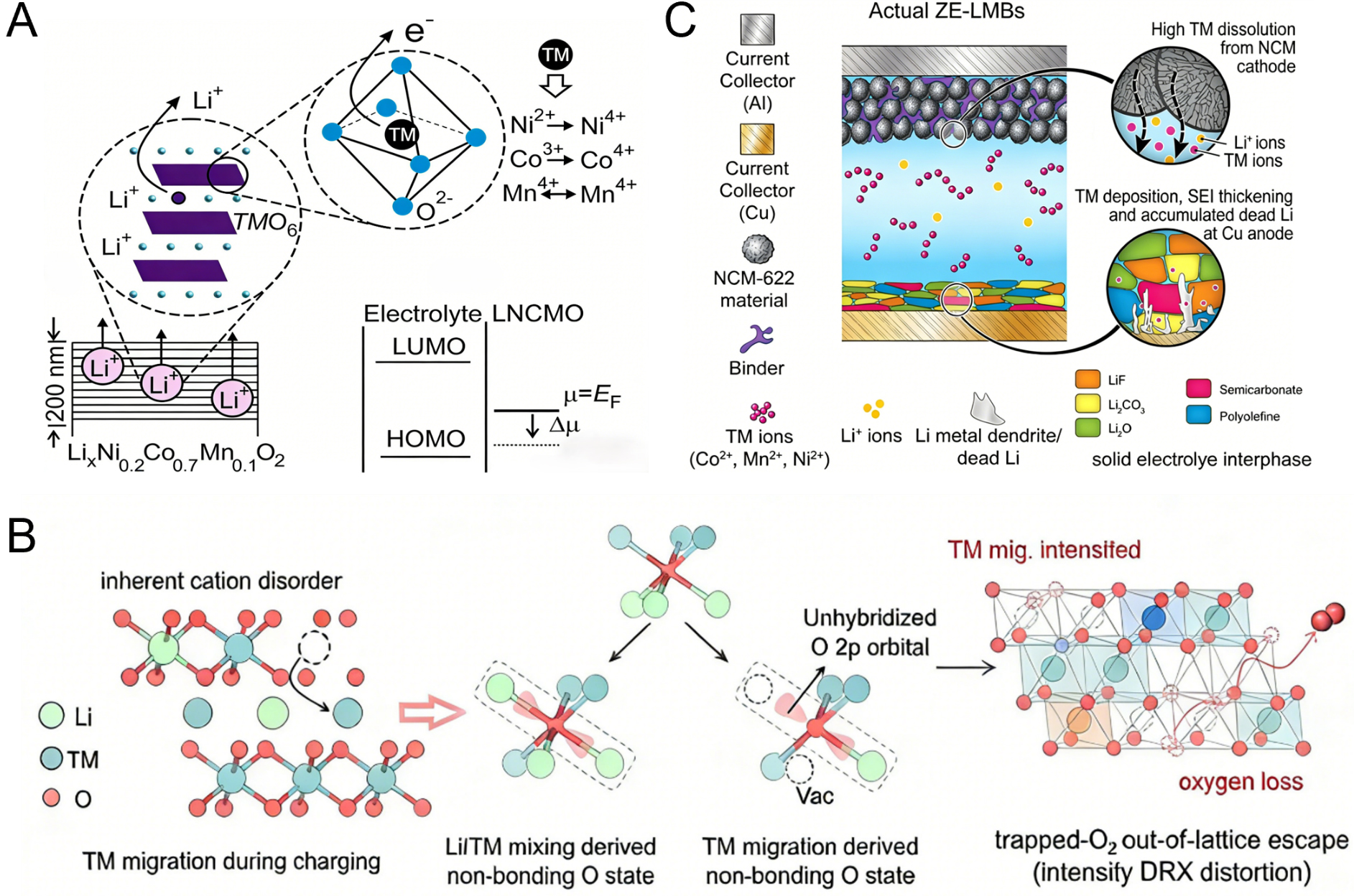
Figure 2. Schematic illustration of the evolution of bulk structural defects and their impact on lithium-ion transport in NCM cathodes. (A) Irreversible lithium loss and formation of lithium vacancies during the cycling process[26]. Copyright 2015, American Chemical Society; (B) TM migration into lithium layers causes cation disorder and oxygen vacancies[32]. Copyright 2026, Wiley-VCH; (C) Dissolved transition metal ions deposit on the anodes[37]. Copyright 2024, Wiley-VCH. TM: Transition metal, including Ni, Co and Mn; LNCMO: LixNi0.2Co0.7Mn0.1O2; LUMO: Lowest Unoccupied Molecular Orbital; HOMO: Highest Occupied Molecular Orbital; LMB: lithium metal batteries; NCM: LiNixCoyMn1-x-yO2; SEI: solid-electrolyte interphase; DRX: disordered rock salts.
Transition-metal ions dissolution, migration, and deposition
Cathode–electrolyte interface instability arises from multiple, interrelated factors, including electrolyte oxidation, Jahn-Teller distortions, and phase transitions, which collectively promote the dissolution of TM ions from the lattice[36]. Dissolved TM ions not only lead to direct loss of active material but also migrate toward the anode under the electric field and deposit there [Figure 2C][37,38]. Such deposition catalyzes further electrolyte decomposition, exacerbates active lithium loss, and promotes the continuous growth of the solid-electrolyte interphase (SEI), ultimately contributing to capacity fade[39-41].
Disruption and failure of electronic conduction pathways
In LIBs, stable electronic conduction is essential for effective charge transport, working in tandem with lithium-ion migration between electrodes. Any disruption that lengthens, blocks, or reroutes electronic pathways can raise internal resistance, lower active material utilization, and accelerate capacity loss. Such failures are especially evident at the particle and electrode levels, where structural and interfacial defects impair electron transport.
Disruption of electronic conduction networks at the particle scale
The electronic conduction capability of NCM cathode materials is intrinsically limited by the electronic structure of their TM-O framework, while variations in the structural continuity at the particle scale further modulate the practical realization of this intrinsic conductivity in actual materials[42,43]. During cycling, structural evolution readily occurs within particle interiors and at interfaces, such as the formation of microcracks and the development of surface insulating layers. These local structural changes introduce barriers to electron transport, weaken the continuity of electron migration across different regions, and consequently reduce the electrochemical participation of certain active areas[44]. A systematic understanding of the degradation behavior of the electronic conduction network at the particle scale is therefore essential to elucidate the mechanisms underlying performance decay in NCM cathodes.
The formation of microcracks disrupts particle structural continuity and introduces additional local barriers to electron transport, thereby weakening the continuity of electronic pathways[45,46]. Although multiple factors contribute to microcrack formation, lattice stress induced by lithium intercalation/deintercalation during cycling is considered a primary driving force[47,48]. During deep charging, NCM materials, particularly Ni-rich compositions, undergo a pronounced H2 to H3 phase transition, accompanied by significant c-axis contraction and comparatively limited a-axis shrinkage, resulting in marked anisotropic volumetric changes[27,49]. In secondary particles formed from agglomerated primary particles with differing crystallographic orientations, non-uniform expansion and contraction generate concentrated internal stresses at vulnerable regions such as grain boundaries. Once the local stress exceeds the material’s cohesive strength, microcracks nucleate and propagate along primary particle boundaries, gradually forming crack networks spanning entire secondary particles [Figure 3A][44,50]. From the perspective of electronic conduction, the emergence of microcracks within particles alters the originally continuous electron transport pathways. This not only reduces the effective contact area between primary particles but also introduces additional interfacial barriers at the local scale, making electron migration between different regions within a particle increasingly dependent on the limited residual contact pathways[51]. As cycling progresses, conduction pathways become increasingly heterogeneous, placing certain regions at a kinetic disadvantage, limiting their electrochemical participation, and progressively degrading overall material performance[52].
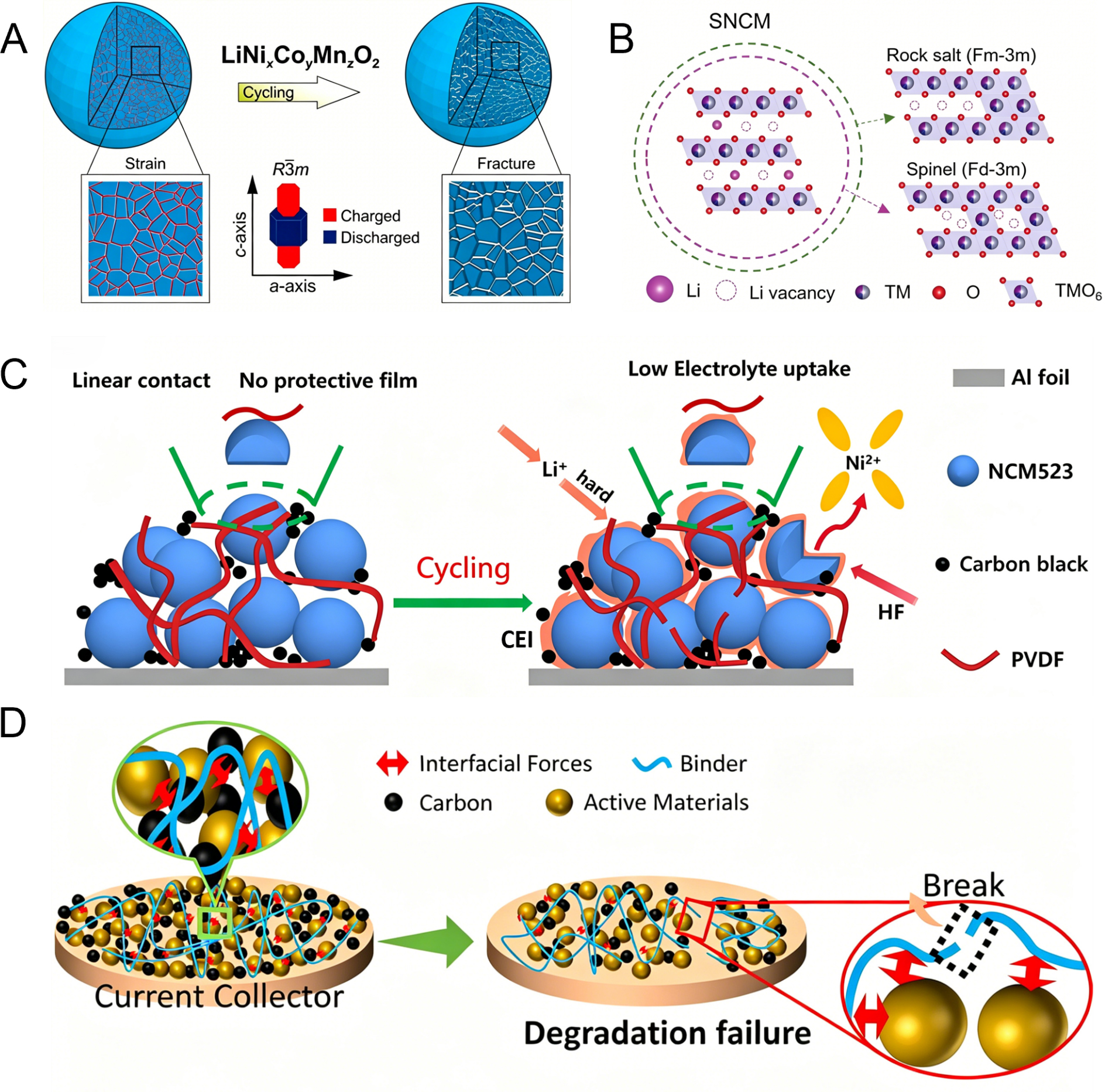
Figure 3. The failure behavior of Electronic Conduction Networks. (A) Anisotropic lattice stress leads to the formation of microcracks[50]. Copyright 2017, American Chemical Society; (B) Transformation of the ordered layered structure into rock-salt and spinel phases on the surface of degraded NCM cathodes[56]. Copyright 2025, Wiley-VCH; (C) Formation of the CEI layer with low electrolyte uptake on the surface of NCM particles induced by electrolyte reactions during cycling[58]. Copyright 2022, American Chemical Society; (D) Polymer chain fracture leads to binder failure, thereby impairing electronic conduction[66]. Copyright 2024, Royal Society of Chemistry. SNCM: Spent LiNixCoyMn1-x-yO2; NCM: LiNixCoyMn1-x-yO2; PVDF: polyvinylidene fluoride; CEI: cathode-electrolyte interphase.
Insulating phases formed on the particle surface constitute an additional barrier to electronic conduction in NCM cathodes. A critical underlying factor is the reconstruction of the crystal structure at the particle surface. During prolonged cycling, particularly under high-voltage conditions, the layered structure at the particle surface irreversibly transforms into thermodynamically more stable rock-salt or spinel phases due to lattice oxygen loss and the migration of TM ions, primarily Ni2+ [Figure 3B][53-56]. These reconstructed surface phases are electronically insulating and form an intrinsic barrier that hinders electron transport from the bulk to the particle surface[55]. In parallel with structural reconstruction, electrochemical side reactions at the cathode/electrolyte interface further exacerbate interfacial resistance[57]. Under high-voltage cycling conditions, a series of complex side reactions readily occur at the interface, and the oxidative decomposition of organic electrolytes on the cathode surface gradually leads to the formation of a cathode-electrolyte interphase (CEI) covering the particle surface [Figure 3C][58-60]. The CEI initially consists primarily of organic lithium salts but evolves into a composite layer dominated by highly ion- and electron-insulating inorganic species (such as LiF and Li2CO3) and polymeric species[59]. As both the reconstructed surface phases and the CEI layer thicken and become more continuous, their combined impediment to interfacial charge transfer becomes increasingly significant, leading to sluggish reaction kinetics, increased polarization, and pronounced performance degradation, particularly under high-rate conditions[59].
The degradation of the electronic conduction network within NCM particles proceeds hierarchically, from physical structural damage to interfacial chemical passivation. Microcrack formation disrupts the continuity of intrinsic electron pathways, while surface insulating phases further impede interfacial charge transfer. These processes are strongly coupled: microcracks allow electrolyte penetration into particle interiors, promoting side reactions and local structural evolution at newly exposed surfaces, while surface reconstruction and the associated volumetric changes and stress accumulation can trigger further crack initiation and propagation[32,61]. The interplay of these physical and chemical processes progressively weakens particle-scale electronic conduction, limiting the electrochemical activity of certain regions during cycling. This behavior is particularly pronounced in Ni-rich NCM materials.
Degradation of macroscopic electronic conduction networks at the electrode scale
Cathode materials in LIBs are composite systems composed of active material particles, conductive additives, binders, and metallic current collectors. The macroscopic electronic conduction of such electrodes relies on the integrity and stability of the three-dimensional conductive network formed by the synergistic interaction of these components[62-64]. During electrochemical cycling, this network can undergo structural and functional evolution under the combined influence of electric fields, mechanical stresses, and chemical reactions, which directly influence electron transport at the electrode scale. Unlike particle-level failures, which are primarily governed by local structural continuity, electrode-scale conduction degradation involves the coordinated evolution of multiple component interfaces, spatial scales, and transport pathways. This complexity leads to more intricate failure modes and exerts a pronounced impact on overall electrode performance.
At the electrode scale, the evolution of physical contacts between active material particles and conductive additives plays a critical role in the stability of the macroscopic electronic conduction network. Conductive additives, such as carbon black or carbon nanotubes, are generally dispersed among active particles through point contacts, bridging, or localized networks rather than forming continuous coatings, facilitating electron transport between the current collector and individual particles[63]. During cycling, NCM particles undergo repeated volumetric changes, which are further amplified under deep charge-discharge conditions, thereby introducing cyclic shear and tensile stresses at the interfaces between particles and the conductive network[49]. Concurrently, microcracks propagating to particle surfaces alter particle geometry and modes of contact. Over extended cycling, these structural and mechanical effects may lead to the gradual deterioration of interfacial contact between active particles and conductive additives[38,65]. Reduced contact areas and redistributed or agglomerated conductive additives increase pathway tortuosity and spatial heterogeneity within the network, manifesting as diminished macroscopic electron transport[66]. Cumulatively, this degradation elevates internal electrode resistance and limits the kinetic accessibility of active material, contributing to a gradual decline in reversible capacity.
The chemical and mechanical stability of the binder is critical for maintaining the structural integrity of the electrode, and its degradation can amplify failures in the electronic conduction network at the electrode scale. Polyvinylidene fluoride (PVDF), the most commonly used binder, is particularly susceptible under high-voltage operation and in cathodes with highly active lattice oxygen[67]. On one hand, residual basic lithium salts on the cathode surface increase the pH of the electrode slurry, which induces PVDF crosslinking via a dehydrofluorination reaction, thereby leading to polymer chain degradation[60]; on the other hand, highly reactive oxygen species generated under high-voltage operation may attack the polymer backbone[68]. These chemical processes can induce chain scission, cross-linking, or chemical modification of the PVDF molecules, leading to changes in their mechanical properties, such as reduced flexibility and diminished adhesive strength [Figure 3D][66,67]. As a key component connecting active material particles, conductive additives, and the current collector, binder degradation weakens cohesion among electrode constituents[69]. Under the combined influence of electrolyte-induced swelling and mechanical stresses generated during cycling, the electrode structure becomes more prone to local loosening, interfacial delamination, and even separation between the active layer and the current collector[66]. Such structural degradation significantly increases the impedance of electron transport from the current collector into the electrode interior, adversely affecting the evolution of cell internal resistance and capacity retention. Because binder failure often involves abrupt structural collapse, its impact on electrode performance can be highly nonlinear.
Coupled degradation mechanisms
In contrast to conventional analyses that treat ionic and electronic degradation as independent processes, we propose that the performance decay of spent NCM cathodes originates from the strong coupling and mutual reinforcement between ionic transport limitations and electronic conduction deterioration. Although numerous previous reviews have summarized degradation phenomena from either ion-transport or electronic-conduction perspectives individually, the intrinsic interdependence and co-evolution mechanisms between these two transport processes remain insufficiently clarified in a systematic manner[32,44,70]. Clarifying this coupled behavior is essential for connecting isolated mechanistic interpretations with the complex, multiscale degradation observed in practical NCM systems.
During prolonged electrochemical cycling, the lattice of Ni-rich cathodes undergoes continuous structural evolution, including TM migration, oxygen loss, and the accumulation of lithium vacancies. These changes gradually distort the lattice and can eventually drive phase transitions, leading to the formation of rock-salt or spinel-like domains[53,55]. As a result, Li+ diffusion pathways become increasingly constricted and, in some cases, partially blocked, which significantly raises ionic transport resistance[71]. At the same time, the evolving structural instability introduces mechanical stress within particles. This stress facilitates the formation and propagation of both intragranular and intergranular microcracks[47]. Once formed, such cracks interrupt the originally continuous electronic conduction network and expose fresh surfaces to the electrolyte, thereby intensifying TM dissolution and parasitic surface reactions. The dissolved TM species may subsequently redeposit on particle surfaces or at interfaces, where they further hinder Li⁺ transport and increase interfacial resistance.
Lithium loss further intensifies this coupled degradation behavior. Irreversible Li depletion disrupts the Li/TM ratio and facilitates Li/Ni cation mixing, which in turn retards Li+ diffusion kinetics[30]. Meanwhile, increased local polarization promotes electrolyte decomposition and contributes to the continuous formation of the CEI layer[59]. As cycling proceeds, the CEI progressively thickens and becomes spatially heterogeneous. This change leads to higher ionic and electronic resistance and, more importantly, induces uneven current distribution across the electrode, ultimately aggravating localized over-delithiation and lattice distortion.
Restricted Li+ diffusion often leads to reaction heterogeneity, causing uneven lithiation and delithiation within individual particles. Over-delithiated regions tend to accumulate stress and structural defects, which can promote crack growth and weaken electronic connectivity over time[51]. As these changes develop, charge distribution within the particle becomes increasingly uneven. In practice, reactions tend to concentrate in certain regions, further aggravating local transport limitations. The interplay between ionic and electronic processes therefore evolves into a coupled degradation loop, extending from particle interiors to interfacial regions.
The interaction between ionic and electronic transport can evolve into a self-reinforcing degradation process, accelerating structural instability and progressively impairing transport properties. As this coupled behavior develops, the reversible recovery of spent NCM cathodes becomes more challenging, and long-term cycling stability is gradually compromised. Understanding how these processes interact is important for the development of direct regeneration strategies. In practice, approaches capable of restoring both lithium transport pathways and electronic conduction tend to be more effective in mitigating structural damage and functional loss.
STRATEGIES OF DIRECT REGENERATION FOR NCM CATHODES
The central objective of direct regeneration techniques is to selectively repair the ionic and electronic transport networks of spent NCM cathode materials degraded during prolonged cycling. By synergistically regulating crystal structure and surface chemical states, these approaches aim to restore the functionality of critical transport pathways and thereby achieve the regeneration of electrochemical performance[72]. Beyond performance restoration, certain regeneration strategies also offer opportunities for further optimization of electrochemical performance[73-75]. This section focuses on bulk structural reconstruction and electronic conduction recovery, systematically outlining key concepts for transport-pathway regeneration and the underlying mechanisms governing their regulation.
Bulk defect repair: lithium replenishment and lattice regulation
Bulk defect repair is a critical component of direct regeneration for NCM cathodes, aiming to restore efficient lithium-ion transport by replenishing lithium and regulating lattice defects[71]. Effective bulk repair requires coordinated optimization of thermodynamic driving forces and kinetic pathways, and typically involves two key steps: relithiation and high-temperature lattice reconstruction. On this basis, additional strategies, such as elemental doping, can be introduced to further modulate the electronic structure and enhance the stability of the material.
Relithiation is a key approach for bulk defect repair in direct regeneration, primarily aimed at replenishing active lithium irreversibly lost during prolonged cycling and restoring proper stoichiometry and continuous lithium-ion transport pathways. To this end, various lithium supplementation strategies have been developed[76-78]. Among them, hydrothermal or solvothermal relithiation is regarded as a relatively mild yet effective approach, typically conducted at 150-200 °C, where a chemical potential gradient in the lithium-containing solutions drives lithium-ion diffusion into the bulk material. Appleberry et al.[79] reported a hydrothermal direct recycling strategy for spent layered oxide cathodes, exploiting residual Li2CO3 and LiF in the black mass for in situ lithium supplementation [Figure 4A]. Guo et al.[59] employed a hydrothermal treatment to achieve uniform deposition of a LiOH layer on the surface of degraded NCM523 particles, providing a sufficient lithium source and structural reconstruction basis for subsequent high-temperature solid-state regeneration. Yu et al.[80] introduced ethylene glycol into a lithium-based hydrothermal system, enabling efficient lithium supplementation under relatively low temperature and ambient pressure conditions, which restored the Li/TM ratio from 0.62 to 1.06, improved lattice parameters, and effectively suppressed Li/Ni cation mixing. Electrochemical relithiation offers precise control over lithium insertion by using the degraded NCM electrode as the working electrode in two- or three-electrode configurations. For example, Zhang et al.[81] applied a constant cathodic current to spent LCO electrodes in a Li2SO4 electrolyte, enabling regulated Li+ insertion into lattice defect sites for targeted repair [Figure 4B]. Molten salt relithiation represents another effective approach for the relithiation of NCM materials. Eutectic molten salt systems provide a liquid-phase environment with high ionic mobility at specific temperatures, offering both a concentrated lithium source and a fast diffusion medium for lithium transport along grain boundaries and into particle interiors. He et al.[82] employed a LiOH-LiNO3-LiC7H5O2 ternary molten salt system, achieving rapid and uniform lithium incorporation at the cathode surface and enabling efficient repair of degraded NCM materials [Figure 4C]. Zha et al.[83] proposed a one-step regeneration strategy based on a LiNO3-LiOH·H2O-Li2CO3 ternary eutectic molten salt system, which enabled precise repair of (003) plane defects and suppression of rock-salt phase formation. Xiao et al.[84] employed a LiOH-Ni(OH)2-Na2SO4 ternary eutectic molten salt system, in which the molten salt simultaneously served as lithium and nickel sources, a fluxing medium, and an ion transport medium, thereby enabling efficient lithium replenishment and defect repair in degraded cathodes. Following lithium supplementation, high-temperature lattice reconstruction is typically employed as a critical post-treatment step to mitigate cation mixing by thermodynamically driving atomic rearrangement within the lattice. This process is generally conducted at 700-900 °C in air or oxygen atmospheres[85,86].
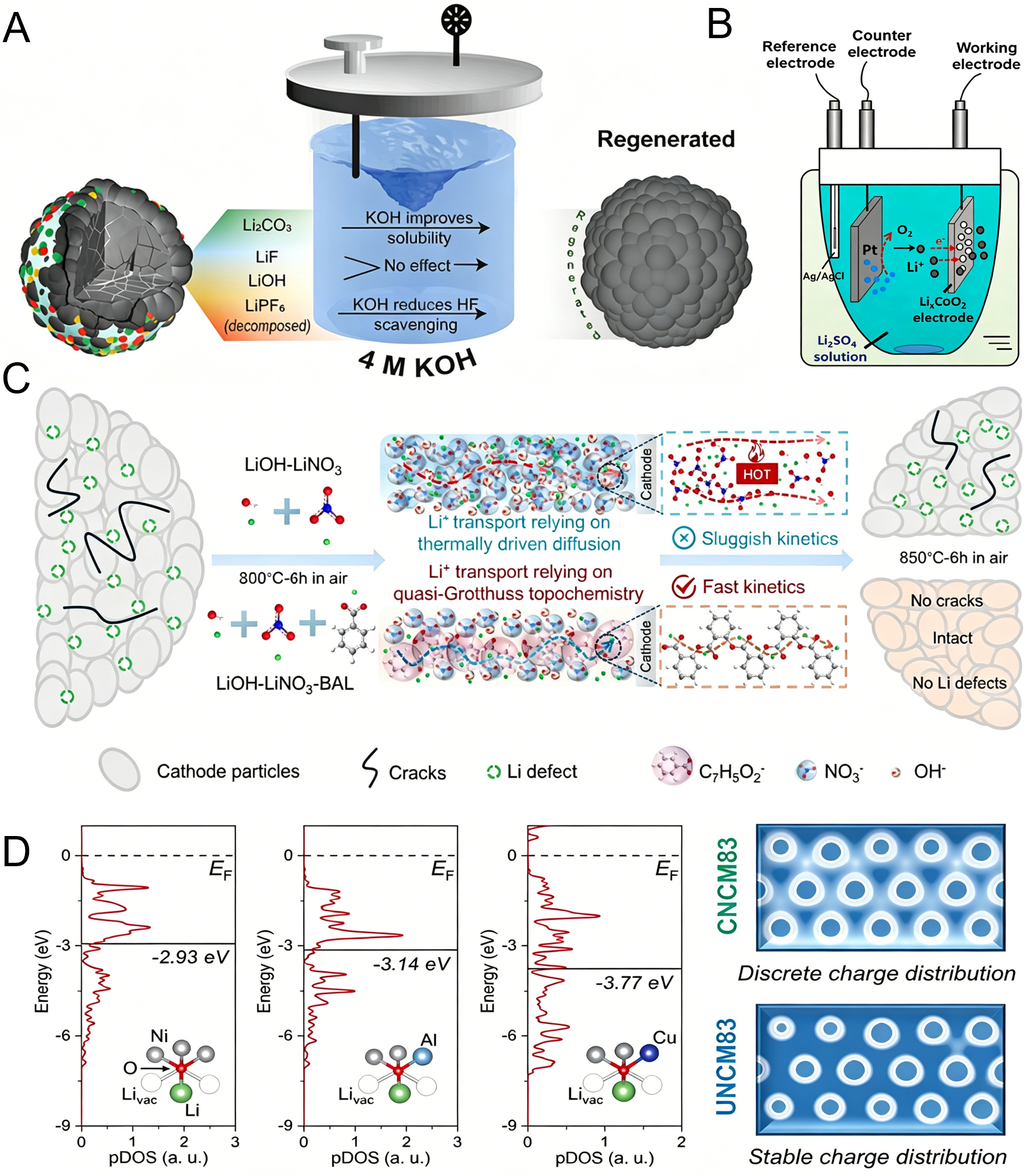
Figure 4. Bulk defect repair strategies for spent NCM cathodes. (A) Schematic illustration of the hydrothermal relithiation mechanism, showing lithium release from residual compounds and its subsequent incorporation into the degraded NCM lattice[79]. Copyright 2026, American Chemical Society; (B) Electrochemical relithiation enabling controlled lithium insertion into defect sites[81]. Copyright 2020, American Chemical Society; (C) Molten salt relithiation providing a high-concentration lithium source[82]. Copyright 2025, Wiley-VCH; (D) The lattice oxygen oxidation activity is suppressed after doping with Al/Cu[87]. Copyright 2024, Wiley-VCH. BAL: Benzoic acid lithium salt; DOS: density of states; NCM: LiNixCoyMn1-x-yO2.
To offer more application-oriented guidance, we performed a comparative analysis of various relithiation techniques. Hydrothermal relithiation occurs under relatively mild conditions and is often associated with improved compositional uniformity, making it suitable for alleviating lithium deficiency while minimizing structural disruption. Its practical use, however, is constrained by long processing times and the need for highly concentrated lithium sources. Molten salt relithiation differs in that lithium transport and lattice reconstruction can proceed rapidly due to the high ionic conductivity of the molten medium. This advantage comes at the expense of elevated operating temperatures and potential corrosion, which impose stricter demands on processing equipment. Electrochemical relithiation, by contrast, allows lithium insertion to be regulated with high precision and offers clear benefits for mechanistic investigation. At present, its application remains limited, mainly due to slow kinetics, low throughput, and relatively high operational cost.
To further enhance the long-term structural stability of regenerated NCM cathodes, elemental doping has emerged as an effective reinforcement strategy that fundamentally improves resistance to subsequent degradation processes[87,88]. Although relithiation and high-temperature lattice reconstruction can largely restore the initial crystal structure, the intrinsic chemical instability of NCM materials, such as the Jahn-Teller activity of Ni3+ and the relatively weak Ni-O bonding, can still promote cation mixing and structural degradation during subsequent cycling. Introducing small amounts of foreign ions, e.g., Al3+, Mg2+, Ti4+, and Zr4+, strengthens TM-O bonding, induces lattice pinning effects, and suppresses unfavorable phase transformations[89,90]. Consequently, the structural stability of regenerated materials is synergistically enhanced at both the electronic and crystallographic levels. Ji et al.[87] recovered from spent current collectors as dopants, resulting in a significantly reduced c-axis contraction of only 3.9% at 4.6 V, compared with 6.9% for commercial NCM materials [Figure 4D]. Similarly, Wu et al.[91] achieved effective structural regulation of NCM90 cathodes via Mg2+ dual-site doping, suppressing the dynamic migration of Ni2+ and enabling a capacity retention of 92% after 100 cycles.
Repair and optimization of electronic conduction networks
Once lithium-ion transport pathways within the bulk crystal structure are restored, efficient electron extraction from individual active particles becomes a key determinant of the electrochemical performance of regenerated cathodes. Degradation of electronic conduction networks occurs across multiple length scales, from the interior of nanoscale particles to the macroscopic electrode architecture, and ultimately manifests as increased internal resistance and incomplete utilization of active materials. Accordingly, the primary objective of electronic-network repair is to reconstruct robust and continuous electron transport pathways by addressing conduction failure modes at different scales. Achieving this goal requires not only the restoration of damaged physical contacts but also the deliberate construction of conductive architectures that preserve electrical connectivity and structural integrity under repeated cycling-induced mechanical and electrochemical stresses.
Particle scale
At the particle scale, degradation of electronic conduction mainly arises from two coupled factors: physical disruption of electron pathways and chemical passivation at particle surfaces. Effective repair strategies must therefore address both mechanisms in a coordinated manner. Surface reconstruction and surface coating have emerged as central approaches for restoring particle-scale electronic conduction networks. Surface reconstruction focuses on activating and transforming electrochemically inactive interfacial phases. Through controlled oxidation or mild chemical/electrochemical treatments, lithium can be replenished into surface-depleted, highly defective rock-salt layers, triggering relithiation and partial recrystallization of the interfacial region[75,92]. Notably, complete restoration of the original layered structure is not always required. In some cases, the formation of spinel phases with three-dimensional lithium-ion diffusion pathways, or layered/rock-salt coexistence structures, can effectively enhance interfacial transport kinetics[93]. In essence, surface reconstruction converts electronically insulating surface layers into mixed-conductive interphases, thereby reducing charge-transfer resistance and re-establishing continuous electron transport pathways between the particle bulk and the electrode interface. For example, Jia et al.[2] employed hydrothermal treatment combined with ammonia regulation to transform the surface rock-salt phase of LiNi0.5Co0.2Mn0.3O2 into a Ni0.5Co0.2Mn0.3(OH)2 precursor, enabling a transition from high-barrier 2-TM lithium-migration channels to lower-barrier 1-TM channels. Alternatively, Huang et al.[71] used citric acid etching to selectively remove surface rock-salt phases while preserving internal spinel or layered domains that retain viable lithium-ion pathways, thereby improving interfacial transport properties [Figure 5A].
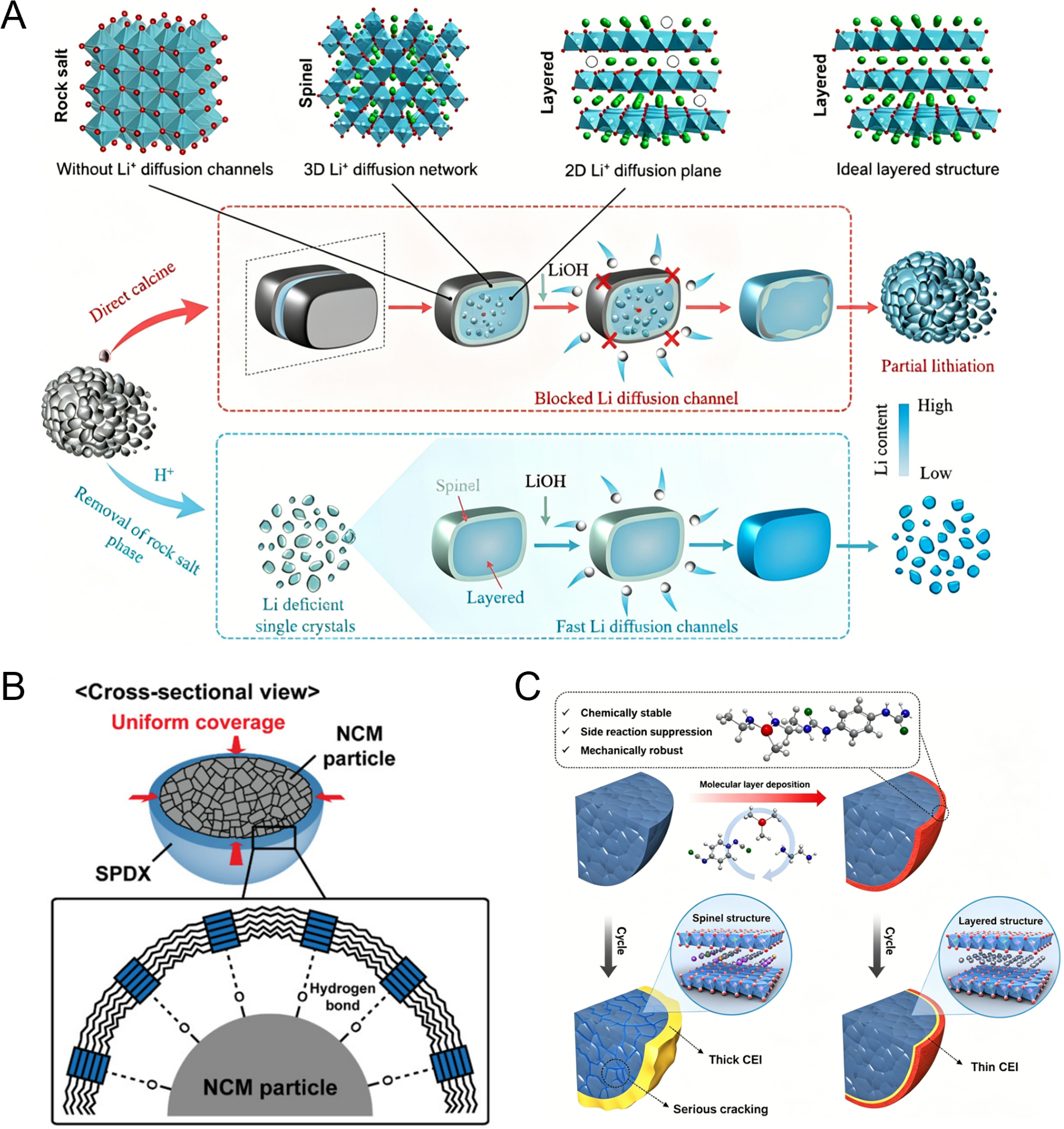
Figure 5. Particle-scale regeneration strategies for spent NCM cathodes. (A) Citric acid treatment selectively removes the surface rock-salt phase to recover spent cathodes[71]. Copyright 2025, Wiley-VCH. (B) The spandex-based binder (SPDX) forms a conformal coating on NCM particle surfaces, enhancing interfacial adhesion and improving cycling stability[53]. Copyright 2020, Wiley-VCH. (C) Molecular Layer Deposition (MLD) enabling enables the construction of multifunctional coatings on Ni94 cathodes[95]. Copyright 2024, Royal Society of Chemistry. NCM: LiNixCoyMn1-x-yO2; CEI: cathode-electrolyte interphase.
In addition to surface reconstruction, constructing uniform coating layers on particle surfaces offers a complementary, synergistic route to enhance the performance of regenerated NCM cathodes. Appropriately designed coatings simultaneously improve electronic conduction, suppress interfacial side reactions, and mitigate cycling-induced mechanical stress. From an electronic transport perspective, ultrathin coatings can facilitate electron transfer via tunneling, while intrinsically conductive coatings introduce supplementary conductive pathways. Both mechanisms partially compensate for electron-transport losses arising from disrupted interparticle contacts and grain-boundary resistance. For instance, Wang et al.[94] employed phosphate etching to achieve a Li3PO4 surface coating, which reduced interfacial polarization and preserved continuous charge-transfer pathways, thereby enabling improved high-rate performance. Coatings also function as effective chemical barriers, physically isolating the active material from direct electrolyte contact. This isolation suppresses oxidative electrolyte decomposition at high potentials and inhibits transition-metal dissolution driven by corrosive species such as HF, thereby slowing the formation and evolution of the CEI. Chang et al.[53] demonstrated that a spandex-based polymer coating, owing to its high elasticity and strong adhesion, uniformly covered active particles and markedly suppressed surface phase reconstruction and transition-metal leaching [Figure 5B]. Beyond chemical stabilization, coating layers can act as structural buffers that accommodate volume changes during repeated lithiation/delithiation. By redistributing local stress, such coatings mitigate crack initiation and propagation at the particle surface. Sun et al.[95] applied molecular layer deposition (MLD) to fabricate a conformal nanoscale HPU coating on NCM94, effectively constraining particle-level volume fluctuations and suppressing microcrack formation during cycling [Figure 5C]. Notably, the uniformity of the coating directly determines its protective effectiveness, as non-uniform coatings can induce localized stress concentration during cycling, thereby accelerating crack propagation and ultimately leading to coating failure[96]. To enable a more systematic and intuitive comparison of the above‑discussed regeneration strategies targeting bulk defects and particle‑scale conduction repair, recent advances are summarized in Table 1.
Summary of the strategies of direct regeneration for NCM cathodes
| Method | Material | Conditions | Performance | Ref. | |
| Bulk defect repair | Hydrothermal | NCM111 | Hydrothermal treatment with 4M LiOH at 100 °C and 1 bar | 157 mAh g-1 at 0.1C, 83% capacity retention at 1C after 200 cycles | [80] |
| NCM111 | Hydrothermal treatment with 4M KOH at 220 °C for 4 h | 157 mAh g-1 at 0.1C, 96% capacity retention at 0.33C after 100 cycles | [79] | ||
| NCM523 | Hydrothermal treatment with 4M LiOH at 220 °C for 3 h | 166.1mAh g-1 at 0.1C, 90.8% capacity retention at 1C after 500 cycles | [59] | ||
| Eutectic mixture | NCM523 | LiOH-LiNO3-LiC7H5O2 at 300 °C for 4 h | 154.8 mAh g-1 at 0.1C, 70.1% capacity retention at 0.5C after 300 cycles | [82] | |
| NCM523 | LiNO3-LiOH·H2O-Li2CO3 at 600 °C for 4 h | 169.47 mAh g-1 at 0.1C, 81.0% capacity retention at 1C after 1,000 cycles | [83] | ||
| NCM622 | LiOH-Ni(OH)2-Na2SO4 at 450 °C for 4 h | 179.9 mAh g-1 at 0.1C, 87.9% capacity retention at 1C after 500 cycles | [84] | ||
| Electrochemical | LCO | Waste LCO-Pt-Ag/AgCl in Li2SO4 solution | 136 mAh g-1 at 0.2C | [81] | |
| Doping | NCM83 | Al/Cu dual-doping | 200 mAh g-1 at 1C, 93.3% capacity retention at 1C after 100 cycles | [87] | |
| NCM90 | Mg dual-site doping | 218 mAh g-1 at 1C, 92% capacity retention at 1C after 100 cycles | [91] | ||
| Electronic Conduction Repair | Surface reconstruction | NCM523 | Ultrasonic treatment with citric acid for 30 min | 165.4 mAh g-1 at 0.1C, 80.1% capacity retention at 1C after 500 cycles | [71] |
| NCM523 | Hydrothermal treatment with ammonium hydroxide at 160 °C for 6 h | 15 2mAh g-1 at 0.5C, 76% capacity retention at 0.5C after 200 cycles | [2] | ||
| Coating | NCM65 | Li3PO4 coating | 186 mAh g-1 at 0.1C, 99% capacity retention at 0.33C after 100 cycles | [94] | |
| NCM811 | Spandex coating | 189.2 mAh g–1 at 0.1C, 96.9% capacity retention at 0.5C after 250 cycles | [53] | ||
| NCM94 | Hybrid polyurea (HPU) coating | 94.9% capacity retention at 0.5C after 200 cycles | [95] |
To further enhance the practical relevance of this review, we have also conducted a comparative analysis of surface reconstruction and coating strategies[32,70]. These two approaches serve different functional purposes. Surface reconstruction primarily aims to recover degraded surface structures and can improve interfacial charge-transfer kinetics. In contrast, surface coating is more effective in enhancing chemical stability and mitigating side reactions during cycling. From an industrial standpoint, coating strategies are generally easier to integrate into existing cathode manufacturing processes. By comparison, reconstruction-based methods tend to rely on tighter control over processing conditions, which currently limits their scalability.
Electrode scale
At the electrode scale, regeneration challenges extend beyond individual particles to the reconstruction of the composite electrode architecture, which comprises active materials, conductive additives, binders, and the current collector[55,58]. The primary objectives are to restore electrical contact between active particles and the conductive network disrupted during cycling, and to repair interfacial delamination between the electrode layer and the current collector. Achieving durable electrode-scale regeneration therefore requires the coordinated regulation of conductive-network architecture and binder stability, ensuring mechanical integrity and continuous electron transport under repeated electrochemical cycling.
Reconstruction of the conductive network is fundamental to restoring macroscopic electronic conduction. During electrode re-fabrication of regenerated cathode materials, the intrinsic limitations of conventional single-component carbon black networks can be overcome by designing multiscale, multidimensional conductive architectures[97,98]. Carbon black mainly provides localized point contacts between particles, whereas carbon nanotubes, with their high aspect ratio, bridge multiple particles to form continuous one-dimensional conduction pathways. Graphene sheets further introduce two-dimensional conductive planes on or between particles, offering low-resistance channels for electron transport. The synergistic integration of these point-line-plane components enables the construction of a three-dimensional conductive network that simultaneously enhances electron transport efficiency and electrode structural stability. For example, Wang et al.[99] optimized a hybrid system of zero-dimensional acetylene black and two-dimensional graphene, establishing efficient point-to-plane conductive pathways and markedly improving electron transport within the cathode.
Restoration of electrode structural integrity also depends critically on optimizing and reconstructing the binder system. Conventional PVDF binders are susceptible to polymer chain scission and cross-linking under high-voltage operation and in the presence of active lattice oxygen, leading to embrittlement and reduced adhesion. In contrast, advanced binders such as polyacrylic acid and sodium alginate have attracted significant attention for their superior chemical adhesion and mechanical resilience[100,101]. These binders are rich in polar functional groups, which enable them to form strong chemical bonds with transition metals on active particle surfaces[100]. Their intrinsic elasticity and flexibility also buffer the repeated volume changes of active particles during cycling, suppressing microcrack formation and preventing electrode-scale delamination. Together, these properties maintain structural and mechanical integrity, supporting stable macroscopic electronic conduction over prolonged cycling.
CONCLUSION AND OUTLOOK
This review examines the multiscale degradation behavior of Ni-rich NCM cathodes during long-term cycling, focusing on the coupled roles of ion transport and electronic conduction. It further discusses corresponding repair strategies, aiming to connect specific degradation modes with feasible regeneration approaches within a coherent framework. From the perspective of ion transport, performance decay is closely related to bulk structural instability. Typical issues include Li/Ni cation disorder and phase transitions, both of which impede lithium diffusion. Regeneration strategies such as relithiation and high-temperature structural reconstruction can recover lithium stoichiometry and partially rebuild the layered framework. In addition, heteroatom doping has been shown to enhance lattice stability and mitigate structural distortion. In terms of electronic conduction, degradation occurs across multiple length scales, ranging from intraparticle transport pathways to the electrode-level architecture. Surface modification and interface reconstruction help lower interfacial resistance and limit side reactions. Meanwhile, the construction of conductive networks at different scales, together with the use of advanced polymer binders, contributes to restoring electron transport pathways and maintaining mechanical cohesion within the electrode.
Despite these significant academic advances, translating laboratory-scale regeneration strategies into industrial practice remains challenging. In particular, the economic feasibility of relithiation reagents continues to be a primary constraint. Although eutectic molten salts and organolithium reagents demonstrate effective restoration capability, their high material costs and energy-intensive processing limit large-scale application[76,82,102]. Hydrothermal approaches operate under comparatively mild conditions, but they often rely on highly concentrated lithium sources and prolonged reaction durations, which raises additional concerns for large-scale implementation. Achieving homogeneous bulk repair and consistent interfacial reconstruction is another unresolved issue. In practice, spent cathode materials are intrinsically heterogeneous, with variations in chemical composition, degradation pathways, particle size, and impurity content. Such complexity can result in uneven lithium replenishment and localized over- or under-treatment, ultimately affecting product uniformity. This challenge becomes more pronounced in Ni-rich NCM systems. Moreover, industrial recycling streams rarely contain single-component cathodes; instead, they typically consist of mixed materials with diverse chemistries and states of degradation. Most current direct regeneration strategies are designed for specific compositions, which limits their applicability under these realistic conditions. The compatibility of regenerated materials with existing electrode fabrication processes, along with their long-term performance under practical operating environments, also remains to be systematically verified. Addressing these issues will require integrated efforts spanning materials design, process engineering, and cost optimization to move toward viable industrial adoption.
Looking ahead, regeneration technologies are poised to advance along three complementary directions: precision, intelligence, and integration. In situ and operando characterization will provide real-time insights into coupled ion-electron dynamics, guiding targeted interventions[103,104]. Artificial intelligence, assisted design and optimization of microstructures and conductive networks, will enable adaptive, high-efficiency transport architectures and predictive performance control[105]. Finally, coordinated strategies that integrate bulk repair, interface reconstruction, and electrode-scale network optimization will achieve multiscale synergy, enhancing both conduction and structural stability. Such advances promise the sustainable reuse of end-of-life NCM cathodes and underpin next-generation LIBs with ultra-high energy density and extended cycle life.
DECLARATIONS
Authors’ contributions
Conceptualization and supervision: Gu, Y.; Li, J. F; Luo, X. C.
Made substantial contributions to writing the paper: Wu, C.
Investigation, original draft, and figure editing: Wu, C.; Liu, Y. M.; Sun, H. L.
Manuscript revision: Gu, Y.
AI and AI-assisted tools statement
Not applicable.
Availability of data and materials
Not applicable.
Financial support and sponsorship
This work was supported by the National Natural Science Foundation of China (Grant Nos. 22522206, 92472203, 22525042), the Fundamental and Interdisciplinary Disciplines Breakthrough Plan of the Ministry of Education of China (JYB2025XDXM201), the Natural Science Foundation of Xiamen, China (Grant No. 3502Z202573023), and the Industry-University-Research Joint Innovation Project of Fujian Province (Grant No. 2023H6029).
Conflicts of interest
Liu, Y. M. and Luo, X. C. is affiliated with XTC New Energy Materials (Xiamen) Co., LTD. The other authors declared that there are no conflicts of interest.
Ethical approval and consent to participate
Not applicable.
Consent for publication
Not applicable.
Copyright
© The Author(s) 2026.
REFERENCES
1. Matsui, T.; Hanada, T.; Goto, M. Non-aqueous direct leaching using a reusable nickel-selective amic-acid extractant for efficient lithium-ion battery recycling. RSC. Sustainability. 2025, 3, 881-9.
2. Jia, K.; Wang, J.; Zhuang, Z.; et al. Topotactic Transformation of Surface Structure Enabling Direct Regeneration of Spent Lithium-Ion Battery Cathodes. J. Am. Chem. Soc. 2023, 145, 7288-300.
3. Chen, J.; Zhang, B.; Hu, X.; et al. Efficient recycling of mixed spent cathodes via divergent chelation. Chem. Eng. J. 2026, 529, 172972.
4. Sun, H.; Xu, Y.; Ding, L.; Gu, Y.; Li, J. Recycling valuable materials from the spent lithium ion batteries to catalysts: methods, applications, and characterization. Chem. Synth. 2024, 4, 23.
5. Wang, J. Y.; Wang, R.; Wang, S. Q.; Wang, L. F.; Zhan, C. Facile one-step solid-state synthesis of Ni-rich layered oxide cathodes for lithium-ion batteries. J. Electrochem. 2022, 28, 2112131.
6. Olivetti, E. A.; Ceder, G.; Gaustad, G. G.; Fu, X. Lithium-ion battery supply chain considerations: analysis of potential bottlenecks in critical metals. Joule 2017, 1, 229-43.
7. Dursun, H. N.; Uysal, E.; Burat, F.; Gürmen, S. Effective and sustainable lithium ion battery recycling strategy for circular economy: Ultrasound assisted direct leaching of black mass containing NMC/LCO/LMO/graphite mixed powders. Hydrometallurgy 2026, 240, 106630.
8. Murdock, B. E.; Toghill, K. E.; Tapia‐Ruiz, N. A perspective on the sustainability of cathode materials used in lithium-ion batteries. Adv. Energy. Mater. 2021, 11, 2102028.
9. Larouche, F.; Tedjar, F.; Amouzegar, K.; et al. Progress and status of hydrometallurgical and direct recycling of Li-ion batteries and beyond. Materials 2020, 13, 801.
10. Zhou, M.; Li, B.; Li, J.; Xu, Z. Pyrometallurgical technology in the recycling of a spent lithium ion battery: evolution and the challenge. ACS. EST. Eng. 2021, 1, 1369-82.
11. Yao, Y.; Zhu, M.; Zhao, Z.; Tong, B.; Fan, Y.; Hua, Z. Hydrometallurgical processes for recycling spent lithium-ion batteries: a critical review. ACS. Sustainable. Chem. Eng. 2018, 6, 13611-27.
12. Chen, L.; Wang, G.; Xing, C.; et al. The alchemy of two degraded cathodes: synergistic surface‐bulk upcycling for degraded NCM materials by leached LiFePO4. Adv. Funct. Mater. 2025, 36, e14508.
13. Gupta, V.; Potts, C.; Tran, D.; et al. Streamlining Ni‐rich LiNixMnyCozO2 cathode black mass purification for direct recycling and upcycling through the alkoxythermal process. Adv. Energy. Mater. 2025, 15, 2406083.
14. Zhao, X.; Zhao, W.; Ma, Q.; et al. Green pathways to closed-loop regeneration: emerging direct recycling strategies for spent cathodes in lithium-ion batteries. Energy. Storage. Mater. 2025, 82, 104657.
15. Hou, W.; Zhang, C.; Zhang, Y.; Chen, X.; Xu, H. Revitalizing battery performance: Li2CuO2 additive for compensating irreversible lithium loss in LiFePO4-based full cells. Mater. Chem. Phys. 2026, 348, 131543.
16. Kaenket, S.; Mamiamuang, T.; Joraleechanchai, N.; et al. Interfacial and structural transformations in Ni-rich cathodes: a roadmap toward chemical stability. Chem. Commun. 2026, 62, 2428-58.
17. Hou, Z.; Zhang, Y.; Kong, F.; Wang, W.; Yu, M.; Cheng, F. Superlattice engineering regulation to address structural defect evolution in Ni‐rich layered cathodes. Adv. Funct. Mater. 2026, 36, e32163.
18. Gao, Y.; Wang, X.; Geng, J.; Liang, F.; Chen, M.; Zou, Z. Research progress on the failure mechanisms and modifications of Ni-rich ternary layered oxide cathode materials for lithium-ion batteries. J. Electron. Mater. 2022, 52, 72-95.
19. Liu, Z.; Zhang, Y.; Pan, S.; et al. Addressing the fundamental issues in Ni-rich cathodes: degradation mechanisms and mitigation strategies. Energy. Environ. Sci. 2026, 19, 84-125.
20. Wang, J. Y.; Guo, S. N.; Wang, X.; Gu, L.; Su, D. Structural degradation of Ni-rich layered oxide cathode for Li-ion batteries. J. Electrochem. 2022, 28, 2108431.
21. Shang, Y.; Chen, J.; Ren, X.; et al. Unveiling competitive coordination in aqueous lithium-ion electrolytes through solvent descriptor engineering. Adv. Mater. 2025, 37, 2506015.
22. Jiang, S.; Wang, J.; Yang, G.; et al. Tailoring lithium-ion coordination in metal-organic frameworks via d-orbital control for fast ion conduction. J. Am. Chem. Soc. 2026, 148, 2481-90.
23. Zeng, W.; Shu, W.; Zhu, J.; et al. Stacking fault slows down ionic transport kinetics in lithium-rich layered oxides. ACS. Energy. Lett. 2024, 9, 346-54.
24. Liu, S.; West, P. J.; Zhong, H.; et al. Origin of phase separation in Ni-rich layered oxide cathode materials during electrochemical cycling. Chem. Mater. 2023, 35, 8857-71.
25. Xu, K. Nonaqueous liquid electrolytes for lithium-based rechargeable batteries. Chem. Rev. 2004, 104, 4303-418.
26. Cherkashinin, G.; Motzko, M.; Schulz, N.; Späth, T.; Jaegermann, W. Electron spectroscopy study of Li[Ni,Co,Mn]O2/electrolyte interface: electronic structure, interface composition, and device implications. Chem. Mater. 2015, 27, 2875-87.
27. Zheng, M.; You, Y.; Lu, J. Understanding materials failure mechanisms for the optimization of lithium-ion battery recycling. Nat. Rev. Mater. 2025, 10, 355-68.
28. Lu, Y.; Zhao, C.; Hu, J.; et al. The void formation behaviors in working solid-state Li metal batteries. Sci. Adv. 2022, 8, eadd0510.
29. Zhang, M.; Teng, G.; Chen-Wiegart, Y. K.; et al. Cationic ordering coupled to reconstruction of basic building units during synthesis of high-Ni layered oxides. J. Am. Chem. Soc. 2018, 140, 12484-92.
30. Wang, R.; Wang, L.; Liu, R.; Li, X.; Wu, Y.; Ran, F. “Fast-charging” anode materials for lithium-ion batteries from perspective of ion diffusion in crystal structure. ACS. Nano. 2024, 18, 2611-48.
31. Yin, J.; Wu, Z.; Fang, K.; et al. Reassessing anionic redox in conventional layered oxide cathodes for Li-ion batteries: ionic and covalent mechanisms. Chem. Sci. 2025, 16, 8268-81.
32. Su, J.; Li, D.; Wang, J.; et al. Multiscale failure mechanisms of ternary oxide cathode materials for lithium‐ion batteries. Adv. Mater. 2025, 38, e06063.
33. House, R. A.; Marie, J.; Pérez-osorio, M. A.; Rees, G. J.; Boivin, E.; Bruce, P. G. The role of O2 in O-redox cathodes for Li-ion batteries. Nat. Energy. 2021, 6, 781-9.
34. Mccoll, K.; Coles, S. W.; Zarabadi-poor, P.; Morgan, B. J.; Islam, M. S. Phase segregation and nanoconfined fluid O2 in a lithium-rich oxide cathode. Nat. Mater. 2024, 23, 826-33.
35. Hou, X.; Ohta, K.; Kimura, Y.; et al. Lattice oxygen instability in oxide-based intercalation cathodes: a case study of layered LiNi1/3Co1/3Mn1/3O2. Adv. Energy. Mater. 2021, 11, 2101005.
36. Rynearson, L.; Antolini, C.; Jayawardana, C.; Yeddala, M.; Hayes, D.; Lucht, B. L. Speciation of transition metal dissolution in electrolyte from common cathode materials. Angew. Chem. Int. Ed. 2023, 63, e202317109.
37. Adhitama, E.; Demelash, F.; Brake, T.; et al. Assessing key issues contributing to the degradation of NCM‐622 || Cu cells: competition between transition metal dissolution and “dead Li” formation. Adv. Energy. Mater. 2024, 14, 2303468.
38. Cha, H.; Kim, J.; Lee, H.; et al. Boosting reaction homogeneity in high-energy lithium-ion battery cathode materials. Adv. Mater. 2020, 32, 2003040.
39. Jayawardana, C.; Rodrigo, N.; Parimalam, B.; Lucht, B. L. Role of electrolyte oxidation and difluorophosphoric acid generation in crossover and capacity fade in lithium ion batteries. ACS. Energy. Lett. 2021, 6, 3788-92.
40. Rinkel, B. L. D.; Hall, D. S.; Temprano, I.; Grey, C. P. Electrolyte oxidation pathways in lithium-ion batteries. J. Am. Chem. Soc. 2020, 142, 15058-74.
41. Gilbert, J. A.; Shkrob, I. A.; Abraham, D. P. Transition metal dissolution, ion migration, electrocatalytic reduction and capacity loss in lithium-ion full cells. J. Electrochem. Soc. 2017, 164, A389-99.
42. Aghili Mehrizi, A.; Yeganehdoust, F.; Madikere Raghunatha Reddy, A. K.; Zaghib, K. Challenges and issues facing ultrafast-charging lithium-ion batteries. Batteries 2025, 11, 209.
43. Li, T.; Yuan, X.; Zhang, L.; Song, D.; Shi, K.; Bock, C. Degradation mechanisms and mitigation strategies of nickel-rich NMC-based lithium-ion batteries. Electrochem. Energ. Rev. 2019, 3, 43-80.
44. Wu, Z.; Zhang, C.; Yuan, F.; et al. Ni-rich cathode materials for stable high-energy lithium-ion batteries. Nano. Energy. 2024, 126, 109620.
45. Liu, H.; Wolfman, M.; Karki, K.; et al. Intergranular cracking as a major cause of long-term capacity fading of layered cathodes. Nano. Lett. 2017, 17, 3452-7.
46. Chen, S.; He, T.; Su, Y.; et al. Ni-Rich LiNi0.8Co0.1Mn0.1O2 oxide coated by dual-conductive layers as high performance cathode material for lithium-ion batteries. ACS. Appl. Mater. Interfaces. 2017, 9, 29732-43.
47. Yu, R.; Zeng, W.; Zhou, L.; et al. Layer-by-layer delithiation during lattice collapse as the origin of planar gliding and microcracking in Ni-rich cathodes. Cell. Rep. Phys. Sci. 2023, 4, 101480.
48. Shin, H.; Ndukwe, A.; Kim, T.; Lee, J. H.; Li, G.; Lee, H. J. Mitigating diffusion-induced intragranular cracking in single-crystal LiNi0.5Mn1.5O4 via extended solid-solution behavior. Angew. Chem. Int. Ed. 2025, 64, e202422726.
49. Wang, L.; Liu, T.; Wu, T.; Lu, J. Strain-retardant coherent perovskite phase stabilized Ni-rich cathode. Nature 2022, 611, 61-7.
50. Kondrakov, A. O.; Schmidt, A.; Xu, J.; et al. Anisotropic lattice strain and mechanical degradation of high- and low-nickel NCM cathode materials for Li-ion batteries. J. Phys. Chem. C. 2017, 121, 3286-94.
51. Xia, S.; Mu, L.; Xu, Z.; et al. Chemomechanical interplay of layered cathode materials undergoing fast charging in lithium batteries. Nano. Energy. 2018, 53, 753-62.
52. Parks, H. C. W.; Boyce, A. M.; Wade, A.; et al. Direct observations of electrochemically induced intergranular cracking in polycrystalline NMC811 particles. J. Mater. Chem. A. 2023, 11, 21322-32.
53. Chang, B.; Kim, J.; Cho, Y.; et al. Highly elastic binder for improved cyclability of nickel-rich layered cathode materials in lithium-ion batteries. Adv. Energy. Mater. 2020, 10, 2001069.
54. Shi, Y.; Chen, G.; Liu, F.; Yue, X.; Chen, Z. Resolving the compositional and structural defects of degraded LiNixCoyMnzO2 particles to directly regenerate high-performance lithium-ion battery cathodes. ACS. Energy. Lett. 2018, 3, 1683-92.
55. Lin, Q.; Guan, W.; Meng, J.; et al. A new insight into continuous performance decay mechanism of Ni-rich layered oxide cathode for high energy lithium ion batteries. Nano. Energy. 2018, 54, 313-21.
56. Jia, K.; He, Y.; Piao, Z.; et al. Low-frequency phonon dispersion relation enabling stable cathode from spent lithium-ion batteries. Adv. Mater. 2024, 37, 2413753.
57. Mahne, N.; Renfrew, S. E.; Mccloskey, B. D.; Freunberger, S. A. Electrochemical oxidation of lithium carbonate generates singlet oxygen. Angew. Chem. Int. Ed. 2018, 57, 5529-33.
58. Fan, X.; Chen, P.; Yin, X.; et al. one stone for multiple birds: a versatile cross-linked poly(dimethyl siloxane) binder boosts cycling life and rate capability of an NCM 523 cathode at 4.6 V. ACS. Appl. Mater. Interfaces. 2022, 14, 16245-57.
59. Guo, Y.; Liao, X.; Huang, P.; et al. High reversibility of layered oxide cathode enabled by direct Re-generation. Energy. Storage. Mater. 2021, 43, 348-57.
60. Seong, W. M.; Cho, K. H.; Park, J. W.; et al. Controlling residual lithium in high-nickel (> 90%) lithium layered oxides for cathodes in lithium-ion batteries. Angew. Chem. Int. Ed. 2020, 59, 18662-9.
61. Zhang, S. S. Understanding of performance degradation of LiNi0.80Co0.10Mn0.10O2 cathode material operating at high potentials. J. Energy. Chem. 2020, 41, 135-41.
62. Sung, S. H.; Kim, S.; Park, J. H.; Park, J. D.; Ahn, K. H. Role of PVDF in rheology and microstructure of NCM cathode slurries for lithium-ion battery. Materials 2020, 13, 4544.
63. Xue, J.; Jiang, C.; Pan, B.; Zou, Z. Constructing multidimensional conducting networks on LiCoO2 cathode for enhanced rate performance and cycle stability. J. Electroanal. Chem. 2019, 850, 113419.
64. Bi, Z.; Zhao, N.; Ma, L.; et al. Interface engineering on cathode side for solid garnet batteries. Chem. Eng. J. 2020, 387, 124089.
65. Wenzel, V.; Nirschl, H.; Nötzel, D. Challenges in lithium-ion-battery slurry preparation and potential of modifying electrode structures by different mixing processes. Energy. Tech. 2015, 3, 692-8.
66. He, Q.; Ning, J.; Chen, H.; et al. Achievements, challenges, and perspectives in the design of polymer binders for advanced lithium-ion batteries. Chem. Soc. Rev. 2024, 53, 7091-157.
67. Pakhare, A. S.; Nadimpalli, S. P. V. Characterization and prediction of polymer/active material interface failure in battery electrodes. Exp. Mech. 2022, 63, 363-76.
68. Liu, Z.; Dong, T.; Mu, P.; Zhang, H.; Liu, W.; Cui, G. Interfacial chemistry of vinylphenol-grafted PVDF binder ensuring compatible cathode interphase for lithium batteries. Chem. Eng. J. 2022, 446, 136798.
69. Grillet, A. M.; Humplik, T.; Stirrup, E. K.; et al. Conductivity degradation of polyvinylidene fluoride composite binder during cycling: measurements and simulations for lithium-ion batteries. J. Electrochem. Soc. 2016, 163, A1859-71.
70. Wu, X.; Liu, Y.; Wang, J.; Tan, Y.; Liang, Z.; Zhou, G. Toward circular energy: exploring direct regeneration for lithium-ion battery sustainability. Adv. Mater. 2024, 36, 2403818.
71. Huang, Q.; Zhang, X.; Lv, X.; et al. Surface engineering enabling efficient upcycling of highly degraded layered cathodes. Adv. Mater. 2025, 37, 2419872.
72. Gao, Z.; Liu, Y.; El‐bahy, Z. M.; et al. Closed-loop recycling methods to treat spent cathode: efficient and direct regeneration. Adv. Funct. Mater. 2025, 35, 2503674.
73. Shi, R.; Li, J.; Zhao, J.; et al. Unraveling and modulating the competitive dynamics in direct regeneration of Ni-rich cathode material. Adv. Mater. 2025, 37, 2506423.
74. Li, J.; Shi, R.; Wu, X.; et al. Integrating high-efficient delamination and structural reconstruction boosting direct regeneration of spent cathode materials. Adv. Mater. 2025, 38, e10888.
75. Chen, W.; Li, J.; Ji, H.; et al. Efficient and scalable direct regeneration of spent layered cathode materials via advanced oxidation. Adv. Mater. 2025, 37, 2416818.
76. Cao, B.; Shi, J.; Liu, Q.; et al. Targeted etching of heterogeneous phases and crystal-induced regrowth for direct single-crystal regeneration of spent cathode materials. Adv. Funct. Mater. 2025, 36, e27055.
77. Liu, Y.; Jiao, B.; Zhang, B.; et al. Green upcycling strategy for spent lithium-ion batteries: one-step coupling of fluoridation inhibition and lattice stabilization. ACS. Nano. 2026, 20, 2830-41.
78. Fei, Z.; Su, Y.; Meng, Q.; Dong, P.; Zhang, Y. Direct regeneration of spent cathode materials by deep eutectic solvent. Energy. Storage. Mater. 2023, 60, 102833.
79. Appleberry, M.; Yu, X.; Gupta, V.; et al. Maximizing lithium recovery in direct recycling: relithiation of layered oxide cathodes using residual lithium. ACS. Appl. Mater. Interfaces. 2026, 18, 13750-64.
80. Yu, X.; Yu, S.; Yang, Z.; et al. Achieving low-temperature hydrothermal relithiation by redox mediation for direct recycling of spent lithium-ion battery cathodes. Energy. Storage. Mater. 2022, 51, 54-62.
81. Zhang, L.; Xu, Z.; He, Z. Electrochemical relithiation for direct regeneration of LiCoO2 materials from spent lithium-ion battery electrodes. ACS. Sustainable. Chem. Eng. 2020, 8, 11596-605.
82. He, Y.; Jia, K.; Piao, Z.; et al. Li+ Quasi-grotthuss topochemistry transport enables direct regeneration of spent lithium-ion battery cathodes. Angew. Chem. Int. Ed. 2025, 64, e202422610.
83. Zha, Y.; Liu, Q.; Hu, Q.; et al. Regeneration of single-crystal with repaired of the (003) crystal plane from degraded polycrystalline ternary cathode. Adv. Mater. 2026, 38, e23547.
84. Xiao, H.; Wang, S.; Wan, K.; et al. Upcycling mixed spent polycrystalline layered oxide cathodes to single‑crystal NCM622 via a ternary eutectic salt strategy. Energy. Storage. Mater. 2026, 88, 105085.
85. Wang, Y.; Yuan, C. Direct upcycling of degraded NCM via low-temperature surface engineering for high performance lithium-ion batteries. EES. Batteries. 2025, 1, 902-12.
86. Barai, P.; Liu, S.; Garcia, J. C.; et al. Substitution-mediated calcination of nickel-based cathodes: decoupling lithiation and crystallization. J. Am. Chem. Soc. 2026, 148, 4999-5011.
87. Ji, H.; Wang, J.; Qu, H.; et al. Closed-loop direct upcycling of spent Ni‐rich layered cathodes into high-voltage cathode materials. Adv. Mater. 2024, 36, 2407029.
88. Fei, Z.; Ji, H.; Dong, E.; et al. Grain boundary hinge structure design for upcycling of cathode materials from spent lithium-ion batteries. eScience 2026, 6, 100476.
89. Weigel, T.; Schipper, F.; Erickson, E. M.; Susai, F. A.; Markovsky, B.; Aurbach, D. Structural and electrochemical aspects of LiNi0.8Co0.1Mn0.1O2 cathode materials doped by various cations. ACS. Energy. Lett. 2019, 4, 508-16.
90. Yin, Z.; Wang, J.; Cao, M. Research progress on the degradation mechanism of layered nickel-rich transition metal oxides cathode materials. Adv. New Renew. Energy. 2020, 8, 216-226.
91. Wu, K.; Ran, P.; Yin, W.; et al. Dynamic evolution of antisite defect and coupling anionic redox in high-voltage ultrahigh‐Ni cathode. Angew. Chem. Int. Ed. 2024, e202410326.
92. Guo, Y.; Guo, C.; Huang, P.; et al. Rejuvenating LiNi0.5Co0.2Mn0.3O2 cathode directly from battery scraps. eScience 2023, 3, 100091.
93. Zhang, H.; Ji, H.; Qu, H.; et al. Multifunctional spinel structure for efficient direct recycling of spent layered cathodes into fast-charging materials. Adv. Mater. 2025, 37, 2420467.
94. Wang, K.; Zhang, H.; Dou, W.; Wang, K.; Wang, T.; Su, X. High rate performance of single-crystalline NCM upcycled from spent lithium-ion batteries via direct recovery and modification. Adv. Funct. Mater. 2024, 35, 2418866.
95. Sun, Y.; Ma, J.; Wu, D.; et al. A breathable inorganic-organic interface for fabricating a crack-free nickel-rich cathode with long-term stability. Energy. Environ. Sci. 2024, 17, 5124-36.
96. Ge, H.; Bai, J.; Wang, C.; et al. Advanced surface engineering of lithium-rich manganese-based cathodes towards next-generation lithium-ion batteries. J. Energy. Chem. 2025, 106, 718-34.
97. Wu, C.; Chung, S. Graphene/CNT foam as a high-loading sulfur cathode for lean-electrolyte lithium-sulfur cells. Energy. Fuels. 2025, 39, 11970-80.
98. Li, J.; Zhang, C.; Wu, C. J.; Tao, Y.; Zhang, L.; Yang, Q. H. Improved performance of Li-Se battery based on a novel dual functional CNTs@graphene/CNTs cathode construction. Rare. Metals. 2017, 36, 425-33.
99. Wang, J.; Shen, Z.; Yi, M. Liquid-exfoliated graphene as highly efficient conductive additives for cathodes in lithium ion batteries. Carbon 2019, 153, 156-63.
100. Shi, W.; Ma, S.; Song, Y.; Liu, J. Ligand-anchoring effect of a PAA/PVDF-cross-linked binder promoting interfacial stability and electrochemical performance of a cathode material. Ind. Eng. Chem. Res. 2024, 64, 392-400.
101. Ding, Y.; Zhong, X.; Yuan, C.; et al. Sodium alginate binders for bivalency aqueous batteries. ACS. Appl. Mater. Interfaces. 2021, 13, 20681-8.
102. Ma, J.; Wang, J.; Jia, K.; et al. Adaptable eutectic salt for the direct recycling of highly degraded layer cathodes. J. Am. Chem. Soc. 2022, 144, 20306-14.
103. Zhang, Y.; Ze, H.; Fang, P.; et al. Shell-isolated nanoparticle-enhanced Raman spectroscopy. Nat. Rev. Methods. Primers. 2023, 3, 36.
104. Yin, X.; You, E.; Zhou, R.; et al. Unraveling the energy storage mechanism in graphene-based nonaqueous electrochemical capacitors by gap-enhanced Raman spectroscopy. Nat. Commun. 2024, 15, 5624.
Cite This Article
 Open Access
How to Cite
Download Citation
Export Citation File:
Type of Import
Tips on Downloading Citation
Citation Manager File Format
Type of Import
Direct Import: When the Direct Import option is selected (the default state), a dialogue box will give you the option to Save or Open the downloaded citation data. Choosing Open will either launch your citation manager or give you a choice of applications with which to use the metadata. The Save option saves the file locally for later use.
Indirect Import: When the Indirect Import option is selected, the metadata is displayed and may be copied and pasted as needed.
About This Article
Copyright

Data & Comments
Data
0





Comments
Comments must be written in English. Spam, offensive content, impersonation, and private information will not be permitted. If any comment is reported and identified as inappropriate content by OAE staff, the comment will be removed without notice. If you have any queries or need any help, please contact us at [email protected].