
Time
December 11, 2026 (Friday)
06:00–08:00 (EST, UTC−5)
19:00–21:00 (CST, UTC+8)
12:00–14:00 (CET, UTC+1)
06:00–08:00 (EST, UTC−5)
19:00–21:00 (CST, UTC+8)
12:00–14:00 (CET, UTC+1)
Host

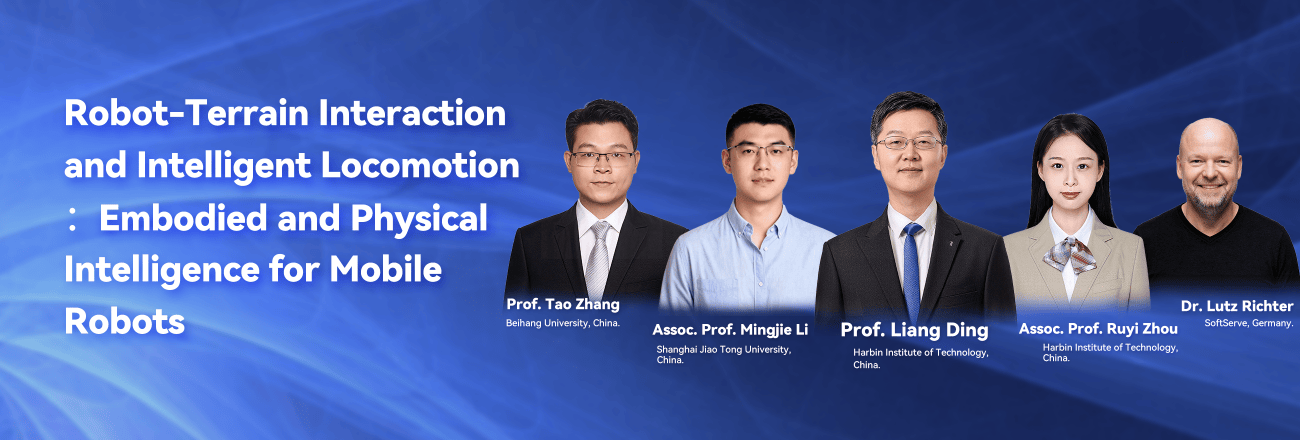
Prof. Liang Ding
State Key Laboratory of Robotics and Systems, Harbin Institute of Technology, Harbin, Heilongjiang, China.
Liang Ding is a Professor at the State Key Laboratory of Robotics and System, Harbin Institute of Technology. His research interests include planetary mobile robotics, legged robots for challenging outdoor environments, and Physical AI operating systems. His research achievements have been applied to the Chang’e lunar rover series and the Tianwen-1 Zhurong Mars rover, including the world's first inversion of lunar farside soil mechanical parameters. He has led several major research projects, including the National Science Fund for Distinguished Young Scholars, the National Science Fund for Excellent Young Scholars, National Key R&D Program projects, and research tasks under China's Tianwen Mars exploration and Chang'e lunar exploration missions. He has published over 200 SCI-indexed papers in leading journals, including Science Robotics (cover article), Nature portfolio journals, National Science Review (cover article), The International Journal of Robotics Research, and IEEE Transactions on Robotics and IEEE Transactions on Neural Networks and Learning Systems. His honors include the First Prize of the Provincial Natural Science Award, the National Technology Invention Award (Second Prize), the China Patent Silver Award, and four provincial or ministerial-level First Prizes for Technological Invention. He has also received the Xplorer Prize and the ISTVS Young Scientist Award, among other honors. Prof. Ding serves as an Associate Editor of Intelligence & Robotics and is an Editorial Board Member of National Science Review, Chinese Journal of Mechanical Engineering, and Journal of Bionic Engineering. His academic service includes serving as General Chair of ISTVS 2022, Associate Editor of ICRA 2023, and Associate Editor of IEEE iSpaRo 2025.
Speaker(s)
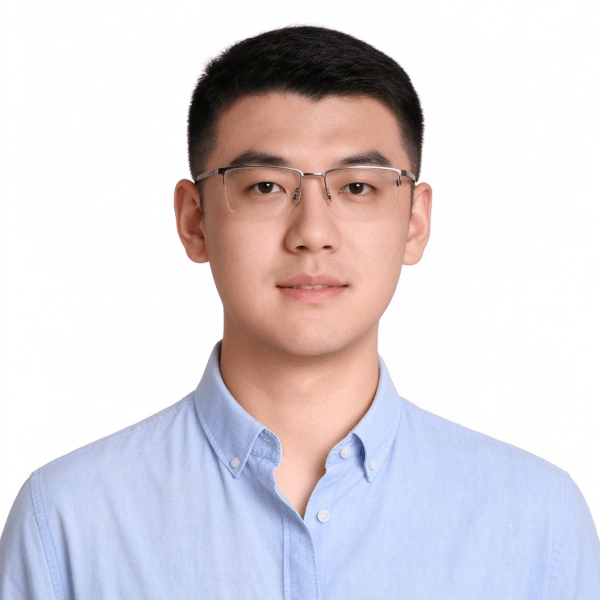
Assoc. Prof. Mingjie Li
School of Automation and Intelligent Sensing, Shanghai Jiao Tong University, Shanghai, China.
Topic: Learning Robotic Manipulation Skills from Human Videos
Topic: Learning Robotic Manipulation Skills from Human Videos
Mingjie Li is a tenure-track Associate Professor at the School of Automation and Sensing, Shanghai Jiao Tong University (SJTU), and a faculty member of the Intelligent Robotics and Machine Vision (IRMV) Lab. Before joining SJTU in 2026, he held postdoctoral positions at Stanford University and the University of Technology Sydney. His research focuses on medical AI, including generative foundation models, world models, multimodal learning and medical image analysis, as well as robot manipulation and robotics visual understanding. He has published in venues including IEEE TPAMI, TNNLS, TIP, CVPR, NeurIPS and ECCV.

Assoc. Prof. Ruyi Zhou
State Key Laboratory of Robotics and Systems, Harbin Institute of Technology, Harbin, Heilongjiang, China.
Topic: Beyond Geometry: Physics-aware Perception and Navigation for Planetary Exploration Rovers
Topic: Beyond Geometry: Physics-aware Perception and Navigation for Planetary Exploration Rovers
Ruyi Zhou is an Associate Professor at Harbin Institute of Technology (HIT), China. She received her Ph.D. degree in Aeronautical and Astronautical Science and Technology from HIT under the supervision of Prof. Liang Ding. During her doctoral studies, she was a visiting Ph.D. student at the Robotic Systems Lab, ETH Zurich, under the supervision of Prof. Marco Hutter. Her research interests lie at the intersection of robotics, terramechanics, and computer vision, with a particular focus on embodied intelligence, physical scene understanding, and autonomous navigation for space robots. She has published research papers in leading journals, including Science Robotics, Nature Geoscience, and Nature Communications. She received the ETH Robotics Research Fellowship and was nominated for the IROS Best Application Paper Award. Her research has contributed to scientific investigations and terrain characterization associated with China's Yutu-2 lunar rover and Zhurong Mars rover.
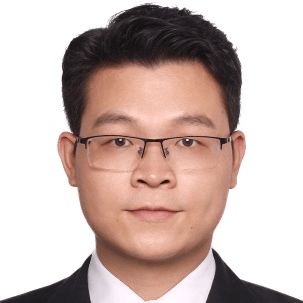
Prof. Tao Zhang
School of Mechanical Engineering and Automation, Beihang University, Beijing, China.
Topic: Mole-inspired Burrowing Robots
Topic: Mole-inspired Burrowing Robots
Tao Zhang received his B.Eng. and Ph.D. degrees in Mechanical Engineering from Beihang University, China, in 2012 and 2017, respectively. In 2017, he joined Guangdong University of Technology, where he successively served as Assistant Professor, Associate Professor, and Professor. From 2020 to 2022, he was a Guest Scientist at the Max Planck Institute for Intelligent Systems, Germany. In July 2024, he joined the Space Robot Laboratory, Beihang University.
His research interests include bio-inspired robotics, planetary robotics, and underwater robotics. He has published over 50 SCI-indexed journal papers, including articles in Nature Astronomy and The International Journal of Robotics Research. His research achievements have contributed to China's major deep-space exploration missions, including Chang'e-5, Chang'e-6, Chang'e-7, and Tianwen-2. He received the Second Prize of the National Technological Invention Award of China (fifth-ranked contributor) and the Masterpiece Award of the Hiwin Doctoral Dissertation Award. He was also selected for the Young Elite Scientists Sponsorship Program of the China Association for Science and Technology and received support from the Distinguished Young Scholars Program of the Guangdong Basic and Applied Basic Research Foundation.
His research interests include bio-inspired robotics, planetary robotics, and underwater robotics. He has published over 50 SCI-indexed journal papers, including articles in Nature Astronomy and The International Journal of Robotics Research. His research achievements have contributed to China's major deep-space exploration missions, including Chang'e-5, Chang'e-6, Chang'e-7, and Tianwen-2. He received the Second Prize of the National Technological Invention Award of China (fifth-ranked contributor) and the Masterpiece Award of the Hiwin Doctoral Dissertation Award. He was also selected for the Young Elite Scientists Sponsorship Program of the China Association for Science and Technology and received support from the Distinguished Young Scholars Program of the Guangdong Basic and Applied Basic Research Foundation.

Dr. Lutz Richter
SoftServe, Munich, Germany.
Topic: Elements of Planetary Rover Design – Innovative Solutions for Optimal Traction on Extraterrestial Bodies
Topic: Elements of Planetary Rover Design – Innovative Solutions for Optimal Traction on Extraterrestial Bodies
Lutz Richter has over 25 years of experience in space robotics and has contributed to major planetary exploration missions led by ESA, NASA, and JAXA, including Rosetta, Mars Express, the Mars Exploration Rovers, and Hayabusa2. His expertise spans planetary rover mobility, landing dynamics, sampling systems, and terramechanics. He played key roles in the development of the Philae lander's landing systems, Beagle 2's sampling mechanisms, and the flexible wheels of the ESA ExoMars rover. He also led the development of sample processing and distribution systems for ExoMars and contributed to lunar exploration technologies, including drilling and in-situ regolith analysis instruments. His recent research collaboration with Harbin Institute of Technology focuses on deriving soil mechanical properties from data collected by China's Yutu-2 lunar rover and Zhurong Mars rover. Dr. Richter is the Founder and Owner of Terra Nova Industries and serves as President of the International Society of Terrain-Vehicle Systems (ISTVS), an international organization dedicated to terramechanics and vehicle interactions with natural terrains on Earth and other planetary bodies.
Programme
Programme
| Time (CET, UTC+1) | Speakers | Topic |
|---|---|---|
| 12:00 - 12:10 | Prof. Liang Ding | Welcome Remarks and Introduction to the Journal |
| 12:10 - 12:30 | Assoc. Prof. Mingjie Li | Learning Robotic Manipulation Skills from Human Videos |
| 12:30 - 12:50 | Assoc. Prof. Ruyi Zhou | Beyond Geometry: Physics-aware Perception and Navigation for Planetary Exploration Rovers |
| 12:50 - 13:10 | Prof. Tao Zhang | Mole-inspired Burrowing Robots |
| 13:10 - 13:30 | Dr. Lutz Richter | Elements of Planetary Rover Design – Innovative Solutions for Optimal Traction on Extraterrestial Bodies |
| 13:30 - 13:55 | All | Discussion (Q&A) |
| 13:55 - 14:00 | Prof. Liang Ding | Concluding Remarks |
Relevant Special Topic(s)