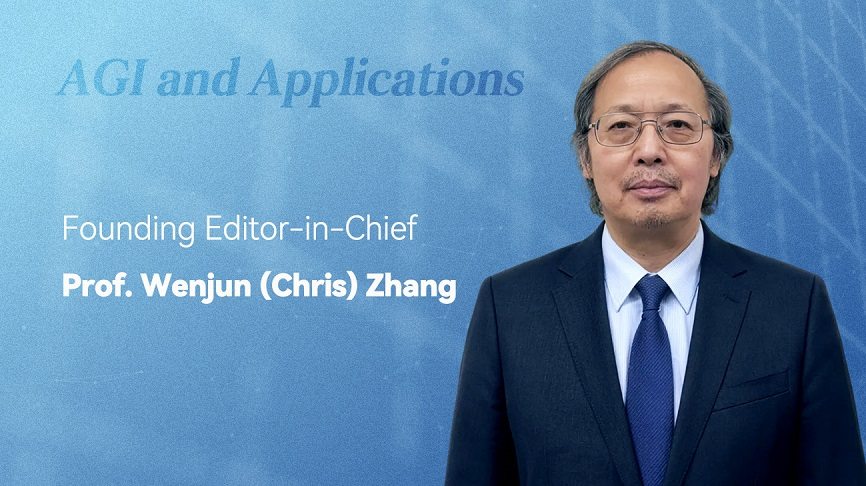
Welcome Prof. Wenjun (Chris) Zhang as Editor-in-Chief of AGI and Applications
AGI and Applications, a newly established international, peer-reviewed, and open-access journal under the OAE portfolio, is honored to announce the appointment of Wenjun (Chris) Zhang as its Editor-in-Chief. Prof. Zhang is internationally recognized for his pioneering contributions to artificial intelligence, machine learning, intelligent systems, computational intelligence, and data-driven engineering, with significant impact in Canada and around the world.
About the Journal
AGI and Applications is committed to providing a high-quality scholarly platform for the dissemination of original research that advances the scientific foundations, architectures, methodologies, and real-world applications of Artificial General Intelligence. The journal promotes rigorous, transparent, and reproducible research that advances intelligent systems capable of adaptive reasoning, knowledge acquisition, autonomous decision-making, and general problem-solving across diverse domains.
The journal serves as an interdisciplinary forum for researchers, engineers, scientists, and practitioners investigating the theoretical and practical challenges associated with building and deploying increasingly general and capable intelligent systems. It welcomes contributions that integrate advances in machine learning, cognitive computing, knowledge representation, reasoning, multimodal intelligence, embodied intelligence, and human-centered AI.
Particular emphasis is placed on AGI research that bridges foundational intelligence theories with practical implementations capable of addressing complex scientific, industrial, societal, and engineering challenges.
Research areas covered by the journal include, but are not limited to, the following:
- Artificial General Intelligence architectures and cognitive intelligence systems
- Machine learning, deep learning, and foundation models for general intelligence
- Large language models, multimodal models, and emergent intelligence capabilities
- Knowledge representation, reasoning, planning, and decision-making systems
- Autonomous agents, agentic AI, and adaptive intelligent systems
- Human-AI collaboration, human-centered intelligence, and interactive learning
- Reinforcement learning, continual learning, transfer learning, and lifelong learning
- Embodied intelligence, intelligent robotics, and autonomous systems
- Explainable, trustworthy, safe, and aligned AGI systems
- Neuro-symbolic intelligence and hybrid reasoning frameworks
- Distributed intelligence, collective intelligence, and multi-agent systems
- Scientific discovery and AI-driven research methodologies
- Intelligent systems for healthcare, manufacturing, transportation, education, finance, and sustainability
- Ethical, legal, governance, and societal implications of AGI technologies
- Computational infrastructure, scalable AI systems, and efficient intelligence deployment
The journal particularly welcomes submissions that integrate theoretical innovation, methodological rigor, interdisciplinary perspectives, and practical relevance, thereby advancing both the scientific understanding and responsible development and application of increasingly capable intelligent systems.
About Prof. Wenjun (Chris) Zhang

Wenjun (Chris) Zhang, FCAE, FASME, FSME, FAAIA, and Senior Member of IEEE, is internationally recognized for his pioneering contributions to machine learning, deep learning, and artificial intelligence. As a Fellow of the Canadian Academy of Engineering, the American Society of Mechanical Engineers, the Society of Manufacturing Engineers, and the American Association for the Advancement of Science, Prof. Zhang has established a distinguished international reputation for advancing intelligent technologies and interdisciplinary engineering research. Throughout his academic career, he has led influential research initiatives that have advanced both the theoretical understanding and practical implementation of artificial intelligence technologies.
Prof. Zhang's research encompasses a broad range of advanced artificial intelligence topics, including deep neural network architectures, representation learning, large-scale model optimization, explainable artificial intelligence, trustworthy machine learning, multimodal learning systems, and the efficient deployment of intelligent algorithms. His contributions have significantly enhanced the robustness, scalability, interpretability, and reliability of modern intelligent systems.
In addition to his theoretical contributions, Prof. Zhang has actively promoted the translation of artificial intelligence technologies into practical applications across computer vision, natural language processing, healthcare, intelligent manufacturing, robotics, and data-driven decision-making systems. His interdisciplinary collaborations and scientific leadership have contributed substantially to bridging the gap between foundational artificial intelligence research and industrial innovation.
Editorial Office Statement
The Editorial Office of AGI and Applications is pleased to welcome Wenjun (Chris) Zhang as Editor-in-Chief. We are confident that, under his leadership, the journal will further develop into a leading international platform for the publication of high-impact research in artificial general intelligence and intelligent systems.
We look forward to collaborating closely with Prof. Zhang and the global research community to strengthen the journal's academic excellence, expand its international visibility, and promote innovative AGI research that advances scientific discovery and technological progress.
Editor: Tina Li
Language Editor: Amir Khan
Production Editor: Ting Xu
Respectfully submitted by the Editorial Office of AGI and Applications