

fig4
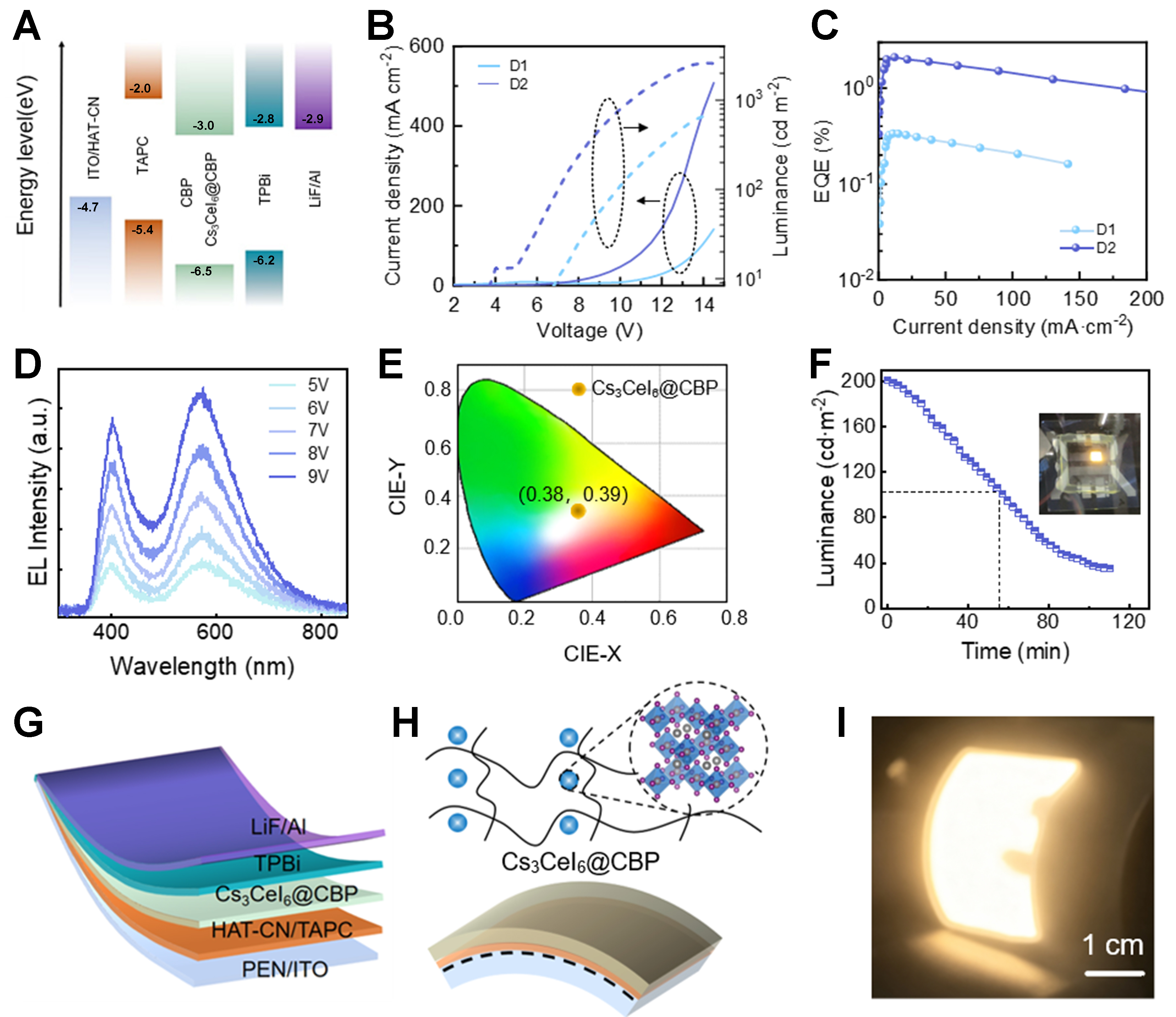
Figure 4. (A) Energy-level diagram and device architecture of the Cs3CeI6@CBP electroluminescent device; (B and C) Current density–voltage, luminance–voltage, and EQE–current-density characteristics of Cs3CeI6@CBP-based LEDs before (D1) and after (D2) optimization; (D) EL spectra of the optimized device measured at different driving voltages. The ellipses with arrows in (B) indicate the ordinate axes corresponding to the two curves; (E) CIE coordinates of the Cs3CeI6@CBP warm-WLEDs; (F) Operational stability of Cs3CeI6@CBP warm-WLEDs at an initial luminance of 200 cd/m2; the inset shows a photograph of the working device; (G) Schematic illustration of the flexible device architecture; (H) Conceptual illustration of the Cs3CeI6@CBP emissive layer integrated on a PEN flexible substrate; (I) Photograph of the flexible device under bending condition with bright warm-white electroluminescence. The photographs shown in (F) and (I) were taken by the authors. CBP: 4,4′-Bis(N-carbazolyl)-1,1′-biphenyl; EQE: external quantum efficiency; LEDs: light-emitting diodes; EL: electroluminescence; CIE: Commission internationale de l'éclairage; WLEDs: white light-emitting diodes; PEN: polyethylene naphthalate; ITO: indium tin oxide; HAT-CN: 2,3,6,7,10,11-Hexacyano-1,4,5,8,9,12-hexaazatriphenylene; TAPC: 1‐Bis[4‐[N,N‐di(4‐tolyl)amino]phenyl]‐cyclohexane; TPBi: 1,3,5-Tris(1-phenyl-1H-benzimidazol-2-yl)benzene; LiF: lithium fluoride.