

Ice-activated hydrogel suction cups enabling unprecedented adhesion
 0
0 
Graphical Abstract
Abstract
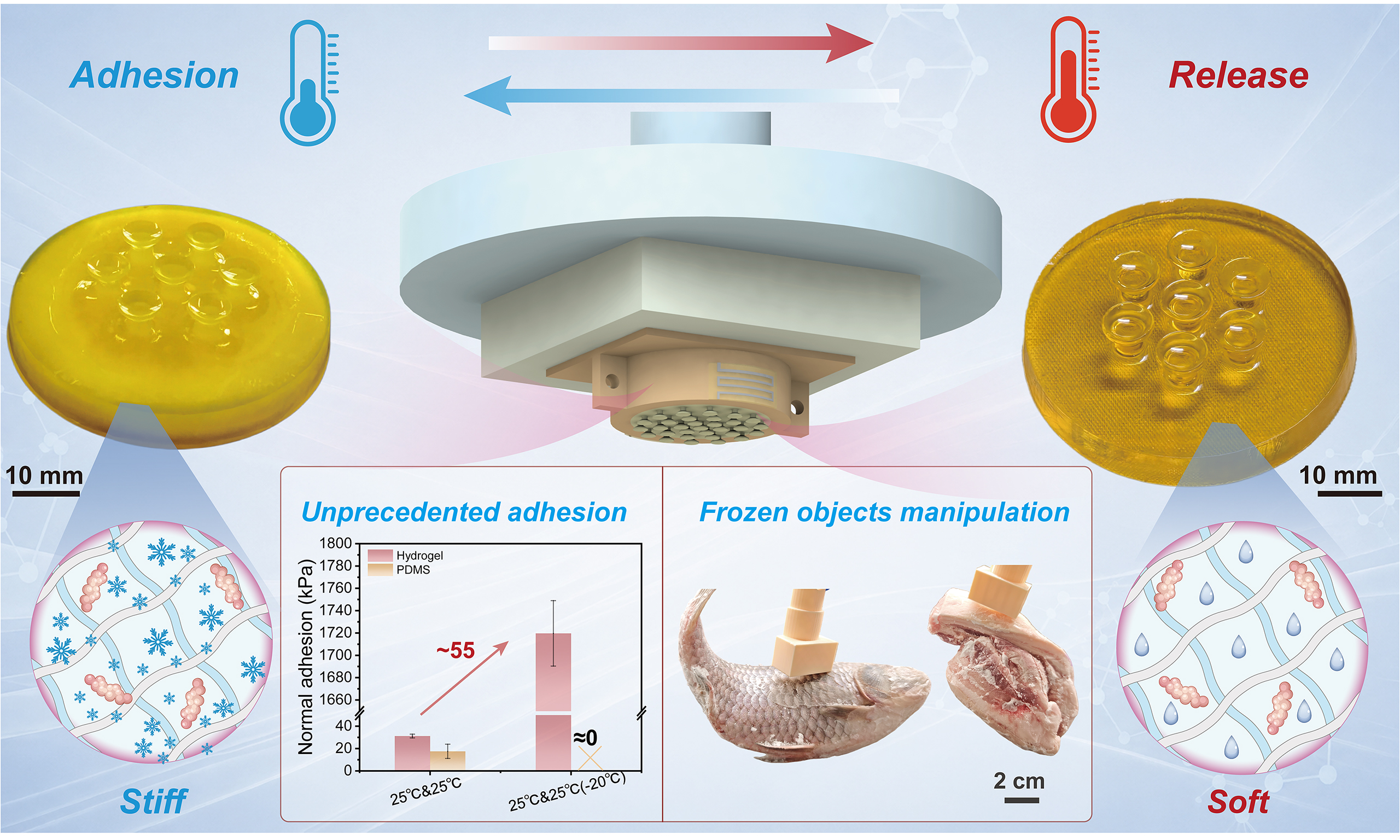
Suction cups are widely used as switchable adhesion devices in manufacturing, robotic manipulation, and automated handling, yet their performance remains limited by insufficient suction force, leakage sensitivity, and poor adaptability to rough, cracked, porous, or irregular surfaces. Inspired by the familiar phenomenon in which a warm, water-rich tongue adheres strongly to ice, we report ice-activated hydrogel suction cups that exploit the phase transition of interfacial water into ice crystals to achieve strong and surface-adaptive adhesion. The hydrogel suction cups were fabricated by vat photopolymerization 3D printing and further programmed into different sizes and array architectures for adaptable adhesion and manipulation. At room temperature, the suction cups adhere through the combined effects of negative-pressure suction, water-mediated sealing, and liquid-bridge forces. Upon cooling, interfacial water freezes and grows into ice crystals within microscopic gaps, generating robust mechanical interlocking, while internal water crystallization stiffens the hydrogel body and reinforces the contact interface. This ice-activated mechanism enhances the adhesion strength to 1,719.67 kPa, which is approximately 100 times greater than that of polydimethylsiloxane suction cups and 55 times greater than that of hydrogel suction cups at room temperature. The suction cups exhibit robust adhesion on various substrates, including cracked or hole surfaces. Furthermore, integrated suction cup arrays facilitate the stable manipulation of objects with diverse geometries, weights, and frozen states, indicating potential applications in cold-chain handling, robotic pick-and-place operations, and automated logistics.
Keywords


 Download PDF
INTRODUCTION
Suction cups represent one of the most widely used strategies for switchable adhesion, with a history spanning more than a century, and serve as indispensable components in advanced manufacturing[1-3] and robotic systems[4-6]. In recent years, significant progress has been witnessed in the development of intelligent and multifunctional suction cups enabled by biomimetic structural engineering and sophisticated control strategies[7-9]. These advancements have endowed suction cups with the capability to handle diverse objects, including rough, soft, or delicate surfaces, thereby further expanding their practical applications in flexible robotic grippers[10-12], climbing robots[13-15], wearable devices[16-18], and industrial automated manipulation[19-21]. Nevertheless, it can be exceedingly challenging to achieve reliable adhesion on rough, non-planar, and irregular surfaces and to realize stable manipulation of heavy objects, largely due to the limited suction force provided by conventional suction cups.
Inspired by biological adhesion mechanisms in organisms such as octopuses[21-24], geckos[25-27], and clingfish[28,29], a wide range of synthetic adhesive systems has been developed over recent decades. Octopus-inspired suction cups can readily pick up objects of diverse materials and geometries, ranging from flat to curved, with smooth to rough surfaces. Through appropriate material and structural design, they can also enable the manipulation of ultra-soft and fragile objects[30]. However, these suction cups require preloading to generate a vacuum, and their adhesion is relatively limited (< 50 kPa), which constrains their ability to achieve long-term stable manipulation of heavy objects[7,31,32]. In industrial settings, stronger adhesion can be achieved using externally generated vacuum, produced by vacuum pumps or Venturi ejectors. While such systems can generate sufficiently high forces for handling heavy objects, they require bulky and energy-intensive infrastructure and remain highly sensitive to leakage, making it difficult to maintain reliable adhesion on rough or irregular surfaces over time[33-35]. In contrast, Gecko-inspired adhesive achieves strong adhesion (~1 MPa) through Van der Waals forces between soft micropillars and the target objects[36-38]. Nevertheless, the adhesion forces are significantly influenced by surface roughness, due to the short-range nature of Van der Waals interactions. In addition, detachment often requires active deformation, which complicates system design and operation. Thus, developing an adhesion strategy that simultaneously provides strong adhesion (> 1 MPa), surface adaptability, and reliable performance under realistic conditions remains a critical challenge.
It is a well-known phenomenon that a tongue can strongly adhere to ice surfaces, making detachment difficult[39,40]. However, replicating this unique adhesive function in synthetic materials remains a significant challenge. This challenge primarily arises from the inherent limitations of interfacial icing: the formation of ice crystals disrupts the intimate contact between the adhesive material and the substrate[39,41,42], while ice growth can cause structural damage to the hydrogel matrix[43]. Moreover, the resulting ice layer serves as a physical barrier, hindering effective interfacial interactions. Consequently, interfacial icing is typically viewed as detrimental to adhesion performance in conventional adhesive systems. Most existing studies have focused on preventing ice formation or mitigating its adverse effects on adhesive materials and interfaces, rather than exploring icing’s potential to enhance adhesion.
In contrast, we propose a new design paradigm that leverages the phase transition of interfacial water into ice crystals at hydrogel suction interfaces. This approach enables the development of suction cups that exhibit strong, switchable, and surface-adaptive adhesion. During the adhesion stage, the hydrogel interface enhances sealing by trapping interfacial water within microscopic gaps under negative pressure. Upon cooling, the freezing-induced conversion of internal water into ice leads to the gradual growth of interfacial ice crystals, which embed in the contact interface and form robust mechanical interlocking. This mechanism fundamentally differs from conventional suction or van der Waals adhesion, as it integrates pressure-driven sealing with phase-transition-induced interfacial reinforcement. Based on the novel mechanism, hydrogel suction cups fabricated through vat photopolymerization 3D printing technology exhibit ultra-strong and switchable adhesion on various surfaces, including silicone wafers, glass, S304 stainless steel, and parylene (PPX). Furthermore, hydrogel suction cup arrays demonstrate stable and switchable adhesion on objects with diverse geometries, large weights, and porous structures. These results highlight the potential of this adaptive adhesion strategy for applications in hydrogel-based soft gripping systems, climbing and moveable robots.
EXPERIMENTAL
Materials
All chemical reagents were used directly as received without additional purification. Acrylamide (AAm, 98%) was purchased from Kermel (Tianjin, China). Acryloyl chloride (98%), semicarbazide hydrochloride (98%), lithium phenyl-2,4,6-trimethylbenzoylphosphinate (LAP, 95%), anhydrous potassium carbonate (K2CO3, 99%), and dimethyl sulfoxide (DMSO, 98%) were obtained from Energy Chemical (Shanghai, China). Diethyl ether (99.5%) was supplied by Rianlon Bohua (Tianjin, China), and tartrazine (95%) was purchased from Aladdin (Shanghai, China). Deionized (DI) water was produced in-house.
Synthesis of N-acryloylsemicarbazide
N-acryloylsemicarbazide (NASC) was synthesized through an acylation reaction between semicarbazide hydrochloride and acryloyl chloride. Briefly, semicarbazide hydrochloride (31.75 g) was dispersed in DI water (30 mL), followed by the addition of chilled K2CO3 solution (168 mL, 2 M) and cold diethyl ether
Preparation of hydrogel
The NASC/AAm hydrogel precursor was prepared through photopolymerization. NASC (8.93 g) and AAm (3.57 g) were dissolved in a DMSO/water mixed solvent containing DMSO (26.25 g) and DI water (11.25 g). LAP (0.5 wt% relative to total monomers) and tartrazine (0.3 g·L-1) were incorporated as the photoinitiator and light absorber, respectively. The precursor solution was homogenized by magnetic stirring at 70 °C for 60 min (400 rpm) and subsequently transferred into an acrylic mold (10 × 10 × 1 cm3). Polymerization was initiated using 405 nm irradiation at room temperature. The obtained organohydrogels were immersed in DI water for 5 days, with water replacement every 12 h, to eliminate residual DMSO and induce network reconstruction.
3D printing the hydrogel suction cups
The hydrogel ink was loaded into the resin vat of a commercial stereolithography 3D printer (SLASH, UNIZ, China) equipped with a 405 nm light source. Three-dimensional suction-cup geometries were designed as stereolithography (STL) files, imported into the printer software, and sliced along the Z direction prior to printing. Unless otherwise specified, all constructs were printed at room temperature using a layer thickness of 100 μm and an exposure time of 15-25 s per layer. After printing, the as-fabricated structures were immersed in DI water for 5 days to obtain hydrogel suction cups with enhanced mechanical performance.
Mechanical properties testing
Mechanical measurements were carried out using a universal testing machine (EZ-Test, Shimadzu, Japan) equipped with a 500 N load cell. For tensile testing, rectangular specimens with dimensions of 1.0-1.3 mm in thickness and width were fixed between clamps with an initial gauge length of 25 mm. A stretching rate of 100 mm·min-1 was applied until sample failure. Fracture stress and strain were obtained from the failure point of the stress–strain curves. Young’s modulus was calculated from the linear region between 5% and 15% strain. The work of fracture, or toughness, W (MJ·m-3), was defined as the area under the stress-strain curve, as follows:
where σb and εb are the fracture stress and fracture strain, respectively[44]. The compressive properties of the hydrogel under freezing conditions were evaluated using a customized temperature-controlled freezing platform. The platform temperature was independently regulated to achieve the desired testing temperatures (-25, -2, -5, -10, -15, and -20 °C). Before compression measurements, the hydrogel samples were placed on the cooling platform and maintained at the target temperature for sufficient time to establish a stable thermal condition. Compression tests were then performed while the sample temperature was maintained by the freezing platform. This setup enables a more realistic simulation of the practical operating conditions of the ice-activated hydrogel suction cup. The compression tests were conducted at a constant crosshead speed of
Rheology behavior
Rheological characterization was performed using a HAAKE RS6000 rheometer equipped with a 35 mm parallel plate geometry. The thixotropic response was evaluated by alternating low and high shear stresses (1 and 2,000 Pa). Temperature-dependent measurements were conducted at 1 Hz frequency and 2,000 Pa stress amplitude while cooling from 25 to -10 °C.
Adhesion characterization of hydrogel suction cups
The adhesion strength of the hydrogel suction cups was measured using a universal testing machine (EZ-Test, Shimadzu, Japan) equipped with a 500 N load cell. All measurements were performed with custom-designed fixtures, which were externally coupled to thermal conduction and refrigeration modules to enable temperature-controlled testing. Force-displacement curves were recorded in compression mode at a crosshead speed of 10, 20, 50, and 100 mm·min-1. To evaluate the effect of freezing time on the nonspecific adhesion performance of the suction cups, a preload of 1 N was applied, and the contact time was varied from 1 to 30 min (1, 3, 5, 8, 9, 10, and 30 min). To assess nonspecific adhesion across different interfacial conditions, adhesion tests were further conducted on substrates with varying attributes and surface roughness. Unless otherwise stated, the applied preload was fixed at 1 N, the crosshead speed was
RESULTS AND DISCUSSION
Design strategy and fabrication of ice-activated hydrogel suction cups
A well-known phenomenon can be observed in everyday life: when a warm, soft, and water-rich tongue contacts a low-temperature surface such as ice, it gradually adheres strongly to the surface and becomes difficult to detach [Figure 1A]. The detailed mechanism is illustrated in Figure 1B. When the moist tongue contacts the cold ice surface, heat is rapidly transferred away from the tongue, leading to the freezing of free water and the boundary water film at the interface. Consequently, an initial ice layer is formed between the oral mucosa and the ice surface. With prolonged contact time, ice crystals continue to nucleate and grow within the microscopic gaps, surface depressions, and interface irregularities. These crystals bridge the two surfaces, forming a mechanically interlocked structure that enhances resistance to interfacial separation. Thus, the combined effects of interfacial freezing, ice-bridge formation, and ice-crystal-mediated mechanical interlocking result in strong adhesion, making detachment challenging. Inspired by this phenomenon, we developed hydrogel suction cups via vat photopolymerization 3D printing [Figure 1C]. To formulate a proof-of-concept supramolecular photocurable hydrogel ink, NASC and AAm were used as monomers, together with the water-soluble photoinitiator LAP and tartrazine as a photoabsorber, all dissolved in a mixed solvent of DMSO and DI water. To provide a more rigorous characterization of NASC, we have added both FTIR and nuclear magnetic resonance (NMR) analyses to confirm its chemical structure and purity in Supplementary Figures 1-3. Following UV curing, the printed organohydrogels were immersed in DI water to facilitate microphase separation and hydrogen-bond reconstruction, yielding supramolecular hydrogels exhibiting excellent mechanical properties[30,45-48]. Notably, vat photopolymerization enables the facile fabrication of hydrogel suction cups with tunable structures, sizes, and geometries. Subsequently, the printed hydrogel suction cups were assembled with a thermally conductive copper tube mold, a semiconductor cooling platform, and a polyimide film heater to construct an adhesion device [Figure 1D]. As shown in Figure 1E, at room temperature, the soft hydrogel suction cup adheres closely to the substrate due to the combined effects of negative pressure and water-mediated sealing. During preloading, free water within the hydrogel is driven into the contact interface, filling microscopic interfacial gaps, reducing trapped air, enhancing negative pressure, and improving sealing[31]. Upon cooling, the interfacial water gradually freezes to form ice crystals within the microscopic gaps of the adhesion interface, resulting in tight mechanical interlocking. Concurrently, the free and bound water inside the hydrogel progressively crystallizes into ice, compressing and immobilizing the polymer network, thereby transitioning the hydrogel from a soft state to a stiffened state. The synergistic effects of ice-crystal-induced mechanical interlocking, negative-pressure suction, and freezing-induced phase transition collectively contribute to ultra-strong adhesion to the contacted object.
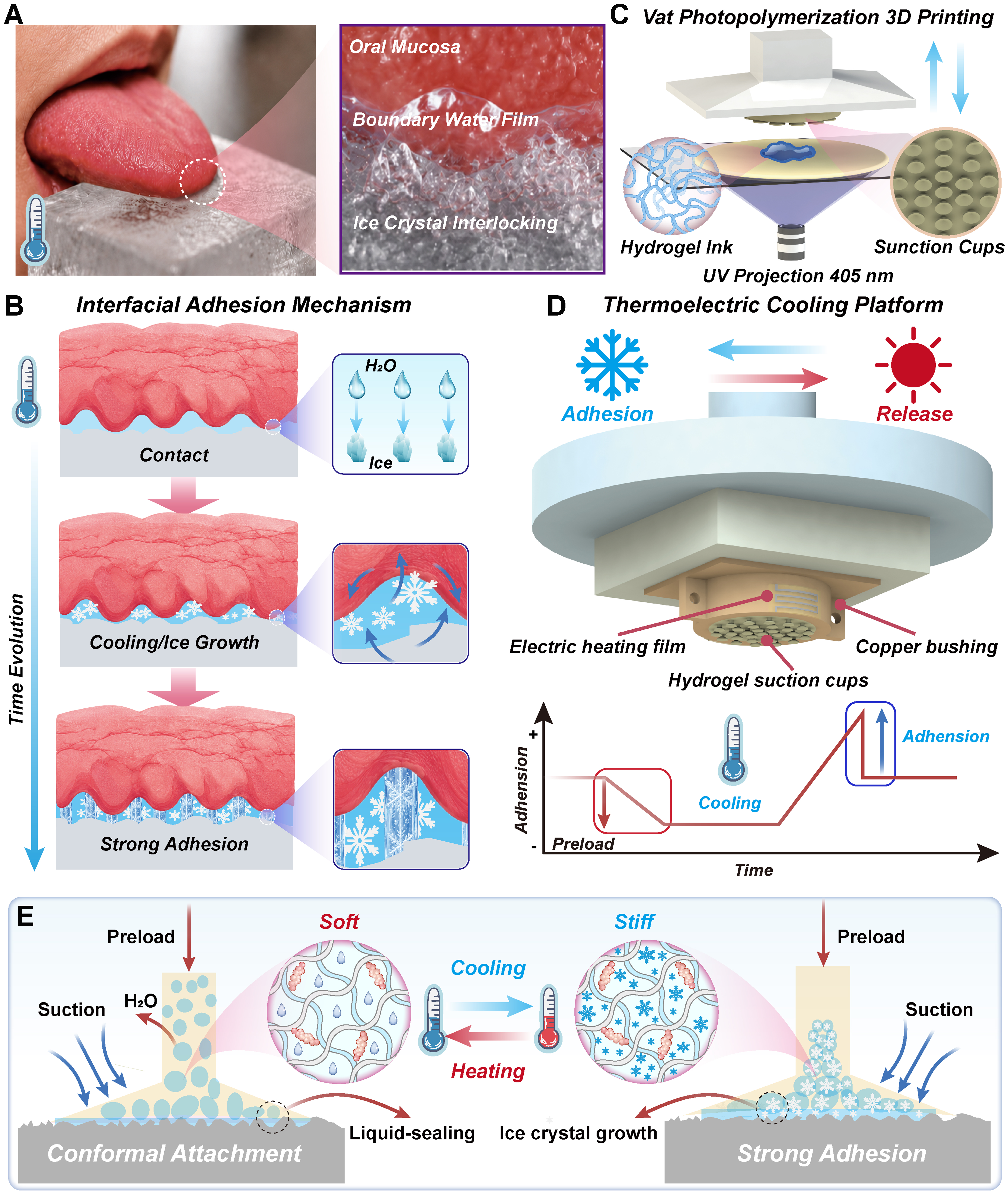
Figure 1. Design and adhesion mechanism of the ice-activated hydrogel suction cups. (A) Schematic illustration of tongue–ice adhesion; (B) Mechanistic schematic of the time-dependent evolution of adhesion at the tongue–ice interface; (C) Hydrogel suction cups fabricated via vat photopolymerization 3D printing; (D) Schematic illustration of ice-activated hydrogel suction cup devices; (E) Illustrations showing the adhesion mechanism of the ice-activated hydrogel suction cups. UV: Ultraviolet.
Mechanical properties and structural evolution of supramolecular hydrogels from ambient to low temperatures
As shown in Figure 2A, DMSO was introduced to disrupt hydrogen bonding, thereby reducing heterogeneity during gelation. The photocured gels were subsequently immersed in DI water to reconstruct the multiple hydrogen-bonding interactions disrupted by the DMSO/H2O mixed solvent. As a result, poly(N-acryloylsemicarbazide-co-acrylamide) hydrogels acquire excellent mechanical properties through the formation of a dense, physically crosslinked network during solvent exchange from DMSO to water[45,46]. In addition, partial hydrogen-bond donors and acceptors on the polymer chains undergo mild local microphase separation due to their hydrophobicity in water, which further contributes to the mechanical reinforcement of the equilibrated hydrogels. As shown in Figure 2B-D, the supramolecular hydrogel exhibits excellent soft mechanical properties at room temperature (25 °C), characterized by a tensile strength of 3.13 ± 0.09 MPa, a strain at break of 569.10% ± 5.94%, a Young’s modulus of 0.52 ± 0.02 MPa, and a toughness of 9.39 ±
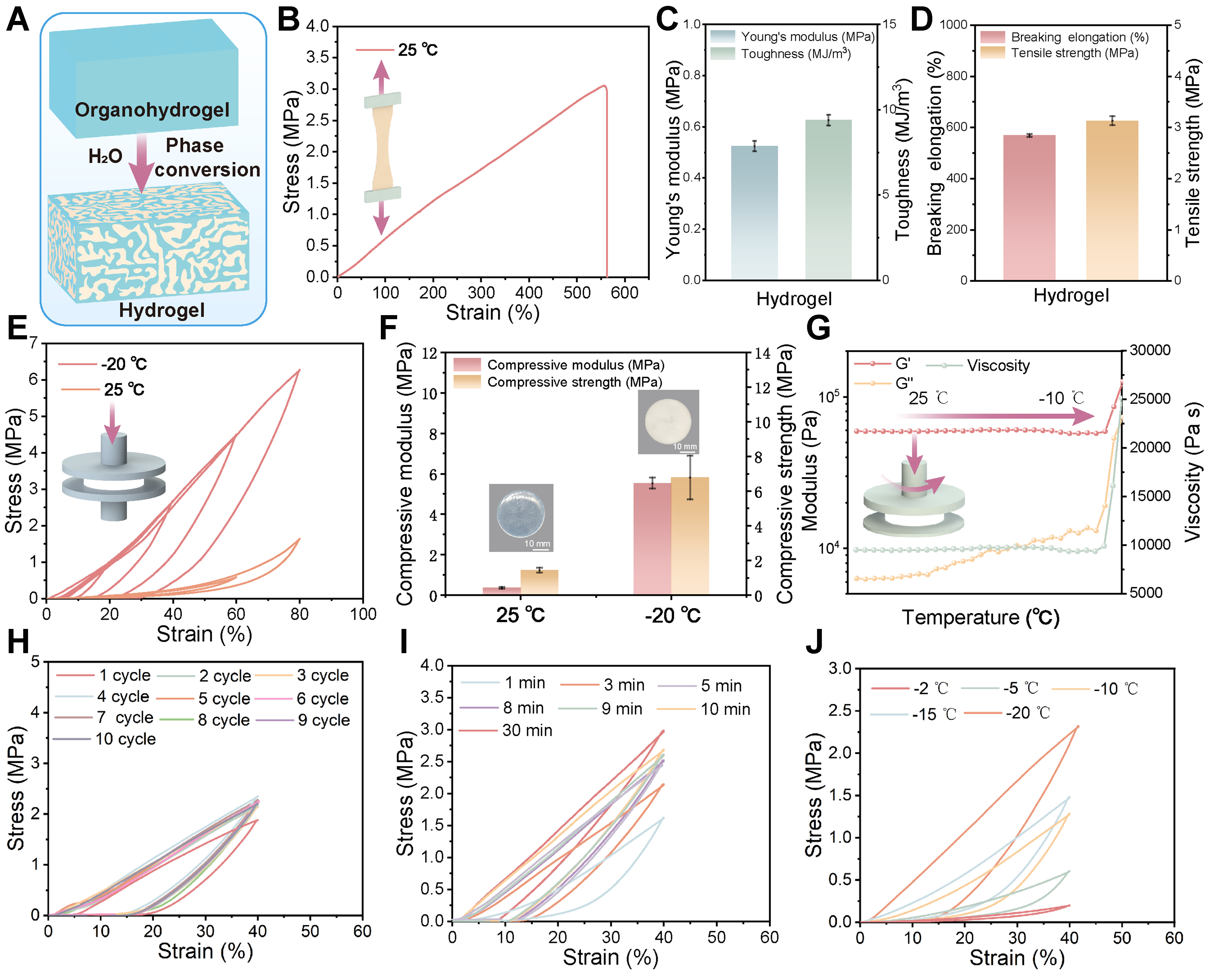
Figure 2. Mechanical properties and structural evolution of supramolecular hydrogels from ambient to low temperatures. (A) Schematic diagram of hydrogen bond reconstruction in hydrogels; (B) Representative tensile stress-strain curves; (C) Young’s modulus and toughness, as well as (D) breaking elongation and tensile strength of hydrogels at 25 °C; (E) Compression stress–strain curves of the hydrogel measured at 25 and -20 °C; (F) Compressive modulus and compressive strength of hydrogels at 25 and -20 °C; (G) Storage modulus G′, loss modulus G′′, and viscosity of the hydrogels from 25 to -10 °C; (H) Compressive loading–unloading curves of the hydrogel during repeated freeze–thaw cycles; (I) Compressive loading–unloading curves of the hydrogel at -20 °C after different freezing times; (J) Compressive loading–unloading curves of the hydrogel at different temperatures. Error bars represent ± SD (n = 3). SD: Standard deviation.
Unprecedented adhesion of ice-activated hydrogel suction cups
As shown in Figure 3A, polydimethylsiloxane (PDMS)-based suction cups adhere to substrates primarily through negative-pressure suction, but their limited conformability prevents them from fully filling microscopic surface gaps, resulting in relatively weak adhesion. Upon rapid cooling, the modulus of PDMS increases sharply as it transitions into a stiffened state. This stiffening induces rapid shrinkage of the suction cup surface and interfacial detachment from the substrate, leading to a significant decrease in adhesion strength. In contrast, water-rich soft hydrogel suction cups demonstrate excellent adhesion at room temperature due to water-mediated sealing and liquid-bridge forces. In contrast, hydrogel suction cups exhibit fundamentally different behavior. The presence of water allows effective filling of interfacial gaps, and upon cooling, ice crystals grow within these gaps to form strong mechanical interlocking. Meanwhile, the hydrogel undergoes a transition from a soft state to a stiffened state, further enhancing adhesion strength [Figure 3B]. As shown in Figure 3C and Supplementary Figure 8A, the PDMS suction cup exhibits an adhesion strength of 17.52 kPa at 25 °C, which decreases drastically to nearly negligible levels at -20 °C. In contrast, the hydrogel suction cup shows a dramatic increase in adhesion strength upon cooling, reaching 1,719.67 kPa at -20 °C, representing more than a 50-fold enhancement compared with its performance at
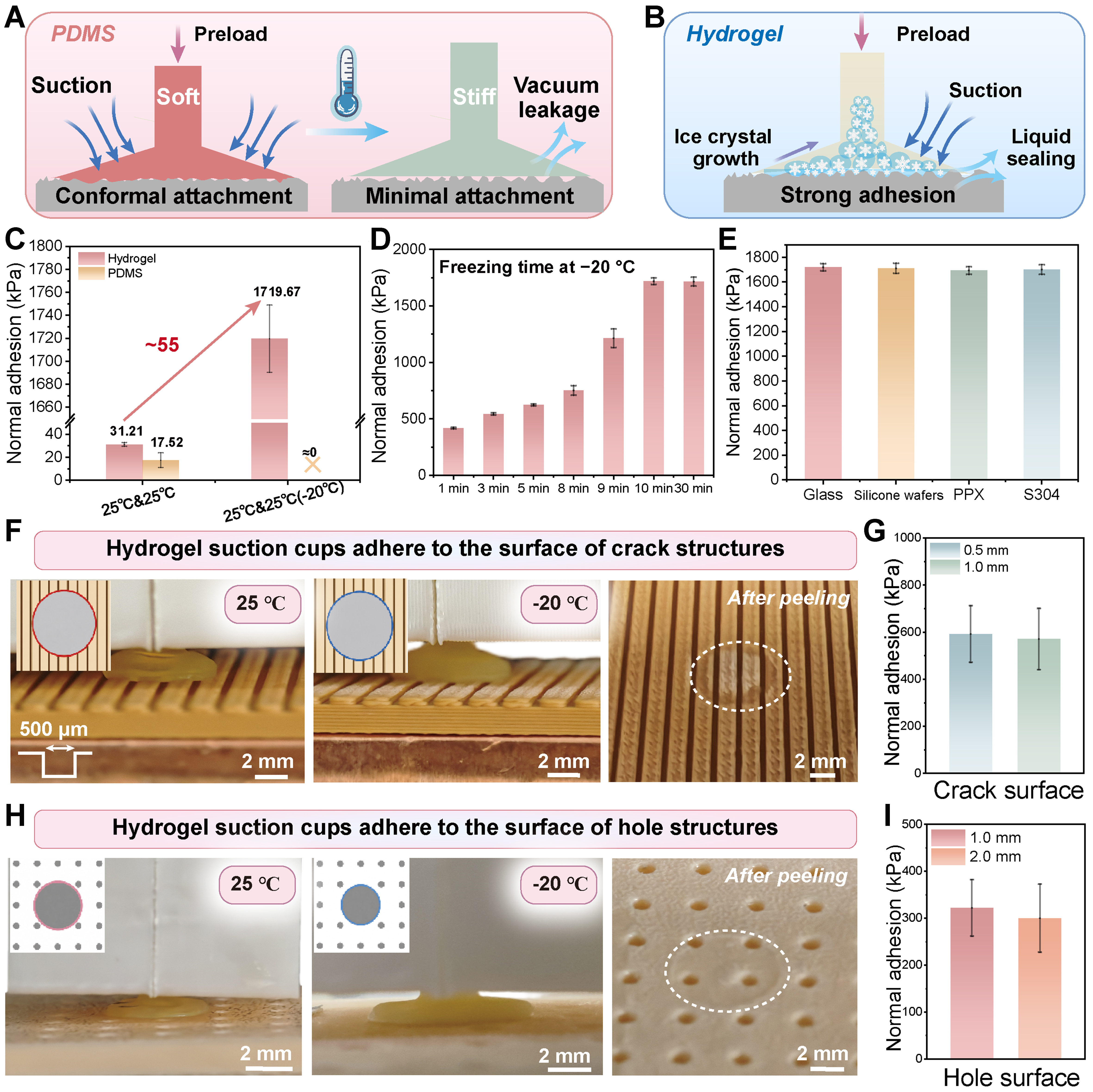
Figure 3. Adhesion performance of ice-activated hydrogel suction cups. (A) Schematic diagram of PDMS suction cup contact process; (B) Schematic illustration of the evolution of interfacial contact in a hydrogel suction cup under freezing conditions; (C) Relative adhesion enhancement of the hydrogel suction cup and PDMS under low-temperature conditions. The annotations (~55 and ~0) indicate the approximately 55-fold increase in adhesion strength of the hydrogel suction cup after ice activation and the nearly negligible adhesion strength of PDMS at low temperature, respectively; (D) Adhesion of hydrogel suction cups at -20 °C after different freezing times; (E) Adhesion of hydrogel suction cups on different substrates; (F) Schematic illustration of ice-activated hydrogel suction cup contact on a cracked surface; (G) Adhesion of ice-activated hydrogel suction cup contact on surfaces with different crack sizes; (H) Schematic illustration of ice-activated hydrogel suction cup contact on a hole surface; (I) Adhesion of ice-activated hydrogel suction cup contact on surfaces with different hole sizes. Error bars represent ± SD (n = 3). PDMS: Polydimethylsiloxane; SD: standard deviation; PPX: parylene.
To provide more direct evidence for ice-crystal-induced mechanical interlocking, optical and fluorescence-microscopy characterizations were performed together with schematic analysis and Supplementary Video recording. As shown in Figure 4A, sequential optical images reveal that ice rapidly propagates upward from the cooling platform into the hydrogel suction cup, leading to rapid freezing of the contact interface. As shown in Figure 4B, we customized the cryogenic adhesion testing platform to facilitate observation of the suction cup’s adhesion process. To visualize interfacial water transport and subsequent ice formation, the hydrogel suction cup was stained with Rhodamine B and observed in situ using a custom-built fluorescence microscope. Transparent acrylic substrates containing gaps of different dimensions were used as model structured surfaces [Figure 4C]. Under preload, the suction cup formed conformal contact with the substrate, while water released from the hydrogel was driven into and filled the interfacial gaps. Residual Rhodamine B fluorescence observed within these gaps after detachment confirmed that interfacial water had penetrated the surface features during contact. More importantly, Figure 4D shown the schematic illustration of ice-crystal growth and evolution in the hydrogel suction cup. As shown in Figure 4E and Supplementary Video show the growth and propagation of ice crystals within the confined interfacial gaps during cooling. Freezing of the trapped water generates physical anchoring sites and mechanical interlocks between the hydrogel suction cup and the substrate, providing an additional adhesion contribution beyond suction-induced negative pressure. Top-view photographs and cross-sectional fluorescence images obtained after detachment further reveal residual fluorescent traces within the gaps [Figure 4F and G], corroborating the infiltration and subsequent freezing of interfacial water. Together, these observations provide direct visual evidence for the proposed ice-activated mechanical interlocking mechanism. To determine whether repeated freezing and thawing compromise the structural integrity and mechanical reliability of the hydrogel, we performed repeated freeze–thaw adhesion cycles and examined the hydrogel suction cup before and after cyclic operation using optical microscopy. As shown in Supplementary Figure 10, the hydrogel suction cup maintained stable adhesion performance during 10 consecutive freezing–adhesion–detachment–thawing cycles, without significant degradation in adhesion strength. Moreover, the optical microscopy images obtained before and after cyclic testing revealed no obvious cracks, surface damage, fragmentation, or permanent structural deformation [Figure 4H]. These results indicate that repeated freezing and thawing do not cause appreciable structural deterioration or increase the susceptibility of the hydrogel suction cup to mechanical failure within the investigated cycle range.
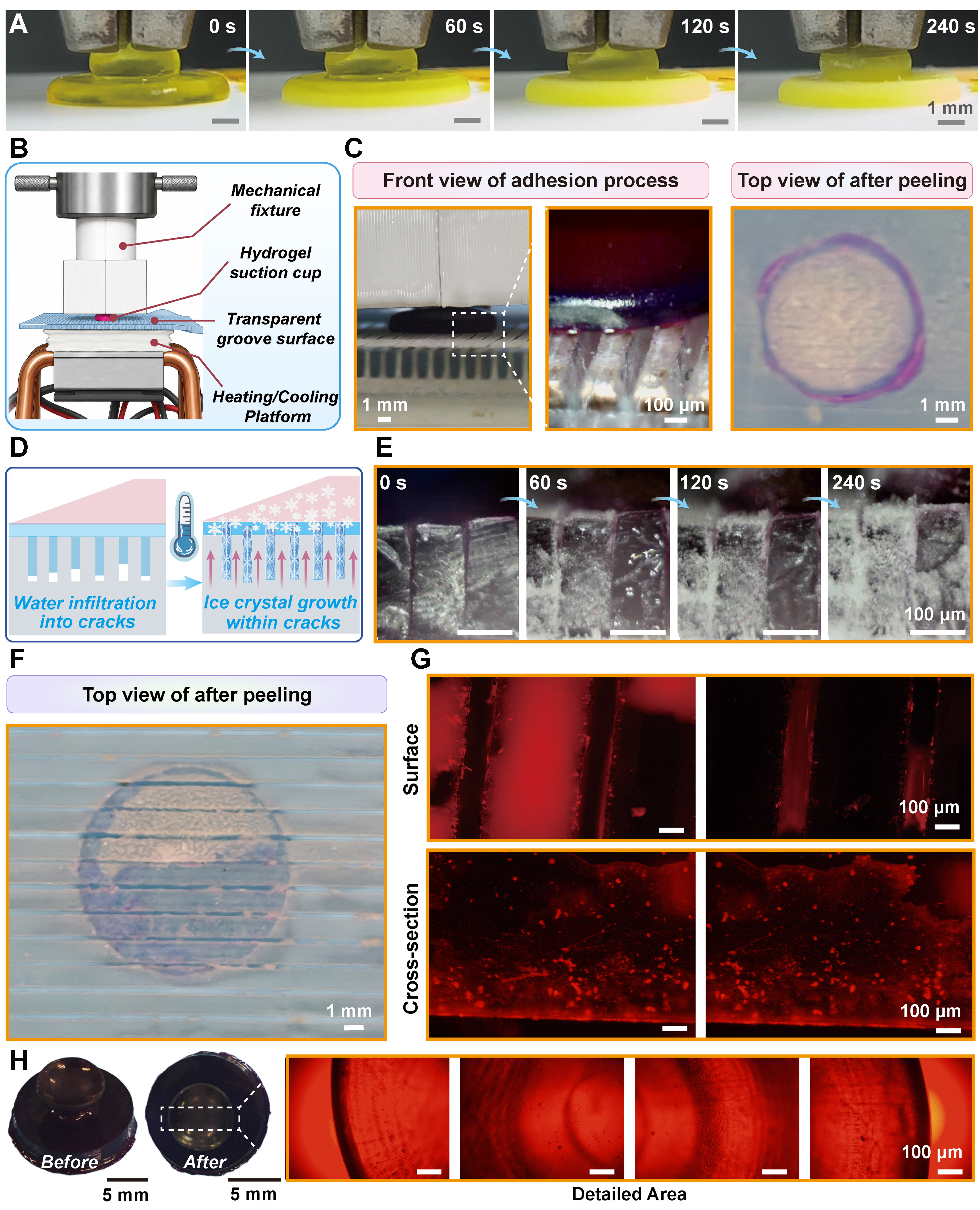
Figure 4. Evolution of the ice-activated hydrogel adhesion process. (A) Time-lapse images of freezing propagation into the hydrogel suction cup; (B) Schematic illustration of the ice-activated suction-cup adhesion testing platform; (C) Photographs showing the adhesion and peeling processes of the hydrogel suction cup; (D) Schematic illustration of ice-crystal growth and evolution in the hydrogel suction cup; (E) Photographs showing ice-crystal growth and evolution in the hydrogel suction cup; (F) Photographs of the interfacial traces after detachment; (G) Fluorescence microscopy images showing residual fluorescent traces within the interfacial grooves after detachment; (H) Photographs and fluorescence microscopy images of the hydrogel suction cup after 10 freeze–thaw adhesion cycles.
To further demonstrate the performance of ice-activated hydrogel suction cups, we fabricated individual hydrogel suction cups with different sizes via vat photopolymerization 3D printing [Figure 5A]. As shown in Figure 5B, individual ice-activated hydrogel suction cups of different sizes all exhibited excellent adhesion performance. Among them, the suction cup with an apparent contact diameters of 7.5 mm showed the highest adhesion strength of 1,719.67 kPa. This can be attributed to the stress-concentrated region at the rim of the hydrogel suction cup during contact, which promotes the formation of an annular sealing zone[31]. Such a sealing zone enhances adhesion at room temperature and facilitates ice-crystal growth during freezing, thereby further improving adhesion under low-temperature conditions. As shown in Figure 5C, the adhesion strength increased with freezing time and reached a maximum after approximately 10 min. To further demonstrate the versatility of this ice-activated adhesion strategy, suction cup arrays with different apparent contact areas were fabricated in Figure 5D-F. These arrays also exhibited excellent adhesion strength, which increased progressively with freezing time in Figure 5E and F. Therefore, combined with vat photopolymerization 3D printing, this strategy enables the fabrication of ice-activated hydrogel suction cups with various sizes and architectures, all showing strong adhesion performance. We further fabricated bioinspired tree-frog and bush cricket pad structures using vat photopolymerization 3D printing, as shown in Figure 5G. At
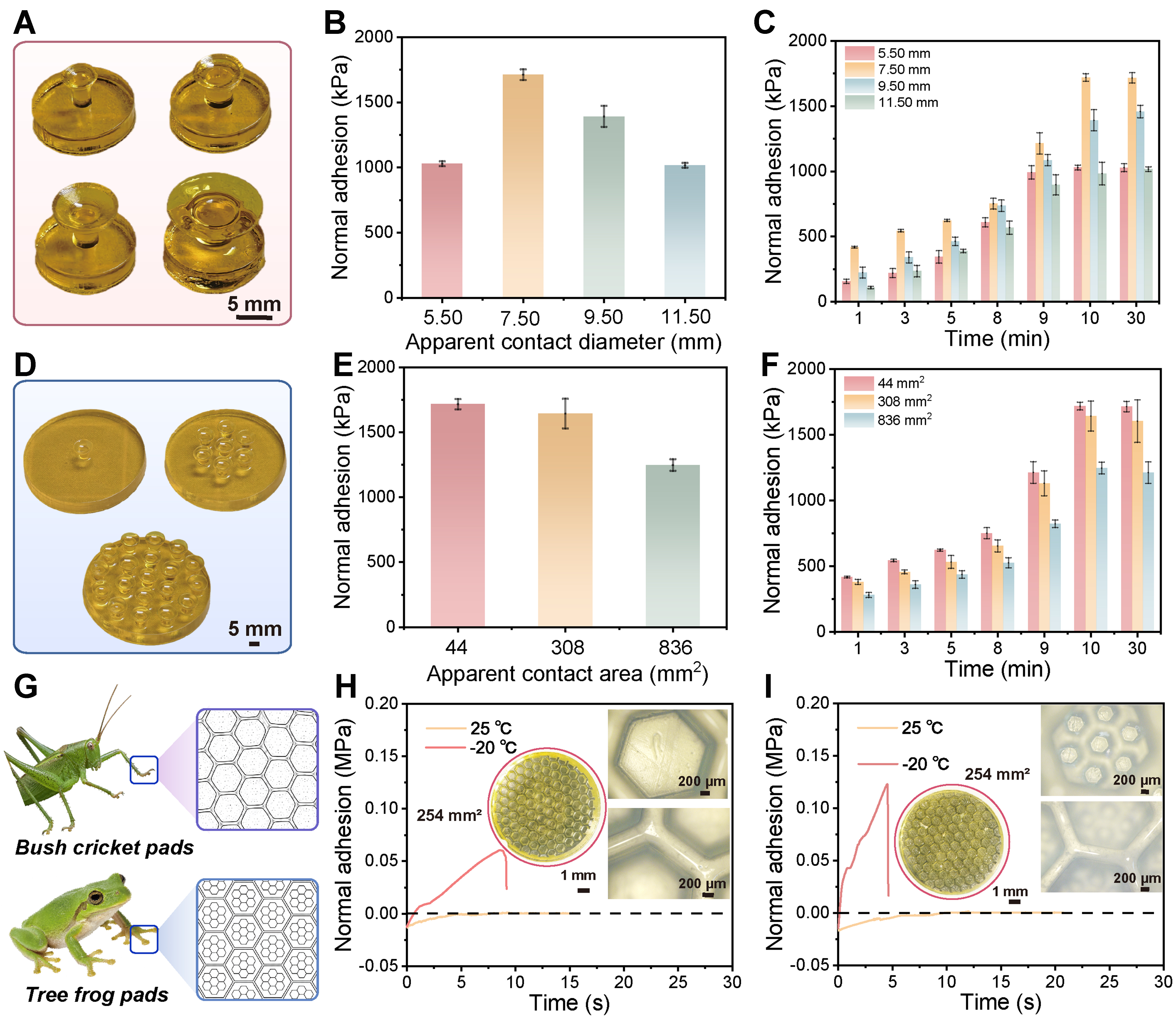
Figure 5. Adhesion performance of ice-activated hydrogel suction cups and arrays with different structures. (A) Photos of a single hydrogel suction cup with different apparent contact diameters; (B) Adhesion of a single hydrogel suction cup with different apparent contact diameters; (C) Adhesion of a single hydrogel suction cup at different freezing times; (D) Photos of hydrogel suction cup arrays with different apparent contact areas; (E) Adhesion of hydrogel suction cup arrays with different apparent contact areas; (F) Adhesion of hydrogel suction cup arrays at different freezing times; (G) Schematic illustration of the bush cricket pads and the tree frog pads; (H) Adhesion of hydrogel bush cricket pads at 25 and -20 °C; (I) Adhesion of hydrogel tree frog pads at 25 and -20 °C. Error bars represent ± SD (n = 3). The elements in (A and D) were photographed by the authors. SD: Standard deviation.
Applications of ice-activated hydrogel suction cups
Based on the outstanding adhesion performance and underlying mechanisms, we explored the practical applications of the ice-activated hydrogel suction cups. As shown in Figure 6A, the single ice-activated hydrogel suction cup can easily lift objects with different materials, weights, and shapes in air. In addition, a size-programmable array of suction cups was fabricated based on the advantages of 3D printing technology in Figure 6B. Hydrogel suction cup arrays can adaptively adhere to a variety of challenging surfaces, readily lifting heavy objects with cracked or porous surfaces, which is difficult to achieve with conventional suction cups. Leveraging this excellent manipulation capability, the hydrogel suction cup arrays were integrated with thermally conductive copper tube molds, polyimide film heaters, and semiconductor cooling platforms to construct an adhesion device. As shown in Figure 6C, the device can control adhesion and detachment through heating and cooling. This device could also readily manipulate frozen fish and meat in Figure 6D. These results demonstrate that the hydrogel suction cup-based adhesion system can grasp a broad range of objects, including those with planar and non-planar geometries, as well as rigid and frozen goods. This proof-of-concept demonstration highlights the potential of ice-activated hydrogel adhesion devices for diverse object-transport tasks, including cold-chain food handling, robotic pick-and-place operations, and automated logistics.
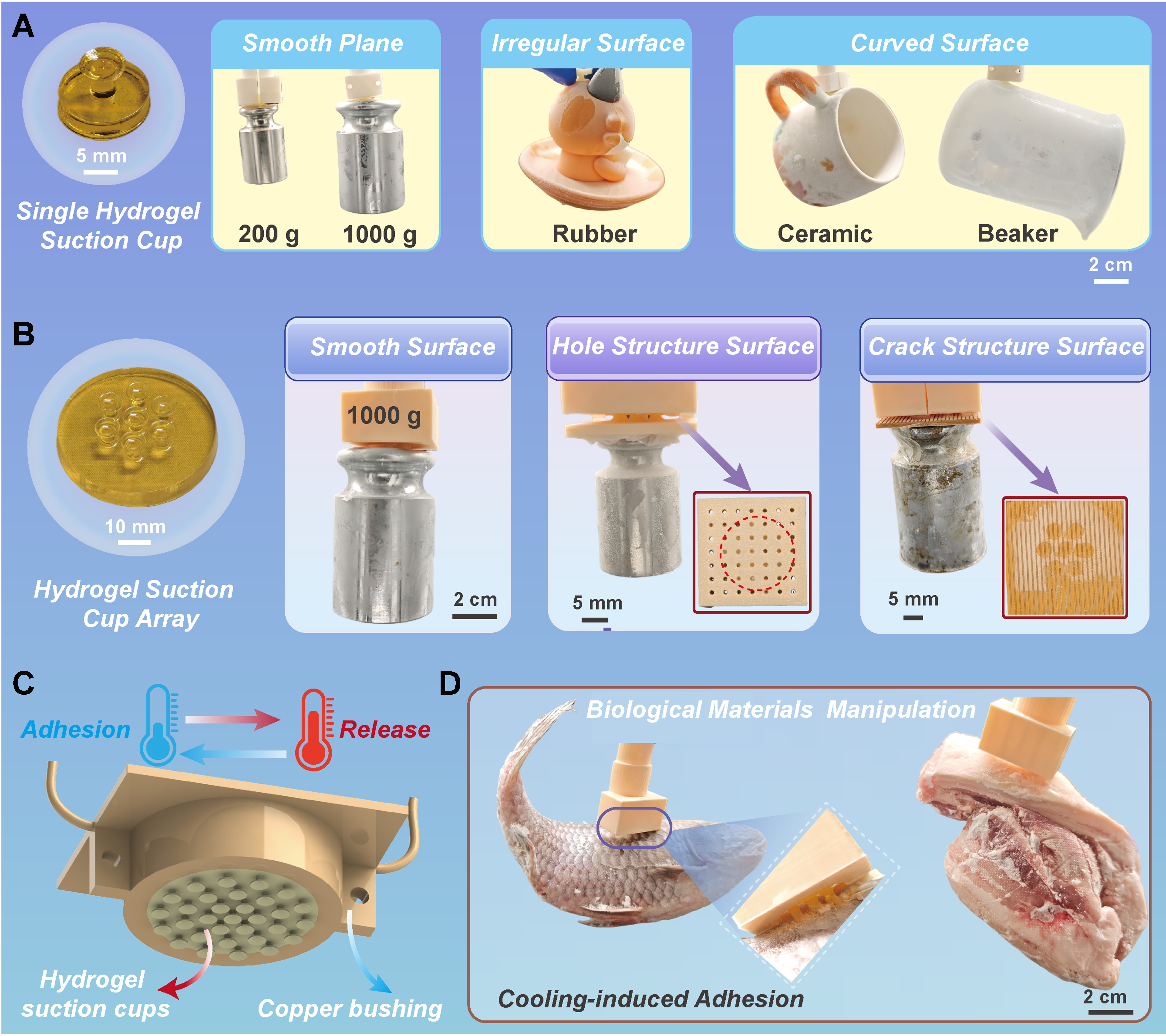
Figure 6. Conceptual application demonstration of the ice-activated hydrogel suction cups for gripping and manipulation. (A) The ice-activated hydrogel suction cup lifting various objects; (B) The ice-activated hydrogel suction cup arrays lifting various objects with crack and hole substates; (C) Demonstration of the adhesion devices with ice-activated hydrogel suction cups; (D) Conceptual application demonstration of the ice-activated hydrogel suction cups for biological materials manipulation. The fish and meat samples shown in the figures were commercially purchased from a local market and were used only as non-living food samples for adhesion demonstrations. No live animals or animal experiments were involved. The elements in Figure 6 were photographed by the authors.
CONCLUSION
This work demonstrates the design and performance of ice-activated hydrogel suction cups, showcasing their exceptional adhesion capabilities under both ambient and low-temperature conditions. Inspired by the everyday phenomenon where a warm, soft, and water-rich tongue adheres strongly to ice, these hydrogel suction cups incorporate the phase transition of interfacial water into ice, providing a unique method to achieve strong, switchable, and surface-adaptive adhesion. Photopolymerization 3D printing enables the fabrication of hydrogel suction cups with tunable geometries and enhanced mechanical properties, making them suitable for diverse surfaces, including planar and non-planar substrates, as well as surfaces with cracks and holes. The experimental results indicate that the ice-activated hydrogel suction cups demonstrate superior performance compared to traditional suction cups, exhibiting enhanced adhesion strength and multifunctionality. Upon cooling, the hydrogel transitions from a soft state to a stiffened state, with the formation of interfacial ice crystals that create strong mechanical interlocks, thereby significantly enhancing adhesion. With an unprecedented adhesion strength of 1,719.67 kPa, these hydrogel suction cups are approximately 100 times stronger than conventional PDMS suction cups and about 55 times stronger than traditional hydrogel suction cups. These hydrogel suction cups can adapt to various surfaces while maintaining high adhesion strength, making them an ideal solution for a wide range of applications, including cold-chain food handling, robotic pick-and-place operations, and automated logistics. Furthermore, integrating hydrogel suction cups with thermal management and cooling modules creates a versatile system for object manipulation across different conditions, demonstrating their potential in both ambient and low-temperature environments. These findings not only underscore the performance advantages of ice-activated hydrogel suction cups but also pave the way for transformative applications across various industries. Particularly in high-load scenarios, they present a promising solution to long-standing challenges in adhesion technology.
DECLARATIONS
Authors’ contributions
Conceptualization, methodology, formal analysis, writing original draft, visualization: Wang, Y
Conceptualization, methodology, formal analysis, validation, supervision, writing original draft: Liu, D.
Methodology, investigation, software: Hu, D.; Bai, C.; Zhao, Y.
Data curation, visualization: Ding, D.; Huang, J.
Conceptualization, Funding acquisition: Jia, X.
Conceptualization, writing - review and editing, supervision, project administration, funding acquisition: Wang, X.
Availability of data and materials
All data are available in the main text or the Supplementary Materials. Information requests should be directed to the corresponding authors upon reasonable request.
AI and AI-assisted tools statement
The tongue photograph in Figure 1A and the tree frog and bush cricket images in Figure 5G were generated with the assistance of AI-based illustration tools ChatGPT (version 5.4, released 2026-03-05) and further modified by the authors. The authors reviewed and edited all AI-generated content and accept full responsibility for the published material.
Financial support and sponsorship
The authors are grateful for the financial support from the National Key Research and Development Program of China (2022YFB4600101), the Strategic Priority Research Program of the Chinese Academy of Sciences (XDB0470303), the National Natural Science Foundation of China (52175201), the Research Program of Science and Technology Department of Gansu Province (24JRRA059, 24JRRA044, and 24YFFA014), the Science Fund of Shandong Laboratory of Advanced Materials and Green Manufacturing at Yantai (AMGM2024F12), the Major Program (ZYFZFX-2) of the Lanzhou Institute of Chemical Physics, CAS, the Special Research Assistant Project of the Chinese Academy of Sciences, the Oasis Scholar of Shihezi University, and the Taishan Scholar Program.
Conflicts of interest
All authors declared that there are no conflicts of interest.
Ethical approval and consent to participate
Not applicable.
Consent for publication
Not applicable.
Copyright
© The Author(s) 2026.
Supplementary Materials
REFERENCES
1. Shintake, J.; Cacucciolo, V.; Floreano, D.; Shea, H. Soft robotic grippers. Adv. Mater. 2018, 30, e1707035.
2. Caruso, F.; Shea, H.; Cacucciolo, V. Electroadhesion suction cups. Adv. Mater. 2025, 37, e2420231.
3. Okuno, Y.; Shigemune, H.; Kuwajima, Y.; Maeda, S. Stretchable suction cup with electroadhesion. Adv. Mater. Technol. 2019, 4, 1800304.
4. Tang, Q.; Du, Y.; Ding, M.; et al. Study on the performance of vortex suction cup for an underwater inspection robot. Ocean. Eng. 2024, 300, 117462.
5. Tun, T. T.; Elara, M. R.; Kalimuthu, M.; Vengadesh, A. Glass facade cleaning robot with passive suction cups and self-locking trapezoidal lead screw drive. Autom. Constr. 2018, 96, 180-8.
6. Wang, C.; Wang, Y.; Li, Z.; Wang, X.; Xia, G.; Wang, Y. Precise adhesion control of an UUV equipped with bioinspired hydrogel sucker. Ocean. Eng. 2024, 295, 116964.
7. Baik, S.; Kim, D. W.; Park, Y.; Lee, T. J.; Bhang, S. H.; Pang, C. A wet-tolerant adhesive patch inspired by protuberances in suction cups of octopi. Nature 2017, 546, 396-400.
8. van Veggel, S.; Wiertlewski, M.; Doubrovski, E. L.; et al. Classification and evaluation of octopus-inspired suction cups for soft continuum robots. Adv. Sci. 2024, 11, e2400806.
9. Wang, Z.; Chen, J.; Sun, G.; et al. Biorobotic non-destructive adhesion strategy for biological tissues inspired by scavenger fish suction cups and haptic perception. Device 2026, 4, 100991.
10. Xin, Y.; Zhou, X.; Bark, H.; Lee, P. S. The role of 3D printing technologies in soft grippers. Adv. Mater. 2024, 36, e2307963.
11. Papadakis, E.; Tsakiris, D. P.; Sfakiotakis, M. An octopus-inspired soft pneumatic robotic arm. Biomimetics 2024, 9, 773.
12. Galloway, K. C.; Becker, K. P.; Phillips, B.; et al. Soft robotic grippers for biological sampling on deep reefs. Soft. Robot. 2016, 3, 23-33.
13. Calisti, M.; Giorelli, M.; Levy, G.; et al. An octopus-bioinspired solution to movement and manipulation for soft robots. Bioinspir. Biomim. 2011, 6, 036002.
14. Jiang, F.; Zhang, Z.; Wang, X.; Cheng, G.; Zhang, Z.; Ding, J. Pneumatically actuated self-healing bionic crawling soft robot. J. Intell. Robot. Syst. 2020, 100, 445-54.
15. Hu, B.; Wang, L.; Zhao, Y.; Fu, Z. A miniature wall climbing robot with biomechanical suction cups. Ind. Robot. 2009, 36, 551-61.
16. Lian, Z.; Wang, L.; Jiang, Y.; et al. 3D-printed octopus-inspired PAM/CS hydrogels with excellent adhesion for high-performance ECG sensors. Chem. Eng. J. 2025, 508, 161043.
17. Lee, S.; Akerson, A.; Pardakhtim, R.; et al. Deformation driven suction cups: a mechanics-based approach to wearable electronics. Adv. Sci. 2026, 13, e20417.
18. Wang, J.; Gao, G.; Guan, X.; Liu, H.; Xu, J.; Wang, T. A bionic gecko suction cup piezoresistive sensor with integrated patterned electrodes for limb movement and physiological electrical signal detection. ACS. Appl. Nano. Mater. 2024, 7, 26978-87.
19. Zhou, Z.; Zhao, J.; Li, R.; et al. Bio-inspired self-sensing suction cups for stable dynamic grasping. Sci. China. Mater. 2026, 69, 1044-53.
20. Pyo, G.; Park, Y. A passive suction cup gripper with a trigger-release mechanism. Intell. Serv. Robot. 2025, 18, 125-35.
21. Aoyagi, S.; Suzuki, M.; Morita, T.; Takahashi, T.; Takise, H. Bellows suction cup equipped with force sensing ability by direct coating thin-film resistor for vacuum type robotic hand. IEEE/ASME. Trans. Mechatron. 2020, 25, 2501-12.
22. Kim, M.; Song, M.; Son, J.; Hwang, G. W.; Park, H.; Pang, C. Effective HA‐loading strategy in internal dome‐assisted suction cups for enhanced transdermal delivery under vertical adhesion and vibration. Adv. Funct. Mater. 2026, 36, e19672.
23. Yue, T.; Lu, C.; Tang, K.; et al. Embodying soft robots with octopus-inspired hierarchical suction intelligence. Sci. Robot. 2025, 10, eadr4264.
24. Chen, H.; Li, Y.; Xu, P.; et al. Octopus-inspired soft gripper with embedded triboelectric tactile sensor for underwater target recognition and grasp. Nano. Energy. 2025, 140, 111007.
25. Tao, D.; Gao, X.; Lu, H.; et al. Controllable anisotropic dry adhesion in vacuum: gecko inspired wedged surface fabricated with ultraprecision diamond cutting. Adv. Funct. Mater. 2017, 27, 1606576.
26. Li, S.; Tian, H.; Zhu, X.; Liu, M.; Li, X.; Shao, J. Gecko toe pad-inspired robotic gripper with rapidly and precisely tunable adhesion. Research 2025, 8, 0687.
27. Zhang, Y.; Ma, S.; Li, B.; et al. Gecko’s feet-inspired self-peeling switchable dry/wet adhesive. Chem. Mater. 2021, 33, 2785-95.
28. Tsujioka, K.; Matsuo, Y.; Shimomura, M.; Hirai, Y. A new concept for an adhesive material inspired by clingfish sucker nanofilaments. Langmuir 2022, 38, 1215-22.
29. Sandoval, J. A.; Sommers, J.; Peddireddy, K. R.; Robertson-Anderson, R. M.; Tolley, M. T.; Deheyn, D. D. Toward bioinspired wet adhesives: lessons from assessing surface structures of the suction disc of intertidal clingfish. ACS. Appl. Mater. Interfaces. 2020, 12, 45460-75.
30. Wang, Y.; Liu, D.; Hu, D.; et al. Octopus-inspired self-adaptive hydrogel gripper capable of manipulating ultra-soft objects. Nanomicro. Lett. 2025, 18, 33.
31. Wang, Y.; Liu, D.; Wang, C.; et al. 3D printing of octopi-inspired hydrogel suckers with underwater adaptation for reversible adhesion. Chem. Eng. J. 2023, 457, 141268.
32. Shi, L.; Wang, Y.; Xu, X.; Liu, D.; Ji, Z.; Wang, X. Vat photopolymerization 3D printing hydrogels and bionic adhesive devices: a minireview. Adv. Mater. Technol. 2024, 9, 2301853.
33. Yun, J.; Jiang, D.; Huang, L.; et al. Grasping detection of dual manipulators based on Markov decision process with neural network. Neural. Netw. 2024, 169, 778-92.
34. Zhang, Y.; Yu, B.; Ma, S.; et al. Engineering surface-grafted polymers for adhesion and friction control. Prog. Polym. Sci. 2024, 157, 101888.
35. Zhou, L.; Ren, L.; Chen, Y.; Niu, S.; Han, Z.; Ren, L. Bio-inspired soft grippers based on impactive gripping. Adv. Sci. 2021, 8, 2002017.
36. Linghu, C.; Liu, Y.; Yang, X.; et al. Fibrillar adhesives with unprecedented adhesion strength, switchability and scalability. Natl. Sci. Rev. 2024, 11, nwae106.
37. Fan, F.; Chen, L.; Wang, Y.; et al. Damage-free dry transfer printing of ultrathin films with on-demand interfacial adhesion: principles and applications. Soft. Sci. 2025, 5, 52.
38. Huang, M.; Liu, S.; Chi, Y.; et al. Multimodal sensing conductive organohydrogel electronics based on chitosan-encapsulated MXene nanocomposites for deep learning-enhanced ball sports recognition. Soft. Sci. 2025, 5, 24.
39. Fillion, R. M.; Riahi, A. R.; Edrisy, A. Design factors for reducing ice adhesion. J. Adhes. Sci. Technol. 2017, 31, 2271-84.
40. Zhang, H.; Du, H.; Zhu, D.; et al. Ice adhesion properties on micropillared superhydrophobic surfaces. ACS. Appl. Mater. Interfaces. 2024, 16, 11084-93.
41. Prime, H.; Lowrey, S.; Blaikie, R.; Sommers, A.; Sun, Z.; Juras, J. Micro-fabricated aluminium surfaces for reduced ice adhesion. Exp. Therm. Fluid. Sci. 2022, 136, 110646.
42. Wright, M.; Parry, T.; Airey, G. Chemical pavement modifications to reduce ice adhesion. Proc. Inst. Civ. Eng. Transp. 2016, 169, 76-87.
43. Yang, S.; Gerber, D.; Feng, Y.; et al. Dehydration drives damage in the freezing of brittle hydrogels. Sci. Adv. 2024, 10, eado7750.
44. Xiao, Y.; Friis, E. A.; Gehrke, S. H.; Detamore, M. S. Mechanical testing of hydrogels in cartilage tissue engineering: beyond the compressive modulus. Tissue. Eng. Part. B. Rev. 2013, 19, 403-12.
45. Wang, Y.; Xu, X.; Liu, D.; et al. Dimethyl sulfoxide mediated high-fidelity 3D printing of hydrogels. Addit. Manuf. 2024, 91, 104346.
46. Wu, J.; Zhang, Z.; Wu, Z.; et al. Strong and ultra‐tough supramolecular hydrogel enabled by strain‐induced microphase separation. Adv. Funct. Mater. 2023, 33, 2210395.
47. Liu, D.; Jiang, P.; Wang, Y.; et al. Engineering tridimensional hydrogel tissue and organ phantoms with tunable springiness. Adv. Funct. Mater. 2023, 33, 2214885.
Cite This Article
 Open Access
How to Cite
Download Citation
If you have the appropriate software installed, you can download article citation data to the citation manager of your choice. Simply select your manager software from the list below and click on download.
Export Citation File
Type of Import
Tips on Downloading Citation
Citation Manager File Format
Type of Import
Direct Import: When the Direct Import option is selected (the default state), a dialogue box will give you the option to Save or Open the downloaded citation data. Choosing Open will either launch your citation manager or give you a choice of applications with which to use the metadata. The Save option saves the file locally for later use.
Indirect Import: When the Indirect Import option is selected, the metadata is displayed and may be copied and pasted as needed.
About This Article
Special Topic
Copyright

Data & Comments
Data
0











Comments
Comments must be written in English. Spam, offensive content, impersonation, and private information will not be permitted. If any comment is reported and identified as inappropriate content by OAE staff, the comment will be removed without notice. If you have any queries or need any help, please contact us at [email protected].