



Stretchable thermoelectric materials for wearable health monitoring and wound treatment
 0
0 
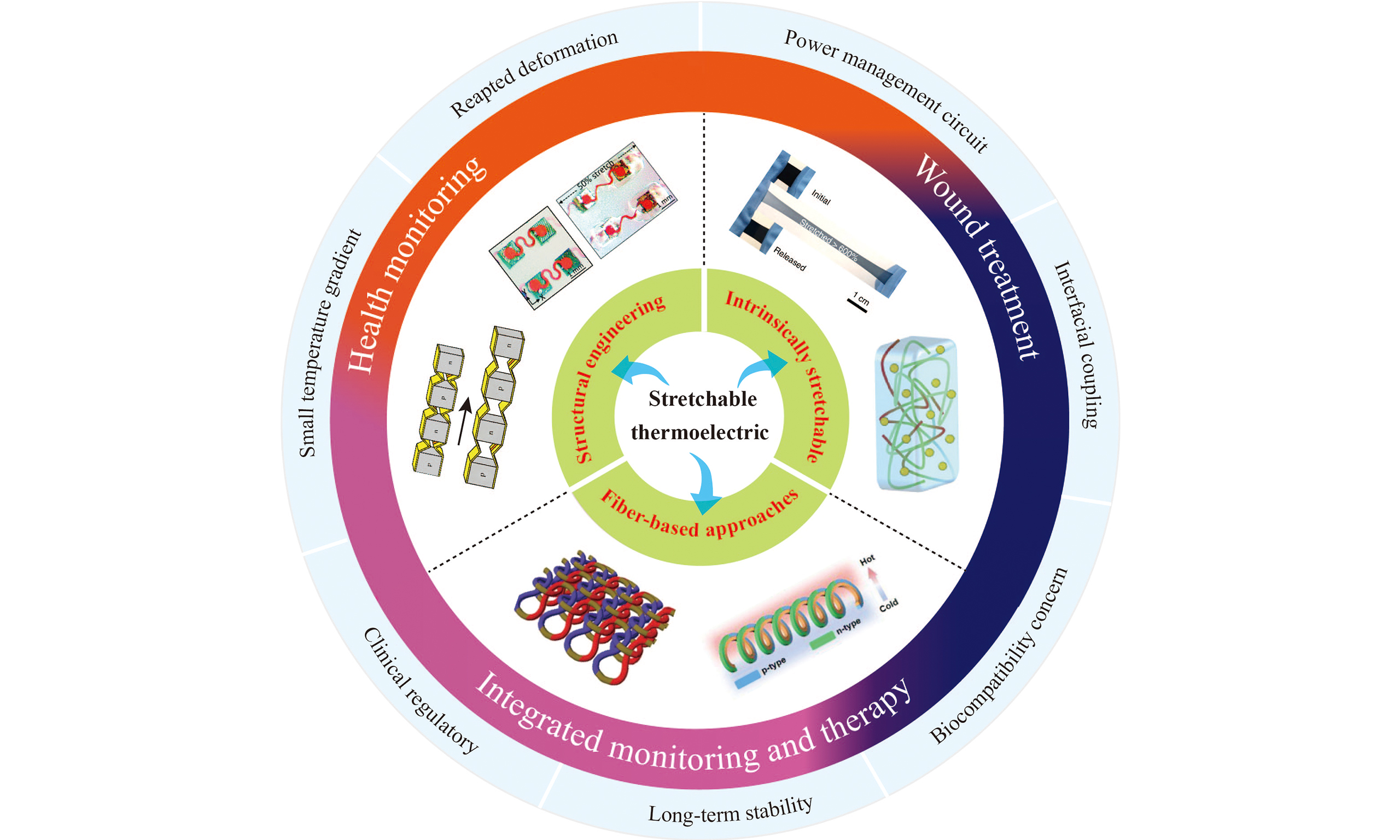
INTRODUCTION
With an aging population and the rising prevalence of chronic diseases, healthcare is gradually shifting from intermittent treatment to continuous, personalized, and home-based management[1]. Wearable biomedical devices have therefore attracted increasing attention for their potential in real-time monitoring and personalized therapy[2]. However, most existing systems remain heavily reliant on external power sources or batteries, which restricts their long-term operation and hinders widespread deployment[3]. To address this challenge, various self-powered technologies have been explored, including piezoelectric and triboelectric systems that harvest mechanical energy from body motion[4-6]. Although these methods are capable of generating relatively high instantaneous power, they often depend on intermittent mechanical stimuli and may be unreliable under low physical activity conditions[7,8]. In this context, thermoelectric (TE) technology stands out by directly converting the temperature difference (ΔT) between the human body and the environment into electrical energy. This unique capability enables continuous energy harvesting under steady thermal gradients, making TE technology particularly suitable for long-term wearable biomedical applications[9-11]. Moreover, recent studies have shown that TE materials can not only function as power sources but also actively contribute to the therapeutic process, opening up new avenues for wound repair and tissue regeneration[12-14].
Unlike traditional rigid TE devices, wearable TE systems designed for biomedical applications must fulfill the requirements of prolonged skin contact. Consequently, resolving the conflict between achieving stable output performance and maintaining excellent mechanical flexibility has emerged as a pivotal challenge. In our prior research, through the adoption of thin-film designs, flexible substrates, and low-modulus materials, TE devices have been engineered to better conform to the skin's curvature, thereby enhancing wearing comfort[15-18]. However, during real-world activities, human skin not only bends but also experiences substantial stretching, compression, and repeated deformation, particularly around joints or wounds[19]. To effectively adapt to these highly dynamic and complex environments, wearable TE devices necessitate greater mechanical freedom[20]. The emergence of stretchable TE generators (S-TEGs) has brought new opportunities, as they are capable of maintaining stable output under conditions of large strain. This distinctive characteristic renders them more akin to the mechanical behavior of actual skin, offering the potential for long-term, stable operation at dynamic human interfaces[21-23].
At present, research on S-TEGs remains firmly in the exploratory stage, especially with respect to their applications in the realm of wearable health management. A timely and comprehensive summary of the current research landscape is therefore essential to advance the development of this emerging field. This perspective provides a focused view on S-TEGs tailored for dynamic wearable biomedical applications, with particular emphasis on the transition from flexible to stretchable systems, as well as the integration of sensing and therapeutic functionalities. The potential advantages of S-TEGs are systematically explored, encompassing their dynamic reliability, self-powered operation capabilities, and multifunctional integration. In addition, key technical challenges and future research directions are discussed in depth, with the aim of providing valuable insights for the development of next-generation intelligent wearable medical systems.
STRETCHABLE THERMOELECTRIC MATERIALS AND STRUCTURES
Many strategies have been developed to endow TE devices with stretchability, which can be broadly classified into three categories: structural engineering, fiber-based approaches, and intrinsically stretchable materials, as illustrated in Figure 1A. These strategies exhibit distinct characteristics in terms of mechanical compliance and TE performance [Table 1]. Structural engineering strategies, such as origami-like[24], island-bridge[25], and wrinkled[34] designs, offer the advantage of preserving high output performance by utilizing conventional high-performance TE materials. However, their reversible strain capacity is typically limited, and repeated deformation may lead to mechanical fatigue at the structural interfaces. In contrast, fiber-based strategies, which include woven[40], knitted[26], and helical[27,36] architectures, provide enhanced stretchability and mechanical compliance, facilitating improved conformal contact with soft and dynamic skin surfaces. Nevertheless, their TE performance may be compromised due to reduced packing density and unstable electrical connections during deformation. Intrinsically stretchable materials, such as TE elastomers[37], stretchable TE films[38], and TE hydrogels[39], exhibit high deformability and robust mechanical stability under cyclic strain. Their exceptional compliance renders them highly attractive for applications that necessitate intimate and dynamic skin contact. However, they often involve trade-offs in terms of TE efficiency and long-term stability when compared to conventional inorganic materials.
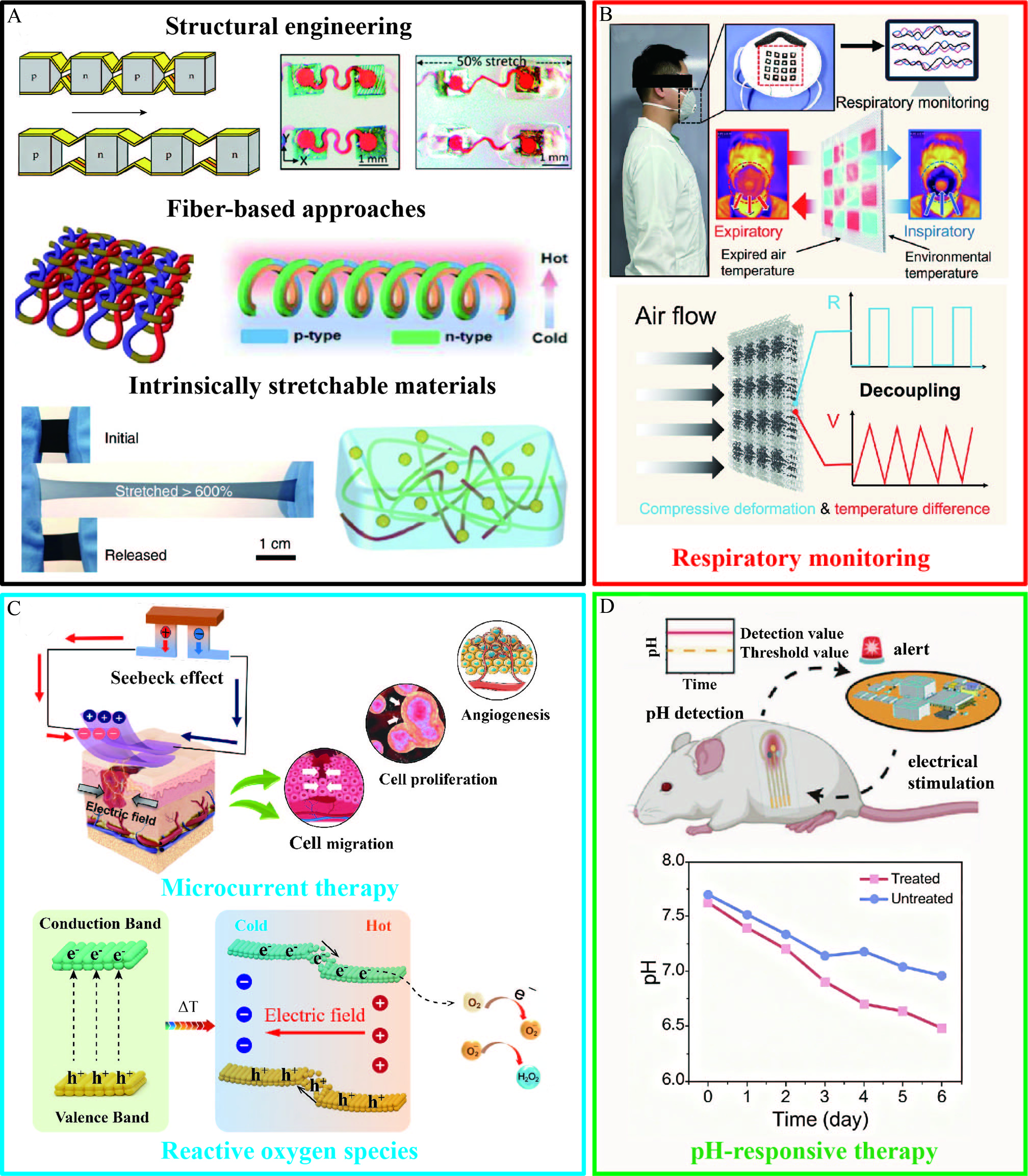
Figure 1. (A) Strategies for achieving stretchability in TE devices, including three main categories: structural engineering[24,25] [Copyright © 2018, The Author(s); © 2020, American Chemical Society], fiber-based approaches[26,27] [Copyright © 2020, The Author(s); © 2025, American Chemical Society], and intrinsically stretchable materials[28,29] [Copyright © 2020, The Author(s); © 2024 Wiley]; (B) Application of S-TEGs for respiratory monitoring[30] [Copyright © 2025, The Author(s)]; (C) Mechanisms of S-TEGs in wound treatment, including microcurrent therapy and reactive oxygen species generation[31] [Copyright © 2023, The Author(s)]; (D) Application of S-TEGs in integrated closed-loop systems for simultaneous monitoring and therapy[32] (Copyright © 2025 Wiley). TE: Thermoelectric; S-TEGs: stretchable TE generators; ΔT: temperature difference.
Representative stretchable thermoelectric generators (S-TEGs) and key performance metrics
| Strategy | Structure | TE material | Stretchability (%) | Output voltage* (mV) | ΔT (K) | Application scenario |
| Structural engineering | Origami-like | Bi0.3Sb1.7Te3/ Bi2Te3[24] | ~20 | ~3.7 | ~35 | - |
| Island-bridge | Bi2Te3/ Sb2Te3[25] | ~50 | 117 | ~19 | Health monitoring | |
| Island-bridge | Bi2Te3[33] | ~23 | ~171 | 8 | Health monitoring | |
| Island-bridge | Bi2Te3[32] | ~30 | 1,100 | 12 | Monitoring & therapy | |
| Wrinkled | WS2/ SWCNT[34] | ~30 | - | - | Wearable electronics | |
| Fiber-based approaches | Woven TE textile | PEDOT:PSS/CNT[26] | ~80 | - | 44 | Health monitoring |
| 3D helical coil | Doped silicon[35] | ~60 | 51.3 | 19 | Wearable electronics | |
| Janus helical fiber | Bi2Te3/ Sb2Te3[36] | > 100 | ~0.035 | 75 | - | |
| Helical architecture | PANa-SWCNT[27] | ~650 | ~21.5 | ~35 | Health monitoring | |
| Intrinsically stretchable materials | TE elastomer | Polymers[37] | ~150 | 2.37 | 4 | Wearable electronics |
| Stretchable TE film | WS2/ NbSe2[38] | > 50 | 2.4 | 3 | Wearable electronics | |
| TE hydrogel | Ionic hydrogel[39] | ~1,160 | 360 | 3.5 | Health monitoring | |
| TE hydrogel | PAATn[28] | > 250 | ~160 | 12 | Wound therapy |
Based on these strategies, S-TEGs have showcased remarkable mechanical flexibility. For example, Sun et al.[26] reported a TE fabric capable of stretching over 80% in the longitudinal direction while maintaining a stable electrical output. More recently, Liu et al.[37] developed an n-type TE elastomer that demonstrates outstanding rubber-like recovery (up to 150% strain) and a figure of merit comparable to that of flexible inorganic materials, even when subjected to mechanical deformations. Typically, human skin experiences strains in the range of 5%-50% during daily activities[41,42]. Hence, the stretchability of current S-TEGs is generally adequate to meet the demands of most wearable scenarios.
From an application perspective, different wearable applications impose distinct requirements concerning strain tolerance, mechanical conformability, thermal coupling, and power output, which in turn determine the most appropriate design strategy. For instance, respiratory monitoring and joint-mounted sensing typically involve significant and repeated deformation, requiring devices with high stretchability and mechanical robustness. In such scenarios, fiber-based or intrinsically stretchable S-TEGs are more suitable due to their capacity to accommodate dynamic strain while maintaining stable electrical performance[43]. Conversely, applications such as epidermal temperature sensing or closed-loop therapeutic systems prioritize stable power output and efficient thermal coupling to the skin, with relatively limited deformation. Therefore, structural designs based on rigid TE materials are more appropriate, as they can deliver higher and more stable power densities[32]. In general, striking a balance between mechanical compliance and TE performance remains a key challenge. Future endeavors should focus on application-oriented frameworks to provide a more rational foundation for the design and optimization of S-TEGs in wearable biomedical systems.
APPLICATIONS OF S-TEGs IN HEALTH MONITORING
S-TEGs offer distinct advantages for wearable health monitoring by enabling continuous and passive energy harvesting from the small but persistent ΔT between the human body and the environment. Intrinsically, S-TEGs can directly function as self-powered thermal sensors for monitoring physiological parameters associated with skin temperature and heat flow. Due to the Seebeck effect[44], even minor temperature variations across the device can be converted into measurable electrical signals without the need of external power input. For example, He et al.[30] developed a three-dimensional flexible TE woven fabric system that can withstand strains exceeding 50% and boasts a precise temperature resolution of 0.02 K, enabling self-powered monitoring of body temperature and human respiration [Figure 1B]. Similarly, Cui et al.[40] fabricated highly stretchable and sensitive TE fabric-based sensors with a wide strain range (1%-100%) and temperature detection limit of 1 K. The sensors can be integrated into an intelligent firefighting suit to continuously monitor both physiological activity and the microenvironmental temperature within the garment. Beyond sensing, S-TEGs can also serve as sustainable power sources for integrated wearable systems, thereby enabling broader range of health monitoring functionalities. For instance, Yang et al.[25] designed a stretchable nanolayered TE generator based on a wavy serpentine interconnect architecture. The device exhibits stretchability exceeding 50% and achieves an output power density of approximately
These capabilities make S-TEGs particularly appealing for applications such as heart rate monitoring, motion tracking, and multimodal physiological sensing. However, the limited ΔT available on skin inherently restricts the achievable power density, which may be insufficient to sustain continuous operation of high-power components. As a result, S-TEGs are currently more appropriate for low-power sensing, intermittent monitoring, or as auxiliary energy units integrated with other power systems.
INTEGRATION OF INTELLIGENT MONITORING AND THERAPY
S-TEGs have recently garnered increasing attention in the field of wound management due to their ability to convert thermal gradients into localized electrical stimuli that actively modulate the wound microenvironment[45-47]. In native tissues, endogenous electric fields (EEFs) play a pivotal role in guiding cell migration, promoting fibroblast proliferation, and accelerating angiogenesis[48]. Disruption of these EEFs, which commonly observed in chronic wounds, can significantly impair the healing process. In this context, S-TEGs provide a unique opportunity to noninvasively reconstruct EEFs by continuously generating mild electric fields driven by the natural temperature gradients between the wound site and the surrounding tissue[31] [Figure 1C]. For example, Gao et al.[28] developed a wearable TE dressing that can generate electrical output under physiological conditions while simultaneously providing antibacterial functionality. By leveraging the intrinsic ΔT at the wound interface, the device enables continuous and self-sustained electrical stimulation, thereby enhancing cell migration and tissue regeneration while suppressing bacterial infection. Beyond electrical regulation, emerging evidence suggests that TE materials may also influence wound healing through modulation of reactive oxygen species (ROS)[49-51]. When coupled with catalytic or redox-active components[52,53], TE materials can enable controlled ROS generation, which is beneficial for wound healing by promoting antibacterial activity and regulating inflammation[54,55] [Figure 1C].
Building on these capabilities, integrating sensing and therapeutic functions into a single S-TEG-based platform enables the development of closed-loop and self-sustained biomedical systems. In such systems, S-TEGs can simultaneously harvest energy, monitor physiological signals, and deliver therapeutic interventions, thereby achieving integrated intelligent monitoring and on-demand treatment[32]. As shown in Figure 1D, Lv et al.[32] reported an S-TEG-based bioelectronic system for the combined monitoring and treatment of infected chronic wounds. The device was capable of delivering a biomimetic EEF to the wound site, while an integrated pH sensor enables real-time assessment of the wound status by detecting wound exudate, thereby guiding therapeutic intervention. Similarly, Lyu et al.[56] designed an S-TEG patch capable of both monitoring wound conditions and providing responsive electrotherapy. When the ΔT between the wound and the surrounding skin exceeds the preset threshold (0.5 °C), the device automatically activates microcurrent stimulation and triggers ROS release for antibacterial treatment, thereby accelerating the healing process.
These advances highlight a promising pathway for next-generation wound care and intelligent healthcare systems. However, significant challenges remain for clinical translation. The magnitude and stability of the reconstructed electric field are strongly dependent on the available temperature gradient, which is typically small and fluctuating in real wound environments[57]. Moreover, precise control of ROS levels is critical, as imbalanced ROS may impair tissue regeneration[58]. Additionally, the wound environment is inherently complex, involving moisture, biofluids, and continuous mechanical deformation, all of which can compromise device performance and long-term stability[59]. Furthermore, system-level integration will introduce additional issues such as interfacial mechanical mismatch and potential performance degradation. Therefore, future development should focus on establishing quantitative correlations between device output with biological responses, with the aim of ensuring both therapeutic efficacy and clinical safety.
CONCLUSION AND OUTLOOK
Despite the encouraging progress, several practical challenges persist in the clinical translation of S-TEGs. Firstly, the trade-off between TE performance and mechanical compliance remains a fundamental issue. High-performance TE devices typically rely on inorganic materials, which are inherently incompatible with large and repeated deformations. Secondly, the limited ΔT available on human skin (typically 5-10 K under ambient conditions) imposes a fundamental constraint on achievable power output, making it challenging to sustain continuous operation without additional power management strategies. These limitations are further compounded at the system level, where the interfacial coupling between S-TEGs and electronic components can lead to mechanical mismatch, electrical instability, and signal fluctuations. In addition, practical considerations such as mechanical durability, long-term wearability, and environmental factors like sweat and moisture can significantly impact device performance and stability but have not been thoroughly investigated. Finally, for biomedical applications, further challenges arise from requirements related to sterilization, biocompatibility, long-term safety, as well as the need for rigorous clinical validation and clear regulatory pathways. Together, these factors underscore the gap between current laboratory demonstrations and real-world implementation.
Looking ahead, the successful translation of S-TEGs into practical applications requires designs that take into account real operating conditions and specific biomedical requirements. First and foremost, evaluation criteria must be redefined. Instead of relying solely on isolated metrics, device-level performance should be evaluated under realistic conditions, including limited ΔT, repeated mechanical deformation, sweat exposure, and prolonged wear. Furthermore, device design should be guided by targeted application scenarios rather than merely focusing on maximizing stretchability. For instance, continuous health monitoring may prioritize stable power output and signal fidelity, whereas applications related to wound care demand high deformability, conformal contact, and biological compatibility. At the same time, a deeper understanding of wound healing biology, electrophysiology, and immune regulation mechanisms is essential to transition from empirical design toward mechanism-driven optimization.
Achieving these goals further demand advances in materials and interface engineering to simultaneously improve mechanical robustness, electrical integrity, and long-term stability under complex physiological environments. In this context, artificial intelligence can serve as a powerful tool to accelerate progress, not only in materials discovery and structural optimization but also in multimodal physiological signal interpretation and closed-loop therapeutic regulation. Collectively, these directions provide a clearer pathway for advancing S-TEGs from proof-of-concept demonstrations toward reliable and clinically relevant wearable technologies.
DECLARATIONS
Authors’ contributions
Made substantial contributions to conception and design of the study and performed the literature analysis, drafted and revised the manuscript: Li, S.
Jointly conceived the topic and scope, as well as provided administrative and technical support: Gong, T.
Conceived the original idea, designed the overall framework of the study, and provided forward-looking insights and professional guidance: Lu, Y.
Availability of data and materials
Not applicable.
AI and AI-assisted tools statement
Not applicable.
Financial support and sponsorship
This work was financially supported by the National Key Research and Development Program of China (No. 2025YFE0126500), the National Natural Science Foundation of China (NSFC) (No. 52402232), Guangdong Basic and Applied Basic Research Foundation (No. 2023A1515110512), Southern University of Science and Technology Grant (No. Y01796223), and University-Enterprise Joint Research and Development Center (No. 602431005PQ).
Conflicts of interest
Lu, Y. is the Guest Editor of the Special Topic “Stretchable Thermoelectrics: Strategies, Performances, and Applications” in the Soft Science. She had no involvement in the review or editorial process of this manuscript, including reviewer selection, evaluation, or the final decision. The other author has declared no conflicts of interest.
Ethical approval and consent to participate
Not applicable.
Consent for publication
Not applicable.
Copyright
© The Author(s) 2026.
REFERENCES
1. Sharma, A.; Badea, M.; Tiwari, S.; Marty, J. L. Wearable biosensors: an alternative and practical approach in healthcare and disease monitoring. Molecules 2021, 26, 748.
2. Stuart, T.; Hanna, J.; Gutruf, P. Wearable devices for continuous monitoring of biosignals: challenges and opportunities. APL. Bioeng. 2022, 6, 021502.
3. Gargiulo, P.; Gaele, M. F.; Costantini, A.; Di Palma, T. M. Batteries for wearable and implantable biomedical devices: a comprehensive review. Biosens. Bioelectron. X. 2026, 28, 100723.
4. Wang, Z. L. Triboelectric nanogenerators as new energy technology for self-powered systems and as active mechanical and chemical sensors. ACS. Nano. 2013, 7, 9533-57.
5. Ali, A.; Shaukat, H.; Bibi, S.; Altabey, W. A.; Noori, M.; Kouritem, S. A. Recent progress in energy harvesting systems for wearable technology. Energy. Strateg. Rev. 2023, 49, 101124.
6. Yin, L.; Kim, K. N.; Trifonov, A.; Podhajny, T.; Wang, J. Designing wearable microgrids: towards autonomous sustainable on-body energy management. Energy. Environ. Sci. 2022, 15, 82-101.
7. Fu, S.; Yi, S.; Ke, Q.; Liu, K.; Xu, H. A self-powered hydrogel/nanogenerator system accelerates wound healing by electricity-triggered on-demand phosphatase and tensin homologue (PTEN) inhibition. ACS. Nano. 2023, 17, 19652-66.
8. Meng, X.; Xiao, X.; Jeon, S.; et al. An ultrasound-driven bioadhesive triboelectric nanogenerator for instant wound sealing and electrically accelerated healing in emergencies. Adv. Mater. 2023, 35, 2209054.
9. Wu, B.; Wei, W.; Guo, Y.; et al. Stretchable thermoelectric generators with enhanced output by infrared reflection for wearable application. Chem. Eng. J. 2023, 453, 139749.
10. Masoumi, S.; O'shaughnessy, S.; Pakdel, A. Organic-based flexible thermoelectric generators: from materials to devices. Nano. Energy. 2022, 92, 106774.
11. Akbar, Z. A.; Jeon, J.; Jang, S. Intrinsically self-healable, stretchable thermoelectric materials with a large ionic Seebeck effect. Energy. Environ. Sci. 2020, 13, 2915-23.
12. Xu, G.; Lu, Y.; Cheng, C.; et al. Battery-free and wireless smart wound dressing for wound infection monitoring and electrically controlled on-demand drug delivery. Adv. Funct. Mater. 2021, 31, 2100852.
13. Gao, M.; Luo, Y.; Zheng, L.; Li, W.; Pei, Y. Biomimetic electric interface-mediated cellular activation promotes diabetic wound healing via self-powered wearable thermoelectric patch. Mater. Today. Bio. 2025, 35, 102520.
14. Gao, M.; Luo, Y.; Li, W.; Zheng, L.; Pei, Y. In vitro and in vivo biocompatibility assessment of chalcogenide thermoelectrics as implants. J. Mater. Chem. B. 2024, 12, 6847-55.
15. Lu, Y.; Zhou, Y.; Wang, W.; et al. Staggered-layer-boosted flexible Bi2Te3 films with high thermoelectric performance. Nat. Nanotechnol. 2023, 18, 1281-8.
16. Li, X.; Wei, P.; Chen, K.; et al. Interface-engineered high-performance flexible thermoelectric films for self-powered health monitoring. Adv. Mater. 2026, 38, e72608.
17. Wu, C.; Li, J.; Zhang, M.; et al. Pressure-free sintering of high-performance crystalline/amorphous Ag2S0.5Te0.5/nylon films for flexible thermoelectric devices. J. Mater. Chem. A. 2026, 14, 12678-89.
18. Zhang, M.; Shen, Y.; Wu, C.; et al. Screen-printed Bi2Se3-modified Ag2Se-based free-standing nanocomposite films for high-performance flexible thermoelectrics. Adv. Compos. Hybrid. Mater. 2026, 9, 136.
19. Peng, J.; Witting, I.; Geisendorfer, N.; et al. 3D extruded composite thermoelectric threads for flexible energy harvesting. Nat. Commun. 2019, 10, 5590.
21. Hao, Y.; He, X.; Wang, L.; Qin, X.; Chen, G.; Yu, J. Stretchable thermoelectrics: strategies, performances, and applications. Adv. Funct. Mater. 2021, 32, 2109790.
22. Zadan, M.; Malakooti, M. H.; Majidi, C. Soft and stretchable thermoelectric generators enabled by liquid metal elastomer composites. ACS. Appl. Mater. Interfaces. 2020, 12, 17921-8.
23. Chen, C.; Wang, R.; Li, X.; et al. Structural design of nanowire wearable stretchable thermoelectric generator. Nano. Lett. 2022, 22, 4131-6.
24. Fukuie, K.; Iwata, Y.; Iwase, E. Design of substrate stretchability using origami-like folding deformation for flexible thermoelectric generator. Micromachines 2018, 9, 315.
25. Yang, Y.; Hu, H.; Chen, Z.; et al. Stretchable nanolayered thermoelectric energy harvester on complex and dynamic surfaces. Nano. Lett. 2020, 20, 4445-53.
26. Sun, T.; Zhou, B.; Zheng, Q.; Wang, L.; Jiang, W.; Snyder, G. J. Stretchable fabric generates electric power from woven thermoelectric fibers. Nat. Commun. 2020, 11, 572.
27. Wang, Z.; Jiang, W.; Cao, P.; et al. Bioinspired programmable and ultrastretchable janus helical hydrogel fibers for strain-invariant thermoelectric body heat harvesting and sensation. Nano. Lett. 2025, 25, 2509-18.
28. Gao, S.; Rao, Y.; Wang, X.; et al. Skin temperature-activated multifunctional thermoelectric dressing for bacterial infected wound treatment. Adv. Funct. Mater. 2024, 35, 2415085.
29. Kim, N.; Lienemann, S.; Petsagkourakis, I.; et al. Elastic conducting polymer composites in thermoelectric modules. Nat. Commun. 2020, 11, 1424.
30. He, X.; Shi, X.; Wu, X.; et al. Three-dimensional flexible thermoelectric fabrics for smart wearables. Nat. Commun. 2025, 16, 2523.
31. Barman, S. R.; Chan, S.; Kao, F.; et al. A self-powered multifunctional dressing for active infection prevention and accelerated wound healing. Sci. Adv. 2023, 9, eadc8758.
32. Lv, J.; Li, X.; An, Z.; et al. A self-powered flexible bioelectronic system based on thermoelectric generator for electrotherapy and monitoring of chronic wounds. Adv. Mater. Technol. 2025, 10, e00332.
33. Yuan, M.; Qi, Y.; Shen, X.; et al. Intermittent self-powered health monitoring device based on stretchable flexible thermoelectric energy harvesting. Nano. Energy. 2026, 148, 111624.
34. Kim, J. Y.; Oh, J. Y.; Lee, T. I. Multi-dimensional nanocomposites for stretchable thermoelectric applications. Appl. Phys. Lett. 2019, 114, 043902.
35. Nan, K.; Kang, S. D.; Li, K.; et al. Compliant and stretchable thermoelectric coils for energy harvesting in miniature flexible devices. Sci. Adv. 2018, 4, eaau5849.
36. Rojas, J. P.; Singh, D.; Conchouso, D.; Arevalo, A.; Foulds, I. G.; Hussain, M. M. Stretchable helical architecture inorganic-organic hetero thermoelectric generator. Nano. Energy. 2016, 30, 691-9.
38. Oh, J. Y.; Lee, J. H.; Han, S. W.; et al. Chemically exfoliated transition metal dichalcogenide nanosheet-based wearable thermoelectric generators. Energy. Environ. Sci. 2016, 9, 1696-705.
39. Wang, Z.; Lv, H.; Gao, Z.; Song, H. Stretchable and thermo-mechanical stable ionogels with high thermoelectric properties for respiratory sensing and energy harvesting. Chem. Eng. J. 2024, 498, 155789.
40. Cui, Y.; He, X.; Liu, W.; Zhu, S.; Zhou, M.; Wang, Q. Highly stretchable, sensitive, and multifunctional thermoelectric fabric for synergistic-sensing systems of human signal monitoring. Adv. Fiber. Mater. 2023, 6, 170-80.
41. Han, S.; Liu, C.; Xu, H.; et al. Multiscale nanowire-microfluidic hybrid strain sensors with high sensitivity and stretchability. npj. Flex. Electron. 2018, 2, 16.
42. Jia, Y.; Jiang, Q.; Sun, H.; et al. Wearable thermoelectric materials and devices for self-powered electronic systems. Adv. Mater. 2021, 33, 2102990.
43. Zhu, S.; Fan, Z.; Feng, B.; et al. Review on wearable thermoelectric generators: from devices to applications. Energies 2022, 15, 3375.
44. Van Herwaarden, A.; Sarro, P. Thermal sensors based on the seebeck effect. Sens. Actuators. 1986, 10, 321-46.
45. Zhang, Y.; Ge, B.; Feng, J.; et al. High-performance self-powered flexible thermoelectric device for accelerated wound healing. Adv. Funct. Mater. 2024, 34, 2403990.
46. Tan, M.; Liu, Y.; Wang, Y.; et al. Wireless thermoelectric hydrogel recreates biomimetic electric field and angiogenic signal accelerating diabetic ulcer repair. Adv. Funct. Mater. 2025, 35, 2425610.
47. Zhao, D.; Tang, X.; Chen, X.; et al. Thermoelectric bionic skin promotes diabetic wound healing by restoring bioelectric field microenvironment. Adv. Funct. Mater. 2025, 36, e22104.
48. Wang, J.; Lin, J.; Chen, L.; Deng, L.; Cui, W. Endogenous electric-field-coupled electrospun short fiber via collecting wound exudation. Adv. Mater. 2022, 34, 2108325.
49. Jia, S.; Qi, C.; Xu, S.; Yang, L.; Sun, Q. Advancements of thermoelectric nanomaterials in ROS-mediated broad-spectrum antibacterial therapies for wound healing. J. Mater. Sci. Technol. 2025, 225, 212-26.
50. Zhang, X.; Wan, Y.; Wen, Y.; et al. SnSe nanosheets with Sn vacancies catalyse H2O2 production from water and oxygen at ambient conditions. Nat. Catal. 2025, 8, 465-75.
51. Khan, S.; Narula, A. K. Bio-hybrid blended transparent and conductive films PEDOT:PSS:Chitosan exhibiting electro-active and antibacterial properties. Eur. Polym. J. 2016, 81, 161-72.
52. Achour, A.; Chen, K.; Reece, M. J.; Huang, Z. Tuning of catalytic activity by thermoelectric materials for carbon dioxide hydrogenation. Adv. Energy. Mater. 2017, 8, 1701430.
53. Lin, Y. J.; Khan, I.; Saha, S.; et al. Thermocatalytic hydrogen peroxide generation and environmental disinfection by Bi2Te3 nanoplates. Nat. Commun. 2021, 12, 180.
54. Yang, B.; Chen, Y.; Shi, J. Reactive oxygen species (ROS)-based nanomedicine. Chem. Rev. 2019, 119, 4881-985.
55. Wang, S.; Qiao, Y.; Liu, X.; et al. Reduced graphene oxides modified Bi2Te3 nanosheets for rapid photo-thermoelectric catalytic therapy of bacteria-infected wounds. Adv. Funct. Mater. 2022, 33, 2210098.
56. Lyu, L.; Zou, Y.; Xie, Y.; et al. A closed-loop thermoelectric patch for autonomous management of MRSA-infected chronic wounds. Chem. Eng. J. 2025, 524, 169401.
57. Zhu, W. P.; Xin, X. R. Study on the distribution pattern of skin temperature in normal Chinese and detection of the depth of early burn wound by infrared thermography. Ann. N. Y. Acad. Sci. 2006, 888, 300-13.
58. Zhou, Q.; Zhuang, Y.; Deng, X.; et al. Hydrogel-based ROS-regulating strategy: reprogramming the oxidative stress imbalance in advanced diabetic wound repair. Adv. Mater. 2025, 38, e12719.
Cite This Article
 Open Access
How to Cite
Download Citation
Export Citation File:
Type of Import
Tips on Downloading Citation
Citation Manager File Format
Type of Import
Direct Import: When the Direct Import option is selected (the default state), a dialogue box will give you the option to Save or Open the downloaded citation data. Choosing Open will either launch your citation manager or give you a choice of applications with which to use the metadata. The Save option saves the file locally for later use.
Indirect Import: When the Indirect Import option is selected, the metadata is displayed and may be copied and pasted as needed.
About This Article
Special Topic
Copyright

Data & Comments
Data
0











Comments
Comments must be written in English. Spam, offensive content, impersonation, and private information will not be permitted. If any comment is reported and identified as inappropriate content by OAE staff, the comment will be removed without notice. If you have any queries or need any help, please contact us at [email protected].