

Lignocellulose-derived hydrogel sensors for new-generation motion monitoring
 0
0 
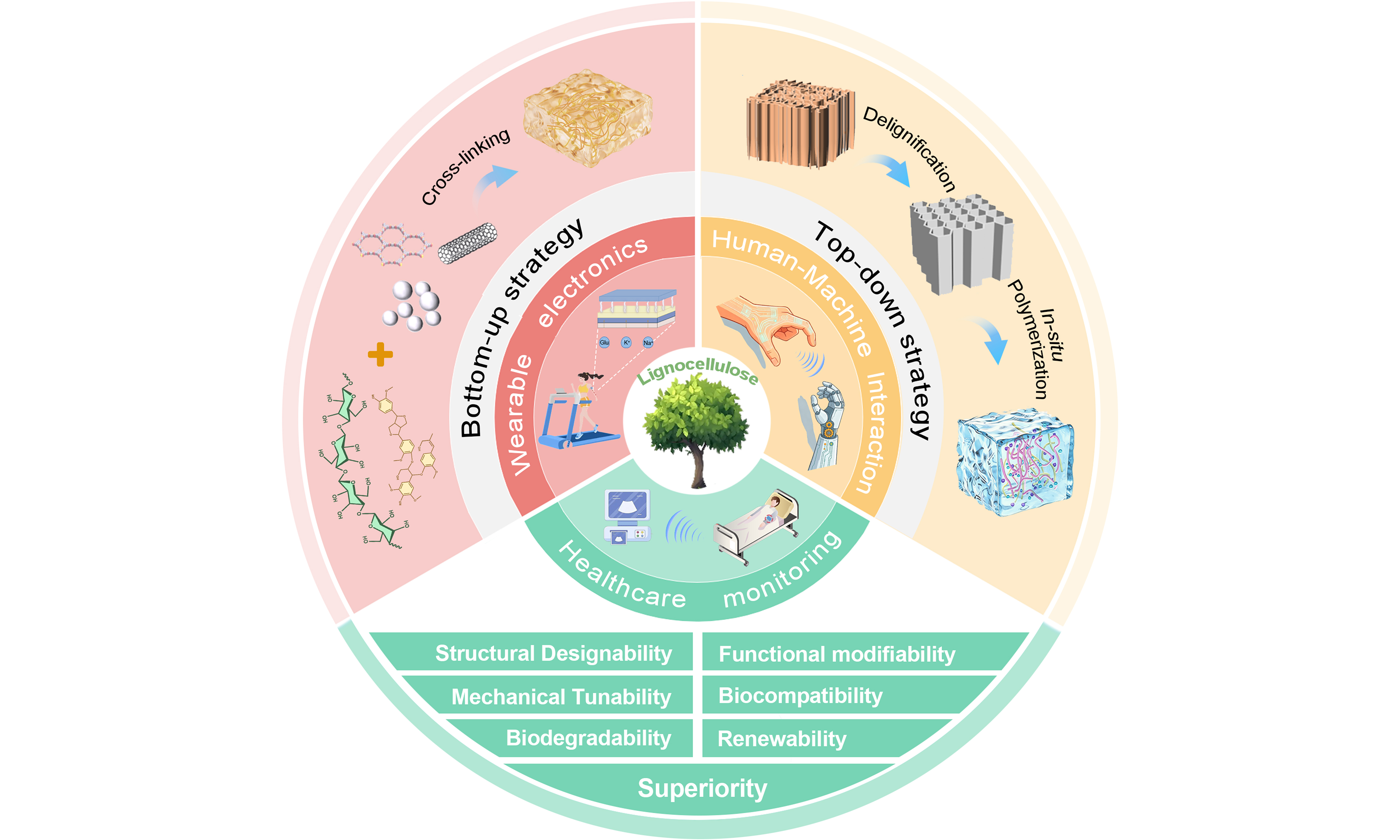
Graphical Abstract
Abstract
The rapid advancement of the Internet of Things, artificial intelligence, and personalized medicine has catalyzed unprecedented demand for wearable flexible sensors as critical interfaces bridging the physical and digital worlds. Lignocellulose-derived hydrogels have emerged as ideal candidates for next-generation motion monitoring platforms, owing to their exceptional flexibility, tissue-like mechanical compliance, intrinsic biocompatibility, and sustainability. In contrast to synthetic petroleum-based polymers and precious metal conductors, lignocellulose - the most abundant natural polymer resource on Earth - offers a unique combination of hierarchical architectures from molecular chains to tissue-level pores, rich chemical modifiability, and inherent biodegradability. This review systematically examines recent progress in lignocellulose-based flexible hydrogel sensors for motion monitoring, innovatively adopting a “motion demand-oriented” perspective. We first discuss the intrinsic advantages of lignocellulose, including the synergistic roles of cellulose (high-strength framework), hemicellulose (dynamic cross-linking and flexibility), and lignin (adhesion, UV resistance, and antioxidant properties), and elaborate on top-down and bottom-up engineering strategies for constructing programmable hydrogel networks. We then provide an in-depth analysis of multiscale sensing mechanisms, encompassing piezoresistive, piezoelectric, triboelectric, capacitive, temperature, and humidity transduction pathways. Furthermore, we highlight cutting-edge applications ranging from macroscopic joint motion detection and subtle physiological signal capture to healthcare monitoring, rehabilitation assistance, and human-machine interaction. Finally, this review discusses key challenges and future development directions in this field from the perspectives of material design, structural regulation, and system integration, providing a theoretical basis and design ideas for the next generation of sustainable, high-performance, and intelligent flexible sensing systems.
Keywords


 Download PDF
INTRODUCTION
As the Internet of Things, artificial intelligence (AI), and personalized medicine take off, wearable flexible sensors are experiencing unprecedented development opportunities as key interfaces connecting the physical world with the digital world[1-3]. These sensors can monitor human physiological signals and motion states in real time[4,5], demonstrating huge application potential in health monitoring[6,7], motion tracking[8,9] and human-machine interaction (HMI)[10,11]. Particularly, flexible sensors based on hydrogels are regarded as ideal candidate for the next generation of wearable electronic devices[7,12,13], due to their excellent flexibility, biocompatibility, and mechanical compliance similar to that of human tissues. However, most traditional flexible sensors rely on synthetic polymers [such as polydimethylsiloxane (PDMS), polyurethane, etc.] and precious metal conductive materials. These materials not only face the problems of resource depletion and high cost, but their non-biodegradability also brings a severe environmental burden[14]. In addition, existing hydrogel sensors generally have bottlenecks such as insufficient mechanical strength, poor environmental tolerance, and single functionality, which seriously restrict their practical applications[15,16]. Consequently, there is an urgent imperative to develop next-generation, green flexible sensing materials with superior biocompatibility, sustainability, and wearer comfort.
Lignocellulosic biomass, the most abundant natural polymer resource on Earth, offers an ideal solution for constructing the next generation of flexible motion sensors[17-20]. Lignocellulose is mainly derived from agricultural waste (such as straw and rice husks), forestry residues (such as sawdust and bark), and specially grown energy crops, and it has significant advantages, including wide availability, low cost, biodegradability, and renewability[21-23]. From a molecular structure perspective, lignocellulose is composed of cellulose (providing a high-strength framework), hemicellulose, and lignin (serving as an adhesive and possessing a natural aromatic structure and antioxidant properties), and this unique composite structure provides rich chemical modification sites and physical cross-linking possibilities for designing multifunctional hydrogels[24-26]. Structurally, lignocellulose exhibits a hierarchical organization spanning multiple structural levels, from macroscopic plant cell-wall architecture to nanoscale molecular assemblies[20]. At the macroscale level, the ordered arrangement of cellulose fibers within plant cell walls provides an anisotropic framework and mechanical support. At the microscale level, cellulose microfibrils act as reinforcing elements, while hemicellulose and lignin form an interconnected matrix surrounding cellulose domains, regulating interfacial interactions, stress transfer, and structural flexibility[27-29]. At the nanoscale level, cellulose nanofibrils and crystalline domains provide highly ordered reinforcing units, whereas lignin-derived aromatic structures and abundant oxygen-containing functional groups offer active sites for hydrogen bonding, chemical modification, and dynamic crosslinking. This hierarchical architecture enables lignocellulose-derived materials to achieve mechanical robustness, structural flexibility, and functional tunability, providing a unique foundation for the development of high-performance flexible hydrogel
Benefiting from this hierarchical structural organization, lignocellulose-derived hydrogels exhibit remarkable structural tunability and multifunctional integration capability. Rational molecular design and structural regulation have enabled lignocellulose-derived hydrogel systems to simultaneously achieve self-healing[43], freeze resistance[44], antibacterial properties[45], and biodegradability[46], meeting the demanding requirements of complex application scenarios. For instance, the poly-pyrrole/CNF/polyvinyl alcohol (PVA) composite hydrogel maintains high ionic conductivity at -20 °C, enabling stable sensing properties in extreme environments[47]; while the carboxymethyl chitosan/carboxylated CNF double-network hydrogel exhibits excellent biocompatibility and biodegradability, laying the foundation for implantable sensing applications[48]. Human motion is a highly complex spatiotemporal physical process accompanied by large deformations, high-frequency vibrations, multiaxial stresses, and extreme microenvironmental interferences such as sweating[49,50]. Simply blending conductive nanomaterials with lignocellulose is no longer sufficient to meet the rigorous demands of high-precision motion monitoring. Breaking the sensitivity-stretchability trade-off and achieving accurate signal decoupling, as well as high-fidelity transmission of complex motions through cross-scale structural engineering, has emerged as critical challenges in this field.
Although several reviews have summarized biomass-derived hydrogels, cellulose-based functional materials, or wearable electronic sensors, a systematic understanding of lignocellulose-derived hydrogel sensors for human motion monitoring from the perspective of hierarchical structure–network design–sensing performance remains insufficient. Unlike previous reviews that mainly focus on individual lignocellulosic components, general biomass-based hydrogels, or specific sensing mechanisms, this review establishes a comprehensive structure–network–property–performance relationship connecting the hierarchical structure of lignocellulose, hydrogel network architecture, physical properties, and motion-sensing capability. Specifically, this review discusses the hierarchical structural characteristics and functional roles of cellulose, hemicellulose, and lignin, followed by an overview of fabrication strategies and structure–property relationships of lignocellulose-derived flexible hydrogels. It then systematically summarizes the sensing mechanisms and their applications in human motion monitoring, physiological signal detection, and rehabilitation assessment. Finally, the review highlights current challenges and future opportunities, including long-term stability, multifunctional integration, self-powered sensing, intelligent signal processing, wireless communication, and scalable manufacturing, to inform the development of sustainable, high-performance lignocellulose-based wearable motion sensors.
OPPORTUNITIES AND SUPERIORITY OF LIGNOCELLULOSE-DERIVED FLEXIBLE HYDROGELS
The basic structure and properties of lignocellulose
Lignocellulose is the most abundant natural polymer on Earth, characterized by its renewable origin, intrinsic biodegradability, and broad availability across a wide range of lignocellulosic feedstocks[51-53]. This natural material is mainly composed of three interconnected biological polymers: cellulose (40%-55%), hemicellulose (24%-40%), and lignin (18%-35%), along with minor extractives and inorganic components
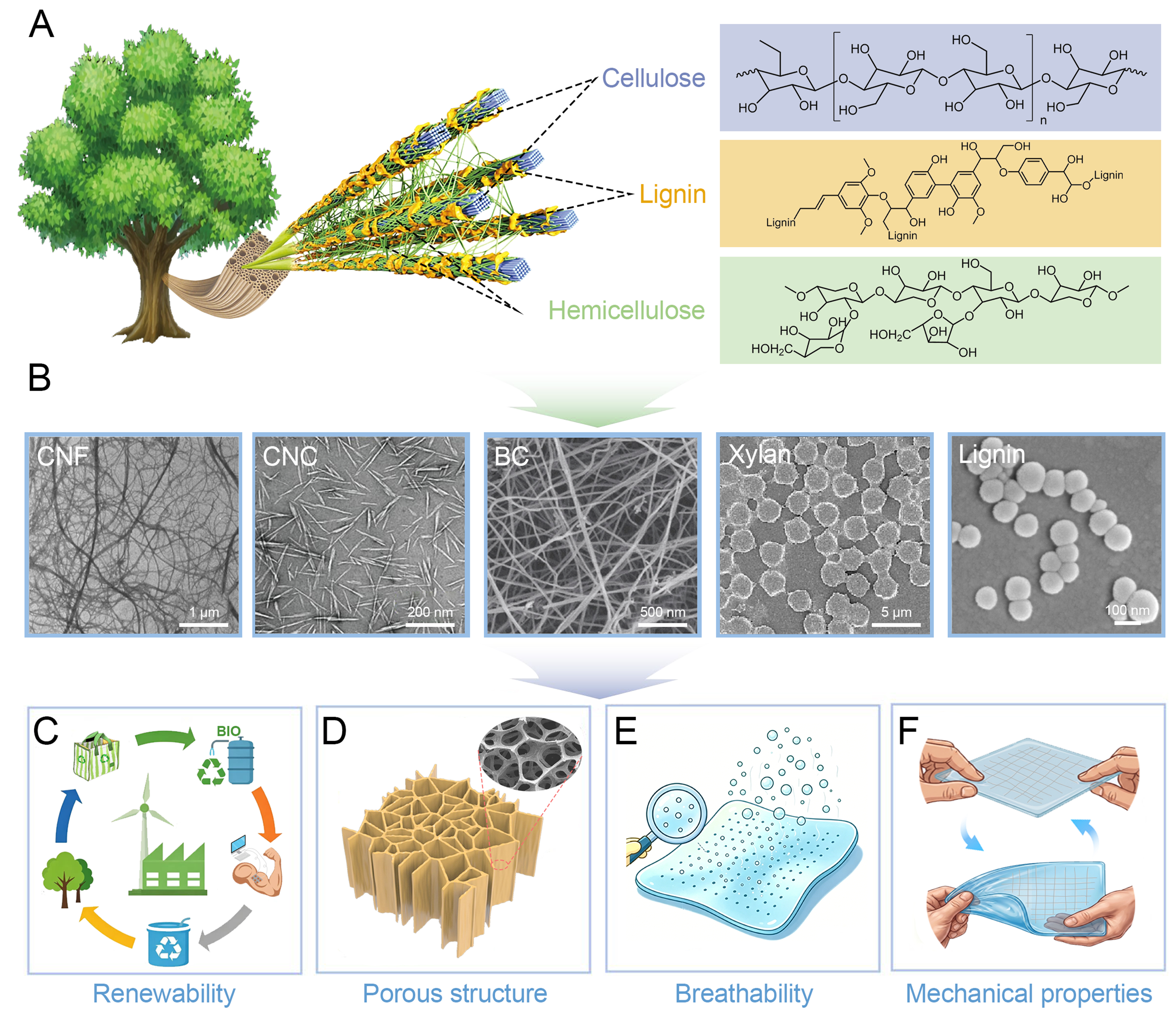
Figure 1. Overview of lignocellulose presentations. (A) Sources and constituents of lignocellulosic materials[20]. Adapted with permission from Ref.[20]. Copyright 2025, WILEY-VCH; (B) The morphologies of representative lignocellulose derivatives, including CNF[19], CNC[52], BC[57], xylan[58], lignin[50]; Various properties of lignocellulosic materials, including (C) renewability, (D) porous structure, (E) breathability, and (F) mechanical properties. Adapted with permission from Ref.[19]. Copyright 2024, Elsevier. Adapted with permission from Ref.[52]. Copyright 2026, Springer Nature. Adapted with permission from Ref.[57]. Copyright 2023, Elsevier. Adapted with permission from Ref.[58]. Copyright 2023, Elsevier. Adapted with permission from Ref.[50]. Copyright 2023, Elsevier. CNF: Cellulose nanofiber; CNC: cellulose nanocrystal; BC: bacterial cellulose.
Cellulose, the primary structural component, is a linear polysaccharide consisting of anhydro-D-glucose units connected via β-1,4-glycosidic bonds[17,59]. Intrachain hydrogen bonds between hydroxyl groups on C3 and ring oxygen, as well as between C2 and C6 hydroxyls of adjacent units, confer linearity to the chains, while interchain hydrogen bonding and van der Waals forces drive the parallel stacking into hierarchical fibrillar structures. These cellulose chains assemble into microfibril bundles and ultimately macroscopic fibers, comprising highly ordered crystalline regions and disordered amorphous domains. CNC, normally isolated via sulfuric acid hydrolysis, exhibits a rod-like morphology with a cellulose Iβ crystal structure (a = 0.778 nm, b = 0.820 nm, c = 1.038 nm, γ = 96.5°), and typically has diameters of 3-50 nm and lengths of 50-500 nm with high crystallinity (58%-88%)[60]. CNF produced through mechanical nanofibrillation, often combined with chemical/enzymatic pretreatments such as 2,2,6,6-tetramethylpiperidinooxy (TEMPO)-mediated oxidation, possesses high aspect ratios exceeding 100 and contains both crystalline and partially amorphous regions[61]. Finally, the abundant surface hydroxyl groups of cellulose provide versatile platforms for functionalization, grafting, and post-modification, enabling strong interfacial interactions within hydrogel matrices.
Hemicellulose, a heterogeneous polysaccharide composed of pyranose and furanose sugar units including D-xylose, D-mannose, D-glucose, D-galactosyl, L-arabinose, galacturonic acid, and glucuronic acid, is a short-chain polymer with a degree of polymerization of 80-200 that functions together with lignin as a filler and adhesive between cellulose microfibrils in the secondary cell wall [Figure 1A][24,62-64]. Among these sugar constituents, D-xylose constitutes the predominant backbone unit of xylan, which represents the most abundant hemicellulose type in hardwood and the second most abundant in softwood, thereby making xylan the archetypal model for hemicellulose-based functional materials. Its molecular chain adopts both two-fold flat-ribbon and three-fold helical screw conformations, enabling intimate non-covalent interactions with cellulose surfaces and lignin[24,65]. Compared with the rigid crystalline structure of cellulose, hemicellulose is amorphous and highly branched, endowing it with structural flexibility and rich chemical modifiability[24,65,66]. These structural features facilitate the introduction of functional groups or conductive components through chemical modification, thereby enabling the construction of sensing materials with responsive interfaces and the flexible regulation of detection signals[67]. Its abundant free hydroxyl groups can act as dynamic cross-linking sites, which further enhance the cycling stability of the hydrogel sensor through hydrogen-bonding reorganization[68,69].
Lignin, the most abundant natural aromatic polymer, is a complex three-dimensional amorphous network composed of phenylpropanoid units[70-72]. These basic building blocks are p-coumaryl, coniferyl, and sinapyl alcohols, which give rise to p-hydroxyphenyl (H), guaiacyl (G), and syringyl (S) units in the lignin macromolecular structure, respectively[26,73-75]. The relative abundance of these three units varies with plant source: softwood lignin predominantly contains G units, hardwood lignin comprises both G and S units and minor H units, and herbaceous lignin possesses all three[76-79]. These aromatic units are randomly interconnected through various ether and carbon–carbon linkages - primarily β-O-4, β-β, β-5, and 5-5 linkages - with the β-O-4 linkage being the most abundant[80,81]. Extracted technical (or industrial) lignins retain abundant functional groups, including phenolic/aliphatic hydroxyl groups, carboxyl, and methoxyl groups[82-85]. These functional moieties are heterogeneously distributed across the three-dimensional aromatic network, contributing to the structural complexity and polydispersity of lignin[86,87]. Lignin can provide a rigid network structure for hydrogels through chemical crosslinking of the stable aromatic structure and the intrinsic hydroxyl groups. Moreover, its catechol structure can even form strong non-covalent bonds with the skin and be directly used for skin adhesion in hydrogel form[88].
Superiority of lignocellulose for flexible sensing
The sensing performance of lignocellulose-derived hydrogels is closely associated with their internal network architectures. Although lignocellulose components provide inherent structural advantages, the final mechanical properties and electrical responses are mainly determined by the interactions and organization within hydrogel networks. These network architectures, including hydrogen-bonded networks, covalently crosslinked networks, dynamic reversible networks, and conductive pathways, regulate the balance between mechanical strength, flexibility, toughness, conductivity, and sensing sensitivity[89-91]. Generally, covalent networks provide enhanced structural stability, whereas dynamic reversible interactions contribute to energy dissipation and self-healing capability during repeated deformation. Therefore, rational regulation of network structures is essential for achieving high-performance lignocellulose-based hydrogel sensors[90,91].
In lignocellulose-derived hydrogels, the hierarchical structures and abundant functional groups of cellulose, hemicellulose, and lignin provide versatile platforms for constructing multifunctional networks. CNFs and nanocrystals can reinforce hydrogel matrices through hydrogen bonding and physical entanglement, improving mechanical strength and structural stability[17,92]. Hemicellulose contributes flexibility and dynamic interactions, while lignin enhances interfacial adhesion and network toughness through hydrogen bonding, π–π interactions, and other supramolecular interactions[93,94]. Through the synergistic contribution of these components, lignocellulose-derived hydrogels can achieve tunable mechanical properties, improved structural stability, and enhanced sensing performance when integrated with appropriate functional components[89].
Naturally, lignocellulose constitutes a uniquely suitable material platform for motion sensing, rather than merely a passive substrate that satisfies generic sensor requirements[95]. Unlike synthetic petroleum-based polymers or inorganic nanomaterials, renewable lignocellulose possesses structural and chemical attributes that intrinsically align with the multifaceted demands of wearable motion sensing [Figure 1C][96,97]. The hierarchical architecture of lignocellulose - spanning multiple structural levels from molecular chains to nanofibrils, microfibrils, macrofibers, and tissue-scale pores - endows hydrogels with highly interconnected, multiscale porous networks [Figure 1D][98-100]. Such multiscale network structures not only enhance mechanical reinforcement but also influence ion transport, water retention, and deformation-induced signal conversion, directly affecting the sensitivity, response time, and long-term stability of wearable motion sensors[91]. These networks facilitate efficient moisture wicking and gas permeation - functions critical to the reliable operation of skin-mounted motion sensors under dynamic physical activity[101]. Without effective moisture management, sweat accumulation can lead to sensor signal drift, epidermal irritation, or premature device delamination[6,102,103]. By contrast, lignocellulose-based hydrogels exhibit intrinsic breathability [Figure 1E], obviating the need for auxiliary perforation strategies and thereby ensuring sustained interfacial functionality during prolonged wear[104-106].
The coexistence and synergy of rigid crystalline domains and flexible amorphous domains in lignocellulose microfibrils are governed by the plasticizing action of hemicellulose and the compressive resilience imparted by lignin, enabling precise, broad-spectrum mechanical tunability [Figure 1F][107,108]. Through controlled deconstruction or reconfiguration of these hierarchical structural components, hydrogels with tailored mechanical properties can be systematically engineered within a compositionally consistent lignocellulosic material system[24,95,109]. In addition, the surface chemical diversity, sustainability, and structural anisotropy of lignocellulose are key advantages as a motion-detection platform. The abundant hydroxyl groups on cellulose and hemicellulose, together with the phenolic/aliphatic hydroxyl, and methoxyl functionalities of lignin, provide dense reactive anchors for covalent and non-covalent functionalization, enabling simultaneous integration of multiple sensing modalities - including conductive pathways (via grafting of aniline/pyrrole precursors), self-healing chemistries (via dynamic boronate ester or disulfide bonding), and bioadhesive interfaces (via catechol-mimicking lignin moieties) - without compromising the structural integrity of the gel network[110-114]. PANI in its emeraldine salt form consists of alternating reduced (–C6H4–NH–C6H4–NH–) and oxidized (–C6H4–N+=C6H4=N+–) repeat units with protonated imine nitrogens that provide charge carriers (polarons/bipolarons) for electronic conduction[36,38]. PPy consists of α,α′-coupled pyrrole rings with a conjugated π-electron backbone; upon oxidative doping, polarons delocalize along the polymer chain, conferring metallic conductivity[36,38]. The aromatic backbones of PANI and PPy enable π–π stacking interactions with lignin aromatic units, enhancing interfacial adhesion and dispersion stability within hydrogel networks[115,116]. Rather than treating environmental friendliness as an afterthought, lignocellulose offers intrinsic biodegradability, non-toxicity, and renewability as inseparable material attributes, eliminating electronic waste accumulation and reducing allergenic risks associated with synthetic polymer degradation products during long-term skin contact or disposable health monitoring
The multi-level structural hierarchy of lignocellulose - from molecular chains to nanofibrils, microfibrils, fibers, and tissue-level architectures - enables precise tuning of mechanical properties through specific assembly strategies. This structural versatility, combined with the inherent biocompatibility, biodegradability, and sustainability of lignocellulosic resources, establishes an unparalleled foundation for developing next-generation eco-friendly flexible sensors. Transforming lignocellulose-based hydrogel materials into functional flexible electronic devices requires key processes such as electrode integration, patterning, and interface encapsulation[120-122]. Conductive electrodes can be constructed by introducing conductive fillers in situ such as CNTs[39], graphene[40], or MXene[123,124] to form a self-supporting conductive network, or by compounding flexible electrodes such as carbon tapes and silver nanowire (AgNW) networks. Carbon-based conductive fillers, including CNTs and graphene, have different crystal structures. CNTs have a high aspect ratio (> 1,000) and a high specific surface area (> 1,000 m2·g-1) and can form efficient permeation networks in hydrogel matrices at low content (< 1 wt%)[39,125]. Graphene has a hexagonal honeycomb lattice, in which carbon atoms are sp2 hybridized, and the π electron system is distributed in a delocalized manner, enabling ballistic electron transport[40,126]. MXene (Ti3C2T) features a hexagonal closely packed layered structure. Each layer of Ti3C2 is composed of edge-shared Ti6C octahedrons, and the surface terminals (T = -O, -OH, -F) can form hydrogen bonds with cellulose hydroxyl groups, promoting the electrostatic self-assembly of charged nanocellulose[127,128]. The interlayer spacing (monolayer Ti3C2T approximately 1.0 nm) provides ion transport channels, thereby enhancing the ionic conductivity of the composite hydrogel[33,129]. In terms of patterning, 3D printing technology enables rapid prototyping of sensors with complex structures, while screen printing and templating methods are suitable for large-area preparation of arrayed sensing units[130-132]. To address the drawbacks of hydrogels, such as easy dehydration and swelling, elastomers like PDMS and TPU are commonly used for encapsulation, or organic hydrogels are prepared by introducing ethylene glycol/water binary solvents or deep eutectic solvents (DESs) to improve environmental tolerance[133-135]. Additionally, by integrating sensing units with flexible circuits, Bluetooth modules, and energy-harvesting devices [e.g., triboelectric nanogenerator (TENG)], a self-powered and wirelessly transmissible intelligent sensing system can be constructed, thus realizing the leap from a single material to a multifunctional wearable platform[136,137].
Compared with conventional synthetic and natural polymer-based hydrogels, lignocellulose-derived hydrogels exhibit a unique balance among mechanical robustness, flexibility, functional tunability, and sustainability[89,138]. Synthetic hydrogels such as polyacrylamide (PAM) and PVA usually provide excellent stretchability and structural tunability but suffer from limited biodegradability and weak environmental adaptability[139,140]. Natural polymer hydrogels, including alginate, gelatin, and chitosan, exhibit good biocompatibility but often require additional reinforcement or functional modification to achieve sufficient mechanical stability and sensing performance[141,142]. In contrast, lignocellulose-derived hydrogels integrate renewable resources, hierarchical reinforcement, abundant functional groups, and multifunctional regulation, making them promising candidates for long-term wearable motion monitoring[89,92,138]. A comparison of representative hydrogel systems based on their mechanical properties, electrical characteristics, and sustainability is summarized in Table 1.
Comparison of representative properties of different hydrogel systems
| Hydrogel system | Representative materials | Tensile strength/toughness | Stretchability | Conductivity | Biodegradability | Representative advantages | Ref. |
| PAM hydrogel | PAM/gelatin/polyurethane | Tensile strength: 3.09 MPa; strain: 614% | Excellent | 1.51 S·m-1 | Poor | Freeze tolerance (-40 °C) | [143] |
| PAM/NH2-rGO | Tensile strength: 0.16 MPa; strain: 1,350% | Excellent | 0.0116 S·m-1 | Poor | Good biocompatibility | [140] | |
| PAM/SA/Zr4+/carbon dots | Tensile strength: 2.56 MPa; toughness: 10.10 MJ·m-3 | Excellent | 2.15 S·m-1 | Limited | Good biocompatibility; excellent anti-swelling performance | [144] | |
| PVA hydrogel | PVA/PNIPAM/PEDOT:PSS | Tensile strength: 0.19 MPa; strain: 300% | Excellent | / | Poor | Rapid response/recovery time (200 ms/200 ms) | [145] |
| PVA/MXene | Tensile strength: 2.87 MPa; strain: 558% | Excellent | / | Poor | Excellent anti-swelling performance; electrical self-healing properties | [146] | |
| PVA/chitosan/p-carboxyphenylboronic acid/MXene | Tensile strength: 3.42 MPa; strain: 600% | Excellent | 163.15 mS·m-1 | Limited | Resistance to freezing and water retention | [147] | |
| Alginate hydrogel | Alginate/CNT | Tensile strength: 50-250 kPa; strain: 50%-340% | Moderate | / | Good | Isotropic sensing performance | [141] |
| Alginate/corn starch/Ca2+ | Tensile strength: 281.51 kPa; toughness: 61.61 kJ·m-3 | Moderate | 9.8 S·m-1 | Excellent | Green and sustainable | [148] | |
| Gelatin/chitosan hydrogel | Gelatin/PAM/LiCl/Li2SO4 | Tensile strength: 239.1 kPa; strain: 1,424% | Excellent | 8.3 S·m-1 | Limited | Skin temperature-triggered adhesion and low temperature-triggered detachment | [149] |
| Carboxymethyl chitosan/acrylamide/2-hydroxyethyl acrylate | Tensile strength: 475.4 kPa; strain: 280% | Moderate | 19 S·m-1 | Limited | Good adhesion properties | [150] | |
| Chitosan/acrylamide/acrylic acid | Tensile strength: 9.01 MPa; strain: 840% | Excellent | 692.30 mS·m-1 | Limited | Superior mechanical properties | [151] | |
| Lignocellulose-derived hydrogel | Acrylamide/methylcellulose/CNCs | Tensile strength: 50.2 kPa; strain: 663.1% | Low | 2.89 S·m-1 | Limited | High transparency | [152] |
| Dialcohol cellulose nanorods | Tensile strength: 25 kPa; strain: 44,200% | Low | 2.5 S·m-1 | Excellent | Ultrahigh stretchability | [153] | |
| Delignified wood/PAM/LiCl | Tensile strength: 7.16 MPa | Excellent | 0.3 S·m-1 | Excellent | Green and sustainable process | [154] |
The rational selection of lignocellulosic components is critical for designing hydrogel sensors with targeted sensing performance. Different lignocellulosic derivatives exhibit distinct structural characteristics and functional contributions. CNFs, owing to their high aspect ratio, excellent mechanical strength, and abundant surface hydroxyl groups, are commonly employed as reinforcing frameworks to enhance mechanical robustness and construct stable hydrogel networks[35,36]. In comparison, CNCs possess highly crystalline domains and rigid rod-like structures, which are advantageous for improving stress transfer efficiency and regulating mechanical reinforcement[58,59]. Lignin, with its aromatic structure and abundant phenolic hydroxyl groups, provides strong interfacial interactions, antioxidant capability, and environmental resistance, making it suitable for improving adhesion, durability, and multifunctional sensing performance[26,71]. Hemicellulose, characterized by its amorphous structure and rich functional groups, contributes to flexibility, hydration regulation, and dynamic crosslinking[24,60,65]. Therefore, the selection of lignocellulosic components should be determined according to specific application requirements: CNF/CNC are preferred for mechanically demanding sensing systems, lignin-containing components are beneficial for durable and adhesive sensors, whereas hemicellulose-rich structures are suitable for flexible and dynamic sensing platforms.
Engineering strategies for lignocellulose-based flexible hydrogel sensors
Natural intrinsic advantages establish lignocellulose not merely as a sustainable alternative to conventional sensor materials, but as a functionally superior platform whose hierarchical architecture and chemical diversity directly address the core challenges of motion monitoring. However, realizing this potential requires deliberate structural engineering strategies that either deconstruct the native lignocellulosic biomass into programmable nanoscale building blocks (top-down) or leverage biological/chemical self-assembly to construct optimized architectures from the molecular level (bottom-up). Figure 2 illustrates the advantages and preparation strategies of fabricating lignocellulose-derived gel sensors.
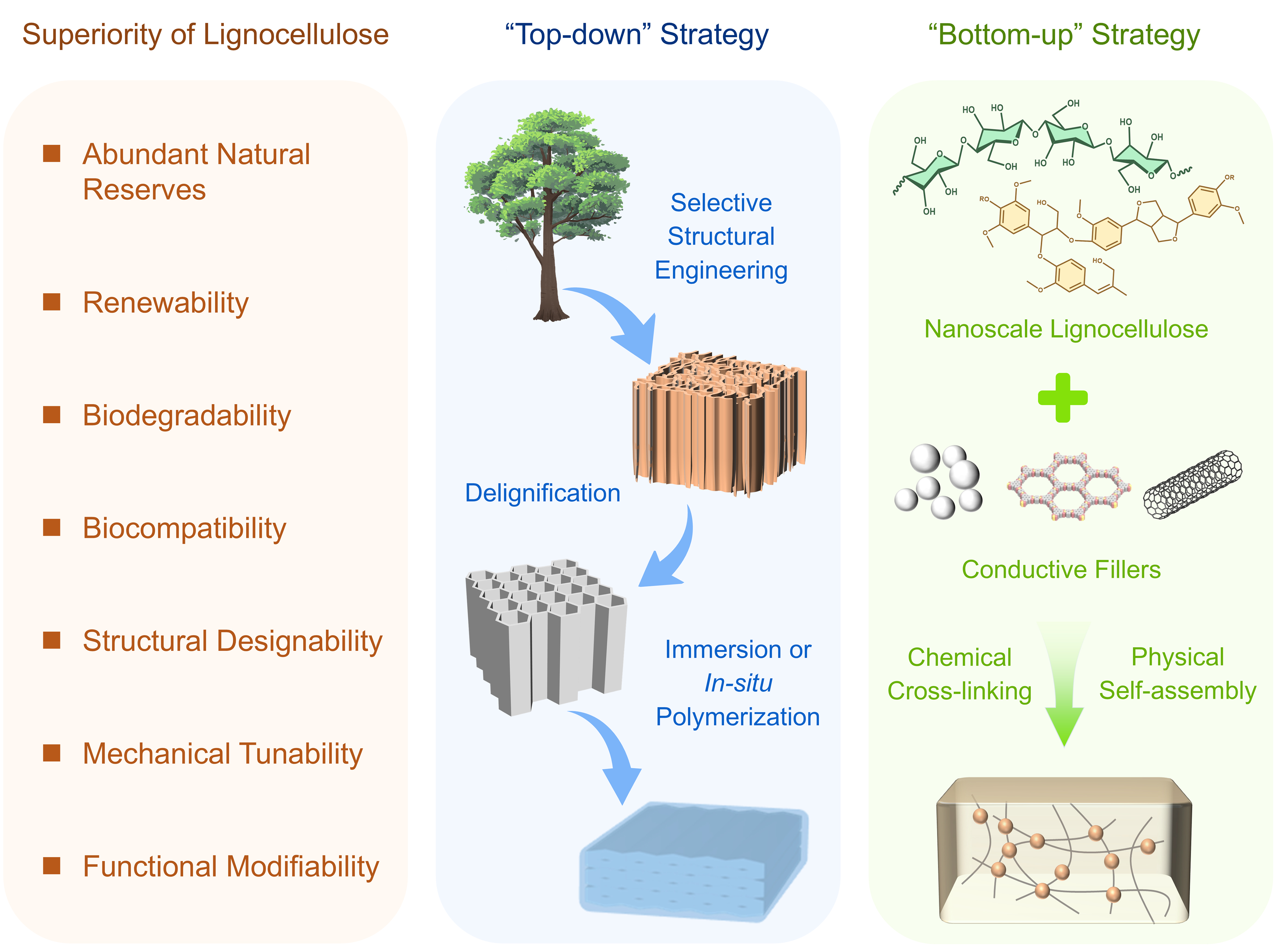
Figure 2. Advantages and preparation strategies for gel sensors using lignocellulose.
“Top-down” strategy
The top-down approach initiates with native lignocellulosic biomass and employs selective structural engineering to tune its hierarchical architecture, thereby preserving the intrinsic hierarchical and anisotropic structural features of the source material[155]. Specifically, the naturally aligned cellulose microfibril networks impart directionally dependent mechanical behavior, while the hierarchical pore architectures (lumen, pits, and interfibrillar spaces) serve as templates for constructing directional ionic or percolative electronic conductive pathways upon incorporation of electrolytes, conductive polymers, or nanomaterials [Figure 2][29,156].
Filling lignocellulosic frameworks is a key strategy for preparing lignocellulose-based hydrogel sensors. Lignin and/or hemicellulose in natural wood are selectively removed with DESs, chlorite, or mild alkali, while the highly oriented lignocellulose framework is retained. This process not only exposes the native lignocellulose microfibril networks but also creates a hierarchical porous structure that can be subsequently functionalized[29,157,158]. For instance, hydrophilic delignified wood was used as a scaffold and impregnated with FeCl3 to fabricate conductive wood. The aligned fibers in the conductive wood scaffold endow the hydrogel with anisotropic mechanical and electrical properties, and its conductivity and sensing response exhibit a strong directional dependence consistent with the orientation of natural fibers[159]. Similarly, Yang et al. chemically delignified pomelo peels, retaining their three-dimensional porous cellulose framework, and subsequently riveted AgNWs onto the surface of this framework. The porous structure of delignified pomelo peel provides stable anchoring sites for AgNWs, and a stable conductive path is constructed on the retained cellulose framework[160].
In addition to filling the lignocellulose framework, chemical modification and treatment strategies have also been reported for preparing high-performance lignocellulose-based flexible hydrogels. Lignocellulose contains a large number of hydroxyl groups, has good compatibility with polymers, and can interact with them at the molecular level[161]. PAM, one of the most widely used synthetic polymer matrices in lignocellulose-based hydrogels, consists of linear chains with repeating –CH2–CH(CONH2)– units. Upon cross-linking with N,N′-methylenebisacrylamide (MBA), PAM forms a three-dimensional covalent network with mesh sizes tunable from nanometers to micrometers, providing elastic mechanical support for conductive fillers[28,161]. The aligned cellulose skeleton was separated from wood through delignification, and then chemically polymerized with PAM to preserve the anisotropic structure of the hydrogel. Further alkali treatment was carried out to provide it with high flexibility[28]. A major superiority of this approach is that lignocellulose and polymers contain many hydroxyl or carboxyl groups and can form high-affinity reversible coordination with metal ions[162,163]. Inspired by catechol chemistry, Yan et al. assembled anisotropic mechanical property-possessing all-wood tough hydrogels through the formation of dynamic bonding among cellulose fibers, natural wood lignin, PAM chains, and iron ions[164]. Iron ions and the catechol groups in lignin can trigger rapid self-gelation under ammonium persulfate (APS) and act as reversible hydrogen bonds and metal coordination bonds to endow the hydrogel with flexibility. Highly oriented delignified wood serves as a framework that confers strong mechanical strength on the hydrogel. Meanwhile, PAM chains filling the spaces between cellulose fibers further enhance the mechanical properties of the hydrogel through hydrogen bonds.
The top-down approach offers distinct advantages in terms of processing simplicity, scalability, and cost-effectiveness[165]. Unlike bottom-up strategies that require energy-intensive deconstruction of lignocellulosic biomass, including complete removal of lignin and hemicellulose to isolate nanocellulose followed by reconstruction into hydrogels, the top-down approach selectively delignifies wood while preserving the native cellulose microfibril alignment and hierarchical architecture, enabling direct and scalable fabrication of anisotropic wood hydrogels[156,161,166]. However, the top-down strategy also presents some limitations. The degree of delignification and the resulting porosity must be carefully controlled to balance mechanical integrity with functional accessibility. Excessive delignification can compromise the structural robustness of the scaffold, while insufficient removal may hinder efficient infiltration of conductive components[157,167].
“Bottom-up” strategy
In contrast to the top-down strategy, the bottom-up approach deconstructs native lignocellulosic biomass into programmable nanoscale building blocks - such as CNFs[126,168], CNCs[33,169], hemicellulose fractions[24,65], and technical lignins[26,34] - which are subsequently reassembled through physical self-assembly, chemical cross-linking, or polymerization into functional hydrogel networks. This approach enables precise nanoscale control over the final material architecture, allowing systematic tuning of porosity, mechanical properties, and conductive pathways through molecular-level design [Figure 3][18,19,65,89].
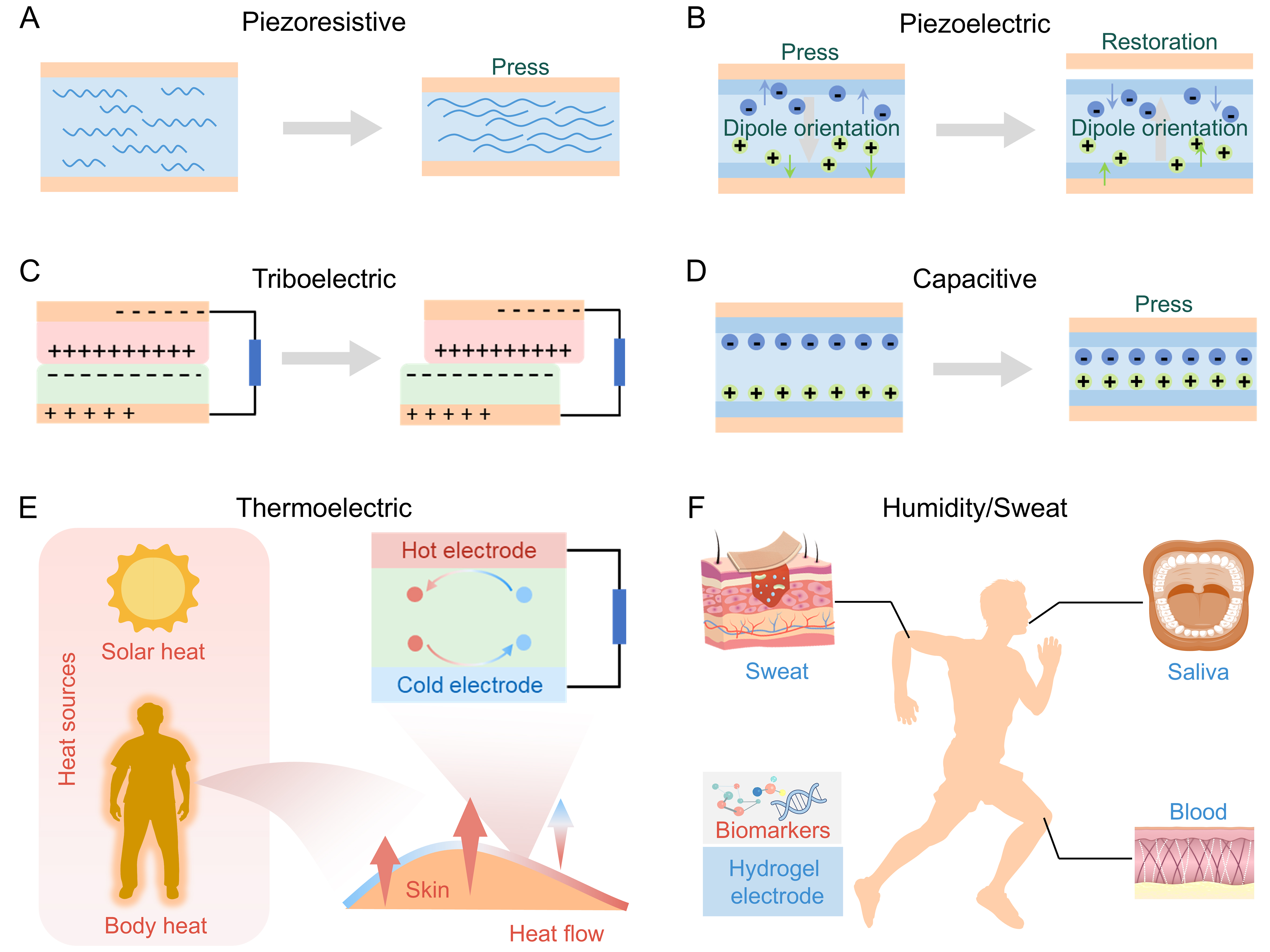
Figure 3. Sensing mechanism of lignocellulose-derived hydrogel sensors, including (A) piezoresistive, (B) piezoelectric, (C) triboelectric, (D) capacitive, (E) thermoelectric, (F) humidity/sweat.
CNFs are prepared through TEMPO-mediated oxidation combined with mechanical nanofibrillation and are excellent nano-building units[125,170]. They benefit from their high aspect ratio, abundant surface hydroxyl groups, and the ability to form a three-dimensional permeable network through the synergistic action of hydrogen bonds and physical entanglements. These nanofibers can be physically cross-linked through reversible non-covalent interactions or chemically cross-linked through stable covalent bonds, thereby constructing three-dimensional hydrogel network matrices, presenting excellent mechanical properties and good structural integrity[171]. For instance, by self-assembling CNTs and cellulose to connect two-dimensional MXene nanosheets and simultaneously crosslinking them into a complete conductive network through the metal-ligand bonding of Zn2+, the resulting composite hydrogel exhibits excellent sensing performance, such as high sensitivity [gauge factor (GF) = 20.17], wide detection range (0%-400%), fast response time
Bottom-up approaches provide high precision and versatility, promoting many feasible and reliable pathways to fabricate flexible hydrogel matrices for motion sensing. However, they inevitably disrupt the native hierarchical architecture of lignocellulose and result in significantly higher energy consumption during nanoscale deconstruction. Persistent challenges in practical implementation include inorganic or metallic filler aggregation, interfacial incompatibility in multicomponent composites, and batch-to-batch variability in nanocellulose dimensions[94,104]. Nevertheless, the bottom-up strategy is indispensable for applications demanding rationally designed nanoscale architectures, precise compositional control, or multimodal sensing integration.
SENSING MECHANISM OF LIGNOCELLULOSE-DERIVED HYDROGEL SENSORS
The sensing performance of lignocellulose-based hydrogel sensors is fundamentally governed by a multiscale structure–function coupling mechanism. This mechanism spans molecular-level reconfiguration of hydrogen-bonding networks to macroscopic deformation of the three-dimensional polymeric scaffold, enabling rich and tunable physicochemical responses to diverse stimuli - including strain, pressure, temperature, and body fluids. A rigorous understanding of these underlying transduction pathways is critical for the rational design and performance-driven optimization of next-generation soft sensing materials. Figure 3 illustrates the sensing mechanisms.
Strain/pressure sensing mechanisms
Piezoresistive sensing is the most extensively studied mechanism in lignocellulose-based hydrogel sensors[17,18]. Its core principle lies in the structural changes of the conductive network within the gel caused by external mechanical stimuli, which in turn leads to corresponding alterations in resistance or conductivity [Figure 3A][175]. Lignocellulose plays a dual role as a structural framework and a functional regulator in this process.
According to percolation theory, when conductive fillers form a continuous conductive network in a polymer matrix, the resistivity of the material will undergo a sudden order-of-magnitude change[176]. CNCs possess an extremely high aspect ratio and abundant surface hydroxyl groups, enabling the construction of an efficient percolation network within the hydrogel matrix[177,178]. When the gel is stretched or compressed, the number of contact points and the contact area between the conductive fillers change, thereby regulating the electronic transmission path[175,179]. CNCs, as functional nanofillers, can be incorporated into dynamic cross-linked hydrogel composites through surface modification, assisting in the construction of materials that possess high stretchability, self-healing ability, and sensing performance[44,117]. Li et al. fabricated a self-healing piezoresistive sensor by in situ polymerization of a PVA-PAM double-network hydrogel with SA and tannic acid-modified CNCs (TA@CNCs)[180]. Tannic acid (TA) is a natural polyphenol (C76H52O46) rich in catechol and pyrogallol groups. It can coordinate polydentately with metal ions and form hydrogen bonds with cellulose hydroxyl groups[13,49]. When TA is grafted onto the surface of CNC, TA forms a conformal coating, introducing catechol-mediated dynamic cross-linking sites while retaining the crystalline core structure of CNC[13]. This dual dynamic cross-linking enables reversible dissociation and reassociation of conductive pathways under deformation, ensuring rapid recovery of the percolation network and thus restoring electrical conductivity upon self-healing. Similarly, Li et al. used CNCs modified with polydopamine (PDA) and gold nanoparticles (AuNPs) (CNCs@PDA-AuNPs) as functional nanofillers, which were embedded in a PVA hydrogel network[49]. PDA, formed by oxidative polymerization of dopamine (3-hydroxytyramine, C8H11NO2), exhibits a heterogeneous structure comprising uncyclized dopamine units, 5,6-dihydroxyindole (DHI), and indole-5,6-quinone moieties cross-linked via Michael addition and Schiff base reactions[181]. The catechol groups of PDA were tightly bound to the PVA chains through hydrogen bonds, and AuNPs provided an electronically conductive path, thus constructing a stable 3D conductive network for human motion monitoring.
Lignin, as a natural aromatic polymer, can enhance the interfacial cohesion and dispersion stability of hydrogel networks through its abundant phenolic hydroxyl and sulfonic acid groups via multiple dynamic supramolecular interactions (hydrogen bonding, π-π stacking)[115,116]. Zhu et al. prepared a thermoresponsive in situ adhesive bio-gel by co-embedding LS with MXene nanosheets into a gelatin/glycerol-water binary solvent matrix[182]. The catechol and sulfonic acid groups on the LS surface form stable interfacial interactions with MXene, ensuring uniform dispersion of conductive nanosheets during deformation and reversible regulation of conductive pathways, thereby endowing the sensor with high sensitivity and a wide detection range. Moreover, as a natural polysaccharide biomass, hemicellulose contains abundant polar groups, such as hydroxyls, along its molecular chains, enabling the formation of multiple hydrogen bonds with conductive polymers or nanoparticles[24]. Nano-polydopamine (nano-PDA) is uniformly dispersed and stably fills the pores through non-covalent interactions and electrostatic forces mediated by functional groups like amino and carboxyl groups in the hemicellulose network, forming continuous electronic conduction pathways. Meanwhile, ions within the hemicellulose matrix can migrate directionally through the three-dimensional porous network, contributing to ionic conductivity and offering unique advantages in flexible strain-sensing applications[183].
These studies collectively demonstrate that rational surface engineering of CNCs with conductive nanomaterials and dynamic bonding motifs represents a versatile strategy for developing high-performance piezoresistive sensors with integrated self-healing and mechanical durability.
Piezoelectric sensing mechanism
Piezoelectric sensing is based on the direct piezoelectric effect, where mechanical deformation induces charge separation due to the redistribution and orientation of electric dipoles within piezoelectric materials[184,185]. As shown in [Figure 3B], the essence of this phenomenon stems from the asymmetry of the internal polar structure of the material. In the absence of stress, the electric dipoles within the material are randomly oriented, resulting in a net dipole moment of zero and no potential difference being generated. When external stress is applied, the displacement of positive and negative charge centers generates an electrical potential difference, which can be collected as an output signal for detecting mechanical stimuli. Conversely, the inverse piezoelectric effect refers to the deformation of piezoelectric materials under an external electric field[184]. In lignocellulose-derived hydrogel sensors, piezoelectric responses can originate from the intrinsic electroactive characteristics of cellulose crystalline regions and can be further enhanced through structural design and functional integration. The ordered arrangement of cellulose chains and asymmetric molecular structures provide potential dipole moments, while hydrogen-bond networks and oriented nanocellulose architectures facilitate stress transfer and polarization changes during deformation. Furthermore, incorporation of piezoelectric components, such as ZnO, BaTiO3, PVDF, or other electroactive polymers, can significantly improve charge generation and signal sensitivity[186]. Therefore, lignocellulose-based piezoelectric hydrogels combine renewable structural frameworks with enhanced electromechanical conversion capability, showing great potential for wearable motion monitoring and physiological signal detection.
While native lignocellulose exhibits only weak piezoelectricity, it serves as an excellent green substrate and functional matrix for constructing high-performance piezoelectric sensors[95,187]. Cellulose can be integrated with piezoelectric polymers such as poly(vinylidene fluoride-trifluoroethylene) [P(VDF-TrFE)] through covalent bonding, hydrogen bonding, and dipolar interactions to form flexible-rigid double-network hydrogels. The molecular structure of P(VDF-TrFE) consists of alternating vinylidene fluoride (–CH2–CF2–) and trifluoroethylene (–CHF–CF2–) units, which can crystallize into the electroactive β-phase with an all-trans conformation[188,189]. Mechanistically, the flexible cellulose network accommodates macroscopic deformation and distributes external stress uniformly across the hydrogel, while the rigid P(VDF-TrFE) network undergoes stress-induced reorientation of molecular dipoles - converting mechanical strain into a piezoelectric potential via the generation of a net dipole moment. The interfacial dipolar interactions between cellulose and P(VDF-TrFE) stabilize the electroactive β-phase and enable self-polarization without external poling, thereby ensuring efficient mechanical-to-electrical transduction[190]. Moreover, inspired by nature’s tendrils, this dual-network design further enables the creation of self-wrapping helical configurations and 3D macrostructures. These non-planar geometries amplify the effective stress concentration within the P(VDF-TrFE) network under identical mechanical stimuli, thereby enhancing the degree of dipole reorientation and significantly improving the mechanical-to-electrical conversion efficiency for energy harvesting and self-powered sensing applications[191].
Triboelectric sensing mechanism
Because of their simple structure, high sensitivity, and self-powered operation, TENGs have attracted increasing attention for applications in wearable electronics, human motion monitoring, and intelligent sensing systems[192-194]. The integration of triboelectric effects with lignocellulosic materials, owing to their renewable characteristics, abundant functional groups, and flexible structures, provides new opportunities for developing environmentally friendly and self-powered sensing platforms. TENGs are based on the coupled effects of contact electrification and electrostatic induction. When two materials with different electron affinities undergo periodic contact and separation under mechanical force, charge transfer occurs at the interface due to differences in surface chemical potential, forming symmetrically distributed positive and negative triboelectric charge layers. As the separation distance changes, the capacitance between the triboelectric layers varies, driving induced charges to flow between electrodes and generating an alternating current output in the external circuit [Figure 3C][137,193,195]. Recent advances have demonstrated that flexible TENGs can simultaneously realize mechanical energy harvesting and self-powered sensing functions. For example, Umapathi et al. developed a flexible PVA/g-C3N4-based TENG, in which hydrogen-bond-mediated interactions between g-C3N4 and PVA enhanced charge trapping capability and electrical output, enabling efficient harvesting of human motion energy for wearable and self-powered electronic applications[194]. Similarly, Katta et al. reported a biodegradable chitosan/sodium bismuth titanate composite TENG, where the incorporation of high-dielectric NBT particles improved interfacial charge storage and triboelectric performance, allowing biomechanical sensing and motion-triggered smart lighting applications[192]. Depending on the device configuration, TENGs can generally be classified into four fundamental modes, including vertical contact-separation mode, lateral sliding mode, single-electrode mode, and freestanding triboelectric-layer mode. These configurations enable TENGs to harvest mechanical energy from diverse sources and convert biomechanical motions, such as finger tapping, body movement, and pressure
Lignocellulose-based materials inherently possess positive triboelectric polarity due to the electron-donating tendency of abundant hydroxyl groups (–OH) along the cellulose chains and lignin macromolecule[137,196,197]. However, the triboelectric charge density of pristine cellulose is relatively low, necessitating surface functionalization to enhance the output performance. By chemically modifying the three reactive hydroxyl groups per glucose unit, researchers can introduce functional groups with tailored electron affinity to precisely manipulate triboelectric polarity[198]. Liu et al. systematically investigated the effects of different functionalization strategies on the triboelectric performance of cellulose hydrogels, with a focus on the mechanism of amino surface modification, confirming that the introduction of 3-aminopropyltriethoxysilane significantly enhances the positive triboelectric polarity of the material[199]. Conductive polymer grafting onto cellulose nanofibrils offers a synergistic strategy to boost triboelectric output and impart self-powered sensing functionality. Qin et al., reported that TEMPO-oxidized cellulose nanofibrils (TOCNF), featuring abundant surface carboxyl and hydroxyl groups, serve as an effective template for in-situ polymerization of PANI via hydrogen-bond-mediated monomer anchoring[200]. The resulting TOCNF/PANI nanocomposite, when integrated into a PVA/borax hydrogel network, forms a flexible electrode with rapid self-healing capability and high stretchability. Furthermore, inspired by directional transport in plant vascular bundles, negatively charged CNFs induce the self-assembly of MXene nanosheets into a continuous multilayer microchannel network via electrostatic adsorption, providing a directed and rapid pathway for free-ion transport[168]. Under mechanical stimuli (tension/compression), deformation of the microchannel structure alters the ion migration rate, resulting in resistance changes that enable highly sensitive strain sensing. Lignin can form a self-catalytic system through redox reactions, providing energy for monomer polymerization[201,202]. In this study, the lignin-Fe3+ system (SL-Fe3+) accelerates the decomposition of APS to produce SO4- and OH· free radicals through a reversible quinone-tyrosine oxidation-reduction cycle. This rapidly initiates in situ polymerization of acrylamide at room temperature. Meanwhile, the covalent-like hydrogen bond network formed between trehalose and PAM chains endows the material with tensile strength, freeze resistance, and dehydration resistance. CNFs act as a network enhancer to increase mechanical strength, providing a new idea for designing frictional electrostatic materials[203].
Capacitive mechanism
Capacitive sensors operate on the principle of parallel-plate capacitance and comprise two conductive electrode layers separated by a hydrogel dielectric layer [Figure 3D]. Upon application of an external mechanical stimulus (e.g., compressive pressure or tensile strain), the geometric parameters of the capacitor - namely, the thickness (d) of the dielectric layer and/or its effective electrode overlap area (S) - undergo reversible changes, resulting in a corresponding modulation of the capacitance. The capacitance can be quantitatively described by the following equation:
where ε0 is the vacuum permittivity, εr is the relative dielectric constant of the dielectric layer, S is the effective overlapping area between electrodes, and d is the dielectric layer thickness. During compression, the decrease in dielectric thickness increases capacitance by reducing the electrode separation distance. Under tensile deformation, the increased electrode overlap area and reduced thickness synergistically contribute to capacitance enhancement[17,204,205].
Lignocellulose is particularly advantageous for capacitive sensing due to its structural tunability[97]. Wang et al. developed a dual-mode capacitive sensing mechanism combining “physical capture” and “chemical adsorption” by synergistically integrating TOCNF with Bi2O2S nanosheets[206]. The abundant hydroxyl and carboxyl groups on the TOCNF surface rapidly physically adsorb water molecules from the environment via hydrogen bonding, acting as a “water-capturing scaffold”. Meanwhile, the high specific surface area and vertically aligned porous structure of TOCNF significantly reduce diffusion resistance for water molecules, accelerating capillary-driven adsorption/desorption processes, thereby enabling ultrafast response and excellent sensing performance. Based on the electric double-layer capacitance effect, Zhang et al. developed a supercapacitive pressure sensor using a sandwich structure[207]. By incorporating TA-encapsulated CNCs as a multifunctional hydrogen-bond donor, they formed a dynamic crosslinked network with polyacrylic acid (PAA) and choline chloride through multiple dynamic hydrogen bonds, ensuring the integrity of ion-transport channels. In addition, a capacitive humidity sensor reported by Huang et al. uses cellulose-derived hydroxyl groups, together with MXene surface groups and sodium polyacrylate carboxylates, to cooperatively generate hierarchical hydrophilic sites. Progressive water adsorption at these sites forms proton/ion transport networks, modulating the dielectric constant and enabling capacitive humidity detection[208].
Temperature sensing mechanism
Ion mobility increases with rising temperature, decreasing resistance. The temperature sensor transduces thermal fluctuations into measurable ionic current variations within the hydrogel matrix, as illustrated in Figure 3E. The sensitivity is evaluated by the temperature coefficient of resistance (TCR), defined as
where RT is the resistance at the measured temperature, R0 is the resistance at the initial temperature, and ΔT is the temperature change (unit: °C). The larger the absolute value of TCR, the more sensitive the sensor is to temperature fluctuations[209-211].
In the temperature-sensing mechanism of hydrogels, lignocellulose enhances this effect by providing a porous network based on the above principle. Pang et al. developed a skin-inspired hydrogel based on a three-dimensional cellulose scaffold integrated with conductive fillers to form a composite conductive network[212]. The resulting hydrogel displays a highly linear and reproducible resistance-temperature relationship, allowing temperature changes to be transduced into quantifiable electrical signals. Analogously, Zhang et al. developed a stretchable and environmentally tolerant hydrogel based on a CNF-stabilized liquid metal (LM)/MXene composite conductive network, where the synergistic effect of highly conductive LM droplets and Ti3C2Tx MXene nanosheets establishes efficient electron transport pathways[213]; when temperature changes, the enhanced thermal excitation accelerates electron mobility while the microstructural evolution of the conductive network alters the resistance, enabling the hydrogel to convert temperature variations into quantifiable electrical signals with high sensitivity and excellent linearity. Beyond the conventional resistive sensing paradigm, an emerging iontronic approach leverages intrinsic temperature gradients rather than uniform temperature changes. Specifically, Cheng et al. engineered a cellulose hydrogel with regulated ion thermal migration channels, wherein the Soret effect drives selective ion diffusion under a thermal gradient to generate a thermoelectric voltage[214]; by optimizing channel-ion interactions through counter-ion condensation and polyelectrolyte crosslinking, the hydrogel achieved an ultrahigh ionic thermopower of 22.09 mV·K-1, establishing a self-powered temperature sensing mechanism that directly transduces heat differentials into electrical outputs without external power sources. The thermal response behavior of lignin is significantly different from its structural role in plant cell walls. Wu et al. utilized the abundant phenolic hydroxyl, hydroxyl, and sulfonic acid groups of LS to form a dual-network hydrogel scaffold through Ca2+ chelation with SA and PAA, and used this as a matrix to polymerize PANI in situ to form a semi-interpenetrating conductive network[215]. Lignin provides a uniform and three-dimensional network support for PANI, while the P-type semiconductor properties of PANI endow the hydrogel with an inherent negative temperature coefficient effect. This ternary system can inhibit ice crystal formation and ensure high-temperature water retention properties.
Humidity and biofluid sensing mechanisms
Humidity and sweat sensors can measure changes in environmental humidity or analyze sweat composition (electrolytes, urea, lactate) in practical applications. The working principle is based on the hydrogel’s ability to absorb or release water molecules[216-218]. When humidity increases, hydrophilic groups on lignocellulose bind to water molecules, causing the hydrogel to swell; this swelling alters either the ion transport pathways (resistance change) or the dielectric constant (capacitance change), generating a detectable electrical signal [Figure 3F][204].
The abundant hydroxyl functional groups on the surface of lignocellulose can form hydrogen bonds with water molecules, causing the hydrogel to swell upon absorbing water or shrink upon dehydration when environmental humidity changes. In low-humidity conditions, moisture in the hydrogel evaporates, increasing the distance between conductive materials and thus raising resistance; whereas in high-humidity environments, the hydrogel absorbs water and swells, making the conductive pathways denser and reducing resistance[17,204,219]. Researchers reported a humidity sensor based on an acrylic/sugarcane bagasse cellulose porous hydrogel doped with graphene oxide (GO)[40]. The sensor leverages the abundant hydroxyl groups in the cellulose framework to adsorb water molecules via hydrogen bonding, while the porous structure facilitates rapid moisture penetration. As humidity increases, more water is absorbed, enhancing the mobility of free ions within the hydrogel and reducing impedance; desorption reverses this effect. Furthermore, GO, with its surface rich in oxygen-containing functional groups, further improves sensitivity by providing additional binding sites for water molecules and promoting charge-carrier formation. Similarly, Bian et al. developed a transparent, intrinsically stretchable CNF-mediated conductive hydrogel by loading poly(3,4-ethylenedioxythiophene):poly(styrenesulfonate) (PEDOT:PSS) onto a three-dimensional porous CNFs network[220]. In this system, the CNF skeleton with abundant hydroxyl groups acts as a humidity-sensitive component: when environmental humidity increases, the hydroxyl groups capture water molecules through hydrogen bonding, causing the CNFs network to swell and enhancing the connectivity of the conductive PEDOT:PSS pathways, which reduces resistance; conversely, dehydration in low-humidity environments shrinks the network and increases resistance. This mechanism enables simultaneous strain and humidity sensing with high transparency (> 80%) and excellent stretchability (> 100% strain), demonstrating the versatility of cellulose-based materials in multimodal flexible sensors. By leveraging the abundant hydrophilic groups (–OH) on the surface of hydroxypropyl cellulose (HPC) molecules and the network structure formed within the hydrogel system, Song et al. developed a composite ionic conductive hydrogel incorporating HPC[221]. This hydrogel retains the inherent self-adhesive stress-strain sensing capability of conductive hydrogels and achieves temperature-responsive transparency variation through the low critical solution temperature property of HPC, forming a multifunctional sensing system with zero crosstalk. Lignin has a higher hygroscopicity than cellulose, attributed to its amorphous structure and a large number of polar functional groups[222]. LS acts as a “moisture capture center”, with its abundant sulfonic acid groups, phenolic hydroxyl groups, carboxyl groups, and other polar functional groups, which can quickly adsorb water molecules and dissociate to release free protons, forming a proton diffusion current under a humidity gradient[175].
Meanwhile, the dynamic hydrogen bond-electrostatic cross-linked network composed of chitosan (CS) and PAA causes the ion transport channels of the hydrogel to undergo reversible changes during mechanical deformation, achieving sensitive responses in resistance, and these effects work together to endow the hydrogel with the dual sensing capabilities of humidity-electroconductivity and stress-resistance[223].
Lignocellulose-derived hydrogel sensors can achieve diverse sensing functionalities through different signal transduction mechanisms, including piezoresistive, piezoelectric, triboelectric, capacitive, thermoelectric, and humidity/biofluid sensing pathways. Each mechanism exhibits distinct advantages and limitations in terms of sensitivity, response speed, environmental stability, and application adaptability. A comparison of the advantages, limitations, and representative applications of different sensing mechanisms is summarized in Table 2. Generally, piezoresistive and capacitive mechanisms are widely employed for pressure and strain sensing due to their simple structures, continuous signal output, and good capability for detecting static deformation. Piezoelectric and triboelectric mechanisms possess rapid response characteristics and self-powered sensing capabilities, making them suitable for dynamic motion monitoring and interactive wearable electronics[193,225,226]. Thermoelectric and humidity/biofluid sensing strategies provide additional functions for environmental and physiological monitoring, although their response is relatively slower due to thermal diffusion, molecular adsorption, and ion transport[200,227]. It should be noted that sensitivity among different sensing mechanisms cannot be directly compared using a single parameter because different transduction principles employ different evaluation criteria. For example, piezoresistive sensors are usually evaluated by GF or pressure sensitivity, while piezoelectric, triboelectric, capacitive, thermoelectric, and humidity sensors are characterized by parameters such as output voltage, charge density, capacitance variation, Seebeck coefficient, and resistance variation. Therefore, these parameters should be considered as representative performance indicators rather than absolute values for direct comparison.
Advantages, limitations, and applications of different sensing mechanisms in lignocellulose-derived hydrogel sensors
| Sensing mechanism | Advantages | Limitations | Typical applications | Ref. |
| Piezoresistive | Simple structure, facile fabrication, high sensitivity, large deformation detection capability | Signal drift, dependence on conductive network stability | Strain/pressure sensing, human motion monitoring | [177,178,181-183,224] |
| Piezoelectric | Self-powered operation, fast response, excellent dynamic signal detection | Ineffective for static sensing, requires piezoelectric components | Vibration sensing, dynamic force detection | [184-186] |
| Triboelectric | Self-powered, high output, low cost, wide material selection | Sensitive to humidity and contact conditions | Wearable electronics, motion monitoring | [192-195] |
| Capacitive | Low power consumption, high stability, good static pressure detection | Complex electrode design, parasitic capacitance interference | Electronic skin, pressure mapping | [204-207] |
| Thermoelectric | Self-powered temperature sensing, continuous thermal monitoring | Requires temperature gradient, relatively slow response | Thermal sensing and management | [210-213] |
| Humidity/biofluid | Multifunctional environmental and physiological monitoring | Strong dependence on environmental conditions, slower recovery | Sweat analysis, humidity monitoring | [217,218,220,221] |
APPLICATION OF LIGNOCELLULOSE-DERIVED HYDROGEL SENSORS IN MOTION MONITORING
Lignocellulose-based flexible hydrogel sensors are emerging as sustainable bioelectronic interfaces that couple renewable feedstocks with soft, real-time signal transduction[68,216,228,229]. Their hydrated networks, tissue-like mechanics, and interfacial conformability allow mechanical information from the human body to be converted into stable electrical outputs[230,231]. Human motion monitoring is intrinsically multiscale, covering joint bending, locomotion, respiration, pulse waves, phonation, and small muscle deformation[232-234]. In practical applications, sensors must also withstand specific environmental stresses such as repeated stretching, sweat immersion, temperature changes, dehydration, and long-term mechanical fatigue. Therefore, high-performance motion sensors must simultaneously deliver sensitivity, stretchability, adhesion, fatigue resistance, environmental tolerance, and signal stability. The multi-level structure, surface chemical diversity, and sustainability of lignocellulose make it a desirable material platform for motion sensors[23,235,236]. Cellulose and nanocellulose contribute crystalline reinforcement, hydrogen-bonded networks, and crack-arresting pathways that improve toughness and cyclic durability of hydrogels[178,237,238]. Hemicellulose-derived polysaccharide segments increase hydration, ion transport, and dynamic interactions within hydrogel networks. Lignin introduces aromatic, phenolic, and antioxidant motifs that can enhance interfacial adhesion, ultraviolet shielding, and aging resistance of hydrogels[239-241]. At present, the research on lignocellulose-based hydrogel sensors has gradually expanded from the early single mechanical signal acquisition to advanced interactive functions such as multi-modal perception, intelligent feedback, and closed-loop control[1]. As shown in Figure 4, through structural engineering, conductive integration, and bio-interface design, lignocellulose-derived hydrogels can be configured for wearable electronics [Figure 4A], healthcare monitoring [Figure 4B], and HMI [Figure 4C][225,228,229,242-244].
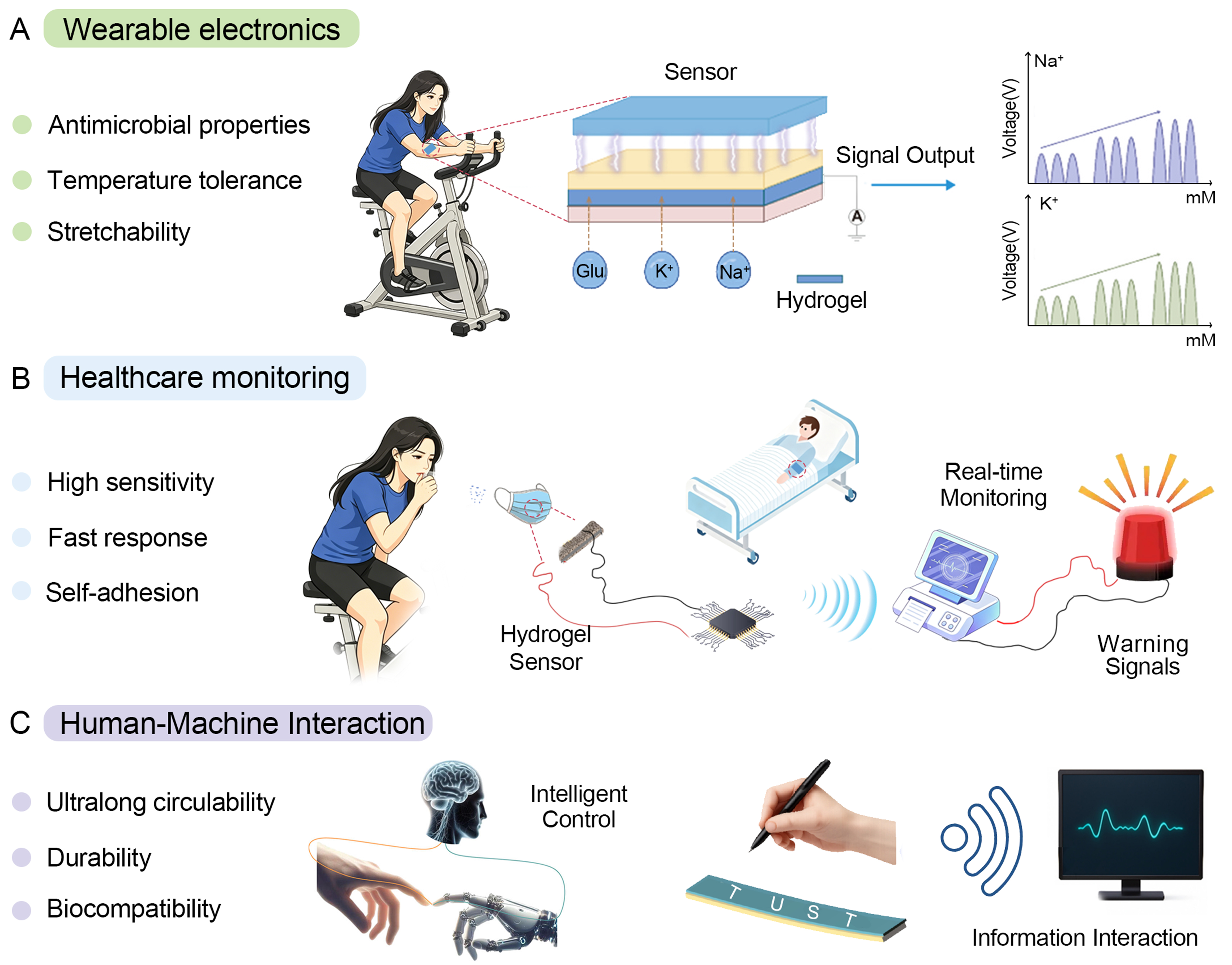
Figure 4. Overview of the applications of lignocellulose-derived hydrogel sensors in motion monitoring. (A) Wearable electronic applications based on lignocellulose hydrogel sensors, including mechanical flexibility, stretchability, temperature tolerance, antimicrobial properties, and physiological signal detection such as glucose (Glu), potassium ions (K+), and sodium ions (Na+)[50]. Adapted with permission from Ref.[50]. Copyright 2026, Elsevier; (B) Healthcare monitoring applications enabled by hydrogel sensors with high sensitivity, rapid response, and self-adhesive capability for real-time physiological monitoring and warning signal generation; (C) Human–machine interaction applications utilizing lignocellulose-derived hydrogel sensors with excellent durability, biocompatibility, and long-term operational stability for intelligent control and information interaction[105,244]. Adapted with permission from Ref.[105]. Copyright 2026, Elsevier. Adapted with permission from Ref.[244]. Copyright 2026, Springer Nature.
Wearable electronics
Wearable electronic devices are the most representative application of lignocellulose-based hydrogel sensors in motion monitoring. Hydrogel sensors must serve as both soft substrates and stable signal-transduction interfaces on moving skin[245,246]. The key value of these sensors lies in precisely capturing and digitally reconstructing human movements by converting macroscopic or microscopic deformations of the human body into quantifiable electrical signals. It also has excellent ductility, adhesion, air permeability, fatigue resistance, and environmental tolerance in different working environments[34,138,228]. Cellulose and nanocellulose usually provide fibrillar reinforcement and hydrogen-bonded energy dissipation, whereas lignin contributes aromatic rigidity, phenolic antioxidation, ultraviolet shielding, and interfacial adhesion in the hydrogels[247-250]. Therefore, lignocellulose-derived hydrogels are not simply renewable substitutes for synthetic elastomers but application-tailored wearable platforms for continuous and comfortable body-signal acquisition.
Macroscopic motion monitoring is the earliest and most mature example of wearable electronics, in which hydrogel sensors attached to fingers, wrists, elbows, knees, ankles, or the neck convert bending and stretching into resistance or ionic-conductivity changes[251,252]. Lignocellulose-derived components play an active role in this sensing process rather than merely serving as passive fillers. By integrating lignin-containing cellulose nanofibers (LCNF) into PVA ionic conductive hydrogels, the trade-off between the mechanical properties and ionic conductivity of ionic conductive hydrogels has been effectively addressed. The ion-conductive hydrogel demonstrates outstanding response time (300 ms) and sensing stability (300 cycles at 80% strain)[253]. Further, to balance viscosity and mechanical thermal sensitivity, CMC and LS are utilized to introduce LM into the gel network by dynamic cross-linking, enabling the long-term uniform diffusion of LM nanodroplets. The resulting hydrogel sensor features excellent adhesion strength [Figure 5A], sensitivity (GF = 3.8; the higher the GF value, the more sensitive it is), and a wide operating range (temperature 293-333 K). Meanwhile, it can detect movements at various human body joints (such as fingers, wrists, elbows, and neck) [Figure 5B-D][105]. However, this method did not address the defect of low-temperature freezing of hydrogels. To ensure the stable operation of gel sensors under low-temperature conditions, researchers introduced the DES into LCNF gels, endowing them with excellent electrical conductivity (2.29 S·m-1) and anti-freezing properties (-80 °C)[106]. Unfortunately, the hydrophilic swelling of the gel matrix can degrade performance when hydrogel sensors are used in underwater electronics. To address this defect, the catechol redox reaction between phosphorylated lignocellulose nanofibers and Ag+ is utilized to generate rapid self-gelation at room temperature, forming strong hydrogen-bond interactions and nano-reinforced effects[103]. The hydrogel has excellent anti-swelling performance (equilibrium swelling ratio of 1.2% after 30 d), high electrical conductivity (2.12 S·m-1), and strain-sensing ability (maximum GF = 3.98). Sensors based on this hydrogel can be conveniently attached to the limbs of the human body, achieving highly stable underwater communication and recognition of the swimming postures of marine organisms [Figure 5E and F][103]. For macroscopic motion monitoring, lignocellulose must balance hydrogel mechanical properties with electrical signal conduction to ensure sensor stability under large-scale motion. At the same time, under complex environmental conditions in real scenarios, functional design must demonstrate excellent environmental adaptability.
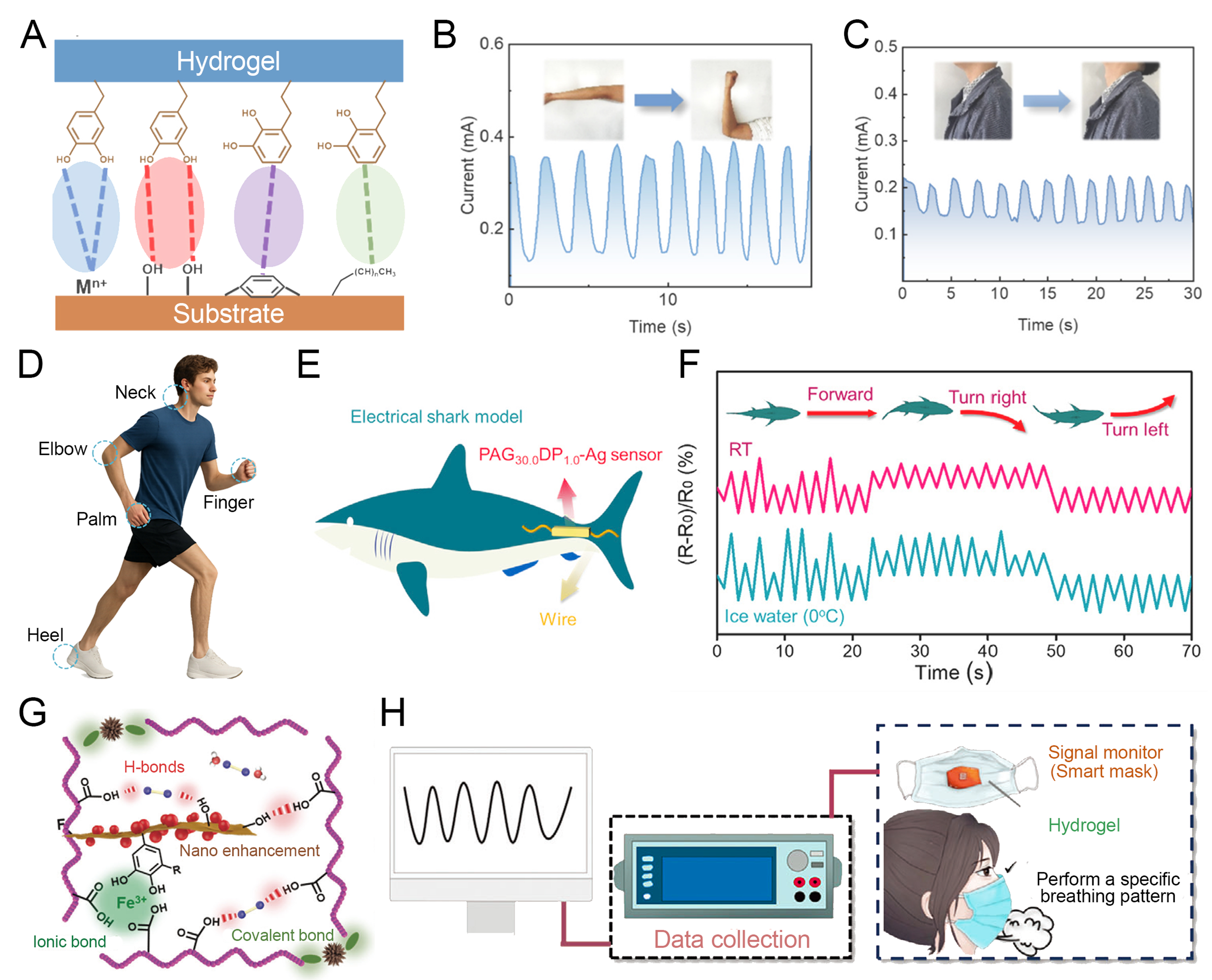
Figure 5. Lignocellulose-derived hydrogel sensors for wearable electronics. (A) The adhesive mechanism of CMC-LM-LS/PAA hydrogels[105]; Current changes monitored by the sensor attached to (B) the elbow for bending-unbending motions and (C) the neck for movements[105]; (D) Human motion-detection performance of the hydrogel-based sensor[105]. (A-D) adapted from Ref.[105]. Copyright 2026, Elsevier; (E) Motion state of bionic shark in water when it is attached to the hydrogel-based sensor, reflected by (F) the evolution of [(R - R0)/R0][103]. (E and F) adapted from Ref.[103]. Copyright 2025, Elsevier; (G) Schematic illustration of multiple interactions in composite hydrogel[138]; (H) Schematic diagram of smart mask operation[138]. (G and H) adapted from Ref.[138]. Copyright 2024, WILEY-VCH. CMC: Carboxymethyl cellulose; LM: liquid metal; LS: sodium lignosulfonate; PAA: polyacrylic acid; RT: room temperature.
Beyond large joint movement, wearable electronics must also detect weak physiological and biomechanical signals such as throat vibration, facial expression, pulse waves, respiration, swallowing, and tremor-related microdeformation[232,254]. This means gel sensors need extremely high sensitivity. Zeng et al. developed a lignin-modified MXene–Fe3+ dual-catalytic system to fabricate conductive hydrogels for wearable sensing under ambient conditions [Figure 5G][138]. The hydrogel exhibited a GF of 2.8, stable sensing performance over 200 cycles at 200% strain, and a broad working strain range of 0%-947%. Moreover, its integration into a smart-mask platform enabled the detection of breathing patterns and other subtle physiological motions
A more advanced direction in lignocellulose-based wearable hydrogel sensors is the transition from individual sensing materials toward system-level wearable platforms that integrate signal acquisition, power supply, energy harvesting, signal processing, and flexible circuit architectures[244,257,258]. Self-powered sensing systems can achieve energy autonomy through energy conversion. Sun et al. developed a transparent, self-adhesive, and conductive lignin-based organohydrogels through an alkali lignin-Cu2+ (AL-Cu2+) self-catalytic system and assembled it into an extreme-environment-resistant TENG[202]. It can achieve self-powered energy collection and movement monitoring of human joints (fingers, wrists)[202]. In another representative study[259], researchers prepared hydrogels with superior mechanical properties and electrical conductivity by using a self-catalytic system of sodium lignosulfonate and Fe3+. The assembled TENG also has an outstanding self-powered sensing capability[259]. Significantly, the hierarchical architecture of electrostatic cross-linking, hydrogen-bonding interactions, and π-π stacking between LS and CMC can balance the mechanical properties, functional versatility, and sustainability of hydrogels. This integrated function enables the hydrogel to serve as a unified and all-in-one sensing platform, achieving the collection and conversion of biomechanical energy, ultra-wide range strain sensing, stable energy storage and output, and real-time self-powered monitoring of human physiological signals[260]. Overall, wearable applications of lignocellulose-based hydrogel sensors are moving from single-point motion detection toward distributed, continuous, multimodal, and self-powered monitoring systems.
Healthcare and biomedical monitoring
Healthcare-oriented applications impose stricter requirements on lignocellulose-based hydrogel sensors than general wearable electronics; the sensing interface must remain mechanically compliant, biologically safe, and signal-stable during long-term contact with skin or soft tissues, and achieve continuous, non-invasive, and real-time tracking of an individual’s vital signs and health status[172,261,262]. Lignocellulose-derived hydrogels are particularly attractive for this purpose because their hydrated polymer networks, low modulus, biocompatible chemistry, and abundant functional groups can collectively support tissue-conformal adhesion, mechanical buffering, and functional biointerface design[106,263]. Such tissue-like mechanical and interfacial properties help reduce modulus mismatch between the device and biological tissue, thereby improving signal fidelity during physiological monitoring[264]. In addition, the renewable and biodegradable nature of lignocellulose-derived networks, particularly cellulose- and lignin-derived hydrogel systems, offers a promising pathway toward sustainable biomedical electronics and transient sensing systems with reduced environmental burden after use[265,266].
Continuous physiological monitoring is one of the most crucial applications of lignocellulose-based hydrogel sensors in clinical use. Pulse, respiration, ventricular tremors, and even the slightest muscle contractions all generate weak and repetitive deformation signals. Long-term stable transmission of these signals requires close, low-irritation, and strong mechanical contact between the hydrogel and the skin or soft tissue[267-270]. Lignocellulose-based hydrogels are renowned for their excellent biocompatibility and typically adhere closely to the skin surface to collect different signals, enabling continuous, non-invasive, and real-time tracking of an individual’s vital signs and health status[26,116]. A self-powered sweat-sensing bioelectronic system was designed by leveraging the close hydrogen-bond interaction between sulfonated cellulose (SC) and PVA chains. Under dynamic mechanical stimulation, glucose, potassium ions, and sodium ions in sweat are directly converted into a stable voltage output. This system, which assembles a TENG, can achieve real-time, non-invasive, multi-channel monitoring during exercise, featuring wireless transmission and thresholding alarm functions that support exercise optimization, early warning of physiological imbalance, and rehabilitation guidance[50]. Similarly, the ability of hydroelectric generators (HVEGs) to generate continuous electricity using a small amount of water vapor also makes them suitable for self-powered health monitoring systems. Compared with TENGs, the open-circuit voltage of HVEGs shows high sensitivity to both water volume and ion concentration, and can detect subtle physiological changes through interaction with body fluids such as sweat, saliva, or blood[271,272]. Researchers obtained an efficient HVEG by introducing a CNT assembly into SC/PVA. This device can detect human breathing, coughing, and speaking activities by collecting energy from water vapor exhaled from the lungs, and also demonstrates outstanding sensitivity (> 40%) and a fast response time (~2 s), capable of monitoring various health conditions in real time[272]. In addition to hydropower sensing, this device also features piezoelectric sensing capabilities, enabling precise real-time strain monitoring of subtle biomechanical inputs such as finger bending, wrist pulse, and neck movements. It has a response sensitivity exceeding 80% and a fast response time of 0.5 to 2 s. In addition, its piezoresistive behavior has been successfully applied in multiple real-world scenarios, including medical emergency alarm interfaces, smart doorbell systems, and public safety boundary crossing detection mechanisms [Figure 6A and B][273]. To enhance the sensitivity of piezoelectric sensing, the strong coordination selectivity of alginate is utilized to fix Al3+, which can significantly increase the ion diffusion difference under pressure[274]. By adopting a controllable phase separation structure strategy, aluminum alginate is introduced into the cellulose network to improve the performance of hydrogel piezoelectric ion sensors. In contrast, the optimized hydrogel sensor features high sensitivity (14.13 mV·kPa-1) and an ultra-fast response time (60 ms)[274]. Compared with cellulose, the intermediate catechol groups generated by the dynamic catalytic system between lignin and metal ions (Al3+, Fe3+) provide hydrogels with excellent self-healing performance and repeatable adhesive performance[275,276]. The hydrogel sensor manufactured by the LS-Fe3+ dynamic redox system features a wide sensing range (500%), fast response time (139 ms), and high sensitivity (GF = 8.98), enabling specific speech recognition and subtle body-movement detection for real-time elderly health and sleep management[276]. The hydrogel obtained by LS-Al3+ also exhibits ideal mechanical properties, good self-recovery ability, and tensile sensitivity[277,278]. Surprisingly, introducing Fe3+ into hemicellulose hydrogel can double its adhesion and sensitivity (the adhesion strength to pigskin increases from 12.3 to 23.85 kPa), and the sensitivity is high (the specification factor increases from 2.36 to 4.87)[62,256]. Generally, continuous physiological monitoring requires hydrogel sensors that balance biocompatibility and functional universality, such as adhesion and signal stability, and provide personalized and operable self-powered bioelectronic interfaces for different health monitoring needs.
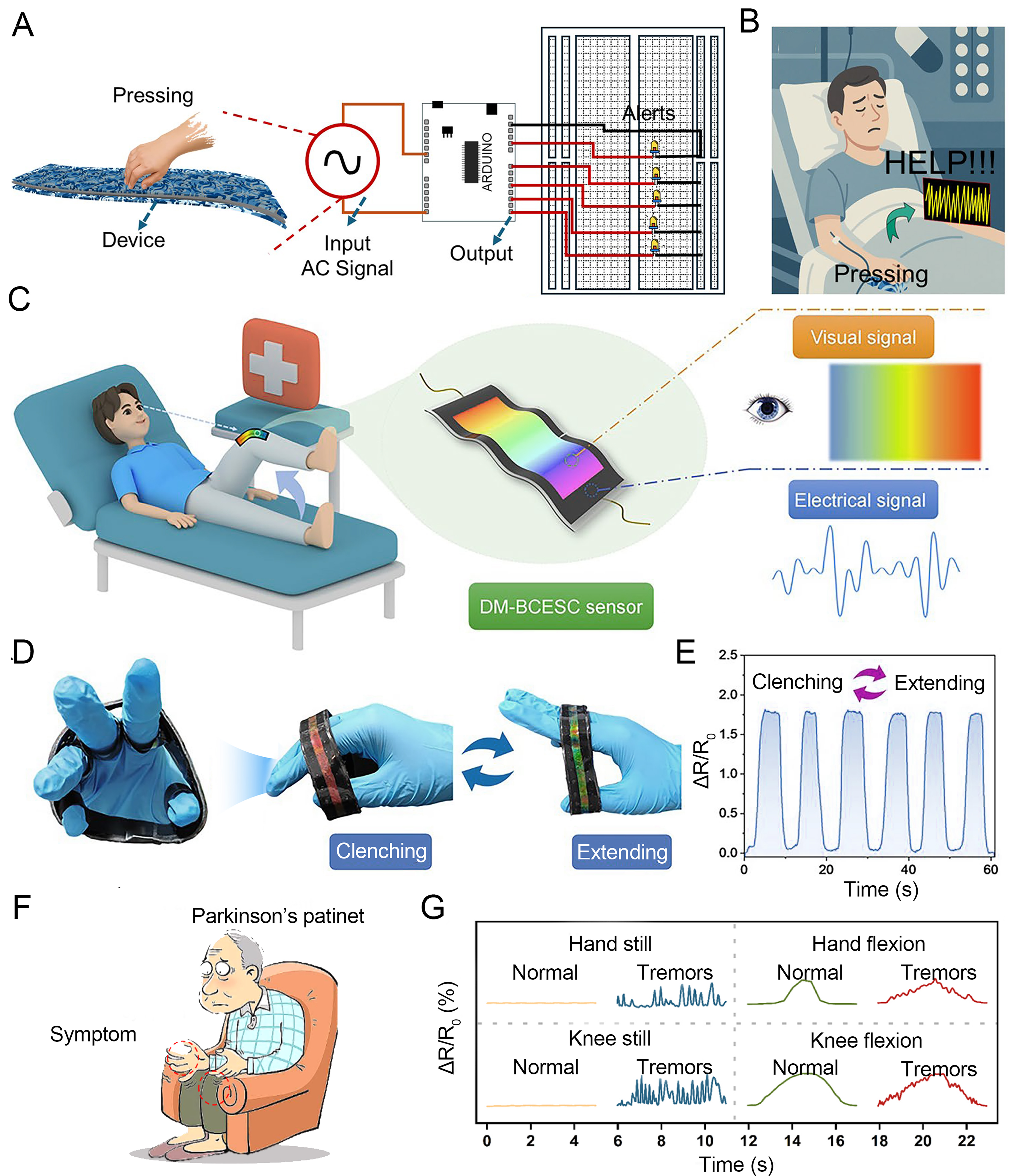
Figure 6. Lignocellulose hydrogel sensors for healthcare and biomedical monitoring. (A) Schematic illustration of the circuit connection of the device attached to an Arduino circuit and monitoring LEDs as an emergency alarm signal[273]; and (B) Graphical suggestion of device application as a sensor in the medical field to generate emergency alerts for patients[273]. (A and B) adapted from Ref.[273]. Copyright 2026, Springer Nature; (C) Schematic diagram illustrating the operational mechanism of the DM-BCESC sensor[285]; (D) Demonstrates the practical application and visual feedback performance of a wearable finger resistance band based on the DM-BCESC sensor in finger flexion and extension rehabilitation training[285]; and (E) Resistance signals synchronously captured by the sensor during finger flexion–extension movements[285]. (C-E) adapted from Ref.[285]. Copyright 2026, Springer Nature; (F) Sensors for applications in Parkinson’s patients[286]; and (G) Real-time resistance monitoring across eight different body postures[286]. (F and G) adapted from Ref.[286]. Copyright 2024, Elsevier. LEDs: Light-emitting diodes; DM-BCESC: dual-mode black CPH-enhanced structural color; AC: alternating current.
Motion-assisted diagnosis and rehabilitation represent another important biomedical direction for lignocellulose-based hydrogel sensors[279]. Clinical rehabilitation often requires quantitative evaluation of joint range of motion, gait symmetry, muscle coordination, and repetitive training performance[280]. Wearable hydrogel sensors mounted on limbs or joints provide an attractive platform for continuous and quantitative monitoring of biomechanical signals during therapeutic exercise, with relevance to stroke rehabilitation, orthopedic recovery, neurodegenerative disease management, sports injury, and postoperative motor-function assessment[281-283]. A highly flexible and mechanically tunable all-wood hydrogel was developed[284]. The neatly arranged cellulose nanochannels endowed it with remarkable anisotropic mechanical properties (longitudinal tensile strength of 36.5 MPa) and strain-sensitive electrical response. All-wood hydrogels can accurately distinguish various macroscopic or subtle human movements, including finger bending, pulse, and swallowing behaviors. In particular, when “Anqi” is called four times within 15 s, two pronunciation changes can be identified[284].
Stroke patients often experience limb motor dysfunction, including impaired finger flexion/extension and decreased wrist/ankle joint mobility. Therefore, precise assessment methods are needed to develop personalized rehabilitation plans for patients[285,286]. A dual-mode sensor (DM-BCESC) was designed by integrating the structural color interface of hydroxypropyl HPC with a black conductive polymer hydrogel (CPH) sensing component [Figure 6C]. It features high strain sensitivity (strain coefficient of 4.24) and excellent durability (over 4,400 cycles). In practice, the structural color shift of the HPC layer provides real-time visual interaction monitoring, enabling patients to self-adjust their movements. Meanwhile, the CPH layer can accurately quantify joint motion parameters, such as motion amplitude and frequency. This collaborative feedback mechanism not only enhances patients’ engagement through color changes but also provides digital assessment standards via electrical signals, demonstrating strong application potential for rehabilitation [Figure 6D and E][285]. In another study, researchers utilized the synergistic effects of PAA, dialdehyde carboxymethyl cellulose (OCMC), gelatin methacryloyl (GelMA), and lignosulfonate methacrylate (MLS) to achieve the best balance of adhesion, antibacterial activity, and conductivity in a multifunctional hydrogel through precise molecular-level regulation[286]. The hydrogel’s wide range and high sensitivity (GF = 5.31) enable the sensor to reliably record human electromyography (EMG) and electrocardiogram (ECG) signals. One of the most promising applications lies in the management of neurodegenerative diseases. Machine-learning models can accurately identify the characteristic tremor signals associated with Parkinson’s disease [Figure 6F and G][286].
Wound microenvironments are mechanically dynamic and chemically heterogeneous, involving changes in pressure, exudate level, humidity, pH, inflammation, oxidative stress, and bacterial load. Therefore, hydrogel wound interfaces should not only adhere to irregular tissue surfaces, but also maintain moisture balance, resist infection, relieve oxidative damage, and monitor wound-related physiological parameters. However, existing designs and manufacturing methods for human skin interfaces still fail to meet the challenging clinical requirements of excellent adhesion. Therefore, researchers have proposed a printable hydrogel with adjustable adhesion force[287]. In clinical cases, the hydrogel interface layer can maintain excellent adhesion and high-fidelity signal acquisition during flap/human skin measurement, while simultaneously exhibiting low adhesion after monitoring to avoid wound damage[287]. Although the research focuses on characterizing tunable adhesion force on flaps/human skin, the responsive hydrogel interface can also achieve good adhesion force to various wet tissues, such as porcine intestines, stomachs, livers, and hearts[287]. The self-adhesive property of hemicellulose hydrogels gives them a natural advantage in wound dressings. The multifunctional composite hydrogel composed of hemicellulose, PVA, and polydopamine-modified zinc oxide nanoparticles (PDA@ZnO NPs) has good cytocompatibility, blood compatibility, and the ability to promote fibroblast migration, showing great potential in wound-healing applications[65]. Meanwhile, the shear adhesion strength of the nano-PDA-reinforced hemicellulose-based hydrogel to skin tissue reaches 7.52 kPa. The excellent adhesion performance extended the hydrogel’s service life in biomedical applications and enabled rapid loading of cationic drugs, serving as a drug patch to promote the transdermal introduction of electrically stimulated drug ions[183]. These lignocellulose-derived hydrogels provide an important material basis for developing sustainable medical sensors that are both biocompatible and environmentally responsible[288-290]. However, most of the lignocellulose-based hydrogel sensors are designed for epidermal or external biomedical monitoring, while truly implantable hydrogel sensing systems remain relatively few[290]. Progress in this emerging direction will require a closer integration of biomass chemistry, hydrogel mechanics, bioelectronic design, and clinical translation[291,292].
Human-machine interaction
In recent years, with the deep integration of the Internet of Things, AI, and flexible electronics technology, HMI is undergoing a paradigm shift from the traditional rigid interface to flexible, adjustable mechanical performance and biocompatibility[13,286,293]. Human intentions must be transformed into digital instructions through natural gestures, touches, pressures, and deformations. Hydrogel sensors can adhere to moving skin and provide continuous mechanical readings while avoiding the discomfort caused by hard input devices[13]. Lignocellulose, with its sustainability, tunable mechanical properties, and biointerface compatibility, has become a promising material platform for building the next generation of HMI systems[291,292,294].
E-skins are a key component for achieving natural HMI, as the front-end interface that simulates the perception function of human skin[1,295,296]. Inspired by natural skin, electronic skin engineering technology has attracted increasing attention, promoting the development of single-component multimodal sensors that can simultaneously respond to multiple external stimuli - temperature, pressure, and biochemical markers - and offer fast response and high spatial resolution[12,244]. Lignocellulose-derived hydrogels offer unique advantages for constructing bionic tactile sensors because their mechanical properties resemble those of biological tissues (low modulus, high flexibility) and ultra-soft characteristics. Researchers have designed hydrogels based on the natural crystallization behavior of cellulose that can mimic human skin[110]. By regulating the self-assembly of cellulose to form a porous, non-swelling supramolecular fiber framework, the mechanical strength and anti-swelling property of hydrogels can be significantly enhanced, enabling stable signal output in water environments[110]. Introducing MXene into the cellulose gel skeleton to form a stable “brick and mortar” structure further enhances the piezoresistive performance of the pressure-sensitive layer, which can be used for accurately monitoring limb movement, pulse, and respiration. The flexible pressure sensor demonstrates high sensitivity (21.457 kPa-1), a wide detection range (0.11-11.022 kPa), fast response/recovery time (41.84 ms/20.82 ms), as well as outstanding stability and cycle repeatability (up to 6,000 cycles). In addition, the pressure sensor array can also be used as an electronic skin to detect pressure distribution [Figure 7A]. With the help of the convolutional neural network (CNN) model [Figure 7B], it has achieved accurate recognition of 9 gestures (98.22%) [Figure 7C][297]. By contrast, the piezoresistive sensor array assembled with hydrogels prepared by combining LS and MXene can achieve uniform and precise signal acquisition. The sensor array on a badminton racket can achieve the spatio-temporal mapping of four different paddling postures, with a recognition accuracy rate of 93.75%[182]. Gesture recognition is crucial for sign language interpretation, virtual and augmented reality control, remote operation of robots, and contactless command systems[12,298]. Compared with rigid electronic devices, hydrogel sensors can better match the mechanical characteristics of joints and reduce discomfort during long-term use[299]. The micro-nanostructured conductive network in lignocellulose hydrogels can maintain repeatable output under a wide range of multidirectional deformation.
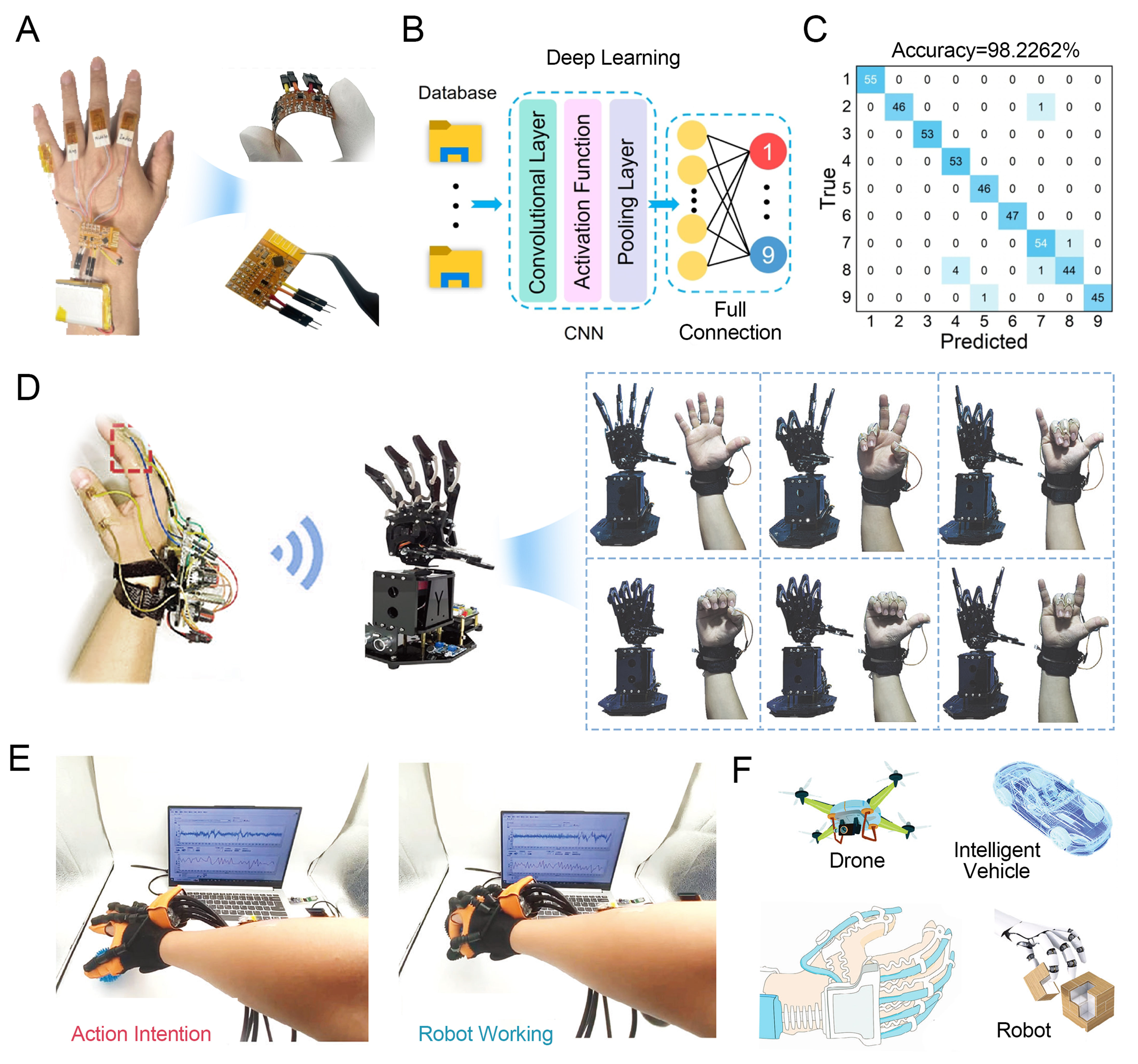
Figure 7. (A) Practical application examples of the MXene/CNFs pressure sensor[297]; (B) Schematic diagram of deep learning for gesture recognition[297]; (C) Confusion matrix diagram of the test set[297]. (A-C) adapted from Ref.[297]. Copyright 2025, Elsevier; (D) Illustration of the lignin-based hydrogel wearable sensor for bionic hand control using a wireless signal transmission system[34]. Adapted with permission from Ref.[34]. Copyright 2025, WILEY-VCH; (E) Photographs showing that the rehabilitation glove used can assist the hand to perform corresponding movements driven by human action intention, indicating the feasibility of the system in active rehabilitation[282]; (F) Construction and demonstration of an HMI system for active rehabilitation and other applications[282]. (E and F) adapted from Ref.[282]. Copyright 2025, WILEY-VCH. CNFs: Cellulose nanofibers; HMI: human-machine interaction; CNN: convolutional neural network.
Introducing an ionic liquid into the cellulose network skeleton can yield an ionic gel sensor with balanced mechanical and inductive properties. The spatial constraint effect of the cellulose skeleton regulates the growth and distribution of the ionic gel microphase structure, enabling the gel sensor to possess both excellent mechanical properties and electrical conductivity[300]. Surprisingly, combining gelatin with cellulose can fabricate all-biomass hydrogels with strength and toughness comparable to cellulose/polymer hydrogels[301]. Furthermore, a lignocellulose-based biomimetic skin hydrogel sensor features moisture resistance, self-repairing properties, and adhesion, and can directly detect the subtle stretches related to human speech and expressions. For instance, a study[210] integrated LCNF and sorbitol to endow the hydrogel platform with outstanding self-healing capabilities and temperature resistance, ensuring stable sensing performance even when damaged or under extreme conditions. Meanwhile, this hydrogel also serves as a platform for speech recognition and hand-drawing, displaying repeatable and highly sensitive electrical signal changes[210]. This route can support silent speech recognition, emotion-sensing interaction, and assistive communication technologies. Nevertheless, pure lignin can be modified to develop 3D-printed hydrogels through photopolymerization, which were incorporated with glycerol and lithium chloride to promote the formation of dynamic hydrogen bonds and correspondingly reduce the covalent cross-linking sites between monomers. This hydrogel exhibited excellent fatigue resistance (up to 10,000 cycles at 50% strain) and frost resistance (achieving effective sensing performance at -40 °C). As shown in Figure 7D, the 3D-printed hydrogel sensor array demonstrated a uniform stress response in controlling complex bionic hand movements[34]. Overall, small-range tactile and pressure interaction interfaces, such as pressing, tapping, sliding, and grasping, are an important direction of HMI[290]. Designing hierarchical conductive paths or ion channels can enable lignocellulose-derived hydrogels to achieve pressure sensitivity over a wide dynamic range, which supports the construction of intelligent flexible electronic skin integrating toughness, sensing, and feedback.
Intelligent control and information interaction interfaces are becoming central to next-generation HMI research. HMI is shifting from one-way instruction input to two-way coupling between human intentions and machine responses. Lignocellulose-based hydrogel sensors not only serve as passive signal acquisition units but also provide active control and information input functions. They thereby become a direct bridge connecting human intentions with machine execution. Researchers have designed a wearable one-handed keyboard with gesture-recognition capabilities, using a multifunctional hydrogel constructed from PAM, sodium CMC, and reduced GO[302]. This sensor features outstanding sensitivity (GF = 8.18) and pressure-sensing capability. By integrating machine learning algorithms and a custom data acquisition system, the wearable keyboard developed has an accuracy rate of up to 98.13% in recognizing gesture signals[302]. In contrast, another study developed a sensor that achieved a gesture signal classification accuracy rate of 99.8% under ultra-low temperature conditions (-76.6 °C)[303]. By using a stepwise dual-salt adjustment strategy similar to bamboo basket weaving, the common trade-offs among sensing performance, mechanical strength, environmental tolerance, and biocompatibility in traditional design strategies have been effectively alleviated. Hydrogel sensors can still achieve stable Morse code communication and gesture-based communication in simulated high-salinity seawater[303]. The complexity and uncertainty of EMG can reduce the accuracy of decoding movement intentions[230,299]. As shown in Figure 7E, researchers have combined a multimodal sensing module with AI algorithms to achieve ultra-high-precision motion-intention decoding to drive robot operations [282]. This multimodal sensing module, composed of TA and PAM, can efficiently analyze motion intentions and form corresponding control commands. Compared with traditional multi-channel EMG signals, this sensor showed high sensitivity to weak pressure and can be used to monitor tiny force myography (FMG) signals[260]. The complementarity of EMG and FMG signals significantly enhanced HMI efficiency. Finally, the multi-modal HMI system was used to control robotic gloves and achieve active rehabilitation training based on the human body’s movement intentions, demonstrating the system’s feasibility. Besides, the precise and repeatable control of the system over mechanical hands, smart cars and unmanned aerial vehicles was also demonstrated [Figure 7F][282].
TA is rich in phenolic hydroxyl groups and can form uniform metal-TA complexes with metals to achieve antioxidant effects. Significantly, introducing it into the MXene/TEMPO BC hydrogel can prevent oxidation of MXene. Moreover, this sensor can also wirelessly monitor human movement quickly (74 ms) and sensitively (GF = 15.65)[123]. A major limitation of this approach is the relatively high cost of MXene. Surprisingly, researchers adopted TA as a “glue” to cross-link anisotropic CNFs decorated with PVA and PPy by imitating the anisotropic structure of human muscles, permanently fixing their hierarchical anisotropic structure through multiple hydrogen bonds[281]. Thus, the hydrogel achieves a balance among excellent mechanical properties (tensile strength of 11.41 MPa and toughness of 12.44 MJ·m-3), anisotropic conductivity, and biocompatibility. This assembled hydrogel sensor can stably monitor the multi-degree-of-freedom joint movements of the human body and facilitate the control of multi-axis virtual robot mechanical arms. In addition, the prepared hydrogel sensor has excellent biocompatibility and protein resistance as well as biological safety, as confirmed by its practical application as an implantable sensor[281]. Interestingly, loading tannic acid onto hemicellulose (TA@HC) can endow the hydrogel with both self-healing property and repeatable self-adhesion. The resulting PAA-TA@HC-Al3+ ionic hydrogel has high tensile strength (1,060%), self-healing property (up to 87%), and high strain sensitivity (GF = 8.34). It can accurately monitor and distinguish between gross and micro-movements, as well as weak pulses and breaths[304]. Further, replacing Al3+ with Fe3+ can significantly enhance the mechanical properties of hydrogels (with a strain of up to 5,600%)[69]. In summary, lignocellulose-derived hydrogel sensors have been deeply integrated into multiple key scenarios of HMI, demonstrating irreplaceable material advantages from basic signal acquisition to multi-modal intelligent control, due to the high strength and mechanical robustness of lignocellulose[172,289,305,306]. It is expected to become the crucial flexible interface connecting the physical human body with the digital world, driving the evolution of HMI technology towards a more natural, intelligent, and sustainable direction[307]. Table 3 integrates key data on lignocellulose-based motion sensors in various motion-monitoring scenarios, including tensile strength, elongation at break, toughness, conductivity, response time, and GF.
Comparison of key performance metrics of lignocellulose-based hydrogel sensors in different motion monitoring applications
| Application | Tensile strength | Elongation at break | Toughness | Conductivity | Response time | GF | Ref. |
| Wearable electronics | 1.28 MPa | 794.94% | 6.32 MJ·m-3 | 0.82 S·m-1 | 300 ms | / | [253] |
| ~0.1 MPa | ~330% | 9 MJ·m-3 | 0.61 S·m-1 | 700 ms | 3.8 | [104] | |
| 0.75 MPa | 1,593% | / | 2.29 S·m-1 | / | 13.66 | [106] | |
| 0.2 MPa | 699% | 0.9 MJ·m-3 | 2.12 S·m-1 | 280 ms | 3.98 | [102] | |
| 0.19 MPa | 2,139% | 2.5 MJ·m-3 | 1.88 S·m-1 | 311 ms | 2.8 | [138] | |
| 1.35 MPa | 930% | 7.81 MJ·m-3 | 1.62 S·m-1 | 161 ms | 4.39 | [33] | |
| Healthcare and biomedical monitoring | 36.50 MPa | 438% | / | / | / | 6.16 | [284] |
| 0.87 MPa | 335.90% | / | / | / | 4.24 | [285] | |
| 0.08 MPa | 1,820% | / | 0.55 S·m-1 | / | 5.31 | [286] | |
| HMI | 0.8 MPa | 914.30% | / | 0.3 S·m-1 | 250 ms | 1.7 | [110] |
| 2.73 MPa | ~300% | 4.27 MJ·m-3 | 0.07 S·m-1 | 125 ms | 1.73 | [300] | |
| 2.6 MPa | 614% | 4.28 MJ·m-3 | 3.94 S·m-1 | / | 0.86 | [301] | |
| 0.42 MPa | 280% | / | 0.18 S·m-1 | 74 ms | 15.65 | [123] | |
| 11.41 MPa | ~150% | 12.44 MJ·m-3 | 10.35 S·m-1 | / | 1.49 | [281] |
CONCLUSION AND OUTLOOK
The development of lignocellulose-based hydrogel sensing systems is undergoing a paradigm shift from “biomass replacing traditional materials” to “structure-function collaborative design”. Relying on its natural multi-level structure and rich functional group system, cellulose provides a high-strength framework, hemicellulose regulates dynamic hydration and ion transport, and lignin endows it with energy dissipation, antioxidant, and interfacial adhesion capabilities, making it a natural “multifunctional integrated platform”. Through deliberate top-down preservation of native anisotropic architectures or bottom-up nanoscale reassembly, these hydrogels can be engineered to reconcile the historically conflicting demands of high mechanical resilience, broad detection range, rapid responsivity, and long-term cyclic stability. Integrating multiple transduction mechanisms (piezoresistive, piezoelectric, triboelectric, capacitive, iontronic, and thermal) has already enabled applications across the full kinematic spectrum, from large-amplitude joint articulations to microscale physiological vibrations, while advancing system-level functionalities such as self-powering, self-healing, and multimodal perception. Despite these remarkable achievements, several critical challenges persist that demand innovative solutions to unlock the full potential of lignocellulose-based motion sensors [Figure 8].
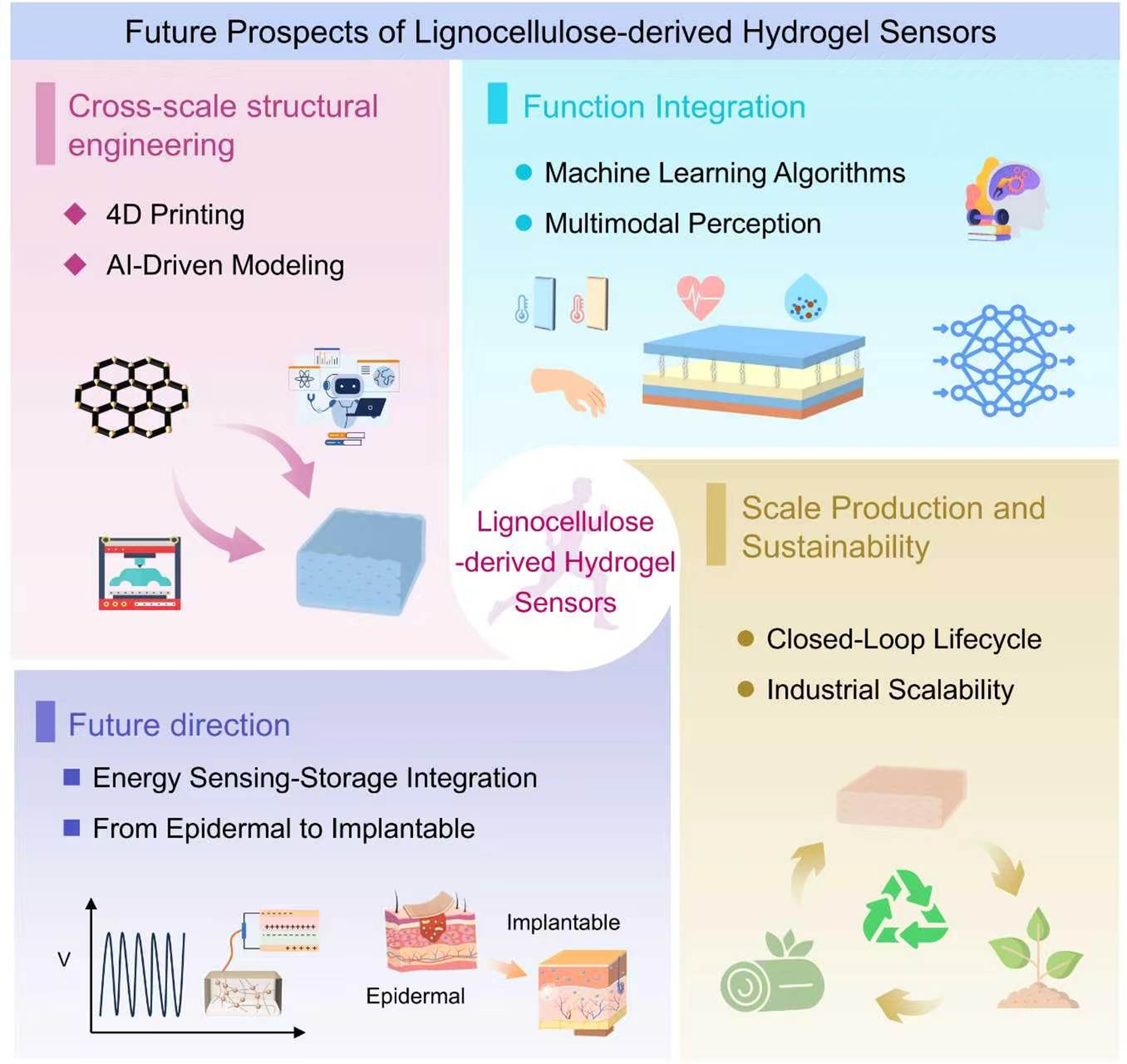
Figure 8. The prospects of lignocellulose-based hydrogel sensors for future applications. AI: Artificial intelligence.
1. Breaking the sensitivity–stretchability trade-off via cross-scale structural engineering.
Future research must move beyond simple compositional blending toward rational cross-scale structural engineering that decouples mechanical compliance from electrical sensitivity. This requires harnessing the intrinsic anisotropy of cellulose microfibrils to construct pre-oriented conductive pathways that maintain percolation efficiency even under extreme deformation. Emerging strategies such as 4D printing, directed self-assembly of nanocellulose liquid crystals, and biomimetic “brick-and-mortar” architectures inspired by plant cell walls offer promising routes to create hydrogels with programmed mechanical gradients and strain-delocalized conductive networks. Such architectures could enable clinical-grade motion monitoring where high-fidelity signal transmission is preserved across large deformations, multiaxial stresses, and high-frequency dynamic loading.
2. Long-term environmental stability and anti-fatigue performance.
Current lignocellulose-based hydrogel sensors face significant challenges in maintaining stable performance under prolonged operation. Issues such as dehydration (water evaporation from the hydrogel matrix), swelling (in high-humidity or underwater environments), and mechanical fatigue (after 1,000-5,000 cycles) remain critical barriers to practical deployment. While strategies such as DES, ethylene glycol/water binary solvents, and elastomer encapsulation have shown promise, further innovations are needed to achieve year-long operational stability without compromising the intrinsic biodegradability of lignocellulose. The reproducibility of nanocellulose dimensions and lignin functionality across batches also presents a significant challenge for industrial scalability.
3. Intelligent multimodal perception and AI-driven signal decoupling.
Human motion is an inherently complex spatiotemporal process accompanied by coupled stimuli (strain, pressure, temperature, humidity, and biochemical flux). The next generation of lignocellulose sensors must evolve from single-parameter detection toward intelligent multimodal perception platforms capable of real-time signal decoupling. The convergence of lignocellulose-based sensor arrays with AI and edge computing presents a transformative opportunity. Machine learning algorithms, particularly deep neural networks, CNNs, and transformer models, can be trained on the rich, cross-responsive datasets generated by lignocellulose hydrogels to disentangle mixed signals. For example, AI-assisted signal processing has already enabled gesture recognition accuracies exceeding 98% and Parkinson’s disease tremor classification with > 95% precision. Future integration with digital healthcare platforms and wireless body area networks will enable remote, continuous health monitoring with real-time diagnostic feedback.
4. Energy-autonomous and self-powered sensing ecosystems.
The future of wearable motion monitoring lies in energy-autonomous systems that eliminate reliance on external power sources. Lignocellulose is intrinsically well-suited for this vision due to its natural triboelectric polarity, piezoelectric potential when coupled with electroactive polymers, and ionic thermoelectric properties. The development of integrated “energy-sensing-storage” trifunctional devices, where triboelectric or piezoelectric nanogenerators harvest biomechanical energy from human motion, supercapacitive hydrogel electrodes store the harvested energy, and the same material matrix performs real-time motion sensing, represents a key frontier. Recent demonstrations of lignin-based TENG systems achieving output voltages of 50-150 V and continuous operation for > 10,000 cycles highlight the practical viability of this approach. Such self-powered ecosystems, potentially combined with wireless transmission modules, will enable continuous, maintenance-free monitoring of chronic diseases, athletic performance, and elderly care.
5. From epidermal to implantable: clinical translation and biointegration.
While current lignocellulose hydrogel sensors predominantly target epidermal or ex vivo applications, a major frontier is developing truly implantable, bioresorbable sensing systems. The biocompatibility, tunable degradation rates, and low immunogenicity of cellulose and lignin derivatives position them as ideal candidates for transient bioelectronics that monitor postoperative recovery, neural activity, or cardiac mechanics from within the body, then safely dissolve without secondary surgical removal. However, significant challenges remain in achieving precise modulus matching with target tissues (brain: ~0.1-1 kPa; muscle: ~10-100 kPa; myocardium: ~10-500 kPa), ensuring long-term stability in complex biological microenvironments (pH fluctuations, enzymatic degradation, protein fouling), and obtaining regulatory approval for clinical use. Future efforts must focus on establishing standardized biocompatibility (ISO 10993) and biodegradation protocols.
6. Scalable manufacturing and commercialization.
To transition from laboratory prototypes to commercial products, the field must establish standardized metrics for evaluating sensor performance, including GF benchmarks under defined strain rates, long-term cyclic fatigue protocols, and interfacial adhesion standards for diverse skin types. Scalable manufacturing methods - such as roll-to-roll coating, injectable in situ gelation, and 3D/4D printing - need to be optimized to ensure batch-to-batch consistency in nanocellulose dimensions and lignin functionality. The development of cost-effective, green chemistry-based processing routes (e.g., DES extraction, aqueous-phase polymerization) will be critical for reducing production costs and environmental impact. Collaboration between materials scientists, bioengineers, clinicians, and regulatory agencies is essential to accelerate the clinical translation and commercialization of lignocellulose-based wearable sensing systems.
7. Environmental resilience and closed-loop sustainability.
As wearable electronics proliferate, their environmental impact cannot be overlooked. Lignocellulose offers an intrinsic advantage, but future designs must embrace a fully closed-loop lifecycle: sourcing from agricultural and forestry waste streams, manufacturing via green chemistry (e.g., DESs, aqueous processing), operating under extreme conditions (freeze resistance, anti-dehydration, anti-swelling in saline or sweat-laden environments), and ultimately biodegrading into non-toxic byproducts (CO2, H2O, and humus). The carbon footprint and life-cycle assessment of lignocellulose-based sensors should be quantitatively compared with synthetic polymer-based counterparts to validate their sustainability claims.
Lignocellulose-derived hydrogel sensors have moved beyond sustainable material alternatives to become functionally superior platforms for motion monitoring. The road ahead demands that we move beyond isolated performance metrics toward system-level reliability, clinical validation, and manufacturing scalability. What distinguishes lignocellulose from every alternative material platform is not any single property, but the inseparable integration of sustainability, hierarchical designability, and biointerfacial compatibility as intrinsic, non-negotiable attributes. As global demand for carbon-neutral, biodegradable electronics accelerates, leveraging Earth’s most abundant renewable polymer through intelligent multiscale engineering will become not merely preferable, but imperative. We anticipate that lignocellulose-based hydrogel systems will emerge as the foundational interface technology for next-generation wearable and implantable bioelectronics - enabling electronic skins that heal, sensors that power themselves, and intelligent interfaces that dissolve harmlessly when their mission is complete, thereby realizing a truly seamless and sustainable integration of biological and electronic systems.
DECLARATIONS
Authors’ contributions
Proposed the overall concept: Wang, H. M.; Shao, C.
Outlined and wrote the manuscript with the support of Wang, H. M.: Qiao, Y. C.; Zhang, D. Y.
Assisted in literature collection: Shang, L. L.; Du, B.
Provided valuable suggestions: Sun, R. C.; Si, C.
Supervised the whole project: Wang, H. M.; Shao, C.; Sun, R. C.; Si, C.
All authors contributed to the general discussion:
Availability of data and materials
Not applicable.
AI and AI-assisted tools statement
During the preparation of this manuscript, AI-assisted tools, including Doubao AI (version 14.3.0, released 2026-07-20) and Gemini 3.5 Flash (Google, released 2026-05-19), were used solely for figure layout, graphic design, and visual optimization. AI-generated graphical elements were incorporated into the Graphical Abstract, Figure 1C and D, Figures 2-4, and 8. The overall figures were designed, assembled, and finalized by the authors. These tools did not influence the study design, data collection, experimental analysis, interpretation of results, or the scientific content of the manuscript. All authors take full responsibility for the accuracy, integrity, originality, and final content of the manuscript.
Financial support and sponsorship
This work was supported by the National Natural Science Foundation of China (22208248), the Natural Science Foundation of Tianjin (25JCYBJC00870), the Foundation (2023GXZZKF69) of Guangxi Key Laboratory of Clean Pulp & Papermaking and Pollution Control, and the Foundation (No. 202403) of Tianjin Key Laboratory of Pulp & Paper.
Conflicts of interest
All authors declared that there are no conflicts of interest.
Ethical approval and consent to participate
Not applicable.
Consent for publication
Not applicable.
Copyright
© The Author(s) 2026.
REFERENCES
1. Wu, T.; Li, Y. T.; Zhao, L.; et al. Recent progress on flexible multimodal sensors: decoupling strategies, fabrication and applications. Adv. Mater. 2026, 38, e21375.
2. Chen, Z.; Huang, Y.; Zhang, B.; Sun, D.; Yu, X. Deformable materials and structures in wearable haptic interfaces. Nat. Rev. Mater. 2026, 11, 266-85.
3. Gao, S.; Li, H.; Li, N.; et al. Additive‐manufacturing‐based flexible tactile sensors. Adv. Funct. Mater. 2026, 36, e32112.
4. Huang, X.; Yang, N.; Sun, S.; Cheng, Y.; Cheng, L. Recent progress of hydrogel-based bioelectronics for mechanophysiological signal sensing. Mater. Sci. Eng. R. Rep. 2025, 162, 100888.
5. Liu, J.; Zhao, W.; Li, J.; et al. Multimodal and flexible hydrogel-based sensors for respiratory monitoring and posture recognition. Biosens. Bioelectron. 2024, 243, 115773.
6. Xiao, W.; He, T.; Cui, X.; et al. Ionogel‐dominated wearable sensors for reliable health monitoring. SusMat 2025, 5, e70026.
7. Mo, F.; Lin, Y.; Liu, Y.; et al. Advances in ionic conductive hydrogels for skin sensor applications. Mater. Sci. Eng. R. Rep. 2025, 165, 100989.
8. Hyun, J. E.; Lim, T.; Kim, S. H.; Lee, J. H. Wearable ion gel based pressure sensor with high sensitivity and ultra-wide sensing range for human motion detection. Chem. Eng. J. 2024, 484, 149464.
9. Zhao, S.; Liu, D.; Yan, F. Wearable resistive-type stretchable strain sensors: materials and applications. Adv. Mater. 2025, 37, e2413929.
10. Li, J.; Zhao, Y.; Fan, Y.; Chen, J.; Gong, J.; Li, W. J. Flexible wearable electronics for enhanced human-computer interaction and virtual reality applications. Nano. Energy. 2025, 138, 110821.
11. Yang, Q.; Li, B.; Wang, M.; et al. Machine learning-enhanced modular ionic skin for broad-spectrum multimodal discriminability in bidirectional human-robot interaction. Adv. Mater. 2025, 37, e08795.
12. Chen, Y.; Lv, C.; Ye, X.; Ping, J.; Ying, Y.; Lan, L. Hydrogel-based pressure sensors for electronic skin systems. Matter 2025, 8, 101992.
13. Gu, Y.; Luo, Y.; Guo, Q.; et al. Empowering human‐machine interfaces: self‐powered hydrogel sensors for flexible and intelligent systems. Adv. Funct. Mater. 2026, 36, e09085.
14. Qin, J.; Tang, Y.; Zeng, Y.; Liu, X.; Tang, D. Recent advances in flexible sensors: from sensing materials to detection modes. TrAC. Trends. Anal. Chem. 2024, 181, 118027.
15. Cao, P.; Wei, J.; Zhang, T.; et al. Multifunctional luffa sponge hydrogel with high mechanical strength, fatigue resistance, and ionic conductivity for monitoring human vital signs. Adv. Funct. Mater. 2025, 35, 2501131.
16. Li, X.; Gong, J. P. Design principles for strong and tough hydrogels. Nat. Rev. Mater. 2024, 9, 380-98.
17. Yao, X.; Zhang, S.; Wei, N.; Qian, L.; Coseri, S. Cellulose-based conductive hydrogels for emerging intelligent sensors. Adv. Fiber. Mater. 2024, 6, 1256-305.
18. Sun, B.; Zhang, C.; Li, X.; Zhong, L.; Zhang, Z.; Zhou, D. Nanocellulose-based hydrogels for smart sensors. Carbohydr. Polym. 2025, 368, 124152.
19. Wang, Z.; Zhu, M.; Li, J.; et al. Nanocellulose based hydrogel for flexible sensors: Current progress and future perspective. Nano. Energy. 2024, 129, 109974.
20. Li, W.; Zhu, L.; Xu, Y.; Wang, G.; Xu, T.; Si, C. Lignocellulose-mediated functionalization of liquid metals toward the frontiers of multifunctional materials. Adv. Mater. 2025, 37, e2415761.
21. Zhang, H.; Xu, T.; Zhang, M.; et al. Natural biomass hydrogels for intelligent sensing: From component crosslinking engineering to stimuli-responsive mechanisms. eScience 2026, 6, 100505.
22. Yang, H.; Zheng, H.; Duan, Y.; et al. Nanocellulose-graphene composites: preparation and applications in flexible electronics. Int. J. Biol. Macromol. 2023, 253, 126903.
23. Sulis, D. B.; Lavoine, N.; Sederoff, H.; et al. Advances in lignocellulosic feedstocks for bioenergy and bioproducts. Nat. Commun. 2025, 16, 1244.
24. Rao, J.; Lv, Z.; Chen, G.; Peng, F. Hemicellulose: structure, chemical modification, and application. Prog. Polym. Sci. 2023, 140, 101675.
25. Wang, J.; Zhang, D.; Chu, F. Wood-derived functional polymeric materials. Adv. Mater. 2021, 33, e2001135.
26. Zhang, Y.; Cheng, G. Lignin-containing hydrogels: transforming a low-value byproduct to absorbents, wound dressings and strain sensors. Chem. Eng. J. 2023, 475, 146460.
27. Chen, X.; Zhu, Q.; Jiang, B.; et al. Research progress of wood and lignocellulose in sustainable piezoelectric systems. Nano. Energy. 2024, 126, 109650.
28. Chen, C.; Wang, Y.; Wu, Q.; Wan, Z.; Li, D.; Jin, Y. Highly strong and flexible composite hydrogel reinforced by aligned wood cellulose skeleton via alkali treatment for muscle-like sensors. Chem. Eng. J. 2020, 400, 125876.
29. Wang, Z.; Zhang, X.; Kong, X.; Yao, J. Top-down fabrication of wood hydrogels: from preparation to application. Chem. Eng. J. 2024, 490, 151518.
30. Wang, H.; Yuan, T.; Song, G.; Sun, R. Advanced and versatile lignin-derived biodegradable composite film materials toward a sustainable world. Green. Chem. 2021, 23, 3790-817.
31. Wang, S.; Ma, H.; Ge, S.; Rezakazemi, M.; Han, J. Advanced design strategies and multifunctional applications of Nanocellulose/MXene composites: a comprehensive review. Mater. Sci. Eng. R. Rep. 2025, 163, 100925.
32. Duan, X.; Mi, Y.; Lei, T.; et al. Highly elastic spongelike hydrogels for impedance-based multimodal sensing. ACS. Nano. 2025, 19, 2909-21.
33. Wang, H.; Han, P.; Yu, Y.; et al. Multifunctional flexible MXene/TA@CNC electronic hydrogel patch with robust adhesion and self-healing properties for wearable electronics. Chem. Eng. J. 2025, 507, 160329.
34. Yang, J.; Yang, K.; An, X.; et al. Highly flexible, stretchable, and compressible lignin‐based hydrogel sensors with frost resistance for advanced bionic hand control. Adv. Funct. Mater. 2025, 35, 2416916.
35. Fu, D.; Xie, Y.; Zhou, L.; Zhang, L.; Zheng, T.; Shen, J. Triple physical cross-linking cellulose nanofibers-based poly(ionic liquid) hydrogel as wearable multifunctional sensors. Carbohydr. Polym. 2024, 325, 121572.
36. Li, M.; Wang, Y.; Wei, Q.; et al. Hydrophobic associations and cellulose nanofibers reinforced PVA/PAM multi-network conductive hydrogel with high sensitivity, fast response, and excellent mechanical properties. Carbohydr. Polym. 2025, 368, 124225.
37. He, X.; Zeng, Z.; Ni, Q.; et al. Mechanical robust and highly conductive composite hydrogel reinforced by a combination of cellulose nanofibrils/polypyrrole toward high-performance strain sensor. Compos. Part. B. Eng. 2023, 266, 111022.
38. Li, Y.; Gong, Q.; Han, L.; et al. Carboxymethyl cellulose assisted polyaniline in conductive hydrogels for high-performance self-powered strain sensors. Carbohydr. Polym. 2022, 298, 120060.
39. Ren, J.; Yang, X.; Xiang, X. Carboxymethyl cellulose-reinforced sandwich-structured carbon nanotube composite hydrogels for strain sensing and joule heating. Carbohydr. Polym. 2025, 369, 124291.
40. Han, Z.; Zhu, H.; Cheng, J. H. Constructing a novel humidity sensor using acrylic acid/bagasse cellulose porous hydrogel combining graphene oxide and citral for antibacterial and intelligent fruit preservation. Carbohydr. Polym. 2024, 326, 121639.
41. Wang, Z.; Xue, R.; Zhang, H.; et al. A hydrogel electrolyte toward a flexible zinc-ion battery and multifunctional health monitoring electronics. ACS. Nano. 2024, 18, 7596-609.
42. Wang, Y.; Jiang, W.; Li, J.; et al. Zinc-ion engineered plant-based multifunctional hydrogels for flexible wearable strain sensors, bio-electrodes and zinc-ion hybrid capacitors. Chem. Eng. J. 2023, 465, 142917.
43. Yang, L.; Wang, H.; Yang, Y.; Li, Y. Self-healing cellulose-based hydrogels: from molecular design to multifarious applications. Carbohydr. Polym. 2025, 347, 122738.
44. Liu, P.; Chen, X.; Wang, C.; et al. Humic acid-based anti-freezing and self-healing hydrogel flexible sensors with functional cellulose nanocrystals. Chem. Eng. J. 2025, 506, 159854.
45. Yu, Z.; Zeng, F.; Cai, Y.; et al. Dual-responsive carboxymethyl cellulose-based hydrogel sensor with antibacterial activity for wound monitoring and infected wound repair. Chem. Eng. J. 2025, 526, 171224.
46. Shin, E.; Kim, G.; Zhao, K.; et al. Environmentally sustainable moisture energy harvester with chemically networked cellulose nanofiber. Energy. Environ. Sci. 2024, 17, 7165-81.
47. Li, W.; Zhao, Y.; Zeren, D.; et al. Mechanically robust, anti-freezing, and conductive dual-crosslinked ionic hydrogel for stable low-temperature sensing. Chem. Eng. J. 2026, 531, 174109.
48. Dong, D.; Lu, H.; Lai, X.; Zeng, X.; Li, H. Cellulose nanofiber-reinforced chitosan conductive hydrogel tailored by double-network strategy for stretchable strain sensor. Int. J. Biol. Macromol. 2025, 333, 148851.
49. Li, P.; Ling, Z.; Liu, X.; et al. Nanocomposite hydrogels flexible sensors with functional cellulose nanocrystals for monitoring human motion and lactate in sweat. Chem. Eng. J. 2023, 466, 143306.
50. Ou, J.; Hu, S.; Yao, L.; Chen, Y.; Qi, H.; Yue, F. Simultaneous strengthening and toughening lignin/cellulose nanofibril composite films: effects from flexible hydrogen bonds. Chem. Eng. J. 2023, 453, 139770.
51. Li, W.; Xu, Y.; Wang, G.; et al. Sustainable carbon‐based catalyst materials derived from lignocellulosic biomass for energy storage and conversion: atomic modulation and properties improvement. Carbon. Energy. 2025, 7, e708.
52. Yang, H.; Zhu, L.; Li, W.; et al. Lignocellulose-mediated gel polymer electrolytes toward next-generation energy storage. Nanomicro. Lett. 2025, 18, 84.
53. Xu, Z.; Wang, X.; Liang, H.; et al. Development of cinnamon essential oil-loaded Pickering emulsions stabilized by chitosan/gelatin nanoparticles with enhanced antibacterial and antibiofilm actives. Collagen. Leather. 2025, 7, 180.
54. Liu, W.; Liu, K.; Li, W.; et al. Sustainable radiative cooling materials enabled by engineered lignocellulose. Adv. Energy. Mater. 2026, 16, e71007.
55. Li, W.; Wang, G.; Zhang, Z.; et al. Lignin‐metal coordination enables rapid and scalable assembly of efficient solar evaporators. Adv. Funct. Mater. 2026, 36, e77041.
56. Wang, X.; Xu, T.; Zhang, H.; et al. Cellulose‐mediated multifunctional fibers in energy storage and harvesting systems. Adv. Energy. Mater. 2026, 16, e70953.
57. Pan, X.; Li, J.; Ma, N.; Ma, X.; Gao, M. Bacterial cellulose hydrogel for sensors. Chem. Eng. J. 2023, 461, 142062.
58. Zhang, H.; Johnson, A. M.; Hua, Q.; et al. Size-controlled synthesis of xylan micro/nanoparticles by self-assembly of alkali-extracted xylan. Carbohydr. Polym. 2023, 315, 120944.
59. Liu, K.; Du, H.; Xu, T.; Xiang, H.; Si, C. Cellulosic fibers for sustainable functional textiles and devices. Adv. Fiber. Mater. 2026, 8, 843-79.
60. Su, Z.; Yang, Y.; Huang, Q.; et al. Designed biomass materials for “green” electronics: a review of materials, fabrications, devices, and perspectives. Prog. Mater. Sci. 2022, 125, 100917.
61. Ye, Y.; Yu, L.; Lizundia, E.; Zhu, Y.; Chen, C.; Jiang, F. Cellulose-based ionic conductor: an emerging material toward sustainable devices. Chem. Rev. 2023, 123, 9204-64.
62. Zhao, L.; Wang, S.; Zhang, H.; et al. A triple-network hydrogel synergistically constructed via hydrophobic interactions, hemicellulose-mediated Diels-Alder bonds, and Fe3+ coordination for flexible sensors and TENGs. Carbohydr. Polym. 2026, 387, 125446.
63. Cai, J.; Li, Y.; Qin, R.; Li, G.; Wang, X. Xylan derived carbon sphere/graphene composite film with low resistance for supercapacitor electrode. Collagen. Leather. 2024, 6, 154.
64. Liu, K.; Du, H.; Xu, T.; Si, C.; Pan, X. Hierarchical cellulose/MXene aerogel films with coral‐like polyaniline skin for absorption‐led broadband EMI shielding. Adv. Funct. Mater. 2026, 36, e74562.
65. Shao, J.; Huang, H.; Yu, J.; Lan, X.; Liu, W.; Huang, Z. Multifunctional self-healing hemicellulose-based hydrogel for antimicrobial wound dressings and motion-responsive wearable sensing. Carbohydr. Polym. 2025, 370, 124364.
66. Wang, Y.; Zhang, J.; Xu, T.; et al. Bioinspired hollow fibers with efficient transport channels for wide humidity atmospheric water harvesting. Adv. Funct. Mater. 2026, 36, e74928.
67. Kamdem Tamo, A.; Doench, I.; Deffo, G.; et al. Lignocellulosic biomass and its main structural polymers as sustainable materials for (bio)sensing applications. J. Mater. Chem. A. 2025, 13, 24185-253.
68. Chowdhury, I. F.; Moulick, S. P.; Al-Amin, M.; et al. A sustainable approach for harnessing the synergy between lignosulfonate and hemicellulose: towards next-generation bio-derived flexible electronics. Int. J. Biol. Macromol. 2025, 330, 147985.
69. Gong, X.; Fu, C.; Alam, N.; et al. Preparation of hemicellulose nanoparticle-containing ionic hydrogels with high strength, self-healing, and UV resistance and their applications as strain sensors and asymmetric pressure sensors. Biomacromolecules 2022, 23, 2272-9.
70. Pang, T.; Zhao, T.; Liu, M.; et al. Lignin ligand boosts Ni3+ species generation for biomass electrocatalytic oxidation. eScience 2026, In Press.
71. Li, W.; Wang, G.; Li, T.; et al. All-in-one self-cleaning lignin-derived spherical solar evaporator for continuous desalination and synergic water purification. Water. Res. 2025, 282, 123932.
72. Li, W.; Zhang, W.; Xu, Y.; et al. Lignin-derived materials for triboelectric nanogenerators with emphasis on lignin multifunctionality. Nano. Energy. 2024, 128, 109912.
73. Yuan, L.; Wang, H.; Wu, Y.; Hou, Q.; Sun, R. The booming lignin-derived functional composites/nanocomposites. Compos. Part. B. Eng. 2024, 287, 111869.
74. Huo, L.; Lu, Y.; Ding, W.; Wang, Y.; Li, X.; He, H. Recent advances in the preparation, properties, and applications of lignin-based hydrogels and adhesives. Green. Chem. 2025, 27, 1895-908.
75. Liu, Y.; Wang, J.; Hou, P.; et al. Preparation of dual cross-linked hydrogel electrolytes containing modified lignin for supercapacitors and sensors. Chem. Eng. J. 2024, 480, 148259.
76. Jiang, B.; Jiao, H.; Guo, X.; et al. Lignin-based materials for additive manufacturing: chemistry, processing, structures, properties, and applications. Adv. Sci. 2023, 10, e2206055.
77. Meng, D.; Berhanu, A.; Kumar, V.; et al. Lignin -based hydrogels through a green-metrics lens: solvents, crosslinking chemistries, and scalable processes. Green. Chem. 2026, 28, 8044-66.
78. Pang, T.; Xue, Z.; Wang, G.; Li, J.; Sui, W.; Si, C. Non-carbonized Pd single-atom catalyst supported on lignin-functionalized phenolic resin for potent catalytic transfer hydrogenation of lignin-derived aldehydes. Angew. Chem. Int. Ed. Engl. 2025, 64, e202503195.
79. Pang, T.; Wang, G.; Sui, W.; Xu, T.; Wang, D.; Si, C. Lignin-based support for metal catalysts: synthetic strategies, performance boost, and application advances. Coord. Chem. Rev. 2025, 528, 216426.
80. Ralph, J.; Lapierre, C.; Boerjan, W. Lignin structure and its engineering. Curr. Opin. Biotechnol. 2019, 56, 240-9.
81. Lee, C. H.; Kim, J.; Ryu, J.; Won, W.; Yoo, C. G.; Kwon, J. S. Lignin structure dynamics: advanced real-time molecular sensing strategies. Chem. Eng. J. 2024, 487, 150680.
82. Liu, X.; Hao, S.; Wang, Y.; et al. Mechanically adaptable microdomed hydrogels for flexible pressure sensors with broad detection range and stable signal output. Chem. Eng. J. 2025, 505, 159113.
83. Österberg, M.; Sipponen, M. H.; Mattos, B. D.; Rojas, O. J. Spherical lignin particles: a review on their sustainability and applications. Green. Chem. 2020, 22, 2712-33.
84. Huang, D.; Li, R.; Xu, P.; et al. The cornerstone of realizing lignin value-addition: exploiting the native structure and properties of lignin by extraction methods. Chem. Eng. J. 2020, 402, 126237.
85. Kim, J.; Pahari, S.; Ryu, J.; et al. Advancing biomass fractionation with real-time prediction of lignin content and MWd: a kMC-based multiscale model for optimized lignin extraction. Chem. Eng. J. 2024, 479, 147226.
86. Yan, L.; Huertas-Alonso, A. J.; Liu, H.; Dai, L.; Si, C.; Sipponen, M. H. Lignin polymerization: towards high-performance materials. Chem. Soc. Rev. 2025, 54, 6634-51.
87. Gigli, M.; Crestini, C. Fractionation of industrial lignins: opportunities and challenges. Green. Chem. 2020, 22, 4722-46.
88. Wu, R.; Abdulhameed, A. S.; Jawad, A. H.; et al. An eco-friendly chitosan-genipin/SiO2 composite for reactive orange 16 dye removal: insights into adsorption statistical modeling and mechanism. Int. J. Biol. Macromol. 2024, 270, 132329.
89. Mu, J.; Li, C.; Li, D.; Song, X.; Chen, S.; Xu, F. Self-gelated flexible lignin-based ionohydrogels for efficient self-powered strain sensors. Chem. Eng. J. 2025, 507, 160750.
90. Li, X.; You, X.; Wang, X.; Kang, J.; Zhang, H. J. Advanced lignin‐based hydrogels with superior stiffness, toughness, and sensing capabilities. Adv. Funct. Mater. 2025, 35, 2415744.
91. Shi, H.; Huo, H.; Yang, H.; et al. Cellulose‐based dual‐network conductive hydrogel with exceptional adhesion. Adv. Funct. Mater. 2024, 34, 2408560.
92. Wang, Y.; Chen, P.; Ding, Y.; et al. Multifunctional nano‐conductive hydrogels with high mechanical strength, toughness and fatigue resistance as self‐powered wearable sensors and deep learning‐assisted recognition system. Adv. Funct. Mater. 2024, 34, 2409081.
93. Chen, B.; Liu, Z.; Shen, Z.; et al. Dual-property lignin macromolecule featuring rigidity and flexibility for the preparation of supramolecular hydrogels with creep resistance and excellent toughness. Chem. Eng. J. 2025, 523, 168828.
94. Qin, L.; Zhu, Y.; Zhang, H.; Ren, H.; Zhai, H. Lignin-modified cellulose nanofibers hydrogel under adjustable binary solvent systems with excellent adhesion, self-healing and anti-freeze properties. Int. J. Biol. Macromol. 2024, 279, 135559.
95. Wong, L. C.; Leh, C. P.; Goh, C. F. Designing cellulose hydrogels from non-woody biomass. Carbohydr. Polym. 2021, 264, 118036.
96. Zhang, C.; Mo, J.; Fu, Q.; Liu, Y.; Wang, S.; Nie, S. Wood-cellulose-fiber-based functional materials for triboelectric nanogenerators. Nano. Energy. 2021, 81, 105637.
97. Gan, Q.; Zhang, J.; Gong, X.; Zou, Y.; Yan, Y. Advancing lignocellulosic conversion though biosensor-enabled metabolic engineering. Green. Chem. 2025, 27, 9862-73.
98. Tang, Q.; Li, X.; Xu, Y.; Han, X. Lignin containing cellulose nanofibers for advanced materials: from hierarchical structure to functional applications. Bioresour. Technol. 2026, 447, 134157.
99. Pang, T.; Wang, L.; Chen, H. Lignocellulosic full-components hydrogelation using steam-exploded corn stover. Green. Chem. 2024, 26, 6078-88.
100. Li, W.; Xu, T.; Pang, T.; et al. Component separation of woody biomass and its application in electromagnetic interference shielding. Nano. Res. 2026, 19, 94908246.
101. Chen, W.; Ma, J.; Li, B.; Feng, L.; Ji, X.; Li, N. Skin-inspired piezoresistive sensor based on hierarchical structures and lignocellulosic bioplastic electrodes with ultrahigh sensitivity. ACS. Appl. Mater. Interfaces. 2025, 17, 65835-47.
102. Teng, Y.; Zhang, Z.; Cui, Y.; et al. High-sensitivity and flexible motion sensing enabled by robust, self-healing wood-based anisotropic hydrogel composites. Small 2025, 21, e2500944.
103. Xu, Z.; Yang, Y.; Pang, X.; et al. Mechanical tough, non-swelling, self-adhesive and highly conductive amphibious hydrogels for motion sensing in complex conditions. J. Mater. Sci. Technol. 2025, 237, 10-9.
104. Abir, S. S. H.; Smith, C.; Zornitzer, J.; Samuel, J.; Akin, S. A composite bacterial cellulose for enhanced-performance triboelectric and piezoelectric nanogenerators. Nano. Energy. 2025, 141, 111123.
105. Ma, J.; Li, S.; Gu, Y.; et al. Innovative cellulose-mediated liquid metal composites hydrogel with adhesive and mechanical-thermal multimodal sensing capabilities for smart wearable devices. Chem. Eng. J. 2026, 530, 173583.
106. Sun, L.; Zhao, J.; Zhao, L.; Sun, S.; Cao, X. Sustainable construction of lignin-containing cellulose nanofibrils reinforced antifreeze deep eutectic solvent gel for wearable human motion strain sensors. J. Clean. Prod. 2026, 553, 148011.
107. Zitting, A.; Paajanen, A.; Altgen, M.; Rautkari, L.; Penttilä, P. A. Role of lignin in moisture interactions of cellulose microfibril structures in wood. Small. Struct. 2024, 5, 2400167.
108. Sejati, P. S.; Obounou Akong, F.; Fradet, F.; Gérardin, P. Understanding the thermoplasticization mechanism of wood via esterification with fatty acids: a comparative study of the reactivity of cellulose, hemicelluloses and lignin. Carbohydr. Polym. 2024, 324, 121542.
109. He, X.; Bai, T.; Lu, J.; et al. High-strength, anisotropic bamboo hydrogel via in situ lignin modification for ion-selective transport and sensor. Chem. Eng. J. 2024, 481, 148416.
110. Zhang, D.; Jian, J.; Xie, Y.; et al. Mimicking skin cellulose hydrogels for sensor applications. Chem. Eng. J. 2022, 427, 130921.
111. Tie, J.; Chai, H.; Mao, Z.; et al. Nanocellulose-mediated transparent high strength conductive hydrogel based on in-situ formed polypyrrole nanofibrils as a multimodal sensor. Carbohydr. Polym. 2021, 273, 118600.
112. Chen, L.; Lou, J.; Rong, X.; et al. Super-stretching and high-performance ionic thermoelectric hydrogels based on carboxylated bacterial cellulose coordination for self-powered sensors. Carbohydr. Polym. 2023, 321, 121310.
113. Yao, X.; Zhang, S.; Qian, L.; et al. Super stretchable, self‐healing, adhesive ionic conductive hydrogels based on tailor‐made ionic liquid for high‐performance strain sensors. Adv. Funct. Mater. 2022, 32, 2204565.
114. Heidarian, P.; Gharaie, S.; Yousefi, H.; et al. A 3D printable dynamic nanocellulose/nanochitin self-healing hydrogel and soft strain sensor. Carbohydr. Polym. 2022, 291, 119545.
115. Meng, Y.; Lu, J.; Cheng, Y.; Li, Q.; Wang, H. Lignin-based hydrogels: a review of preparation, properties, and application. Int. J. Biol. Macromol. 2019, 135, 1006-19.
116. Gu, Y.; Yuan, Y.; Zhang, C.; et al. Interfacial strategies and bioengineering of lignin-derived strong and tough gels. Renew. Sustain. Energy. Rev. 2026, 226, 116415.
117. Shojaeiarani, J.; Bajwa, D.; Shirzadifar, A. A review on cellulose nanocrystals as promising biocompounds for the synthesis of nanocomposite hydrogels. Carbohydr. Polym. 2019, 216, 247-59.
118. Sun, X.; Tyagi, P.; Agate, S.; McCord, M. G.; Lucia, L. A.; Pal, L. Highly tunable bioadhesion and optics of 3D printable PNIPAm/cellulose nanofibrils hydrogels. Carbohydr. Polym. 2020, 234, 115898.
119. Zhang, M.; Wang, Y.; Liu, K.; et al. Strong, conductive, and freezing-tolerant polyacrylamide/PEDOT:PSS/cellulose nanofibrils hydrogels for wearable strain sensors. Carbohydr. Polym. 2023, 305, 120567.
120. Chen, J.; Liu, F.; Abdiryim, T.; Liu, X. An overview of conductive composite hydrogels for flexible electronic devices. Adv. Compos. Hybrid. Mater. 2024, 7, 841.
121. Zhao, W.; Shi, Z.; Hu, S.; Yang, G.; Tian, H. Understanding piezoelectric characteristics of PHEMA-based hydrogel nanocomposites as soft self-powered electronics. Adv. Compos. Hybrid. Mater. 2018, 1, 320-31.
122. Wang, G.; Jiang, G.; Zhu, Y.; et al. Developing cellulosic functional materials from multi-scale strategy and applications in flexible bioelectronic devices. Carbohydr. Polym. 2022, 283, 119160.
123. Dong, B.; Yu, D.; Lu, P.; et al. TEMPO bacterial cellulose and MXene nanosheets synergistically promote tough hydrogels for intelligent wearable human-machine interaction. Carbohydr. Polym. 2024, 326, 121621.
124. Wei, J.; Zhu, C.; Zeng, Z.; et al. Bioinspired cellulose‐integrated MXene‐based hydrogels for multifunctional sensing and electromagnetic interference shielding. Interdiscip. Mater. 2022, 1, 495-506.
125. Lu, Y.; Li, S.; Ma, Y.; et al. Nanocellulose-assisted construction of conductive gradient hydrogel for remote actuated and self-sensing soft actuator. Carbohydr. Polym. 2025, 368, 124092.
126. Zou, Y.; Liao, Z.; Zhang, R.; et al. Cellulose nanofibers/liquid metal hydrogels with high tensile strength, environmental adaptability and electromagnetic shielding for temperature monitoring and strain sensors. Carbohydr. Polym. 2025, 348, 122788.
127. Xu, Q.; Wu, Z.; Zhao, W.; et al. Strategies in the preparation of conductive polyvinyl alcohol hydrogels for applications in flexible strain sensors, flexible supercapacitors, and triboelectric nanogenerator sensors: an overview. Adv. Compos. Hybrid. Mater. 2023, 6, 783.
128. Ni, Q.; He, X.; Zhou, J.; et al. Mechanical tough and stretchable quaternized cellulose nanofibrils/MXene conductive hydrogel for flexible strain sensor with multi-scale monitoring. J. Mater. Sci. Technol. 2024, 191, 181-91.
129. Sima, H.; Liu, B.; Shi, X.; Zhang, C. CNT@CNF/MXene hydrogel with complete conductive network for flexible anti-freeze sensor and electromagnetic shielding. Carbohydr. Polym. 2025, 366, 123825.
130. Hu, L.; Chee, P. L.; Sugiarto, S.; et al. Hydrogel-based flexible electronics. Adv. Mater. 2023, 35, e2205326.
131. Ye, Y.; Yu, Z.; Zhang, Y.; Jiang, F. An information encrypted heterogeneous hydrogel with programmable mechanical properties enabled by 3D patterning. Mater. Horiz. 2023, 10, 2667-76.
132. Song, Y.; Hu, Z.; Hao, S.; et al. Heterogeneous interface interlocking hydrogel by harnessing cellulose scaffold for robust and controllable soft actuators. Adv. Funct. Mater. 2025, 35, 2509712.
133. Yi, J.; Lin, D.; Lin, Y.; et al. Bentonite nanosheets-incorporated silk fibroin double-network hydrogel as a multifunctional triboelectric sensor for real-time monitoring of basketball motion in virtual reality. Nano. Energy. 2026, 155, 112068.
134. Zheng, Z.; Dong, C.; Bai, X.; et al. Cellulose nanofibril-filled damping and lubricating hydrogels for mitigating friction-induced vibration of polyurethane composites. Small 2026, 22, e13307.
135. Wang, S.; Zhang, L.; Khan, K. A.; Ullah, M. W.; Fan, Y.; Wang, Z. Deep eutectic solvents as a ‘multifunctional operating platform’ for nanocellulose production and modification: a review on sustainable composite advancements. Mater. Sci. Eng. R. Rep. 2025, 165, 101025.
136. Wang, H.; Shang, R.; Chen, J.; et al. Flexible chitosan sensing hydrogel enabled by phytic acid coordination effect with high-conductivity and ultra-sensitivity for self-powered handwriting recognition and multimodal sensors. Nano. Energy. 2024, 128, 109843.
137. Liao, J.; Shamshina, J. L.; Wang, Y.; et al. Emerging cellulosic materials for sustainable mechanosensing and energy harvesting devices: advances and prospect. Nano. Today. 2024, 56, 102232.
138. Zeng, Z.; Yang, Y.; Pang, X.; et al. Lignin nanosphere‐modified MXene activated‐rapid gelation of mechanically robust, environmental adaptive, highly conductive hydrogel for wearable sensors application. Adv. Funct. Mater. 2024, 34, 2409855.
139. Karimzadeh, Z.; Mahmoudpour, M.; Rahimpour, E.; Jouyban, A. Nanomaterial based PVA nanocomposite hydrogels for biomedical sensing: advances toward designing the ideal flexible/wearable nanoprobes. Adv. Colloid. Interface. Sci. 2022, 305, 102705.
140. Zhang, K.; You, H.; Liu, Y.; et al. Development of a multifunctional and biocompatible hydrogel for flexible implantable sensors. Chem. Eng. J. 2025, 522, 167403.
141. Hang, C.; Guo, Z.; Li, K.; et al. Anisotropic hydrogel sensors with muscle-like structures based on high-absorbent alginate fibers. Carbohydr. Polym. 2025, 349, 123015.
142. Liu, R.; Wang, Y.; Chu, H.; et al. High-performance gelatin-based hydrogel flexible sensor for respiratory monitoring and human–machine interaction. Chem. Eng. J. 2024, 502, 157975.
143. Wang, D.; Zhang, J.; Fan, C.; et al. A strong, ultrastretchable, antifreezing and high sensitive strain sensor based on ionic conductive fiber reinforced organohydrogel. Compos. Part. B. Eng. 2022, 243, 110116.
144. Zhang, Y.; Jing, X.; Zou, J.; et al. Mechanically robust and anti‐swelling anisotropic conductive hydrogel with fluorescence for multifunctional sensing. Adv. Funct. Mater. 2024, 34, 2410698.
145. Zhao, Y.; Zhang, X.; Hao, Y.; et al. Multifunctional PVA/PNIPAM conductive hydrogel sensors enabled human-machine interaction intelligent rehabilitation training. Adv. Compos. Hybrid. Mater. 2024, 7, 1066.
146. Zhang, S.; Guo, F.; Gao, X.; et al. High-strength, antiswelling directional layered PVA/MXene hydrogel for wearable devices and underwater sensing. Adv. Sci. 2024, 11, e2405880.
147. Wang, T.; Xu, B.; Yu, T.; et al. PVA/chitosan-based multifunctional hydrogels constructed through multi-bonding synergies and their application in flexible sensors. Carbohydr. Polym. 2025, 350, 123034.
148. Su, C.; Li, D.; Wang, L.; Wang, Y. Green double crosslinked starch-alginate hydrogel regulated by sustained calcium ion-gluconolactone release for human motion monitoring. Chem. Eng. J. 2023, 455, 140653.
149. Zhang, Y.; Dai, Y.; Xia, F.; Zhang, X. Gelatin/polyacrylamide ionic conductive hydrogel with skin temperature-triggered adhesion for human motion sensing and body heat harvesting. Nano. Energy. 2022, 104, 107977.
150. Xie, T.; Ou, F.; Ning, C.; et al. Dual-network carboxymethyl chitosan conductive hydrogels for multifunctional sensors and high-performance triboelectric nanogenerators. Carbohydr. Polym. 2024, 333, 121960.
151. Lin, H.; Yuan, W.; Zhang, W.; et al. Strong and tough anisotropic short-chain chitosan-based hydrogels with optimized sensing properties for flexible strain sensors. Carbohydr. Polym. 2025, 348, 122781.
152. Gao, J.; Li, X.; Xu, L.; Yan, M.; Bi, H.; Wang, Q. Transparent multifunctional cellulose-based conductive hydrogel for wearable strain sensors and arrays. Carbohydr. Polym. 2024, 329, 121784.
153. Zhang, Y.; Sun, X.; Ye, Y.; et al. All-cellulose hydrogel with ultrahigh stretchability exceeding 40000%. Mater. Today. 2024, 74, 67-76.
154. Song, Y.; Yang, M.; Liu, T.; et al. Design of a flexible cellulose framework via supramolecular structure modulation and its application in hydrogel sensors. Carbohydr. Polym. 2026, 373, 124591.
155. Koch, S. M.; Goldhahn, C.; Müller, F. J.; et al. Anisotropic wood-hydrogel composites: Extending mechanical properties of wood towards soft materials’ applications. Mater. Today. Bio. 2023, 22, 100772.
156. Chen, C.; Kuang, Y.; Zhu, S.; et al. Structure–property–function relationships of natural and engineered wood. Nat. Rev. Mater. 2020, 5, 642-66.
157. Spies, P. A.; Keplinger, T.; Horbelt, N.; et al. Cellulose lattice strains and stress transfer in native and delignified wood. Carbohydr. Polym. 2022, 296, 119922.
158. Li, J.; Chen, C.; Zhu, J. Y.; Ragauskas, A. J.; Hu, L. In situ wood delignification toward sustainable applications. Acc. Mater. Res. 2021, 2, 606-20.
159. Xiong, J.; Wu, W.; Hu, Y.; Guo, Z.; Wang, S. An anisotropic conductive hydrogel for strain sensing and breath detection. Appl. Mater. Today. 2023, 34, 101909.
160. Yang, B.; Chen, W.; Zhou, X.; et al. Strong and crack-resistant hydrogel derived from pomelo peel for highly sensitive wearable sensors. Chem. Eng. J. 2022, 431, 134094.
161. Kong, W.; Wang, C.; Jia, C.; et al. Muscle-inspired highly anisotropic, strong, ion-conductive hydrogels. Adv. Mater. 2021, 33, e2103732.
162. Nie, K.; Wang, Z.; Tang, R.; et al. Anisotropic, flexible wood hydrogels and wrinkled, electrodeposited film electrodes for highly sensitive, wide-range pressure sensing. ACS. Appl. Mater. Interfaces. 2020, 12, 43024-31.
163. Nair, R. R.; Hyun, J. H.; Kim, J.; Jung, K. O.; Kim, D. Recent progress in the development of cellulose-derived organic-nanopolymer and coordination network platforms for application as optical chemosensors. Adv. Compos. Hybrid. Mater. 2025, 8, 1078.
164. Yan, G.; He, S.; Ma, S.; et al. Catechol-based all-wood hydrogels with anisotropic, tough, and flexible properties for highly sensitive pressure sensing. Chem. Eng. J. 2022, 427, 131896.
165. Qin, Q.; Zeng, S.; Duan, G.; et al. “Bottom-up” and “top-down” strategies toward strong cellulose-based materials. Chem. Soc. Rev. 2024, 53, 9306-43.
166. Rai, R.; Ranjan, R.; Dhar, P. Life cycle assessment of transparent wood production using emerging technologies and strategic scale-up framework. Sci. Total. Environ. 2022, 846, 157301.
167. Lu, Y.; Li, S.; Deng, F.; et al. Programmable and multi-stimuli responsive hydrogel actuator mediated by nanocellulose with intrinsic self-sensing capacity. Carbohydr. Polym. 2026, 371, 124527.
168. Zhao, Z.; Zheng, S.; Wang, Y.; et al. Vascular bundle-inspired MXene ion-conducting microchannels enabled tough ionic hydrogels with high-sensitivity sensing and high-efficiency mechanical-electric conversion. Nano. Energy. 2023, 113, 108540.
169. Nie, X.; Xie, Y.; Ding, X.; et al. Highly elastic, fatigue-resistant, antibacterial, conductive, and nanocellulose-enhanced hydrogels with selenium nanoparticles loading as strain sensors. Carbohydr. Polym. 2024, 334, 122068.
170. Zheng, C.; Lu, K.; Lu, Y.; et al. A stretchable, self-healing conductive hydrogels based on nanocellulose supported graphene towards wearable monitoring of human motion. Carbohydr. Polym. 2020, 250, 116905.
171. Ma, Y.; Lu, Y.; Yue, Y.; et al. Nanocellulose-mediated bilayer hydrogel actuators with thermo-responsive, shape memory and self-sensing performances. Carbohydr. Polym. 2024, 335, 122067.
172. Lu, Y.; Yue, Y.; Ding, Q.; et al. Environment‐tolerant ionic hydrogel–elastomer hybrids with robust interfaces, high transparence, and biocompatibility for a mechanical–thermal multimode sensor. InfoMat 2023, 5, e12409.
173. Zhang, Z.; Wang, Z.; Wang, X.; Zhou, X.; Zhang, X.; Wang, J. Synthesis of mimicking plant cell wall‐like anti‐swelling hydrogels based on a “bottom‐up” strategy and their application in osmotic energy harvesting. Adv. Funct. Mater. 2025, 35, 2502946.
174. Yang, Y.; Zhang, C.; Zou, Y.; et al. Polymerizable deep eutectic solvent assisted facile preparation of lignin hydrogel with high transparency, adhesion and environmental tolerance for flexible electronics. Chem. Eng. J. 2025, 526, 171440.
175. Luo, F.; Ciesielski, A.; Samorì, P. Design strategies and emerging applications of high‐performance flexible piezoresistive pressure sensors. Adv. Funct. Mater. 2026, 36, e75473.
176. Yang, L.; Weng, W.; Fei, X.; et al. Revealing the interrelation between hydrogen bonds and interfaces in graphene/PVA composites towards highly electrical conductivity. Chem. Eng. J. 2020, 383, 123126.
177. Shen, C.; Chen, W.; Guo, L.; et al. In-situ heterojunction on high-aspect-ratio cellulose nanocrystals for long-range charge transport in e-skin. Carbohydr. Polym. 2026, 383, 125305.
178. Gu, R.; Chen, W.; Zou, Y.; et al. Cellulose nanocrystal-modified hydrogel wearable sensor with self-healing function from dynamic bond and controllable dual hydrogen-bond crosslinking. Carbohydr. Polym. 2025, 363, 123760.
179. Zhang, H.; Chen, H.; Lee, J. H.; et al. Mechanochromic optical/electrical skin for ultrasensitive dual-signal sensing. ACS. Nano. 2023, 17, 5921-34.
180. Li, Y.; Tian, Z.; Gao, X.; et al. All‐weather self‐powered intelligent traffic monitoring system based on a conjunction of self‐healable piezoresistive sensors and triboelectric nanogenerators. Adv. Funct. Mater. 2023, 33, 2308845.
181. Shi, W.; Li, H.; Chen, J.; et al. Stretchable, self-healing, and bioactive hydrogel with high-functionality N,N'-bis(acryloyl)cystamine dynamically bonded Ag@polydopamine crosslinkers for wearable sensors. Adv. Sci. 2024, 11, e2404451.
182. Zhu, H.; Yu, W.; Liu, X.; et al. Mechanically compliant and stable hydrogel interfaces for long‐term dynamic pressure detection toward intelligent sports training. Adv. Funct. Mater. 2026, 36, e22847.
183. Li, Y.; Yao, M.; Luo, Y.; et al. Polydopamine-reinforced hemicellulose-based multifunctional flexible hydrogels for human movement sensing and self-powered transdermal drug delivery. ACS. Appl. Mater. Interfaces. 2023, 15, 5883-96.
184. Zhang, C.; Kwon, S. H.; Dong, L. Piezoelectric hydrogels: hybrid material design, properties, and biomedical applications. Small 2024, 20, e2310110.
185. Bai, Z.; Lv, M.; Zhai, Q.; Bian, D.; Sang, L.; Chen, Z. Frontier applications of piezoelectric hydrogels: principles, design strategies, and translational perspectives. Mater. Design. 2026, 266, 116155.
186. Rahmani, P.; Shojaei, A.; Sakorikar, T.; Wang, M.; Mendoza-Apodaca, Y.; Dickey, M. D. Liquid metal nanoparticles physically hybridized with cellulose nanocrystals initiate and toughen hydrogels with piezoionic properties. ACS. Nano. 2024, 18, 8038-50.
187. Guan, Q. F.; Yang, H. B.; Han, Z. M.; et al. Sustainable cellulose-nanofiber-based hydrogels. ACS. Nano. 2021, 15, 7889-98.
188. Pan, L.; Wang, Y.; Jin, Q.; Hu, Z.; Zhou, Z.; Zhu, M. Self-poled PVDF/recycled cellulose composite fibers utilizing cellulose nanocrystals to induce PVDF β-phase formation through wet-spinning as a flexible fabric piezoelectric sensor. Chem. Eng. J. 2024, 479, 147742.
189. Wang, L.; Cheng, T.; Lian, W.; et al. Flexible layered cotton cellulose-based nanofibrous membranes for piezoelectric energy harvesting and self-powered sensing. Carbohydr. Polym. 2022, 275, 118740.
190. Zhang, C.; Kwon, S. H.; Huerta, A.; Jiang, Z.; Sun, M.; Dong, L. Self-polarized piezoelectric hydrogels with flexible-rigid networks for ultrasensitive multifunctional sensors. ACS. Mater. Lett. 2025, 7, 2607-16.
191. Zhang, C.; Jiang, Z.; Sun, M.; Augustin-Lawson, R.; Kwon, S. H.; Dong, L. Nature-inspired helical piezoelectric hydrogels for energy harvesting and self-powered human-machine interfaces. Nano. Energy. 2025, 136, 110755.
192. Katta, V.; Mohana Rani, G.; Umapathi, R.; Huh, Y. S.; Sanasi, P. D. Chitosan-loaded lead-free sodium bismuth titanate composite flexible triboelectric nanogenerator for energy harvesting, biomechanical sensing, and smart-path touch-lighting for safe walking applications. Small 2026, 22, e12352.
193. Mo, X.; Zhang, L.; Wang, H.; et al. High‐performance hydrogels for triboelectric tactile sensing: principles, design, and applications. Adv. Funct. Mater. 2026, 36, e74686.
194. Umapathi, R.; Rani, G. M.; Patil, S. R.; et al. Human motion driven energy harvesting system enabled by a flexible PVA/g-C3N4 triboelectric nanogenerator. Ceram. Int. 2026, In Press.
195. Luo, Q.; Yu, K.; Bai, Y.; Nie, S. Self-powered triboelectric wireless sensors for embodied intelligence. Nat. Sens. 2026, 1, 283-4.
196. Cui, X.; Du, G.; Liu, T.; et al. Cellulosic triboelectric elastomers for energy harvesting and emerging applications. Adv. Funct. Mater. 2025, 35, 2507912.
197. Zhu, S.; Liu, Y.; Du, G.; et al. Customizing temperature-resistant cellulosic triboelectric materials for energy harvesting and emerging applications. Nano. Energy. 2024, 124, 109449.
198. Du, G.; Wang, J.; Liu, Y.; et al. Fabrication of advanced cellulosic triboelectric materials via dielectric modulation. Adv. Sci. 2023, 10, e2206243.
199. Liu, A.; Zheng, S.; Wu, W.; et al. Surface amination modification of cellulose hydrogels for enhancing triboelectric performance of extreme environment-resistant triboelectric sensors. J. Bioresour. Bioprod. 2026, 11, 100214.
200. Qin, Y.; Mo, J.; Liu, Y.; et al. Stretchable triboelectric self‐powered sweat sensor fabricated from self‐healing nanocellulose hydrogels. Adv. Funct. Mater. 2022, 32, 2201846.
201. Li, N.; Sun, D.; Su, Z.; et al. Rapid fabrication of xylan-based hydrogel by graft polymerization via a dynamic lignin-Fe3+ plant catechol system. Carbohydr. Polym. 2021, 269, 118306.
202. Sun, D.; Feng, Y.; Sun, S.; et al. Transparent, self‐adhesive, conductive organohydrogels with fast gelation from lignin‐based self‐catalytic system for extreme environment‐resistant triboelectric nanogenerators. Adv. Funct. Mater. 2022, 32, 2201335.
203. Yuan, J.; Zou, X.; Qin, Y.; et al. Anti-freeze, anti-dehydrating and stretchable triboelectric materials enabled by covalent-like hydrogen bond interaction. Nano. Energy. 2024, 131, 110215.
204. Li, Z.; Wang, J.; Xu, Y.; et al. Green and sustainable cellulose-derived humidity sensors: a review. Carbohydr. Polym. 2021, 270, 118385.
205. Chen, L.; Abdalkarim, S. Y. H.; Yu, H.; et al. Nanocellulose-based functional materials for advanced energy and sensor applications. Nano. Res. 2022, 15, 7432-52.
206. Wang, Z.; Cheng, F.; Cai, H.; et al. Robust versatile nanocellulose/polyvinyl alcohol/carbon dot hydrogels for biomechanical sensing. Carbohydr. Polym. 2021, 259, 117753.
207. Zhang, X.; Fu, Q.; Wang, Y.; et al. Tough liquid‐free ionic conductive elastomers with robust adhesion and self‐healing properties for ionotronic devices. Adv. Funct. Mater. 2024, 34, 2307400.
208. Huang, C.; Chen, J.; Zhang, Y.; et al. Wide-detection-range, highly-sensitive, environmental-friendly and flexible cellulose-based capacitive humidity sensor. Carbohydr. Polym. 2025, 358, 123507.
209. Mo, F.; Zhou, P.; Lin, S.; Zhong, J.; Wang, Y. A review of conductive hydrogel-based wearable temperature sensors. Adv. Healthc. Mater. 2024, 13, e2401503.
210. Xu, Z.; Yang, Y.; Pang, X.; et al. Rapid gelation of mechanical robust, conductive, and self-healing lignocellulosic nanofibrils hydrogel toward flexible sensor over a broad temperature spectrum. Chem. Eng. J. 2025, 503, 158243.
211. Li, X.; Zhou, Y.; Wei, Z.; et al. High-performance hydrogel-based temperature sensor by integrating ion channels and stabilized ion gradients. Adv. Funct. Mater. 2026, 36, e74877.
212. Pang, J.; Wang, L.; Xu, Y.; et al. Skin-inspired cellulose conductive hydrogels with integrated self-healing, strain, and thermal sensitive performance. Carbohydr. Polym. 2020, 240, 116360.
213. Zhang, W.; Wang, P.; Huang, L.; Guo, W.; Zhao, J.; Ma, M. A stretchable, environmentally tolerant, and photoactive liquid metal/MXene hydrogel for high performance temperature monitoring, human motion detection and self-powered application. Nano. Energy. 2023, 117, 108875.
214. Cheng, X.; Hu, Y.; Chen, P.; Qi, H.; Lu, A. Regulation of thermal migration channel in cellulose hydrogel to enhance thermopower. Chem. Eng. J. 2024, 498, 155161.
215. Wu, J.; Xu, J.; Liu, S.; Ma, Z.; Guo, Y.; Wang, X. Anti-freezing, long-term-usability conductive organo-hydrogels containing lignin for the manufacture of high-performance flexible strain and temperature sensors. Int. J. Biol. Macromol. 2025, 306, 141662.
216. Liu, X.; Su, C. Y.; Zheng, L. Y.; Li, D.; Wang, L. J. Nature’s answer to flexible electronics: polysaccharide-based hydrogel sensors. Carbohydr. Polym. 2025, 366, 123925.
217. Ding, Q.; Wang, H.; Zhou, Z.; et al. Stretchable, self‐healable, and breathable biomimetic iontronics with superior humidity‐sensing performance for wireless respiration monitoring. SmartMat 2023, 4, e1147.
218. Zhang, Z.; Li, J.; Chen, H.; et al. Scalable fabrication of uniform fast‐response humidity field sensing array for respiration recognition and contactless human‐machine interaction. Adv. Funct. Mater. 2025, 35, 2502583.
219. Heng, W.; Weihua, L.; Bachagha, K. Review on design strategies and applications of flexible cellulose‑carbon nanotube functional composites. Carbohydr. Polym. 2023, 321, 121306.
220. Bian, Z.; Li, Y.; Sun, H.; et al. Transparent, intrinsically stretchable cellulose nanofiber-mediated conductive hydrogel for strain and humidity sensing. Carbohydr. Polym. 2023, 301, 120300.
221. Song, L.; Chen, W.; Huang, J.; et al. Conductive hydrogels with HPC additions for humidity sensing and temperature response. Chem. Eng. J. 2025, 506, 160000.
222. Zhang, J.; Wang, Y.; Xu, T.; et al. Strategies, mechanism, and prospects for wood biomass-based intelligent food packaging materials. Trends. Food. Sci. Technol. 2025, 160, 105022.
223. Jiao, X.; Sawut, A.; Simayi, R.; Abudiwayiti, A. Preparation and performance of multifunctional composite hydrogel based on xanthate lignin/chitosan/poly(acrylic acid) with underwater adhesion and sensing properties. ACS. Appl. Polym. Mater. 2024, 6, 14726-39.
224. Gu, Z.; Ma, R.; Chen, X.; et al. Polyvinyl alcohol modified plant fiber hydrogel pressure and strain dual-model sensors for biomedical signal detection. Adv. Compos. Hybrid. Mater. 2025, 8, 1165.
225. Zhu, J.; Tao, J.; Yan, W.; Song, W. Pathways toward wearable and high-performance sensors based on hydrogels: toughening networks and conductive networks. Natl. Sci. Rev. 2023, 10, nwad180.
226. Wei, Q.; Gao, W.; Zhang, T.; et al. A “PHASE” strategy for preparing flexible piezoelectric polylactic acid double network hydrogel sensors. Adv. Funct. Mater. 2026, 36, e25548.
227. Sun, S.; Jiang, D.; Zheng, H.; et al. Temperature-arousing thermoelectric sensor based on oriented cellulose fibrils toward self-powered active fire protection. Chem. Eng. J. 2026, 535, 175288.
228. Wang, Q.; Pan, X.; Guo, J.; et al. Lignin and cellulose derivatives-induced hydrogel with asymmetrical adhesion, strength, and electriferous properties for wearable bioelectrodes and self-powered sensors. Chem. Eng. J. 2021, 414, 128903.
229. Wei, D.; Chen, Y.; Lv, S.; et al. One-step fabrication of dual-network cellulose-based hydrogel sensors with high flexibility and conductivity under ZnCl2 solvent method for flexible sensing properties. Int. J. Biol. Macromol. 2025, 295, 139440.
230. Lao, J.; Jiao, Y.; Zhang, Y.; et al. Intrinsically adhesive and conductive hydrogel bridging the bioelectronic-tissue interface for biopotentials recording. ACS. Nano. 2025, 19, 7755-66.
231. Qu, X.; Wang, Q.; Gan, D.; Sun, H.; Ni, Z.; Dong, X. Tissue-adaptable hydrogel for mechanically compliant bioelectronic interfaces. Nano. Lett. 2025, 25, 4759-66.
232. Xu, H.; Zheng, W.; Zhang, Y.; et al. A fully integrated, standalone stretchable device platform with in-sensor adaptive machine learning for rehabilitation. Nat. Commun. 2023, 14, 7769.
233. Zhou, J.; Long, X.; Huang, J.; et al. Multiscale and hierarchical wrinkle enhanced graphene/Ecoflex sensors integrated with human-machine interfaces and cloud-platform. Npj. Flex. Electron. 2022, 6, 55.
234. Ali, M.; Hoseyni, S. M.; Das, R.; Awais, M.; Basdogan, I.; Beker, L. A flexible and biodegradable piezoelectric‐based wearable sensor for non‐invasive monitoring of dynamic human motions and physiological signals. Adv. Mater. Technol. 2023, 8, 2300347.
235. Wu, Z.; Peng, K.; Zhang, Y.; et al. Lignocellulose dissociation with biological pretreatment towards the biochemical platform: a review. Mater. Today. Bio. 2022, 16, 100445.
236. Wang, S.; Yu, L.; Wang, S.; et al. Strong, tough, ionic conductive, and freezing-tolerant all-natural hydrogel enabled by cellulose-bentonite coordination interactions. Nat. Commun. 2022, 13, 3408.
237. Li, N.; Qi, S.; Buccoli, L.; et al. Multiscale mechanical properties and enhancement mechanism of cellulose-composited hydrogels. Carbohydr. Polym. 2025, 357, 123421.
238. Zhou, Y.; Chen, J.; Lu, Z.; et al. Super-strong hydrogel reinforced by an interconnected hollow microfiber network via regulating the water-cellulose-copolymer interplay. Sci. Bull. 2025, 70, 923-33.
239. Seidi, F.; Liu, Y.; Huang, Y.; Xiao, H.; Crespy, D. Chemistry of lignin and condensed tannins as aromatic biopolymers. Chem. Soc. Rev. 2025, 54, 3140-232.
240. Lu, X.; Gu, X.; Shi, Y. A review on lignin antioxidants: their sources, isolations, antioxidant activities and various applications. Int. J. Biol. Macromol. 2022, 210, 716-41.
241. Liu, B.; Zhang, W.; Zeng, J.; et al. Acid-catalyzed phenolation of lignin with tea polyphenol: enhancing uv resistance and oxidation resistance for potential applications. Int. J. Biol. Macromol. 2024, 267, 131462.
242. Ren, K.; Shi, Y.; Wen, C.; et al. Lignin-based conductive hydrogels with plasticity, recyclability, and self-adhesion as flexible strain sensors for human motion monitoring. ACS. Appl. Polym. Mater. 2024, 6, 5297-307.
243. Zhou, Q.; Abushammala, H.; Gao, D.; et al. Human soft tissues-like PVA/cellulose hydrogels with multifunctional properties towards flexible electronics applications. Carbohydr. Polym. 2025, 357, 123425.
244. Bai, C.; Dong, X.; Liu, Q.; et al. A self-powered hydrogel electronic skin with decoupled multimodal sensing for closed-loop human-machine interactions. Nat. Commun. 2026, 17, 2675.
245. Chen, Y.; Lv, X.; Wang, Y.; et al. Skin-adhesive lignin-grafted-polyacrylamide/hydroxypropyl cellulose hydrogel sensor for real-time cervical spine bending monitoring in human-machine interface. Int. J. Biol. Macromol. 2023, 247, 125833.
246. Hao, Y.; Wang, C.; Jiang, W.; et al. Lignin-silver triggered multifunctional conductive hydrogels for skinlike sensor applications. Int. J. Biol. Macromol. 2022, 221, 1282-93.
247. Bai, L.; Yang, C.; Sun, X.; et al. Antifreeze proteins and surface-modified cellulose nanocrystals for designing anti-freezing conductive hydrogel sensors. Carbohydr. Polym. 2025, 350, 123056.
248. Xu, Y.; Li, C.; Yang, S.; et al. Metal ion cross-linked cellulose/lignin nanocomposite films: a pathbreaking approach toward high-performance sustainable biomaterials. ACS. Nano. 2025, 19, 9801-13.
249. Cheng, G.; Zeng, F.; Liu, X.; Yang, Q.; Wei, S.; Huang, Q. Mussel-inspired adhesive and tough hydrogel for drug release based on lignin-containing cellulose nanofiber. Int. J. Biol. Macromol. 2025, 306, 141458.
250. Baraka, F.; Morales, A.; Velazco-Cabral, I.; Rivilla, I.; Labidi, J. Physically cross-linked cellulose nanofiber (LCNF/CNF) hydrogels: impact of the composition on mechanical and swelling properties. Adv. Compos. Hybrid. Mater. 2025, 8, 1218.
251. Chen, L.; Chang, X.; Chen, J.; Zhu, Y. Ultrastretchable, antifreezing, and high-performance strain sensor based on a muscle-inspired anisotropic conductive hydrogel for human motion monitoring and wireless transmission. ACS. Appl. Mater. Interfaces. 2022, 14, 43833-43.
252. Ren, J.; Liu, Y.; Wang, Z.; et al. An anti‐swellable hydrogel strain sensor for underwater motion detection. Adv. Funct. Mater. 2022, 32, 2107404.
253. Zhou, Q.; Sun, M.; Hu, J.; et al. Lignin-containing nanofiber-reinforced flexible strain sensors with excellent mechanical properties and ionic conductivity for human motion detection. Int. J. Biol. Macromol. 2025, 300, 140322.
254. Gao, Y.; Yu, L.; Yeo, J. C.; Lim, C. T. Flexible hybrid sensors for health monitoring: materials and mechanisms to render wearability. Adv. Mater. 2020, 32, e1902133.
255. Zhao, L.; Luo, B.; Gao, S.; et al. Stretchable, self-adhesive, and conductive hemicellulose-based hydrogels as wearable strain sensors. Int. J. Biol. Macromol. 2024, 282, 137313.
256. Zhao, L.; Dai, L.; Yu, H.; Zhang, D.; Lai, C.; Liu, Y. A dual crosslinking strategy to fabricate hemicellulose-based tough hydrogels for flexible sensors and triboelectric nanogenerator applications. Int. J. Biol. Macromol. 2025, 321, 146127.
257. Chen, R.; Gao, M.; Chu, D.; Cheng, W.; Lu, Y. Self-powered hydrogel wearable bioelectronics. Nano. Energy. 2024, 128, 109960.
258. Sun, W.; Liu, X.; Hua, W.; et al. Self-strengthening and conductive cellulose composite hydrogel for high sensitivity strain sensor and flexible triboelectric nanogenerator. Int. J. Biol. Macromol. 2023, 248, 125900.
259. Yu, M.; Zhang, H.; Yang, Q.; et al. Rapid preparation of tough, anti-freezing, and conductive hydrogel via lignin-Fe3+ self-catalytic system for extreme environment-resistant triboelectric nanogenerator. Chem. Eng. J. 2025, 505, 159105.
260. Mi, Y.; Wu, T.; Sun, Y.; Wang, Y.; Cao, X.; Wang, N. Synergistic, biomass-enhanced hydrogels for sustainable, all-in-one sensing and energy-autonomous bioelectronics. Adv. Funct. Mater. 2026, 36, e74956.
261. Liang, Q.; Xia, X.; Sun, X.; et al. Highly stretchable hydrogels as wearable and implantable sensors for recording physiological and brain neural signals. Adv. Sci. 2022, 9, e2201059.
262. Yi, X.; Luo, D.; Liu, S.; et al. An environmentally benign chelative biosorbent for efficient adsorption remediation of tetracycline contamination. Collagen. Leather. 2025, 7, 230.
263. Zhang, F.; Liu, H.; Pang, X.; Ding, Z.; Zhang, W.; Li, G. Fabrication and characterization of the bio-based nanofiber solid facial mask with moisturizing and antioxidant efficacy. Collagen. Leather. 2025, 7, 204.
264. Zhang, Z.; Yang, J.; Wang, H.; et al. A 10-micrometer-thick nanomesh-reinforced gas-permeable hydrogel skin sensor for long-term electrophysiological monitoring. Sci. Adv. 2024, 10, eadj5389.
265. Liu, Y.; Wang, F.; Hu, Z.; et al. Applications of cellulose-based flexible self-healing sensors for human health monitoring. Nano. Energy. 2024, 127, 109790.
266. Song, Y.; Zhou, J.; Hao, S.; et al. Next-gen cellulose therapeutics: fusing in vivo/in vitro data for precision healthcare. Prog. Mater. Sci. 2026, 161, 101700.
267. Jing, X.; Li, H.; Mi, H.; et al. Highly transparent, stretchable, and rapid self-healing polyvinyl alcohol/cellulose nanofibril hydrogel sensors for sensitive pressure sensing and human motion detection. Sens. Actuators. B. Chem. 2019, 295, 159-67.
268. Wei, J.; Liu, C.; Shi, L.; Liu, Y.; Lu, H. High-performance conductive double-network hydrogel base on sodium carboxymethyl cellulose for multifunctional wearable sensors. Carbohydr. Polym. 2025, 350, 122943.
269. Zhao, Y.; Wang, Z.; Wang, Y.; Cheng, Z. Mechanically resilient, freeze-resistant, and antibacterial carboxymethyl cellulose/phytic acid hydrogel sensors for respiratory monitoring. Int. J. Biol. Macromol. 2026, 337, 149374.
270. Li, X.; Xiao, S.; Lao, Y.; et al. A nanocellulose-based flexible multilayer sensor with high sensitivity to humidity and strain response for detecting human motion and respiration. Int. J. Biol. Macromol. 2024, 266, 131004.
271. Wang, X.; Lin, F.; Wang, X.; et al. Hydrovoltaic technology: from mechanism to applications. Chem. Soc. Rev. 2022, 51, 4902-27.
272. Lal, S.; Re, G. L.; Hwang, B. Surface charge-enhanced cellulose nanocrystal/polyvinyl alcohol/carbon nanotube composite for high-efficiency hydrovoltaic power generation and durable wearable health monitoring sensor. Nano. Energy. 2025, 142, 111269.
273. Lal, S.; Pawar, O. Y.; Lund, A.; Wang, E.; Lim, S.; Hwang, B. Sulfated cellulose nanocrystals into piezoelectricity- introducing a new material into piezoelectric energy harvesting and smart strain sensing for health monitoring applications. Adv. Compos. Hybrid. Mater. 2026, 9, 1819.
274. Li, J.; Zhang, M.; Cheng, X.; Lu, A. Phase‐separation enhanced piezoionic effect in cellulose/alginate hydrogels for high‐sensitivity self‐powered sensing. Adv. Funct. Mater. 2026, 36, e75275.
275. Afewerki, S.; Edlund, U. Unlocking the power of multicatalytic synergistic transformation: toward environmentally adaptable organohydrogel. Adv. Mater. 2024, 36, e2306657.
276. Wang, J.; Du, P.; Hsu, Y.; Uyama, H. Rapid preparation of dynamic-crosslinked nanocomposite hydrogel sensors with efficiency self-healing and adhesion properties for elderly health and sleep management. Chem. Eng. J. 2024, 480, 148324.
277. He, S.; Liu, Z.; Wu, X.; Liu, J.; Fang, H.; Shao, W. Novel flexible hydrogels based on carboxymethyl guar gum and polyacrylic acid for ultra-highly sensitive and reliable strain and pressure sensors. Carbohydr. Polym. 2024, 324, 121515.
278. Zong, J.; Zheng, N.; Zang, X.; Wang, X. Intelligent electronic sensors enabled by metal-coordination reinforced lignin-based supramolecular hydrogels with remarkable mechanical performance. Chem. Eng. J. 2026, 531, 174055.
279. Han, X.; Su, Y.; Che, G.; Zhou, J.; Li, Y. Novel lignin hydrogel sensors with antiswelling, antifreezing, and anticreep properties. ACS. Sustain. Chem. Eng. 2023, 11, 8255-70.
280. Porciuncula, F.; Roto, A. V.; Kumar, D.; et al. Wearable movement sensors for rehabilitation: a focused review of technological and clinical advances. PM. R. 2018, 10, S220-32.
281. Lin, F.; Yang, W.; Lu, B.; et al. Muscle‐inspired robust anisotropic cellulose conductive hydrogel for multidirectional strain sensors and implantable bioelectronics. Adv. Funct. Mater. 2025, 35, 2416419.
282. Wang, H.; Ding, Q.; Luo, Y.; et al. High-performance hydrogel sensors enabled multimodal and accurate human-machine interaction system for active rehabilitation. Adv. Mater. 2024, 36, e2309868.
283. Sapienza, S.; Tsurkalenko, O.; Giraitis, M.; et al. Assessing the clinical utility of inertial sensors for home monitoring in Parkinson’s disease: a comprehensive review. NPJ. Parkinsons. Dis. 2024, 10, 161.
284. Yan, G.; He, S.; Chen, G.; et al. Highly flexible and broad-range mechanically tunable all-wood hydrogels with nanoscale channels via the hofmeister effect for human motion monitoring. Nanomicro. Lett. 2022, 14, 84.
285. Sun, Z.; Yu, B.; Dong, C.; et al. Dual-mode sensor with saturated mechanochromic structural color enhanced by black conductive hydrogel for interactive rehabilitation monitoring. Nanomicro. Lett. 2026, 18, 110.
286. Ding, S.; Yu, X.; Wang, Q.; et al. Multifunctional hydrogel sensors with dynamic covalent networks for machine learning-assisted Parkinson’s disease diagnosis and encrypted human-computer interaction. Mater. Today. Bio. 2025, 35, 102524.
287. Qiu, Y.; Yang, G.; Wang, Z.; et al. A soft biosensor with printable responsive hydrogel interfaces for detection and differentiation of blood circulation complications. Natl. Sci. Rev. 2026, 13, nwag058.
288. Saleh, A. K.; El-Sayed, M. H.; El-Sakhawy, M. A.; et al. Cellulose-based conductive materials for bioelectronics. ChemSusChem 2025, 18, e202401762.
289. Le, T. A.; Huynh, T. P. Hemicellulose-based sensors: when sustainability meets complexity. ACS. Sens. 2024, 9, 4975-5001.
290. Suryaprabha, T.; Choi, C.; Wu, Y.; Liu, L.; Hwang, B. Smart wearable and implantable biosensors for continuous health monitoring: materials, biocompatibility, and AI integration. npj. Flex. Electron. 2026, 10, 560.
291. Andrew, L. J.; Lizundia, E.; MacLachlan, M. J. Designing for degradation: transient devices enabled by (nano)cellulose. Adv. Mater. 2025, 37, e2401560.
292. Hu, C.; Wang, L.; Liu, S.; Sheng, X.; Yin, L. Recent development of implantable chemical sensors utilizing flexible and biodegradable materials for biomedical applications. ACS. Nano. 2024, 18, 3969-95.
293. Tan, Z.; Hu, Q.; Yang, B.; et al. Superelastic and highly sensitive biomass‐derived piezoresistive aerogels for deep‐learning‐assisted sensing. Adv. Funct. Mater. 2025, 35, e11831.
294. Guo, X.; Wang, Z.; Yang, Y.; Zhu, X.; Liao, Q. Cellulose-based hydrogel in flexible sensor. Curr. Opin. Electrochem. 2026, 58, 101870.
295. Liu, Z.; Hu, X.; Bo, R.; et al. A three-dimensionally architected electronic skin mimicking human mechanosensation. Science 2024, 384, 987-94.
296. Zhang, L.; Chen, L.; Wang, S.; et al. Cellulose nanofiber-mediated manifold dynamic synergy enabling adhesive and photo-detachable hydrogel for self-powered E-skin. Nat. Commun. 2024, 15, 3859.
297. Zhang, X.; Wang, Y.; Zhang, L.; et al. Facile preparation of porous MXene/cellulose nanofiber composite for highly-sensitive flexible piezoresistive sensors in e-skin. Chem. Eng. J. 2025, 505, 159369.
298. Pyo, S.; Lee, J.; Bae, K.; Sim, S.; Kim, J. Recent progress in flexible tactile sensors for human-interactive systems: from sensors to advanced applications. Adv. Mater. 2021, 33, e2005902.
299. Tang, H.; Li, Y.; Chen, B.; et al. In situ forming epidermal bioelectronics for daily monitoring and comprehensive exercise. ACS. Nano. 2022, 16, 17931-47.
300. Xu, A.; Liu, J.; Wang, Y.; Xiao, Z.; Xie, Y. Leaf‐inspired cellulose ionogels under spatial confinement with synergistically enhanced mechanical and sensing performance for flexible sensors. Adv. Funct. Mater. 2026, 36, e19010.
301. Qin, X.; Zhao, Z.; Deng, J.; et al. Tough, conductive hydrogels based on gelatin and oxidized sodium carboxymethyl cellulose as flexible sensors. Carbohydr. Polym. 2024, 335, 121920.
302. Li, W.; Wu, S.; Kang, M.; et al. Wearable one-handed keyboard using hydrogel-based mechanical sensors for human-machine interaction. J. Mater. Sci. Technol. 2024, 201, 130-8.
303. Fang, S.; Zhou, Q.; Yang, S.; et al. Bamboo‐basket‐inspired stepwise modulated hydrogel for multifunctional and extreme‐environment sensing. Adv. Funct. Mater. 2026, 36, e31290.
304. Gong, X.; Fu, C.; Alam, N.; et al. Tannic acid modified hemicellulose nanoparticle reinforced ionic hydrogels with multi-functions for human motion strain sensor applications. Ind. Crops. Prod. 2022, 176, 114412.
305. Zhao, P.; Mao, X.; Song, J.; et al. Integrated self-powered sensors for continuous foot health monitoring via laser-induced MXene-composited graphene hybrids from lignocellulose. Adv. Sci. 2026, 13, e16691.
306. Zhang, X.; Ni, H.; Xu, X.; Li, L.; Kang, H.; Li, D. Recent advancements in the synthesis, functionalization, and utilization of cellulose nanocrystals. Resour. Chem. Mater. 2025, 4, 100073.
Cite This Article
 Open Access
How to Cite
Qiao, Y.C.; Zhang, D.Y.; Wang, H.M.; Shang, L.L.; Du, B.; Shao, C.; Si, C.; Sun, R.C. Lignocellulose-derived hydrogel sensors for new-generation motion monitoring. Soft Sci. 2026, 6, 89. https://dx.doi.org/10.20517/ss.2026.196
Download Citation
If you have the appropriate software installed, you can download article citation data to the citation manager of your choice. Simply select your manager software from the list below and click on download.
Export Citation File
Type of Import
Tips on Downloading Citation
Citation Manager File Format
Type of Import
Direct Import: When the Direct Import option is selected (the default state), a dialogue box will give you the option to Save or Open the downloaded citation data. Choosing Open will either launch your citation manager or give you a choice of applications with which to use the metadata. The Save option saves the file locally for later use.
Indirect Import: When the Indirect Import option is selected, the metadata is displayed and may be copied and pasted as needed.
About This Article
Copyright

Data & Comments
Data
0












Comments
Comments must be written in English. Spam, offensive content, impersonation, and private information will not be permitted. If any comment is reported and identified as inappropriate content by OAE staff, the comment will be removed without notice. If you have any queries or need any help, please contact us at [email protected].