
fig6
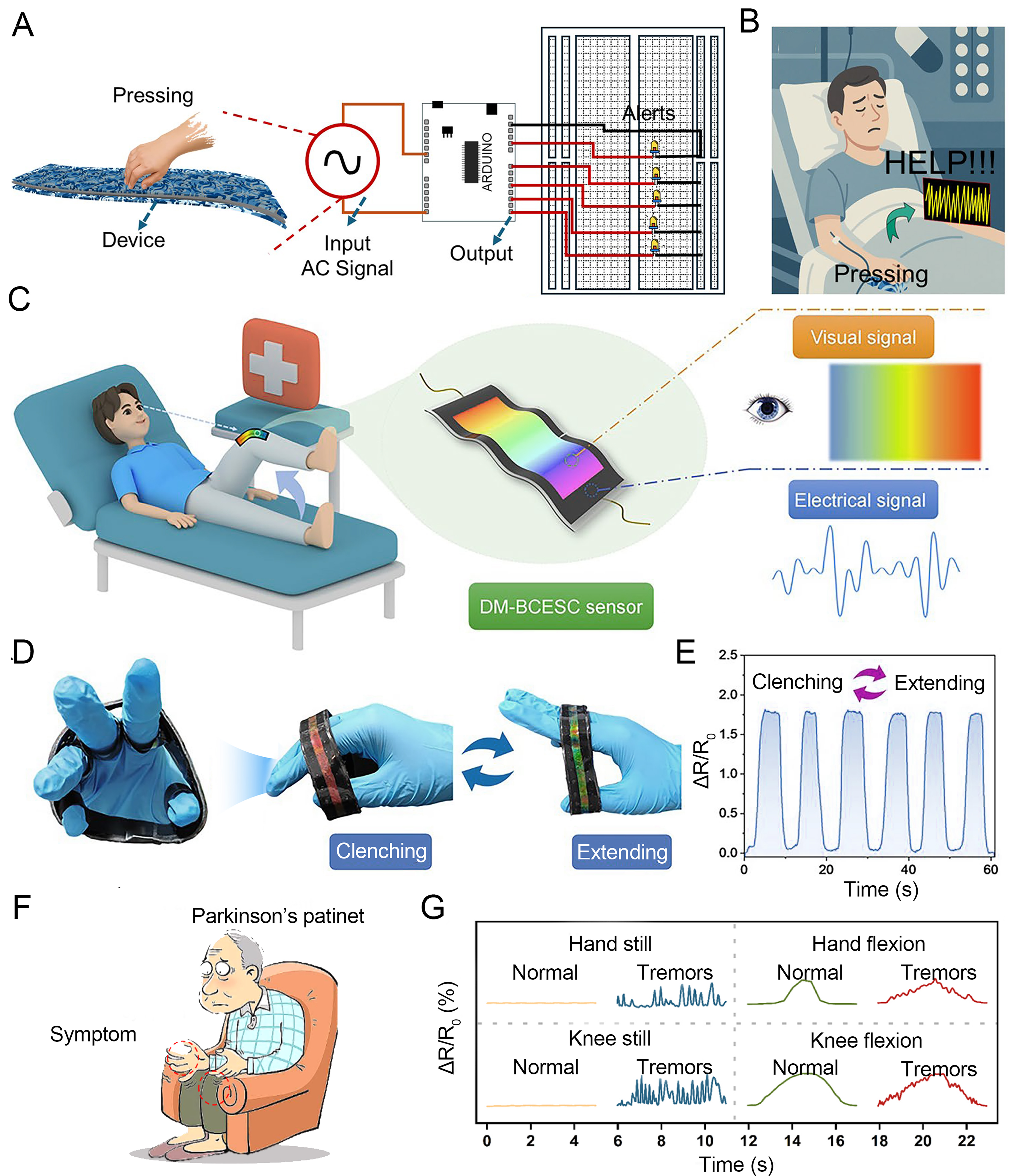
Figure 6. Lignocellulose hydrogel sensors for healthcare and biomedical monitoring. (A) Schematic illustration of the circuit connection of the device attached to an Arduino circuit and monitoring LEDs as an emergency alarm signal[273]; and (B) Graphical suggestion of device application as a sensor in the medical field to generate emergency alerts for patients[273]. (A and B) adapted from Ref.[273]. Copyright 2026, Springer Nature; (C) Schematic diagram illustrating the operational mechanism of the DM-BCESC sensor[285]; (D) Demonstrates the practical application and visual feedback performance of a wearable finger resistance band based on the DM-BCESC sensor in finger flexion and extension rehabilitation training[285]; and (E) Resistance signals synchronously captured by the sensor during finger flexion–extension movements[285]. (C-E) adapted from Ref.[285]. Copyright 2026, Springer Nature; (F) Sensors for applications in Parkinson’s patients[286]; and (G) Real-time resistance monitoring across eight different body postures[286]. (F and G) adapted from Ref.[286]. Copyright 2024, Elsevier. LEDs: Light-emitting diodes; DM-BCESC: dual-mode black CPH-enhanced structural color; AC: alternating current.