
fig5
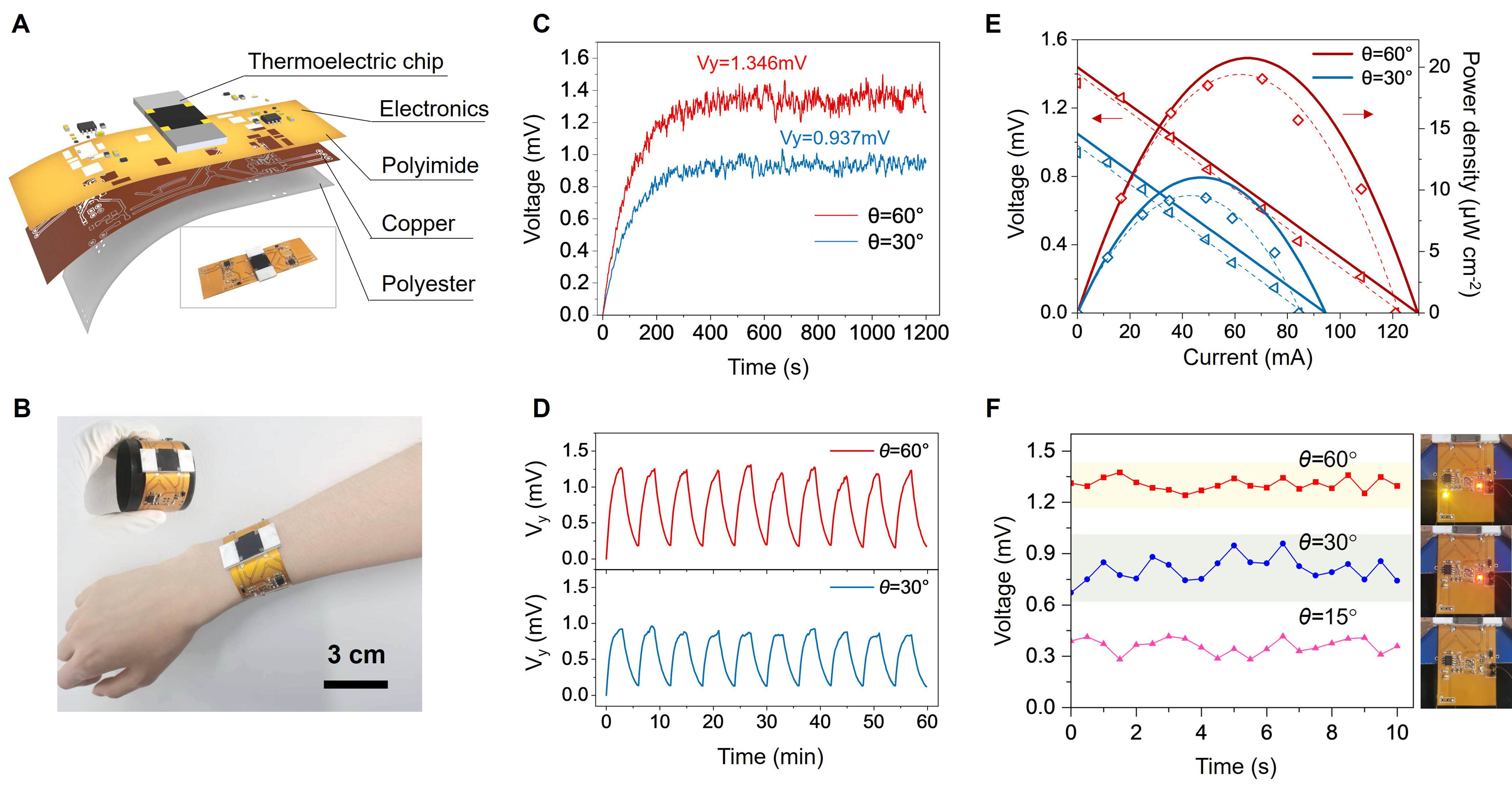
Figure 5. Conformal attachment and energy harvesting on curved surfaces. (A) Schematic illustration of the flexible device integrated on an FPC substrate. Inset: optical photograph; (B) Optical photograph of the conformally attached device on a cylindrical surface and worn on a human arm (scale bar, 3 cm). The photograph of the device worn on the human arm was taken with the informed consent of the volunteer; (C) Time-dependent transverse open-circuit voltage (Vy) measured at a fixed temperature difference of ΔT = 40 K. The red and blue curves correspond to θ = 60° and θ = 30°, respectively; (D) Thermal cycling stability of the conformal devices. Transverse open-circuit voltage (Vy) of the θ = 30° (blue) and θ = 60° (red) flexible devices recorded over 60 min under periodic thermal cycling at ΔT = 40 K; (E) Current–voltage characteristics and corresponding power densities (normalized to the 15 mm × 15 mm active area) for the 60° and 30° flexible devices. Red and blue colors correspond to θ = 60° and θ = 30°, respectively. Solid lines and scattered points denote simulation and experimental results, respectively, while dashed lines correspond to fitted curves; (F) Proof-of-concept demonstration of an angle-resolved heat-flux indicator. (Left) Time-dependent transverse output voltage of the device under a fixed thermal bias (ΔT = 40 K) for θ = 60° (red), 30° (blue), and 15° (pink), driving a dual-LED threshold circuit. (Right) Corresponding optical states of the indicator: dual-LED ON (top), red-LED ON (middle), and dual-LED OFF (bottom). FPC: Flexible printed circuit.