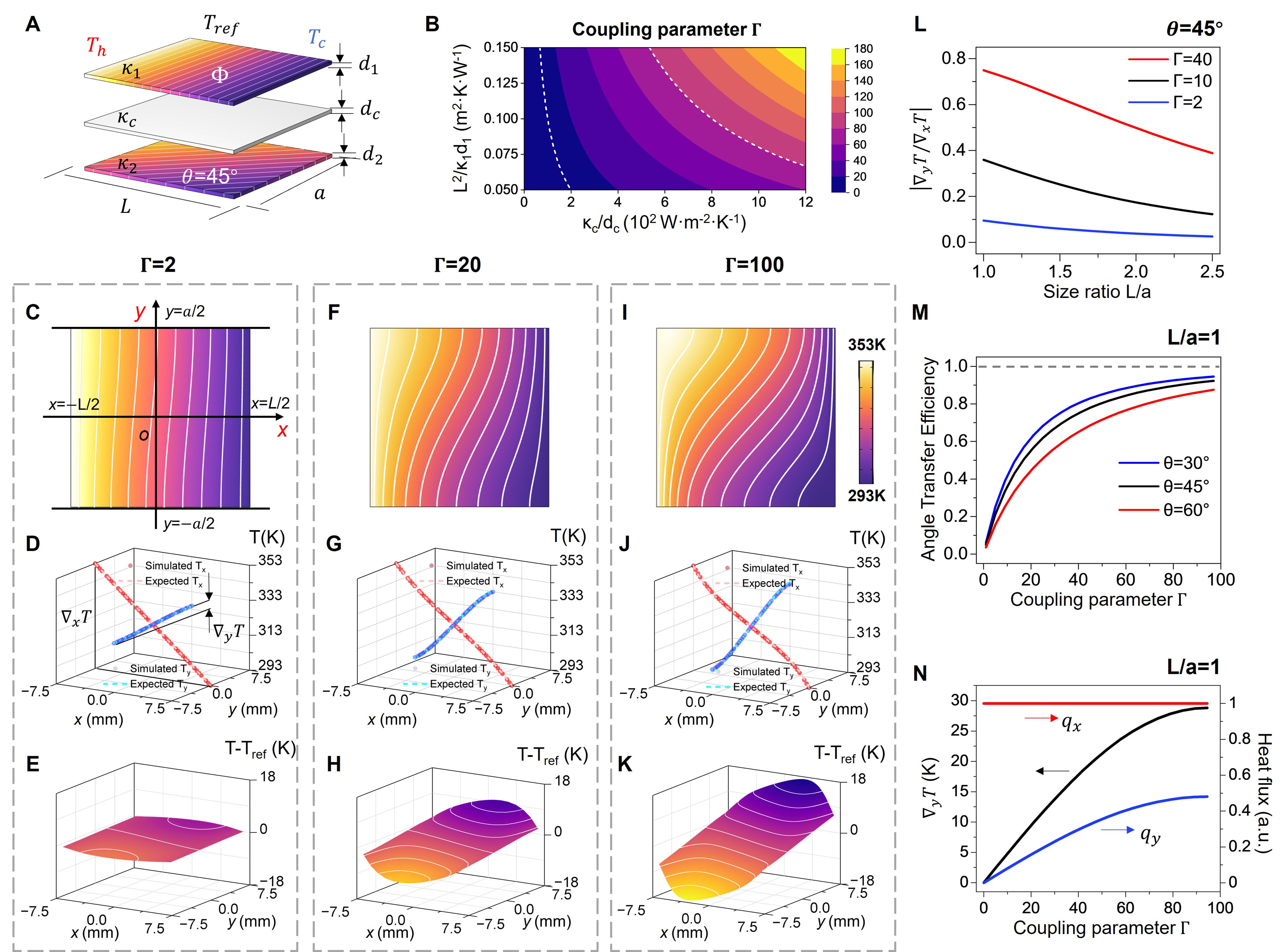
Figure 2. Thermal manipulation via interlayer coupling and corresponding simulation results. (A) Schematic illustration of the influence of bottom thermal field rotation by θ on the thermal reference value Tref of the upper layer; (B) The dimensionless coupling parameter Γ as a function of κc/dc and L2/κ1d1. The white dashed lines denote the contours at Γ = 10 and Γ = 80, delineating the boundaries between weak (Γ < 10), moderate (10 ≤ Γ ≤ 80), and strong (Γ > 80) coupling regimes; (C-K) Temperature distributions for three typical coupling strengths, all simulated with identical parameters: L = 15 mm, a = 15 mm, d1 = dc = d2 = 1 mm, θ = 45°, κ1 = 2.25 W/(m·K), κ2 = 30 W/(m·K), Th = 353 K, Tc = 293 K. Only the coupling-layer thermal conductivity κc is varied: κc = 0.02 W/(m·K) for weak coupling, κc = 0.2 W/(m·K) for moderate coupling, and κc = 1 W/(m·K) for strong coupling. (C-E) Temperature contour of the upper layer (C), transverse and longitudinal temperature profiles comparing simulated and expected results (D), and temperature difference relative to the reference value (E) under weak coupling. Corresponding analyses for moderate and strong coupling cases are presented in (F-H) and (I-K), respectively; (L) Dependence of the thermal deflection at the center on the aspect ratio L/a under different coupling strengths. The red, black, and blue curves correspond to Γ= 40, 10, and 2, respectively; (M) Continuous evolution of the thermal deflection transfer efficiency with increasing Γ. The blue, black, and red curves correspond to θ = 30°, 45°, and 60°, respectively; (N) Y-direction temperature difference (black line) and magnitude of heat flux (red line for qx, blue line for qy) as functions of Γ, where the heat flux is normalized to that in the x-direction.