

fig1

Designable transverse thermoelectricity through interlayer thermal coupling for conformal heat harvesting

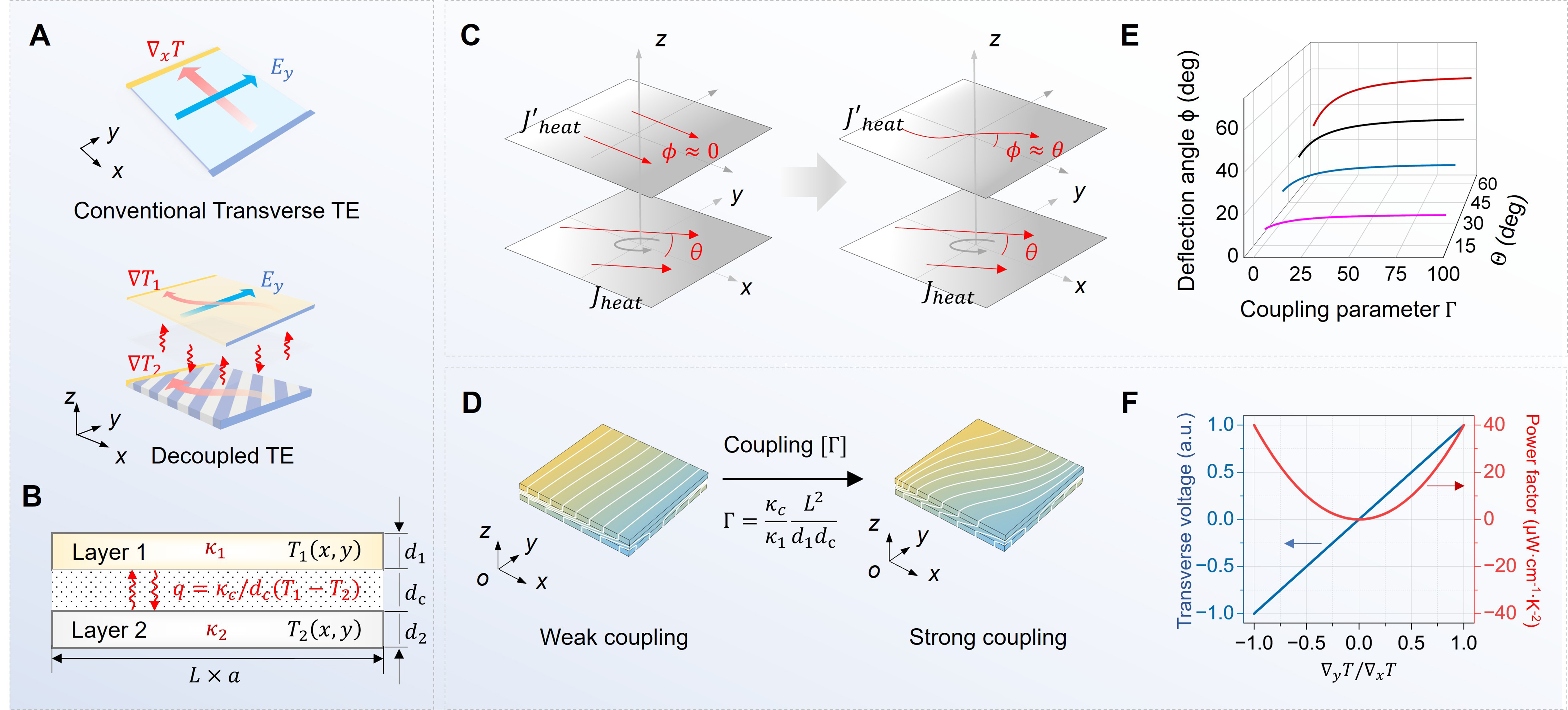
Figure 1. Principle of spatially decoupled transverse thermoelectric response. (A) Comparison between conventional transverse TE elements (top) and the proposed decoupled TE architecture (bottom); (B) Schematic of a two-layer thermal diffusion system model. The thermal conductivities and thicknesses of Layer 1 and Layer 2 are denoted as κ1, κ2 and d1, d2, with their corresponding temperature fields defined as T1, T2. A thermally coupled interlayer with equivalent thermal conductivity κc and thickness dc exists between the two layers; (C) Schematic illustration of the 3D thermal coupling mechanism: the lower layer with thermal deflection angle θ drives the upper layer to present continuously adjustable oblique angles that shift from ϕ = 0 to ϕ ≈ θ; (D) The effect of the dimensionless coupling parameter Γ = $$ \frac{\kappa _cL^2}{\kappa _1d_1d_c} $$ on the degree of thermal deflection; (E) Parametric response of the upper-layer deflection angle ϕ as a function of Γ and the lower-layer angle θ. The colored curves represent different lower-layer deflection angles: pink: θ = 15°, blue: θ = 30°, black: θ = 45° and red: θ = 60°; (F) Theoretically derived normalized thermoelectric voltage (blue line) and power factor (red line) as a function of $$ \nabla $$yT/$$ \nabla $$xT. TE: Thermoelectric.

Soft Science
ISSN 2769-5441 (Online)

Portico

All published articles are preserved here permanently:

https://www.portico.org/publishers/oae/

Portico

All published articles are preserved here permanently:

https://www.portico.org/publishers/oae/