
fig5
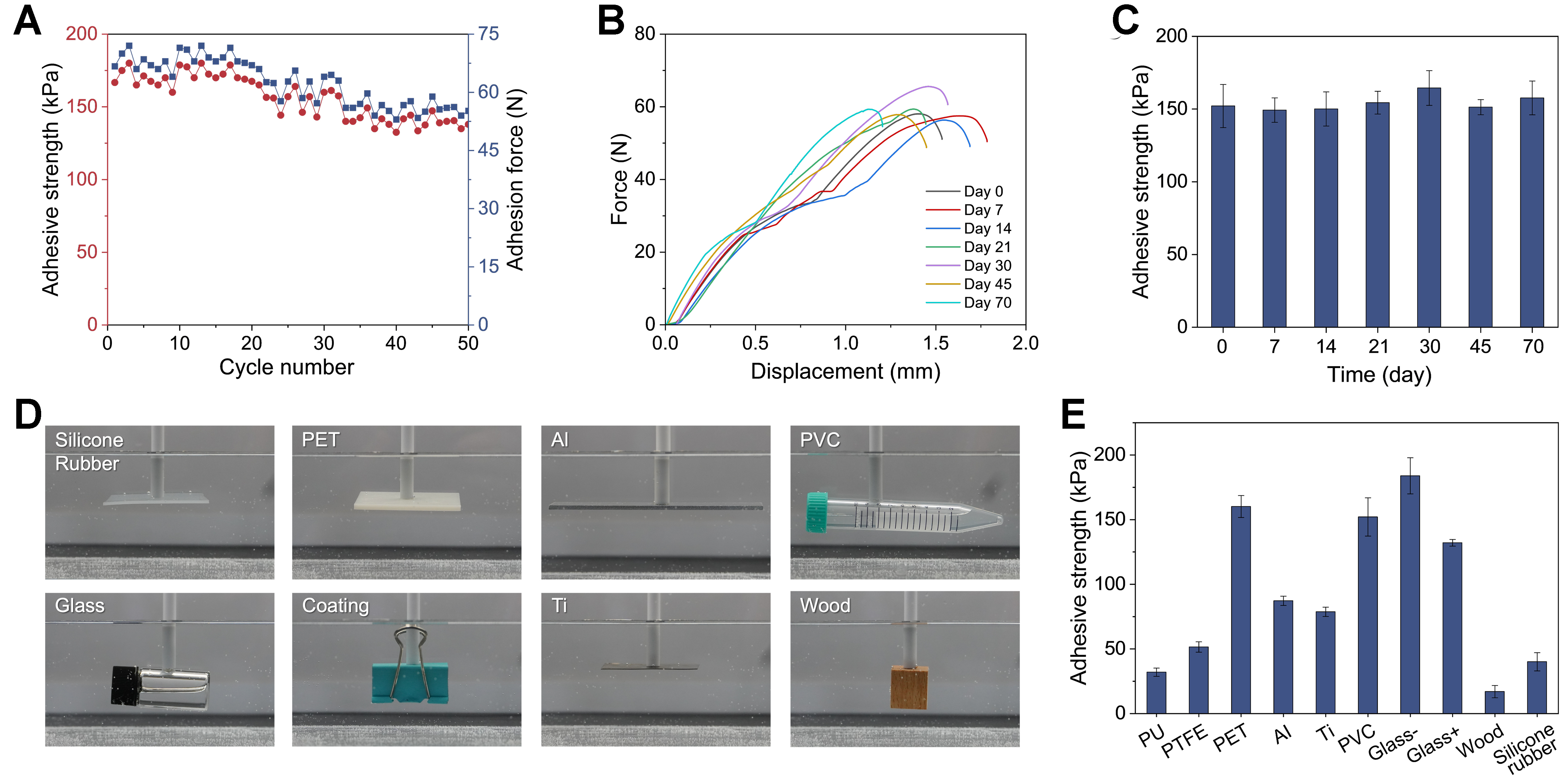
Figure 5. Underwater adhesion performance of the AP-2: durability and substrate versatility. (A) Repeatable underwater lap-shear adhesion performance of AP-2 on PVC substrates (Red circles indicate adhesive-strength data points, while blue squares indicate adhesion-force data points); (B) Force-displacement curves obtained from long-term underwater lap-shear tests of AP-2 on PVC substrates after immersion for different durations; (C) Long-term underwater lap-shear adhesion strength of AP-2 on PVC substrates after immersion in water for different periods; (D) Underwater adhesion of AP-2 to different substrates; (E) Underwater lap-shear adhesion strengths of AP-2 on various substrates. Hydrogel specimens (20 × 20 × 1 mm3) were compressed at 10 kPa for 30 s and stretched at 5 mm·min-1. Lap-shear strength was calculated as the maximum load divided by the bonded area. Data are presented as mean ± SD (n = 3 independent samples). PVC: Polyvinyl chloride; SD: standard deviation; PET: polyethylene terephthalate; PU: polyurethane; PTFE: polytetrafluoroethylene.