

fig4
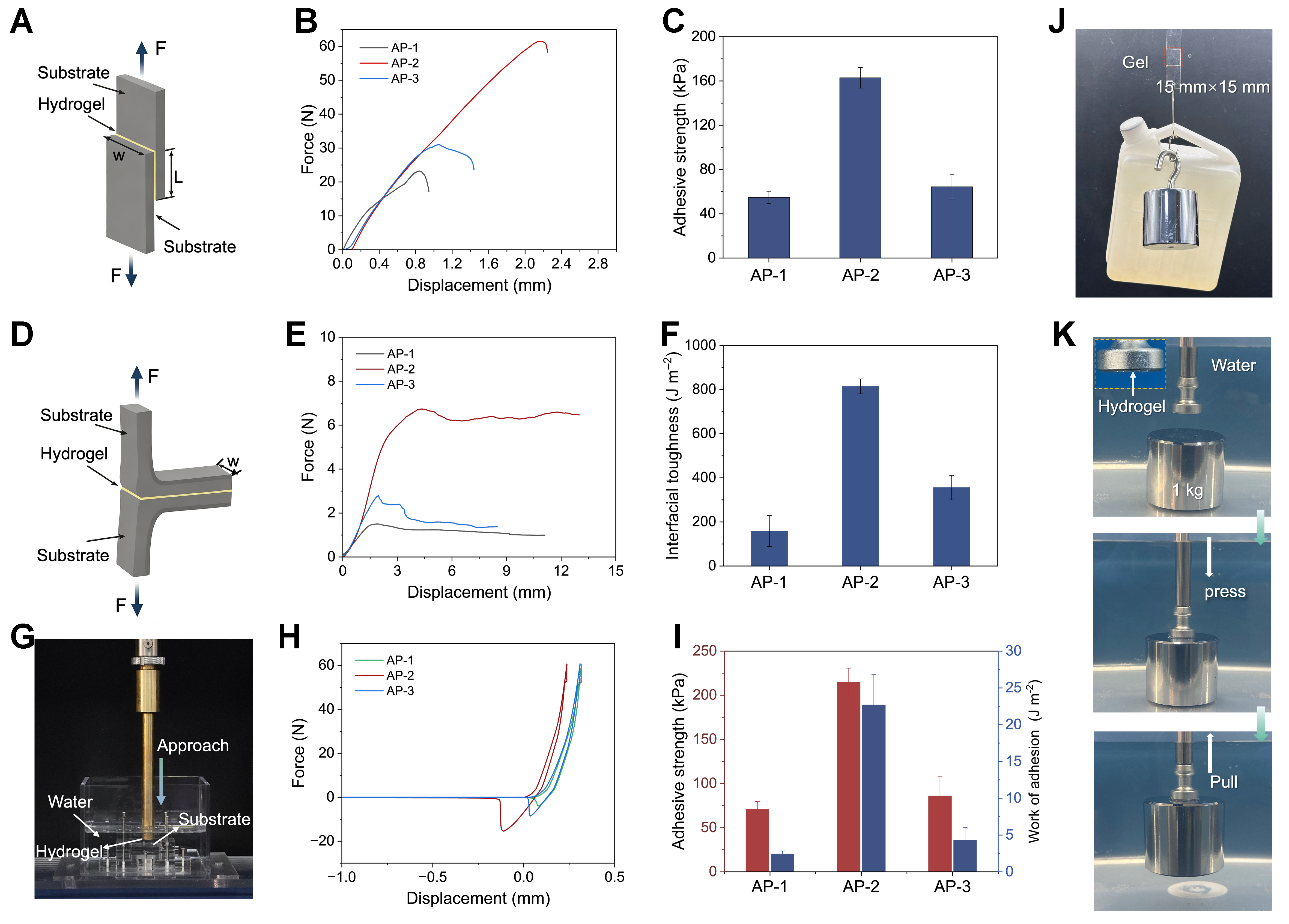
Figure 4. Underwater adhesion performance of the AP-gel. (A) Schematic illustration of the lap-shear adhesion test; (B and C) Force-displacement curves and corresponding adhesion strengths of AP-gel on PVC substrates measured by lap-shear tests. (specimen size: 20 × 20 × 1 mm3; testing speed: 5 mm·min-1); (D) Schematic illustration of the 180° peel test; (E and F) Force-displacement curves and corresponding interfacial toughness values of AP-gel on PET film substrates measured by 180° peel tests. (specimen size: 20 × 20 × 1 mm3; peeling speed: 5 mm·min-1); (G) Schematic illustration of the probe tack test for underwater adhesion; (H and I) Force-displacement curves, adhesion strengths, and work of adhesion of AP-gel on negatively charged glass substrates in water (specimen diameter: 10 mm; thickness: 1 mm; approach and withdrawal speeds: 10 mm·min-1); (J) Load-bearing test of a 15 by 15 mm AP-gel sample connecting two PVC plates and suspending a heavy weight; (K) Photograph showing that AP-gel can adhere to a 1.0 kg weight underwater and lift it from water into air. PVC: Polyvinyl chloride; PET: polyethylene terephthalate.