

fig2
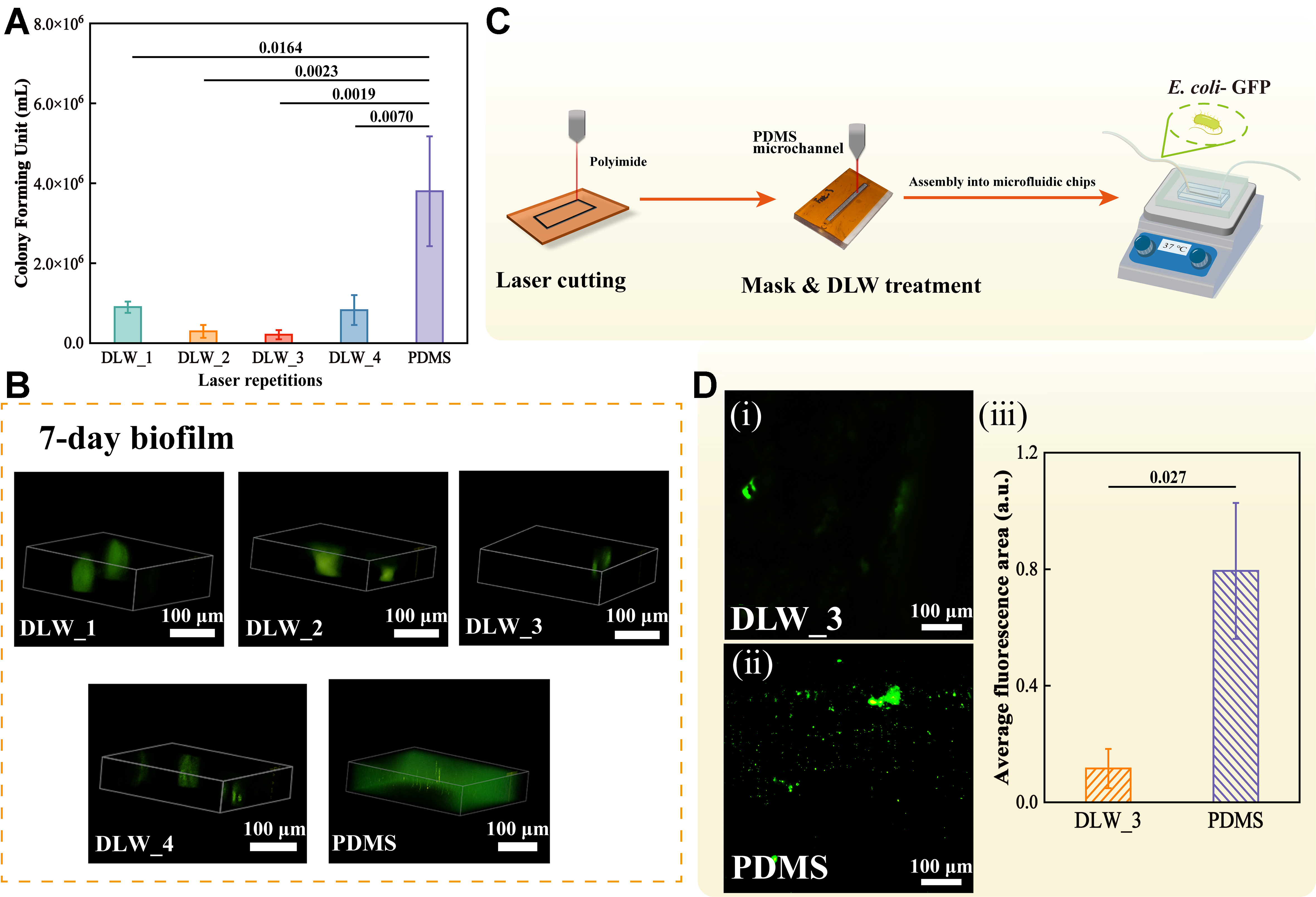
Figure 2. Antifouling performance of DLW-PDMS surfaces. DLW_n denotes n repetitions of the laser treatment, and PDMS refers to the untreated substrate. (A) Quantification of bacterial (E. coli) adhesion via CFU counts after 24 h of incubation. Data are presented as mean ± SD (n = 3, independent substrates per group). Statistical significance was determined using ANOVA with Tukey’s test, with pure PDMS as the control group; (B) Representative 3D CLSM reconstructions of E. coli-GFP biofilm formation after 7 days of static culture on DLW_n surface and an untreated PDMS control. Scale bars: 100 μm; (C) Schematic of the fabrication process for integrating DLW-modified surfaces into a PDMS microfluidic device; (D) CLSM images showing bacterial adhesion in a DLW_3-treated channel (i) and an untreated PDMS control channel (ii) after 7 days of dynamic flow. Scale bars: 100 μm. (iii) The quantification of the fluorescent area was analyzed using an unpaired t-test. Each group replicates (n = 3), with 5 sites per sample as technical replicates, at 20× magnification. Data are presented as mean ± SD. DLW: Direct laser writing; PDMS: polydimethylsiloxane; E. coli: Escherichia coli; CFU: colony-forming unit; SD: standard deviation; ANOVA: analysis of variance; CLSM: confocal fluorescence microscope; GFP: green fluorescent protein.