
fig5
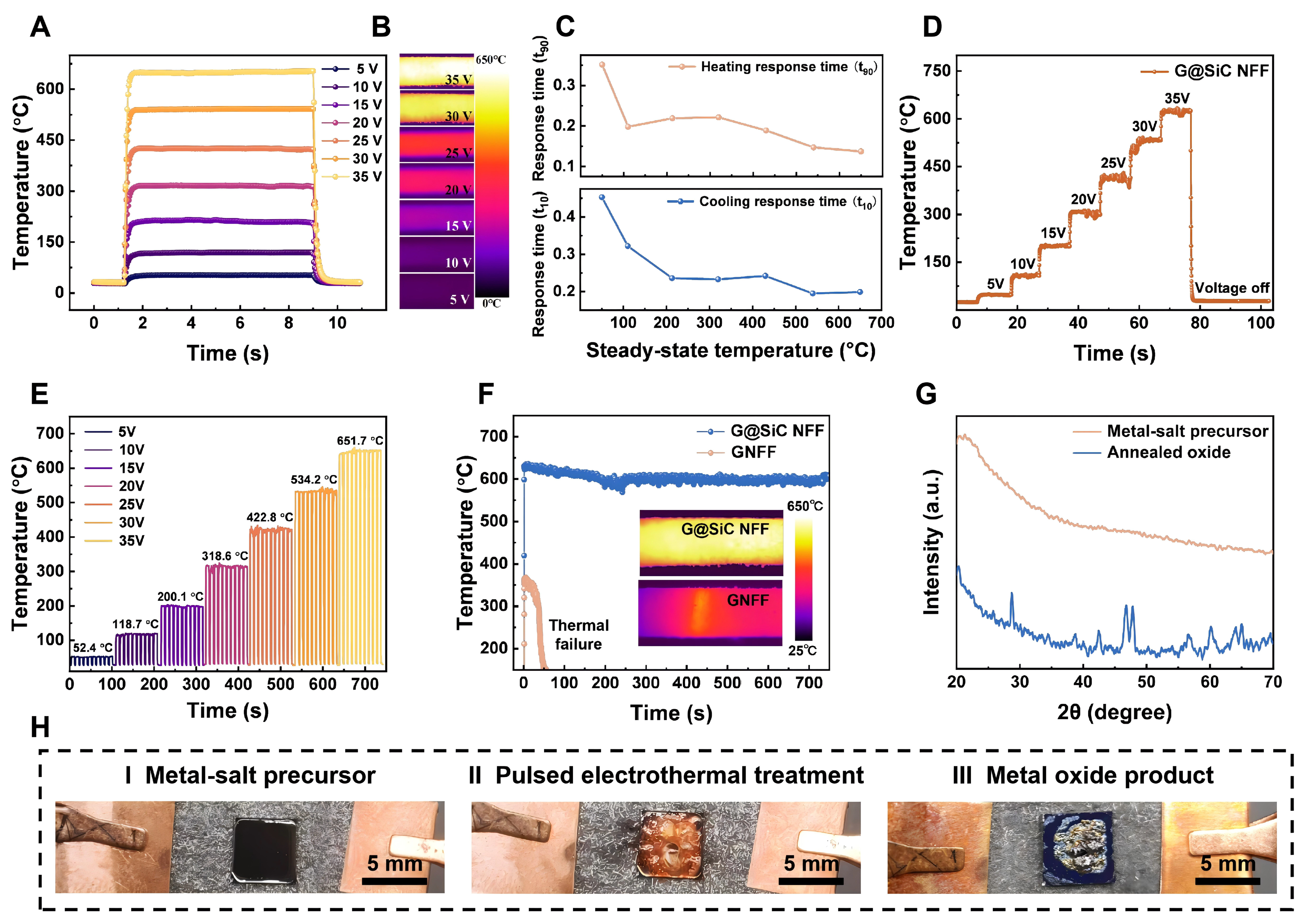
Figure 5. Rapid, stable, and high-temperature electrothermal functionality of G@SiC NFF in an air environment. (A) Time-dependent surface temperature of G@SiC NFF under different applied voltages, showing rapid voltage-programmable Joule heating and fast cooling; (B) Infrared thermal images of G@SiC NFF during Joule heating at different voltages; (C) Heating and cooling response times as a function of steady-state temperature; (D) Stepwise electrothermal response under programmed voltage loading; (E) Cyclic heating and cooling behaviour under repeated electrical stimulation at different voltages; (F) Long-term high-temperature Joule-heating stability of G@SiC NFF at approximately 600 °C compared with pristine GNFF; (G) XRD patterns of the metal-salt precursor and the electrothermally annealed oxide; (H) Optical photographs showing ultrafast electrothermal conversion of metal-salt precursors into metal oxides using G@SiC NFF as a localized high-temperature heating platform. All photographs in (H) were taken by the authors. G@SiC NFF: Graphene@silicon carbide nanofiber fabric; GNFF: graphene nanofiber fabric; XRD: X-ray diffraction.