



Optimal conductivity matching for cardiac electrical patches
 0
0 
Conductive biomaterials are the key interfaces linking biological tissues and flexible electronics, holding essential significance for closed-loop healthcare[1-3]. They act as electrical conduction bridges to restore electrophysiological communication in damaged tissues and facilitate tissue recovery[4]. Myocardial infarction (MI) is a prevalent and life-threatening cardiovascular disease[5], and the associated arrhythmia is a major risk to patients. Since 2015, conductive materials, such as polypyrrole[6], carbon nanotubes[5], and reduced graphene oxide[7], have been investigated for electrical conduction restoration in MI treatment. Besides fundamental properties such as biocompatibility, mechanical compatibility, and adhesion, conductivity is a crucial parameter for cardiac function recovery in therapeutic scenarios[8,9]. Notably, conductive biomaterials tailored for tissue electrical conduction differ from those designed for signal acquisition and sensing, where low impedance and high signal-to-noise ratios are preferred. However, excessively high conductivity does not guarantee better therapeutic efficacy. Previous studies are limited by narrow tunable range of materials conductivity and insufficient theoretical modeling, leaving the selection of optimal conductivity without systematic evaluation and solid theoretical support.
Recently, Miao et al. used conductive graphene oxide aerogel (GA) to prepare highly conductive electroactive cardiac patches (eCarPs) with the conductivity ranging from 10-3 to 101 S/cm for MI treatment [Figure 1A][10]. This range, covering five orders of magnitude, exceeds those reported in existing studies, where the optimal conductivity of eCarP should be 100 to 1,000 times that of native myocardium
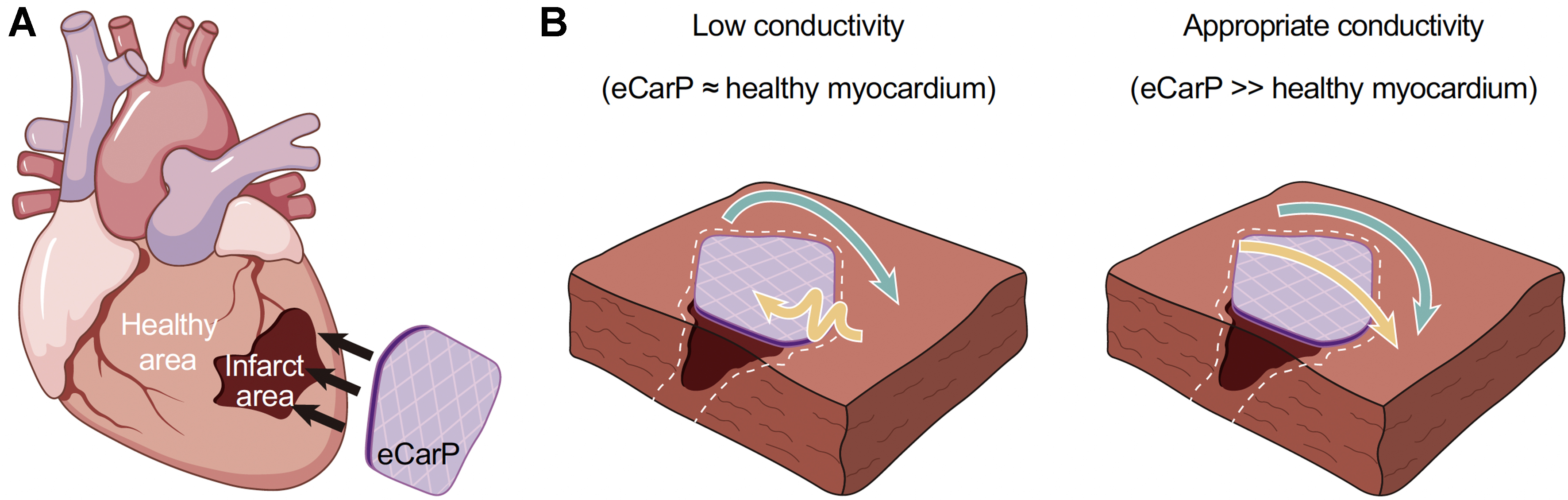
Figure 1. (A) Schematic of eCarP with the relative positions of heart and eCarP; (B) Scheme of eCarPs reducing the risks of arrhythmia. eCarP: Electroactive cardiac patche.
More interestingly, from the perspective of tissue repair, eCarPs exhibit versatile therapeutic potentials beyond the regulation of abnormal electrical signals[10]. They can increase ventricular wall thickness, improve cardiac function, facilitate angiogenesis, and upregulate the expression of relevant proteins. Such synergistic effects provide comprehensive biological support for myocardial repair after infarction.
Collectively, investigations into the optimal conductivity of cardiac patches deepen our understanding of how conductive biomaterials restore cardiac electrical synchrony. It also emphasizes that evaluating new-generation biomaterials and biomedical devices requires considerations beyond simple matching of physical properties. The compatibility with the intrinsic characteristics of biological signals is equally important, which acts as a core driving force to advance personalized precision medicine.
Despite the promising therapeutic efficacy of highly conductive biomaterials for MI treatment, there are remaining challenges to be addressed. The adaptability of conductive cardiac patches fundamentally depends on matching the CV of cardiac electrical signals. The myocardial CV is highly dynamic rather than stable, which is strongly dependent on heart rate and susceptible to fluctuations induced by medications, metabolic conditions, and other factors. Further studies are therefore required to validate whether highly conductive patches could maintain stable electrical adaptability under dynamic physiological variations.
Besides therapeutic conduction modulation, cardiac patches also offer potentials for in-situ physiological monitoring throughout cardiac treatment and recovery. Various biomaterials can be involved for multimodal sensing platforms, enabling real-time acquisition of bio-signals[12-14]. Due to their conductivity, cardiac patches can not only be used to sense the intrinsic activities of the heart such as electrophysiological signal and physical deformation, but also monitor key parameters of the cardiac microenvironment, such as temperature and pH levels. The integrated system requires optimizing the structure of the devices to adapt to the dynamic surface of the organ, and overcoming obstacles such as wireless energy supply and signal transmission to ensure the long-term and efficient operation. By integrating electrical conduction therapy with signal sensing within a single patch, such an engineered system can further lower the arrhythmia risks. Ultimately, this integrated design facilitates a closed-loop health management strategy, featuring continuous monitoring and targeted treatment, which sustains optimal cardiac electrical synchrony and prevents adverse cardiovascular events.
DECLARATIONS
Authors’ contributions
Investigation, writing - original draft: Tian, L.
Writing - review and editing, supervision: Song, Y.
Availability of data and materials
Not applicable.
AI and AI-assisted tools statement
Not applicable.
Financial support and sponsorship
The work was supported by the National Natural Science Foundation of China (62501507), the Natural Science Foundation of Guangdong Province, China (2025A1515010362), the Research Grants Council of Hong Kong (JLFS-YSF/E-101/26), City University of Hong Kong (9382003), and Institute of Digital Medicine (City University of Hong Kong).
Conflicts of interest
Song, Y. is the Guest Editor of the Special Topic “Flexible Electronic Skins and Human-Machine Interface Technologies” in Soft Science. He had no involvement in the review or editorial process of this manuscript, including but not limited to reviewer selection, evaluation, or the final decision, while the other author has declared that he has no conflicts of interest.
Ethical approval and consent to participate
Not applicable.
Consent for publication
Not applicable.
Copyright
© The Author(s) 2026.
REFERENCES
1. Zhao, C.; Park, J.; Root, S. E.; Bao, Z. Skin-inspired soft bioelectronic materials, devices and systems. Nat. Rev. Bioeng. 2024, 2, 671-90.
2. Zhou, T.; Yuk, H.; Hu, F.; et al. 3D printable high-performance conducting polymer hydrogel for all-hydrogel bioelectronic interfaces. Nat. Mater. 2023, 22, 895-902.
3. Montazerian, H.; Davoodi, E.; Wang, C.; et al. Boosting hydrogel conductivity via water-dispersible conducting polymers for injectable bioelectronics. Nat. Commun. 2025, 16, 3755.
4. Liang, Y.; Qiao, L.; Qiao, B.; Guo, B. Conductive hydrogels for tissue repair. Chem. Sci. 2023, 14, 3091-116.
5. Wang, L.; Liu, Y.; Ye, G.; et al. Injectable and conductive cardiac patches repair infarcted myocardium in rats and minipigs. Nat. Biomed. Eng. 2021, 5, 1157-73.
6. Mihic, A.; Cui, Z.; Wu, J.; et al. A conductive polymer hydrogel supports cell electrical signaling and improves cardiac function after implantation into myocardial infarct. Circulation 2015, 132, 772-84.
7. Qiu, R.; Zhang, X.; Song, C.; et al. E-cardiac patch to sense and repair infarcted myocardium. Nat. Commun. 2024, 15, 4133.
8. Jalilinejad, N.; Rabiee, M.; Baheiraei, N.; et al. Electrically conductive carbon-based (bio)-nanomaterials for cardiac tissue engineering. Bioeng. Transl. Med. 2023, 8, e10347.
9. Li, Y.; Wei, L.; Lan, L.; et al. Conductive biomaterials for cardiac repair: a review. Acta. Biomater. 2022, 139, 157-78.
10. Miao, Y.; Fu, Z.; Zhang, J.; et al. Theoretical quantitative model and clinical outcome predictions of conductive cardiac patches for electrophysiological treatments. Nat. Biomed. Eng. 2026.
11. He, S.; Wu, J.; Li, S. H.; et al. The conductive function of biopolymer corrects myocardial scar conduction blockage and resynchronizes contraction to prevent heart failure. Biomaterials 2020, 258, 120285.
12. Gu, M.; Guo, C. F.; Song, Y. Multimodal bioelectronics: a pathway to digital health management. Matter 2025, 8, 102048.
13. Choi, S.; Han, S. I.; Jung, D.; et al. Highly conductive, stretchable and biocompatible Ag-Au core-sheath nanowire composite for wearable and implantable bioelectronics. Nat. Nanotechnol. 2018, 13, 1048-56.
Cite This Article
 Open Access
How to Cite
Download Citation
Export Citation File:
Type of Import
Tips on Downloading Citation
Citation Manager File Format
Type of Import
Direct Import: When the Direct Import option is selected (the default state), a dialogue box will give you the option to Save or Open the downloaded citation data. Choosing Open will either launch your citation manager or give you a choice of applications with which to use the metadata. The Save option saves the file locally for later use.
Indirect Import: When the Indirect Import option is selected, the metadata is displayed and may be copied and pasted as needed.
About This Article
Special Topic
Copyright

Data & Comments
Data
0











Comments
Comments must be written in English. Spam, offensive content, impersonation, and private information will not be permitted. If any comment is reported and identified as inappropriate content by OAE staff, the comment will be removed without notice. If you have any queries or need any help, please contact us at [email protected].