




Liquid crystal polyarylate tailored functionalized boron nitride alignment for constructing high thermal conductivity composites
 0
0 Abstract
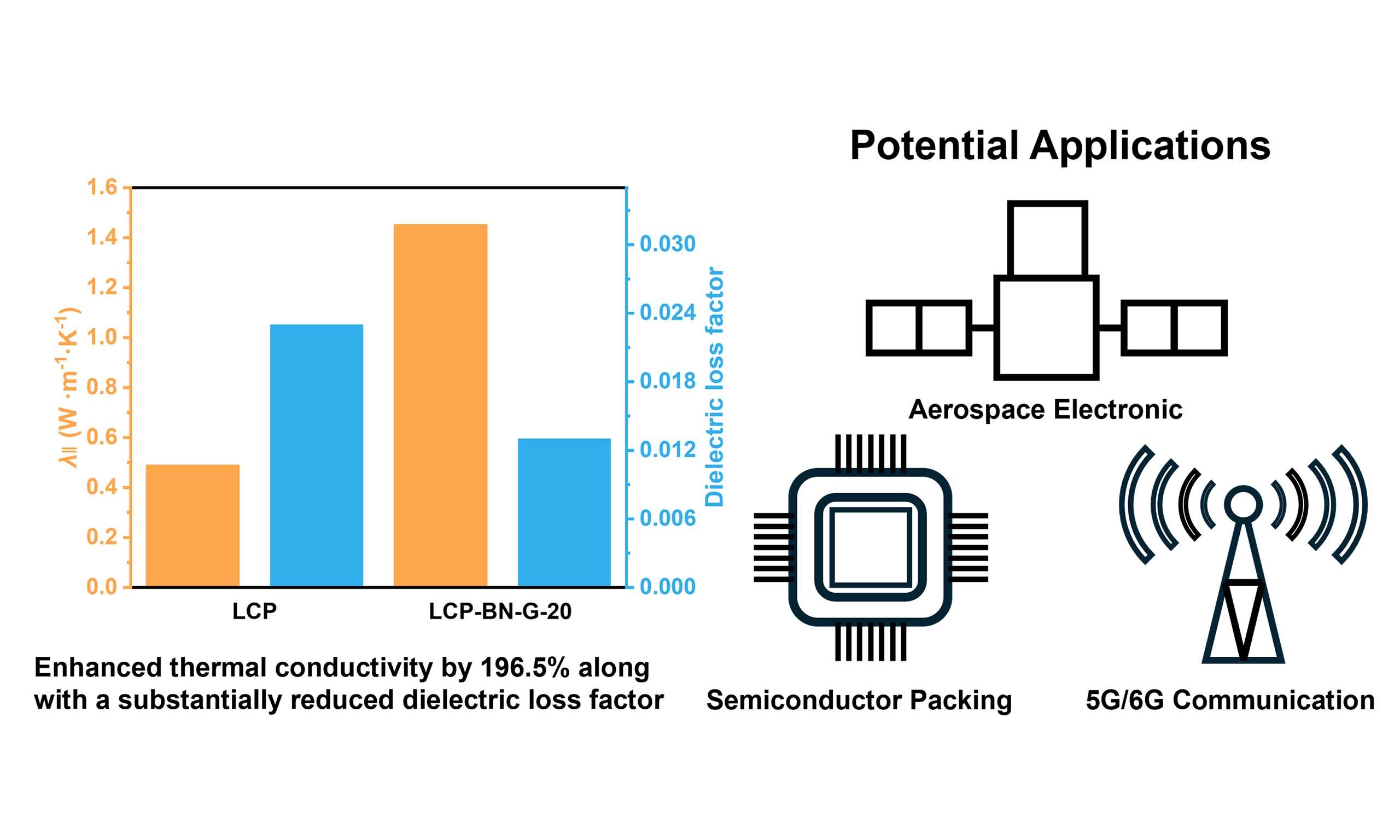
With the rapid development of high-frequency electronic devices toward greater integration and power density, electronic packaging materials that simultaneously offer high thermal conductivity and low dielectric loss are urgently needed. However, constructing an effective thermal conduction network typically requires high filler loadings, which in turn increase interfacial thermal resistance and raise dielectric loss. To address this challenge, a strategy is proposed that utilizes the liquid crystal orientation behavior of thermotropic liquid crystal polyarylate (LCP) to control the ordered arrangement of functionalized boron nitride (BN-G). During melt processing, highly oriented LCP molecular chains form in-situ microfibrillar structures along the shear flow direction, which align BN-G and facilitate continuous thermal conduction pathways at low filler loadings. These results demonstrate that BN-G is uniformly distributed in an ordered fashion along the in-plane direction within the LCP matrix. The LCP-BN-G composite with 20 wt% filler loading achieved an in-plane thermal conductivity of
Keywords
INTRODUCTION
The ever-increasing demand for miniaturized, highly integrated, and intelligent electronic devices imposes higher requirements on material performance[1-4]. Polymer materials have been widely used in microelectronic applications owing to their advantages such as easy processability, light weight, excellent electrical insulation, good mechanical properties, and environmental resistance. In particular, with the rapid advancement of high-frequency and high-speed communication technologies, polymer materials that simultaneously exhibit heat dissipation capabilities and low dielectric loss have attracted significant attention. In recent years, polymers such as liquid crystal polyarylate (LCP), polyimide (PI), and polytetrafluoroethylene (PTFE) have been extensively applied in the electronics field because of their low dielectric constants (Dk)[5,6]. The inability of these materials to efficiently conduct heat[7,8] (0.1-0.4 W·m-1·K-1) results in severe heat accumulation within densely packed integrated circuits, compromising their reliability and scalability. Consequently, there is an urgent need to develop polymer-based composites with high thermal conductivity and low dielectric loss[9].
As is well known, achieving a low Dk and high thermal conductivity simultaneously in polymer composites is inherently difficult. On the one hand, conventional methods used to reduce Dk tend to disrupt the formation of thermal conduction networks. On the other hand, introducing a large amount of thermally conductive fillers to obtain high thermal conductivity can significantly compromise the dielectric properties of the matrix. Therefore, achieving a balance between high thermal conductivity and a low dissipation factor
Although surface modification effectively reduces interfacial polarization, conventional processing methods typically result in a random distribution of h-BN within the polymer matrix, making it difficult for fillers to connect effectively. Consequently, an extremely high filler loading is usually required to form a thermal conduction network. However, high filler loadings not only exacerbate filler agglomeration and interfacial thermal resistance, but may also compromise the mechanical properties and processability of the composite. Thus, inducing the ordered arrangement of h-BN at low filler loadings is a critical challenge. To address this, researchers have developed various strategies, including the use of external electric or magnetic fields to induce the orientation of anisotropic fillers[16], employing ice-templating methods[17] to construct oriented thermally conductive skeletons, and leveraging mechanical force fields[18] (e.g., hot pressing, extrusion) to promote filler alignment along specific directions. With their unique self-assembly behavior and long-range ordered molecular arrangement, liquid crystals offer an effective means of controlling the ordered distribution of thermally conductive fillers. Ma et al. constructed an ordered liquid crystal network in polydimethylsiloxane using a liquid crystal crosslinker[19]. By leveraging the π-π stacking and orientational interactions of liquid crystal units, locally ordered domains are formed. These domains effectively induce the alignment of h-BN nanosheets along the orientation direction, thereby significantly improving filler dispersion and interfacial compatibility. At a total filler loading of 30 wt%, the in-plane thermal conductivity of the boron nitride nanosheets (BNNs)/liquid crystal polydimethylsiloxane (LC-PDMS) composite reached 12.50 W·m-1·K-1, a 68.5% improvement over the BNNs/PDMS composite (7.42 W·m-1·K-1). The orientation of the liquid crystal induces the directional alignment of fillers along a specific direction. Such a strategy proves effective for the design of high-performance thermally conductive materials[16,20-22].
In this paper, a strategy is proposed for preparing composites with both low Df and high thermal conductivity by utilizing the characteristic of thermotropic LCP to form in situ microfibrillar structures [Figure 1A]. Taking advantage of the highly aligned molecular chains during melt processing[23], the in-situ formed microfibrils facilitate the oriented arrangement of two-dimensional thermally conductive fillers. First, h-BN was subjected to surface amino-functionalization modification using glycine[24] to reduce interfacial thermal resistance and suppress conduction loss [Figure 1B]. Subsequently, through liquid crystal orientation induced in-situ fibrillation process, the modified h-BN was aligned orderly along the microfiber direction. Thereby, continuous and efficient thermally conductive pathways were constructed at a relatively low filler loading. The resulting LCP-BN-G composites with a filler loading of 20 wt% achieved an in-plane thermal conductivity of 1.45 W·m-1·K-1, a 196.5% increase compared to pure LCP. Notably, they also exhibited a low Dk (3.36) and Df (0.014) at 1 MHz, demonstrating a significant enhancement in thermal conductivity alongside retained low dielectric loss. The resultant LCP-BN-G retained excellent intrinsic flame retardancy and good thermomechanical properties, thereby showing great potential for application in high-frequency electronic packaging [Figure 1C].
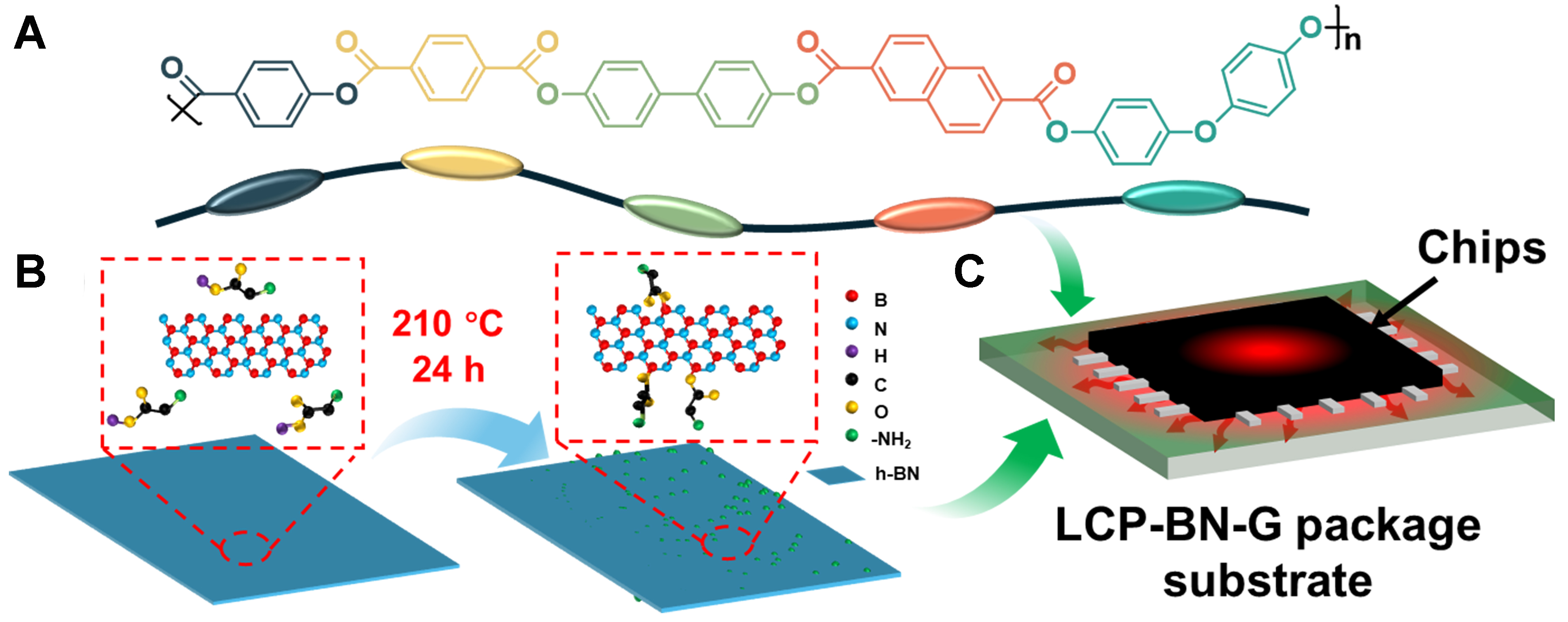
Figure 1. Schematic illustration of the application of LCP-BN-G composites. (A) Backbone composition of LCP (B) Surface modification process of BN; (C) Possible application scene of LCP-BN-G composite in electronic packaging. LCP: Liquid crystal polyarylate; BN-G: functionalized boron nitride; h-BN: hexagonal boron nitride.
EXPERIMENTAL
Materials
The thermotropic LCP matrix was synthesized in our laboratory following a previously reported procedure[25]. h-BN platelets with an average lateral size of 1-2 μm were purchased from Beijing Huawei Ruike Chemical Technology Co., Ltd. (Beijing, China). 1,2,4-Trichlorobenzene was obtained from Shanghai Titan Scientific Co., Ltd. (Shanghai, China). Glycine was supplied by Shanghai Yuanye Bio-Technology Co., Ltd. (Shanghai, China).
Preparation of BN-G fillers
The detailed synthesis procedure of BN-G is as follows: 4 g of h-BN, 1 g of glycine, and 100 mL of 1,2,4-trichlorobenzene were placed in a 200 mL conical flask. The mixture was magnetically stirred at 300 rpm. After homogenization at room temperature for 10 min, the temperature was raised to 210 °C (the boiling point of the solvent) while maintaining the same stirring rate, and the reaction was carried out under reflux for 24 h, yielding a gray suspension. After cooling to 70 °C, the mixture was subjected to suction filtration. The obtained solid was washed repeatedly with ethanol and deionized water to eliminate unreacted glycine, and then dried in a vacuum oven at 50 °C for 24 h.
LCP-BN-G composites
Before processing, LCP and BN-G were dried at 110 °C for 12 h. The LCP and BN-G were then uniformly mixed using a pulverizer. Melt blending was carried out using a miniature twinscrew mixer (Model HLY-6/18-C5, custom-made by Donghua University) with heating zone temperatures set at 180, 250, and 290 °C. The screws rotated at 60 rpm, and the melt reflux blending time was 5 min. After blending, the extruded material was naturally cooled and pulverized to obtain LCP-BN-G thermally conductive composites. The resulting composite samples were designated as LCP-BN-G-X, where X represents the BN-G loadings of 5, 10, 15, and 20 wt%, respectively.
Characterizations
All characterizations and corresponding experimental details are described in the Supplementary Materials. A complete list of instruments, including their manufacturers and models, is provided in Supplementary Table 1.
RESULTS AND DISCUSSION
The surface chemical structures of pristine h-BN and the glycine-modified sample (BN-G) were investigated by Fourier transform infrared (FT-IR) spectroscopy, and the corresponding spectra are presented in Figure 2A. In both spectra, the absorption peak at 1,345 cm-1 corresponds to the stretching vibration of the B–N bond. The peak at 784 cm-1 is attributed to the bending vibration of B-N-B[26]. In the attenuated total reflection-Fourier transform infrared spectroscopy (ATR-FTIR) spectra of the LCP-BN-G composites [Supplementary Figure 1], the B–N stretching vibration and B-N-B bending vibration were clearly identified, and their intensities gradually increased with increasing BN-G loading. Notably, the position and transmittance of these peaks remained essentially unchanged after modification, indicating that the intrinsic structure of BN was well preserved. In the spectrum of BN-G, several additional absorption features emerged. A weak absorption peak at around 3,300 cm-1 can be assigned to the N–H bending vibration[27], while the absorption peak at 1,014 cm-1 corresponds to the C–O stretching vibration[28]. The appearance of these new peaks indicates that glycine has been covalently grafted onto the BN surface.
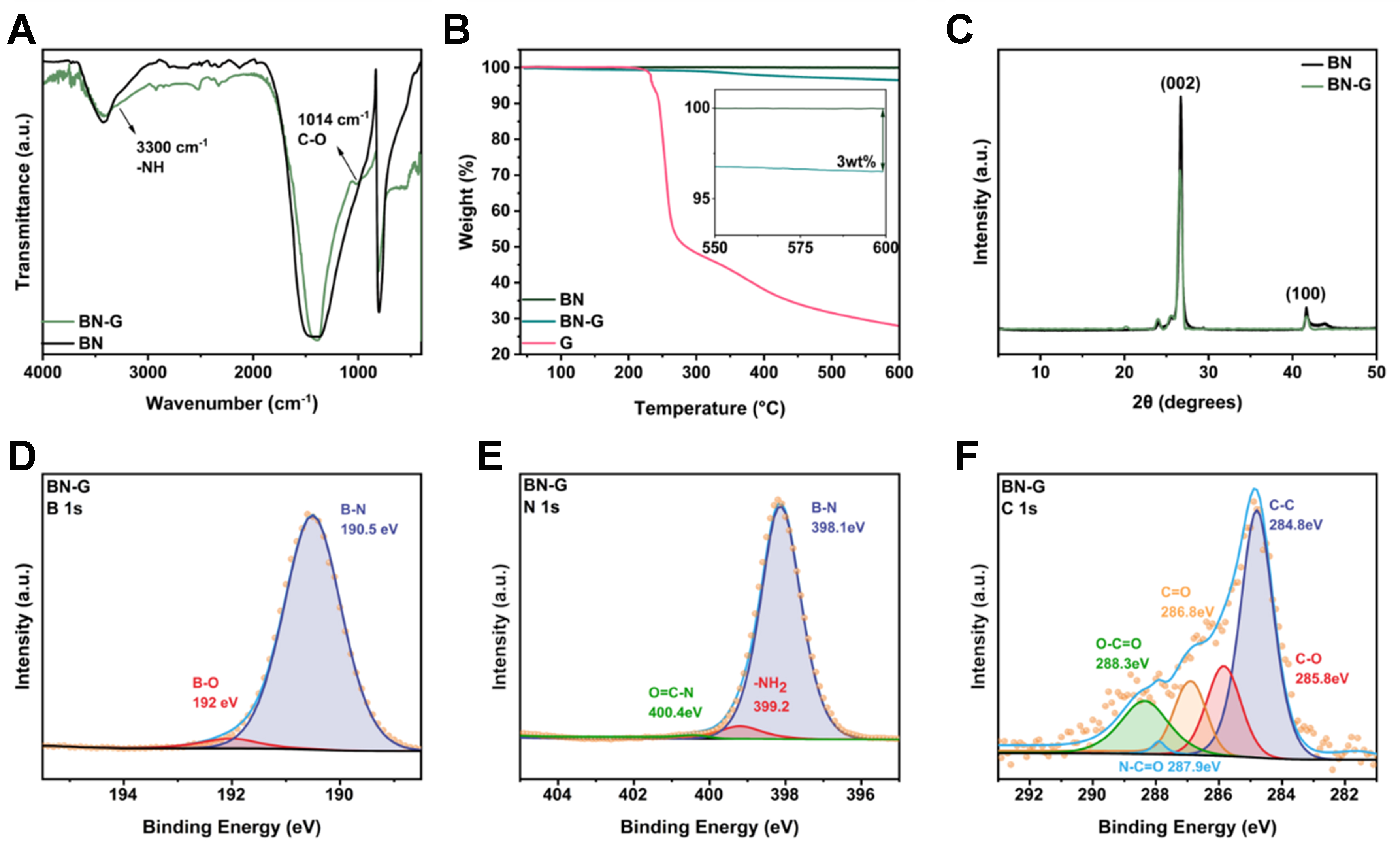
Figure 2. Surface chemical characterization of pristine BN and BN-G. (A) FTIR spectra; (B) TGA curves; (C) XRD patterns; (D-F) High-resolution XPS spectra and peak deconvolution results of BN-G corresponding to (D) B 1s, (E) N 1s, and (F) C 1s core levels, respectively. BN-G: Functionalized boron nitride; FTIR: Fourier transform infrared; TGA: thermogravimetric analysis; XRD: X-ray diffraction; XPS: X-ray photoelectron spectroscopy.
Thermogravimetric analysis (TGA) was performed over a temperature range of 40-600 °C [Figure 2B] to investigate the thermal stability of glycine, unmodified BN, and BN-G, thereby providing insight into the presence of grafted glycine on the BN surface. Glycine began to decompose at around 200 °C, while BN-G exhibited significant weight loss near 300 °C. In contrast, unmodified BN remained stable within this temperature range, with no observable mass change[29]. The additional weight loss observed for BN-G between 300 and 600 °C, further confirms the successful grafting of glycine onto the BN surface.
As shown in Figure 2C, after glycine modification, the crystal structure of boron nitride remains intact, with the characteristic diffraction peaks of the (002) and (100) planes of h-BN still observable at 26.3°-26.9° and 41.7°-41.9°, respectively. The intensity ratio between the diffraction peaks of these two crystal planes (I002/I100) exhibits no obvious change, indicating that the modification process does not alter the crystal structure of boron nitride[30]. In contrast, compared with pristine BN, the full width at half maximum (FWHM) of the (002) diffraction peak for BN-G increases, accompanied by a decrease in diffraction intensity [Supplementary Figure 2]. This phenomenon is mainly ascribed to the X-ray absorption and scattering effects arising from the grafted amorphous organic layer[31]. More importantly, the emergence of a diffraction peak at approximately 21° and the broadening of the diffraction shoulder at 25.6° jointly confirm that glycine has been covalently grafted onto the boron nitride surface and has undergone intermolecular self-condensation[32].
To further establish definitive evidence for the covalent grafting of glycine onto the BN surface, X-ray photoelectron spectroscopy (XPS) analysis was conducted. As shown in Figure 2D-F, the high-resolution core-level spectra of B 1s, N 1s, and C 1s were carefully deconvoluted. In the B 1s spectrum, a B–O peak at 192.0 eV appears alongside the dominant B–N peak at 190.5 eV, implying an interfacial chemical reaction between BN and the carboxyl groups of glycine[24]. In the N 1s spectrum, besides the primary B–N peak at 398.1 eV, the detection of -NH2 (399.2 eV) and, critically, an amide O=C–N bond (400.4 eV) unequivocally demonstrates the successful chemical grafting of glycine. The C 1s spectrum is reliably fitted with five distinct components corresponding to C–C (284.8 eV), C–O (285.8 eV), C=O (286.8 eV), N–C=O (287.9 eV), and O–C=O (288.3 eV), collectively matching the chemical skeleton of the grafted glycine molecules[33]. In conjunction with the aforementioned FTIR, TGA, and X-ray diffraction (XRD) analyses, these XPS results provide conclusive evidence for the covalent binding of glycine to the BN surface.
The thermal behavior of LCP and its composites during two heating and cooling cycles was investigated by differential scanning calorimetry (DSC) to evaluate the effect of BN-G incorporation on the segmental dynamics of the LCP matrix [Figure 3A and B]. Both LCP and the composites exhibit a distinct glass transition step at approximately 120 °C, suggesting that the presence of BN-G does not substantially impede chain segment mobility. Accordingly, no significant shift in the glass transition temperature (Tg) is observed.
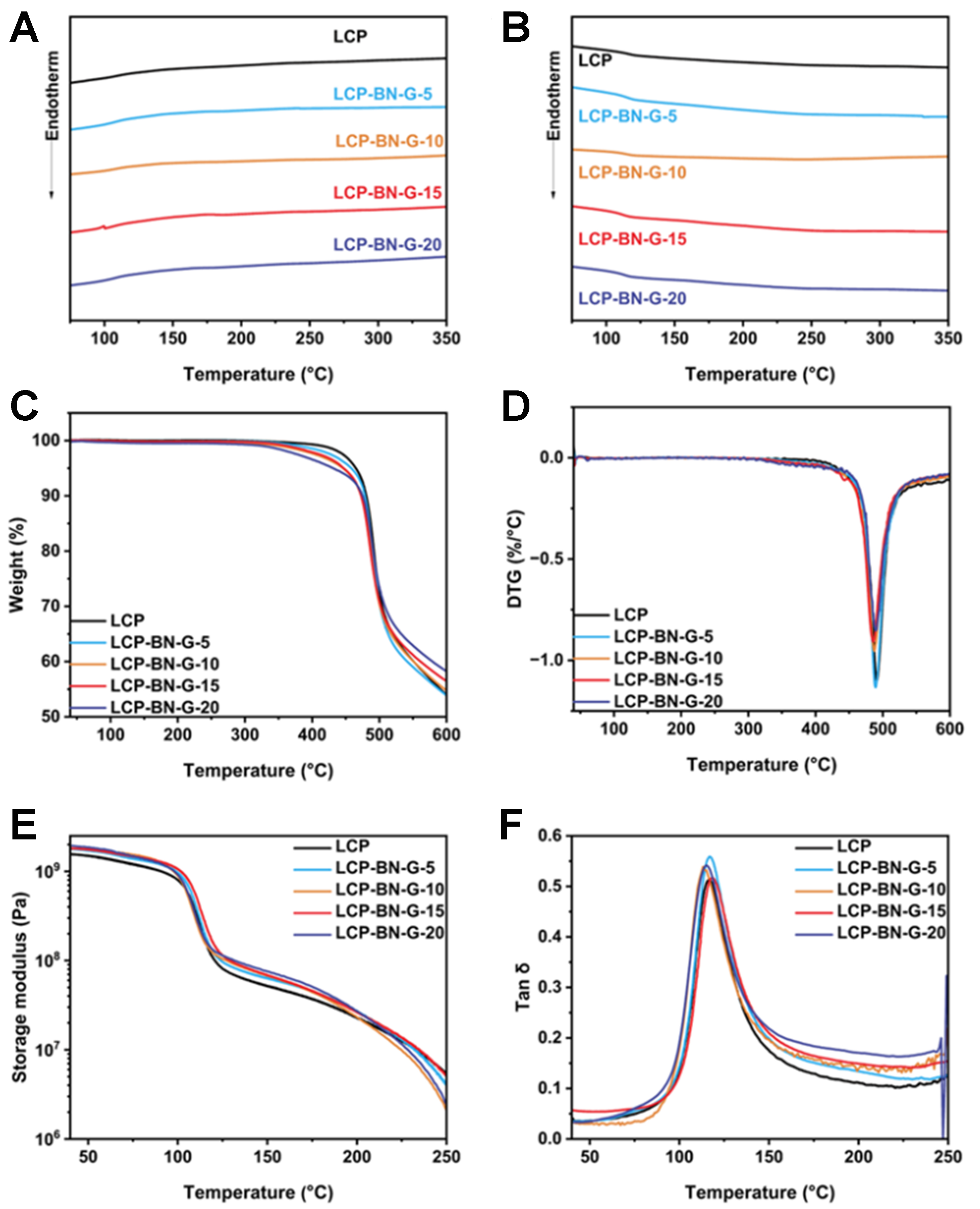
Figure 3. Thermal performance analysis of LCP and LCP-BN-Gs. (A and B) DSC curves during first cooling and second heating cycles at
TGA was conducted to assess the thermal stability of the LCP-BN-G composites, with the corresponding data presented in Supplementary Table 2. As the BN-G content increased, the initial decomposition temperature (Td5%) of the composites exhibited a decreasing trend, dropping from 464 °C for pure LCP to
Understanding the thermomechanical properties of LCP and its composites is of great significance for evaluating their suitability as thermal management materials. The samples were investigated using dynamic thermomechanical analysis (DMA), and the results are shown in Figure 3E. After the introduction of BN-G, the storage modulus (E′) of the composites was higher than that of pure LCP. Specifically, the storage modulus of LCP-BN-G-20 reached 1,948 MPa at 50 °C, which is approximately 25% higher than that of the pure LCP (1,556 MPa). This improvement is primarily attributed to both the good interfacial adhesion between BN-G and the LCP matrix and the mechanical interlocking structure formed between them, which effectively enhances stress transfer efficiency. As the temperature increased, all samples exhibited a decrease in storage modulus by an order of magnitude around 120 °C, corresponding to a typical glass transition behavior; subsequently, the modulus showed a gradual downward trend with increasing temperature. Notably, that the glass transition temperature (Tg) of the composites did not shift significantly with the introduction of BN-G, consistently remaining within the range of 114-118 °C [Figure 3F]. This finding is consistent with the glass transition step observed in the second DSC heating curve. These results indicate that although the introduction of BN-G significantly enhances the storage modulus of the composites, it does not impose significant constraints on the segmental mobility of the LCP molecular chains.
Azimuthal intensity profiles of the characteristic LCP peak at 2θ ≈ 20° were derived from the two-dimensional wide-angle X-ray scattering (2D-WAXS) patterns to quantitatively assess the orientational behavior of the LCP matrix upon BN-G incorporation. The diffraction rings corresponding to LCP exhibit distinct brightened regions along the equatorial direction [Figure 4A], indicative of a preferential uniaxial orientation, which is further confirmed by the azimuthal intensity profiles [Supplementary Figure 4]. Pure LCP displays the sharpest peak with an FWHM of 77.2°, corresponding to an orientation degree of 57.1%, confirming that high shear stress effectively induces LCP nematic domains, consistent with the self-orientation behavior of LCP reported in the literature[35]. Upon incorporation of 10 wt% BN-G, the FWHM broadens to 85.6° (orientation degree ≈ 52.4%), and at 20 wt% BN-G, the FWHM narrows to 81.7° (orientation degree ≈ 54.6%). Notably, the LCP matrix retains a substantial degree of orientation across all filler loadings, indicating that the introduction of BN-G does not destructively interfere with the liquid crystalline order of the LCP matrix. This preserved orientation capability of the LCP matrix is essential for templating the aligned dispersion of BN-G sheets and for constructing in-plane thermally conductive pathways.
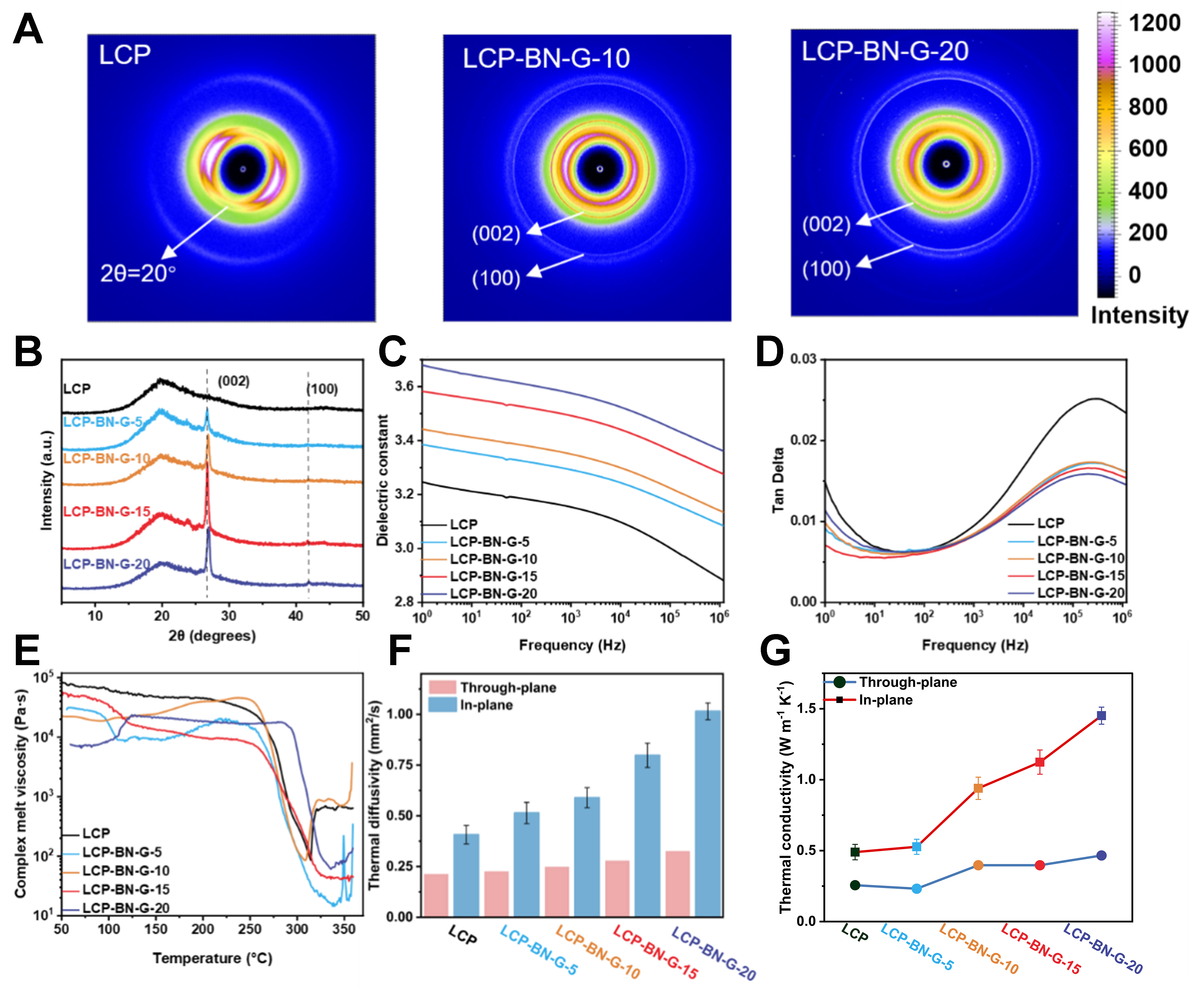
Figure 4. Effect of BN-G loading on the processing, structural, and functional properties of LCP composites. (A) 2D-WAXS patterns of LCP and its BN-G composites; (B) Crystallization behavior curves of LCP-BN-Gs; Dielectric properties of LCP-BN-Gs: (C) Dielectric constant and (D) dissipation factor; (E) Rheological behavior curves of LCP-BN-Gs; Thermal conduction properties of LCP-BN-Gs: (F) In-plane and through-plane thermal diffusivity; and (G) In-plane and through-plane thermal conductivity (Error bars represent the standard error of the mean from four independent measurements). BN-G: Functionalized boron nitride; LCP: liquid crystal polyarylate; 2D-WAXS: two-dimensional wide-angle X-ray scattering.
To investigate the crystallization behavior of the polymer matrix and the orientation of the filler, the samples were analyzed using wide-angle X-ray diffraction (WXRD). As shown in Figure 4B, both pure LCP and its composites exhibit a distinct diffraction peak around 2θ ≈ 20°. This peak is attributed to the characteristic peak of the nematic liquid crystal structure formed by the LCP main chain[23], indicating that the introduction of BN-G does not disrupt the ordered arrangement of the LCP molecular chains. Notably, the in-plane orientation degree of thermally conductive fillers is closely related to the in-plane thermal conductivity of the resulting composite. In this study, the following formula was used to quantify the planar orientation degree (φ) of BN-G[36-38]:
Here, I002 and I100 represent the diffraction peak intensities of the (002) crystal plane (corresponding to horizontal orientation) and the (100) crystal plane (corresponding to vertical orientation) of BN-G, respectively. As shown in Supplementary Table 3, the φ value exhibits a clear dependence on BN-G content: it increases progressively up to 15 wt% (reaching 88.90%) and then slightly decreases at 20 wt%. The upward trend demonstrates that the intrinsic liquid crystal orientation of the LCP matrix can effectively guide the in-plane alignment of BN-G sheets without the need for external fields. The slightly lower φ value at 20 wt% compared to that at 15 wt% is attributed to the sharp increase in melt viscosity, which restricts the mobility and rotation of BN-G sheets and thus compromises their macroscopic in-plane orientation.
For thermal management materials used in electronic devices, the dielectric constant (Dk) and dissipation factor (tan δ/Df) are also among the most concerning performance parameters. To investigate the impact to introduce BN-G on the dielectric properties of LCP-BN-G composites, a broadband dielectric spectrometer was used to measure their Dk and Df. Both LCP and its composites exhibited a strong frequency dependence in their Dk. This is due to a relaxation phenomenon where the dipole reversal cannot keep up with changes in the electric field, manifesting as a decrease in Dk with increasing frequency. With the addition of the boron nitride filler, the Dk of the composites showed a significant increase [Figure 4C]. This change primarily stems from the intrinsic Dk of h-BN (ε ≈ 4[39]). From a composite perspective, as the filler concentration increases, the number of two-phase interfaces correspondingly increases, enhancing the interfacial polarization effect, which typically leads to a further increase in the Df. LCP-BN-G-20 exhibited a Dk of 3.36 and a Df of 0.014 at a test frequency of 1 MHz. These values indicate that although Dk moderately increases due to filler incorporation, Df remains low, and the overall dielectric performance can still satisfy the basic requirements of most high-frequency, high-stability electronic devices for thermal management materials. Typically, the introduction of inorganic fillers can increase Df due to the interfacial polarization between the filler and the resin matrix. Interestingly, the Df of the composites did not increase with the introduction of BN-G, as shown in Figure 4D. To further elucidate the specific role of the modification layer, we compared the unmodified LCP-BN and modified LCP-BN-G composites at the same filler loadings [Supplementary Figure 5]. For dielectric constant, LCP-BN exhibits slightly higher Dk values than LCP-BN-G, which is attributable to the low-polarity organic layer introduced by glycine functionalization. For dielectric loss, LCP-BN-G shows a marginally higher Df than LCP-BN due to the grafted polar groups; however, both composites display substantially lower Df than neat LCP. This comparison indicates that while the surface modification moderately influences the dielectric parameters, the intrinsic nature of the BN filler plays a dominant role. It is well known that Df is divided into polarization loss and conduction loss[40]. For BN-G, its wide bandgap characteristic of approximately 5.5 eV[11] results in extremely low intrinsic conductivity. Therefore, the BN-G embedded in the LCP resin matrix effectively reduces the concentration of charge carriers and suppresses the leakage current formed by their migration[41,42]. This mechanism primarily reduces the conduction loss of the material, thus playing a key role in lowering the overall Df of the composite.
The rheological behavior of polymers is key to evaluating their processability and defining the processing window. The complex melt viscosity of LCP and its composites exhibits a typical N-type trend, decreasing slowly and then gradually rising [Figure 4E]. This behavior is a characteristic rheological response of LCP under the combined effect of heat and shear, indicating that the introduction of BN-G does not disrupt the liquid crystal structure of LCP. Specifically, the LCP-BN-G-5 composite exhibited a minimum complex viscosity (|η*| ≈ 14.4 Pa·s) at around 339 °C. This behavior can be ascribed to the sheet-like morphology of BN-G. At low filler contents, BN-G is able to align along the flow direction under shear stress. This ordered arrangement significantly lowers the flow resistance of the composite system and thus improves the chain mobility of the LCP matrix at high temperatures[43]. Comparative experiments [Supplementary Figure 6] demonstrate that surface modification effectively reduces the melt viscosity of the composites at identical filler loadings and improves their processability. More importantly, at a loading of 20 wt%, LCP-BN-G-20 exhibits the characteristic “N-type” viscosity–temperature curve of thermotropic liquid crystal polymers, whereas the unmodified LCP-BN-20 does not show this feature, indicating that surface modification promotes the ordered alignment of LCP under shear flow. With a further increase in BN-G content, the densely packed sheets cause physical confinement and steric hindrance, which restrict the mobility of LCP chains near the filler surfaces. Control experiments with unmodified BN confirm that the viscosity rise at higher loadings is predominantly physical in origin, arising from interfacial interactions and steric effects[44].
In high-power, highly integrated microelectronic devices, efficient heat-dissipating materials are required to promptly conduct away heat generated during operation, ensuring that the devices function within a suitable and stable temperature range. Figure 4F and G illustrate the thermal diffusivity and thermal conductivity of LCP and its composites in the in-plane and through-plane directions. The specific heat capacity and density values used for the calculation are listed in Supplementary Table 4. The LCP-BN-G composites are designed as typical 2-3 type composites, characterized by a 2D continuous filler network embedded within a 3D continuous matrix[45]. The results show that the through-plane thermal conductivity did not significantly increase with the introduction of BN-G. The through-plane thermal conductivity of LCP-BN-G-20 was only 0.456 W·m-1·K-1, merely 78.1% higher than that of pure LCP (0.256 W·m-1·K-1). This is primarily attributed to BN-G being a two-dimensional sheet-like material; XRD testing indicated that BN-G sheets were less aligned in the through-plane direction, failing to form a continuous and stable, efficient thermally conductive pathway. Notably, the improvement in the in-plane thermal conductivity of the material was far greater than that in the through-plane direction. The in-plane thermal conductivity of LCP-BN-G-20 reached
For thermally conductive composites, the ordered distribution of the filler within the matrix is crucial to thermal conductivity. LCP and its composites were fractured in liquid nitrogen, and the fracture surface morphologies were observed using scanning electron microscopy (SEM). The pure LCP resin without BN-G exhibits distinct macroscopic orientation, with microfibrils aggregating into clusters, forming micron-scale fibrillar structures [Figure 5A]. After the introduction of BN-G, the nano-scale fibrillar structures were retained. However, with increasing filler content [Figure 5B and C], the micron-scale fibrils gradually decreased, and the overall orientation order of the fibers diminished. In LCP-BN-G-20 [Figure 5C], micron-scale fibrils almost completely disappeared, and the nano-scale fibrils appeared macroscopically disordered. These morphological changes indicate that the addition of BN-G disrupts the original macroscopic orientation of the matrix resin to some extent and inhibits the ordered arrangement of nanofibrils. To further elucidate the effect of glycine functionalization on filler dispersion, we compared the fracture surfaces of unmodified LCP-BN composites with those of LCP-BN-G at identical filler loadings. At the same filler loadings, the SEM images (as shown in Supplementary Figure 7) demonstrate that LCP-BN and LCP-BN-G composites share similar morphologies. Both exhibit distinct LCP fibrillar structures with no obvious BN agglomeration or phase separation. This observation indicates that glycine functionalization does not primarily serve to improve the macroscopic dispersion of the filler, since pristine BN itself is already relatively uniformly distributed within the LCP matrix.
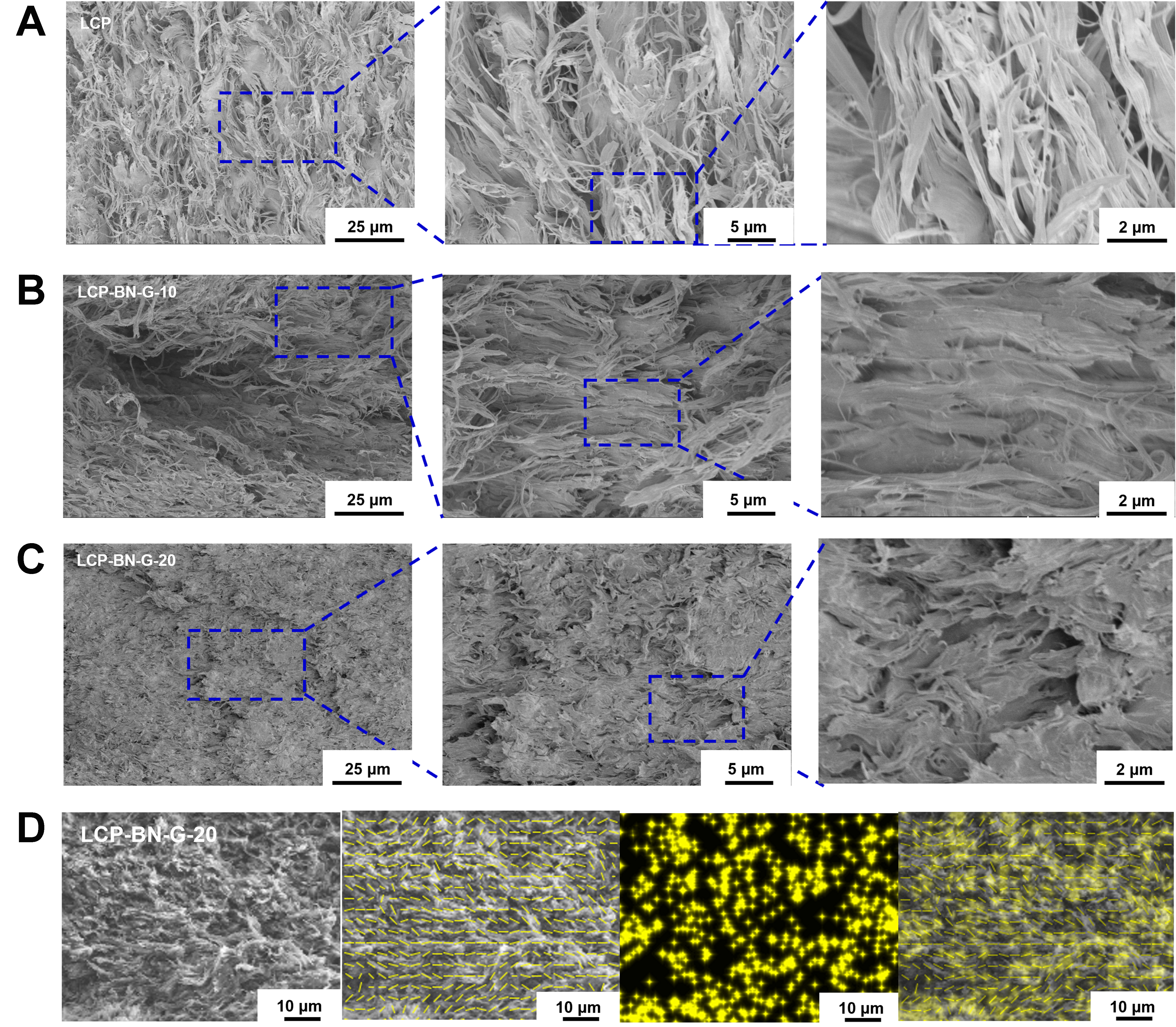
Figure 5. The surface characterizations of LCP-BN-Gs. The fracture surface micromorphology of (A) LCP, (B) LCP-BN-G-10, and (C) LCP-BN-G-20; (D) SEM morphology, microscale orientation distribution, EDS elemental mapping of boron, and their overlay for LCP-BN-G-20. LCP: Liquid crystal polyarylate; BN-G: functionalized boron nitride; SEM: scanning electron microscopy; EDS: energy-dispersive X-ray spectroscopy.
Notably, the distinct outline of sheet-like BN-G was not directly observed in the SEM images, possibly due to its small size and good interfacial compatibility with the resin. To further investigate the distribution of BN-G within the resin, energy-dispersive X-ray spectroscopy (EDS) was performed on the fracture surface of LCP-BN-G-20. This composite primarily consists of two phases: the polymer matrix (LCP) and the inorganic filler (BN-G). The distributions of C and O elements can indicate the resin matrix, while B and N elements correspond to BN-G. The overall elemental distribution maps of the fracture surface [Supplementary Figure 8] show that B and N signals are uniformly distributed throughout the matrix, indicating good dispersion of BN-G within the resin. This provides a structural basis for the superior thermal conductivity of LCP-BN-G-20. The large dark areas observed in the B and N distribution maps correspond to regions where C and O signals are also absent, primarily due to signal collection limitations caused by the uneven fracture surface, rather than uneven filler distribution. To examine the influence of nanofiber orientation on BN-G distribution, a highly oriented region was selected for further analysis [Figure 5D]. Orientation analysis of the SEM image was performed using the ImageJ plugin OrientationJ[46,47], generating a microscale orientation distribution map. Subsequently, the corresponding EDS elemental map of element B (with transparency adjusted to 65%) was overlaid with the orientation map. The overlay results show that the B-rich regions closely match the orientation features observed in the SEM image, confirming that element B exhibits a clear preferential alignment along a specific direction[48].
To evaluate the potential of LCP-BN-G composites for thermal management in high-power electronic devices, they were fabricated into thin films and placed at the base of an light-emitting diode (LED) bulb as a heat dissipation substrate [Figure 6A][49]. An LED with a rated power of 20 W and an active area of 25 mm × 27.5 mm was selected, and its surface temperature changes during operation were monitored in real time using an infrared thermal imager. To minimize the influence of contact thermal resistance, a thin layer of thermally conductive silicone grease was uniformly applied between all films and the heat sink, as well as between the films and the LED. Figure 6B displays the temperature-time curves of the LED surface when using different films as substrates, while Figure 6C provides a visual comparison of the heating and cooling processes for LCP, LCP-BN-G-10, and LCP-BN-G-20 over a 210 s period. When the bulb is turned on, heat accumulated rapidly, causing the LED surface temperature to rise significantly. Among the samples, the pure LCP film exhibited the highest heating rate, whereas LCP-BN-G-20 showed the lowest, indicating its higher thermal conductivity. Upon reaching thermal equilibrium, the LED surface temperature corresponding to LCP-BN-G-20 was only 104 °C. This represents a reduction of 8.6, 10.9, 14.7, and 27.5 °C compared to LCP-BN-G-15 (112.6 °C), LCP-BN-G-10 (114.9 °C), LCP-BN-G-5 (118.7 °C), and pure LCP (131.5 °C), respectively. Infrared thermographs further revealed that with pure LCP, the heat distribution was uneven, forming localized high-temperature zones due to insufficient heat dissipation. As the BN-G content increased, the heat distribution became more uniform, and the maximum temperature decreased significantly. This indicates that the introduction of BN-G formed continuous thermally conductive pathways in the in-plane direction, thereby accelerating and equalizing heat diffusion. In summary, the LCP-BN-G-20 composite exhibited excellent thermal management performance, effectively dissipating heat generated during device operation, which helps maintain operational stability and extend service life [Supplementary Figures 9 and 10]. An ideal schematic illustrating the evolution of heat flow within the LCP-BN-G composites before and after shear field application is provided [Figure 6D]. Under the influence of the shear field, BN-G aligns along the LCP orientation, forming an efficient thermally conductive network and promoting bridging between BN-G sheets, thereby constructing a stable thermally conductive structure. The comprehensive performance of this study is compared with previously published thermally conductive low-dielectric materials [Figure 6E], such as epoxy resin (EP), PI, polyphenylene sulfide (PPS), and polyethylene naphthalate (PEN)[50-53]. Among all compared materials, LCP-BN-G-20 exhibits the highest thermal conductivity and the lowest dielectric constant (3.36). Although its dissipation factor (Df = 0.014) and thermal stability (Td5% = 430 °C) are not the highest among the compared materials, they remain at a competitively good level. This well-balanced performance highlights the potential of LCP-BN-G-20 as a promising candidate for advanced electronic packaging applications.
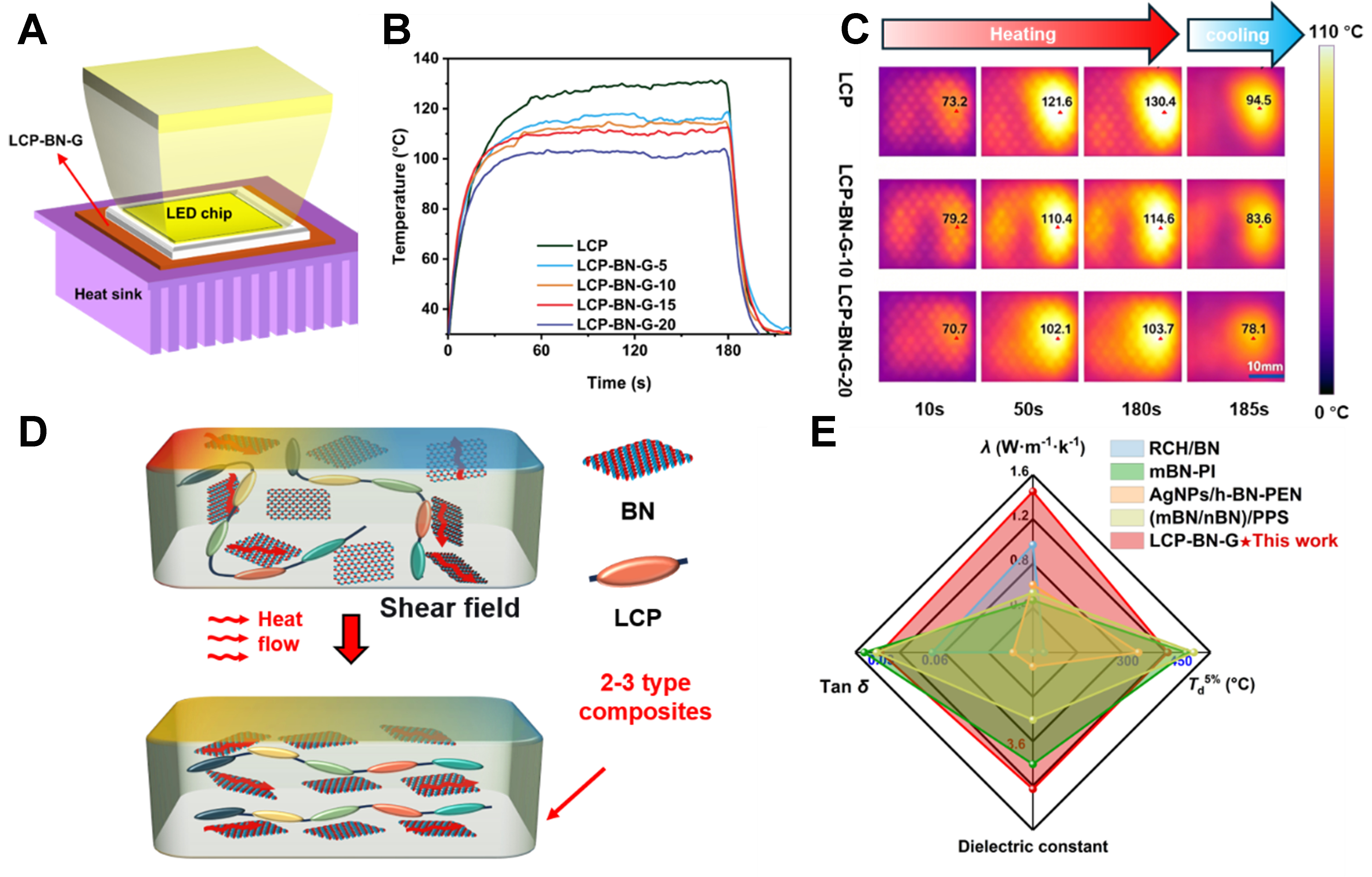
Figure 6. Application demonstration and performance evaluation of LCP-BN-Gs in thermal management. (A) Schematic diagram of the LED heat dissipation setup; (B) Evolution of the maximum temperature of LCP-BN-Gs over time; (C) Infrared thermal images of LCP-BN-Gs used as heat spreaders; (D) Schematic illustration of the thermal conduction pathway construction in LCP-BN-Gs; (E) Comprehensive performance comparison between LCP-BN-G-20 and other reported materials. LCP: Liquid crystal polyarylate; BN-G: functionalized boron nitride; LED: light-emitting diode; RCH: regenerated chitin; PI: polyimide; PEN: polyethylene naphthalate; PPS: polyphenylene sulfide.
CONCLUSION
In this work, a thermally conductive composite based on a LCP matrix and BN-G filler was successfully fabricated via melt blending. Benefiting from the liquid crystal orientation characteristics of the LCP matrix, BN-G aligned orderly along the orientation direction under shear field induction, forming 2-3 type composites with continuous in-plane thermally conductive pathways. The introduction of BN-G significantly enhanced the in-plane thermal conductivity of the composites. The LCP-BN-G-20 composite achieved an inplane thermal conductivity of 1.45 W·m-1·K-1, representing a 196.5% increase compared with pure LCP (0.489 W·m-1·K-1). XRD analysis revealed that the in-plane preferential alignment of BN-G reached 88.90% for the LCP-BN-G-15 composite. This ordering, together with the LCP matrix orientation of approximately 55% as determined by 2D-WAXS, provides the structural basis for efficient thermal pathways. Meanwhile, the composite exhibited a dielectric constant of 3.36 and a dissipation factor of 0.014 at 1 MHz. Overall, this composite strategy is based on the surface functionalization of the filler and the orientation behavior of the liquid crystal matrix. It fully harnesses the unique advantage of LCP orientation in inducing orderly alignment of BN-G, thereby effectively resolving the conflict between achieving high thermal conductivity and maintaining low dielectric loss in traditional thermally conductive composites.
DECLARATIONS
Authors’ contributions
Writing - original draft, visualization, validation, methodology, investigation, formal analysis, data curation, conceptualization: Guan, Q.; Liu, J.; Zhang, H.
Validation, investigation: Lu, J.; Liu, P.
Supervision, funding acquisition: Zhu, M; Qiao, X.; Lu, J.
Review and editing, supervision: Zhu, M.; You, Z.; Guan, Q.
Availability of data and materials
The data supporting the findings of this study are presented in this manuscript and Supplementary Materials.
AI and AI-assisted tools statement
Not applicable.
Financial support and sponsorship
This work was supported by the National Natural Science Foundation of China (T2550172, U25A20251, 52541029 and 52473004), the Science and Technology Commission of Shanghai Municipality (20DZ2254900), Manned Space Station Project: Space Science and Application Program (Project No. KJZ-YY-NJS0601), the Fundamental Research Funds for the Central Universities (2232024G-12), the Yangtze River Delta Sci-Tech Innovation Community Joint Research Program (Basic Research, 2025CSJZN00800), the Taishan Industrial Experts Program (NO.tscx202507143), Donghua University 2025 Cultivation Project of Discipline Innovation (xkcx-202521).
Conflicts of interest
Liu, P. is affiliated with NETZSCH Scientific Instruments (Shanghai) Co., Ltd., and You, Z. is affiliated with Shandong Inov Polyurethane Co., Ltd. Other authors have declared that they have no conflicts of interest.
Ethical approval and consent to participate
Not applicable.
Consent for publication
Not applicable.
Copyright
© The Author(s) 2026.
Supplementary Materials
REFERENCES
1. Yun, J. Recent progress in thermal management for flexible/wearable devices. Soft. Sci. 2023, 3, 12.
2. Wei, B.; Luo, W.; Du, J.; et al. Thermal interface materials: from fundamental research to applications. SusMat 2024, 4, e239.
3. Wang, S.; Ruan, K.; Guo, Y.; Kong, J.; Gu, J. Thermally conductive naphthalene epoxy resin by tailoring flexible chain length and liquid crystal structure. Angew. Chem. Int. Ed. Engl. 2025, 64, e202501459.
4. Zhou, X.; Min, P.; Liu, Y.; Jin, M.; Yu, Z. Z.; Zhang, H. B. Insulating electromagnetic-shielding silicone compound enables direct potting electronics. Science 2024, 385, 1205-10.
5. Yang, Z.; Sun, M.; Wang, J.; et al. Study on crystallization behavior and microstructure regulation of liquid crystal polymer films fabricated by rotational film blowing. Polym. Int. 2026, 75, 434-43.
6. Zahidul Islam, M.; Fu, Y.; Deb, H.; Khalid Hasan, M.; Dong, Y.; Shi, S. Polymer-based low dielectric constant and loss materials for high-speed communication network: dielectric constants and challenges. Eur. Polym. J. 2023, 200, 112543.
7. Ngo, I.; Jeon, S.; Byon, C. Thermal conductivity of transparent and flexible polymers containing fillers: a literature review. Int. J. Heat. Mass. Transf. 2016, 98, 219-26.
8. Kong, Q.; Zhang, J.; Zhang, K.; et al. Recyclable side-chain azobenzene-based semicrystalline polymer films with outstanding intrinsic thermal conductivity and photoresponsive actuation. Angew. Chem. Int. Ed. Engl. 2025, 64, e202512721.
9. Chen, J.; Huang, X.; Sun, B.; Jiang, P. Highly thermally conductive yet electrically insulating polymer/boron nitride nanosheets nanocomposite films for improved thermal management capability. ACS. Nano. 2019, 13, 337-45.
10. Liao, P.; He, H.; Guo, H.; et al. Highly thermally conductive boron nitride fiber. ACS. Nano. 2025, 19, 16043-52.
11. Guerra, V.; Wan, C.; Mcnally, T. Thermal conductivity of 2D nano-structured boron nitride (BN) and its composites with polymers. Prog. Mater. Sci. 2019, 100, 170-86.
12. Zhang, R.; Wang, Z.; Zhao, R.; et al. Construction of cellulose 3D network composite membrane supported by hydroxylated boron nitride with high surface charge density to achieve high-efficiency osmotic energy harvesting. Chem. Eng. J. 2024, 500, 157000.
13. Bashir, A.; Maqbool, M.; Lv, R.; et al. Surface modified boron nitride towards enhanced thermal and mechanical performance of thermoplastic polyurethane composite. Compos. Part. B. Eng. 2021, 218, 108871.
14. Peng, Z.; Guo, Q.; Zhang, L.; Li, C. High thermal conductivity and low dielectric polyimide nanocomposites using diamine-assisted mechanochemical exfoliation boron nitride and in-situ polymerization under pressure. Chem. Eng. J. 2024, 488, 150824.
15. Niu, T.; Zhang, Z.; Yi, Q.; Yang, Y. Interface engineering for synergistic achievement of enhanced thermal conductivity and suppressed dielectric loss of epoxy/boron nitride composite. High. Volt. 2025, 10, 1073-82.
16. Ruan, K.; Shi, X.; Zhang, Y.; Guo, Y.; Zhong, X.; Gu, J. Electric-field-induced alignment of functionalized carbon nanotubes inside thermally conductive liquid crystalline polyimide composite films. Angew. Chem. Int. Ed. Engl. 2023, 62, e202309010.
17. Pan, D.; Dong, J.; Yang, G.; et al. Ice template method assists in obtaining carbonized cellulose/boron nitride aerogel with 3D spatial network structure to enhance the thermal conductivity and flame retardancy of epoxy-based composites. Adv. Compos. Hybrid. Mater. 2022, 5, 58-70.
18. Feng, C.; Bai, L.; Bao, R.; et al. Electrically insulating POE/BN elastomeric composites with high through-plane thermal conductivity fabricated by two-roll milling and hot compression. Adv. Compos. Hybrid. Mater. 2018, 1, 160-7.
19. Ma, X.; Zhang, H.; Guo, Y.; et al. Enhancing thermal conductivity in polysiloxane composites through synergistic design of liquid crystals and boron nitride nanosheets. J. Mater. Sci. Technol. 2025, 231, 54-61.
20. Luo, F.; Yang, S.; Yan, P.; et al. Orientation behavior and thermal conductivity of liquid crystal polymer composites based on three-dimensional printing. Compos. Part. A. Appl. Sci. Manuf. 2022, 160, 107059.
21. Ruan, K.; Li, M.; Pang, Y.; et al. Molecular brush‐grafted liquid crystalline hetero‐structured fillers for boosting thermal conductivity of polyimide composite films. Adv. Funct. Mater. 2025, 35, 2506563.
22. Wang, W.; Cheng, W.; Liu, F.; et al. Hollow cholesteric liquid crystal elastomer fiber with synergistically enhanced resilience and mechanochromic sensitivity. Adv. Sci. 2025, 12, e04487.
23. Luo, K.; Peng, T.; Zheng, Y.; et al. High performance and reprocessable in situ generated nanofiber reinforced composites based on liquid crystal polyarylate. Adv. Mater. 2024, 36, e2312500.
24. Lin, Z.; Li, J.; Sun, Z.; et al. Facile chemical surface modification of boron nitride platelets and improved thermal and mechanical properties of their polymer compounds for 2.5D/3D packaging applications. Compos. Sci. Technol. 2024, 256, 110778.
25. Zhao, T.; Gao, J.; Zheng, Y.; et al. High-temperature enhancing triboelectric nanogenerator based on antioxidant liquid crystalline polyarylate. Adv. Mater. 2025, 37, e2510431.
26. Wu, K.; Wang, J.; Liu, D.; et al. Highly thermoconductive, thermostable, and super-flexible film by engineering 1D rigid rod-like aramid nanofiber/2D boron nitride nanosheets. Adv. Mater. 2020, 32, e1906939.
27. Lei, W.; Mochalin, V. N.; Liu, D.; Qin, S.; Gogotsi, Y.; Chen, Y. Boron nitride colloidal solutions, ultralight aerogels and freestanding membranes through one-step exfoliation and functionalization. Nat. Commun. 2015, 6, 8849.
28. Erdogan, O.; Abbak, M.; Demirbolat, G. M.; et al. Green synthesis of silver nanoparticles via Cynara scolymus leaf extracts: the characterization, anticancer potential with photodynamic therapy in MCF7 cells. PLoS. One. 2019, 14, e0216496.
29. Tian, X.; Wu, N.; Zhang, B.; Wang, Y.; Geng, Z.; Li, Y. Glycine functionalized boron nitride nanosheets with improved dispersibility and enhanced interaction with matrix for thermal composites. Chem. Eng. J. 2021, 408, 127360.
30. Liu, Z.; Li, J.; Liu, X. Novel functionalized BN nanosheets/epoxy composites with advanced thermal conductivity and mechanical properties. ACS. Appl. Mater. Interfaces. 2020, 12, 6503-15.
31. Hafeez, A.; Karim, Z. A.; Ismail, A. F.; Samavati, A.; Said, K. A. M.; Selambakkannu, S. Functionalized boron nitride composite ultrafiltration membrane for dye removal from aqueous solution. J. Membr. Sci. 2020, 612, 118473.
32. Ali Ahamed, S. Z.; Dillip, G.; Raghavaiah, P.; Mallikarjuna, K.; Deva Prasad Raju, B. Spectroscopic and thermal studies of γ-glycine crystal grown from potassium bromide for optoelectronic applications. Arab. J. Chem. 2013, 6, 429-33.
33. Yang, D.; Velamakanni, A.; Bozoklu, G.; et al. Chemical analysis of graphene oxide films after heat and chemical treatments by X-ray photoelectron and micro-Raman spectroscopy. Carbon 2009, 47, 145-52.
34. Yang, X.; Tang, H.; Li, Y.; et al. Synthesis, characterization, and thermal pyrolysis mechanism of high temperature resistant phenolphthalein-based poly (arylene ether nitrile). Polym. Degrad. Stab. 2024, 224, 110754.
35. Kamal, T.; Shin, T. J.; Park, S. Uniaxial tensile deformation of poly(ε-caprolactone) studied with SAXS and WAXS techniques using synchrotron radiation. Macromolecules 2012, 45, 8752-9.
36. He, H.; Peng, W.; Liu, J.; et al. Microstructured BN composites with internally designed high thermal conductivity paths for 3D electronic packaging. Adv. Mater. 2022, 34, e2205120.
37. Yuan, C.; Duan, B.; Li, L.; Xie, B.; Huang, M.; Luo, X. Thermal conductivity of polymer-based composites with magnetic aligned hexagonal boron nitride platelets. ACS. Appl. Mater. Interfaces. 2015, 7, 13000-6.
38. Zhi, C.; Bando, Y.; Tan, C.; Golberg, D. Effective precursor for high yield synthesis of pure BN nanotubes. Solid. State. Commun. 2005, 135, 67-70.
39. Cuenca, J. A.; Mandal, S.; Morgan, D. J.; Snowball, M.; Porch, A.; Williams, O. A. Dielectric spectroscopy of hydrogen-treated hexagonal boron nitride ceramics. ACS. Appl. Electron. Mater. 2020, 2, 1193-202.
40. Li, X.; Weng, L.; Wang, X.; et al. 200 °C‐stable dielectric polymer enabled by molecular‐scale carrier trapping: synergy of steric hindrance and deep energy level engineering. Adv. Funct. Mater. 2026, 36, e12257.
41. Huang, X.; Zhi, C.; Jiang, P.; Golberg, D.; Bando, Y.; Tanaka, T. Polyhedral oligosilsesquioxane‐modified boron nitride nanotube based epoxy nanocomposites: an ideal dielectric material with high thermal conductivity. Adv. Funct. Mater. 2013, 23, 1824-31.
42. Wang, X.; Gao, F.; Zhao, H.; et al. Polymer‐based dielectric composite films with excellent dielectric energy storage and thermal management capabilities. Adv. Funct. Mater. 2026, 36, e12371.
43. Kader, M. A.; Lyu, M.; Nah, C. A study on melt processing and thermal properties of fluoroelastomer nanocomposites. Compos. Sci. Technol. 2006, 66, 1431-43.
44. Rueda, M. M.; Auscher, M.; Fulchiron, R.; et al. Rheology and applications of highly filled polymers: a review of current understanding. Prog. Polym. Sci. 2017, 66, 22-53.
45. Lin, Y.; Li, P.; Liu, W.; et al. Application-driven high-thermal-conductivity polymer nanocomposites. ACS. Nano. 2024, 18, 3851-70.
46. Morrill, E. E.; Tulepbergenov, A. N.; Stender, C. J.; Lamichhane, R.; Brown, R. J.; Lujan, T. J. A validated software application to measure fiber organization in soft tissue. Biomech. Model. Mechanobiol. 2016, 15, 1467-78.
47. Liu, Z. Q. Scale space approach to directional analysis of images. Appl. Opt. 1991, 30, 1369-73.
48. Ghasemi, S.; Rahimzadeh-Bajgiran, P.; Tajvidi, M.; Shaler, S. M. Birefringence-based orientation mapping of cellulose nanofibrils in thin films. Cellulose 2020, 27, 677-92.
49. Yan, Q.; Dai, W.; Gao, J.; et al. Ultrahigh-aspect-ratio boron nitride nanosheets leading to superhigh in-plane thermal conductivity of foldable heat spreader. ACS. Nano. 2021, 15, 6489-98.
50. Zhan, Y.; Ren, Y.; Wan, X.; Zhang, J.; Zhang, S. Dielectric thermally conductive and stable poly(arylene ether nitrile) composites filled with silver nanoparticles decorated hexagonal boron nitride. Ceram. Int. 2018, 44, 2021-9.
51. Gu, J.; Lv, Z.; Wu, Y.; et al. Dielectric thermally conductive boron nitride/polyimide composites with outstanding thermal stabilities via in-situ polymerization-electrospinning-hot press method. Compos. Part. A. Appl. Sci. Manuf. 2017, 94, 209-16.
52. Wang, J.; Chen, H.; Li, X.; et al. Flexible dielectric film with high energy density based on chitin/boron nitride nanosheets. Chem. Eng. J. 2020, 383, 123147.
Cite This Article
 Open Access
How to Cite
Download Citation
Export Citation File:
Type of Import
Tips on Downloading Citation
Citation Manager File Format
Type of Import
Direct Import: When the Direct Import option is selected (the default state), a dialogue box will give you the option to Save or Open the downloaded citation data. Choosing Open will either launch your citation manager or give you a choice of applications with which to use the metadata. The Save option saves the file locally for later use.
Indirect Import: When the Indirect Import option is selected, the metadata is displayed and may be copied and pasted as needed.
About This Article
Copyright

Data & Comments
Data
0










Comments
Comments must be written in English. Spam, offensive content, impersonation, and private information will not be permitted. If any comment is reported and identified as inappropriate content by OAE staff, the comment will be removed without notice. If you have any queries or need any help, please contact us at [email protected].