
fig2
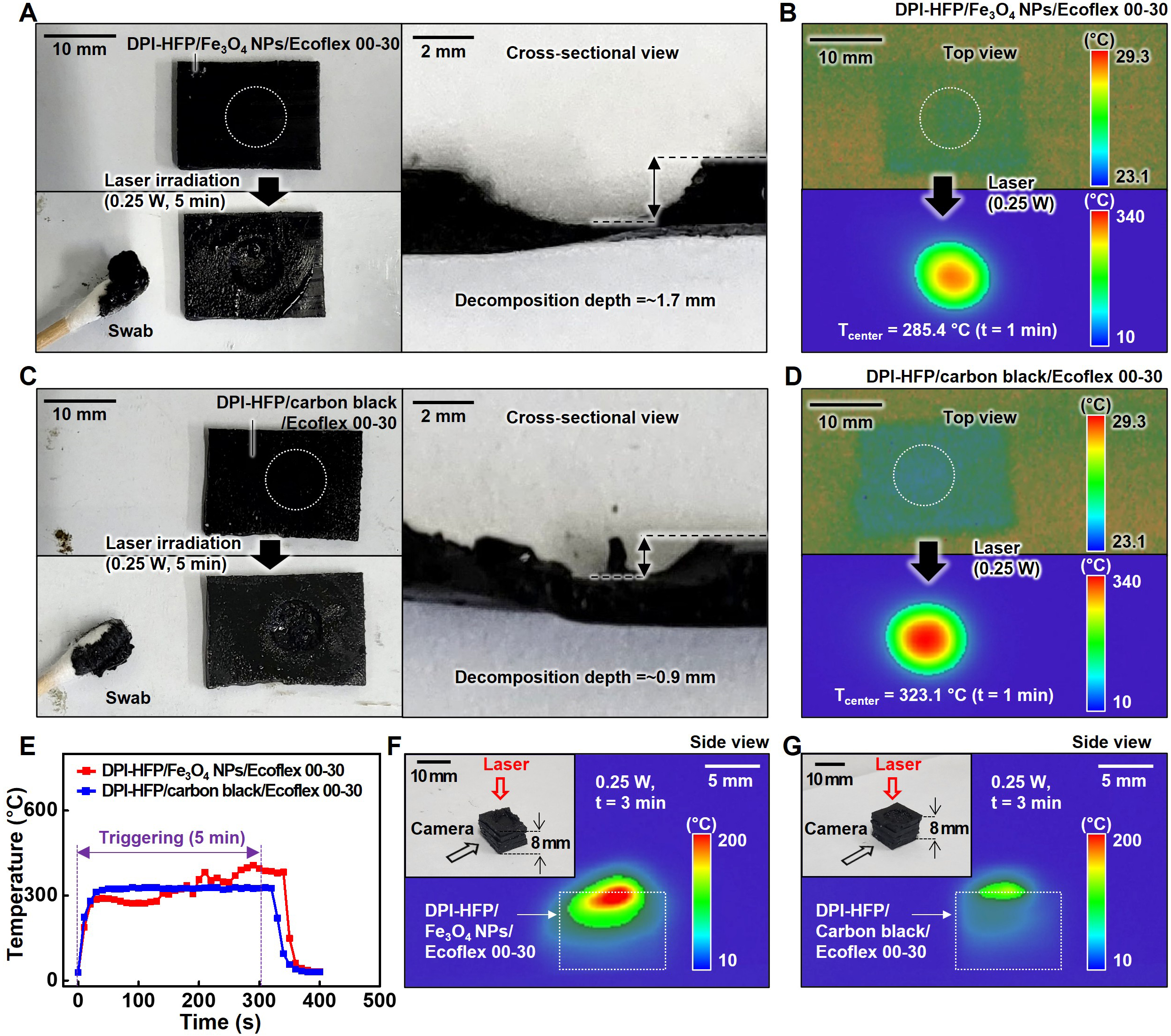
Figure 2. Comparison of decomposition efficiency of Fe3O4 NPs-based and carbon black-based silicone composites. (A) Morphological images of DPI-HFP/Fe3O4 NPs (1.00 wt.%)/Ecoflex 00-30 sheets before (top left) and after (bottom left, top view; right, cross-sectional view) laser exposure (5 min); (B) Thermographic images of DPI-HFP/Fe3O4 NPs/Ecoflex 00-30 sheets before (top) and after (bottom) laser exposure (1 min); (C) Morphological images of DPI-HFP/carbon black (1.00 wt.%)/Ecoflex 00-30 sheets before (top left) and after (bottom left, top view; right, cross-sectional view) laser exposure (5 min); (D) Thermographic images of DPI-HFP/carbon black/Ecoflex 00-30 sheets before (top) and after (bottom) laser exposure (1 min); (E) Temperature profile of the silicone composites during 5 minutes of laser triggering (DPI-HFP/Fe3O4 NPs/Ecoflex 00-30, red; DPI-HFP/carbon black/Ecoflex 00-30, blue). Side-view thermographic images of (F) DPI-HFP/Fe3O4 NPs/Ecoflex 00-30 and (G) DPI-HFP/carbon black/Ecoflex 00-30 taken 3 min after laser triggering. [Thickness of sheets: (A-D), 2 mm; (F and G) 8 mm; Laser condition: spot size = 8 mm (diameter), laser power = 0.25 W, λ = 800 nm, pulse width = ~ 100 fs]. NP: Nanoparticle; DPI-HFP: diphenyliodonium hexafluorophosphate.