

fig7
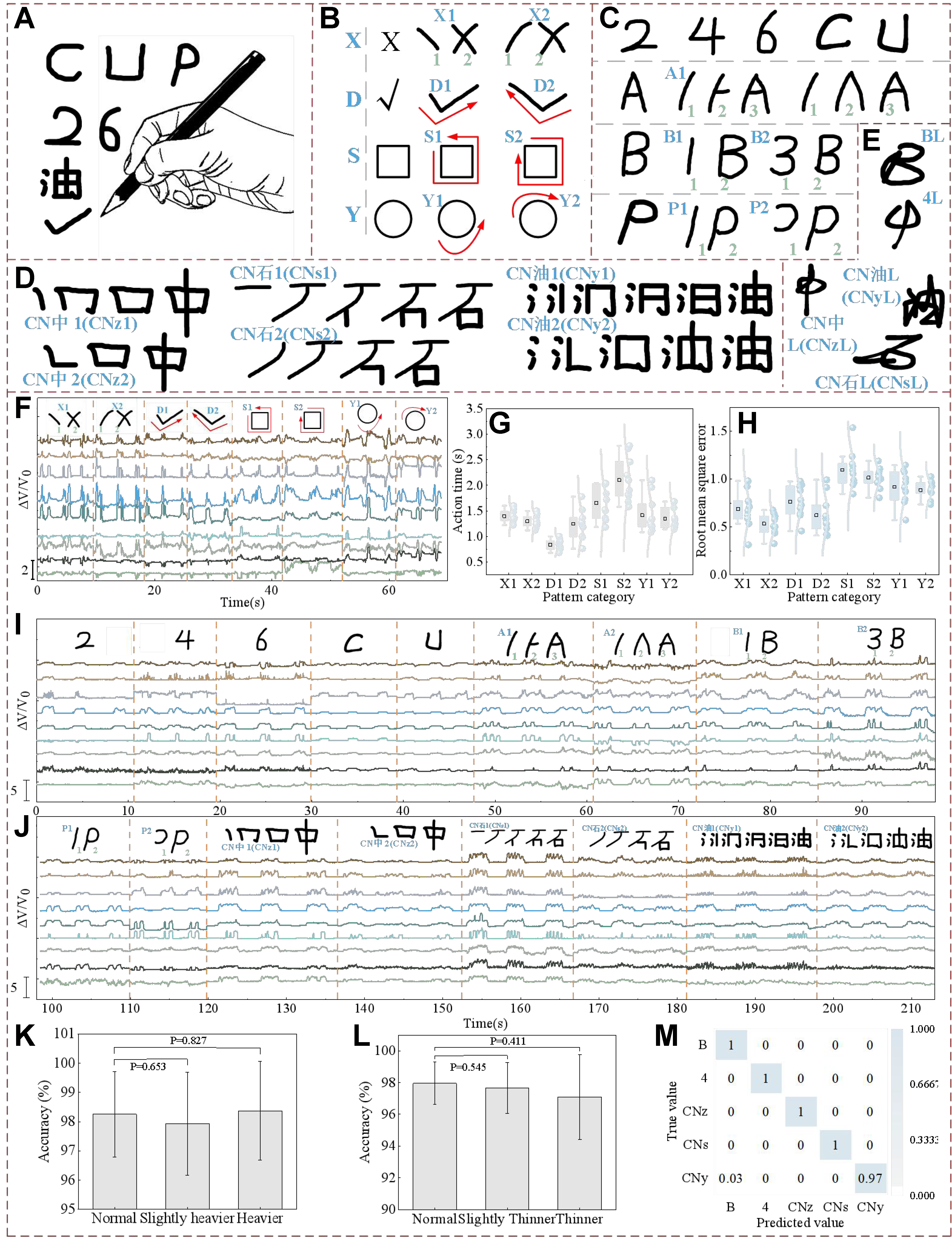
Figure 7. Writing-recognition results. (A) Schematic showing the writing of different words; (B) Writing symbols in different stroke orders; (C) Writing different numbers and letters; (D) Writing Chinese characters using different stroke orders; (E) Writing numbers, letters, and Chinese characters using a continuous stroke. Here, “中”, “石”, and “油” are Chinese characters, abbreviated as “CNz”, “CNs”, and “CNy”, respectively. The numbers “1” and “2” represent different writing orders, and “L” represents cursive writing; (F) Response curves of each channel for symbols written using different stroke orders; (G) Action time for writing symbols using different stroke orders; (H) RMS for writing symbols using different stroke orders; (I and J) Response curves of each channel for writing numbers, letters, and Chinese characters using different stroke orders; Recognition accuracy of different characters under different pen (K) weight and (L) thickness conditions. The error bars represent the SD obtained from a five-fold cross-validation (n = 5). Data are presented as mean ± SD. Statistical analysis was performed using MATLAB R2023b (MathWorks, Natick, MA, USA). Paired t-tests were conducted based on matched cross-validation folds; (M) Confusion matrices for classifying different words during writing. RMS: Root-mean-square; SD: standard deviation.