

fig8
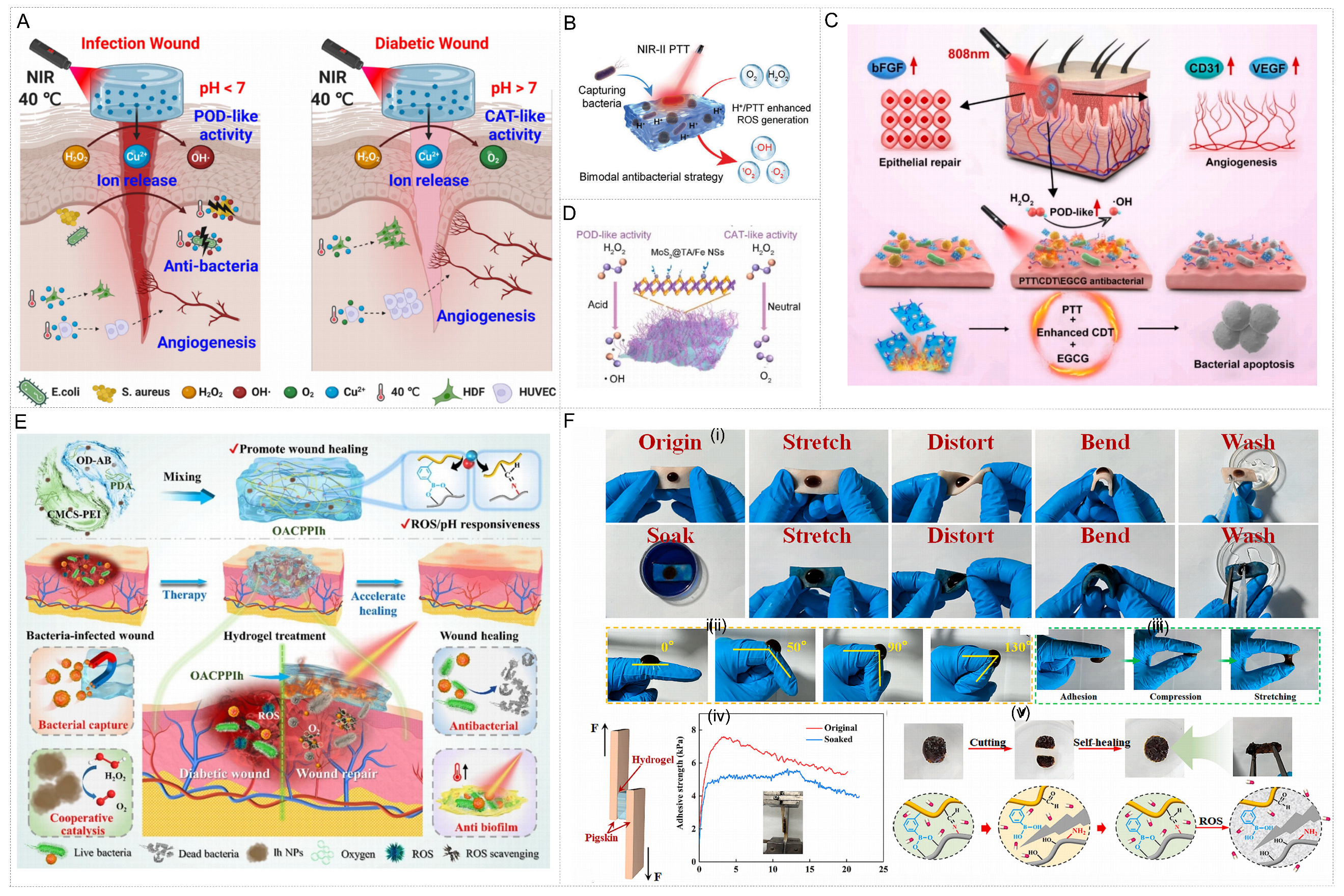
Figure 8. External environment-triggered metal nanozyme-hydrogel systems for antibacterial therapy and infected wound healing. (A) Multifunctional, pH-switchable CuP nanozyme-composite alginate hydrogel exhibiting mild photothermal-enhanced catalytic activity and therapeutic ion release, significantly accelerating the healing of various refractory wounds. Reproduced with permission from Ref.[125]. Copyright 2023, American Chemical Society; (B) Schematic illustration of the antibacterial effect of the hydrogel. Reproduced with permission from Ref.[127]. Copyright 2023, Wiley; (C) Schematic illustration of a NIR-responsive nanozyme-hydrogel combines ROS generation, photothermal effects, antibacterial activity and antioxidation to promote healing of bacteria-infected wounds. Reproduced with permission from Ref.[128]. Copyright 2025, Elsevier; (D) Schematic diagram of the MoS2@TA/Fe NSs’ POD- and CAT-like activities. Reproduced with permission from Ref.[131]. Copyright 2022, Elsevier; Figure 8D is reproduced from (Li, Y., 2022) under the CC BY-NC-ND license. No modifications were made; (E) Stimuli-responsive hydrogel dressings integrating bacterial-trapping, antimicrobial, and antibiofilm functions to accelerate wound healing. Reproduced with permission from Ref.[132]. Copyright 2025, Elsevier; (F) The adhesion, rheological properties and microstructure of the hydrogel. Reproduced with permission from Ref.[132]. Copyright 2025, Elsevier. NIR: Near-infrared; ROS: reactive oxygen species; NSs: nanozymes; POD: peroxidase; CAT: catalase; PTT: photothermal; bFGF: basic fibroblast growth factor; CDT: chemodynamic therapy; EGCG: epigallocatechin gallate; OD-AB: modified dextran; PDA: polydopamine; CMCS-PEI: carboxymethyl chitosan - polyethylenimine; OACPPIh: developed using OD-AB, CMCS-PEI, PDA, and iron-hydrated nanoparticles; NPs: nanoparticles.