
fig2
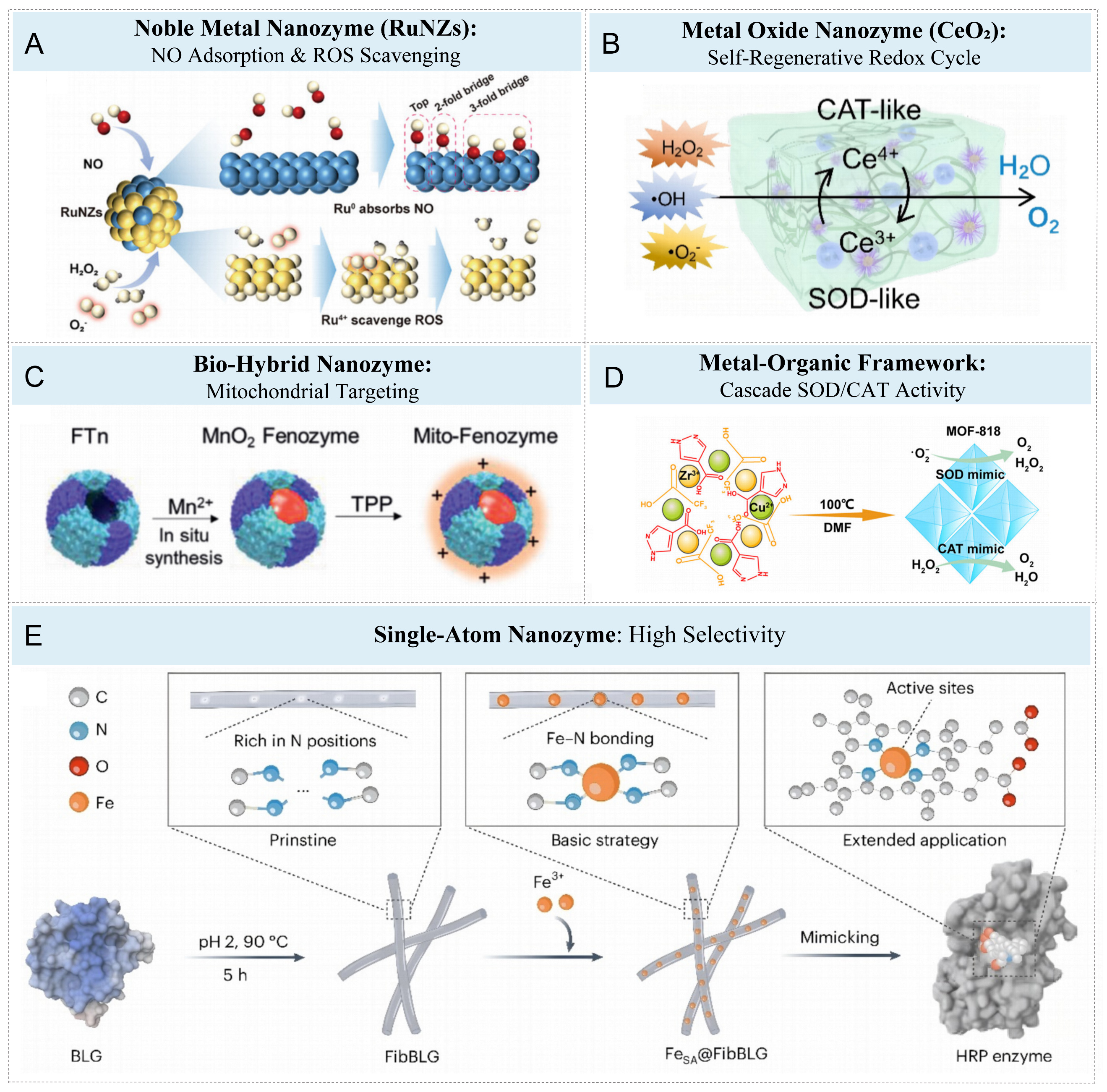
Figure 2. Engineering strategies and functional mechanisms of metallic nanozymes in metal nanozyme-hydrogel systems. (A) Noble Metal Nanozyme: Schematic illustration of the RuNZs’ multienzymatic activities, highlighting NO adsorption at Ru0 sites and ROS scavenging mediated by Ru4+ centers. Reproduced with permission from Ref.[29]. Copyright 2024, Wiley; (B) Metal Oxide Nanozyme: Schematic representation of the ROS-scavenging performance of F/Rgel. Reproduced with permission from Ref.[33]. Copyright 2025, Nature; Figure 2B is reproduced from (Zhang, F., 2025) under the CC BY-NC-ND license. No modifications were made; (C) Bio-Hybrid Nanozyme: Schematic illustration of the preparation of Mito-Fenozyme. Reproduced with permission from Ref.[34]. Copyright 2021, Wiley; (D) Metal-Organic Framework: Schematic illustration of the preparation of the MOF. Reproduced with permission from Ref.[45]. Copyright 2022, American Chemical Society; (E) Single-Atom Nanozyme: Illustration depicting the synthesis process of FeSA@FibBLG. Reproduced with permission from Ref.[47]. Copyright 2024, Nature. ROS: Reactive oxygen species; MOF: metal-organic framework; FeSA@FibBLG: single-iron atom-anchored amyloid hydrogel catalytic platform based on β -lactoglobulin self-assembled fibers; NZs: nanozymes; CAT: catalase; SOD: superoxide dismutase; FTn: ferritin; TPP: triphenylphosphonium; DMF: N,N-dimethylformamide; BLG: β-lactoglobulin; FibBLG: nitrogen-rich site fiber structure; HRP: horseradish peroxidase.