

fig6
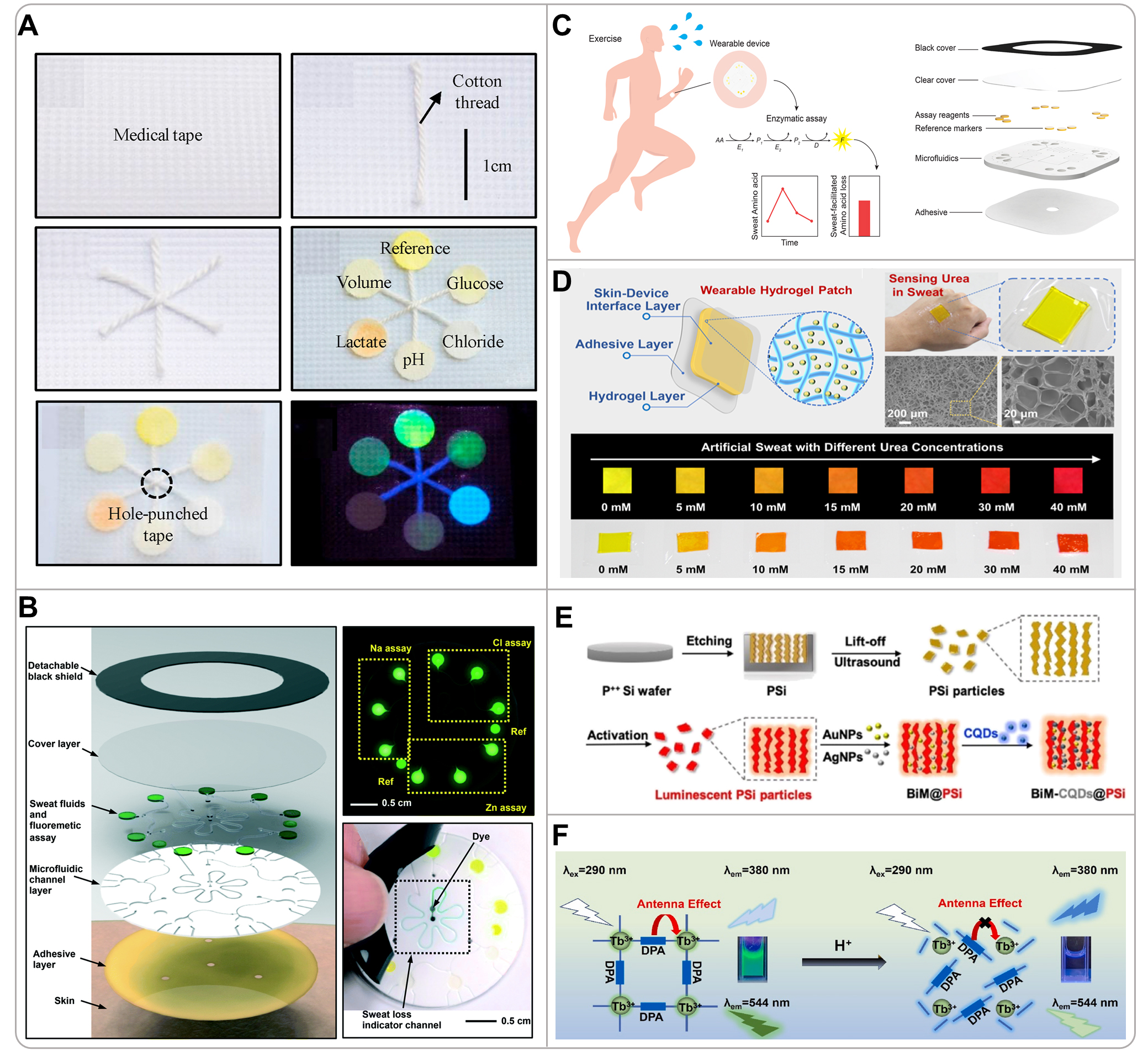
Figure 6. (A) Digital photograph of the IoT-integrated cellulose microfluidic fluorescent patch constructed from medical tape, cotton thread, and paper. Reproduced with permission[79]. Copyright 2020, Elsevier; (B) Schematic of a microfluidic platform with in situ fluorescence analysis: collection and retention of chloride, sodium, and zinc with corresponding chemical-probe fluorescence signals. Reproduced with permission[102]. Copyright 2018, The Royal Society of Chemistry; (C) Schematic representation of a soft microfluidic device for fluorescent measurement of amino acid concentrations in sweat via enzymatic reactions. Reproduced with permission[103]. Copyright 2025, The Royal Society of Chemistry; (D) Schematic illustration of the fabrication of a wearable hydrogel sensing patch embedded with upconversion optical probes and its multichromatic response to urea by inner-filter effect. Reproduced with permission[54]. Copyright 2023, American Chemical Society; (E) Schematic representation of the process of luminescent silicon-loaded carbon quantum dots and bimetallic nanoparticles for red-to-blue fluorescence detection of glucose in sweat. Reproduced with permission[104]. Copyright 2020, American Chemical Society; (F) Schematic diagram of the principle of Tb-DPA MOF-based detection of human sweat pH. Reproduced with permission[105]. Copyright 2024, Elsevier. CQD: Carbon quantum dot; DPA: 2,6-pyridinedicarboxylic acid; IoT: internet of things; MOF: metal-organic framework.