

fig6
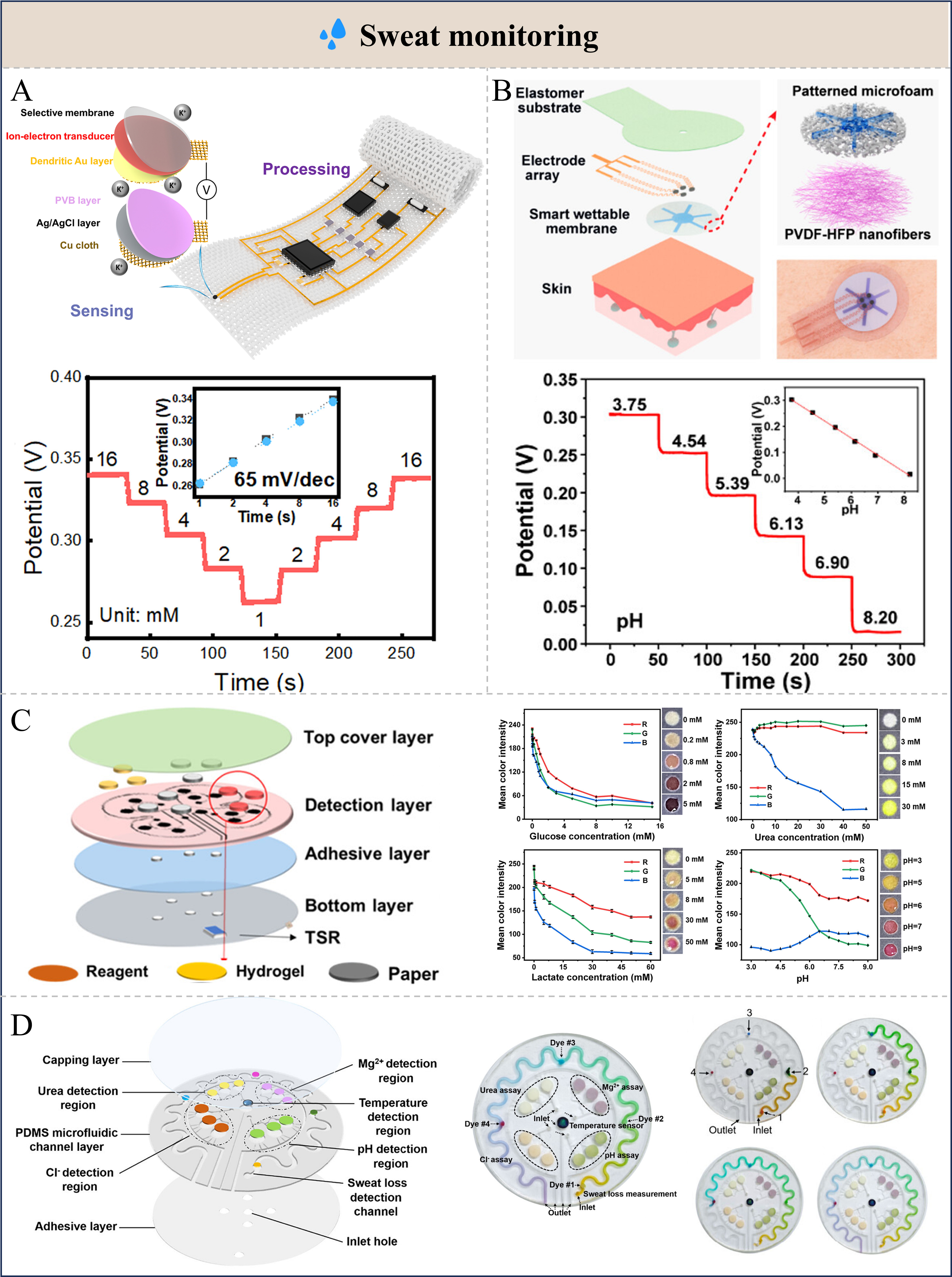
Figure 6. Sensors for sweat monitoring and their performance. (A) Schematic of textile wristband for wireless sweat analysis and the response of the K+ sensor to different K+ concentrations. Reproduced with permission[173]. Copyright 2018, American Association for the Advancement of Science; (B) Schematic illustration and optical image of a sweat-sensing patch attached to the skin and the sensors show open-circuit potentials in physiologically relevant analytes in the range of 3.75 to 8.20 pH. Reproduced with permission[175]. Copyright 2024, American Chemical Society; (C) Illustration of the composition of the sweat sensor and its color and RGB responses of the colorimetric sensing units toward glucose, lactate, urea, and pH. Reproduced with permission[177]. Copyright 2022, American Chemical Society; (D) Illustrates the three-dimensional schematic structure of the flexible multifunctional microfluidic colorimetric detection device and photographs of the microfluidic detection device after the sweat reached different positions. Reproduced with permission[178]. Copyright 2025, American Chemical Society. RGB: Red, green, blue; PVB: polyvinyl Butyral; PVDF-HFP: poly(vinylidene fluoride-co-hexafluoropropylene); TSR: temperature-sensitive resistor; PDMS: polydimethylsiloxane.