fig3
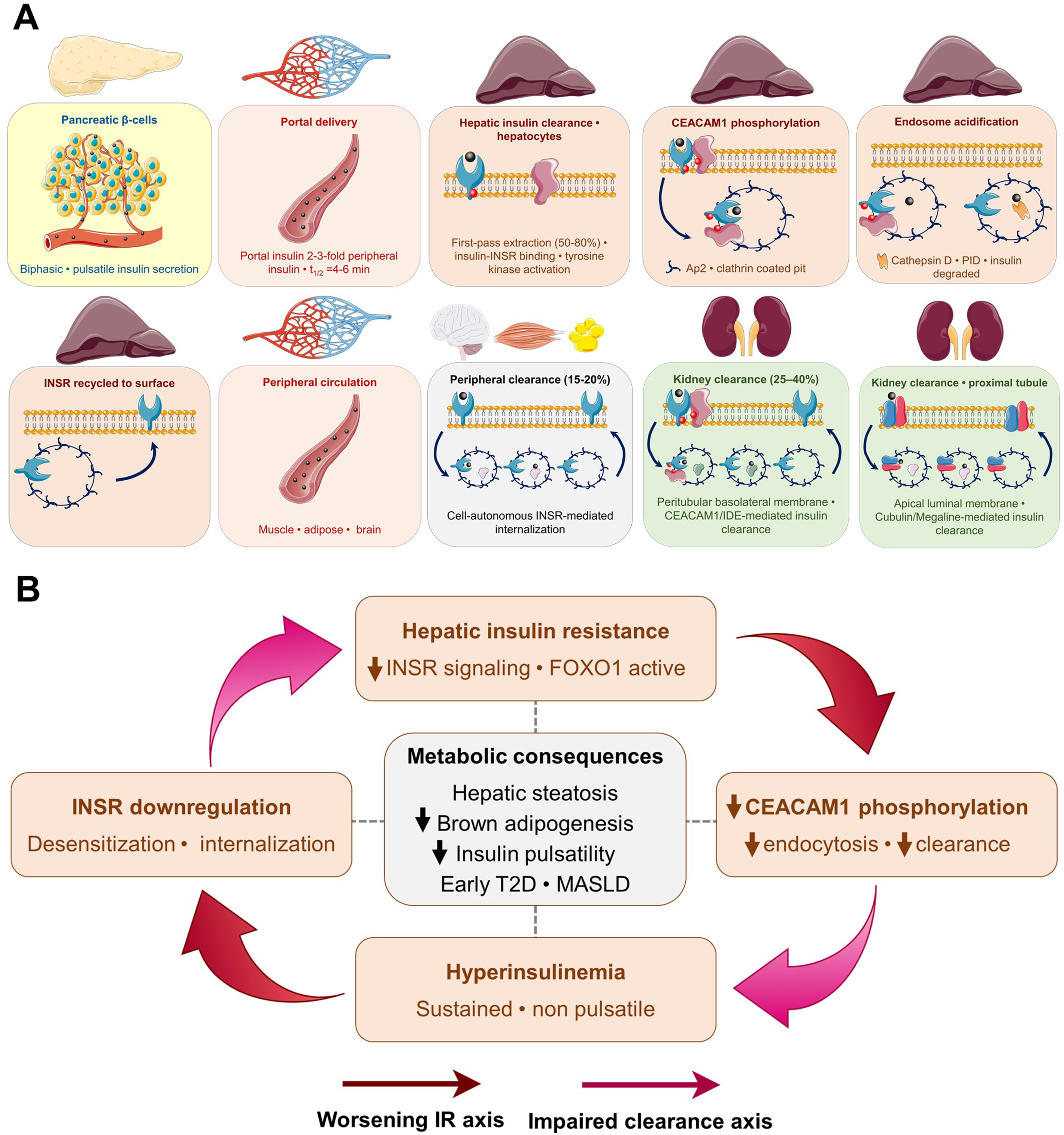
Figure 3. Hepatic insulin clearance and the clearance-resistance loop. (A) Hepatic insulin clearance. Portal delivery, receptor-mediated endocytosis, and consequences of impaired clearance. Under physiological conditions, insulin secreted in a biphasic, pulsatile pattern by pancreatic β-cells enters the portal venous system, establishing a portal-to-peripheral insulin gradient. Upon reaching the liver, 50%-80% of portal insulin is extracted during the first pass via receptor-mediated endocytosis in hepatocytes. Insulin binding to the INSR activates tyrosine kinase signaling, which phosphorylates CEACAM1; the phosphorylated CEACAM1-INSR-insulin complex is recruited to clathrin-coated pits via AP2 and internalized into acidified endosomes, where insulin is degraded by IDE, CTSD, and PDI, while the INSR is recycled to the plasma membrane. The residual ~20-50% of insulin reaches the peripheral circulation, where muscle, adipose tissue, brain, and erythrocytes contribute to disposal; Beyond hepatic extraction, renal clearance contributes substantially to systemic insulin disposal via megalin-mediated reabsorption and IDE-dependent degradation in proximal tubule cells. The exact quantification of this renal contribution typically varies depending on the specific physiological context and the methodologies employed, though it consistently represents a major secondary clearance pathway. This high hepatic exposure to portal insulin directly drives the suppression of HGP, the regulation of lipogenesis, and the activation of glycogen synthesis, while simultaneous hepatic clearance subsequently limits systemic hyperinsulinemia. Conditions that impair hepatic clearance - including downregulation of CEACAM1, hepatic steatosis, obesity, and high-fat feeding - disrupt this axis and promote chronic hyperinsulinemia, peripheral insulin resistance, and MASLD. Subcutaneous insulin administration bypasses the portal route, abolishing the portal-to-peripheral gradient and resulting in relative hepatic under-insulinization alongside peripheral hyperinsulinemia; (B) The clearance-resistance loop. Pathological feedback between hepatic IR and impaired insulin clearance. Hepatic insulin resistance reduces INSR kinase activity and CEACAM1 phosphorylation, impairing receptor-mediated endocytosis and lowering hepatic insulin clearance. The resulting chronic hyperinsulinemia desensitizes and promotes INSR downregulation, further worsening hepatic insulin signaling and completing a self-reinforcing feedback cycle. Each node of this loop independently contributes to a common set of metabolic consequences (central panel). This clearance-resistance loop may represent an underappreciated and early driver of metabolic deterioration, operating independently of primary defects in β-cell secretory capacity. CEACAM1: Carcinoembryonic antigen-related cell adhesion molecule 1; INSR: insulin receptor; AP2: adaptor protein 2; IDE: insulin-degrading enzyme; CTSD: cathepsin D; PDI: protein disulfide isomerase; HGP: hepatic glucose production; MASLD: metabolic dysfunction-associated steatotic liver disease; IR: insulin resistance; T2D: type 2 diabetes.