
fig2
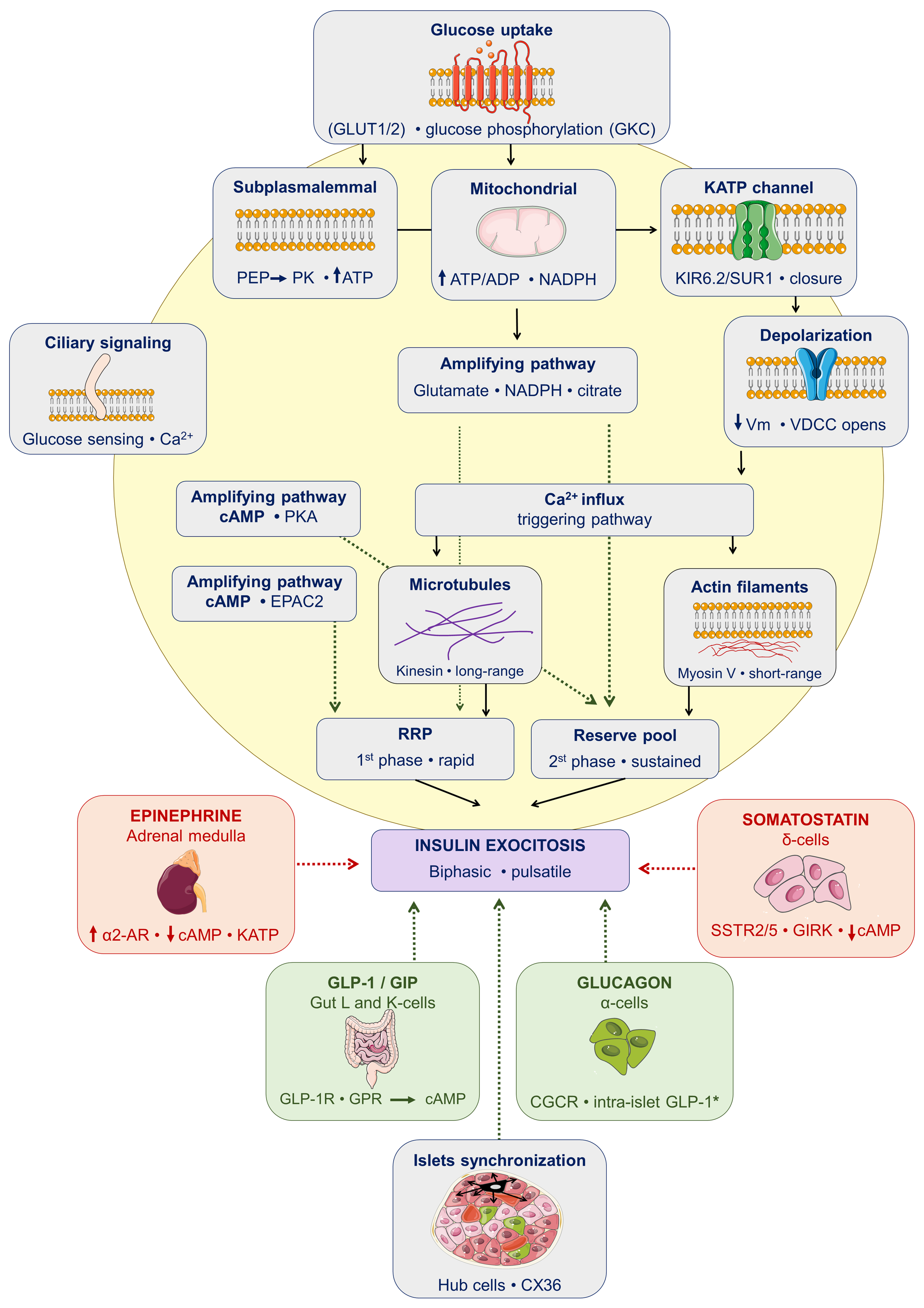
Figure 2. Paracrine, endocrine, and intracellular regulation of insulin secretion in pancreatic β-cells. The diagram distinguishes three tiers of regulatory input converging on the β-cell (yellow). Within the islet, α-cells provide paracrine stimulation via glucagon acting on GCGR to activate the cAMP-PKA-EPAC2 axis; under conditions of metabolic stress, α-cells also generate GLP-1* through alternative proglucagon processing by PC1/3, which acts on β-cell GLP-1 receptors. δ-cells exert tonic paracrine inhibition through somatostatin, which suppresses cAMP production and hyperpolarizes the β-cell membrane via SSTR2/5-coupled GIRK channels. Systemic endocrine signals include gut-derived incretins GLP-1 and GIP, which amplify GSIS through Gs-coupled receptor signaling; epinephrine, released from the adrenal medulla, inhibits secretion via α2-adrenergic receptors by suppressing cAMP and promoting KATP channel opening. Gap junction coupling through CX36 among hub and follower β-cells coordinates calcium oscillations across the islet syncytium, while primary cilia contribute to glucose sensing and intracellular Ca2+ coordination. Within the β-cell, glucose enters via GLUT1/2 and is phosphorylated by GCK, initiating glycolytic and mitochondrial flux that raises the cytoplasmic ATP/ADP ratio. Subplasmalemmal ATP is additionally supplied by PEP-dependent PK activity. Together these signals drive KATP channel closure (KIR6.2/SUR1), membrane depolarization, VDCC activation, and Ca2+ influx, the triggering pathway. An amplifying pathway, acting independently of KATP, enhances exocytosis through MCF (NADPH, glutamate, citrate) and cAMP-PKA-EPAC2 signaling. Insulin granule mobilization requires sequential cytoskeletal remodeling: kinesin-driven long-range transport along microtubules followed by myosin V-mediated short-range delivery along actin filaments. Granules from the RRP are released rapidly in the first secretory phase; RP granules sustain the prolonged second phase. The resulting biphasic, pulsatile insulin output is delivered to the portal circulation. Dashed green arrows, stimulatory; dashed red arrows, inhibitory. GLUT1/2: Glucose transporter 1/2; GCK: glucokinase; KATP: ATP-sensitive potassium channel; PEP: phosphoenolpyruvate; PK: pyruvate kinase; tATP: total ATP; ATP: adenosine triphosphate; ADP: adenosine diphosphate; NADPH: reduced nicotinamide adenine dinucleotide phosphate; KIR6.2: potassium inwardly rectifying channel subfamily J member 11; SUR1: sulfonylurea receptor 1; VDCC: voltage-dependent calcium channel; cAMP: cyclic adenosine monophosphate; PKA: protein kinase A; EPAC2: exchange protein directly activated by cAMP 2; RRP: readily releasable pool; RP: reserve pool; AR: adrenergic receptor; SSTR2/5: somatostatin receptor 2/5; GIRK: G protein-gated inwardly rectifying potassium channel; GLP-1: glucagon-like peptide-1; GIP: glucose-dependent insulinotropic polypeptide; GLP-1R: glucagon-like peptide-1 receptor; GPR: G protein-coupled receptor; GCGR: glucagon receptor; PC1/3: proprotein convertase 1/3; CX36: connexin 36; GSIS: glucose-stimulated insulin secretion; MCF: mitochondria-derived metabolic coupling factors.