

fig8
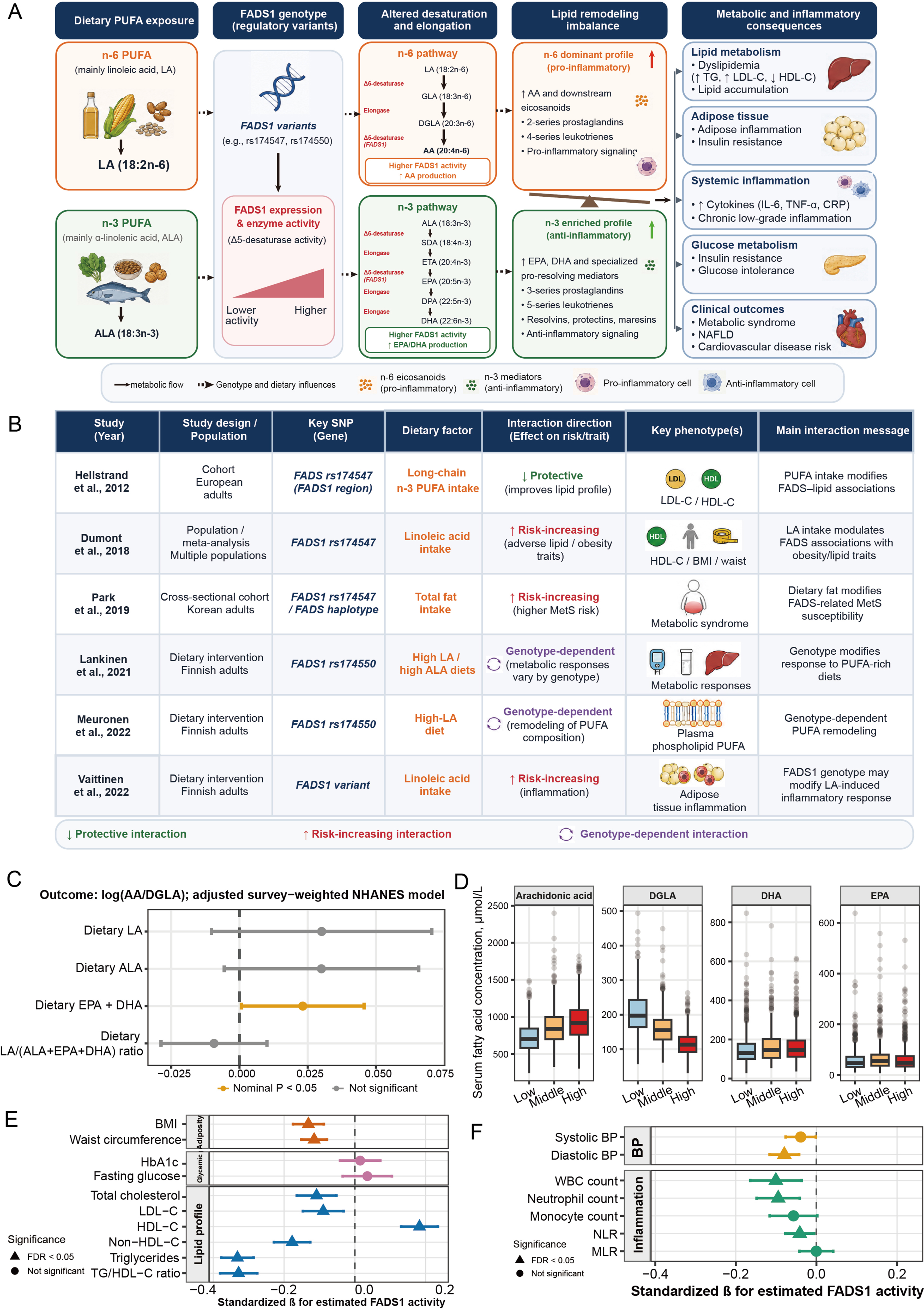
Figure 8. Nutrigenetic evidence and cross-sectional population associations involving the FADS locus and polyunsaturated fatty acid metabolism. (A) Conceptual framework illustrating proposed relationships among dietary PUFA exposure, FADS1 genetic variation, PUFA desaturation and elongation pathways, and cardiometabolic phenotypes. These mechanistic links were not directly tested in the present study. Conversion of precursor fatty acids into downstream long-chain PUFAs and lipid mediators is shown as a biological hypothesis rather than a demonstrated effect of immune-cell FADS1 expression; (B) Summary of previously published human nutrigenetic studies reporting gene-diet interactions involving FADS1-region variants and dietary fatty-acid exposure. These studies provide context for possible interactions between genetic variation and dietary PUFA composition, but the reported effects may vary according to population, diet, outcome, and genetic variant; (C) Associations between dietary PUFA intake and the serum log-transformed AA-to-DGLA ratio [serum log(AA/DGLA)] in NHANES 2013-2014. Points and error bars represent standardized regression coefficients and 95% confidence intervals from survey-weighted linear regression models adjusted for age, sex, race and ethnicity, and total energy intake, accounting for the complex sampling design. Four dietary exposures are displayed: LA, ALA, combined EPA + DHA, and the LA/(ALA + EPA + DHA) ratio. Separate EPA and DHA estimates are reported in Supplementary Table 13A. Orange indicates nominal P < 0.05, whereas grey indicates nominal P ≥ 0.05. The LA/(ALA + EPA + DHA) ratio represents selected dietary fatty acids and should not be interpreted as a comprehensive ratio of total dietary n-6 to total dietary n-3 fatty acids; (D) Descriptive distribution of circulating PUFA components across tertiles of the serum log(AA/DGLA) proxy in NHANES participants. Because AA and DGLA are mathematical components of the ratio used to define the tertiles, these comparisons are expected component-level descriptions and should not be interpreted as independent validation of the ratio-based associations. DHA and EPA distributions are also shown; (E) Associations between the serum log(AA/DGLA) proxy and adiposity, glycaemic, and lipid-related traits in NHANES 2013-2014. Higher serum log(AA/DGLA) was associated with lower BMI, waist circumference, total cholesterol, LDL-C, non-HDL-C, triglycerides, and TG/HDL-C ratio, and with higher HDL-C. No significant associations were observed for HbA1c or fasting glucose after multiple-testing correction. Standardized β coefficients and 95% confidence intervals are shown. Triangles indicate FDR-adjusted significance (FDR < 0.05), whereas circles indicate non-significant associations. The serum log(AA/DGLA) measure is an indirect, non-gene-specific proxy that may be influenced by diet, FADS2, other enzymes, and metabolic clearance; (F) Associations between the serum log(AA/DGLA) proxy and blood pressure and inflammatory traits in NHANES 2013-2014. Higher serum log(AA/DGLA) was inversely associated with diastolic blood pressure, white blood cell count, neutrophil count, and NLR, whereas monocyte count and monocyte-to-lymphocyte ratio (MLR) were not significantly associated after multiple-testing correction. These observational associations should not be interpreted as evidence that increasing FADS1 expression is beneficial or that the proxy directly measures FADS1 enzymatic activity. The favorable proxy associations also differ from the modestly lipid-adverse direction observed in some expression-based genetic analyses, supporting a context-dependent interpretation of the FADS gene cluster. (A and B) were prepared with AI assistance using OpenAI Codex and subsequently assembled and edited in Adobe Illustrator. Details are provided in the AI and AI-assisted tools statement. AA: Arachidonic acid; AI: artificial intelligence; ALA: α-linolenic acid; BMI: body mass index; BP: blood pressure; CI: confidence interval; CRP: C-reactive protein; DGLA: dihomo-γ-linolenic acid; DHA: docosahexaenoic acid; DPA: docosapentaenoic acid; EPA: eicosapentaenoic acid; ETA: eicosatetraenoic acid; FADS: fatty acid desaturase; FADS1: fatty acid desaturase 1; FADS2: fatty acid desaturase 2; FDR: false discovery rate; GLA: γ-linolenic acid; HbA1c: glycated haemoglobin; HDL: high-density lipoprotein; HDL-C: high-density lipoprotein cholesterol; IL-6: interleukin-6; LA: linoleic acid; LDL: low-density lipoprotein; LDL-C: low-density lipoprotein cholesterol; MetS: metabolic syndrome; MLR: monocyte-to-lymphocyte ratio; NAFLD: non-alcoholic fatty liver disease; NHANES: National Health and Nutrition Examination Survey; NLR: neutrophil-to-lymphocyte ratio; non-HDL-C: non-high-density lipoprotein cholesterol; PUFA: polyunsaturated fatty acid; SDA: stearidonic acid; SNP: single-nucleotide polymorphism; TG: triglycerides; TNF-α: tumour necrosis factor-α; WBC: white blood cell. The terms n-3 and n-6 denote the omega-3 and omega-6 fatty acid families, respectively; rs denotes a reference SNP identifier.