

fig1
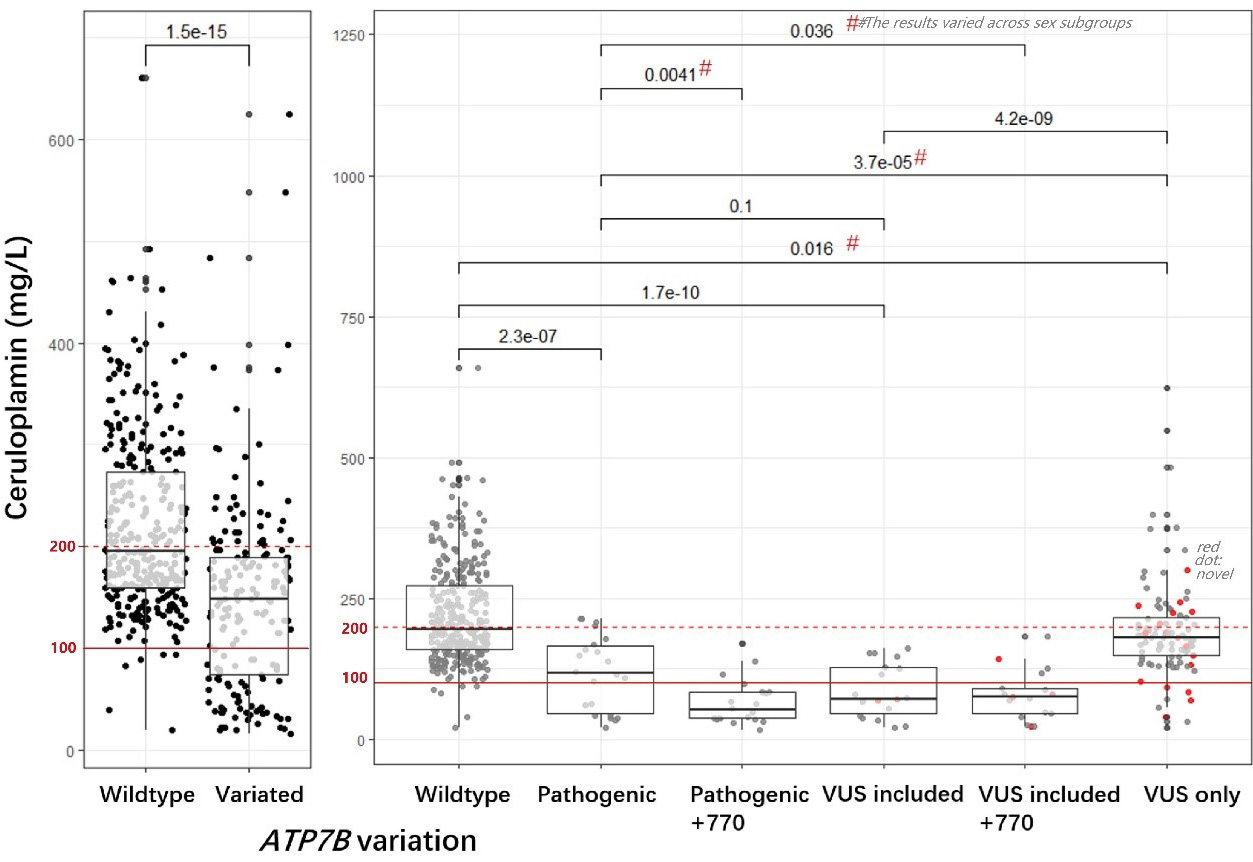
Figure 1. Comparisons of serum ceruloplasmin levels between ATP7B wild-type and variant carriers. The left panel compares ceruloplasmin levels between individuals with wild-type ATP7B and those with variants, showing significantly lower levels in the variant group. Further stratifying variants by pathogenicity and VUS status, the right panel compares individuals with wild-type alleles to those carrying various types of variants (from left to right: individuals with only known pathogenic variant, pathogenic plus p.Leu770=, pathogenic plus VUS, pathogenic plus both p.Leu770= and VUS, and VUS only). Red dots denote novel mutations identified in the cohort. All variant groups show significantly lower median ceruloplasmin levels than the wild-type group, as indicated by P-values (e.g., P = 0.016 for VUS-only vs. wild-type). The red dashed line indicates the normal reference range (200 mg/L), while the solid line marks 100 mg/L, below which ceruloplasmin levels are considered low and very low, respectively. The hashtag (#) signifies a statistically significant difference in ceruloplasmin levels between females and males within specific genotype groups. Notably, female VUS carriers had lower ceruloplasmin levels, whereas male VUS and wild-type carriers showed comparable levels (data not shown). A two-sample t-test was employed to assess the significance of mean differences. VUS: Variants of unknown significance.