
fig7
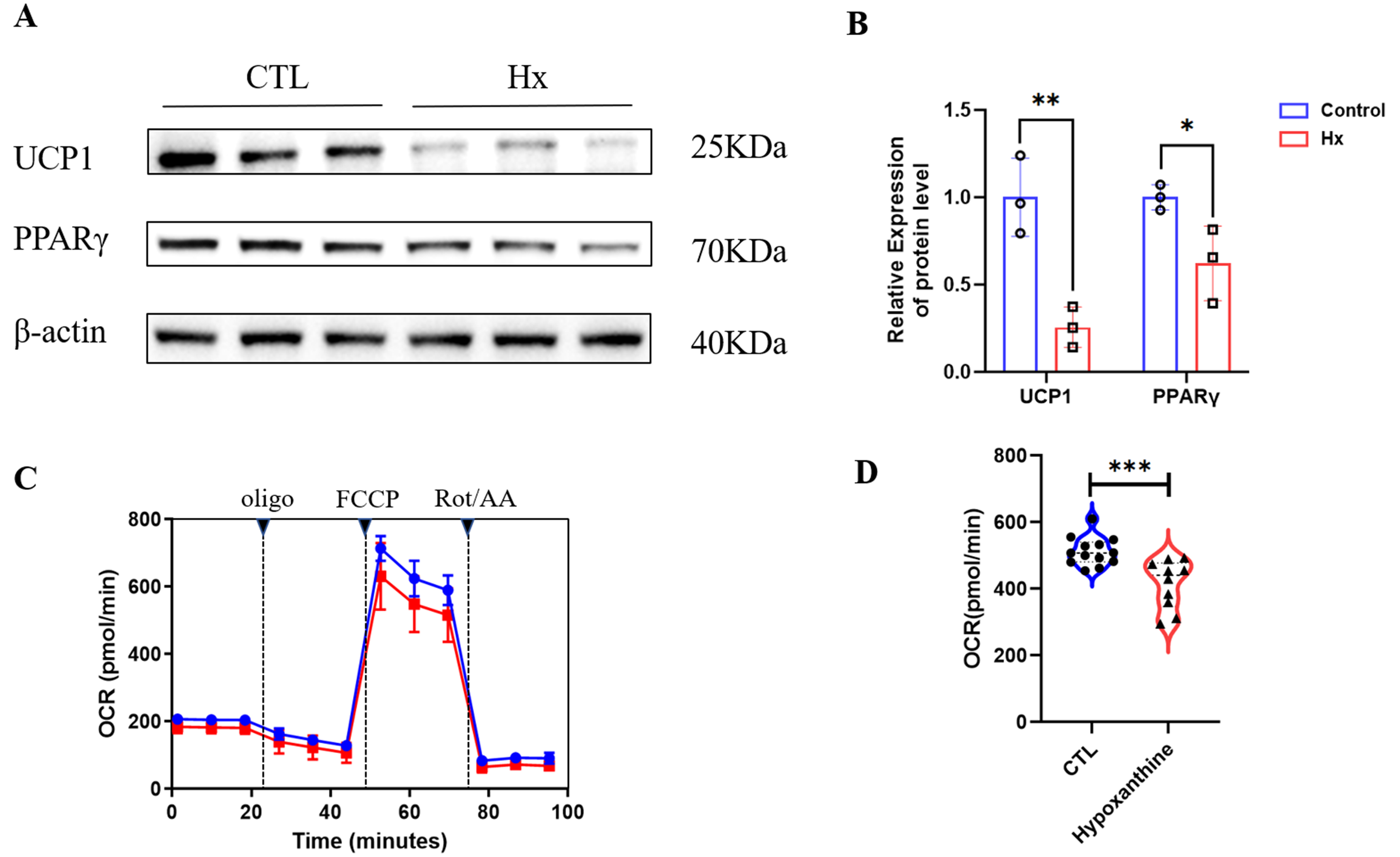
Figure 7. (A and B) Hypoxanthine (Hx) modulates adipogenic and thermogenic programs in mature white adipocytes. (A) Western blot analysis of adipogenic markers (PPARγ, CEBPα) and thermogenic markers (UCP1, PGC1α) in mature WAT treated with 100 μM Hx (n = 3); (B) Densitometric quantification of protein expression normalized to β-actin (Western blot experiments were performed with biological replicates, n = 3, *P < 0.05, **P < 0.01); (C and D) Hx suppresses mitochondrial thermogenesis in mature WAT. (C) Real-time OCR profiles demonstrating Hx-induced inhibition of mitochondrial respiration. Basal OCR decreased by 35% (*P < 0.01) in Hx-treated adipocytes; (D) Quantitative analysis of OCR parameters. Maximal respiration and ATP-linked respiration were reduced by 42% and 38%, respectively (*P < 0.01 vs. control). Error bars represent SEM (n = 8 replicates). ***P < 0.001. CEBPα: CCAAT/enhancer-binding protein alpha; Hx: hypoxanthine; OCR: oxygen consumption rate; PGC1α: peroxisome proliferator-activated receptor gamma coactivator 1-alpha; PPARγ: peroxisome proliferator-activated receptor gamma; SEM: standard error of the mean; UCP1: uncoupling protein 1; WAT: mature white visceral adipocytes.