fig1
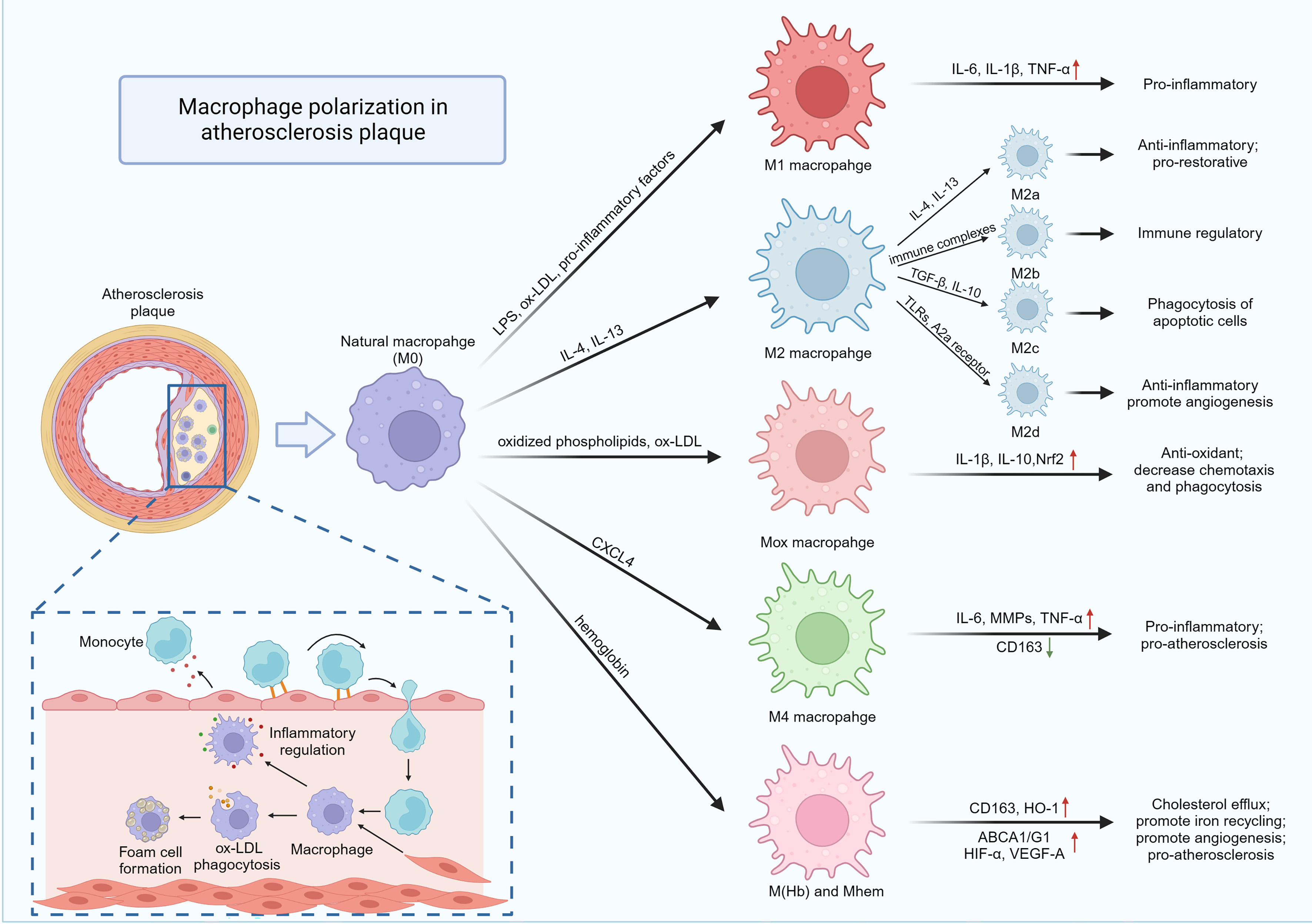
Figure 1. Macrophage polarization in atherosclerotic plaques. During atherosclerotic plaque formation, endothelial activation recruits monocytes that infiltrate and differentiate into macrophages. Macrophages play dual roles, releasing both inflammatory and anti-inflammatory factors and participating in the clearance of ox-LDL and the formation of foam cells. Additionally, vascular smooth muscle cells contribute to macrophage formation through migration and differentiation. Macrophages undergo polarization into distinct phenotypes. LPS, ox-LDL, and pro-inflammatory factors promote macrophage M1 polarization, which plays a pro-inflammatory role by releasing IL-6, IL-1β, and TNF-α. IL-4 and IL-13 induce M2 macrophage polarization, and M2-type macrophages are further subdivided into M2a, M2b, M2c, and M2d, playing various roles, such as anti-inflammatory, pro-tissue repair, immunomodulation, facilitating the phagocytosis of apoptotic cells, and promoting angiogenesis. Macrophages induced Mox polarization by oxidized phospholipids and ox-LDL and exhibited antioxidant activity, low migration, and low phagocytic activity by synthesizing IL-1β, IL-10, and Nrf2. CXCL4 activates M4 macrophages that exhibit pro-inflammatory and pro-atherosclerotic development by increasing the expression of IL-6, MMPs, and TNF-α, and inhibiting CD163 expression. In response to hemoglobin, macrophages differentiate into M(Hb) and Mhem macrophages, which express higher levels of CD163 and HO-1, ABCA1/G1, HIF-α and VEGF-A. These macrophages promote cholesterol efflux, iron recycling, and angiogenesis, and contribute to the progression of atherosclerosis. Red arrows indicate upregulation/positive regulation (e.g., promoting pro-inflammatory cytokine expression and macrophage polarization toward pro-inflammatory phenotypes). Green arrows indicate downregulation/negative regulation (e.g., CXCL4-mediated inhibition of CD163 expression and anti-inflammatory/protective pathways). Created in BioRender. Fan, F. (2026) https://BioRender.com/f63x996. ox-LDL: Oxidized low-density lipoprotein; LPS: lipopolysaccharide; IL: interleukin; TNF-α: tumor necrosis factor-alpha; TGF-β: transforming growth factor-beta; TLRs: Toll-like receptors; A2a receptor: adenosine A2 receptor; Nrf2: nuclear factor erythroid 2-related factor 2; CXCL4: CXC chemokine ligand 4; MMPs: matrix metalloproteinases; HO-1: heme oxygenase-1; ABCA1/G1: ATP-binding cassette transporter A1/G1; HIF-α: hypoxia-inducible factor-alpha; VEGF-A: vascular endothelial growth factor-A; CD163: cluster of differentiation 163; M(Hb): hemoglobin-associated macrophages.