

Recent advances in room-temperature hydrogen sulfide gas sensors: materials design, interface engineering, and sensing mechanisms
 0
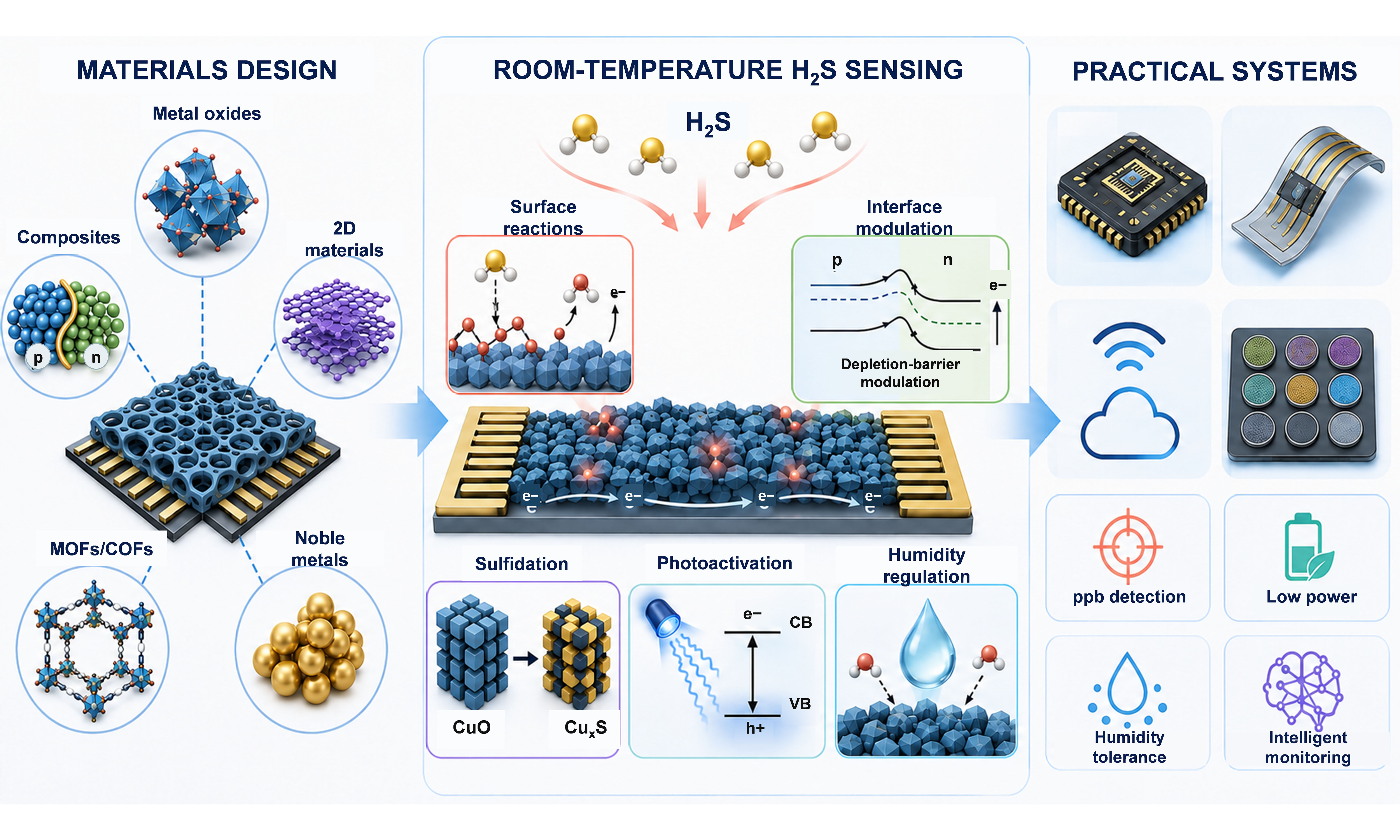
0 Graphical Abstract
Abstract
Hydrogen sulfide (H2S) is a highly toxic, corrosive, and flammable gas generated from industrial production, petroleum refining, wastewater treatment, municipal waste, and anaerobic decomposition of organic matter. Reliable H2S monitoring is therefore essential for environmental safety, industrial process control, and human health protection. Conventional chemiresistive H2S sensors based on metal oxide semiconductors often require elevated operating temperatures, which increase power consumption and restrict device miniaturization, flexible integration, and long-term deployment. Room-temperature H2S sensors have consequently attracted increasing attention as low-power sensing platforms. This review summarizes recent progress in room-temperature H2S sensing across single-component semiconductors, composite heterojunctions, two-dimensional materials and their heterostructures, metal-organic-framework-based materials, noble-metal-sensitized systems, and photoactivated sensors. Representative preparation methods, structure-performance relationships, and key sensing parameters are compared. Particular emphasis is placed on sensing mechanisms and supporting evidence, including oxygen-adsorption-mediated conductivity modulation, H2S-induced sulfidation, interfacial barrier modulation, defect-related activation, noble-metal-mediated catalytic and electronic sensitization, photoinduced carrier and photothermal effects, and framework-mediated transduction. Humidity interference and mitigation are further discussed, together with advances in micro electromechanical system (MEMS) devices, flexible and self-powered platforms, wireless sensing, sensor arrays, electronic noses, and AI-assisted identification. Finally, challenges and future directions are highlighted, including ppb-level detection, reversibility, humidity tolerance, complex-gas selectivity, long-term stability, standardized evaluation, real-sample validation, and intelligent-system integration. This review provides a systematic framework for developing reliable, low-power, and application-oriented room-temperature H2S sensors.
Keywords


 Download PDF
INTRODUCTION
H2S is colorless, highly corrosive, and extremely toxic, with a characteristic rotten-egg odor at even low concentrations[1,2]. The main sources of H2S include industrial emissions, petroleum and natural gas processing, wastewater treatment, municipal waste, and anaerobic bacterial decomposition. Exposure to low H2S concentrations can cause eye and respiratory irritation as well as neurological discomfort, whereas exposure to high concentrations can lead to respiratory paralysis, loss of consciousness, and death[3]. Thus, sensitive, selective, and rapid H2S detection is required for occupational safety, environmental monitoring, food-spoilage assessment, and potential breath analysis.
Chemiresistive metal-oxide-semiconductor (MOS) sensors are attractive because of their simple structure, low cost, and compatibility with microfabrication. However, most require temperatures above 100 °C to accelerate oxygen adsorption, surface reactions, and desorption; high-performing examples can operate at 200-400 °C[4,5]. This energy demand complicates portable, wearable, and distributed sensing.
Room-temperature H2S sensing has therefore been pursued through material, interface, and external-activation strategies. ZnO, WO3, CuO, and In2O3 benefit from morphology and defect regulation[6-12]; composites exploit interfacial charge redistribution and, especially in CuO-containing p-n systems, H2S-driven surface chemistry[13-18]. Graphene derivatives[19-27], TMDs[28-35], MXenes[36-38], covalent organic frameworks (COFs)[39-41], metal-organic frameworks (MOFs)[42-47], noble metals[48-58], and photoactivation[59-61] provide accessible adsorption sites, efficient transport, molecular recognition, catalytic activation, or carrier control.
Recent room-temperature H2S sensing research has increasingly focused on low-power operation, humidity tolerance, ppb-level detection, and flexible or miniaturized device integration. Accordingly, sensor performance should be evaluated not only by response magnitude but also by detection limit, response and recovery kinetics, long-term stability, humidity tolerance, and practical device compatibility[13,62,63].
Nevertheless, high response under controlled conditions does not guarantee reliable practical operation. At room temperature, adsorbed water can compete with H2S and oxygen species, alter surface hydroxylation and interfacial charge transfer, and cause baseline drift. It may either inhibit H2S adsorption or promote its ionization, hydrolysis, and water-mediated charge transport. Humidity management should therefore regulate water accessibility and water-surface interactions rather than simply suppress water adsorption[64-69]. Practical deployment also requires integration of sensing materials with electrodes, packaging, power, signal processing, and communication modules. micro electromechanical system (MEMS), flexible and self-powered devices, wireless systems, sensor arrays, electronic noses, and machine-learning-assisted identification are important for application-oriented H2S monitoring[70-74].
In this review, recent advances in room-temperature H2S sensors are systematically summarized according to sensing materials and functionalization strategies, including single-material-based sensors, conventional composite and heterojunction sensors, two-dimensional material platforms and their heterostructures, noble-metal-sensitized sensors, and photoactivated sensing systems. For consistency throughout this review, room temperature (RT) encompasses both operating temperatures of 20-30 °C and conditions explicitly described by the original authors as room or ambient temperature when no numerical value is reported. Operating temperatures above 30 °C are reported using their specific values. For each material category, representative preparation methods, structural features, sensing performance, structure-property relationships, and mechanistic interpretations are critically compared, with particular attention to the evidence supporting the proposed sensing pathways. The review then discusses humidity interference and mitigation strategies, followed by device design, MEMS and flexible integration, self-powered and wireless sensing, sensor arrays, electronic noses, and AI-assisted gas identification. Finally, current challenges and future opportunities are evaluated in terms of ppb-level detection, reversibility, humidity tolerance, mixed-gas selectivity, standardized performance evaluation, long-term reproducibility, total system power, real-sample validation, and scalable intelligent monitoring [Figure 1].
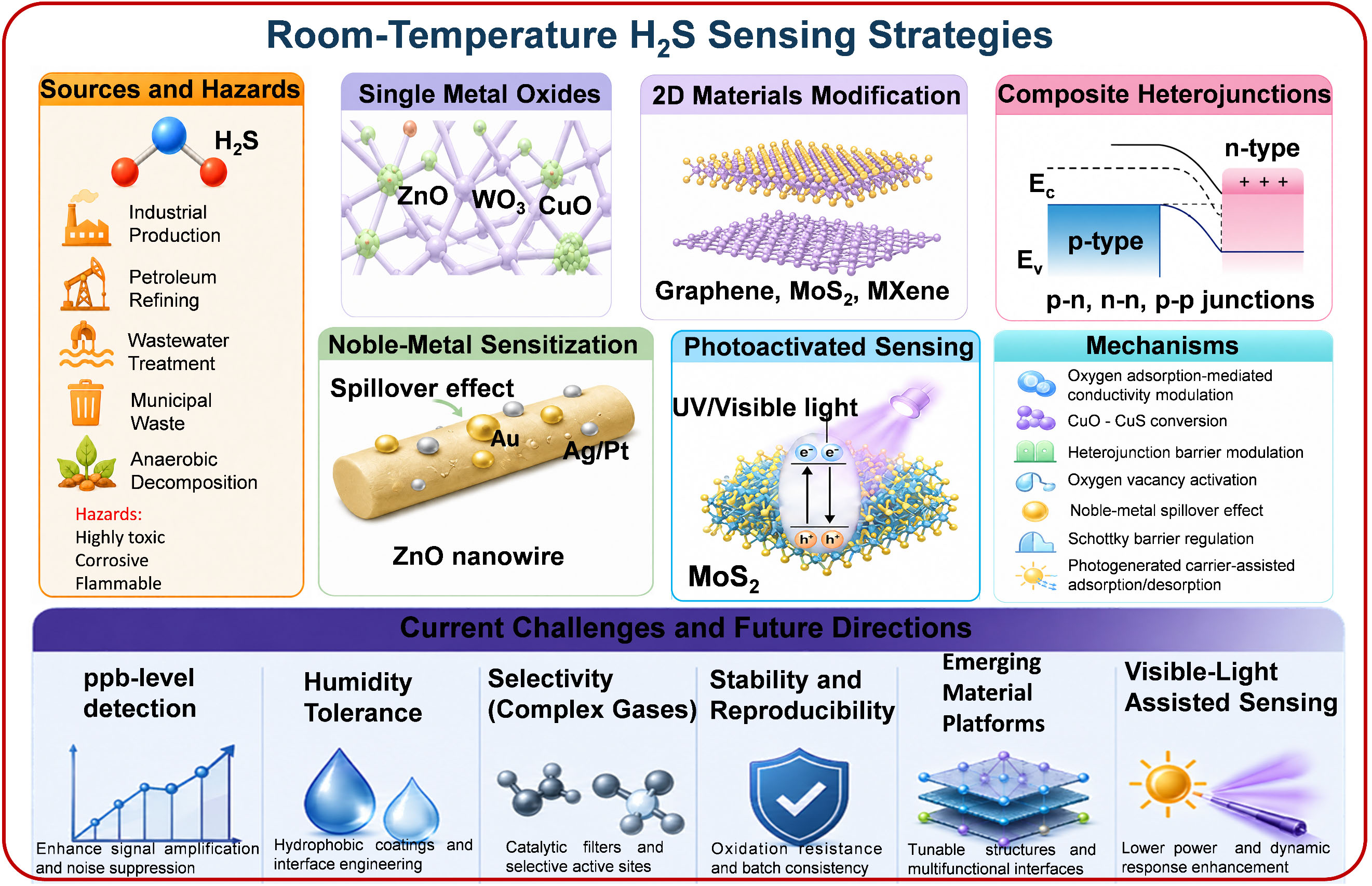
Figure 1. Roadmap of representative material strategies for room-temperature H2S sensing and their target performance outcomes.
SINGLE-MATERIAL-BASED GAS SENSORS
ZnO-based gas sensors
Zinc oxide (ZnO) is a typical n-type MOS with a wide bandgap of 3.37 eV, high exciton binding energy, high electron mobility, strong ultraviolet absorption, and good chemical stability[75-77]. These features make ZnO one of the most widely studied sensing materials. At room temperature, the H2S response of pristine ZnO is generally limited by insufficient surface reaction kinetics, therefore, nanostructure engineering is essential for increasing active adsorption sites and shortening diffusion pathways[78,79]. Wang et al. fabricated ZnO nanorod thick films by a hydrothermal method and controlled the ZnAc2/NaOH ratio to regulate morphology and selectivity[12]. The resulting sensor showed preferential ethanol response at 350 °C but selective H2S detection at room temperature, with Ra/Rg = 1.7[12], whereas vapor-grown vertically aligned nanorods formed a porous flower-like network that increased exposed area[78]. Other comb-like, prismatic, and belt-like ZnO architectures likewise demonstrate that anisotropic and porous structures can improve H2S accessibility[6,80,81].
Overall, ZnO enables room-temperature H2S detection, but its performance remains limited by sluggish oxygen-mediated surface reactions, highlighting the importance of defect and nanostructure engineering.
WO3-based gas sensors
Tungsten trioxide (WO3) is a chemically stable n-type metal-oxide semiconductor that has been extensively investigated for H2S sensing[82-84]. Its H2S response mainly originates from oxygen-mediated surface reactions that modulate carrier concentration and conductivity. Nanostructured WO3 films and colloidal quantum dots have shown improved low-temperature H2S sensing owing to increased surface exposure and enhanced surface-controlled charge transport[11,85]. Hoel et al. further reported a 250-fold increase in conductivity toward 5 ppm H2S at room temperature using WO3 nanoparticles[8]. These results indicate that particle sizes approaching the Debye length are beneficial.
Pristine WO3 remains limited by sluggish room-temperature activation and incomplete recovery. Its sensing performance is strongly governed by the relationship between particle size and Debye length, together with W5+/W6+ redox states and oxygen-vacancy distributions.
CuO-based gas sensors
Copper oxide (CuO) is a narrow bandgap p-type semiconductor and one of the most effective room-temperature H2S sensing materials[10,86]. In addition to oxygen-mediated reactions, H2S can form conductive copper sulfide species and thus create additional conduction paths[10,87,88]. Porous CuO nanosheets and biotemplated tubular structures have demonstrated that accessible surface sites, shortened diffusion pathways, and Cu/CuS-related conductive pathways can improve room-temperature H2S sensing[10,88]. More notably, sea-anemone-like CuO nanoarrays achieved a response of 24.08 toward 5 ppb H2S with negligible responses to common interfering gases[87]. Their high sensitivity was attributed to nanotentacle diameters approaching the Debye length and point-to-point contacts that amplified modulation of the hole-accumulation layer, while the preferential reaction of H2S with chemisorbed oxygen contributed to selectivity. These results highlight the importance of coupling gas-accessible CuO architectures with Debye-length-scale conduction channels.
Despite its high H2S sensitivity, pristine CuO often suffers from incomplete recovery, baseline drift, and poor reversibility because of H2S-induced sulfide formation. Competitive water adsorption can further destabilize its response and baseline. Although MEMS and surface-acoustic-wave platforms improve power efficiency and portability[89,90], the central challenge remains controlling reversible CuO/CuxS conversion while maintaining strong H2S affinity and humidity resistance.
In2O3-based gas sensors
Indium oxide (In2O3) is a typical n-type MOS with high electrical conductivity, good chemical stability, and abundant oxygen-vacancy-related active sites. Early studies demonstrated the evolution of In2O3-based H2S sensors from high-temperature nanocrystalline materials to porous nanotubes and nanowires capable of room-temperature operation[91,92]. The improved performance of the latter was associated with their gas-accessible one-dimensional architecture and H2S-induced surface sulfuration.
More importantly, ordered porous In2O3 ultrathin films exhibited an ultrahigh room-temperature response through a proposed humidity-assisted mechanism. Ambient water promoted H2S hydrolysis, chemisorbed oxygen desorption, and the formation of a conductive surface water layer, thereby markedly increasing sensor conductance[93]. Porous In2O3 nanoparticles achieved a response of 26,268.5 toward 1 ppm H2S with a detection limit of 1 ppb at room temperature, while UV-generated holes were proposed to promote oxygen desorption and narrow the electron-depletion layer, thereby regulating surface conductivity[59]. In2O3 nanocubes, colloidal quantum dots, and oxidized thin films have also demonstrated that crystal size, ligand-mediated surface states, and film structure strongly influence H2S adsorption and carrier transport[94-96]. These findings identify porous architecture, sulfuration, surface oxygen regulation, and humidity-assisted reactions as the principal factors governing room-temperature H2S sensing by In2O3.
For practical room-temperature operation, In2O3-based H2S sensors still require further improvement in reversibility, humidity calibration, and quantitative reliability. The sulfuration of In2O3 and humidity-induced H2S hydrolysis can greatly amplify the sensing signal, but they may also cause baseline drift and recovery instability if not well controlled. Future studies should therefore clarify the coupled roles of surface oxygen species, hydroxyl groups, In2O3/In2S3 conversion, and surface-state-regulated charge transport. In addition, ligand engineering in In2O3 quantum dots and thickness/orientation control in In2O3 thin films may provide effective routes toward fast, stable, and low-power room-temperature H2S detection.
As summarized in Table 1, single-material sensors achieve room-temperature H2S detection mainly through increased surface accessibility and enhanced charge modulation. Porous architectures and dimensions approaching the Debye length increase active-site exposure and amplify surface-induced conductivity changes. However, their sensing pathways remain material-dependent. ZnO and WO3 rely primarily on oxygen-mediated surface reactions and are limited by sluggish kinetics. CuO achieves high sensitivity through H2S-induced CuO-to-CuxS conversion, but excessive sulfuration compromises recovery and repeatability. In2O3 combines oxygen-mediated reactions, humidity-assisted hydrolysis, and partial sulfuration, producing high responses but also pronounced humidity dependence and baseline instability. Future priorities should therefore focus on improving surface reactivity in ZnO and WO3, balancing H2S affinity with reversible sulfuration in CuO, and regulating humidity-related reactions in In2O3. These material-specific challenges must be addressed to balance response, recovery, selectivity, humidity tolerance, and long-term stability.
Representative single-material room-temperature H2S sensors
| Material | Preparation method | O. T. (°C) | Conc. (ppm) | Response | Tres/Trec | LOD | Key feature/mechanism | Ref. |
| ZnO | Hydrothermal | RT | 0.05 | 1.7a | - | - | Morphology-controlled selectivity | [12] |
| ZnO | CVD | RT | 4 | 6a | 22/540 s | 100 ppb | Anisotropic morphology increases adsorption sites | [6] |
| ZnO | sol-gel | RT | 0.75 | 73.3%b | 93/90 s | 30ppb | In-situ synthesis strengthens electrode contact | [97] |
| WO3 | Gas deposition | RT | 35 | 3500c | 10 min/- | - | Nanoparticle film and high surface area | [8] |
| CuO | Hydrothermal | RT | 0.2 | 5.01a | 336/543 s | 10 ppb | Porosity and CuO/CuS-related conductive pathways | [10] |
| CuO | In-situ growth | RT | 0.005 | 24.08a | 102/539 s | 1.52 ppb | Nanotentacle diameter close to Debye length | [87] |
| CuO | Hydrothermal | RT | 1 | 365.2a | 55.2/2106 s | 0.1 ppb | Reversible CuO-to-CuS phase transition boosts conductance shift | [98] |
| In2O3 | Colloidal template | RT | 50 | 2.4 × 10⁵ a | 140/1440 s | - | Ordered porous film and humidity-induced H2S hydrolysis | [93] |
| In2O3 | High-temperature Pyrolysis | 37 °C | 5 | 1.2a | 6/10 s | - | Surface-state-regulated transport and ligand exchange | [95] |
| In2O3 | Thermal oxidation of In films | RT | 5 | 68%b | 18/504 s | 100 ppb | Thickness-dependent morphology and abundant surface oxygen | [96] |
TWO-DIMENSIONAL MATERIAL PLATFORMS AND THEIR HETEROSTRUCTURES
Two-dimensional materials are particularly attractive for room-temperature H2S sensing because their atomically thin structures provide high surface accessibility and allow adsorption-induced charge transfer to directly modulate the conduction channel[31,32,111,112]. Different material families contribute distinct functions. Graphene and reduced graphene oxide (rGO) provide continuous conductive networks, improve oxide dispersion, and introduce oxygen-containing adsorption sites[23,113,114]. Transition metal dichalcogenides (TMDs) offer tunable semiconducting channels, exposed edge sites, and chalcogen vacancies that regulate H2S adsorption and interfacial charge transfer[28,115,116]. MXenes combine high electrical conductivity with chemically active surface terminations, enabling rapid signal transport and tunable gas-surface interactions[61,117,118]. Two-dimensional COFs (2D COFs) further provide ordered pores, designable recognition sites, and conjugated frameworks for molecularly regulated adsorption and transduction[39-41]. When coupled with metal oxides, these materials are not merely structural supports. They can suppress oxide aggregation, improve gas diffusion and carrier transport, and create electronically active heterointerfaces whose barriers or space-charge regions are modulated by H2S exposure. Their sensing performance therefore depends strongly on defect density, layer stacking, surface chemistry, and interface quality.
COMPOSITE MATERIAL-BASED GAS SENSORS
Composite heterostructures have been developed to overcome the sluggish kinetics, limited response, and incomplete recovery of single-component sensors at room temperature[99,100]. Cu2O/ZnO heterostructures achieved a response of 8.53 × 10⁴ toward 1 ppm H2S with a detection limit of 10 ppb at room temperature. Post-exposure S 2p X-ray photoelectron spectroscopy (XPS) revealed sulfur-containing species, supporting H2S-induced surface sulfidation. On this basis, weakening of the p-n interfacial barrier and formation of additional sulfide-related conductive pathways were proposed to account for the pronounced resistance modulation[101]. CuO-nanocluster-decorated flower-like In2O3 exhibited a response of 18,108 toward 10 ppm H2S, a response time of 4 s, and a detection limit of 10 ppb at 25 °C. Density functional theory (DFT) calculations supported enhanced H2S adsorption and interfacial charge transfer, while p-n barrier modulation and possible CuO sulfidation were proposed as additional contributions[102]. These results demonstrate that CuO-containing composites enhance H2S sensing through coupled surface sulfidation, interfacial barrier modulation, and gas-accessible nanostructures.
Beyond CuO-based systems, other oxide heterostructures have also improved room-temperature H2S sensing through enhanced gas transport and interfacial charge modulation. MoO3/MnO2 n-n heterostructures achieved a theoretical detection limit of 4.58 ppb and maintained relatively stable performance over 30%-90% relative humidity (RH)[103]. SnO2@ZnO heterostructures combined hierarchical diffusion pathways, H2S-induced surface reactions, and interfacial charge transfer, as supported by spectroscopic characterization and DFT calculations[2]. Core-shell n-SnO2@p-SnO heterojunctions achieved a response of 66.7 toward 30 ppm H2S with a response time of 1 s[104]. SnO2 quantum-dot-decorated α-Fe2O3 hollow cubes further demonstrated the contribution of porous heterointerfaces to oxygen adsorption and carrier transport[105].
Conducting polymer/oxide composites offer an alternative route for room-temperature H2S sensing by coupling polymer conductivity modulation with oxide surface activity and interfacial charge transfer, as demonstrated by the improved response and kinetics of PANI/ZnO relative to its individual components[106,107].
As summarized in Table 2, oxide/oxide and polymer/oxide composites improve room-temperature H2S sensing primarily by coupling surface reactions with heterointerfacial charge modulation. Recent designs have evolved from simple component mixing toward controlled core-shell, hollow, and hierarchical porous architectures that increase the utilization of functional interfaces. CuO-loaded porous In2O3 nanosheets exemplify this strategy by combining accessible diffusion pathways with CuO/In2O3 interfacial modulation[108]. However, the resulting response depends strongly on component ratio, interface continuity, phase stability, and the reversibility of H2S-induced chemical changes. Future work should therefore prioritize reproducible interface construction and distinguish the contributions of heterojunction-barrier modulation, surface sulfuration, and conductive-network changes under humid and mixed-gas conditions.
Representative composite materials for room-temperature H2S sensing
| Material | O. T. (°C) | Conc. (ppm) | Response | Tres/Trec | LOD | Key feature/mechanism | Ref. |
| CuO/TiO2 | RT | 100 | 46.81%b | - | 3 ppm | Flexible nanochannel structure; barrier modulation | [100] |
| CuO/In2O3 | RT | 5 | 9,170a | - | - | Electrospun fibers; strong CuO-H2S interaction | [16] |
| ZnO/CuO | RT | 1 | 3,672a | -/<15 s | - | Rapid response with strong CuO-H2S interaction | [13] |
| PANI/ZnO | RT | 2 | 11.5%b | 63/12 s | 100 ppb | Conductive polymer charge-transfer mechanism | [107] |
| CuO/In2O3 | RT | 10 | 58,000a | 2 s/- | 50 ppb | 2D porous nanosheets; CuO sensitization; p-n heterojunction; | [108] |
| CdS/Co3O4 | RT | 10 | 1.04c | 86/51 s | 200 ppb | p-n heterojunction; hierarchical porous nanoflower structure; increased gas-accessible active sites | [109] |
| GC/Fe2O3 | 50 °C | 1 | 25.2a | 26/2430 s | 1 ppb | Bio-template hierarchical tubes; graphitized carbon decoration; abundant oxygen vacancies; moisture resistance | [110] |
| Cu2O/ZnO | RT | 0.01 | 61d | - | 10 ppb | p-n barrier modulation; CuxS conductive pathways; breath validation | [101] |
| MoO3/MnO2 | RT | 1 | 5.71a | 40/42 s | 4.58 ppb | Oxygen vacancies; adsorbed oxygen; interfacial charge transfer | [103] |
| SnO2@SnO | RT | 30 | 66.7a | 1/174 s | 850 ppb | Coupled depletion/space-charge modulation; humidity-assisted reaction | [104] |
Graphene-based gas sensors
Functionalized graphene and rGO have been widely investigated as functional components in H2S sensors because their high specific surface area and favorable charge-transport properties can promote gas adsorption and transduce adsorption-induced charge transfer into measurable electrical signals[25,119,120]. Rather than acting as passive supports, they can serve as conductive scaffolds, nanocrystal-growth templates, and interfacial charge-transfer media. In particular, the residual oxygen-containing groups and structural defects of rGO provide adsorption and anchoring sites, while its conductive network facilitates carrier transport between semiconductor components. In oxide/rGO composites, these effects can be coupled with heterojunction-barrier modulation and changes in surface oxygen adsorption, thereby amplifying H2S-induced resistance variations. The resulting performance depends strongly on the reduction degree, defect density, layer stacking, and interfacial contact of rGO.
Early studies showed that functionalized graphene could regulate the nucleation and dispersion of Cu2O nanocrystals while providing conductive pathways for room-temperature H2S sensing[26]. Liu et al. subsequently constructed a well-defined Cu2O/graphene heterojunction that achieved responses of 24,125.8% toward 500 ppb H2S and 386% toward 5 ppb H2S at 20 °C[19]. Other graphene/oxide composites have further demonstrated that rGO can improve oxide dispersion, adsorption-site accessibility, and carrier transport, while dopants, hollow structures, and heterointerfaces provide additional pathways for H2S activation and resistance modulation[21,22,27]. More recently, Amith et al. integrated an rGO-Er2O3/Co3O4 composite with a low-cost disc electrode[114]. The optimized sensor achieved a response of 75% toward 10 ppm H2S, response and recovery times of 47 and 11 s, and stability exceeding 100 days[114]. These studies show that graphene-based modification has evolved from simple conductivity enhancement toward coordinated control of oxide growth, charge transport, and heterointerfacial properties. However, reliable performance still requires precise regulation of rGO reduction, defect density, layer restacking, humidity sensitivity, and graphene/oxide interface quality.
Comparable improvements in response magnitude and response/recovery kinetics have also been reported for SnO2 quantum-wire/rGO, CeO2/graphene, and WO3/rGO composites, further supporting the role of graphene in facilitating carrier transport and interfacial resistance modulation[24,25,121].
Transition-metal dichalcogenide-based gas sensors
TMDs, particularly MoS2 and WS2, have attracted widespread attention in the field of room-temperature H2S sensing due to their semiconductor layered structures, which feature tunable bandgaps, abundant edge sites, and defect-sensitive surface chemistry[30,122]. Kundu et al. demonstrated that the response of liquid-phase-exfoliated WS2 nanosheets was strongly dependent on gas flow rate, highlighting the importance of mass transport and testing conditions for ultrathin sensing layers[9]. MoS2-GO hybrids further achieved a response of 39.16% toward 100 ppm H2S at 28 °C with a response time of 6.13 s[123]. Coupling TMDs with metal oxides provides additional interfacial amplification. Porous CuO/MoS2 p-n heterostructures improved H2S response and selectivity through increased surface accessibility and interfacial charge modulation[18]. Huo et al. constructed In2O3@MoS2 heterojunction fibers that exhibited a response of 460.61 toward 50 ppm H2S and a detection limit of 3 ppb at room temperature[28]. Beyond MoS2, MOF-derived α-Fe2O3 hollow nanospheres decorated with MoSe2 nanoflowers achieved a response of 57.7 toward 30 ppm H2S with response and recovery times of 50 and 53 s[124]. These studies demonstrate that TMD-based heterostructures combine edge- and defect-mediated adsorption with oxide-supported gas diffusion and junction-induced charge modulation. Further progress requires reproducible control of layer stacking, defect density, interfacial structure, humidity interference, and room-temperature desorption.
MXene-based gas sensors
MXenes, particularly Ti3C2Tx, are attractive for low-power H2S sensing because of their high electrical conductivity, chemically active surface terminations, and tunable interfacial properties. Recent studies have extended their role beyond conductive additives by integrating molecular enrichment, termination-dependent adsorption, and external activation[125-127]. Ding et al. assembled Co-MOF nanoparticles on Ti3C2Tx nanosheets to form a 0D-2D heterostructure in which the porous MOF enriched H2S molecules and the MXene provided rapid electron transport[125]. The sensor achieved a response of 11.1 toward 400 ppb H2S with an experimental detection limit of 50 ppb, demonstrating the value of coupling molecular preconcentration with conductive transduction[125]. Ti3C2Tx-organic composites further preserved the inherent H2S selectivity of MXene while producing a 30-fold enhancement in sensing response[128]. DFT calculations indicated that mixed O, OH, and F terminations strongly influenced H2S adsorption and charge transfer, emphasizing that termination composition is a critical determinant of MXene sensing behavior[128]. Han et al. developed an near-infrared (NIR)-activated MXene/PbS heterostructure that achieved a response of 90% toward 10 ppm H2S, response and recovery times of 2 and 89 s, and stable operation for up to 60 days [Figure 2A][126]. Its enhanced performance was attributed to improved NIR absorption and carrier separation within the heterostructure, together with photothermal acceleration of surface reaction and desorption kinetics. These studies show that MXene-based sensors are evolving into multifunctional platforms that integrate adsorption, charge transport, and external activation. Practical application, however, still requires improved control over oxidation, surface-termination stability, layer restacking, humidity interference, and batch-to-batch reproducibility.

Figure 2. Performance and mechanisms of 2D-material-based H2S sensors. (A) MXene/PbS responses to 10 ppm H2S under NIR irradiation (0.525 W cm-2, A1), varied 808 nm power (A2), and NIR, matched-temperature heating, and UV conditions (A3), with in situ DRIFTS under dark and NIR conditions (A4-A5). Reproduced with permission from Ref.[126]. Copyright 2025, Wiley-VCH; (B) PCA plots of the M-COF-DC-8 (M = Fe, Co, Ni, Cu) array responses, evaluating discrimination of the carrier gas, NO, CO, H2S, and NH3 and their different concentrations (B1); PCA plot evaluating discrimination of NO, CO, H2S, and NH3 (80 ppm) by the M-COF-DC-8 (M = Co, Ni, Cu) array under humidity, with compressed response vectors under dry (training) and humid (projected onto dry-trained PCs) conditions (B2). Reproduced from Ref.[39], under CC BY 4.0 license. For Figure 2A1-A3, response (%) = (Rair - Rgas)/Rair × 100%, where Rair and Rgas denote the resistances in air and H2S, respectively. DRIFTS: Diffuse reflectance infrared Fourier transform spectroscopy; NIR: near-infrared; PCA: principal component analysis; UV: ultraviolet; COF: covalent organic framework; PC: principal component.
Two-dimensional covalent organic framework-based gas sensors
2D COFs are crystalline porous polymers with molecularly tunable pores, recognition sites, π-conjugated backbones, and charge-transport properties. Meng et al. developed the intrinsically conductive nickel-phthalocyanine COF Ni-COF-DC-8 with a bulk conductivity of 2.51 × 10⁻³ S m-1[40]. The corresponding chemiresistive sensor exhibited a response of 62% toward 40 ppm H2S and a theoretical detection limit of 204 ppb, with the signal attributed to charge transfer between H2S and the nickel-phthalocyanine units[40]. Benedetto et al. subsequently constructed an array of isostructural M-COF-DC-8 materials containing Fe, Co, Ni, or Cu centers. Cu-COF-DC-8 achieved the highest response of approximately 99% toward 80 ppm H2S and a theoretical detection limit of 28 ppb in dry N2, while the array enabled discrimination among H2S, NO, CO, and NH3 under both dry and humid conditions [Figure 2B][39]. Beyond chemiresistive sensing, a nanoporous COF optical-waveguide film achieved a response time below 2 s and a detection limit of 1.07 ppb through proton transfer at triazine-containing sites and the resulting refractive-index change[41]. These studies demonstrate that COFs can regulate both molecular recognition and signal transduction through framework-level design. Their practical development, however, requires improved conductivity, crystallinity, film uniformity, reversibility, and humidity stability.
In summary, graphene/rGO, TMDs, MXenes, and 2D COFs share high surface accessibility and short gas-diffusion pathways, but differ substantially in their sensing functions. Graphene and rGO mainly provide conductive networks and heterointerfacial charge transport, while their performance is sensitive to reduction degree, layer restacking, and humidity-induced drift. TMDs contribute semiconducting channels, edge sites, and chalcogen vacancies for H2S adsorption and interface modulation, although defect reproducibility and slow desorption remain concerns. MXenes combine high conductivity with termination-dependent adsorption and interfacial chemistry, but oxidation and batch-dependent surface composition limit stability. COFs offer molecularly designable pores and coordination sites for selective H2S recognition, while insufficient conductivity and poor film uniformity constrain electrical transduction. Coupling these materials with metal oxides or other functional phases can integrate gas accessibility with interfacial charge modulation, but the resulting enhancement depends strongly on defect density, layer stacking, surface chemistry, and interface quality. Future studies should therefore prioritize reproducible material preparation, operando analysis of interface evolution, and standardized evaluation under humid and long-term operating conditions.
METAL-ORGANIC FRAMEWORK-BASED GAS SENSORS
MOFs are versatile platforms for room-temperature H2S sensing because their pore environments, metal sites, and coordination structures can be tailored to regulate gas adsorption, molecular enrichment, and chemical reactivity[44,45]. MOF-based sensing materials can be divided into three categories according to framework retention and charge-transport behavior. Pristine MOFs preserve their coordination frameworks and mainly utilize pore confinement, open metal sites, and host-guest interactions for H2S recognition. Conductive MOFs additionally contain intrinsic charge-transport pathways that directly convert gas-framework interactions into chemiresistive signals[42,47]. MOF-derived materials sacrifice the original framework during thermal or chemical conversion but inherit its morphology and metal distribution, producing porous oxides, carbon-containing phases, or heterostructures with accessible defects and interfaces[124,129]. These three categories therefore emphasize molecular recognition, direct electrical transduction, and structural inheritance, respectively, providing complementary routes for low-power H2S sensing.
Pristine MOF-based gas sensors
Pristine and framework-retaining MOFs provide permanent porosity, tunable pore environments, and accessible metal sites for H2S enrichment and molecular recognition. Luo et al. compared MIL-100(Fe), HKUST-1(Cu), and bimetallic MOF-919(Fe-Cu), among which MOF-919 exhibited the highest response of 931.6% toward 10 ppm H2S and a detection limit of 0.31 ppm at room temperature[44]. The improvement was attributed to suitable pore dimensions and cooperative Fe/Cu adsorption sites, demonstrating that metal-site chemistry is as important as surface area in determining MOF sensing behavior. A porous Cu-MOF was also employed as the sensing electrode in a K2Fe4O7-based mixed-potential sensor, achieving a detection limit below 5 ppb at room temperature. Electrode passivation extended stable operation to 66 cycles by suppressing the accumulation of sulfur-containing products[43]. In a different transduction mode, Cu-modified MOF-808 enabled reversible colorimetric detection of 100 ppm H2S through Cu2+/Cu+ redox conversion, with response times of 1.3-2.2 min and thermal regeneration under moist air[45]. These studies demonstrate that intact MOFs can combine pore-confined enrichment and metal-site chemistry with electrical, mixed-potential, or optical readout. Their practical use remains constrained by low intrinsic conductivity, humidity-dependent adsorption, slow desorption, and sulfur-induced deactivation of active metal sites.
Conductive MOF-based gas sensors
Unlike conventional MOFs with limited intrinsic conductivity, conductive metal-organic frameworks (cMOFs) combine permanent porosity and accessible coordination sites with framework-mediated charge-transport pathways, enabling direct chemiresistive transduction of gas-framework interactions[42,130,131]. Two-dimensional cMOFs based on square-planar metal nodes and π-conjugated ligands are particularly attractive because charge transport can proceed through in-plane π-d conjugation and interlayer π-π stacking. Jeon et al. compared six 2,3,6,7,10,11-hexasubstituted triphenylene-based metal-organic frameworks (M-HXTP; M = Co, Ni, or Cu) and found that the Cu-containing cMOFs exhibited the strongest H2S responses[42]. Spectroscopic characterization and DFT calculations linked the resistance modulation to H2S oxidation, Cu reduction, and distortion of the conductive CuX4 units. Zhao et al. further tuned the metal-node composition by constructing bimetallic Co1.8Ni1.2(HITP)2, which showed a 7.5-fold higher response toward 5 ppm H2S than Ni3(HITP)2[47]. The sensor maintained a signal drift below 4.13% over 60 days in oxygen-deficient SF6, indicating that metal-node engineering can regulate H2S affinity, oxygen-independent charge transfer, and operational stability.
Beyond metal-node and ligand selection, 2D cMOF sensing can be regulated through morphology, layer stacking, and film processing. Solution-processable Ni3(HITP)2/NUS-8 MOF-on-MOF nanosheets (HITP: 2,3,6,7,10,11-hexaiminotriphenylene; NUS: National University of Singapore) enabled the fabrication of large-area, thickness-controlled films, as confirmed by the cross-sectional scanning electron microscope (SEM) images in Figure 3A1-A4. Kelvin probe force microscopy (KPFM) revealed different surface-potential contrasts for NUS-8 and Ni3(HITP)2/NUS-8 [Figure 3A5 and A6], consistent with interfacial charge redistribution. Following exposure to 10 ppm H2S, the S 2p and N 1s XPS changes and the electron paramagnetic resonance (EPR) signal at g ≈ 2.0 supported the formation of sulfur-containing species, modification of the N coordination environment, and generation of paramagnetic centers; the corresponding redox sensing mechanism is illustrated in Figure 3A7-A10. The resulting sensor achieved a room-temperature detection limit of approximately 6 ppb[46]. Zeolitic imidazolate framework-67 (ZIF-67)-templated cobalt–2,3,6,7,10,11-hexahydroxytriphenylene (Co-HHTP) architectures improved electrical conduction, Co-site accessibility, and gas diffusion, achieving detection limits of 44 and 34 ppb for nanoparticles and nanosheets, respectively[132]. Their response mainly arose from H2S binding at exposed Co sites, where Co-S interactions reduced the effective hole concentration and increased resistance. 1,4,5,8,9,12-hexaazatriphenylenehexacarbonitrile (HATCN) intercalation between Cu3(HHTP)2 layers further introduced out-of-plane transport pathways and electron-deficient adsorption environments, enabling selective H2S detection down to 120 ppb[133]. These studies demonstrate that morphology, active-site accessibility, interlayer coupling, and scalable film formation are critical to the sensing performance of 2D cMOFs.
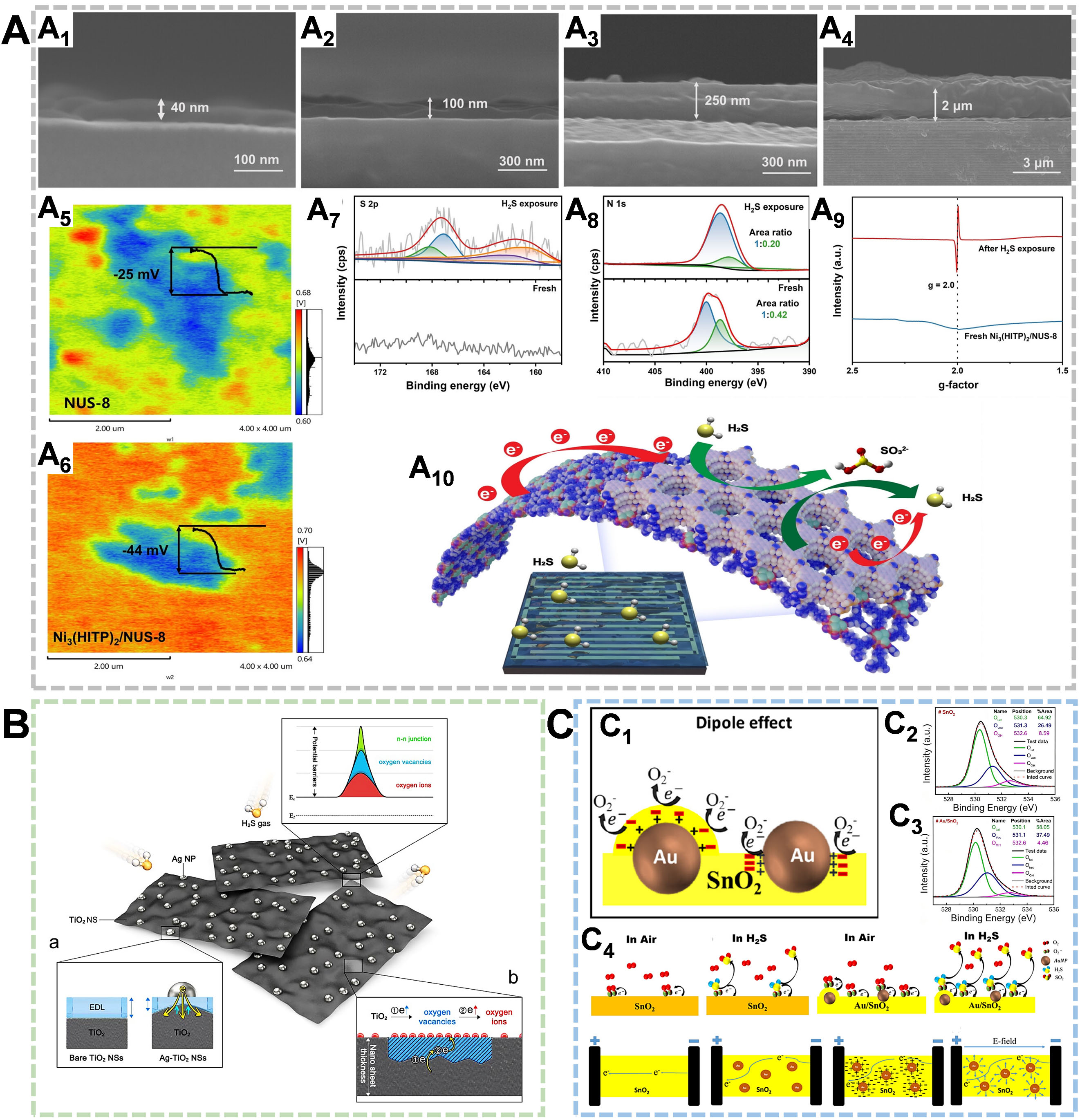
Figure 3. Structural characterization and proposed sensing mechanisms of MOF-based and noble-metal-sensitized H2S sensors. (A) Cross-sectional SEM images of thickness-controlled Ni3(HITP)2/NUS-8 films (A1-A4); KPFM maps of pristine NUS-8 (A5) and Ni3(HITP)2/NUS-8 (A6), S 2p and N 1s XPS spectra before and after exposure to 10 ppm H2S (A7-A8); EPR spectra (A9); and the proposed redox sensing mechanism (A10). Reproduced with permission from Ref.[46]. Copyright 2024, Wiley-VCH; (B) Proposed sensing mechanism of Ag nanoparticle-decorated TiO2 nanosheets, including Ag-to-TiO2 electron transfer, defect-assisted electron transport, and potential-barrier formation. Reproduced from Ref.[138], under CC BY 4.0 license; (C) Proposed Au/SnO2 interfacial dipole effect under low bias(C1); O 1s XPS spectra of pristine SnO2 (C2) and Au/SnO2 (C3); and the proposed surface-reaction and charge-transport mechanisms (C4). Adapted from Ref.[48], under CC BY 4.0 license. MOF: Metal-organic framework; SEM: scanning electron microscope; KPFM: Kelvin probe force microscopy; NUS: National University of Singapore; XPS: X-ray photoelectron spectroscopy; EPR: electron paramagnetic resonance.
Conductive-MOF heterostructures couple framework-mediated transport with the adsorption and electronic properties of secondary semiconductors. Sun et al. decorated Co3(HITP)2 with SnO2 nanoparticles, producing a flexible sensor with a response of 3.3 toward 50 ppm H2S and a detection limit of 160 ppb at room temperature under 25% RH[134]. DFT and band-structure analyses attributed the enhancement to stronger H2S adsorption, interfacial charge transfer, and heterojunction-mediated carrier modulation. Key limitations include anisotropic transport, layer stacking, humidity-dependent conductivity, limited film processability, and partially irreversible reactions at redox-active metal sites.
MOF-derived gas-sensing materials
MOF-derived sensing materials are produced by converting MOF precursors into metal oxides, carbon-containing phases, or multicomponent heterostructures. Although the coordination framework is destroyed, the derivatives can retain the precursor morphology, porosity, and homogeneous metal distribution while generating small crystallites, defects, and accessible diffusion pathways. Jiang et al. converted CuBDC into hollow rod-shaped CuO, which exhibited a response of 330 toward 1 ppm H2S at 20 °C and a theoretically estimated detection limit in the ppt range[135]. The enhancement was attributed to the porous hollow architecture, optimized oxygen-vacancy concentration, and strong CuO-H2S interaction. This example demonstrates that MOF templating can suppress oxide aggregation and preserve gas-accessible internal structures.
MOF precursors enable compositionally uniform heterojunctions by preserving metal distribution and porous architectures during conversion. Ding et al. derived porous NiO-CuO structures containing multiple p-p junctions from a bimetallic MOF[136]. The sensor exhibited responses of 3.99 and 11.0 toward 1 ppm H2S in dry air and at 40% RH, respectively, with a detection limit of 50 ppb[136]. The enhancement was attributed to inherited porosity, increased adsorbed oxygen, and NiO/CuO interfacial regulation. Cai et al. further derived a CeO2/N-doped carbon p-n heterojunction that achieved a detection limit of 16 ppb and stable sensing at 80% RH through the combined effects of a built-in electric field, oxygen vacancies, and a hydrophobic carbon matrix[129].
Coupling MOF-derived oxides with two-dimensional materials can improve carrier transport and interface utilization. Zhang et al. dispersed MIL-88-derived γ-Fe2O3 octahedra on rGO, producing a response of 520.73 toward 97 ppm H2S at room temperature[137]. The rGO network promoted charge transport and limited oxide aggregation, while porous γ-Fe2O3 provided accessible reaction sites. MOF-derived α-Fe2O3 hollow nanospheres decorated with MoSe2 nanoflowers exhibited response and recovery times of 50 and 53 s toward 30 ppm H2S through improved gas diffusion, additional adsorption sites, and interfacial charge modulation[124]. These studies show that MOF derivation can integrate porous structures with conductive networks and heterointerfaces. Remaining challenges include calcination-induced shrinkage, phase variability, uncontrolled defect concentrations, slow recovery, and humidity-dependent reactions.
MOF-based H2S sensors follow three distinct design routes with different advantages and limitations. Pristine MOFs exploit permanent pores and open metal sites for H2S enrichment and molecular recognition, but their low conductivity, humidity-sensitive adsorption, slow desorption, and sulfur poisoning restrict reusable electrical sensing. Conductive MOFs introduce framework-mediated charge transport for direct chemiresistive transduction, although anisotropic conductivity, dense layer stacking, limited film processability, and redox-induced signal irreversibility remain problematic. MOF-derived materials sacrifice the original coordination framework but retain precursor morphology and metal distribution, enabling porous oxides, carbon-containing phases, and heterostructures with abundant defects and interfaces. Their performance is instead limited by calcination-induced shrinkage, phase variability, uncontrolled defect populations, and slow room-temperature recovery. Future priorities should therefore focus on protecting and regenerating active sites in pristine MOFs, controlling layer orientation and film assembly in conductive MOFs, and achieving reproducible phase and defect regulation during MOF conversion. Operando studies under humid H2S exposure are particularly important for resolving framework reactions, sulfur accumulation, and recovery pathways across these material classes.
NOBLE METAL-SENSITIZED GAS SENSORS
Noble-metal sensitization is widely used to improve the response, selectivity, and kinetics of room-temperature H2S sensors. Representative systems employ Ag[138-140], Au[48,54,141], Pt[142-144], and Pd[116,145,146]. Their enhancement generally involves coupled chemical and electronic sensitization. Chemically, noble-metal nanoparticles promote O2 and H2S adsorption or activation and may transfer reactive species to the supporting semiconductor. Electronically, work-function differences induce interfacial charge redistribution and modify depletion regions, localized dipoles, or Schottky barriers, thereby amplifying resistance changes during H2S exposure. On MXenes, TMDs, and graphene, noble metals can additionally interact with surface terminations or defect sites and regulate local carrier transport. Metals with strong sulfur affinity, particularly Ag, may further enhance H2S capture through metal-sulfur interactions[147]. Practical limitations include nanoparticle aggregation, sulfur-induced deactivation, humidity interference, support instability, and material cost.
Ag-sensitized sensors
Ag is attractive for H2S sensing because of its electrical conductivity, catalytic activity, and strong affinity for sulfur-containing species. Ag nanowire/hollow polypyrrole nanotube composites achieved a detection limit of 10 ppb at room temperature[55]. The proposed mechanism involved preferential H2S adsorption and partial dissociation on Ag, followed by proton transfer to polypyrrole that increased its carrier concentration and conductivity. Ag-In2O3 nanorod composites further exhibited an ultrahigh response of 93,719 toward 20 ppm H2S with a detection limit of 5 ppb[58], while Ag incorporation into CeO2/porous-Si films improved sensing stability and humidity tolerance[140]. Lee et al. decorated TiO2 nanosheets with Ag nanoparticles, increasing the response from 1.12 to 2.55 toward 20 ppm H2S at 25 °C and improving selectivity over H2, NH3, and acetone[138]. XPS analysis showed that the oxygen-vacancy-related and adsorbed-oxygen-related O 1s contributions increased from 16.18% to 26.14% and from 9.54% to 13.18%, respectively. Negative shifts of the Ag 3d peaks relative to bulk Ag further supported electron transfer from Ag to TiO2. The proposed interfacial mechanism, including narrowing of the TiO2 electron-depletion layer, defect-assisted electron transport, and modulation of inter-nanosheet potential barriers, is illustrated in Figure 3B[138]. Ag-catalyzed H2S dissociation, oxygen spillover, and possible silver-sulfide formation were additionally proposed to contribute to the enhanced response. These studies indicate that Ag sensitization can enhance H2S sensing through sulfur-affinitive adsorption, catalytic oxygen activation, and support-dependent charge-transfer pathways.
Ag sensitization operates through three material-dependent pathways. Ag promotes O2 and H2S adsorption and activation, thereby increasing the reactivity of surface oxygen species[138,139,148]. Ag/support charge redistribution also modifies carrier concentration and interfacial barriers, amplifying resistance changes[56,138,139,148]. In addition, Ag-S affinity favors H2S capture and the formation of Ag-S-related species in Ag/polymer and selected Ag/oxide systems[55,138,148]. Their relative contributions depend on the Ag state, support, surface oxygen chemistry, and operating conditions. Although Ag-S interactions enhance affinity and selectivity, excessive sulfidation may impede desorption, baseline recovery, and long-term stability.
Au-sensitized sensors
Au sensitization enhances room-temperature H2S sensing through coupled catalytic and electronic effects. Au nanoparticles promote oxygen adsorption and H2S surface reactions, while their high work function relative to many n-type oxides induces interfacial electron transfer and Schottky-type barriers, thereby amplifying resistance modulation under limited thermal activation.
Au decoration markedly improves room-temperature ZnO sensing. Flower-like Au/ZnO nanorods achieved a response of 1,270 toward 6 ppm H2S, 3.7 times that of pristine ZnO, although their response and recovery remained slow[50]. Au-modified ZnO nanowires reached a response of 79.4 toward 5 ppm H2S, representing a 16-fold enhancement, and shortened the recovery time from 860 to 170 s[54]. These results demonstrate strong Au sensitization, although recovery remains dependent on morphology and surface-reaction reversibility.
Deb et al. developed a flower-petal-like Au/SnO2 sensor for ppb-level H2S detection at room temperature. At 0.5 V and 24 ± 1 °C, the sensor achieved an experimental detection limit of 2 ppb[48]. Upon exposure to 500 ppb H2S, the response increased from 35% ± 7% for pristine SnO2 to 250% ± 30% for Au/SnO2, while the recovery time decreased from 510 to 126 s[48]. Figure 3C1 illustrates the proposed low-bias interfacial dipole effect. The O 1s XPS spectra show an increase in the oxygen-vacancy-related contribution from 26.49% to 37.49% after Au incorporation [Figure 3C2 and C3], while Figure 3C4 illustrates the overall gas-sensing mechanism. However, the contribution of localized interfacial dipoles remains a plausible interpretation that requires further experimental verification[48].
Overall, Au sensitization enhances H2S sensing through catalytic oxygen activation and Au/oxide interfacial electronic modulation. Unlike Ag, whose enhancement often involves strong Ag-S interactions and surface sulfidation, Au systems more commonly rely on Schottky-barrier regulation, morphology-dependent surface exposure, and low-bias interfacial polarization. Future studies should clarify the evolution of Au/oxide interfaces during repeated H2S exposure and improve recovery, humidity tolerance, and scalable low-voltage device fabrication without sacrificing ultralow detection limits.
Pt-sensitized sensors
Pt sensitization of room-temperature H2S sensors primarily combines catalytic oxygen activation, electron extraction, and interfacial barrier modulation[52,57,142,143]. Xuan et al. integrated Pt with etched W-doped ZnO nanotubes grown in situ on FTO electrodes. The optimized Pt(1.5%)-ZnO sensor exhibited a response of 16.59 toward 5 ppm H2S and detected concentrations down to 100 ppb[57]. Pt 4f binding-energy shifts and increased chemisorbed oxygen supported electron transfer from ZnO to Pt and enhanced oxygen activation. Based on this evidence and the Pt/ZnO work-function difference, the enhancement was attributed to oxygen-spillover-mediated chemical sensitization and nano-Schottky-barrier-mediated electronic sensitization. This study demonstrates the benefit of coupling Pt sensitization with defect regulation and integrated device architecture[57].
Pt size, dispersion, and electronic state critically influence H2S sensing. Kou et al. decorated TiO2@ZnFe2O4 nanotube arrays with Pt nanoclusters, achieving a response of 16.6 toward 10 ppm H2S and a detection limit of 0.43 ppb at room temperature[52]. The highly dispersed Pt generated oxygen vacancies and Ptδ+ species, enabling H2S activation without heating or UV irradiation. Similarly, 0.3 wt.% Pt-SnO2 mesoporous nanoflowers exhibited a response of 68 toward 1 ppm H2S at 30 °C with a detection limit of 100 ppb[143]. Their enhancement arose from efficient gas diffusion through the mesoporous structure and Pt-mediated catalytic sensitization and oxygen spillover.
Pt sensitization is progressing from simple nanoparticle decoration toward precise regulation of dispersion, cluster size, and valence state. Highly dispersed Pt species improve atomic utilization and electron extraction, enabling H2S reactions under limited thermal activation. The central challenge is to stabilize these active states at low Pt loading while preventing aggregation and preserving catalytic and electronic sensitization during humid operation and repeated H2S exposure.
Noble-metal-functionalized two-dimensional materials
Noble-metal functionalization has expanded from metal oxides to two-dimensional MXenes, TMDs, and graphene-based sensing layers. Their exposed surfaces, defects or terminations, and in-plane conductive pathways favor metal dispersion and amplify adsorption-induced electrical changes. Noble metals anchored at surface terminations, chalcogen vacancies, or other defect sites can provide catalytic and sulfur-affinitive centers, redistribute local carriers, and modulate contact resistance, thereby coupling H2S adsorption more effectively to room-temperature electrical transduction.
MXenes are attractive noble-metal supports because their high conductivity and active surface terminations enable nanoparticle anchoring and rapid signal transduction. Xu et al. functionalized monolayer Ti3C2Tx with Ag nanoparticles to construct a room-temperature field-effect-transistor sensor[56]. The device achieved a detection limit of 35 ppb over 0.05-10 ppm H2S, response and recovery times of 34 and 58 s, and a response to 1 ppm H2S more than 4.5 times that of pristine Ti3C2Tx[56]. Ag-mediated chemical and electronic sensitization enhanced the response, while calibration curves obtained at 5%-80% RH enabled humidity-compensated quantification. In a fuel-cell-type sensor, Pt/Ti3C2 achieved a sensitivity of 0.162 μA ppm-1 and a detection limit of 10 ppb. Its response decreased by only approximately 2% after 90 days, compared with 22.9% for Pt/C[149]. Experiments and DFT calculations attributed this durability to Pt-O-Ti bonding and strong metal-support interactions, while Pt lowered the H2S dissociation barrier[149]. These studies establish MXenes as both conductive sensing channels and stable catalyst supports, although oxidation and termination-dependent behavior remain concerns.
Noble-metal functionalization creates active adsorption sites and tunes the electronic structure of TMDs. Verma et al. developed 5 at% Pd-doped MoS2 films that exhibited a response of 276% toward 100 ppm H2S, response and recovery times of 45 and 65.8 s, and a reported detection limit of 0.3 ppb at room temperature[116]. Experiments and DFT calculations indicated that Pd altered the electronic structure of MoS2 and strengthened H2S adsorption and charge transfer. An oxygen-vacancy-rich MoS2/Au@Cu2O multi-heterostructure achieved a response of 201.6% toward 0.5 ppm H2S after 5 s of exposure. Its enhancement arose from the combined contributions of defect-rich MoS2, Au sensitization, Cu2O-H2S affinity, and multiple heterointerfaces[150]. DFT calculations further predicted that Au, Ag, and Pt incorporation could strengthen H2S adsorption and electronic modulation on monolayer WS2, identifying Ag-WS2 as a promising but experimentally unverified candidate[151].
Graphene provides an ultrathin conductive channel highly sensitive to adsorption-induced charge transfer. Ag-decorated chemical vapor deposition (CVD) graphene enabled selective and repeatable room-temperature H2S sensing with a reported detection limit below 100 ppb[120]. The enhancement was attributed to Ag-assisted H2S adsorption and dissociation, followed by charge transfer that modulated the graphene carrier density.
Overall, noble-metal/oxide sensors benefit from mature synthesis, tunable defect chemistry, and well-established Schottky- or depletion-layer modulation, while catalytic oxygen spillover accelerates surface reactions. Their performance may nevertheless be limited by metal aggregation, insufficient surface accessibility, and buried interfaces. Noble-metal-functionalized two-dimensional materials combine Ag, Au, Pt, or Pd sensitization with exposed surfaces and rapid in-plane transport. MXenes enable termination-mediated anchoring and strong metal-support interactions, TMDs provide defect-rich semiconducting channels, and graphene improves metal dispersion and carrier transport. Shared limitations include aggregation, sulfur-induced deactivation or overly strong H2S binding, humidity-dependent transport, MXene oxidation, and poorly controlled metal loading. Operando characterization combined with site-controlled synthesis is needed to distinguish catalytic activation, metal-sulfur interactions, defect-assisted adsorption, and interfacial charge modulation under realistic conditions.
PHOTOACTIVATED GAS SENSORS
Photoactivation reduces reliance on thermal energy and enables low-power H2S sensing at room temperature[152,153]. Ultraviolet, visible, or near-infrared irradiation generates carriers that regulate oxygen adsorption and desorption, interfacial charge transfer, and surface redox kinetics. Because illumination shifts the balance among carrier generation, recombination, and oxygen exchange, it may increase or decrease steady-state oxygen coverage depending on the material and operating conditions. Wavelength, intensity, and irradiation mode therefore provide controllable parameters for tuning sensing reactions. However, heater-free operation does not necessarily imply low total power because the illumination source and driving circuitry must also be included in energy assessments.
Photoactivation has improved room-temperature H2S sensing across ultraviolet, visible, and near-infrared wavelengths. Among four light-emitting diodes (LEDs) evaluated for hollow CuO-SnO2 nanotubes, 465 nm illumination produced the highest response. At 660 mW cm-2, the sensor exhibited a response of 4.7 toward 10 ppm H2S, a detection limit of 2.5 ppm, and response and recovery times of 21 and 61 s [Figure 4][154]. However, the unreported electrical input power, illumination-induced temperature rise, and total device consumption prevent a complete assessment of energy efficiency. Under UV irradiation, SnO2@Y2O3 heterojunctions enhanced photocarrier separation and electron availability for oxygen activation. DFT calculations supported favorable H2S adsorption and charge transfer, while the response enhancement was primarily attributed to photoinduced carrier separation and surface-oxygen regulation[155]. For visible-light activation, Bi2S3/Sb2S3 heterostructures achieved a response of 23.3 toward 500 ppb H2S at 60 mW cm-2, approximately twice the dark response[156]. Light-switching and intensity-dependent measurements confirmed the photoresponsive contribution, while KPFM-derived work-function differences supported the proposed role of a built-in electric field in carrier separation and oxygen-anion generation. Near-infrared-activated MXene/PbS further combined heterointerfacial carrier separation with localized photothermal heating to accelerate H2S reaction and desorption[126].
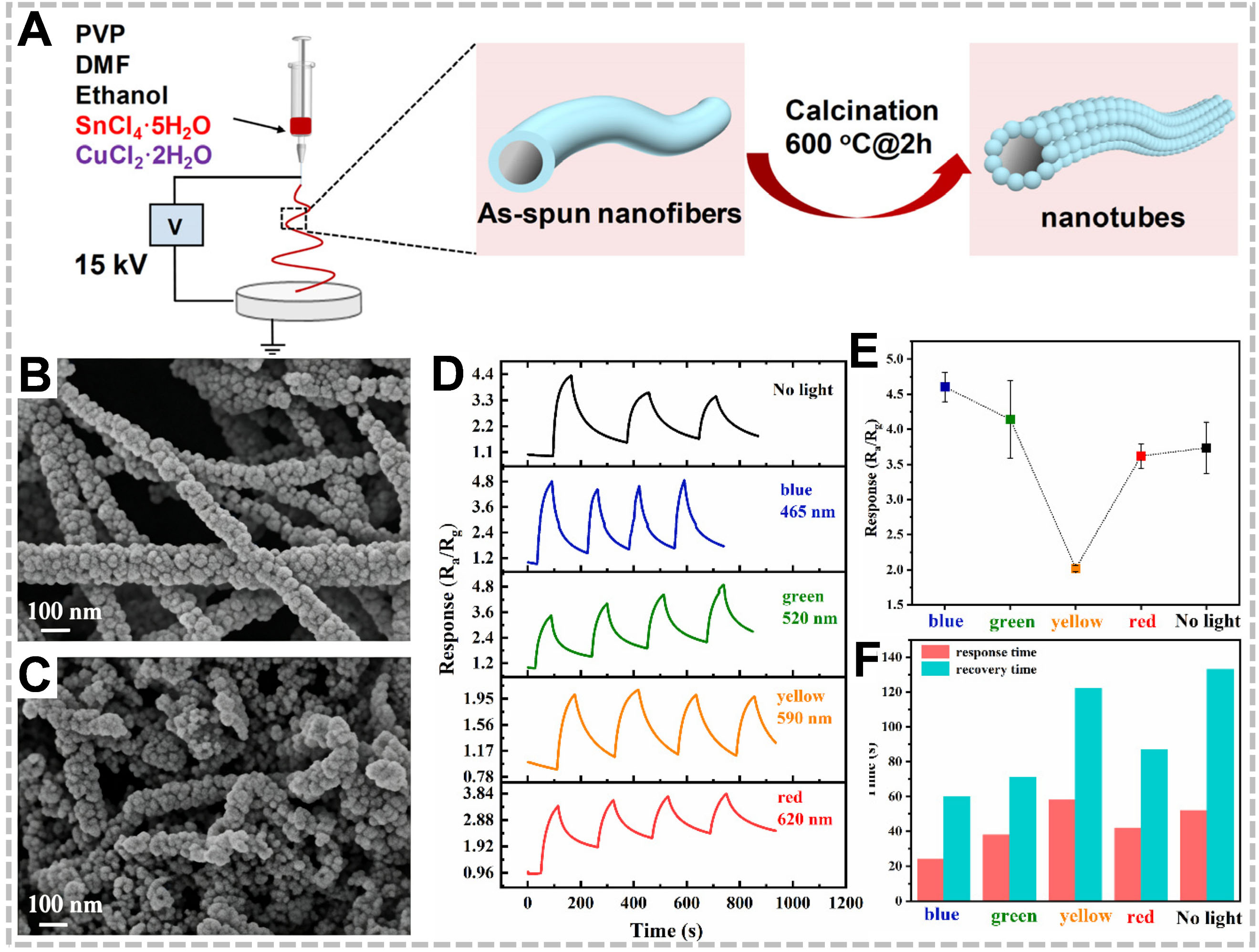
Figure 4. Performance of photoactivated-based H2S sensors. Schematic illustration of the material preparation process (A); SEM images of pure SnO2 (B) and CuO-SnO2 (C) samples; real-time response (D), mean response (E) and response/recovery times (F) for 10 ppm H2S under various visible-light activation. Figure 4 is reproduced from Ref.[154], under CC BY 4.0 license. PVP: Polyvinylpyrrolidone; DMF: N,N-dimethylformamide; SEM: scanning electron microscope; Ra/Rg: resistance in air/resistance in test gas; ppm: parts-per-million.
Overall, photoactivated H2S sensors are progressing from light-assisted oxides toward heterostructures that couple photocarrier generation, interfacial charge separation, reactive oxygen species, and photothermal effects. However, illumination is not inherently low power because its energy cost depends on source efficiency, optical power density, illuminated area, irradiation mode, and driving power. LEDs favor compact and duty-cycled devices, whereas lasers provide high localized intensity at the cost of greater power consumption and system complexity. Photoelectronic and photothermal contributions must be distinguished by measuring the sensing-layer temperature and performing matched-temperature dark controls. Otherwise, enhanced response or recovery cannot be attributed solely to photogenerated carriers. Future studies should report the light-source type, wavelength, optical power density, irradiation mode, sensing-layer temperature, light-source electrical input power, sensor bias power, and total device power. Energy efficiency should also be compared with passive room-temperature sensing and duty-cycled heating.
The mechanisms summarized in Table 3 are supported with varying levels of directness. BET analysis, microscopy, and structure-dependent comparisons can establish morphology- and diffusion-related effects but cannot identify the dominant surface reaction. Sulfidation-induced phase conversion requires operando, in situ, or pre- and post-exposure XPS, Raman, XRD, or TEM evidence. Oxygen-vacancy-mediated activation should be supported by EPR, O2-TPD, conductivity measurements, and controlled defect series because O 1s fitting alone is insufficient. Heterojunction and Schottky-barrier modulation can be examined using UPS/KPFM, work-function measurements, I-V characteristics, and impedance spectroscopy, although detailed band-bending models remain inferential. Noble-metal spillover, photocarrier transfer, and reactive-oxygen-species generation require stronger validation through operando spectroscopy, product analysis, action spectra, selective trapping, or matched-temperature controls. For porous frameworks, in situ Raman/XPS and conductivity measurements can distinguish coordination or redox processes from physical adsorption. DFT provides atomic-level support for adsorption and charge transfer but does not constitute direct experimental verification. Because multiple pathways may coexist, mechanistic conclusions should rely on converging structural, spectroscopic, electrical, and theoretical evidence rather than sensing performance alone.
Major sensing mechanisms and evidence assessment for room-temperature H2S sensors
| Mechanism | Signal origin | Preferred evidence | Key limitation | Ref. |
| Morphology and diffusion regulation | More accessible sites and shorter diffusion paths | BET, microscopy, thickness/porosity series | Surface area alone cannot identify reaction pathway | [10,12,78,87] |
| Oxygen vacancy activation | Enhanced oxygen adsorption and carrier exchange | EPR, O2-TPD, XPS, conductivity | O 1s fitting alone is insufficient | [103,155] |
| Sulfidation-induced phase conversion | Conductive sulfide formation and barrier collapse | In situ/quasi-in situ XPS, Raman, XRD, TEM | May cause irreversible drift and poisoning | [10,17,87,88] |
| Heterojunction / Schottky modulation | Gas-dependent barrier and depletion-width change | UPS/KPFM, I-V, impedance, work-function data | Idealized band diagrams may over-simplify contacts | [13-18,100,124,157] |
| Noble-metal catalysis/spillover | Catalytic H2S dissociation or oxidation, oxygen spillover, metal-sulfur interaction, and interfacial electronic sensitization | TEM/HAADF-STEM, XPS/XAS, in situ spectroscopy, work-function measurements, particle-size/loading controls, and product analysis | Sulfur poisoning and aggregation affect stability | [48-58] |
| Photoactivation/photothermal effect | Photocarriers, ROS generation, thermal acceleration | Action spectra, matched-temperature controls, IR imaging, DRIFTS | Total optical/electrical power often underreported | [152-156,158] |
| Porous-framework-mediated electronic transduction | Coordination, redox, and pore-confined charge transfer | In situ Raman/XPS, conductivity, DFT, array patterns | Humidity and irreversible coordination may alter framework | [39-42,46,47,132,133] |
HUMIDITY INTERFERENCE AND MITIGATION STRATEGIES
Humidity critically affects room-temperature H2S sensing by altering active sites, surface oxygen, charge transfer, and baseline conductivity. Water often competes with H2S and adsorbed oxygen for surface sites, reducing target-gas adsorption and causing baseline drift. For example, in Yb-doped Bi2S3 nanoribbons, raising RH from 8% to 91% lowered baseline resistance from 510 to 148 kΩ and decreased response to 100 ppb H2S, attributed to competitive adsorption[65]. However, water does not invariably suppress H2S sensing. In n-SnO2@p-SnO heterojunctions, H2S reacts with hydrolysis products from adsorbed water, releasing electrons and improving response at 20%-60% RH[104]. More deliberately, defect-rich UiO-67/TiO2 nanotube heterojunctions were designed to exploit adsorbed water to promote H2S ionization, pore-confined capture, surface reactions, and charge transport, achieving a response of approximately 194 toward 10 ppm H2S at 75% RH[66]. These contrasting observations indicate that humidity effects depend strongly on material chemistry, surface structure, transduction pathway, and RH range and may therefore be suppressive, promotive, or non-monotonic. Accordingly, humidity-mitigation strategies should regulate water access and water-surface interactions rather than simply eliminate water adsorption, thereby suppressing excessive competitive adsorption and baseline drift without blocking H2S transport or potentially beneficial moisture-assisted reactions.
Material-level humidity regulation includes hydrophobic surface design, porous adsorption layers, and phase or interface engineering. Dense hydrophobic coatings can suppress water uptake but may impede H2S diffusion, whereas intrinsic hydrophobicity combined with controlled surface chemistry can reduce this trade-off. H2-annealed and H2O2-treated ReS2 films combined strongly bound chemisorbed oxygen with intrinsic hydrophobicity, showing negligible response variation over 13%-87% RH and a dry-to-wet response ratio of 1.0006 at 87% RH[68]. Ce-doped rhombohedral/cubic In2O3 nanotubes maintained nearly constant responses over 20%-90% RH, suggesting that dopant-regulated oxygen chemistry and dual-phase interfaces can stabilize sensing behavior[64]. Pt-Co3O4@SnO2 core-shell nanofibers further integrated Pt sensitization, p-n junction modulation, and active oxygen species. Their response decreased by only 9%, 11%, and 22% at 60%, 80%, and 90% RH, respectively, and remained 385 at 90% RH[69]. However, the baseline resistance decreased markedly with humidity, demonstrating that response retention does not necessarily indicate baseline stability. Humidity can also enhance nonresistive signals. A CuO@V2C surface-acoustic-wave sensor exhibited repeatable H2S sensing over 20-80% RH, while its frequency shift increased from 39.71 to 92.43 kHz as RH increased from 0% to 80%[67]. This behavior was attributed to H2S/H2O co-adsorption, increased mass loading, and water-mediated proton transport rather than moisture rejection. Humidity tolerance should therefore be evaluated using baseline drift, response and recovery kinetics, hysteresis, repeated RH cycling, and long-term stability under consistent operating conditions.
DEVICE DESIGN, SENSOR ARRAYS, AND INTELLIGENT SYSTEM INTEGRATION
High sensitivity under controlled laboratory conditions is insufficient for practical H2S monitoring, which requires compact and stable systems tailored to concentration range, humidity, interfering gases, sampling method, power supply, signal readout, and communication[73,74]. Application requirements differ substantially. Exhaled-breath analysis demands trace detection in highly humid, multicomponent matrices[70,72], whereas food-spoilage monitoring requires continuous operation and timely warning in enclosed environments[74,159]. Industrial safety prioritizes rapid alarms, wide dynamic range, post-exposure recovery, and sulfur resistance. Environmental monitoring instead requires stable low-concentration detection, temperature and humidity calibration, and selectivity in complex pollutant mixtures. MEMS, flexible, wearable, and self-powered platforms support miniaturized and portable monitoring[73,74]. Sensor arrays and electronic noses convert cross-responsive signals into multidimensional fingerprints[70,74], while machine learning enhances identification, concentration estimation, and drift correction. Coordinating materials, devices, and data processing is essential for translating room-temperature H2S sensors into application-ready systems.
Device design and system integration
Device design determines whether a material response can be converted into a stable monitoring signal, requiring coordinated control of electrode geometry, film deposition, gas transport, packaging, power supply, readout, and communication. Huang et al. integrated a ZnO:Ga nanowire/nanosheet sensor with a suspended membrane, interdigitated electrodes, and a microheater on a silicon MEMS platform[73]. The device detected 0.1-0.8 ppm H2S and exhibited response and recovery times of 22.4 and 16.8 s toward 0.4 ppm[73]. A complementary flexible and self-powered system combined an Ag-Zn galvanic cell with a leather-hydrogel electrolyte, open-circuit-voltage readout, Bluetooth, and cloud communication for monitoring periodontitis, meat spoilage, and H2S leakage [Figure 5A][74]. These examples show that practical devices require not only miniaturization and low-power operation but also reproducible film-electrode interfaces, corrosion-resistant packaging, low-noise readout, and reliable wireless transmission
Sensor arrays, electronic noses, and AI-assisted identification
In complex atmospheres, the nominal selectivity of a single sensor may be insufficient for distinguishing H2S from coexisting gases. Sensor arrays instead combine partially selective elements to generate differentiated response patterns, while an electronic nose integrates gas sampling, signal conditioning, data acquisition, and pattern-recognition algorithms. Shahid et al. developed a room-temperature single-chip electronic nose based on silicon field-effect transistors (Si-FETs) functionalized with VO2, TiO2, Au, and Pd[160]. Combined with a polydimethylsiloxane (PDMS) microfluidic channel and a PCB-based readout system, the array produced distinct patterns for H2S, NH3, NO2, and air, and linear discriminant analysis achieved an overall classification accuracy of 89.66%. Zhou et al. further constructed an eight-channel MEMS electronic nose incorporating temperature/humidity acquisition, pump control, signal conditioning, 4G transmission, and cloud connectivity[161]. K-nearest-neighbor and random-forest models achieved 97% test-set accuracy for H2S, NH3, and their mixtures, while a neural network enabled quantitative prediction of both components[161]. Long-term reliability was addressed by Gawande et al., who used robust regression to correct the response drift of a six-sensor MEMS electronic nose after one year of operation[71]. These approaches convert multidimensional signals into gas identity, concentration, and monitoring decisions; however, reliable evaluation requires independent train-test separation by experiment, device, or measurement date, together with external validation under variable humidity and mixed-gas conditions.
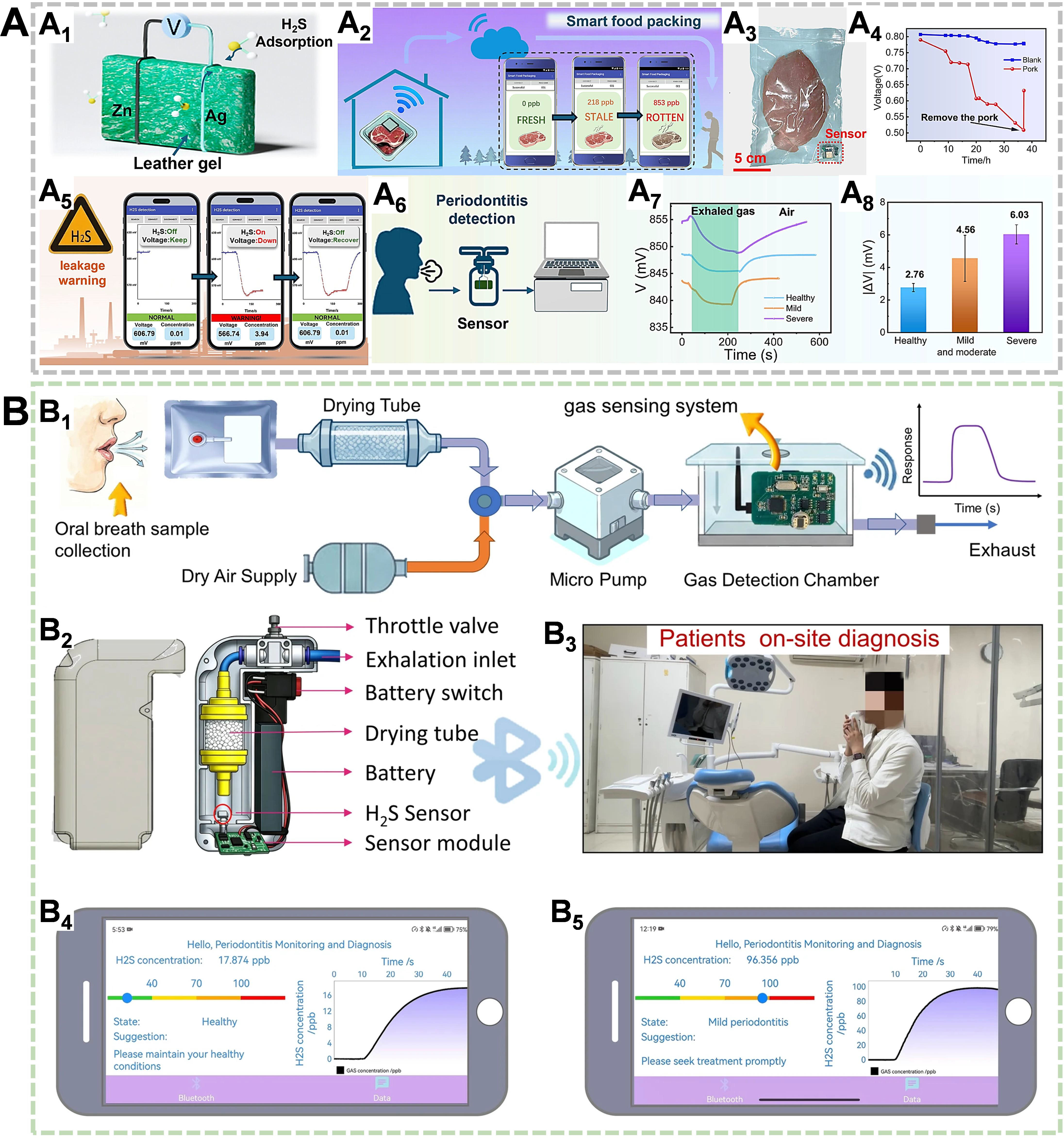
Figure 5. Device design and integration for intelligent H2S sensing. (A) Self-powered wireless H2S sensing platform showing the device and adsorption sites (A1), smart food-packaging test and OCV evolution (A2-A4), wireless leakage alarm (A5), and periodontitis monitoring (A6-A8). Figure 5A is reproduced with permission from Ref.[74]. Copyright 2026, Wiley-VCH; (B) Portable breath-analysis system for periodontitis diagnosis showing the detection protocol (B1), analyzer structure (B2), clinical measurement (B3), and smartphone readout (B4 and B5). Figure 5B is reproduced from Ref.[65], under CC BY 4.0 license. OCV: Open-circuit voltage; ppb: parts-per-billion.
Application-oriented validation and deployment
Practical validation should reproduce the sample matrix, environmental conditions, sampling procedure, and decision criteria of the intended application. For on-site periodontitis screening, a portable analyzer based on Yb-doped Bi2S3 nanoribbons integrated oral-exhalation sampling, real-time H2S detection, and smartphone-based readout, enabling the differentiation of healthy individuals from patients with periodontitis [Figure 5B][65]. For oral-health monitoring, a flexible Mo2CTx/MoSe2 sensor coupled with molecular-sieve and silica-gel dehumidification distinguished breath samples from 15 patients with periodontitis and 15 healthy controls. Measurements from six patients after treatment further indicated its potential for longitudinal monitoring[72]. For food storage, an In2O3/SnO2 H2S sensor was combined with a commercial ethanol channel in a refrigerator-monitoring system, enabling real-time freshness assessment across multiple spoilage products[159]. At the industrial scale, an electronic nose containing CuO-, SnO2-, and WO3-based sensors was trained using dynamic olfactometry as a reference and validated with samples from a municipal solid-waste treatment plant and two full-scale biofilters[162]. Broader deployment requires larger clinical or field datasets, standardized sampling, application-specific alarm thresholds, continuous-operation testing, and long-term calibration and maintenance strategies.
Overall, practical H2S monitoring requires coordinated development of application-specific devices, cross-responsive arrays, data-processing methods, and field validation. MEMS platforms support miniaturization but require stable packaging, while flexible and self-powered sensors improve portability at the cost of environmental robustness. Electronic noses address limited single-sensor selectivity through multidimensional response patterns but remain vulnerable to device variability, baseline drift, and insufficient training data. Future work should standardize device-level evaluation, validate systems using real samples, and develop data-processing frameworks that maintain accuracy under variable humidity, temperature, and background gases.
CONCLUSION AND OUTLOOK
This review summarizes recent advances in room-temperature H2S gas sensors from the perspectives of sensing materials, structural design, device configuration, and sensing mechanisms. Single-component materials, including ZnO, WO3, In2O3, CuO, and related semiconductors, have demonstrated the feasibility of room-temperature detection through morphology engineering, surface-reaction regulation, and defect optimization. CuO is particularly attractive because of its strong H2S affinity and the possible formation of conductive CuxS species. Nevertheless, pristine materials still face insufficient response at low concentrations, incomplete recovery, humidity interference, and limited selectivity in complex environments.
Composite design provides a versatile route for addressing these limitations by combining heterojunction modulation, interfacial charge transfer, and complementary surface chemistry. CuO-based p-n heterojunctions, Fe2O3-based composites, oxide/conducting-polymer systems, and other multicomponent structures generally outperform their single-material counterparts. Two-dimensional materials further expand this design space. Graphene and rGO facilitate carrier transport, TMDs provide active edge sites and tunable semiconducting interfaces, and MXenes offer high conductivity and chemically adjustable surface terminations. MOF-based platforms contribute pore-confined recognition, intrinsic framework transport, or porous defect-rich derivatives, while COFs provide molecularly tunable recognition sites. Noble-metal sensitization using Ag, Au, and Pt can strengthen H2S interactions, catalytic activation, oxygen regulation, and interfacial electronic modulation. Photoactivation also reduces continuous heater demand, although the power consumed by illumination and readout must be included when evaluating device-level energy efficiency.
Translating these advances into practical monitoring systems requires application-specific and quantitatively defined benchmarks. As suggested research targets rather than universal acceptance criteria, trace-level sensors should pursue experimentally validated detection limits below 10 ppb, response and recovery times below approximately 30 and 120 s at relevant concentrations, response retention above 90% over at least three months, and reproducible performance during repeated exposure. Device-to-device and batch-to-batch variations should be explicitly quantified. Humidity tolerance should be evaluated over application-relevant ranges, while selectivity should be tested in realistic mixed-gas backgrounds rather than only against individual interferents. Laboratory evaluation should be complemented by real-sample or field-relevant validation whenever possible. Response definitions, gas-flow conditions, calibration procedures, kinetic criteria, baseline drift, test atmosphere, stability duration, and total system power should also be reported consistently to enable meaningful comparisons.
Scalability, cost, and fabrication compatibility must be considered alongside sensing performance. Hydrothermal and solvothermal methods are accessible for batch synthesis but still face limitations in morphology reproducibility, film-thickness uniformity, precursor utilization, and electrode integration. MOF-based materials provide porous and compositionally tunable structures, although multistep synthesis, limited film processability, thermal conversion, structural shrinkage, and process-energy consumption may restrict large-scale production. Two-dimensional materials offer accessible surfaces and efficient charge transport, but scalable synthesis, oxidation resistance, restacking control, dispersion stability, and large-area film uniformity remain manufacturing barriers. Noble-metal sensitization must balance performance gains against metal loading, aggregation, cost, and recycling. Future studies should therefore report synthesis yield, batch variation, deposition area, film uniformity, device yield, processing temperature, material utilization, and compatibility with printing, spraying, electrodeposition, roll-to-roll processing, or wafer-level integration.
Future progress is unlikely to depend on a single material family or enhancement strategy. MXene/metal-oxide heterostructures, conductive MOFs and COFs, TMD-based interfaces, noble-metal-sensitized semiconductors, humidity-resistant architectures, and photoactivated systems provide complementary rather than universally superior solutions. Platform selection should reflect the target concentration, environmental conditions, reversibility, power demand, fabrication cost, device architecture, and intended application. Mechanisms involving oxygen vacancies, heterojunction barriers, Schottky contacts, catalytic spillover, phase conversion, and photocarrier transfer should be evaluated according to the strength of their evidence and verified through appropriate in situ or operando characterization. At the device level, sensing materials should be co-designed with low-power MEMS or flexible electrodes, corrosion-resistant packaging, controlled gas delivery, temperature and humidity compensation, wireless readout, sensor arrays, and drift-correction or pattern-recognition algorithms. Ultimately, validation in industrial safety, environmental monitoring, food storage, and breath analysis will determine whether material-level advances can be translated into reliable, low-power, reproducible, and manufacturable H2S monitoring systems.
DECLARATIONS
Authors’ contributions
Investigation: Wang, H.; Yao, L.; Sheng, W.
Writing - original draft preparation: Xu, W.; Sun, Z.
Writing - review & editing: Yang, X.
Supervision: Yang, X.
Funding acquisition: Yang, X.; Pan, G.
Availability of data and materials
Not applicable.
AI and AI-assisted tools statement
During the preparation of this manuscript, the AI tool ChatGPT (versions 5.5 and 5.6, released on 2026-04-24 and 2026-07-09) was used solely for language editing. AI-assisted tools were also employed to generate partial graphical elements for the graphical abstract and Figure 1. The tool did not influence the study design, data collection, analysis, interpretation, or the scientific content of the work. All authors take full responsibility for the accuracy, integrity, and final content of the manuscript.
Financial support and sponsorship
This work was supported by the National Natural Science Foundation of China (Nos. 62473126 and 62003123) and the Science and Technology Cooperation Special Project of Shijiazhuang (No. SJZZXB25005).
Conflicts of interest
All authors declared that there are no conflicts of interest.
Ethical approval and consent to participate
Not applicable.
Consent for publication
Not applicable.
Copyright
© The Author(s) 2026.
REFERENCES
1. Nagarjuna, Y.; Lin, J. C.; Wang, S. C.; Hsiao, W. T.; Hsiao, Y. J. AZO-based ZnO nanosheet MEMS sensor with different Al concentrations for enhanced H2S gas sensing. Nanomaterials. (Basel). 2021, 11, 3377.
2. Bai, X.; Chen, J.; He, L.; et al. Pine-needle-like SnO2@ZnO heterostructures for enhanced room temperature H2S gas sensing. Chem. Eng. J. 2025, 524, 169494.
3. Batterman, S.; Grant-Alfieri, A.; Seo, S. H. Low level exposure to hydrogen sulfide: a review of emissions, community exposure, health effects, and exposure guidelines. Crit. Rev. Toxicol. 2023, 53, 244-95.
4. Park, K.; Cho, H.; Lee, J.; Song, Y.; Kim, W.; Choa, Y. Design of highly porous SnO2-CuO nanotubes for enhancing H2S gas sensor performance. Sens. Actuators. B:. Chem. 2020, 302, 127179.
5. Galstyan, V.; Poli, N.; Comini, E. Highly sensitive and selective H2S chemical sensor based on ZnO nanomaterial. Appl. Sci. 2019, 9, 1167.
6. Faisal, A. D. Synthesis of ZnO comb-like nanostructures for high sensitivity H2S gas sensor fabrication at room temperature. Bull. Mater. Sci. 2017, 40, 1061-8.
7. Sood, T.; Thundiyil, R.; Anusha; Chattopadhyay, S.; Poornesh, P. Optimized nanostructured In2O3 gas sensors: harnessing annealing-induced defects and oxygen vacancies for ultra-sensitive and selective H2S detection at trace levels. RSC. Adv. 2025, 15, 16555-69.
8. Hoel, A.; Reyes, L.; Heszler, P.; Lantto, V.; Granqvist, C. Nanomaterials for environmental applications: novel WO3-based gas sensors made by advanced gas deposition. Curr. Appl. Phys. 2004, 4, 547-53.
9. Kundu, S.; Gorthala, G.; Ghosh, R. Room temperature detection of H2S by two dimensional WS2 based chemiresistive sensors. Sens. Actuators. B:. Chem. 2024, 416, 136018.
10. Li, Z.; Wang, N.; Lin, Z.; et al. Room-temperature high-performance H2S sensor based on porous CuO nanosheets prepared by hydrothermal method. ACS. Appl. Mater. Interfaces. 2016, 8, 20962-8.
11. Solis, J.; Saukko, S.; Kish, L.; Granqvist, C.; Lantto, V. Semiconductor gas sensors based on nanostructured tungsten oxide. Thin. Solid. Films. 2001, 391, 255-60.
12. Wang, C.; Chu, X.; Wu, M. Detection of H2S down to ppb levels at room temperature using sensors based on ZnO nanorods. Sens. Actuators. B:. Chem. 2006, 113, 320-3.
13. Doan, T. L. H.; Kim, J.; Lee, J.; et al. Facile synthesis of metal-organic framework-derived ZnO/CuO nanocomposites for highly sensitive and selective H2S gas sensing. Sens. Actuators. B:. Chem. 2021, 349, 130741.
14. He, M.; Xie, L.; Zhao, X.; Hu, X.; Li, S.; Zhu, Z. Highly sensitive and selective H2S gas sensors based on flower-like WO3/CuO composites operating at low/room temperature. J. Alloys. Compd. 2019, 788, 36-43.
15. Kong, X.; Li, Y. High sensitivity of CuO modified SnO2 nanoribbons to H2S at room temperature. Sens. Actuators. B:. Chem. 2005, 105, 449-53.
16. Liang, X.; Kim, T.; Yoon, J.; Kwak, C.; Lee, J. Ultrasensitive and ultraselective detection of H2S using electrospun CuO-loaded In2O3 nanofiber sensors assisted by pulse heating. Sens. Actuators. B:. Chem. 2015, 209, 934-42.
17. Patil, L.; Patil, D. Heterocontact type CuO-modified SnO2 sensor for the detection of a ppm level H2S gas at room temperature. Sens. Actuators. B:. Chem. 2006, 120, 316-23.
18. Zhang, D.; Wu, J.; Cao, Y. Ultrasensitive H2S gas detection at room temperature based on copper oxide/molybdenum disulfide nanocomposite with synergistic effect. Sens. Actuators. B:. Chem. 2019, 287, 346-55.
19. Liu, Z.; Song, J.; Wang, T.; et al. Ultrasensitive H2S sensor based on Cu2O/Graphene heterostructures at room temperature. Appl. Surf. Sci. 2025, 702, 163339.
20. Ugale, A. D.; Umarji, G. G.; Jung, S. H.; et al. ZnO decorated flexible and strong graphene fibers for sensing NO2 and H2S at room temperature. Sens. Actuators. B:. Chem. 2020, 308, 127690.
21. Balasubramani, V.; Sureshkumar, S.; Rao, T. S.; Sridhar, T. M. Impedance spectroscopy-based reduced graphene oxide-incorporated ZnO composite sensor for H2S investigations. ACS. Omega. 2019, 4, 9976-82.
22. Liu, L.; Yang, M.; Gao, S.; et al. Co3O4 hollow nanosphere-decorated graphene sheets for H2S sensing near room temperature. ACS. Appl. Nano. Mater. 2019, 2, 5409-19.
23. Wang, H.; Zhou, F.; Zhang, R.; et al. Ppb-level H2S gas sensor based on Li-doped CuO nanoparticles compounded on graphene at room temperature. ACS. Sens. 2026, 11, 2325-34.
24. Peng, F.; Wang, S.; Yu, W.; et al. Ultrasensitive ppb-level H2S gas sensor at room temperature based on WO3/rGO hybrids. J. Mater. Sci:. Mater. Electron. 2020, 31, 5008-16.
25. Song, Z.; Wei, Z.; Wang, B.; et al. Sensitive room-temperature H2S gas sensors employing SnO2 quantum wire/reduced graphene oxide nanocomposites. Chem. Mater. 2016, 28, 1205-12.
26. Zhou, L.; Shen, F.; Tian, X.; Wang, D.; Zhang, T.; Chen, W. Stable Cu2O nanocrystals grown on functionalized graphene sheets and room temperature H2S gas sensing with ultrahigh sensitivity. Nanoscale 2013, 5, 1564-9.
27. Shewale, P. S.; Yun, K. Synthesis and characterization of Cu-doped ZnO/RGO nanocomposites for room-temperature H2S gas sensor. J. Alloys. Compd. 2020, 837, 155527.
28. Huo, Y.; Qiu, L.; Wang, T.; et al. P-N Heterojunction formation: Metal sulfide@metal oxide chemiresistor for ppb H2S detection from exhaled breath and food spoilage at flexible room temperature. ACS. Sens. 2024, 9, 3433-43.
29. Zhang, H.; Zou, J.; Luo, S.; Huang, Y.; Fan, D. Research progress of gas sensors based on two-dimensional materials. J. Shenzhen. Univ. Sci. Eng. 2018, 35, 221.
30. Kim, T.; Kim, Y.; Park, S.; Kim, S.; Jang, H. Two-dimensional transition metal disulfides for chemoresistive gas sensing: perspective and challenges. Chemosensors 2017, 5, 15.
31. Wang, B.; Gu, Y.; Chen, L.; Ji, L.; Zhu, H.; Sun, Q. Gas sensing devices based on two-dimensional materials: a review. Nanotechnology 2022, 33, 252001.
32. Xie, Y.; Zhang, Z.; Meng, F.; et al. Strategies and challenges for improving the performance of two-dimensional materials-based gas sensors. Adv. Phys. X. 2024, 9, 2288353.
33. Hingangavkar, G. M.; Kadam, S. A.; Ma, Y.; Selvaraj, M.; Mulik, R. N.; Patil, V. B. On the behavior of MoS2-rGO nanocomposites for chemiresistive H2S detection at room temperature. Sens. Actuators. B:. Chem. 2024, 399, 134843.
34. Sadaf, S.; Zhang, H.; Akhtar, A. MoS2-NiO nanocomposite for H2S sensing at room temperature. RSC. Adv. 2023, 13, 28564-75.
35. Alagh, A.; Annanouch, F. E.; Umek, P.; Bittencourt, C.; Colomer, J. F.; Llobet, E. An ultrasensitive room-temperature H2S Gas sensor based on 3D assembly of Cu2O decorated WS2 nanomaterial. IEEE. Sensors. J. 2021, 21, 21212-20.
36. Akhtar, A.; Yao, C.; Zhou, R.; et al. Hydrothermally synthesized MXene Ti3C2/Zn2SnO4 based nanocomposite for H2S sensing at room temperature. Ceram. Int. 2024, 50, 12298-309.
37. Mirzaei, A.; Lee, M. H.; Safaeian, H.; et al. Room temperature chemiresistive gas sensors based on 2D MXenes. Sensors. (Basel). 2023, 23, 8829.
38. Sadaf, S.; Zhang, H.; Akhtar, A. H2S/butane dual gas sensing based on a hydrothermally synthesized MXene Ti3C2Tx/NiCo2O4 nanocomposite. Molecules 2023, 29, 202.
39. Benedetto, G.; Stolz, R. M.; Meng, Z.; et al. Conductive covalent organic frameworks as chemiresistive sensor arrays for the detection and differentiation of gasotransmitters. J. Am. Chem. Soc. 2025, 147, 43438-52.
40. Meng, Z.; Stolz, R. M.; Mirica, K. A. Two-dimensional chemiresistive covalent organic framework with high intrinsic conductivity. J. Am. Chem. Soc. 2019, 141, 11929-37.
41. Nizamidin, P.; Du, X.; Gao, H.; Li, Y. A nanoporous covalent organic framework film-based optical waveguide sensor for H2S gas detection. ACS. Appl. Nano. Mater. 2025, 8, 3876-86.
42. Jeon, M.; Lee, J. S.; Kim, M.; et al. Triphenylene-Based 2D cMOFs: Unraveling the H2S sensing mechanism and applications for a real-time wireless chemiresistive sensor. ACS. Appl. Mater. Interfaces. 2024, 16, 62382-91.
43. Li, Q.; Liu, X.; Zhang, Y.; et al. Passivation-enhanced mixed-potential Cu-MOF sensor for ppb-level H2S detection and real-time food freshness evaluation. Sens. Actuators. B:. Chem. 2026, 447, 138908.
44. Luo, K.; Tai, H.; Chittibabu, D. K. D.; et al. New improved metal-organic frameworks using dual metal centers: a novel H2S gas sensing capability through synergistic interactions. Sens. Actuators. B:. Chem. 2025, 443, 138200.
45. Marquardt, N.; Dahlke, M.; Schaate, A. Cu-MOF-808 as a sensing material for gaseous hydrogen sulfide. Chempluschem 2023, 88, e202300109.
46. Wu, X.; Tian, X.; Zhang, W.; et al. Solution-processable MOF-on-MOF system constructed via template-assisted growth for ultratrace H2S detection. Angew. Chem. Int. Ed. Engl. 2024, 63, e202410411.
47. Zhao, X.; Jiang, S.; Zhang, Z.; et al. High-performance H2S sensors to detect SF6 leakage. ACS. Sens. 2024, 9, 5512-9.
48. Deb, M.; Lu, C. J.; Zan, H. W. Achieving room-temperature ppb-level H2S detection in a Au-SnO2 sensor with low voltage enhancement effect. ACS. Sens. 2024, 9, 4568-77.
49. Goncharov, T.; Nasriddinov, A.; Zubenko, A.; et al. Nanocrystalline SnO2 functionalized with Ag(I) organometallic complexes as materials for low temperature H2S detection. Materials. (Basel). 2021, 14, 7778.
50. Hosseini, Z.; Mortezaali, A.; Iraji, zad. A.; Fardindoost, S. Sensitive and selective room temperature H2S gas sensor based on Au sensitized vertical ZnO nanorods with flower-like structures. J. Alloys. Compd. 2015, 628, 222-9.
51. Khoshnood, F.; Manouchehri, S.; Yousefi, M. H. Sensing sub-ppm concentration of H2S gas at room temperature using silver-doped SnO2 nanocrystals. J. Electron. Mater. 2022, 51, 1804-12.
52. Kou, R.; He, H.; Lu, Y.; et al. Boosting H2S gas sensing performance of metal oxide semiconductors at room-temperature by the electron-extracting effect of Pt nanocluster. Chem. Eng. J. 2023, 476, 146546.
53. Navale, S.; Shahbaz, M.; Mirzaei, A.; Kim, S. S.; Kim, H. W. Effect of Ag addition on the gas-sensing properties of nanostructured resistive-based gas sensors: an overview. Sensors. (Basel). 2021, 21, 6454.
54. Ramgir, N. S.; Sharma, P. K.; Datta, N.; et al. Room temperature H2S sensor based on Au modified ZnO nanowires. Sens. Actuators. B:. Chem. 2013, 186, 718-26.
55. Su, P.; Chai, X. Room-temperature ppb-level H2S gas sensors based on Ag nanowire/hollow PPy nanotube nanocomposites. Chemosensors 2022, 10, 305.
56. Xu, Q.; Zong, B.; Li, Q.; Fang, X.; Mao, S.; Ostrikov, K. K. H2S sensing under various humidity conditions with Ag nanoparticle functionalized Ti3C2Tx MXene field-effect transistors. J. Hazard. Mater. 2022, 424, 127492.
57. Xuan, J.; Zhao, G.; Gong, Q.; et al. Fabrication of in-situ grown and Pt-decorated ZnO nanoclusters on new-type FTO electrode for room-temperature detection of low-concentration H2S. J. Alloys. Compd. 2021, 860, 158499.
58. Yan, S.; Li, Z.; Li, H.; et al. Ultra-sensitive room-temperature H2S sensor using Ag-In2O3 nanorod composites. J. Mater. Sci. 2018, 53, 16331-44.
59. Li, Z.; Yan, S.; Zhang, S.; et al. Ultra-sensitive UV and H2S dual functional sensors based on porous In2O3 nanoparticles operated at room temperature. J. Alloys. Compd. 2019, 770, 721-31.
60. Thota, C.; Modigunta, J. K. R.; Reddeppa, M.; et al. Light stimulated room-temperature H2S gas sensing ability of Cl-doped carbon quantum dots supported Ag nanoparticles. Carbon 2022, 196, 337-46.
61. Xie, Y.; Sun, F.; Yang, Y.; et al. Gas-sensing mechanism and performances of Ti3C2Tx/CuO for H2S at room temperature. Chem. Eng. J. 2025, 519, 165339.
62. Wu, K.; Zhang, W.; Zheng, Z.; Debliquy, M.; Zhang, C. Room-temperature gas sensors based on titanium dioxide quantum dots for highly sensitive and selective H2S detection. Appl. Surf. Sci. 2022, 585, 152744.
63. Sun, H.; Cao, M.; Zhang, P.; et al. Magnetic-field-enhanced H2S sensitivity of Cu2O/NiO heterostructure ordered nanoarrays. ACS. Sens. 2022, 7, 1903-11.
64. Guo, L.; Jiang, Y.; Cai, Y.; et al. Towards high-performance room-temperature H2S sensors: crystal phase engineering and Ce doping in In2O3 nanotubes. Sens. Actuators. B:. Chem. 2026, 458, 139766.
65. Guo, P.; Wang, K.; An, X.; et al. On-site periodontitis diagnosis via room-temperature oral exhalation H2S sensor based on Yb-doped Bi2S3 nanoribbon. Nanomicro. Lett. 2026, 18.
66. Kou, R.; Zhang, Y.; Cai, Y.; et al. Moisture-promoted, defect-rich UiO-67/TiO2 nanotube heterojunctions for ppb-level H2S detection under ambient conditions. ACS. Sens. 2025, 10, 9447-56.
67. Pasupuleti, K. S.; Pham, T. M. T.; Abraham, B. M.; et al. Room temperature ultrasensitive ppb-level H2S SAW gas sensor based on hybrid CuO@V2C MXene van der Waals heterostructure. Adv. Compos. Hybrid. Mater. 2025, 8, 1194.
68. Peng, Q.; Zhang, Y.; Feng, W.; Yang, X.; Cheng, J. Humidity resistant room temperature H2S sensor via surface-adsorbed oxygen modulation of ReS2 nano-film. Physica. B:. Condensed. Matter. 2026, 720, 418000.
69. Song, X.; Wang, H.; Huang, W.; Lu, Y.; Wang, Z.; Wang, H. Rapid and high responsive Pt-Co3O4@SnO2 core-shell nanofibers for room-temperature detection of H2S in exhaled breath for non-invasive asthma diagnosis. Chem. Eng. J. 2026, 533, 174765.
70. Duan, Q.; Zhang, W.; Li, L.; et al. W-CeO2 nanospheres gas sensor array for accurate and selective H2S detection in exhaled breath. Chem. Eng. J. 2024, 479, 147748.
71. Gawande, T.; Deshmukh, R.; Deshmukh, S. MEMS-based electronic nose system for measurement of industrial gases with drift correction methodology. Meas. Sci. Technol. 2023, 34, 105110.
72. Han, Q.; Hu, C.; Shi, F.; et al. Flexible Mo2CTx/MoSe2 heterostructure sensors for ultrasensitive, room-temperature detection of exhaled H2S in periodontitis diagnosis. ACS. Sens. 2025, 10, 5108-19.
73. Huang, C.; Wu, C.; Hsueh, T. A room temperature ZnO:Ga NWs&NSs/MEMS H2S gas sensor. Mater. Sci. Semicond. Process. 2025, 187, 109149.
74. Zhong, W.; Yang, L.; Zhou, Y.; et al. A Self‐Powered, Ultrasensitive, and flexible gas sensor based on tough and degradable leather hydrogel for portable wireless trace H2S detection. Adv. Funct. Mater. 2026, 36, e32190.
75. Gong, H.; Hu, J.; Wang, J.; Ong, C.; Zhu, F. Nano-crystalline Cu-doped ZnO thin film gas sensor for CO. Sens. Actuators. B:. Chem. 2006, 115, 247-51.
76. Hong, R.; Li, J.; Chen, L.; et al. Synthesis, surface modification and photocatalytic property of ZnO nanoparticles. Powder. Technol. 2009, 189, 426-32.
77. Zhu, L.; Zeng, W. Room-temperature gas sensing of ZnO-based gas sensor: a review. Sensor. Actuat. A-Phys. 2017, 267, 242-61.
78. Hosseini, Z.; zad, A. I.; Mortezaali, A. Room temperature H2S gas sensor based on rather aligned ZnO nanorods with flower-like structures. Sens. Actuators. B:. Chem. 2015, 207, 865-71.
79. Kaiser, A.; Mauritz, T.; Bansmann, J.; Biskupek, J.; Herr, U.; Thonke, K. Mechanism of optical and electrical H2S gas sensing of pristine and surface functionalized ZnO nanowires. ACS. Omega. 2024, 9, 50188-200.
80. Shinde, S.; Patil, G.; Kajale, D.; Gaikwad, V.; Jain, G. Synthesis of ZnO nanorods by spray pyrolysis for H2S gas sensor. J. Alloys. Compd. 2012, 528, 109-14.
81. Kaur, M.; Kailasaganapathi, S.; Ramgir, N.; et al. Gas dependent sensing mechanism in ZnO nanobelt sensor. Appl. Surf. Sci. 2017, 394, 258-66.
82. Frühberger, B.; Grunze, M.; Dwyer, D. Surface chemistry of H2S-sensitive tungsten oxide films. Sens. Actuators. B:. Chem. 1996, 31, 167-74.
83. Solis, J.; Saukko, S.; Kish, L.; Granqvist, C.; Lantto, V. Nanocrystalline tungsten oxide thick-films with high sensitivity to H2S at room temperature. Sens. Actuators. B:. Chem. 2001, 77, 316-21.
84. Punginsang, M.; Zappa, D.; Comini, E.; et al. Selective H2S gas sensors based on ohmic hetero-interface of Au-functionalized WO3 nanowires. Appl. Surf. Sci. 2022, 571, 151262.
85. Yu, H.; Song, Z.; Liu, Q.; et al. Colloidal synthesis of tungsten oxide quantum dots for sensitive and selective H2S gas detection. Sens. Actuators. B:. Chem. 2017, 248, 1029-36.
86. Chen, J.; Wang, K.; Hartman, L.; Zhou, W. H2S detection by vertically aligned CuO nanowire array sensors. J. Phys. Chem. C. 2008, 112, 16017-21.
87. Huang, Z.; Wang, X.; Sun, F.; et al. Super response and selectivity to H2S at room temperature based on CuO nanomaterials prepared by seed-induced hydrothermal growth. Mater. Design. 2021, 201, 109507.
88. Zhang, J. Z.; Yan, Y. Synthesis of biomorphic tube-like CuO using pomelo white flesh as biotemplate and its sensing properties over H2S at room temperature. J. Mater. Sci. 2017, 52, 13711-8.
89. Verma, G.; Gupta, A. Sensing performance of room temperature operated MEMS gas sensor for ppb level detection of hydrogen sulfide: a review. J. Micromech. Microeng. 2022, 32, 094002.
90. Zhao, L.; Che, J.; Cao, Q.; Shen, S.; Tang, Y. Highly sensitive surface acoustic wave H2S gas sensor using electron-beam-evaporated CuO as sensitive layer. Sens. Mater. 2023, 35, 2293.
91. Xu, J.; Wang, X.; Shen, J. Hydrothermal synthesis of In2O3 for detecting H2S in air. Sens. Actuators. B:. Chem. 2006, 115, 642-6.
92. Xu, L.; Dong, B.; Wang, Y.; Bai, X.; Liu, Q.; Song, H. Electrospinning preparation and room temperature gas sensing properties of porous In2O3 nanotubes and nanowires. Sens. Actuators. B:. Chem. 2010, 147, 531-8.
93. Wang, Y.; Duan, G.; Zhu, Y.; et al. Room temperature H2S gas sensing properties of In2O3 micro/nanostructured porous thin film and hydrolyzation-induced enhanced sensing mechanism. Sens. Actuators. B:. Chem. 2016, 228, 74-84.
94. Li, Z.; Yan, S.; Sun, M.; et al. Significantly enhanced temperature-dependent selectivity for NO2 and H2S detection based on In2O3 nano-cubes prepared by CTAB assisted solvothermal process. J. Alloys. Compd. 2020, 816, 152518.
95. Yang, S.; Song, Z.; Gao, N.; et al. Near room temperature operable H2S sensors based on In2O3 colloidal quantum dots. Sens. Actuators. B:. Chem. 2019, 286, 22-31.
96. Kumar Pradhan B, Kumar Mauraya A, Chatterjee K, Pal P, Kumar Muthusamy S. High-sensitive and fast-responsive In2O3 thin film sensors for dual detection of NO2 and H2S gases at room temperature. Appl. Surf. Sci. 2024, 678, 161111.
97. Xuan, J.; Zhao, G.; Shi, X.; et al. In-situ fabrication of ZnO nanoparticles sensors based on gas-sensing electrode for ppb-level H2S detection at room temperature*. Chinese. Phys. B. 2021, 30, 020701.
98. Ping, Y.; Zhao, M.; Dan, Zhao.; et al. Construction of hierarchical CuO sphere-like structure for ppb-level H2S sensing at room temperature. J. Alloys. Compd. 2025, 1031, 181095.
99. Yamazoe, N.; Shimanoe, K. Basic approach to the transducer function of oxide semiconductor gas sensors. Sens. Actuators. B:. Chem. 2011, 160, 1352-62.
100. He, H.; Zhao, C.; Xu, J.; et al. Exploiting free-standing p-CuO/n-TiO2 nanochannels as a flexible gas sensor with high sensitivity for H2S at room temperature. ACS. Sens. 2021, 6, 3387-97.
101. Chen, H.; Lv, L.; Xue, K.; Zhang, P.; Du, L.; Cui, G. Oral exhalation H2S sensor based on Cu2O/ZnO heterostructures. ACS. Sens. 2025, 10, 2579-88.
102. Zhou, T.; Wang, Y.; Liu, Y.; et al. Ultrasensitive and selective room-temperature H2S sensor based on CuO/In2O3 heterojunction via dual sensitization mechanism. Sens. Actuators. B:. Chem. 2026, 462, 140017.
103. Bai, H.; Feng, C.; Chen, Y.; et al. Chemiresistive room temperature H2S gas sensor based on MoO3 nanobelts decorated with MnO2 nanoparticles. Sens. Actuators. B:. Chem. 2024, 420, 136468.
104. Xu, J.; Feng, J.; Ye, J.; et al. Core-shell n-SnO2@p-SnO heterojunctions via on-chip annealing for ultrasensitive H2S detection at room temperature. J. Alloys. Compd. 2025, 1043, 184217.
105. Tang, J.; Wang, H.; Dong, W.; et al. SnO2 QDs loaded α-Fe2O3 hollow cubes for H2S room temperature detection and insights into their gas sensing mechanism. Ceram. Int. 2024, 50, 14151-60.
107. Zhang, D.; Fan, X.; Hao, X.; Dong, G. Facile fabrication of polyaniline nanocapsule modified zinc oxide hexagonal microdiscs for H2S gas sensing applications. Ind. Eng. Chem. Res. 2019, 58, 1906-13.
108. Sun, Z.; Yang, X.; Yang, S.; et al. Ultrasensitive and ultra-selective room-temperature H2S gas sensor based on CuO-loaded In2O3 2D porous nanosheets. J. Hazard. Mater. 2025, 493, 138355.
109. Xue, H.; Huang, F.; He, X.; et al. Hierarchical porous CdS-Co3O4 heterostructures for H2S gas sensing at room temperature. ACS. Appl. Nano. Mater. 2025, 8, 18434-45.
110. Cao, M.; Lei, H.; Jiang, H.; et al. Bio-template synthesis of graphitized carbon-decorated Fe2O3 hierarchical tubes for high-response and low-temperature H2S detection. Chem. Eng. J. 2026, 531, 174072.
111. Tang, X.; Du, A.; Kou, L. Gas sensing and capturing based on two‐dimensional layered materials: overview from theoretical perspective. WIREs. Comput. Mol. Sci. 2018, 8, e1361.
112. Varghese, S.; Varghese, S.; Swaminathan, S.; Singh, K.; Mittal, V. Two-dimensional materials for sensing: graphene and beyond. Electronics 2015, 4, 651-87.
113. Eum, J. H.; Kwon, S. J.; Eo, S.; Kim, D. H. Tunable chemiresistive gas selectivity of thin-layered conductive metal-organic framework/reduced graphene oxide composites. ACS. Sens. 2026, 11, 3840-50.
114. Amith, S. L.; Koventhan, C.; Richard, Y. A.; Radhakrishnan, K.; Piraman, S. Compact disc-based sensor utilizing Er2O3/Co3O4 nanorods anchored on rGO nanosheets for enhanced detection of hydrogen sulfide at room temperature. J. Hazard. Mater. 2026, 507, 141778.
115. Jing, W.; Xiangzhao, Z.; Guoqiang, W.; et al. MoSe2/In2O3 nanocomposite for room-temperature H2S sensing: Theoretical design and experimental validation. Sensor. Actuat. A-Phys. 2025, 394, 116897.
116. Verma, V. K.; Patel, C.; Mukherjee, S.; et al. Ultrasensitive and selective room temperature H2S detection using Pd-doped MoS2 synthesized via APCVD. Sens. Actuators. B:. Chem. 2026, 447, 138812.
117. Hilal, M.; Fayaz, H.; Ali, Y.; et al. Quantum-engineered Ti3C2Tx-QD@V2CTx hybrid composite with Ti-O-V interfacial bonding for extreme-humidity H2S sensing. Adv. Compos. Hybrid. Mater. 2026, 9, 1646.
118. Sun, Y.; Guo, W.; Wang, B.; et al. Construction of a Co3(HITP)2/Ti3C2 MXene heterojunction for selective sensing of H2S with high resistance to humidity. Sens. Actuators. B:. Chem. 2026, 450, 139224.
119. Balandin, A. A. Thermal properties of graphene and nanostructured carbon materials. Nat. Mater. 2011, 10, 569-81.
120. Ovsianytskyi, O.; Nam, Y.; Tsymbalenko, O.; Lan, P.; Moon, M.; Lee, K. Highly sensitive chemiresistive H2S gas sensor based on graphene decorated with Ag nanoparticles and charged impurities. Sens. Actuators. B:. Chem. 2018, 257, 278-85.
121. Balasubramani, V.; Sridhar, T.; Liu, B. Impedance spectroscopy analysis on reduced graphene oxide and CeO2 nanocomposites coated on screen-printed alumina substrate for highly selective H2S gas detection at room temperature. Ceram. Int. 2024, 50, 4359-73.
122. Ganatra, R.; Zhang, Q. Few-layer MoS2: a promising layered semiconductor. ACS. Nano. 2014, 8, 4074-99.
123. Hingangavkar, G. M.; Kadam, S. A.; Ma, Y.; Bandgar, S. S.; Mulik, R. N.; Patil, V. B. MoS2-GO hybrid sensor: a discerning approach for detecting harmful H2S gas at room temperature. Chem. Eng. J. 2023, 472, 144789.
124. Pan, W.; Zhang, Y.; Yu, S.; Liu, X.; Zhang, D. Hydrogen sulfide gas sensing properties of metal organic framework-derived α-Fe2O3 hollow nanospheres decorated with MoSe2 nanoflowers. Sens. Actuators. B:. Chem. 2021, 344, 130221.
125. Ding, J.; Wang, Q.; Liu, X.; Li, S.; Li, H. Ultrasensitive detection of hazardous gas at room temperature enabled by MOF@MXene 0D-2D heterostructure. J. Hazard. Mater. 2024, 480, 136261.
126. Han, Y.; Yin, Z.; Zhuang, H.; et al. Synergistic effects of photoactivation and photothermal in MXene heterostructures for the enhanced H2S detection capability. Adv. Funct. Mater. 2025, 35, e09735.
127. Vovusha, H.; Amorim, R.; Bae, H.; Lee, S.; Hussain, T.; Lee, H. Sensing of sulfur containing toxic gases with double transition metal carbide MXenes. Mater. Today. Chem. 2023, 30, 101543.
128. Hosseini-Shokouh, S. H.; Zhou, J.; Berger, E.; et al. Highly selective H2S gas sensor based on Ti3C2Tx MXene-organic composites. ACS. Appl. Mater. Interfaces. 2023, 15, 7063-73.
129. Cai, H.; Yao, Y.; Zhang, Q.; Cui, Y.; Qian, G. Ultrasensitive room-temperature hydrogen sulfide sensing via built-in electric field in porous p-n heterojunction derived from N-doped cerium metal-organic framework. Chem. Eng. J. 2026, 538, 176687.
130. Cline, E. L.; Noh, H.; Benedetto, G.; et al. Array of bimetallic metallophthalocyanine-based metal-organic frameworks for chemiresistive detection and differentiation of toxic gases. Chem 2026, 12, 103037.
131. Lee, K.; Jo, Y. M.; Sohn, M. S.; et al. Photoactivated conductive MOF thin film arrays on micro-LEDs for chemiresistive gas sensing. Nat. Commun. 2025, 16, 9612.
132. Liu, J.; Yang, F.; Tian, X.; et al. Construction of hierarchical conductive metal-organic frameworks via template-directed synthesis strategy for ultratrace H2S sensing. ACS. Sens. 2026, 11, 4600-7.
133. Zhang, W.; Ji, C.; Liu, L.; et al. Intercalated conductive metal-organic frameworks constructed via donor-acceptor interactions for ultratrace gas sensing. Mater. Today. 2026, 97, 103381.
134. Sun, Y.; Wang, B.; Wang, B.; et al. Coupling between conductive Co3(HITP)2 and SnO2 NPs for heterogeneous architectures: toward sensitive chemiresistors for H2S at room temperature. Chem. Eng. J. 2024, 500, 157253.
135. Jiang, H.; Wang, X.; Wang, X.; et al. Ultra-low hydrogen sulfide gas detection of metal-organic framework derived hollowed-out rod-shaped copper oxide nanostructures. Appl. Surf. Sci. 2025, 683, 161628.
136. Ding, Y.; Zhuang, Q.; Guo, X.; et al. NiO-CuO hydrangeas-like composite derived from Ni/Cu bimetallic MOFs for sensitive detection of H2S at room temperature. Appl. Surf. Sci. 2023, 612, 155792.
137. Zhang, C.; Zhang, S.; Yang, Y.; Yu, H.; Dong, X. Highly sensitive H2S sensors based on metal-organic framework driven γ-Fe2O3 on reduced graphene oxide composites at room temperature. Sens. Actuators. B:. Chem. 2020, 325, 128804.
138. Lee, U. Y.; Kim, M. Y.; Lee, K. H.; et al. Surface reaction mechanism and characteristics of 2-dimensional TiO2 and 0-dimensional Ag nanocomposites specialized for H2S gas sensing at room temperature. Sens. Actuators. Rep. 2025, 9, 100290.
139. Yan, Y.; Turdi, G.; Yimit, A.; Nizamidin, P. Ag-doped ZnFe2O4 nanoparticles for highly selective room-temperature H2S detection: experiment and DFT study. Mater. Sci. Semicond. Process. 2026, 208, 110495.
140. Abed, H. R.; Alwan, A. M. Effect of incorporating Ag nanoparticles within CeO2/PS thin film on the structural, morphological, and room temperature H2S gas sensing. Chinese. Journal. of. Physics. 2025, 98, 591-603.
141. Kumar, A.; Joshi, N.; Samanta, S.; et al. Room temperature detection of H2S by flexible gold-cobalt phthalocyanine heterojunction thin films. Sens. Actuators. B:. Chem. 2015, 206, 653-62.
142. Shen, Y.; Zhang, B.; Cao, X.; et al. Microstructure and enhanced H2S sensing properties of Pt-loaded WO3 thin films. Sens. Actuators. B:. Chem. 2014, 193, 273-9.
143. Sun, Y.; Zhao, Y.; Sun, H.; Jia, F.; Kumar, P.; Liu, B. Synthesis and room-temperature H2S sensing of Pt nanoparticle-functionalized SnO2 mesoporous nanoflowers. J. Alloys. Compd. 2020, 842, 155813.
144. Zuo, P.; Wang, R.; Li, F.; Wu, F.; Xu, G.; Niu, W. A trace ppb-level electrochemical H2S sensor based on ultrathin Pt nanotubes. Talanta 2021, 233, 122539.
145. Xue, S.; Jin, Q.; Wang, X.; Lu, G. Microwave gas sensor based on differential planar resonator synergistically loaded with Pd-doped CdSnO3 for enhanced H3S detection. IEEE. Electron. Device. Lett. 2025, 46, 480-3.
146. Sharma, P.; Bhattacharya, K.; Kumar, S.; Girija, K. Reliable and reversible detection of H2S at room temperature engendered via Pd doping of ZnO films synthesized by SILAR method. J. Alloys. Compd. 2024, 1003, 175591.
147. He, R.; Sun, Y.; Hou, Y.; et al. In-situ construction of Ag@Co-HHTP nanoparticles flexible sensor for H2S monitoring at room-temperature. Microchem. J. 2026, 228, 119088.
148. Wang, Y.; Li, J.; Zhang, D.; et al. Hydrothermal synthesis of Ag-doped WO3-based H2S room temperature sensors: unprecedented high and fast response. Sens. Actuators. B:. Chem. 2025, 438, 137811.
149. Zong, H.; Li, X.; Zhang, Y.; et al. Pt/Ti3C2 electrode material used for H2S sensor with low detection limit and high stability. Chin. Chem. Lett. 2025, 36, 110195.
150. Zhang, F.; Wang, Q.; Jiao, C.; et al. Oxygen vacancies-rich MoS2/Au@Cu2O for highly selective and ultrafast detection of hydrogen sulfide. J. Alloys. Compd. 2026, 1057, 186867.
151. Kong, D.; Ma, B.; Zhang, L.; et al. Metal (Au, Ag, Pt) Doping effects on the gas-sensing mechanism and characteristics of two-dimensional WS2: a first-principle. ACS. Appl. Electron. Mater. 2024, 6, 958-68.
152. Chen, H.; Liu, Y.; Xie, C.; Wu, J.; Zeng, D.; Liao, Y. A comparative study on UV light activated porous TiO2 and ZnO film sensors for gas sensing at room temperature. Ceram. Int. 2012, 38, 503-9.
153. Deb, S.; Mondal, A.; Ashok, Kumar. Reddy. Y. Review on development of metal-oxide and 2-D material based gas sensors under light-activation. Curr. Opin. Solid. St. M. 2024, 30, 101160.
154. Zou, C.; Peng, C.; She, X.; Wang, M.; Peng, B.; Zhou, Y. Photoelectric H2S sensing based on electrospun hollow CuO-SnO2 nanotubes at room temperature. Sensors. (Basel). 2024, 24, 6420.
155. Sun, Y.; Cui, J.; Fu, S.; et al. Rare earth-driven photogenerated charge separation in SnO2@Y2O3 heterojunctions for enhanced H2S sensing at room temperature. ACS. Appl. Mater. Interfaces. 2025, 17, 15948-58.
156. Yu, M.; Li, J.; Yin, D.; et al. Enhanced oxygen anions generation on Bi2S3/Sb2S3 heterostructure by visible light for trace H2S detection at room temperature. J. Hazard. Mater. 2024, 476, 134932.
157. Guo, X.; Ding, Y.; Liang, C.; et al. Humidity-activated H2S sensor based on SnSe2/WO3 composite for evaluating the spoilage of eggs at room temperature. Sens. Actuators. B:. Chem. 2022, 357, 131424.
158. Chinh, N. D.; Kim, C.; Kim, D. UV-light-activated H2S gas sensing by a TiO2 nanoparticulate thin film at room temperature. J. Alloys. Compd. 2019, 778, 247-55.
159. Sun, Y.; Qian, K.; Yue, J.; et al. High-response In2O3/SnO2 heterojunction sensor for detection of food spoilage gas H2S in refrigerators. Sens. Actuators. B:. Chem. 2026, 451, 139341.
160. Shahid, A.; Widdicombe, B.; Mokkapati, S.; Unnithan, R. R. Intelligent single-chip Si-FET based E-nose using metal and oxides functionalization. In 2025 IEEE 20th Nanotechnology Materials and Devices Conference (NMDC), Delhi, India, October 9-11, 2025; IEEE, 2025, pp 210-5.
161. Shahid, Y.; Hu, Y.; Jiang, Y.; Xu, Z.; Yao, L. An electronic nose based on gas sensor microarray for malodorous pollutants detection. In 2026 6th International Conference on Sensors and Information Technology (ICSI), Zhengzhou, China, April 24-26, 2026; IEEE, 2026, pp 116-20.
Cite This Article
 Open Access
How to Cite
Xu, W.; Sun, Z.; Wang, H.; Yao, L.; Sheng, W.; Pan, G.; Yang, X. Recent advances in room-temperature hydrogen sulfide gas sensors: materials design, interface engineering, and sensing mechanisms. Micro Nano Sci. 2026, 1, 14. https://dx.doi.org/10.20517/mns.2026.06
Download Citation
If you have the appropriate software installed, you can download article citation data to the citation manager of your choice. Simply select your manager software from the list below and click on download.
Export Citation File
Type of Import
Tips on Downloading Citation
Citation Manager File Format
Type of Import
Direct Import: When the Direct Import option is selected (the default state), a dialogue box will give you the option to Save or Open the downloaded citation data. Choosing Open will either launch your citation manager or give you a choice of applications with which to use the metadata. The Save option saves the file locally for later use.
Indirect Import: When the Indirect Import option is selected, the metadata is displayed and may be copied and pasted as needed.
About This Article
Copyright

Data & Comments
Data
0








Comments
Comments must be written in English. Spam, offensive content, impersonation, and private information will not be permitted. If any comment is reported and identified as inappropriate content by OAE staff, the comment will be removed without notice. If you have any queries or need any help, please contact us at [email protected].