

fig3
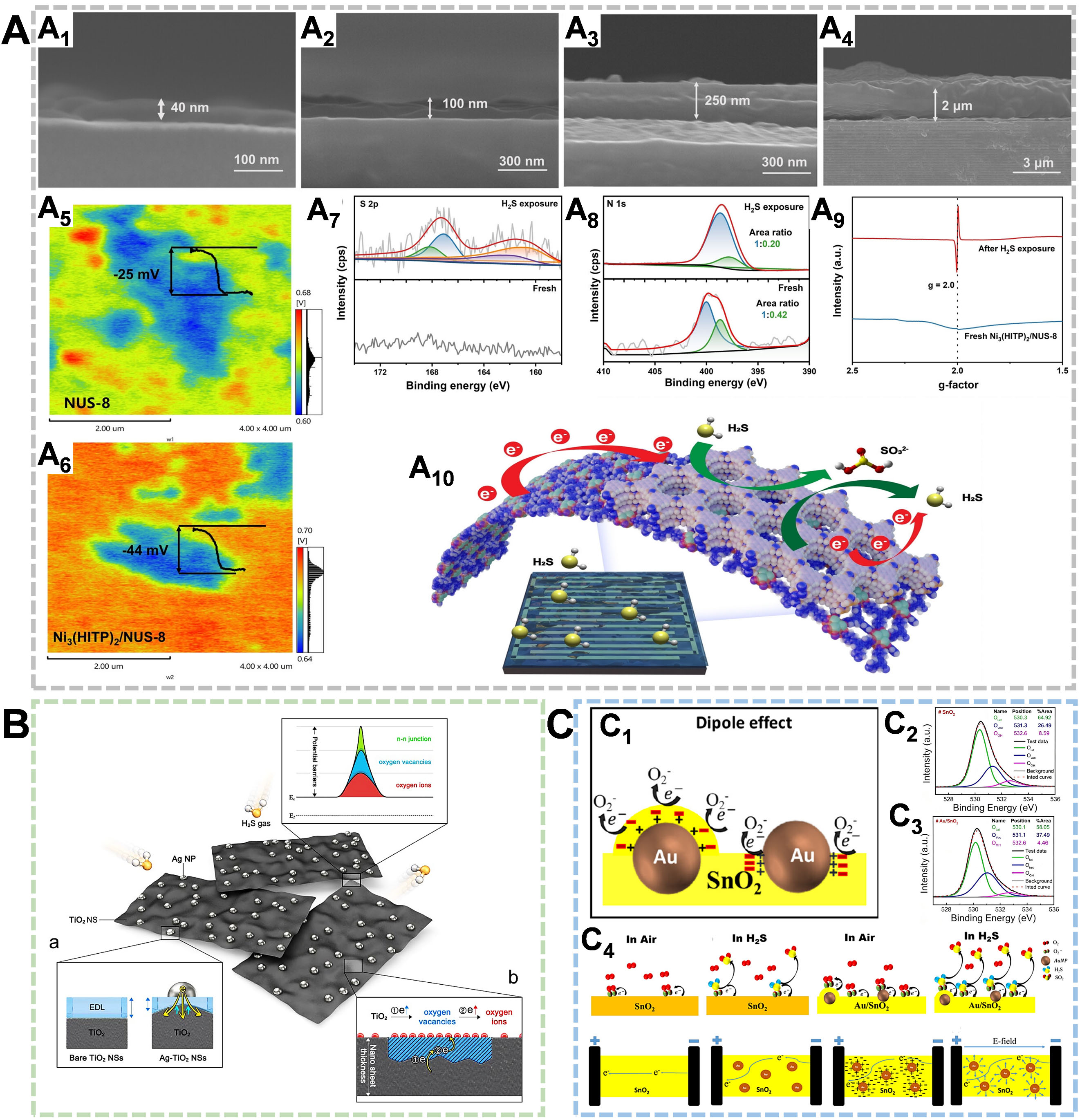
Figure 3. Structural characterization and proposed sensing mechanisms of MOF-based and noble-metal-sensitized H2S sensors. (A) Cross-sectional SEM images of thickness-controlled Ni3(HITP)2/NUS-8 films (A1-A4); KPFM maps of pristine NUS-8 (A5) and Ni3(HITP)2/NUS-8 (A6), S 2p and N 1s XPS spectra before and after exposure to 10 ppm H2S (A7-A8); EPR spectra (A9); and the proposed redox sensing mechanism (A10). Reproduced with permission from Ref.[46]. Copyright 2024, Wiley-VCH; (B) Proposed sensing mechanism of Ag nanoparticle-decorated TiO2 nanosheets, including Ag-to-TiO2 electron transfer, defect-assisted electron transport, and potential-barrier formation. Reproduced from Ref.[138], under CC BY 4.0 license; (C) Proposed Au/SnO2 interfacial dipole effect under low bias(C1); O 1s XPS spectra of pristine SnO2 (C2) and Au/SnO2 (C3); and the proposed surface-reaction and charge-transport mechanisms (C4). Adapted from Ref.[48], under CC BY 4.0 license. MOF: Metal-organic framework; SEM: scanning electron microscope; KPFM: Kelvin probe force microscopy; NUS: National University of Singapore; XPS: X-ray photoelectron spectroscopy; EPR: electron paramagnetic resonance.