

fig2
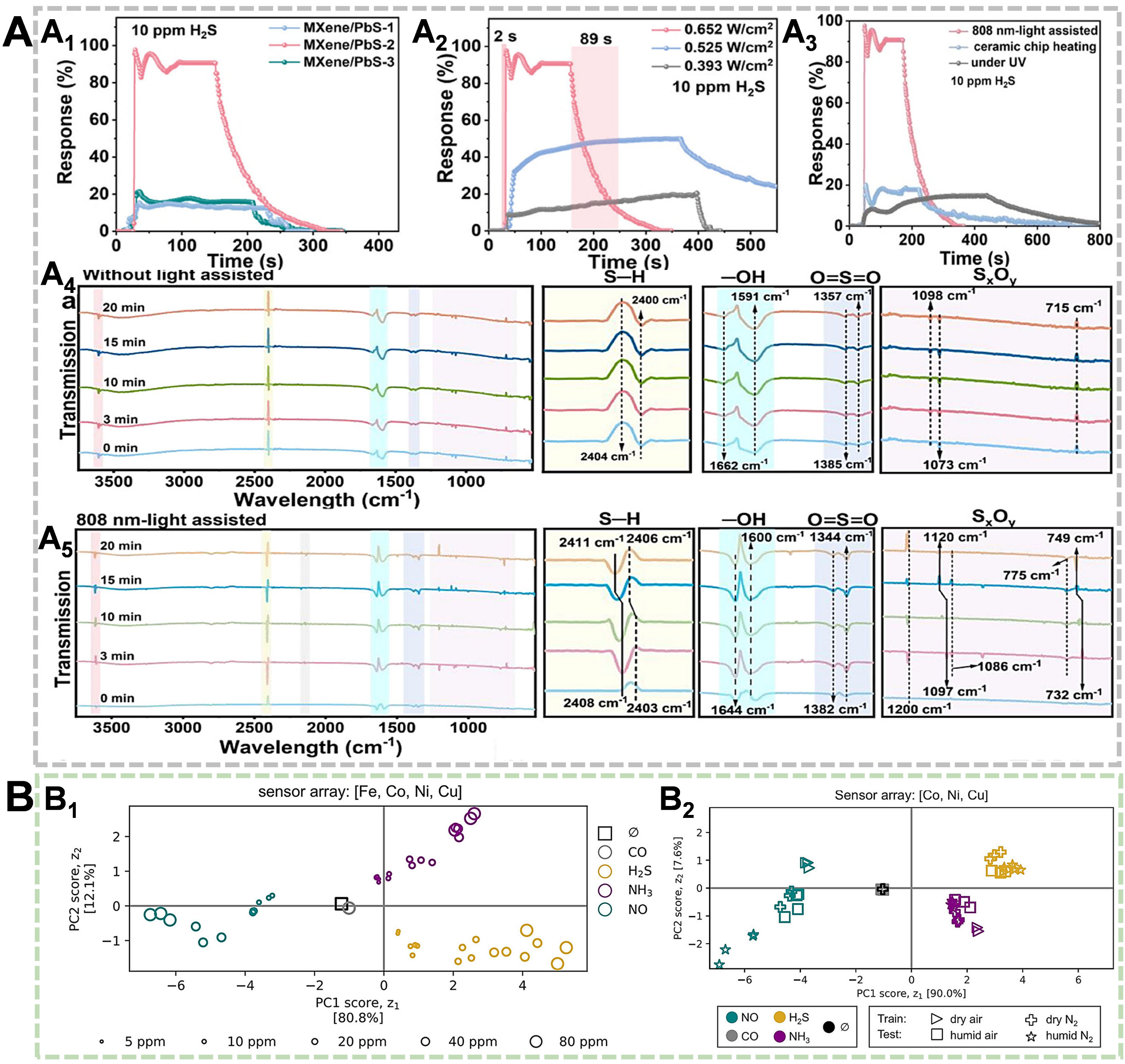
Figure 2. Performance and mechanisms of 2D-material-based H2S sensors. (A) MXene/PbS responses to 10 ppm H2S under NIR irradiation (0.525 W cm-2, A1), varied 808 nm power (A2), and NIR, matched-temperature heating, and UV conditions (A3), with in situ DRIFTS under dark and NIR conditions (A4-A5). Reproduced with permission from Ref.[126]. Copyright 2025, Wiley-VCH; (B) PCA plots of the M-COF-DC-8 (M = Fe, Co, Ni, Cu) array responses, evaluating discrimination of the carrier gas, NO, CO, H2S, and NH3 and their different concentrations (B1); PCA plot evaluating discrimination of NO, CO, H2S, and NH3 (80 ppm) by the M-COF-DC-8 (M = Co, Ni, Cu) array under humidity, with compressed response vectors under dry (training) and humid (projected onto dry-trained PCs) conditions (B2). Reproduced from Ref.[39], under CC BY 4.0 license. For Figure 2A1-A3, response (%) = (Rair - Rgas)/Rair × 100%, where Rair and Rgas denote the resistances in air and H2S, respectively. DRIFTS: Diffuse reflectance infrared Fourier transform spectroscopy; NIR: near-infrared; PCA: principal component analysis; UV: ultraviolet; COF: covalent organic framework; PC: principal component.